





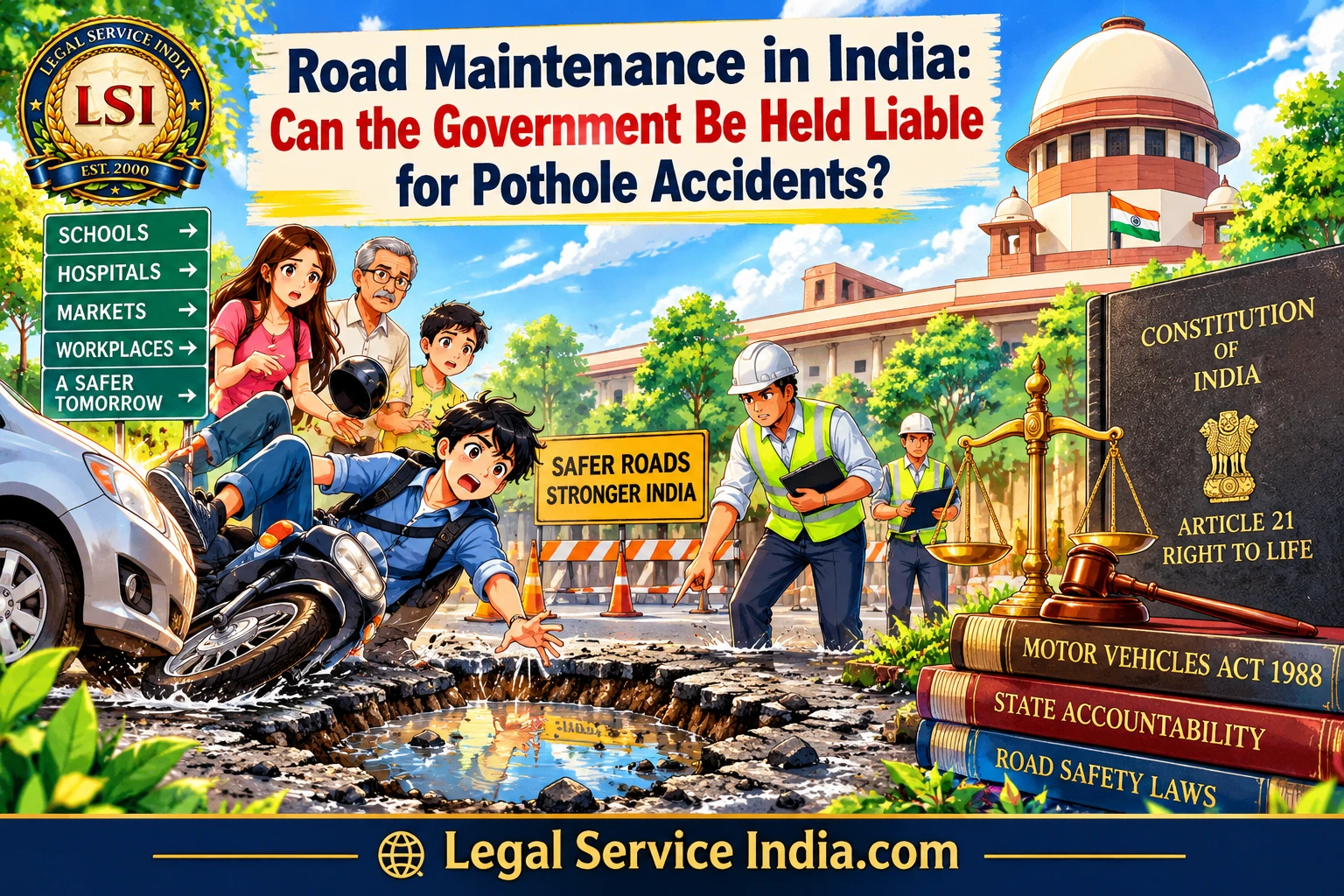
Road Maintenance and State Accountability
Abstract
Roads are a basic part of everyday life. People use roads to go to work, school, hospitals, markets and other places. However, poor road conditions have become a serious public problem in India. Potholes, broken roads, poor drainage, lack of proper lighting and delayed repairs can cause accidents, injuries and even death. The problem becomes more serious when the authorities know about unsafe roads but do not take timely steps to repair them.
This article examines the responsibility of the State and local authorities in maintaining roads and protecting people who use them. It studies the issue from the point of view of constitutional governance and state accountability. Article 21 of the Constitution protects life and personal liberty, and the courts have given this right a wide meaning. The article therefore examines whether failure to maintain safe roads can, in suitable cases, affect the right to life.
The paper also discusses the Motor Vehicles Act 1988, the National Highways Authority of India Act 1988 and important decisions of the Supreme Court, especially Dr S Rajaseekaran v Union of India and cases relating to compensation for violation of fundamental rights. The paper argues that road construction alone is not enough. Regular inspection, timely repair, transparency and fixing responsibility are equally important for good governance.
Keywords: Road Safety, Public Infrastructure, State Accountability, Right to Life, Road Maintenance, Constitutional Governance
Introduction
Roads are often treated as an ordinary part of public infrastructure, but their condition directly affects the daily life and safety of citizens. A person using a road should reasonably expect that the road will be fit for normal use. When roads have deep potholes, broken surfaces, open drains, poor lighting or other dangerous conditions, the risk is not limited to inconvenience. Such conditions may result in serious accidents and loss of life.
The issue of road conditions is therefore not only a question of administration. It is also a question of public duty. Government authorities spend public money on the construction and maintenance of roads. Once a road is opened for public use, the authority responsible for it has a continuing responsibility to keep it reasonably safe.
The Supreme Court has taken road safety seriously. In Dr S Rajaseekaran v Union of India, the Court considered road safety as a matter requiring proper implementation of laws, policies and administrative measures. The Court also directed States and Union Territories to take several steps relating to road safety and road improvement.¹ (Lawsathi)
The issue of potholes has also reached the Supreme Court. In 2018, the Court noted the large number of deaths caused by pothole-related accidents and expressed concern about the failure of authorities to maintain roads properly.² (Indian Kanoon)
This makes it necessary to examine where the legal responsibility lies when a public road is allowed to remain unsafe.
1. Research Problem / Research Question
The main research problem is the lack of effective accountability for poor road maintenance in India. There are laws and government bodies responsible for roads, but unsafe roads continue to exist in many places.
The main research question of this paper is:
Whether failure of State and local authorities to properly construct, inspect and maintain public roads can amount to a violation of constitutional and legal duties, particularly the right to life under Article 21 of the Constitution of India?
A further question is whether existing legal remedies are sufficient for people who suffer injury or death because of unsafe road conditions.
2. Objectives of the Study
The main objectives of this study are:
- To understand the legal responsibility of government authorities towards road maintenance.
- To examine the relationship between road safety and Article 21 of the Constitution.
- To study the provisions of the Motor Vehicles Act 1988 relating to road design, construction and maintenance.
- To examine important judicial decisions concerning road safety, negligence and compensation.
- To identify problems in the present system of accountability.
- To suggest practical measures for better road maintenance and protection of citizens.
3. Research Methodology
This paper follows the doctrinal method of legal research. The study is mainly based on primary and secondary legal sources. Primary sources include the Constitution of India, statutes and judgments of the Supreme Court of India. The Motor Vehicles Act 1988 and the National Highways Authority of India Act 1988 have been considered for understanding the statutory duties relating to roads.
Judicial decisions have been studied to understand how Indian courts have dealt with road safety, negligence, public duties and compensation. Secondary sources have been used only to support the legal discussion.
The research is qualitative in nature. It does not involve field surveys or interviews. The focus is on understanding the existing legal position and identifying gaps in the system of accountability.
4. Main Discussion and Legal Analysis
4.1 Road Maintenance as a Public Duty
A road is not properly maintained merely because it was constructed according to the required standard at the beginning. Roads are exposed to rain, traffic, heavy vehicles and regular wear and tear. Therefore, maintenance has to be a continuous process.
The Supreme Court made this point clearly while considering the issue of potholes. The Court observed that if governments construct roads, they are also expected to maintain them. Road construction cannot be treated as a one-time activity after which the responsibility ends.³ (Indian Kanoon)
This is an important point from the perspective of public administration. Citizens cannot be expected to bear the consequences of administrative delay. If a pothole is reported and remains unrepaired for a long period, the question naturally arises as to whether the responsible authority acted with reasonable care.
The responsibility may differ depending upon the type of road. National highways may fall within the responsibility of the National Highways Authority of India, while other roads may come under State departments, municipal corporations, municipal councils or other local authorities. The National Highways Authority of India Act 1988 itself provides for the development, maintenance and management of national highways.⁴ (India Code)
Therefore, identifying the correct authority is important before fixing liability.
4.2 Article 21 and Safe Use of Roads
Article 21 provides that no person shall be deprived of life or personal liberty except according to procedure established by law. The Supreme Court has repeatedly given a broad meaning to the protection of life under Article 21.
The Constitution does not expressly use the words “right to safe roads”. Therefore, it would be too broad to say that every bad road condition automatically amounts to a violation of Article 21. However, where unsafe public infrastructure creates a serious and foreseeable risk to life, the constitutional protection of life becomes relevant.
The Supreme Court’s approach in Rudul Sah v State of Bihar is important in this regard. The Court recognised that compensation can be granted in public law where State action results in a serious violation of a fundamental right.⁵ (Indian Kanoon)
Similarly, in Nilabati Behera v State of Orissa, the Supreme Court explained that compensation can be a public law remedy for violation of fundamental rights. The Court also made clear that such compensation is separate from an ordinary claim for damages under private law.⁶ (Indian Kanoon)
These decisions do not directly create an automatic constitutional claim for every road accident. However, they show that where State authorities fail in a manner that results in a serious violation of the right to life, constitutional remedies may become available.
4.3 Statutory Responsibility Under the Motor Vehicles Act
The Motor Vehicles Act 1988 is mainly concerned with motor vehicles, drivers, transport and road safety. Its importance has increased after the 2019 amendment.
Section 198A is particularly relevant to the present issue. It deals with failure to comply with standards for road design, construction and maintenance. The provision places responsibility upon the designated authority, contractor, consultant or concessionaire responsible for road design, construction or maintenance to follow the prescribed safety standards. Where failure to comply results in death or disability, the Act provides for a penalty.⁷ (India Code)
This provision is important because it moves the discussion beyond the responsibility of drivers alone. Road accidents can happen because of careless driving, but they can also be connected with road design, poor construction or failure to maintain the road.
Therefore, road safety should be understood as a shared responsibility. Drivers have a duty to follow traffic rules, but government authorities and persons responsible for roads also have legal duties.
4.4 Judicial Approach Towards Road Safety
The decision in Dr S Rajaseekaran v Union of India is one of the important decisions in this area. The petition was filed under Article 32 and concerned enforcement of road safety norms and treatment of accident victims. The Supreme Court issued several directions relating to road safety policy, road safety councils, road safety funds, district road safety committees, engineering improvements and accident-prone areas.⁸ (Lawsathi)
The Court specifically recognised poor quality of roads and improper road design as matters requiring attention. It directed steps for identifying and improving dangerous locations on roads.⁹ (Lawsathi)
The judgment is important because it shows that road safety cannot be dealt with only after an accident has happened. The State has to take preventive steps.
The later proceedings concerning potholes made the problem even clearer. In September 2018, the Supreme Court considered reports concerning deaths caused by potholes and noted that the States were disputing data about such deaths. The Court also expressed surprise at the lack of proper attention to road maintenance.¹⁰ (Indian Kanoon)
In December 2018, the Court was informed that 14,936 deaths had occurred due to potholes during the period 2013–2017. The Court observed that such a high number showed that the concerned authorities were not maintaining roads effectively.¹¹ (Indian Kanoon)
These observations show that potholes should not be dismissed as a small civic problem. When unsafe roads repeatedly cause serious accidents, the issue becomes one of public safety and accountability.
4.5 Negligence and Liability of Public Authorities
The question of negligence is also important. In Municipal Corporation of Delhi v Subhagwanti, the Supreme Court considered the liability of a municipal authority where a clock tower maintained by it collapsed and caused deaths. The Court accepted the principle of res ipsa loquitur, meaning that in suitable circumstances the event itself may raise an inference of negligence.¹² (LegalStreet)
The case concerned a structure rather than a road, but its reasoning is relevant to public infrastructure. Where an authority has control over a public facility and fails to maintain it properly, questions of duty of care and negligence can arise.
At the same time, liability cannot be imposed simply because an accident happened. A claimant would generally need to establish the relevant facts, including the condition of the road, the responsibility of the authority, the connection between the unsafe condition and the accident, and the resulting injury or death.
Therefore, each case has to be examined on its own facts.
4.6 Compensation as a Form of Accountability
For a family that loses a member because of an unsafe road, repairing the road after the accident is not enough. The family may lose its main earning member and may face medical expenses, emotional suffering and financial difficulties.
The Supreme Court’s decisions on public law compensation show that monetary relief can sometimes be granted when State conduct results in violation of fundamental rights. Rudul Sah and Nilabati Behera establish this principle in the context of serious violations of Article 21.¹³ (Indian Kanoon)
The 2018 pothole proceedings are particularly important because the Supreme Court itself raised the question of compensation for families of people who died due to pothole accidents.¹⁴ (S3WAAS)
However, there is still a need for a clear and simple system through which victims of road-related negligence can seek compensation without facing a long and expensive legal process.
5. Relevant Statutory and Judicial Analysis
The legal position shows that responsibility for road safety is spread across different laws and authorities.
Constitutional Framework
First, the Constitution of India provides the basic framework. Article 21 protects life and personal liberty. Articles 38 and 39 also reflect the constitutional concern for social welfare and protection of citizens.
Motor Vehicles Act, 1988
Second, the Motor Vehicles Act 1988 contains important provisions dealing with road safety. Section 198A is especially relevant because it directly deals with standards for road design, construction and maintenance.¹⁵ (India Code)
National Highways Authority of India Act, 1988
Third, the National Highways Authority of India Act 1988 gives the National Highways Authority responsibility for the development, maintenance and management of national highways.¹⁶ (India Code)
Right to Information Act, 2005
Fourth, the Right to Information Act 2005 can support public accountability. The Act aims to promote transparency and accountability in the working of public authorities.¹⁷ (India Code)
The RTI Act can be useful where citizens want information about road repair contracts, funds allocated for maintenance, inspection reports, complaints received, work orders and action taken by authorities. Such transparency can help identify where the failure actually occurred.
Judicial Oversight and Executive Responsibility
The judicial decisions discussed above show that courts are willing to examine failures of public authorities when they affect public safety. At the same time, courts cannot replace the everyday work of municipal bodies, engineering departments and road authorities. The primary responsibility must remain with the executive authorities that manage the roads.
6. Findings / Observations
The study leads to the following findings.
- First, road safety is not only the responsibility of the driver. Authorities responsible for road design, construction and maintenance also have important responsibilities.
- Second, the legal framework already contains provisions dealing with road safety and maintenance. The major problem is often implementation rather than complete absence of law.
- Third, Article 21 can provide constitutional support in serious cases where failure of public authorities has a direct and established connection with the loss of life or serious injury. However, every pothole or bad road should not automatically be treated as a constitutional violation.
- Fourth, the Supreme Court has repeatedly shown concern about poor road conditions and road accidents. The Rajaseekaran proceedings are particularly important because the Court directed governments to adopt preventive road safety measures.¹⁸ (Lawsathi)
- Fifth, accountability should not stop with repairing the road after an accident. There should be proper records showing when a dangerous condition was reported, which authority received the complaint, what inspection was done and when repair was ordered.
- Sixth, citizens should have an easy way to report dangerous roads and receive a response. Public authorities should also make basic road maintenance information available to citizens.
7. Conclusion and Suggestions
Good roads are not a luxury. They are necessary for ordinary life. A person should be able to travel to work, school, hospital or home without facing an avoidable danger created by poor public maintenance.
The law in India already recognises the importance of road safety. The Constitution protects life, the Motor Vehicles Act places duties regarding road design and maintenance, and the National Highways Authority of India Act provides for maintenance of national highways. Courts have also repeatedly reminded public authorities that road safety requires proper implementation.
The Gap Between Legal Duties and Implementation
The main problem is therefore not simply the absence of law. It is the gap between legal duties and their actual performance.
Practical Measures for Road Safety
Some practical steps can improve the present system. Every public road should be inspected at regular intervals. Complaints regarding potholes and dangerous road conditions should be given a tracking number and should have a fixed time for action. Authorities should maintain public records of road inspections and repair work. Contractors should be held responsible where poor construction or failure to follow required standards is proved. Where a person dies because of a known and neglected dangerous condition, the responsible authority should face proper inquiry.
Compensation for Road Accident Victims
There should also be a simple compensation mechanism for victims in cases where negligence of the responsible authority is established. Such a mechanism would reduce the burden on families who are already suffering because of an accident.
Road Maintenance, Accountability and Good Governance
Finally, accountability must be treated as a part of good governance. Roads are built with public money and are used by the public. The State therefore has a duty to ensure that roads remain reasonably safe for use. A government cannot claim successful infrastructure merely by constructing roads. The real test of good governance is whether those roads are maintained, whether complaints are heard and whether responsibility is fixed when preventable harm occurs.
8. Bibliography
A. Primary Sources
Constitution
- Constitution of India 1950.
Legislation
- Motor Vehicles Act 1988.
- National Highways Authority of India Act 1988.
- Right to Information Act 2005.
Cases
- Dr S Rajaseekaran v Union of India (2018) 13 SCC 516.
- S Rajaseekaran v Union of India (2018) 8 SCC 447.
- Municipal Corporation of Delhi v Subhagwanti AIR 1966 SC 1750.
- Rudul Sah v State of Bihar (1983) 4 SCC 141.
- Nilabati Behera v State of Orissa (1993) 2 SCC 746.
- Delhi Jal Board v National Campaign for Dignity and Rights of Sewerage and Allied Workers (2011) 8 SCC 568.
B. Secondary Sources
- Ministry of Road Transport and Highways, Government of India, materials and reports relating to road safety and road accidents.
- Supreme Court Committee on Road Safety, reports and directions relating to road safety and pothole accidents.
- India Code, official database of Central legislation.
- Supreme Court of India, judgments and orders concerning road safety and public authority responsibility.
Written By: Anushka Tak – University College of Law, MLSU, Udaipur

