





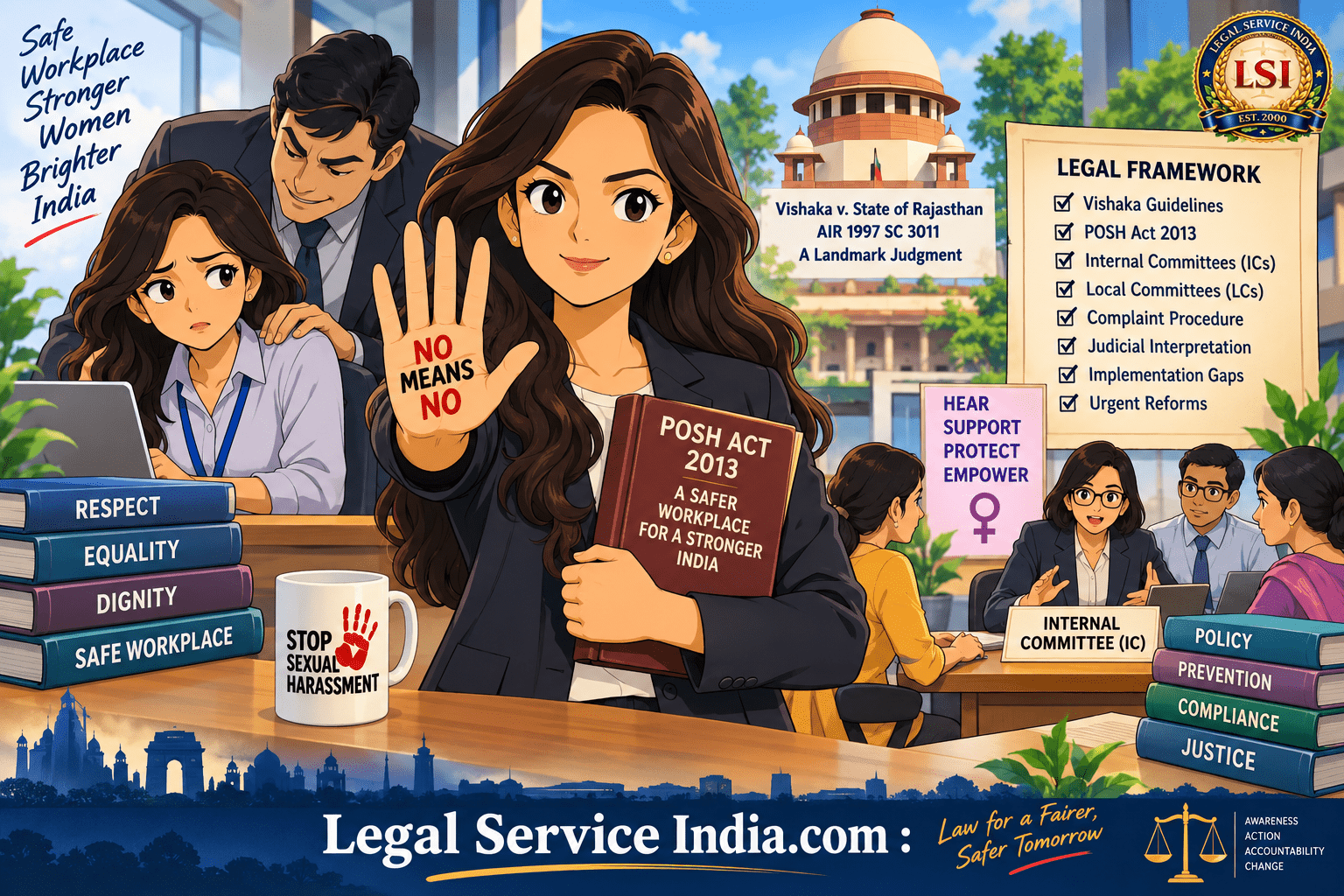
Introduction
Work, in any society, ought to be a space where individuals realize their economic potential free from the threat of humiliation or coercion. Yet the reality for a substantial section of India’s female workforce has been starkly different.
Sexual harassment at the workplace—whether in the form of unwanted physical contact, suggestive remarks, explicit demands tied to career advancement, or the creation of a hostile work environment—strips women of their dignity and curtails their professional autonomy in ways that ordinary labor legislation was never designed to address.
India’s engagement with this problem at a legal level began not with Parliament but with the judiciary. The brutal gang rape and subsequent death of Bhanwari Devi, a social worker in Rajasthan who faced retaliation after trying to prevent a child marriage, prompted a public interest petition by the women’s rights group Vishaka.
The Supreme Court’s ruling in Vishaka v. State of Rajasthan, AIR 1997 SC 3011, was a landmark moment: for the first time, the Court read Article 19(1)(g)—the right to practice any profession—alongside Articles 14, 15, and 21 to hold that sexual harassment at the workplace constituted a violation of fundamental rights.
In the absence of enacted legislation, the Court issued binding guidelines that required every employer to constitute a Complaints Committee, frame a prohibition policy, and sensitise employees. These guidelines operated as the de facto law for the next sixteen years.
The Sexual Harassment of Women at Workplace (Prevention, Prohibition and Redressal) Act, 2013, finally gave statutory force to what the judiciary had mandated.
It introduced mandatory Internal Committees (ICs) within larger organizations, created Local Committees (LCs) at the district level for unorganized sector workers, and prescribed a detailed inquiry procedure along with penalties for non-compliance.
On paper, it was a comprehensive architecture. In practice, a decade of implementation has revealed significant gaps—in awareness, in enforcement, and in the very definitions that determine who the law protects.
This paper undertakes a systematic analysis of the Act’s provisions, their judicial interpretation, and the reforms that are urgently required.
From Vishaka to the POSH Act: A Legislative Journey
Understanding the POSH Act requires appreciating the regulatory vacuum that preceded it.
Before 1997, a woman who experienced harassment at work could theoretically rely on Section 354 of the Indian Penal Code (outraging modesty) or Section 509 (word, gesture, or act intended to insult modesty), but these provisions were designed for public spaces, not for the nuanced dynamics of an employment relationship where the harasser may be a supervisor or a client with institutional power.
Civil tort remedies were theoretically available but practically useless given the absence of a defined cause of action, the burden of proof, and the social stigma that made litigation a second ordeal.
The Vishaka Guidelines
The Vishaka guidelines changed the normative landscape by recognizing two distinct categories of harassment:
- ‘Quid Pro ‘Quo’—where employment benefits are conditioned on sexual favors.
- ‘Hostile Work Environment’—where pervasive conduct makes the workplace intimidating or offensive.
These categories, borrowed from American Title VII jurisprudence, were explicitly retained in the 2013 Act’s definition of sexual harassment under Section 2(n), which lists five forms:
| Form | Conduct Covered |
|---|---|
| Physical Contact and Advances | Physical contact and advances of a sexual nature. |
| Sexual Favors | Demands or requests for sexual favors. |
| Sexually Coloured Remarks | Sexually colored remarks. |
| Pornographic Material | Displaying pornographic material. |
| Other Unwelcome Conduct | Any other unwelcome physical, verbal, or non-verbal conduct of a sexual nature. |
The path from judicial guideline to enacted statute was neither swift nor smooth.
Multiple draft bills circulated between 2005 and 2012, each generating debate around definitional scope, the treatment of domestic workers, and the consequences of false complaints.
The Protection of Women against Sexual Harassment at Workplace Bill was finally introduced in the Lok Sabha in 2012 and received presidential assent on 23 April 2013. It came into force on 9 December 2013.
The Act’s long gestation reflects the tension between feminist demands for an expansive, worker-centered law and employer lobbies concerned about procedural certainty and reputational exposure.
Architecture of the Act: Key Provisions
Definition of Sexual Harassment
Section 2(n) of the Act provides an inclusive definition, enumerating specific acts while adding a residual clause that captures any ‘unwelcome physical, verbal or non-verbal conduct of a sexual nature.’
The phrase ‘unwelcome’ is crucial—it imports a subjective element, meaning that the complainant’s perception of the conduct matters.
The accompanying explanation to Section 3 goes further by listing ‘circumstances’ that amount to sexual harassment even without an explicit demand:
- Implied or explicit promise of preferential treatment;
- Implied or explicit threat of detrimental treatment;
- Implied or explicit threat about present or future employment;
- Interference with work or creating an intimidating, hostile, or offensive work environment; and
- Humiliating treatment likely to affect the employee’s health or safety.
Scope: Workplace and Aggrieved Woman
The Act defines ‘workplace’ broadly under Section 2(o) to include government bodies, private enterprises, educational institutions, hospitals, sports institutions, and any place visited by the employee arising out of or during the course of employment.
This expansive definition is significant because it covers off-site work—a client’s premises, a conference venue, or a business trip.
‘Aggrieved woman’ under Section 2(a) means any woman of any age, whether employed or not, who alleges to have been subjected to sexual harassment in the workplace.
The inclusion of non-employees—such as clients, visitors, or research scholars—broadens protection meaningfully.
Limitations Of The Act’s Coverage
However, the Act covers only women as complainants.
Men who experience harassment and members of the LGBTQ+ community are outside its protective ambit, a limitation that legal scholars and activists have criticized as constitutionally suspect after the Supreme Court’s recognition of the rights of transgender persons in National Legal Services Authority v. Union of India (2014) and the decriminalization of Section 377 in Navtej Singh Johar v. Union of India (2018).
Internal Committee (IC)
Section 4 mandates that every employer with ten or more employees constitute an internal committee at each office or branch. The IC must have a presiding officer who is a senior woman employee, at least two members from among employees, preferably committed to the cause of women, and one external member from an NGO or association committed to the cause of women or a person familiar with issues of sexual harassment. The external member requirement was designed to prevent institutional capture—the risk that an employer-controlled committee would systematically favor the employer’s interests over the complainant’s.
Members of the IC hold office for a period not exceeding three years. The requirement of having a woman as presiding officer reflects an understanding that a complainant is more likely to trust and engage with a committee led by someone who shares her gender. However, in practice, many organizations have constituted ICs with inadequate training, no independent external members, and insufficient institutional support—treating compliance as a boxticking exercise rather than a genuine redressal mechanism.
Internal Committee Composition
| Requirement | Provision |
|---|---|
| Presiding Officer | A senior woman employee |
| Employee Members | At least two members from among employees, preferably committed to the cause of women |
| External Member | One external member from an NGO or association committed to the cause of women or a person familiar with issues of sexual harassment |
| Term | A period not exceeding three years |
Local Committee (LC)
Recognizing that the majority of India’s female workers are employed informally—as domestic workers, agricultural laborers, home-based piece-workers, or micro-enterprise employees—the Act creates Local Committees under Section 6 at the district level. Each LC is chaired by a woman, ideally an eminent social worker committed to women’s causes, and includes a nominated woman from a block, taluka, or tehsil-level officer, two members from NGOs, and one officer from the district dealing with social welfare. The LC receives complaints from women in establishments with fewer than ten employees and from domestic workers.
The LC concept was imaginative in design but has been largely ineffective in practice. Studies conducted across multiple states have found that a significant majority of district-level LC members are unaware of their powers, untrained in inquiry procedures, and under-resourced. The LC’s existence is often unknown to the very women it is meant to serve, pointing to a structural failure in awareness generation.
Role of the Local Committee
- The LC operates at the district level.
- Each LC is chaired by a woman.
- The LC receives complaints from women in establishments with fewer than ten employees.
- The LC also receives complaints from domestic workers.
- The LC was designed to address gaps affecting women employed in the informal economy.
Complaint and Inquiry Procedure
Under Section 9, a complaint must be submitted in writing within three months of the incident (or last incident in a series), extendable by a further three months if the IC or LC is satisfied that exceptional circumstances prevented timely filing. This six-month outer limit is more flexible than ordinary limitation periods but remains a source of criticism: trauma, fear of retaliation, and lack of awareness often mean that women take longer than six months to feel safe enough to complain. Section 9 also allows the IC to render assistance where the complainant cannot produce a written complaint.
The inquiry under Section 11 is to be completed within sixty days. The IC is vested with powers of a civil court for the purpose of summoning persons, requiring discovery of documents, and issuing commissions for examination of witnesses. Section 12 permits the IC to recommend interim relief—transfer of the respondent or the complainant, or granting leave—pending inquiry. The inquiry report under Section 13 must be submitted to the employer within ten days of completion, and the employer is required to act on the recommendations within sixty days.
Complaint and Inquiry Timeline
| Stage | Time Limit |
|---|---|
| Submission of Complaint | Within three months of the incident or last incident in a series |
| Extension of Complaint Period | A further three months in exceptional circumstances |
| Completion of Inquiry | Within sixty days |
| Submission of Inquiry Report | Within ten days of completion |
| Employer Action | Within sixty days |
Penalties and Employer Obligations
Section 19 casts a range of duties on employers: constituting an IC, displaying penal consequences prominently, organizing awareness programs, treating sexual harassment as misconduct under the service rules, and monitoring the timely submission of IC annual reports. Failure to constitute an IC attracts a fine of up to fifty thousand rupees under Section 26, doubling on repeat offenses and potentially leading to cancellation of business licenses or registration. While the fine is modest by corporate standards, the reputational damage from a public penalty may be a stronger deterrent.
Key Employer Duties
- Constituting an IC.
- Displaying penal consequences prominently.
- Organizing awareness programs.
- Treating sexual harassment as misconduct under the service rules.
- Monitoring the timely submission of IC annual reports.
Judicial Interpretation of the POSH Act
The decade since the Act’s commencement has seen an expanding body of case law that has sharpened—and occasionally complicated—its application. Several themes emerge from the decisions of high courts and the Supreme Court.
Internal Committee Composition
On the question of the IC’s composition, courts have consistently held that any departure from the mandatory requirements of Section 4 renders the inquiry void ab initio. In Aureliano Fernandes v. State of Goa (2023), the Supreme Court emphasized that non-compliance with the composition requirements is not a procedural irregularity but a jurisdictional defect, and findings of such a committee cannot stand. This has had the salutary effect of compelling organizations to constitute their ICs correctly, though it has also been used by accused persons to escape accountability on technical grounds.
Burden of Proof in POSH Inquiries
The burden of proof in POSH inquiries has also attracted judicial attention. Courts have held that the standard is the civil standard of preponderance of probabilities, not the criminal standard of proof beyond reasonable doubt. This is appropriate given the nature of workplace harassment, where the act often occurs without witnesses and relies heavily on the complainant’s testimony. High courts have cautioned ICs against demanding corroborative evidence as a matter of routine, recognizing that such demands effectively reproduce the very evidentiary skepticism that the Act sought to dismantle.
Natural Justice Principles
Natural justice principles have featured prominently. The Bombay High Court, in Tathagat Bhattacharya v. ICICI Bank Ltd (2019), held that a respondent must be given a fair opportunity to cross-examine the complainant’s witnesses, but that this right must be balanced against the Act’s purpose of providing a safe, non-intimidating redressal environment. The Court affirmed that the IC has discretion in structuring the hearing to prevent retraumatization of the complainant.
False Complaints and Section 14
On the question of false complaints, Section 14 provides for action against a complainant who has made a complaint knowing it to be false, but courts have consistently held that this provision must not be used as a sword to deter genuine complainants. In multiple decisions, High Courts have cautioned that the mere fact that a complaint was not substantiated does not mean it was false or malicious and that ICs must make a separate, affirmative finding of malice before recommending action against the complainant.
Critical Analysis: Gaps and Limitations
The Informal Economy Problem
Perhaps the most fundamental limitation of the POSH Act is its structural inability to reach the informal economy, which employs the vast majority of Indian women. Agricultural workers, domestic helpers, gig economy workers, and home-based laborers—none of these categories fit comfortably within the employer-employee framework that the Act assumes. While the Local Committee was designed precisely for this gap, its implementation has been so inadequate that it functions more as a symbolic provision than a real redressal channel. State governments have not invested in LC training, infrastructure, or outreach, and many LCs exist only on paper.
Gender Exclusivity
The Act’s restriction to women complainants reflects the legislative moment in which it was conceived—a moment when feminist advocacy was rightly centered on female vulnerability. However, the post-Navtej Singh Johar constitutional landscape demands reconsideration. Gay men, transgender persons, and non-binary individuals experience workplace harassment that is often sexual in nature, and they currently have no statutory redressal mechanism tailored to the workplace context. A gender-neutral amendment would not dilute the Act’s feminist purpose; it would extend its logic of dignity protection to all workers.
Definitional Challenges in the Digital Age
The workplace has been radically reconfigured since 2013. Remote work, virtual meetings, professional social media platforms, and messaging applications have created new modes of harassment that the Act’s drafters could not have fully anticipated. While courts have taken an expansive view of ‘workplace’ to include digital communication channels, the statute itself does not explicitly address cyber harassment, the non-consensual sharing of intimate images, or sustained digital intimidation. A legislative amendment explicitly covering online conduct arising out of the employment relationship is long overdue.
Power Imbalances and Retaliation
The Act’s greatest practical weakness may be its inability to adequately address retaliation. While Section 19 requires employers to treat sexual harassment as misconduct and Section 12 permits the IC to recommend transfer of the respondent, the statute does not contain a standalone anti-retaliation provision.
Women who complain routinely face informal retaliation—poor performance reviews, professional isolation, denial of promotions—that is difficult to prove and that falls between the gaps of the POSH Act and ordinary service law.
The absence of explicit retaliation protection functions as a powerful structural deterrent to complaints.
Retaliation as a Structural Deterrent
| Issue | Practical Impact |
|---|---|
| Poor performance reviews | Difficult to prove as retaliation |
| Professional isolation | Can discourage women from pursuing complaints |
| Denial of promotions | May create professional and financial consequences |
| Absence of standalone anti-retaliation provision | Creates a structural deterrent to complaints |
Compliance Without Commitment
Annual IC reports, mandatory display of information, and employer obligations under Section 19 have created a compliance infrastructure, but compliance is not the same as culture change.
In many organizations, the IC exists but has never received a complaint—not because harassment does not occur, but because workers do not trust the institution or fear reprisal.
The Act creates the skeleton of an accountability system but does not mandate the muscles of genuine institutional commitment:
- Trained investigators
- Confidentiality protocols
- Survivor support services
- Accountability for senior leadership
The Act creates the skeleton of an accountability system but does not mandate the muscles of genuine institutional commitment: trained investigators, confidentiality protocols, survivor support services, and accountability for senior leadership.
Comparative Perspectives
A brief comparative glance illuminates both the strengths and the lacunae of the Indian model.
United States Model
In the United States, Title VII of the Civil Rights Act of 1964 and the Equal Employment Opportunity Commission (EEOC) provide a centrally administered enforcement mechanism with the power to investigate, conciliate, and litigate—a stronger state role than anything the POSH Act envisages.
United Kingdom Model
The UK Equality Act 2010 similarly confers a range of remedies through Employment Tribunals and provides explicit third-party harassment liability.
Indian Model
The Indian model of internal committees, modelled partly on alternative dispute resolution philosophy, has the virtue of keeping disputes within the organization and preserving confidentiality, but its weakness is that it places accountability for adjudication in the hands of the very institution that has a structural interest in minimizing reputational damage.
| Jurisdiction | Legal Framework | Key Feature |
|---|---|---|
| India | POSH Act | Internal committees and organizational redressal |
| United States | Title VII of the Civil Rights Act of 1964 | Central enforcement through the EEOC |
| United Kingdom | Equality Act 2010 | Employment Tribunal remedies and third-party harassment liability |
| South Africa | Employment Equity Act and Code of Good Practice | Recognition of workplace power dynamics and a victim-centered approach |
South Africa’s Model
South Africa’s Employment Equity Act and the Code of Good Practice on the Handling of Sexual Harassment Cases in the Workplace represent another instructive model.
The Code explicitly recognizes that power dynamics in the workplace complicate consent and welcomeness, and it recommends a responsive, victim-centered approach that Indian policymakers would do well to study.
Bangladesh and Sri Lanka
Bangladesh and Sri Lanka, India’s immediate neighbors, have enacted legislation modelled partly on Vishaka but with variations that merit attention as India considers reform.
Towards Reform: What the Act Needs
Based on the analysis above, several reforms appear necessary to bring the POSH Act’s practical reality into alignment with its normative promise.
First: Gender-Inclusive Protection
First, the Act must be amended to extend its protective scope to all genders. This is not only constitutionally sound but practically necessary to ensure that harassment of men, transgender persons, and non-binary individuals does not go unaddressed in the workplace.
Second: Reform the Local Committee Mechanism
Second, the Local Committee mechanism must be substantially reformed.
State governments should be required by the central government to fund, staff, and train LCs adequately.
Independent audits of LC functioning should be conducted annually and placed in the public domain.
The failure of LCs is, in essence, a failure of federalism and administrative will rather than a failure of legislative design.
Third: Cover Digital and Remote Workplaces
Third, the Act should explicitly cover digital and remote work environments, including harassment occurring through professional communication platforms.
The Ministry of Women and Child Development should issue guidelines clarifying how existing provisions apply to virtual workplaces, pending a formal amendment.
Fourth: Introduce a Dedicated Anti-Retaliation Provision
Fourth, the statute should incorporate a dedicated anti-retaliation provision making adverse action against a complainant a separately punishable offense with a presumption in favor of the complainant where retaliation occurs within a defined period after the filing of a complaint.
Fifth: Make POSH Training Mandatory
Fifth, mandatory POSH training — not merely awareness display — should be required for all employees at the time of joining and at periodic intervals.
ICs should be required to complete certified training before assuming office.
The ministry or a designated statutory authority should maintain a public registry of trained IC members and qualified external members.
Conclusion
The POSH Act of 2013 was a hard-won legislative achievement, the product of decades of feminist advocacy, judicial creativity, and tragic real-world events that made the need for legal protection undeniable.
It created, for the first time, a dedicated statutory framework for addressing sexual harassment in the workplace—one that combined prevention obligations, institutional redressal mechanisms, and employer accountability.
For organized sector workers in medium- and large-sized enterprises, the Act has made a tangible difference, creating a formal channel that did not exist before.
Continuing Gaps in POSH Protection
Yet the law’s promise remains undelivered for the majority of India’s working women, who toil in informal arrangements beyond the reach of either ICs or functional LCs.
Its gender exclusivity, its silence on digital harassment, its inadequate retaliation protections, and the compliance without commitment culture that pervades many organizations all point to a statute in need of serious legislative attention.
Law and Workplace Culture
Ultimately, no law, however well-crafted, can by itself transform workplace culture.
Culture shifts happen through sustained organizational commitment, leadership accountability, survivor solidarity, and social norm change—processes that the law can incentivize but not command.
The POSH Act must be seen as one instrument in a larger toolkit of feminist reform rather than a complete solution.
With the amendments and enforcement improvements outlined in this paper, it can become a significantly more effective instrument.
Without them, it risks remaining—for too many Indian women—a right that exists on paper but offers little protection in practice.
References
Statutes
- The Sexual Harassment of Women at Workplace (Prevention, Prohibition and Redressal) Act, No. 14 of 2013, INDIA CODE.
- The Indian Penal Code, No. 45 of 1860, INDIA CODE, ss. 354, 509.
- The Equal Remuneration Act, No. 25 of 1976, INDIA CODE.
- The Protection of Children from Sexual Offences Act, No. 32 of 2012, INDIA CODE.
Case Law
- Vishaka v. State of Rajasthan, AIR 1997 SC 3011 (India).
- Apparel Export Promotion Council v. A.K. Chopra, AIR 1999 SC 625 (India).
- National Legal Services Authority v. Union of India, (2014) 5 SCC 438 (India).
- Navtej Singh Johar v. Union of India, (2018) 10 SCC 1 (India).
- Aureliano Fernandes v. State of Goa, (2023) 6 SCC 391 (India).
- Tathagat Bhattacharya v. ICICI Bank Ltd, 2019 SCC Online 732 (India).
Secondary Sources
- Ratna Kapur & Brenda Cossman, Subversive Sites: Feminist Engagements with Law in India (Sage Publications, 1996).
- Flavia Agnes, Law and Gender Inequality: The Politics of Women’s Rights in India (Oxford University Press, 1999).
- Puja Kapoor, ‘Whispers and Wounds: Why the POSH Act Is Failing India’s Informal Workers’ (2022) 47(2) Economic and Political Weekly 38.
- Mrinal Satish, ‘Rethinking Sexual Harassment Law in India: A Post-Navtej Reading’ (2019) 31 NLSIR 1.
- International Labour Organization, Ending Violence and Harassment in the World of Work (ILO, Geneva, 2019).
- Ministry of Women and Child Development, Government of India, Annual Report 2022-23 (MoWCD, 2023).
Written By: Garvit Sen—4th Year Law Student, University College of Law, MLSU, Udaipur

