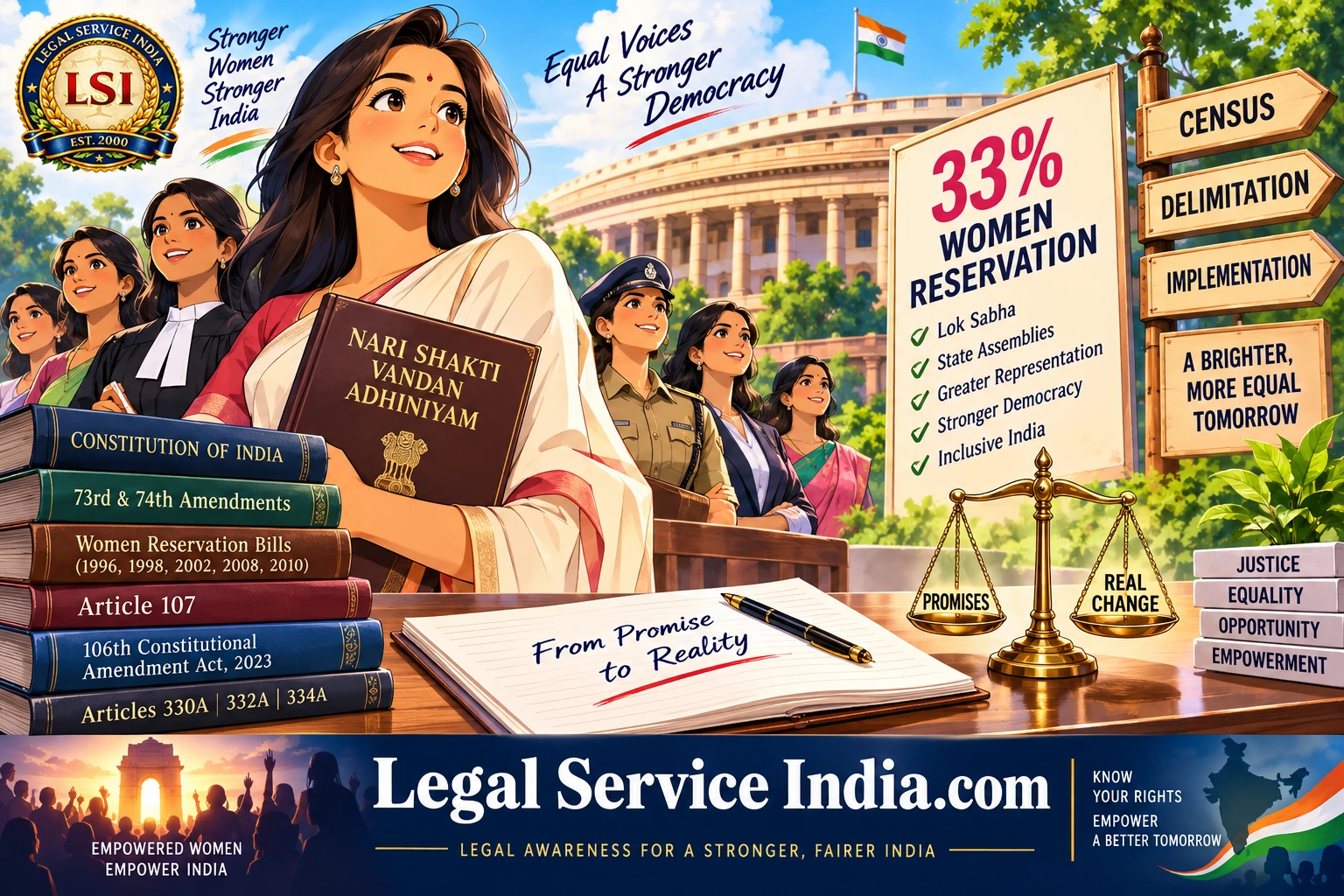
“Nari Shakti Vandan Adhiniyam”: A Ray Of Hope Or A Post-Dated Cheque On A Crumbling Bank?
History Of Women’s Reservation In India
Women’s reservation has always been a debatable topic. It has been brought up by different governments at different times in history, including the Constituent Assembly itself, yet it could never become a reality until 2023, which followed the Supreme Court’s direction in a PIL filed by the National Federation of Indian Women in 2021. Let us trace down the women’s reservation back to the enactment of the Constitution, including the legal and political battles that ensued thereafter, dealing with its current status.
Constitutional Foundation Of Women’s Reservation
The 73rd and 74th Amendments passed in 1993 introduced panchayats and municipalities in the Constitution and, from the very beginning, reserved one-third of seats for women in these bodies.
The Constitution also provides for reservation of seats in Lok Sabha and state legislative assemblies for Scheduled Castes (SCs) and Scheduled Tribes (STs) in proportion to their number in the population.
Constituent Assembly Debate On Women’s Reservation
However, despite the issue being discussed at length in the Constituent Assembly debates, it remained a gentleman’s promise that proportionate seats would be held by women in the parliament and that reservation was not required. This promise failed, as today women account for only about 14%, which is half the global average of 26.5%, but I must not fail to mention that countries like Norway, Sweden and Japan have around 45% women MPs despite having no reservations for women.
It is noteworthy that the Constitution itself does not provide for reservation of seats for women in the Lok Sabha and state legislative assemblies.
Some members of the Constituent Assembly had opposed reserving seats for women in legislatures; attempts have been made in the past.
Earlier Attempts At Women’s Reservation Bill
Bills to reserve seats for women in Parliament and state legislative assemblies have been introduced in:
- 1996 First Introduction: The Women’s Reservation Bill was first introduced in the Lok Sabha in September 1996 by the United Front government, but it failed to garner consensus and lapsed.
- 1998–2003 Re-introductions: The bill was reintroduced by the NDA government under Atal Bihari Vajpayee in 1998, 1999, and 2002, facing similar political resistance and failing to pass each time.
- 2008 Rajya Sabha Introduction: A fresh version of the bill was introduced in the Rajya Sabha in 2008 by the UPA government.
- 2010 Rajya Sabha Passage: The 2008 bill was passed by the Rajya Sabha in March 2010. However, it was never brought to a vote in the Lok Sabha due to a lack of political consensus and eventually lapsed with the dissolution of the 15th Lok Sabha in 2014.
Article 107 And The Lapse Of Bills
These bills lapsed with dissolution of their respective Lok Sabhas as per Article 107, which states as under:
“107. Provisions as to introduction and passing of Bills
- Subject to the provisions of articles 109 and 117 with respect to money bills and other financial bills, a bill may originate in either House of Parliament.
- Subject to the provisions of articles 108 and 109, a Bill shall not be deemed to have been passed by the Houses of Parliament unless it has been agreed to by both Houses, either without amendment or with such amendments only as are agreed by both Houses.
- A Bill pending in Parliament shall not lapse by reason of the prorogation of the Houses.
- A bill pending in the Council of States which has not been passed by the House of the People shall not lapse on a dissolution of the House of the People.
- A bill which is pending in the House of the People, or which has been passed by the House of the People and is pending in the Council of States, shall, subject to the provisions of article 108, lapse on a dissolution of the House of the People.”
Fate Of The 2008 Women’s Reservation Bill
However, the 2008 Bill was introduced and passed by the Rajya Sabha, but it also lapsed with the dissolution of the 15th Lok Sabha.
The 1996 Bill had been examined by a Joint Committee of Parliament, while the 2008 Bill was examined by the Standing Committee on Personnel, Public Grievances, Law and Justice.
Women’s Reservation and the 106th Constitutional Amendment Act
It was then the Act 124 of 2023, the 128th Constitutional Amendment Bill (hereafter referred to as the Bill) was introduced in the Lok Sabha, seeking to reserve one-third of the total number of seats in Lok Sabha and state legislative assemblies for women, this Bill after passing from both the house and receiving President’s assent became the 106th Constitutional Amendment Act, the much acclaimed Nari Shakti Vandan Adhiniyam.
The Constitutional Amendments Proposed By The Bill
The bill proposed the following amendments to be made to the constitution:
- Art. 239AA says seats shall be reserved for women in the Legislative Assembly of the National Capital Territory of Delhi.
- Art. 330A was added after Art. 330, which says that seats shall be reserved for women in the House of People.
- Art. 332A was added after Art. 332, which says that seats shall be reserved for women in the Legislative Assembly of every state.
- Art. 334A provides that such reservations shall continue till such date as parliament prescribes.
The Government’s Objective Behind The Act
Now, as per the government itself, the objective behind the act can be summed up in the following words: “The Convention on the Elimination of All Forms of Discrimination Against Women provides that discrimination against women must be eliminated in political and public life. While India is a signatory to the Convention, discrimination in matters of representation of women in decision-making bodies has continued. 8 The number of women MPs has increased from 5% in the first Lok Sabha to 15% in the 17th Lok Sabha, but the number continues to be quite low.
A 2003 study about the effect of reservation for women in panchayats showed that women elected under the reservation policy invest more in the public goods closely linked to women’s concerns. The Standing Committee on Personnel, Public Grievances, Law and Justice (2009) had noted that reservation of seats for women in local bodies has enabled them to make meaningful contributions. It also noted that concerns regarding women being proxies to men in local bodies have turned out to be baseless. The Inter-Parliamentary Union (2022) has noted that legislated quotas have been a decisive factor in women’s representation.”
What Then Makes It A Hollow Promise?
It sounds quite appeasing and egalitarian in approach. What then makes it a hollow promise?
The Core Issue: Census and Delimitation
Let us now directly address the core issue revolving around the bill that has kept this in headlines for quite a long time with both the ruling party and opposition, the way the government is bringing it into effect. It is Art. 334A clauses 1 and 3 specifically tie it to the distant anchors of census and delimitation, which state as quoted under-
Reservation Linked To Census And Delimitation
Simply put, no reservation shall be given to women before the next census and delimitation exercise takes place, where on one hand ‘census’ means the official counting of a country’s population, done every ten years. In India, it is managed by the Office of the Registrar General and Census Commissioner of India, whereas, on the other hand, delimitation refers to the process of fixing seat numbers and borders for the Lok Sabha and State Legislative Assemblies.
The 1976 Freeze And Its Connection With Delimitation
It is pertinent to mention here that we are currently under the 1976 Freeze, wherein the total number of seats for each state was frozen based on the 1971 census to encourage states to control population growth. The 84th Constitutional Amendment extended this freeze until the first census after 2026.
Also Read: AI-Generated Fake Nude Images: Minnesota vs. xAI and the Future of Deepfake Law
Population Growth and State Representation
This is where it becomes interesting: at a time when India’s population surged rapidly, the government pushed in family planning policies and awareness programmes, states committed to reduce the population surge.
In the last few decades the population of Southern India decreased or, to say, was under control, while in Northern India it exploded.
Now, the representation in the houses is given based on the state’s population, but this representation also represents the voice of the masses.
| State | Lok Sabha Seats Mentioned |
|---|---|
| Uttar Pradesh | 80 |
| West Bengal | 42 |
| Bihar | 40 |
| Telangana | 17 |
Whereas states like Uttar Pradesh, West Bengal and Bihar have as many as 80, 42 and 40 seats in the Lok Sabha, respectively, while southern states already have a staggering number of seats, as low as 17 in Telangana.
Current Status: Inter-State Seat Distribution
Current Status: Inter-state seat distribution has not changed in decades, meaning current representation relies on older population numbers rather than today’s totals.
Now since we currently rely upon the 2011 census, we are all set to have another census around 2030, followed by delimitation, which shall also change the representation of states in the parliament.
Expected Change In Lok Sabha Seats
As proposed, the seats in the Lower House are expected to rise from 545 currently to around 800+ in the future. With this change in number and surge in population, the well-governed and less-populated states will be at a clear disadvantage, and their voices won’t be at the same pedestal as that of the ones in the majority.
Also the bill which was passed in 2023 is to become a reality in a decade or so. This is the bone of contention between the ruling party and the ones opposing it.
Conclusion: Women’s Reservation, Census and Delimitation
Thus, to conclude where the idea of reservation for women in lobbies of power where the law of the land is made is indeed thought provoking and probably the need of the hour, yet at the very same time this should have been given effect right away instead of tying it to the distant anchors of census and Delimitation as aforementioned.