





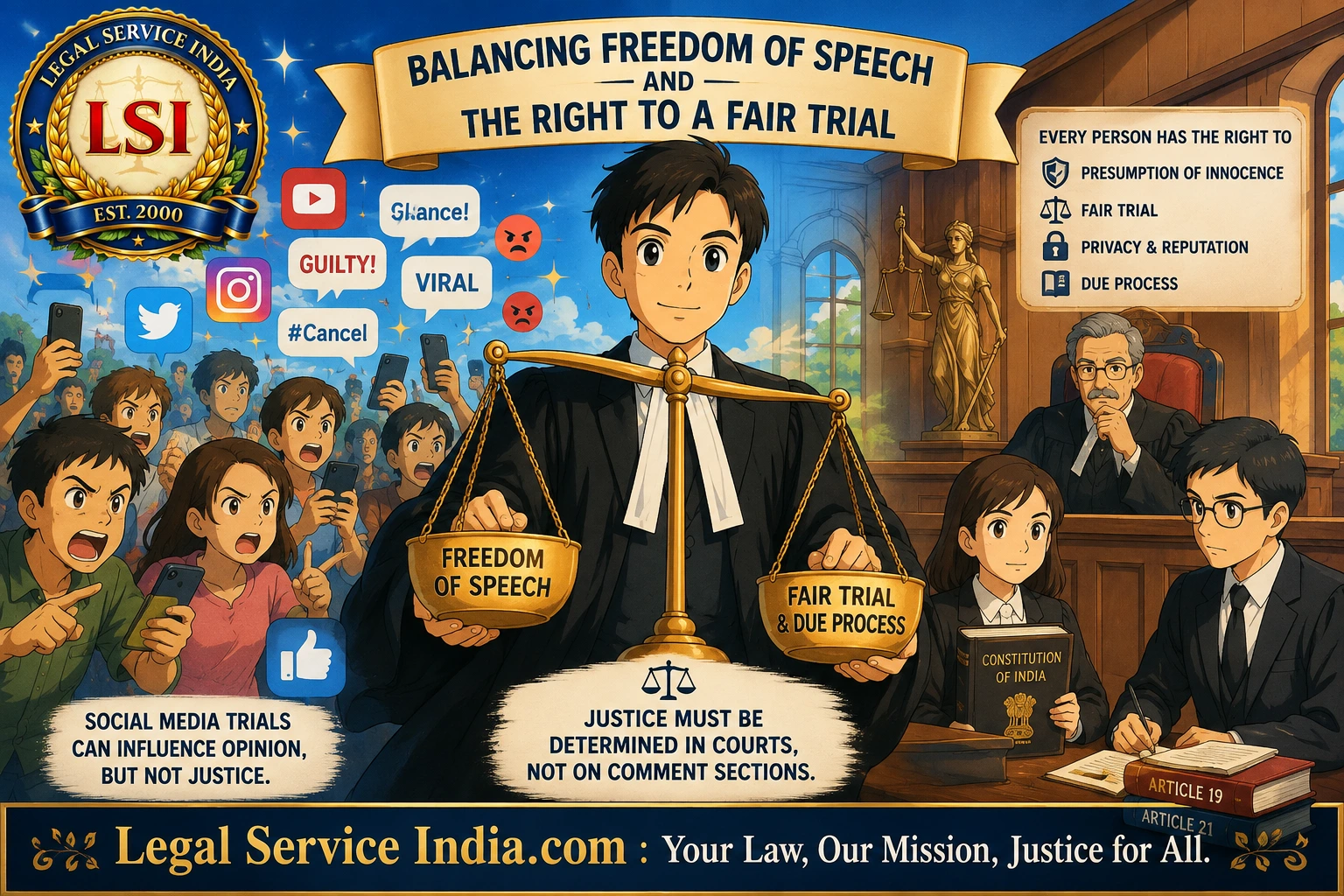
Social Media Trials and Public Perception of Justice
Social media has increased and democratised access to justice by empowering citizens to expose wrongdoing and demand accountability from the system. However, the same platforms often transform allegations into public convictions, influencing public perception, damaging reputations, and threatening the constitutional guarantee of a fair trial. The challenge is to strike a balance between freedom of expression and due process, without silencing public discourse.
Justice in the Digital Age
In today’s digital age, justice is no longer debated solely inside courtrooms. Every breaking news story is accompanied by thousands of tweets, Instagram posts, comments, YouTube analyses and opinions, and viral hashtags. Before a judge examines the case or looks into the evidence, millions of users often announce the guilt or innocence of a person with remarkable certainty. This phenomenon, commonly known as a ‘social media trial’, has transformed public engagement with the justice system, giving citizens a platform to participate in the process of serving justice.
What Is a Social Media Trial?
A social media trial refers to the widespread discussion, investigation, analysis, or criticism of an individual on social media platforms before or during legal proceedings. Unlike a judicial trial, which is governed by law and consists of rules of evidence, procedural safeguards, and the principle of due process, social media trials are driven by public opinion, emotions, personal beliefs, and information that is often incomplete or unverified.
In such situations, users on such platforms assume the role of investigators, judges, and jurors, forming conclusions long before a competent court delivers its verdict. Social media trials are becoming increasingly important because they have the ability to impact how the public views justice. While this kind of digital activism has occasionally assisted in exposing injustice and demanding responsibility, it has also led to situations in which people have been publicly condemned without adequate proof or a fair chance to defend themselves.
The topic has become particularly relevant in today’s digital society, where information travels across the globe within seconds and millions of people actively consume and share news through social media rather than traditional media outlets.
Overview of Social Media Trials
| Aspect | Description |
|---|---|
| Definition | Public discussion, analysis, or criticism of individuals on social media before or during legal proceedings. |
| Driving Factors | Public opinion, emotions, personal beliefs, and rapidly shared information. |
| Judicial Difference | Unlike courts, social media trials are not governed by rules of evidence or due process. |
| Impact | Shapes public perception of justice and may influence reputations before judicial findings. |
Positive Impact of Social Media Trials
Although social media trials have often been criticised for undermining the principles of a fair judicial process, they have also emerged as a powerful tool for promoting accountability and public participation in matters of justice. In several instances, digital platforms have exposed wrongdoing, questioned social issues, amplified marginalised voices, and compelled authorities to act where institutional responses were delayed. When used responsibly, social media can complement the justice system by encouraging transparency and fostering public awareness.
Key Positive Contributions
- Empowers citizens to expose wrongdoing.
- Promotes accountability within institutions.
- Encourages public participation in justice-related issues.
- Amplifies the voices of marginalised communities.
- Raises awareness about important social issues.
- Can encourage authorities to take timely action.
- Supports transparency when used responsibly.
Holding Powerful Individuals Accountable
Holding influential people and organisations responsible is one of social media’s most significant contributions. In the past, charges against powerful political figures, celebrities, companies, or public authorities sometimes remained ignored because of fear, lack of media attention, or institutional bias. Social media now allows people to demand accountability, generate public support, and exchange knowledge instantly. Global movements like #MeToo demonstrated how digital platforms enabled thousands of victims of sexual assault and workplace harassment to share their experiences, exposing systemic wrongdoing that had been concealed for years. Similarly, instances of police brutality, corruption, and abuse of power have received considerable attention due to viral posts and videos, forcing authorities to launch investigations that could otherwise have been delayed.
Key Benefits of Public Accountability
- Enables citizens to demand accountability from powerful individuals and institutions.
- Helps expose systemic wrongdoing through collective public participation.
- Encourages transparency by increasing public scrutiny.
- Supports quicker investigations through widespread public attention.
Giving a Voice to Victims
For victims whose voices are frequently disregarded by the traditional system, social media has emerged as a crucial platform. Victims of abuse, discrimination, or crime can share their stories, receive emotional support, and spread awareness of their situation. Public campaigns frequently motivate other victims and witnesses to come forward with fresh information, strengthening the fight for truth. Investigative authorities have frequently reopened cases, gathered new evidence, or carried out more transparent investigations as a result of considerable online attention. As a result, social media has helped make justice more accessible and participative for people who might not otherwise be heard.
How Social Media Supports Victims
- Provides a platform for victims to share their experiences.
- Encourages witnesses and other victims to come forward.
- Raises public awareness of important issues.
- Promotes transparency during investigations.
Prompting Faster Institutional Response
Social media’s speed and reach frequently encourage governments, law enforcement, and other public institutions to respond to issues of public concern more swiftly. Widespread public outrage and viral campaigns can speed up investigations, prompt official comment, and ensure that authorities address problems that have garnered significant public attention. Social media has undeniably enhanced public scrutiny of official conduct, making institutions more accountable to the citizens they serve.
Institutional Impact of Social Media
| Area | Impact |
|---|---|
| Government Response | Encourages quicker official action on matters of public concern. |
| Law Enforcement | May accelerate investigations and public communication. |
| Public Institutions | Increases transparency and accountability. |
Promoting Legal Awareness and Civic Engagement
By bringing conversations about criminal procedure, gender justice, constitutional rights, privacy, and human rights into the public eye, social media trials have greatly raised legal awareness. These conversations improve citizens’ comprehension of the legal system and promote greater involvement in discussions about public policy and legal reform. However, social media trials can only be beneficial if used responsibly. Social media may improve public awareness and democratic accountability when it is founded on reliable information and respect for due process. On the other hand, the values of justice and a fair trial may be compromised by misinformation and sensationalism.
Major Contributions to Legal Awareness
- Promotes discussion on criminal procedure.
- Raises awareness about gender justice.
- Encourages understanding of constitutional rights.
- Highlights privacy and human rights issues.
- Supports informed public participation in legal reform debates.
Negative Consequences of Social Media Trials
Social media trials pose significant challenges to the proper functioning of the justice system. Despite their ability to enhance accountability and public awareness, individuals accused of crimes are often judged based on public opinion rather than through the legal process of the court, owing to the rapid spread of information, strong emotional reactions, and a lack of legal safeguards. These media trials can undermine fundamental legal principles and harm the fairness and credibility of the judicial system.
Major Risks of Social Media Trials
| Risk | Potential Consequence |
|---|---|
| Public Opinion | Individuals may be judged before legal proceedings conclude. |
| Rapid Spread of Information | Unverified claims can quickly become widely accepted. |
| Emotional Reactions | Public sentiment may overshadow legal evidence. |
| Lack of Legal Safeguards | Fair trial rights may be adversely affected. |
Violation of the Presumption of Innocence
One of the most serious issues caused by social media trials is the weakening of the ‘presumption of innocence’, which is a key part of the criminal justice system. In a fair legal process, every person accused of a crime is considered innocent until proven guilty in a court of law. But on social media, claims are often treated as facts, and public opinion can quickly label someone as guilty before any official legal decision is made. This shift goes against a basic legal principle and puts the accused at risk of not receiving a fair trial, which also harms trust in the justice system.
Comparison: Legal Process vs. Social Media Trial
| Legal Process | Social Media Trial |
|---|---|
| The accused is presumed innocent until proven guilty. | Public opinion may assume guilt before trial. |
| Evidence is examined in court. | Claims and opinions often spread without verification. |
| Due process protects legal rights. | Limited or no procedural safeguards exist. |
| Judgement is delivered by the judiciary. | Judgement is often influenced by online sentiment. |
Trial by Public Opinion
Social media platforms often act as informal courts where millions of users take on the roles of investigators, judges, and jurors. Opinions are shaped by viral content, selective information, and emotional narratives rather than by legal evidence or proper reasoning. Unlike traditional court proceedings, social media trials do not have important legal protections such as cross-examination, rules about what evidence is admissible, or the opportunity for both sides to present their case fully. Because of this, public opinion often replaces the judgement of a court, leading to unfair outcomes.
Influence on the Judicial Process
Judges are supposed to remain neutral and base their decisions strictly on evidence and the law. However, widespread media coverage can change the environment surrounding a case. Heavy public focus might pressure witnesses, influence investigators, and affect how prosecutors handle a case. High-profile cases often lead to public demands for quick results, making it harder for authorities to carry out fair and independent investigations without outside influence.
How Public Attention Affects Legal Proceedings
- Pressure on witnesses during investigations.
- Influence on investigators and prosecutors.
- Demand for quick outcomes in high-profile cases.
- Risk to fair and independent investigations.
Irreparable Damage to Reputation
A social media trial can permanently harm someone’s reputation, even if they are later found not guilty in court. Viral posts, videos, news stories, and online comments remain online long after legal matters are settled. Because digital content is easy to search and share, the initial allegations often receive more attention than the final verdict. As a result, the accused may face ongoing social judgement, career setbacks, and emotional distress even after being proven innocent.
Long-Term Consequences of Online Allegations
| Cause | Possible Impact |
|---|---|
| Viral allegations | Permanent online visibility |
| Searchable digital content | Continued public scrutiny |
| Greater attention to accusations than verdicts | Career setbacks and emotional distress |
| Social media discussions | Ongoing damage to personal reputation |
Spread of Misinformation
The rapid spread of false or misleading information is a serious issue. Edited videos, fake screenshots, AI-generated content, and information taken out of context can go viral on social media within minutes. This misinformation can shape public opinion before the facts are fully known, and it is often difficult to correct false narratives even once the truth comes out. By the time the real facts are established, the damage to individuals and to public trust may already be irreversible.
Common Sources of Misinformation
- Edited videos.
- Fake screenshots.
- AI-generated content.
- Information taken out of context.
- Rapid viral sharing across social media platforms.
Online Harassment and Digital Vigilantism
Social media trials often put victims, the accused, lawyers, judges, journalists, and even their families at risk of online harassment. They may face abusive messages, threats, cyberbullying, doxxing, and organised attacks online. In many cases, public anger turns into vigilante behaviour, where individuals attempt to mete out punishment through public shaming instead of allowing the legal system to determine guilt or innocence. This behaviour not only affects those directly involved but also makes witnesses and victims less likely to participate in legal processes for fear of online abuse.
Forms of Online Harassment
- Abusive messages.
- Threats.
- Cyberbullying.
- Doxxing.
- Organised online attacks.
- Public shaming and digital vigilantism.
Balancing Free Speech and Fair Trial
The growing prevalence of social media trials underscores the importance of balancing free speech with legal principles such as due process, fair trial, and the presumption of innocence. While public involvement is important in a democracy, justice should always be decided by courts, not by public opinion. The topic of social media trials raises significant constitutional issues in India, particularly concerning the balance between the right to freedom of speech and expression and the right to a fair trial.
Key Constitutional Principles
| Legal Principle | Importance |
|---|---|
| Freedom of Speech and Expression | Protects democratic discussion and public participation. |
| Due Process | Ensures legal procedures are followed fairly. |
| Fair Trial | Protects the impartial administration of justice. |
| Presumption of Innocence | Requires every accused person to be treated as innocent until proven guilty. |
Constitutional Perspective in India
The issue of social media trials raises important constitutional questions in India, particularly regarding the balance between the right to freedom of speech and expression and the right to a fair trial.
Article 19(1)(a): Freedom of Speech and Expression
Freedom of speech and expression is fundamental to the development of a democratic society. Article 19(1)(a) of the Constitution of India ensures every citizen has the fundamental right to freedom of speech and expression. This right enables individuals to express their opinions, criticise and question public authorities, discuss current social issues, and share information using various platforms, including social media. In a democratic society, freedom of expression is essential for promoting transparency, accountability, and informed public discussion.
Media is often described as the fourth pillar of democracy, serving as a medium through which people connect with authorities and the wider world. In the modern world, social media has broadened the reach of this freedom, allowing ordinary citizens to share their concerns, draw attention to injustices, and take part in discussions on important public matters. It has fostered more active civic participation and has frequently drawn attention to issues that might otherwise have gone unnoticed.
Key Features of Article 19(1) (a)
- Guarantees freedom of speech and expression.
- Allows citizens to express opinions and discuss public issues.
- Supports transparency, accountability, and democratic governance.
- Enables wider public participation through social media platforms.
Article 21: Right to Life and Personal Liberty
Article 21 ensures that no person can be deprived of life or personal liberty except according to the procedure established by law, as contemplated under Article 19(2) of the Constitution. Through judicial interpretation, the scope of Article 21 has been widened to include several rights closely related to social media trials, such as the right to reputation, the right to privacy, the right to a fair trial, and the principles of due process.
A fair trial is a vital part of the justice system. Every accused person has the right to be judged solely on the basis of the evidence presented in court, not on public opinion. Similarly, the right to reputation and privacy is a key element of an individual’s dignity and personal liberty. When a person is labelled guilty on social media before a court has delivered its verdict, these rights can be seriously affected.
Rights Protected Under Article 21
- Right to life and personal liberty.
- Right to reputation.
- Right to privacy.
- Right to a fair trial.
- Principles of due process.
Conflict Between Articles 19 and 21
Social media trials often create a conflict between Article 19(1)(a) and Article 21. On one hand, citizens have the right to comment on legal cases and express their views on public matters. On the other hand, excessive media coverage, online speculation, and public criticism can influence legal proceedings and harm the reputation and social standing of the person involved. The challenge is to ensure that freedom of expression does not undermine the right to a fair trial.
If uncontrolled online discussion shapes public opinion to the extent that the accused is judged before a court delivers its verdict, the constitutional protections under Article 21 may be compromised. At the same time, overly strict limits on public discourse can weaken democratic values and freedom of speech.
Comparison Between Article 19(1)(a) and Article 21
| Article 19(1)(a) | Article 21 |
|---|---|
| Freedom of speech and expression. | Right to life and personal liberty. |
| Allows discussion of legal and public issues. | Protects fair trial, reputation, and privacy. |
| Encourages democratic participation. | Ensures justice based on evidence, not public opinion. |
| Can lead to excessive public commentary. | Can be affected by social media trials and prejudicial publicity. |
Judicial Approach
Indian courts have consistently maintained that neither freedom of speech nor the right to a fair trial is absolute. The judiciary has aimed to strike a balance between these two rights rather than favouring one over the other. Courts have repeatedly acknowledged the importance of free public discussion while also highlighting the need to protect the integrity of judicial processes and the rights of those involved in them.
Therefore, the constitutional debate around social media trials is not about choosing between free speech and fair trial rights. Instead, it is about ensuring that both rights can coexist in a manner that supports democratic values, safeguards individual liberties, and maintains public trust in the justice system.
Judicial Balancing Principles
- Freedom of speech is not absolute.
- The right to a fair trial is not absolute.
- Courts seek to balance constitutional rights rather than prioritise one over the other.
- The objective is to preserve democratic values while protecting judicial fairness and individual rights.
Important Indian Cases
The following landmark Indian cases illustrate how courts have addressed media reporting, fair trial principles, and the balance between freedom of expression and the administration of justice.
Manu Sharma v. State (NCT of Delhi)
The Court addressed the role of media reporting and the significance of maintaining fair trial principles in this notable criminal appeal decided by the Supreme Court of India, arising from the Jessica Lal murder case. The Court affirmed Manu Sharma’s conviction for murder and laid down key principles regarding the assessment of eyewitness accounts, testimony from hostile witnesses, circumstantial evidence, and the influence of media coverage on the conduct of criminal trials.
Sahara India Real Estate Corp. Ltd. v. Securities and Exchange Board of India
The Court examined the issuance of postponement orders to safeguard fair trials while honouring the right to freedom of expression in this significant 2012 ruling of the Supreme Court of India concerning securities regulation and investor protection. The Court determined that the Sahara Group’s Optionally Fully Convertible Debentures (OFCDs), despite being characterised as hybrid instruments, fell under the regulatory authority of SEBI and directed the companies to return the funds collected from investors along with appropriate interest.
Sushant Singh Rajput Case
Another case that deserves attention is the ‘Sushant Singh Rajput case’, where widespread social media discussion often occurred before conclusive evidence was established.
Key Takeaways from the Cases
| Case | Primary Issue | Key Legal Principle |
|---|---|---|
| Manu Sharma v. State (NCT of Delhi) | Media reporting and criminal trial | Fair trial, evaluation of evidence, hostile witnesses, and media influence |
| Sahara India Real Estate Corp. Ltd. v. Securities and Exchange Board of India | Media reporting and postponement orders | Balancing freedom of expression with the right to a fair trial |
| Sushant Singh Rajput Case | Social media discussions during investigation | Public commentary should not replace judicial determination. |
Conclusion
Social media has transformed every person into a potential publisher, commentator, and activist. This shift has made it easier for people to hold those in power accountable and for under-represented groups to share their views. However, it has also made it harder to distinguish between public discussion and legal decision-making.
Justice cannot be based on what is popular online or what spreads quickly through social platforms. A true democracy needs an informed public and a judiciary that operates independently. The future of justice is not about choosing between free speech and fair legal process, but about creating a system where both can coexist while upholding truth, proper legal procedure, and the rule of law.
References
- Manu Sharma v. State (NCT of Delhi), AIR 2010 Supreme Court 2352.
- Sahara India Real Estate Corp. Ltd. & Ors. v. Securities & Exch. Board of India & Anr., AIR 2012 Supreme Court 3829.
- Sushant case: media trial impacts investigation, says HC, https://www.thehindu.com/news/cities/mumbai/sushant-case-media-trial-can-affect-probe-says-hc/article33600567.etc.
Important Links
- Lawyers in India
- Copyright Registration in India
- Caveat Filing in Supreme Court of India
- Mutual Consent Divorce in Delhi NCR: WhatsApp 9650499965

