





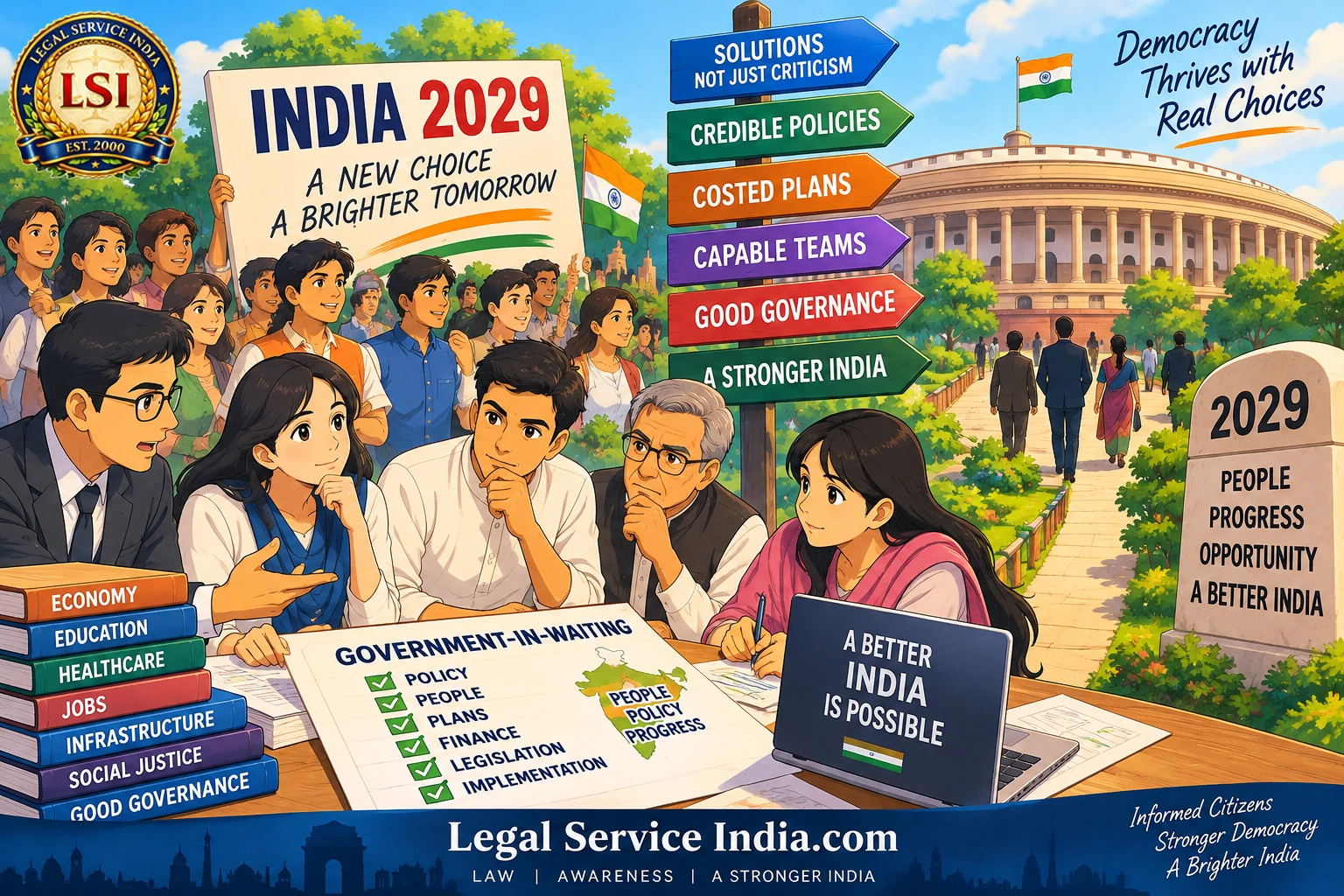
India 2029: How the Opposition Can Build a Credible Alternative and Give India a New Choice
I have spent more than twenty-five years looking at India through the eyes of a lawyer.
A lawyer learns something very early in his career:
Winning an argument is not the same as proving a case.
Politics is not very different.
For years, much of India’s opposition politics has been organised around one central question:
How do we defeat the ruling party?
I believe India needs the opposition to ask a much more important question before 2029:
If the people of India decide to change their government, what credible alternative will they actually be offered?
That is a fundamentally different question.
An opposition can be successful at criticising a government and still be unprepared to replace it.
It can identify problems without having workable solutions.
It can promise change without explaining how that change will be financed, legislated and implemented.
It can unite against one political force without agreeing on what it intends to do once it obtains power.
That is why the real challenge before India’s opposition for 2029 is not simply to become anti-incumbent.
It is to become pro-governance.
India needs a choice.
But a choice becomes meaningful only when the alternative is credible.
Quick Overview
| Topic | Key Idea |
|---|---|
| Central Question | What credible alternative will India be offered by 2029? |
| Main Argument | The opposition should become pro-governance rather than merely anti-incumbent. |
| Core Principle | Proof Before Promise. |
| Ultimate Goal | Build a government-in-waiting before asking for power. |
India 2029 Should Be About Choice, Not Merely Change
A healthy democracy requires competition.
Citizens should have the ability to examine competing political visions and decide which one they trust with the country’s future.
But electoral competition becomes meaningful only when voters have genuine alternatives.
The opposition therefore has an opportunity between now and 2029.
It can spend the next few years primarily attacking the incumbent government.
Or it can use those years to build something considerably more difficult:
A government-in-waiting.
That means building policy.
Building teams.
Testing ideas.
Training administrators.
Studying legislation.
Calculating costs.
Learning from failures.
And, above all, demonstrating competence before asking the Indian people for power.
The question should not simply be:
“Why should India vote against the present government?”
The better question is:
“Why should India vote for us?”
That is the question that can produce a genuinely new political choice.
This Should Not Be an “Anti-Modi” Election Strategy
Let me make one point clear.
A credible alternative to the present government cannot be built merely around opposition to Narendra Modi, the BJP or any particular ideology.
That would be too narrow.
The Modi years have produced developments that any serious political assessment must acknowledge, including the expansion of digital payments, infrastructure development, welfare delivery, financial inclusion and India’s more assertive international profile.
An opposition that refuses to recognise achievements simply because another political party delivered them will immediately weaken its own credibility.
But acknowledgement is not surrender.
A mature democracy must be capable of holding two thoughts together:
“This worked.”
And:
“This needs improvement.”
That is the standard I would expect from a serious alternative government.
- If an existing programme works, retain it.
- If it works partially, improve it.
- If it is fundamentally defective, replace it.
The objective should not be to erase the previous government.
The objective should be to govern India better.
The First Question for Every Opposition Leader: “What Will You Do on Monday?”
If I were sitting across the table from an opposition leader preparing for 2029, I would ask a simple but uncomfortable question:
“Suppose you win. What exactly will you do on Monday morning?”
Not what will you say at a rally?
Not what will appear in the manifesto.
Not what will generate applause.
What will actually happen?
Questions That Separate Political Opposition from an Alternative Government
- Which ministry will act first?
- Which law needs amendment?
- What will it cost?
- Where will the money come from?
- Which government agency will implement it?
- Which states need to cooperate?
- What happens if the bureaucracy resists?
- What happens if coalition partners disagree?
- What happens if the policy fails?
- How will citizens know whether you succeeded?
These questions expose the difference between political opposition and an alternative government.
India has no shortage of speeches, manifestos and political promises.
What it needs is an alternative operating system for governance.
Build the Government Before Asking for the Government
This should become the central philosophy of the opposition’s preparation for 2029:
Do not wait until after the election to learn how to govern.
Prepare before the election.
Research before the election.
Cost policies before the election.
Legally examine them before the election.
Test them before the election.
Identify implementation difficulties before the election.
Where possible, demonstrate results before the election.
Proof Before Promise
That principle could change the character of Indian opposition politics.
Instead of merely announcing what it intends to do, the opposition could demonstrate that it has already thought through how it will do it.
Create an “India 100 Problems” Mission
I would propose an India 100 Problems Project.
The objective would not be to create 100 political slogans.
It would be to identify 100 genuine national problems and investigate each one systematically.
They could include:
- youth employment;
- wages and income security;
- agricultural productivity;
- education and learning outcomes;
- healthcare costs;
- judicial delays;
- police investigation;
- criminal justice;
- MSME financing;
- urban congestion;
- air pollution;
- water security;
- manufacturing competitiveness;
- energy security;
- women’s workforce participation;
- municipal finances;
- government procurement;
- artificial intelligence;
- technology adoption;
- infrastructure maintenance;
- administrative accountability.
Every problem should be approached with evidence.
How many people are affected?
What does the problem cost India?
What has already been attempted?
What worked?
What failed?
Why did it fail?
What would fixing it cost?
What law needs to change?
Which ministry or agency must act?
How long will implementation take?
What are the risks?
And finally:
How will success be measured?
The result would be much more valuable than another conventional manifesto.
It would become a national problem-solving database.
Every Promise Should Carry a Price Tag
Political promises are easy.
Implementation is not.
Therefore, I would introduce one basic rule:
No Major Unfunded Promise
Every significant proposal should disclose:
- Estimated Cost: ₹X
- Funding Source: Y
- Implementation Period: Z
- Legal Requirements: A
- Principal Risks: B
- Expected Outcome: C
If the financial mathematics do not work, the promise should not be made.
There is nothing politically weak about withdrawing an unrealistic proposal before an election.
In fact, it demonstrates responsibility.
A government that discovers after taking office that its promises cannot be financed has already damaged public trust.
A political party should therefore be willing to tell voters:
“We examined this proposal. The numbers do not work. We will not make a false promise.”
That is credibility.
Also Read: Can America Reform the Supreme Court? Latest 5–4 Ruling Reignites Term Limits Debate
Keep, Repair or Replace
There is another temptation that an incoming government must resist.
The belief that everything created by its predecessor must be destroyed.
That is not reform.
That is political revenge.
Every major government programme should instead face three tests.
| Test | Question | Action |
|---|---|---|
| Keep | Is it working? | Keep it. |
| Repair | Is the underlying idea sound but the implementation weak? | Repair it. |
| Replace | Is the architecture fundamentally flawed? | Replace it. |
This principle should apply irrespective of political ownership.
If a BJP-era programme works, keep it.
If a Congress-era programme works, keep it.
If a regional government’s programme works, learn from it.
Good governance should not carry a party label.
The Indian taxpayer does not care which party originally designed a successful public service.
The citizen cares whether it works.
The Real Test of an Alternative Government: Jobs
If the opposition wants to convince India’s young population that it deserves power, employment should be one of its central tests.
But the employment debate also needs greater sophistication.
The number of jobs alone is not enough.
We should ask:
- What does the worker earn?
- Is the employment sustainable?
- Does productivity increase?
- Can the worker acquire new skills?
- Does the family achieve greater economic security?
A person working extremely long hours for inadequate income cannot simply be converted into a favourable employment statistic.
The objective should be:
Productive, Dignified and Sustainable Work
An alternative government should therefore publish measurable employment targets and explain exactly how it intends to achieve them.
Justice Must Become a National Economic Priority
As a lawyer, I would place judicial reform considerably higher on the political agenda.
Justice delayed is not merely a legal problem.
It is an economic problem.
It is a social problem.
It is an institutional problem.
It is also a constitutional concern.
Court delays affect businesses, families, victims, accused persons, property disputes, commercial contracts and government litigation.
An alternative government should therefore move beyond the familiar promise:
“We will modernise the judiciary.”
That sentence means very little without measurable commitments.
How many judicial vacancies will be filled?
How much court infrastructure will be created?
How will case management improve?
How will unnecessary government litigation be reduced?
How will investigation and prosecution be strengthened?
How will technology be used intelligently?
How will disposal times be measured?
The principle is simple:
Governance Begins When Slogans Become Numbers
Every Policy Should Have a Red Team
One of the most useful reforms the opposition could adopt is an institutional Red Team.
Its job would be to attack the party’s own policies before the public does.
Suppose the proposed government announces a ₹50,000-crore employment programme.
The Red Team should try to destroy the proposal.
- Where will the money come from?
- Will it actually create productive employment?
- Can the states implement it?
- Can businesses exploit it?
- Can beneficiaries manipulate the system?
- Could it increase inflation?
- Could it displace existing workers?
- What happens during an economic downturn?
- What happens if corruption enters the programme?
- What happens if the expected economic benefits never materialise?
A policy that survives serious adversarial examination has a much better chance of surviving contact with reality.
This is not merely a political concept.
It comes from engineering, risk management and adversarial testing.
Indian politics needs more of it.
Publish the “Day-One Government Manual”.
A manifesto tells voters what a party intends to do.
A government manual would tell voters how it intends to do it.
Before 2029, every serious opposition alliance should ideally prepare a Day-One Government Manual.
For every major ministry:
| Timeline | Question |
|---|---|
| Day 1 | What happens? |
| Day 30 | What happens? |
| Day 100 | What happens? |
| Year 1 | What happens? |
| Year 5 | What outcome should citizens expect? |
Every major commitment should identify:
Authority → Law → Budget → Personnel → Technology → KPI → Deadline
That is what preparedness looks like.
The country should be able to examine an alternative government before it votes for it.
The Opposition Needs More Than an Alliance
There is a particularly difficult question for any coalition.
Can several political parties form a government merely because they oppose the BJP?
I do not believe that is sufficient.
“We all oppose the BJP” is not a governing philosophy.
A coalition seeking national power should agree beforehand on a written governance framework.
It should answer:
- Who will lead the government?
- How will ministries be allocated?
- What policies are common?
- What policies remain within individual party autonomy?
- How will disagreements be resolved?
- What happens when coalition partners disagree publicly?
- How will fiscal discipline be maintained?
- How will major legislation be agreed upon?
- What happens if a coalition partner withdraws support?
These questions should be answered before power arrives.
The country should not be forced to discover a coalition’s governing arrangements after the election.
Give Citizens a Government Scorecard
The opposition should also create a genuinely public digital accountability platform.
Not propaganda.
Not political advertising.
Not a party-controlled publicity machine.
A Public Scorecard
Citizens should eventually be able to see:
- promises made;
- money allocated;
- money spent;
- projects completed;
- employment indicators;
- education outcomes;
- healthcare outcomes;
- infrastructure progress;
- legislative performance;
- justice-sector indicators.
Think of it as a public balance sheet of government.
And there should be one important rule:
The scorecard must also judge the alternative government when it comes to power.
If it fails, the public should be able to see the failure.
That is the price of asking citizens for trust.
A Government Should Be Allowed to Admit Failure
This may be politically uncomfortable.
I believe it is essential.
Suppose an employment pilot fails.
The government should be capable of saying:
The pilot failed.
Then explain:
- Why?
- What did we misunderstand?
- What did the evidence show?
- What will change?
- What will be discontinued?
That may initially appear politically dangerous.
In reality, honest admission of failure can strengthen democratic trust.
Citizens do not expect governments to be perfect.
They should expect governments to be honest, accountable and capable of correction.
2026–2029: The Preparation That Could Change the Opposition
If the opposition genuinely wants to create a credible alternative by 2029, the next three years should be treated as a preparation period.
2026 — Understand India
Build the national problem database.
- Identify the 100 major problems.
- Audit existing government programmes.
- Create research, economic, administrative and legal teams.
- Study what is already working.
- Identify what is failing.
2027 — Build and Test Solutions
- Develop policy proposals.
- Calculate their costs.
- Examine their constitutional and legal implications.
- Subject them to Red Team scrutiny.
- Begin controlled pilots wherever feasible.
- Learn from state-level experiments.
2028 — Demonstrate Capability
- Publish independent evaluations.
- Show citizens which ideas worked.
- Discard policies that failed.
- Refine successful programmes.
- Prepare the Day-One Government Manual.
- Develop a clear coalition governance framework wherever an alliance is proposed.
2029 — Present the Alternative
The final programme should not necessarily be hundreds of pages of promises.
I would prefer perhaps 50 major commitments.
But each should answer seven basic questions:
| Question | What It Should Establish |
|---|---|
| What? | What is the proposed action? |
| Why? | Why is the action necessary? |
| How much? | What will it cost? |
| Who? | Who will be responsible? |
| When? | When will it be implemented? |
| What law? | What legal framework will be required? |
| What KPI? | How will performance be measured? |
That is not merely an election promise.
It is a government contract with the people.
The New Political Currency Should Be Credibility
Indian politics has traditionally rewarded political communication.
- Who speaks better?
- Who campaigns better?
- Who attracts larger crowds?
- Who dominates television?
- Who creates the strongest narrative?
All of those things matter.
But there should be another question:
Who can demonstrate that their government is capable of working?
That requires a different political culture.
A culture that respects economists without becoming technocratic.
Lawyers without becoming legalistic.
Administrators without becoming bureaucratic.
Technology without becoming obsessed with technology.
And citizens without treating them merely as voters.
The ultimate political asset should be credibility.
India Can Become a Laboratory of Governance
India’s diversity is not merely a challenge.
It can also be an enormous advantage.
Different states are already experimenting with different approaches.
- If one state develops an effective education intervention, study it.
- If another develops a successful healthcare model, study it.
- If another improves municipal services, study it.
- If another creates a stronger MSME ecosystem, study it.
Then ask:
Can this be reproduced elsewhere?
India could become a laboratory of governance innovation.
Not every experiment will succeed.
That is acceptable.
A controlled pilot that fails after spending a relatively limited amount is preferable to a national programme that fails after thousands of crores have been spent.
The objective should be to fail intelligently before scaling.
What Would Success Look Like?
The success of a new opposition project should not primarily be measured by rallies, social media followers or television appearances.
It should be measured by evidence.
| Measure | What Should Be Evaluated? |
|---|---|
| Policy Credibility | How many proposals survive independent scrutiny? |
| Pilot Performance | How many interventions produce measurable improvements? |
| Financial Credibility | How many promises have identified funding? |
| Governance Readiness | Can every major ministry produce a credible 100-day plan? |
| Coalition Stability | Have alliance partners agreed upon transparent governing procedures? |
| Transparency | Can policy assumptions and finances be independently examined? |
| Public Confidence | Does independent evidence indicate increasing confidence in the alternative’s ability to govern? |
These indicators would tell the country far more than the size of a political rally.
Can This Defeat The BJP In 2029?
I would not make such a prediction.
No serious political analysis should promise an election outcome three years in advance.
Elections depend on countless variables:
- economic conditions;
- leadership;
- national security;
- international developments;
- political alliances;
- candidate selection;
- public sentiment;
- regional dynamics;
- unexpected events.
Anyone claiming certainty about the result of the 2029 election is offering confidence where none can responsibly exist.
But one thing can be controlled.
The opposition can control whether its alternative is:
- prepared,
- competent,
- financially credible,
- legally sound,
- institutionally serious and
- capable of explaining exactly what it intends to do.
That is where its energy should go.
The Opposition Must Become More Than Opposition
This, ultimately, is the central issue.
Opposition has a legitimate constitutional and democratic role.
- It must question government.
- It must scrutinise legislation.
- It must expose failures.
- It must represent citizens.
- It must hold power accountable.
But an opposition that wants to become the government has another responsibility.
It must demonstrate that it is capable of governing.
There is a fundamental difference between saying:
“The government is wrong.”
And saying:
“Here is what we believe is wrong. Here is the evidence. Here is what should be retained. Here is what should change. Here is what it will cost. Here is the law required. Here is how it will be implemented. And here is the number by which you can judge us.”
The second is not merely opposition.
It is an alternative.
India Does Not Need Another Election Promise
India is too large to be governed through slogans.
It is too young to have its aspirations reduced to political arithmetic.
It is too diverse to be governed through simplistic solutions.
And it is too important to accept untested promises from anyone seeking power.
The country does not need politicians merely saying:
“Give us a chance.”
It needs political leaders capable of saying:
“We have done the work. We have tested our ideas. We have calculated the costs. We have examined the laws. We have prepared the institutions. Here is the evidence. Judge us.”
That would represent a very different kind of politics.
The New Choice India Deserves
The 2029 election should not ultimately be reduced to a referendum on one individual or one political party.
It should offer Indian citizens something more meaningful:
A genuine choice between competing models of governance.
The ruling party should have to defend its record.
The opposition should have to prove its alternative.
Neither should receive a blank cheque.
The people should be given evidence, competing policies, measurable commitments and credible leadership—and then allowed to decide.
That is how democracy becomes stronger.
The Real Contest For India’s Future
The real contest for India’s future should therefore not merely be:
- One party versus another.
It should be:
| Political Model | Core Approach |
|---|---|
| Politics as Permanent Conflict | Continuous political confrontation |
| Politics as Competent Public Service | Effective governance focused on public service and results |
I would choose the second.
Prepare To Govern India, Not Merely To Win
And if India’s opposition genuinely wants to give the people a new choice in 2029, my advice would be simple:
Do not spend the next three years merely preparing to win an election.
Spend those three years preparing to govern India.
- Build the team.
- Study the country.
- Identify the problems.
- Test the solutions.
- Calculate the costs.
- Respect the Constitution.
- Prepare the legislation.
- Train the administrators.
- Build the technology.
- Audit your own promises.
- Measure your own failures.
The Message The Opposition Should Give India
And when 2029 arrives, do not merely ask India:
“Give us a chance.”
Be prepared to say:
“We have done the work. Here is the evidence. Here is our plan. Here is how you can judge us. Now make your choice.”
That, in my view, would be a far more meaningful challenge to any incumbent government.
More importantly, it would give the people of India something democracy should always provide:
- A credible alternative.
- A genuine choice.
- A new possibility for India’s future.
Need Legal Guidance? Speak With An Experienced Supreme Court Advocate
Adv. Tarun Choudhury
Supreme Court Advocate | 25+ Years of Legal Experience
For professional legal guidance, consultation, or assistance with your legal matter, get in touch directly.
- 📞 Call: 9891244487
- 💬 WhatsApp: 9891244487
Experienced. Practical. Constitutionally Grounded Legal Guidance.
Your legal rights deserve informed and experienced representation.
Frequently Asked Questions
1. How Can The Indian Opposition Build A Credible Alternative Government For The 2029 Lok Sabha Election?
The opposition can build a credible alternative by preparing a detailed governance plan before the 2029 Lok Sabha Election. This should include costed policies, legal analysis, implementation timelines, measurable KPIs, trained leadership teams and a clear Day-One Government Manual.
The focus should shift from merely opposing the incumbent government to demonstrating the ability to govern effectively.
2. What Should The Opposition Offer Indian Voters As A New Political Choice In 2029?
The opposition should offer voters a positive and practical alternative based on employment, economic growth, judicial reform, education, healthcare, infrastructure, administrative accountability and institutional governance.
Instead of relying primarily on anti-incumbency, it should explain what it would retain, repair or replace and provide evidence supporting its proposed policies.
3. Why Is A Common Opposition Agenda Important For The 2029 Indian General Election?
A common opposition agenda can provide greater clarity and credibility to voters, particularly if several parties intend to govern together.
A serious alliance should establish its common policies, leadership arrangements, ministry-sharing principles, dispute-resolution mechanisms, fiscal discipline and legislative priorities before seeking a mandate.
4. How Can The Opposition Prove That Its 2029 Election Promises Are Financially And Legally Feasible?
Every major election promise should disclose its estimated cost, funding source, implementation timeline, legal requirements, principal risks and expected outcomes.
Policies should also undergo independent economic, constitutional and administrative scrutiny before being presented to voters.
This “proof before promise” approach can make an alternative government more credible.
5. What Can Make The 2029 Lok Sabha Election A Genuine Choice For The People Of India?
The 2029 Lok Sabha Election can become a more meaningful democratic choice if voters are presented with competing and credible governance models rather than simply competing political personalities.
A genuine alternative should demonstrate its policies, explain how they will be implemented, disclose their costs and establish measurable standards against which citizens can judge its performance.
Key Takeaways: India 2029 and the Opposition’s Credible Alternative
- India 2029 needs more than an anti-incumbency campaign—the opposition must present a credible and practical alternative government that voters can trust.
- The opposition should become a government-in-waiting by preparing policies, legislation, budgets, implementation plans and administrative teams before the 2029 Lok Sabha Election.
- “Proof Before Promise” should guide election planning. Major policies should be researched, legally examined, financially costed, tested and independently evaluated before being promised to voters.
- A genuine political alternative must focus on governance, including jobs, economic growth, education, healthcare, judicial reform, agriculture, MSMEs, infrastructure, technology and administrative accountability.
- The “India 100 Problems Project” could identify and systematically address India’s most important national challenges, replacing political slogans with evidence-based problem solving.
- Election promises should be financially credible. Major commitments should disclose their estimated cost, funding source, implementation timeline, legal requirements, risks and measurable outcomes.
- The next government should follow a “Keep, Repair or Replace” approach—retain successful programmes, improve defective implementation and replace policies that are fundamentally ineffective.
- Judicial reform should become a major national priority, with measurable targets for judicial vacancies, court infrastructure, case management, government litigation and case disposal.
- Opposition parties should establish independent “Red Teams” to challenge and stress-test major policies before presenting them to the Indian electorate.
- A “Day-One Government Manual” can demonstrate governing readiness, setting out what each major ministry will do on Day 1, Day 30, Day 100, Year 1 and Year 5.
- Opposition alliances need a common governance framework, not merely an agreement to oppose the BJP. Coalition leadership, policy priorities, ministry allocation, dispute resolution and fiscal discipline should be settled beforehand.
- A public government scorecard can strengthen political accountability by allowing citizens to track promises, expenditure, project completion, employment, education, healthcare and other measurable outcomes.
- The 2029 Lok Sabha Election should offer voters a genuine choice between competing governance models, rather than being reduced to a contest between personalities or political parties.
- The opposition cannot guarantee an election victory in 2029, but it can control whether its alternative is prepared, competent, financially credible, legally sound and institutionally serious.
- For the 2029 Lok Sabha Election, India’s opposition can build a credible alternative by moving beyond anti-government politics and becoming a prepared government-in-waiting—with costed policies, tested solutions, legal and financial scrutiny, measurable goals and a clear plan to govern.
