Aung San Suu Kyi: Loved, Hated, Jailed—What Happens Next for Myanmar’s Democracy?
For decades, Aung San Suu Kyi has been one of the most powerful political symbols in Myanmar and one of the world’s best-known political prisoners. A Nobel Peace Prize winner who spent years under house arrest, she became internationally associated with democracy, nonviolence, and resistance to military rule.
But her legacy is far more complicated today.
After the military coup of 2021, Suu Kyi was detained along with members of her government and has remained largely out of public view. Years of civil war have transformed Myanmar, while questions about her political future and the future of the country’s democracy remain unresolved.
The recent release of photographs showing Suu Kyi has therefore attracted enormous attention. For years, concerns had grown about her condition and whereabouts, particularly after her son publicly raised questions about whether his elderly mother was still alive. The photographs appear to provide a form of proof of life after years of limited information about her.
Who Is Aung San Suu Kyi?
Aung San Suu Kyi is the daughter of Aung San, a central figure in Myanmar’s struggle for independence from British colonial rule and a figure closely associated with the country’s military establishment. He was assassinated when she was only two years old.
Her political journey took shape dramatically in 1988, when she returned to Yangon while the country was experiencing major pro-democracy protests against military rule.
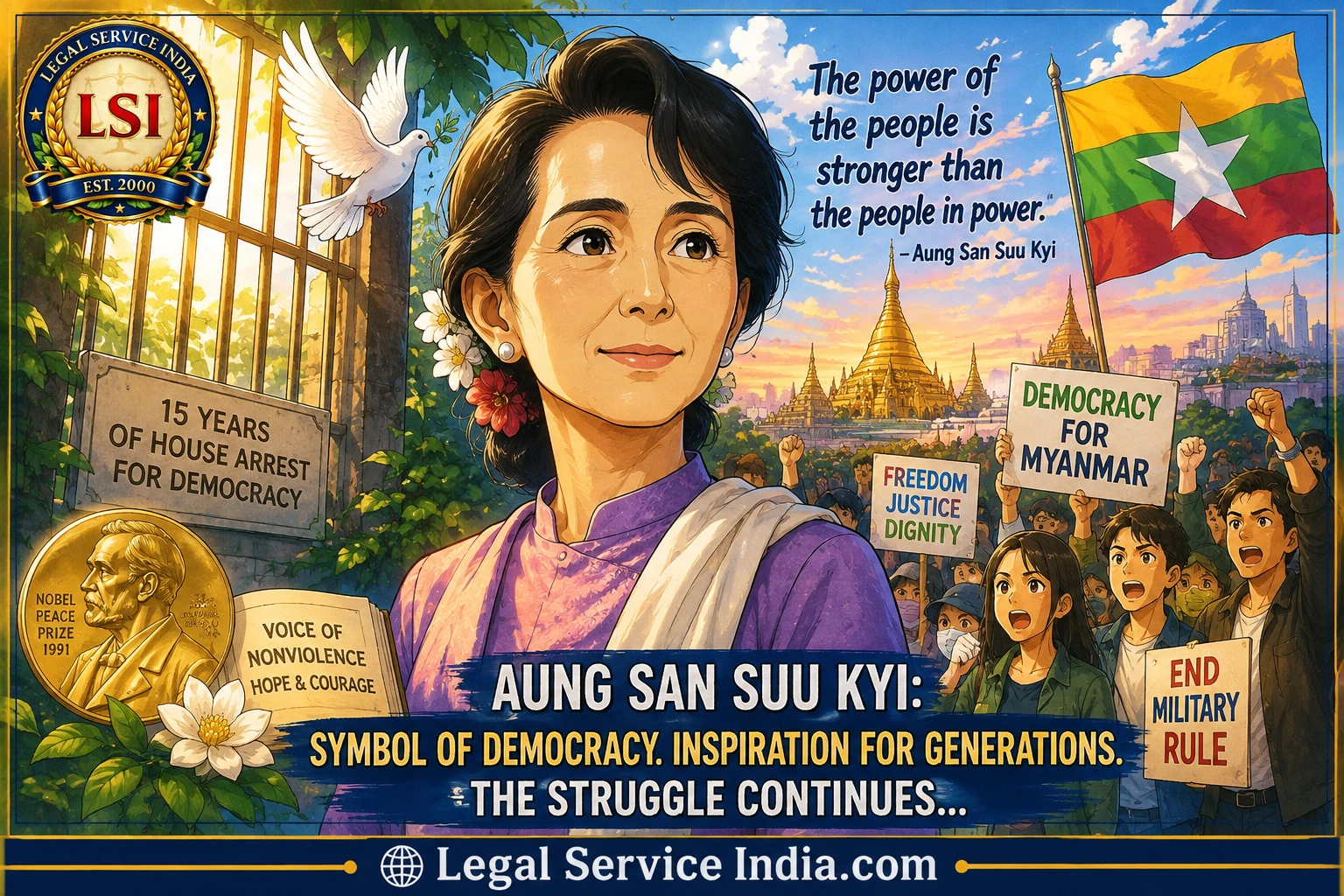
She soon emerged as a leading figure of the democracy movement. The military placed her under house arrest, and she spent 15 of the following 21 years confined to her lakeside home in Yangon.
Rather than leave Myanmar, she repeatedly accepted personal hardship and isolation. Her refusal to choose exile became an important part of her public image. When her husband, Michael Aris, was dying of cancer in England, the military indicated that she could leave Myanmar. She refused because she believed that leaving could prevent her from returning to her country.
That decision reinforced her image as a leader who placed the country and its people above personal considerations.
The Nobel Peace Prize and International Icon
Suu Kyi’s years of detention transformed her into an international symbol of resistance to authoritarian rule.
She was awarded the Nobel Peace Prize in 1991 while still under detention. Her reputation grew both internationally and within Myanmar.
She became a powerful symbol of democracy, freedom, and nonviolent political resistance. Her image appeared on posters, clothing, and political material, while international personalities and artists helped elevate her status as a global democratic icon.
But being placed on such a pedestal also created enormous expectations.
Her later political record demonstrated that the image of Suu Kyi as an uncomplicated symbol of democracy could not be separated from the difficult realities of governing Myanmar.
Myanmar’s Democratic Opening
Myanmar experienced a significant political opening in the years leading up to and following the 2015 election.
Suu Kyi’s National League for Democracy won decisively against the military-backed political party. Her campaign attracted enormous public enthusiasm, and her supporters viewed the election as a historic moment.
The victory appeared to offer Myanmar an opportunity to move away from decades of military domination and toward democratic government.
Yet the military retained substantial political power. Suu Kyi and her supporters therefore faced the difficult task of attempting to advance democratic reforms while operating within a political system in which the military remained extraordinarily influential.
The Rohingya Crisis Changed Her International Reputation
Suu Kyi’s international reputation suffered a major setback following the military crackdown against the Rohingya minority in Rakhine State in 2017.
The humanitarian consequences were devastating. Large numbers of Rohingya civilians fled across the border into Bangladesh. Accounts described families arriving traumatised, people carrying children, and some children suffering gunshot wounds. Reports also described villages being burned and allegations of rape and torture. More than 400,000 civilians had fled to Bangladesh within weeks.
For many observers in the West, Suu Kyi’s response became a defining stain on her international reputation.
Critics argued that, as the country’s civilian leader, she should have done more to speak against the violence. Her supporters, however, argued that she was operating within a system where the military retained enormous political power and that openly confronting it could have threatened the fragile democratic transition.
This created a profound contradiction in her legacy: the international icon of democracy was simultaneously being criticized for her response to one of Myanmar’s most serious humanitarian crises.
The 2021 Military Coup
Despite continuing electoral support for Suu Kyi’s party, Myanmar’s democratic experiment ultimately collapsed.
In 2021, the military staged a coup and detained Suu Kyi and other political leaders. Her imprisonment became another chapter in a political life already defined by detention and resistance to military rule.
But the response to the coup was different from the earlier pro-democracy movement.
People initially took to the streets demanding Suu Kyi’s release and opposing military rule. As the military responded with deadly force, however, the resistance increasingly expanded beyond Suu Kyi herself.
Students, young doctors, lawyers, and other civilians were among those killed. The brutality of the crackdown pushed sections of the pro-democracy movement toward armed resistance. Many people who had previously supported nonviolent political action became fighters operating in areas outside the government’s control.
Myanmar’s Struggle Became Bigger Than Suu Kyi
One of the central questions today is whether Myanmar’s resistance is still fundamentally about Aung San Suu Kyi.
The answer suggested by the discussion in the source material is more complicated.
The broader objective remains a democratic Myanmar in which the military is subordinate to a civilian government. But the movement has expanded beyond one individual leader.
For generations, ethnic minorities had already been fighting the Myanmar military. After the 2021 coup, a new generation of students and other young people joined those struggles.
For people who have spent years in jungles while facing bombing, shelling, and violence, Suu Kyi’s historic commitment to nonviolence may be difficult to reconcile with their own experiences.
The political movement has therefore become larger than Suu Kyi, even though she continues to command substantial respect and affection among significant sections of the population.
Why Is Aung San Suu Kyi Being Seen Now?
The recent photographs of Suu Kyi are significant precisely because she has been largely inaccessible for years.
The International Committee of the Red Cross confirmed that one of its representatives had privately met her in accordance with its standards for people deprived of liberty.
The choice of the ICRC is particularly significant because it carries less political baggage than a meeting involving a particular foreign government. It may therefore have been viewed as a neutral channel through which contact could take place without necessarily signalling the beginning of diplomatic negotiations.
Her son had also been publicly raising concerns about her condition and seeking information about his mother.
The new images consequently have significance beyond the photographs themselves. They answer, at least partially, years of uncertainty surrounding her condition and whereabouts.
But they also raise a much larger question:
Why Now?
Could the Military Be Trying to Reintroduce Suu Kyi Into Politics?
One possibility raised in the discussion is that the military-backed authorities could be considering whether Suu Kyi might once again play some role in Myanmar’s political landscape.
This remains uncertain.
Suu Kyi still possesses considerable political capital inside Myanmar. Even after years of isolation, she retains goodwill among substantial sections of the population.
That creates a dilemma for the military.
On one hand, allowing her greater political space could potentially help create a political process or reduce pressure. On the other hand, her continued popularity makes her a formidable political rival.
There is also speculation that bringing her back into the political conversation could divide an opposition movement that has increasingly grown beyond her personal leadership.
The possibility that the military might use her political influence to fracture the opposition is therefore one of the questions surrounding the latest developments.
The Human Cost of Myanmar’s Civil War
Whatever happens to Suu Kyi, Myanmar’s larger crisis cannot be reduced to the fate of one politician.
More than five years after the coup, the country has experienced enormous human suffering.
The discussion describes more than 100,000 people being killed, millions being displaced, and younger people fleeing to neighboring countries to avoid military conscription.
The economic consequences have also been severe. The formal economy has been badly damaged, while instability has created opportunities for illicit activities, including scam operations and narcotics production.
The result is a country where political conflict, humanitarian suffering, economic destruction, and armed violence have become deeply intertwined.
Myanmar’s Elections and the Question of Legitimacy
The country’s recent elections have also done little to settle the political crisis.
The elections described in the discussion were widely criticized because opposition forces were banned and could not participate. The process therefore largely involved groups aligned with the military regime.
The apparent confidence of the military authorities in allowing foreign journalists into Yangon and permitting them to operate relatively freely was notable. Yet the absence of meaningful opposition participation left fundamental questions about the democratic legitimacy of the process.
Against this background, the appearance of Aung San Suu Kyi becomes even more politically significant.
If she were allowed to return to public political life, even in a limited manner, the military would have to confront the reality that she remains one of its most recognized political rivals.
What Happens If Aung San Suu Kyi Is Released?
The most difficult question may be what would happen if Suu Kyi were suddenly released.
Would she still possess the extraordinary aura that once surrounded her?
The answer is not straightforward.
Her personal popularity and symbolic importance remain considerable. But Myanmar has changed dramatically during the years she has been detained.
A generation has experienced military violence and civil war. Armed resistance has expanded. Ethnic armed organizations and newly mobilized young fighters have become central to the conflict.
The political struggle is no longer simply the struggle of one Nobel laureate against a military regime.
It has become a much broader national confrontation over the country’s political future.
That may make it difficult for Suu Kyi to simply return to the political role she occupied before the coup.
Can Her Message of Nonviolence Still Unite Myanmar?
Nonviolence was one of the central principles associated with Suu Kyi’s political identity.
But the reality confronting many of Myanmar’s young resistance fighters is radically different from the environment in which her philosophy gained international prominence.
People who have spent years facing military attacks may find it difficult to accept a renewed appeal for nonviolent resistance.
This does not necessarily mean that Suu Kyi’s political influence has disappeared. Rather, it means that Myanmar’s political landscape has evolved beyond the framework through which the international community once understood her.
Her challenge, if she returns to public life, would be to find a way to connect her historic democratic message with a country profoundly transformed by years of violence.
A Symbol Still Powerful, But No Longer Alone
Aung San Suu Kyi remains a powerful symbol in Myanmar, but the nature of that symbolism has changed.
Before the coup, she represented hope that Myanmar could gradually transition from military rule to democracy.
After the coup, her imprisonment became another symbol of military repression.
Yet the resistance that followed has acquired its own identity.
This may ultimately be the most important development in understanding Myanmar today. The country’s democratic struggle is no longer dependent solely on one political figure. It has been carried forward by students, young professionals, ethnic communities, and armed resistance groups, many of whom have paid an enormous price.
Suu Kyi may remain an important figure in that struggle, but she is no longer the whole story.
What the Latest Developments Could Mean
The release of photographs and the private meeting with an ICRC representative offer a rare glimpse into Suu Kyi’s situation after years of uncertainty.
But they do not, by themselves, establish that she is being released or that she is returning to politics.
Several questions remain open:
- Will Suu Kyi remain detained?
- Could the military allow her greater contact with the outside world?
- Could she eventually be released?
- Would she return to active politics?
- Would the National League for Democracy regain a political role?
- Could her presence unite the opposition or create divisions within it?
- Can her historic commitment to nonviolence resonate with a generation shaped by civil war?
- What role, if any, could she play in a future democratic Myanmar?
These questions may take days, weeks, or even years to answer.
Conclusion: A Political Legacy at a Crossroads
Aung San Suu Kyi’s life has come to represent both the promise and the contradictions of Myanmar’s modern political history.
She was once the world’s celebrated symbol of democratic resistance, a Nobel Peace Prize winner who endured years of detention rather than accept exile. She later became the elected civilian leader of a country attempting a difficult transition away from military rule.
Her reputation was severely damaged by the Rohingya crisis, while the 2021 military coup returned her to detention and plunged Myanmar into a devastating civil war.
Now, the emergence of new images of Suu Kyi has reopened questions about her future and Myanmar’s political direction.
But the central reality remains that Myanmar has changed.
The democratic struggle that once centered heavily on Aung San Suu Kyi has grown into something larger. Her influence remains substantial, but the country now faces a generation shaped by war, displacement, and resistance.
If Aung San Suu Kyi is eventually released, the question will not simply be whether she can return to the role she once occupied.
The deeper question will be whether the woman who became the face of Myanmar’s nonviolent democratic movement can find a meaningful place in a country transformed by years of conflict.
For Myanmar, that answer could shape not only Suu Kyi’s legacy, but the future of the country’s long and painful struggle for democracy.
Also Read: Krishna Janmabhoomi Case: Supreme Court May Remand Representative Suit Issue
FAQs: Aung San Suu Kyi and Myanmar’s Political Crisis
1. Who Is Aung San Suu Kyi and Why Is She Important to Myanmar’s Democracy?
Aung San Suu Kyi is Myanmar’s most prominent pro-democracy leader and a Nobel Peace Prize winner. She became an international symbol of nonviolent resistance after spending many years under house arrest and later led Myanmar’s civilian government following the 2015 election.
2. Why Was Aung San Suu Kyi Detained by the Myanmar Military?
Aung San Suu Kyi was detained after the Myanmar military staged a coup in 2021 and removed the elected government. She and other political leaders were subsequently imprisoned, while Myanmar descended into widespread armed conflict and civil unrest.
3. Why Has Aung San Suu Kyi’s International Reputation Changed?
Aung San Suu Kyi was once celebrated globally as a symbol of democracy and human rights. However, her response to the 2017 military crackdown against the Rohingya significantly damaged her international reputation, with critics arguing that she should have done more to oppose the violence.
4. What Is the Significance of the Recent Photographs of Aung San Suu Kyi?
The photographs are significant because Aung San Suu Kyi had been largely out of public view for years. A private meeting with an International Committee of the Red Cross representative also pr but alsoovided an important indication that she was alive and had been accessible to an independent humanitarian organization.
5. Could Aung San Suu Kyi Return to Myanmar Politics?
Aung San Suu Kyi continues to retain considerable political goodwill among sections of Myanmar’s population, but the country’s political landscape has changed dramatically since the 2021 military coup. The resistance movement has expanded beyond her leadership, making her future political role uncertain.
Key Takeaways: Aung San Suu Kyi and Myanmar’s Political Crisis
- Aung San Suu Kyi remains a major symbol of Myanmar’s pro-democracy movement, despite years of detention and Myanmar’s dramatic political transformation.
- Aung San Suu Kyi won the Nobel Peace Prize in 1991 after becoming internationally recognized for her commitment to democracy and nonviolent political resistance.
- Myanmar’s 2015 election marked a historic democratic opening, with Suu Kyi’s National League for Democracy winning decisively against the military-backed political party.
- The Rohingya crisis severely damaged Aung San Suu Kyi’s international reputation, particularly because of criticism surrounding her response to the military crackdown and mass displacement in 2017.
- The Myanmar military coup in 2021 ended the country’s democratic experiment, with Aung San Suu Kyi and other political leaders detained and the country subsequently entering a devastating period of armed conflict.
- Myanmar’s resistance movement has grown beyond Aung San Suu Kyi, involving students, young professionals, ethnic communities, and armed resistance groups seeking a democratic system with civilian control over the military.
- Recent photographs of Aung San Suu Kyi are significant because she had remained largely out of public view for years, while concerns about her health and whereabouts had intensified.
- The International Committee of the Red Cross confirmed a private meeting with Aung San Suu Kyi, providing an important indication of contact with her after years of limited information.
- Aung San Suu Kyi still retains substantial political goodwill among sections of Myanmar’s population, raising questions about whether the military could eventually attempt to use, restrict, or reshape her political role.
- Myanmar’s political future remains uncertain, with major questions surrounding Suu Kyi’s possible release, her potential return to politics, the future of the opposition, and whether her message of nonviolence can resonate with a generation shaped by years of civil war.
Summary
Aung San Suu Kyi remains a central figure in Myanmar’s struggle for democracy, but her political role has changed dramatically since the 2021 military coup. Recent photographs and an ICRC meeting have renewed questions about her condition, possible release, and political future. However, Myanmar’s resistance has evolved beyond Suu Kyi, making the country’s democratic future dependent on a much broader movement.