





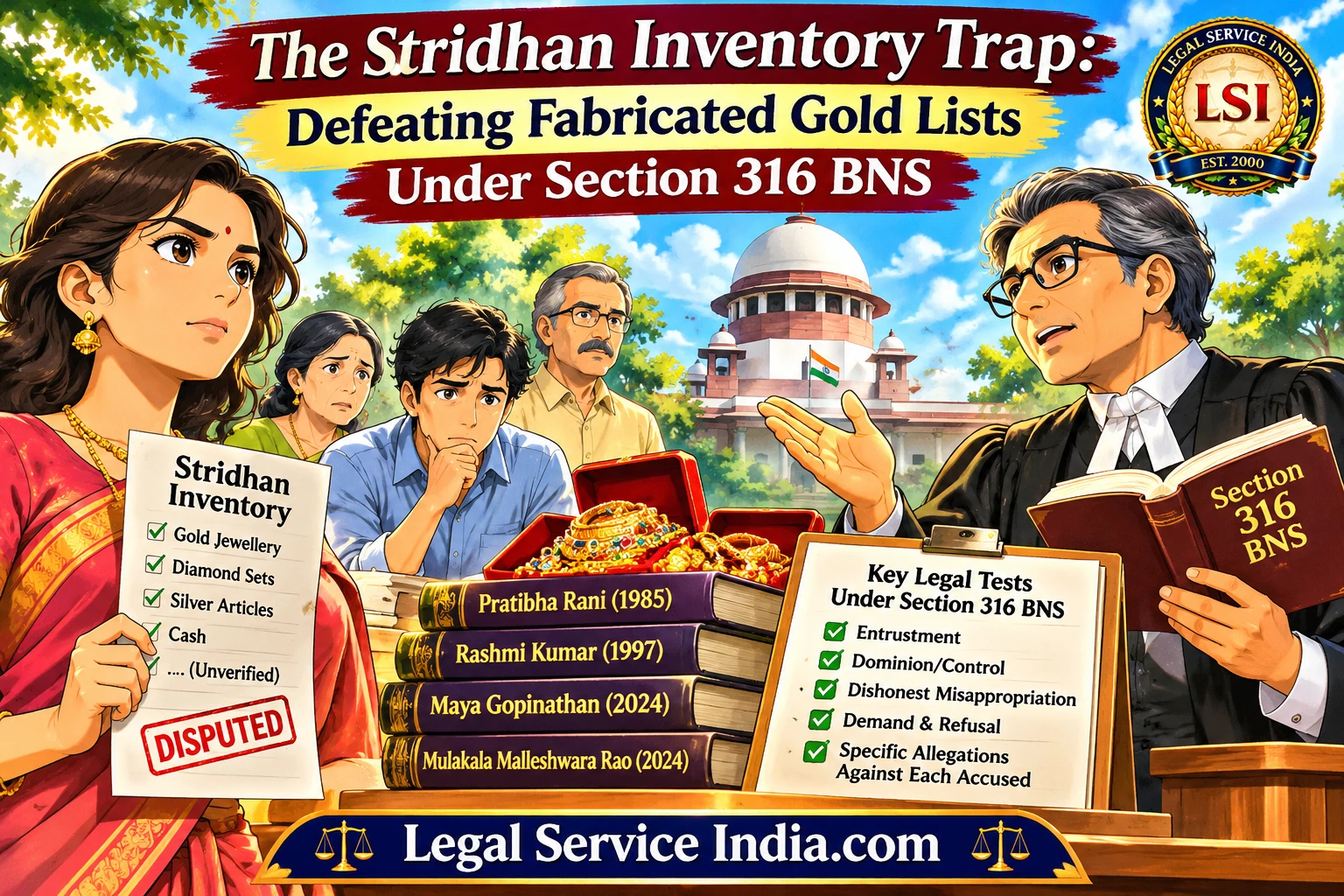
The Stridhan Inventory Trap: How to Challenge False Gold Claims Under Section 316 BNS
Abstract
In matrimonial litigation an unverified “stridhan inventory” is increasingly deployed not merely to claim property but to trigger a police notice, an arrest threat, a bail objection and, finally, a coercive settlement. A wife’s ownership of stridhan is beyond dispute, and the defence must never contest it. What is not automatic is criminal liability under Section 316 of the Bharatiya Nyaya Sanhita, 2023 (“BNS”). The Supreme Court’s own decisions, from Pratibha Rani (1985) to Mulakala Malleshwara Rao (2024), show that the offence stands or falls on specific entrustment, dishonest misappropriation, particularised attribution to each accused, and demand followed by dishonest refusal. This article assembles those authorities, confronts the adverse ones candidly, maps the evidentiary and procedural response under the Bharatiya Nagarik Suraksha Sanhita, 2023 (“BNSS”) — including the Supreme Court’s January 2026 ruling on Section 35 — and supplies a defence matrix and checklists for chamber use.
I. Introduction: When Recovery Becomes Coercion
On marital breakdown, a handwritten or typed list may surface cataloguing dozens of tolas of gold, diamond sets, silver articles and cash, with the allegation that all of it was “entrusted” to the husband or his relatives and is now dishonestly retained. The danger lies in the way the list is used. A notice under Section 35(3) BNSS (the successor to Section 41A CrPC) follows, carrying an implied threat of arrest unless the articles are “produced”. Bail is then opposed because the accused is “not cooperating in recovery”. A property-recovery dispute has quietly become a criminal-coercion mechanism.
The correct response is neither denial nor indignation. It is discipline. Stridhan belongs to the wife; that settles title. Section 316 BNS asks a different set of questions — entrustment, dominion, dishonesty, demand, refusal — and each is a fact the complainant must plead and prove. This article is built around that distinction: ownership is not entrustment, and entrustment is not dishonesty.
Transitional note: Section 316 BNS applies to conduct on or after 1 July 2024. For misappropriation or refusal before that date, the charge lies under Sections 405/406 IPC (punishment up to three years, not five), and, under Article 20(1), the enhanced BNS penalty cannot be applied retrospectively. The first task in any file is to fix the date of the alleged dishonest act or refusal — not the date of marriage — and identify the governing code.
II. The Legal Status of Stridhan: What the Defence Must Concede
A. Pratibha Rani v. Suraj Kumar, (1985) 2 SCC 370
Decided on 12 March 1985 by a bench of Fazal Ali, Sabyasachi Mukharji and A. Varadarajan JJ. (Varadarajan J. dissenting), Pratibha Rani is the foundation. The majority held that stridhan does not become joint property merely because the bride enters her matrimonial home; that she remains its absolute owner; that where it is placed in the custody of the husband or in-laws, they are deemed trustees; and that Section 27 of the Hindu Marriage Act and Section 14 of the Hindu Succession Act supply only an additional civil remedy without displacing criminal liability. The Court overruled the Punjab & Haryana Full Bench in Vinod Kumar Sethi and, of particular interest in this Circuit, the Allahabad High Court’s decision in Kailash Nath Agarwal v. Prem Pal Agarwal (22.12.1983), which had treated jointly kept stridhan as incapable of entrustment. A defence built on the “joint possession in the matrimonial home” theory is therefore closed.
But read the facts. The complaint in Pratibha Rani identified the articles by a list appended to it, alleged that they were handed over at the doli on a stated date to six named persons in the presence of named witnesses, pleaded a demand on a stated date and a refusal, and referred to a legal notice. The majority allowed the complainant to proceed because the ingredients were specifically pleaded and expressly acknowledged that a High Court may quash where the ingredients of Sections 405/406 IPC are not made out on the allegations. It also treated furniture and utensils differently from jewellery and clothing, observing that the former may well have been meant for joint use. And Varadarajan J.’s dissent articulates the defence thesis in terms: absent a specific entrustment, civil remedies are the proper course.
Ratio for the defence, in one line: Pratibha Rani decides that stridhan can be the subject of criminal breach of trust; it does not decide that every allegation about stridhan is one.
B. Rashmi Kumar v. Mahesh Kumar Bhada, (1997) 2 SCC 397
Rashmi Kumar reaffirmed that stridhan is the wife’s exclusive property, that it does not merge into the husband’s or the family’s property, and that dishonest misappropriation by the husband or a family member who held it can amount to criminal breach of trust. It is cited with Pratibha Rani as the standard statement of the proposition; it adds ownership, not a presumption of guilt.
C. Maya Gopinathan v. Anoop S.B., 2024 INSC 334
Decided on 24 April 2024 by Sanjiv Khanna and Dipankar Datta JJ., this was a civil recovery claim before the Family Court at Alappuzha, Kerala, for the value of 89 sovereigns of gold and a sum of ₹2 lakh handed to the husband. The High Court had cut down the relief; the Supreme Court restored it and ordered ₹25 lakh, reiterating that the husband has no title or independent dominion over stridhan and that, in distress, he may use it but is morally bound to restore it or its value. The Court found the High Court’s reasoning rested on assumptions and suppositions, and criticised its approach to the burden of proof and its reading of photographs. The respondents there had admitted that the wife brought stridhan to the matrimonial home.
It was a civil decree, and it is the best illustration of where a gold dispute belongs. Importantly, it is an adverse authority on proof: a court that wants to do justice to a wife will not insist on hallmarked invoices for every item. The defence must therefore attack the list with evidence, not merely with the absence of bills.
D. Mulakala Malleshwara Rao v. State of Telangana, 2024 INSC 639
Decided on 29 August 2024 by J.K. Maheshwari and Sanjay Karol JJ., this is the most useful recent authority for the defence. A father lodged an FIR under Section 406 IPC and Section 6 of the Dowry Prohibition Act against his divorced daughter’s former in-laws years after separation and after a separation agreement, alleging non-return of stridhan. The Supreme Court quashed the proceedings. It reaffirmed the wife’s sole ownership, held that the father had no standing to pursue recovery while the daughter was alive and capable of doing so, found no material that the stridhan was ever entrusted to the appellants, noted the unexplained delay, and cautioned that criminal process must not become an instrument of vendetta. It relied on Bobbili Ramakrishna Raju Yadav for the proposition that wedding presents are not presumed to be entrusted to the in-laws.
III. Section 316 BNS: The Real Test
Section 316(1) BNS defines criminal breach of trust (corresponding to Section 405 IPC). Section 316(2) prescribes imprisonment up to five years, or a fine, or both (corresponding to Section 406 IPC, where the ceiling was three years). The offence is cognisable, non-bailable and triable by a magistrate of the first class. The aggravated forms — carriers, clerks and servants, public servants and bankers — sit in Sections 316(3) to 316(5) and are irrelevant to a matrimonial claim; a charge invoking them against a husband should be questioned at once.
The Supreme Court’s authorities decompose the offence into elements, each of which the complainant must plead with particulars:
The Essential Ingredients of Criminal Breach of Trust
| Element | What Must Be Shown | Authority |
|---|---|---|
| Entrustment or dominion | The property was handed over in a fiduciary capacity, by or on behalf of the owner, who continues to own it. Mere existence of dominion is not enough; the dominion must be the result of entrustment. | Pratibha Rani (applying Velji Raghavji Patel, AIR 1965 SC 1433; State of Gujarat v. Jaswantlal Nathalal, [1968] 2 SCR 408; Jaswantrai Manilal Akhaney, [1956] SCR 483); Delhi Race Club, 2024 INSC 626 |
| Property of another | Beneficial ownership lies in someone other than the accused. Stridhan satisfies this element. | Chelloor Manaklal Narayan Ittiravi Nambudiri, AIR 1953 SC 478; Pratibha Rani |
| Dishonest misappropriation, conversion, use or disposal | Two distinct parts: an obligation created in relation to the property and a later dishonest dealing contrary to it. Dishonest intention must be proved; breach of a civil obligation is not enough. | Superintendent & Remembrancer of Legal Affairs v. S.K. Roy, (1974) 4 SCC 230 (as applied in Pratibha Rani); S.W. Palanitkar v. State of Bihar, (2002) 1 SCC 241 (as applied in Delhi Race Club) |
| Demand and refusal | The usual proof of dishonesty where custody was lawful: a specific demand, on a specific date, to a specific person, and a refusal. The Court in Pratibha Rani approved the view that the offence is committed when a demand is made and declined. | Pratibha Rani (approving Avtar Singh v. Kirpal Kaur, Punj. & Har. HC, 16.8.1979) |
| Attribution to each accused | Which accused received what, when, where and in what capacity. Collective allegations against “husband and in-laws” do not suffice. | Neelu Chopra v. Bharti, (2009) 10 SCC 184; Kahkashan Kausar v. State of Bihar, (2022) 6 SCC 599; Bobbili, (2016) 3 SCC 309 |
Delhi Race Club: Entrustment and the Incompatibility of Criminal Charges
Delhi Race Club (1940) Ltd. v. State of U.P., 2024 INSC 626 (Criminal Appeal No. 3114 of 2024), adds a further point of drafting discipline. The Court held that entrustment is the quintessential ingredient of criminal breach of trust and that criminal breach of trust and cheating, resting on contradictory premises (lawful handing-over followed by misappropriation versus dishonest inducement at inception), cannot co-exist on the same facts. FIRs that add Section 316 BNS and Section 318 BNS “for good measure” over one inventory can be attacked on that footing.
IV. The Dowry Prohibition Overlay
Stridhan complaints are almost always paired with Section 6 of the Dowry Prohibition Act, 1961, under which a person who receives dowry other than the woman herself must transfer it to her within three months of marriage (or receipt), failing which he commits an offence. In Bobbili Ramakrishna Raju Yadav v. State of Andhra Pradesh, (2016) 3 SCC 309 (2016 INSC 60; decided 19 January 2016), the Supreme Court held that the giving of dowry and traditional presents at or about the time of the wedding does not raise a presumption that they were entrusted to the parents-in-law or other close relatives so as to attract Section 6. There the couple lived in Bangalore while the in-laws lived separately in Vizianagaram, and in the absence of specific allegations of entrustment the proceedings against the in-laws were quashed. The Court also confirmed the other side of the coin: where dowry articles are placed in the custody of husband or in-laws, they are deemed trustees.
The Contemporaneous-List Argument
Section 3(2) of the Act excludes from the definition of dowry presents given to the bride without demand, provided they are entered in a list maintained in accordance with the rules. Those rules are the Dowry Prohibition (Maintenance of Lists of Presents to the Bride and Bridegroom) Rules, 1985 (G.S.R. 664(E), dated 19 August 1985, in force from 2 October 1985, made under Section 9 of the Act). Rule 2 requires the list of presents to the bride to be maintained by the bride, in writing, with prescribed particulars, and signed by both bride and bridegroom; the bride and bridegroom may also obtain signatures of relatives or others present at the marriage. A post-separation inventory sits uneasily beside this scheme.
A candid limit. The Rules cast the duty on the bride and the bridegroom alike, so the absence of a list embarrasses both sides, and no authority known to us treats the absence of a list as fatal to a stridhan claim. The point is best pleaded as a circumstance bearing on credibility — “the only signed record of what was given is the 1985-Rules list, and the complainant does not rely on it” — and not as a presumption.
V. The Inventory Trap: How It Operates
| Step | Event | Legal Pressure Point |
|---|---|---|
| 1 | Marital separation. | Fix the date of separation and every date after it; limitation, delay and the governing code all depend on it. |
| 2 | Post-facto “gold list” prepared without invoices or independent record. | No signed list under the 1985 Rules; no earlier mention in maintenance, DV or mediation records; financial-capacity audit. |
| 3 | FIR (or private complaint) under cruelty provisions and Section 316 BNS. | Particulars of entrustment; omnibus allegations; BNSS Section 173(3) preliminary enquiry; Section 175(3) affidavit route for complaints. |
| 4 | Police notice under Section 35(3) BNSS demanding “production”. | Section 35(5) bars arrest of a compliant noticee absent recorded reasons; Satender Kumar Antil v. CBI, 2026 INSC 115. |
| 5 | Bail opposed for “non-recovery of stridhan”. | Recovery of unadjudicated stridhan cannot be a condition of liberty; custody is not needed to produce what the accused does not hold. |
| 6 | Coercive settlement or deposit of alleged value. | Quashing under Section 528 BNSS; civil forum for valuation; Mulakala on abuse of process. |
The trap works because it inverts the burden emotionally and procedurally. The accused is pushed to prove a negative — “I never received these articles” — while the complainant avoids proving the positive facts: acquisition, existence, entrustment, retention and dishonest conversion.
VI. The Case-Law Arsenal
A. Specificity: Omnibus Allegations Fail
Neelu Chopra v. Bharti, (2009) 10 SCC 184 (Crl. A. 949 of 2003, decided 7 October 2009, V.S. Sirpurkar and Deepak Verma JJ.), arose from a complaint under Sections 406 and 498A read with Section 114 IPC against husband, parents-in-law and sister-in-law. The Supreme Court quashed it against the in-laws because the complaint was vague and general, silent on the precise acts of the appellants and the role of each, with all concrete allegations directed at the husband.
The principle has since been repeatedly restated in matrimonial prosecutions. Preeti Gupta v. State of Jharkhand, (2010) 7 SCC 667, and Geeta Mehrotra v. State of U.P., (2012) 10 SCC 741, warn against the tendency to implicate all relatives; K. Subba Rao v. State of Telangana, (2018) 14 SCC 452, applies the caution to roping in distant relatives; Kahkashan Kausar @ Sonam v. State of Bihar, (2022) 6 SCC 599 (2022 INSC 163; decided 8 February 2022, S. Abdul Nazeer and Krishna Murari JJ.), holds that general and omnibus allegations against in-laws, unaccompanied by specific roles, do not warrant prosecution; and Dara Lakshmi Narayana v. State of Telangana, 2024 INSC 953 (decided 10 December 2024, B.V. Nagarathna and N. Kotiswar Singh JJ.), notes the growing misuse of matrimonial provisions and the use of vague, generalised allegations as an arm-twisting device.
The defence should demand particularisation on six axes:
- Which article;
- Entrusted to whom exactly;
- When and where;
- In what capacity (safe custody, bailment, agency or otherwise);
- What dishonest act followed; and
- When a demand was made, by whom, and who refused.
B. Wedding Gifts and Entrustment
Bobbili (above) and Mulakala (above) together establish that neither the fact of marriage nor the traditional handing-over of presents raises a presumption of entrustment to the in-laws. Read with Pratibha Rani, the position is: the bride owns the stridhan; custody by husband or in-laws may create a fiduciary relationship; but criminal liability still requires a pleaded and proved entrustment, followed by dishonest misappropriation or refusal after demand.
C. Criminal Breach of Trust Is Not Cheating
Where the FIR alleges both that the articles were obtained by deception and that they were entrusted and later misappropriated, Delhi Race Club (above) shows the contradiction. The point is strongest at the stage of framing of charge and in quashing petitions that challenge the stacking of Sections 316 and 318 BNS.
D. The Civil Cloak
Indian Oil Corporation v. NEPC India Ltd., (2006) 6 SCC 736, and Prof. R.K. Vijayasarathy v. Sudha Seetharam, (2019) 16 SCC 739, warn against converting civil disputes into criminal prosecutions to exert pressure, and recognise the High Court’s power to examine whether a civil dispute has been given the cloak of a crime. Where the real question is “how much jewellery existed, who kept it and what became of it,” the natural forums are the Family Court and Section 12 of the Protection of Women from Domestic Violence Act, 2005, or a civil suit — Maya Gopinathan is the model.
Use with care. Pratibha Rani itself called it an anathema to suppose that criminal prosecution is barred whenever a civil remedy exists; the two are coextensive. The civil-cloak authorities therefore do not say that a stridhan claim is always civil. They say that where the ingredients of Section 316 are absent on the face of the complaint, the availability of a civil remedy confirms that the dispute is civil in character.
E. Delay, Settlement and Standing
Mulakala also supplies three practical points. Unexplained delay in lodging an FIR after separation, particularly where the parties have settled their affairs by a separation agreement, weakens the claim of recent dishonest conversion. A third party — even the bride’s father — cannot pursue recovery of stridhan without her authority while she is alive and capable of acting. And criminal proceedings must not be used for vendetta. For the practitioner the lesson is drafting: every settlement or separation deed should contain a specific clause on stridhan, jewellery and gifts, with a receipt and release.
F. Continuing Wrong and Limitation: Use Carefully
Krishna Bhatacharjee v. Sarathi Choudhury, (2016) 2 SCC 705 (Crl. A. 1545 of 2015, decided 20 November 2015, Dipak Misra and Prafulla C. Pant JJ.), arose under the Domestic Violence Act. The Court held that retention of stridhan is a continuing wrong so long as the marital status subsists and the stridhan remains in the custody of the husband or his family, so that an application cannot be thrown out on limitation; it distinguished a decree of judicial separation from divorce. It is an authority on Section 12 of the DV Act, not a holding that Section 406 IPC or Section 316 BNS is a continuing offence.
A further point of analysis requires attention. The limitation bar in Section 468 CrPC (and its BNSS counterpart) applies only to offences punishable with imprisonment up to three years. Section 406 IPC fell within that class; Section 316(2) BNS, with a five-year ceiling, does not. For post-July 2024 conduct, a plea of statutory limitation under the BNSS is therefore unlikely to be available, and delay must be deployed as a factor going to credibility and abuse of process (Mulakala), not as a bar.
G. Allahabad High Court
In Anamika Tiwari v. State of U.P. (Allahabad HC, 16 March 2026, Chawan Prakash J.; 2026 LiveLaw (AB) 155), a husband’s Section 406 IPC complaint against his wife and her relatives for taking away her own jewellery was quashed on the footing that stridhan belongs absolutely to the wife and that the ingredients of criminal breach of trust were not made out. It is useful for the Circuit’s approach to the ingredients of Sections 405/406, though it arose on a reversed fact-pattern.
VII. Candour to the Court: Adverse Authorities and How to Meet Them
A defence that ignores the adverse line loses credibility at the first hearing. The following should be anticipated and distinguished on principle, not on rhetoric.
Adverse Authorities: What the Other Side Will Say and the Answer
| Adverse Authority | What the Other Side Will Say | The Answer |
|---|---|---|
| Pratibha Rani (majority) | Joint custody is no answer; jointly kept stridhan is deemed in the husband’s custody; refusal after demand is breach of trust; civil remedy no bar; High Court should not quash on speculation. | Specific pleadings drove the result: articles listed, entrusted on a stated occasion to named persons, demand and refusal pleaded. Quashing remains proper where the ingredients are not disclosed. Varadarajan J.’s dissent states the thesis for the case that lacks particulars. |
| Rashmi Kumar | Husband and family are trustees of stridhan. | Concede ownership. Trusteeship requires custody by entrustment, which must be shown against each accused. |
| Maya Gopinathan | Courts will not demand invoices; assumptions about photographs and lockers are reversible error. | It is a civil decree on evidence, with the husband’s admission that stridhan was brought. Challenge quantity and entrustment with affirmative evidence; do not rest on missing bills. |
| Krishna Bhatacharjee | Retention is a continuing wrong; delay is no answer. | DV Act authority. Post-July 2024 limitation analysis in Part VI.F; delay still weighs on credibility (Mulakala). |
| Pratibha Rani postscript | Courts must not brush aside specific allegations as “vague”. | Agree, and meet it by showing the allegations are vague: no date, no person, no article-wise entrustment. |
VIII. Attacking the Inventory: Evidentiary Strategy
A. Financial-Capacity Audit
Where the list claims extraordinary quantities of gold, seek production or summoning of the complainant’s and her parents’ income-tax returns for the relevant years; bank statements, loan files and declared assets; insurance proposals and visa or immigration declarations; and every earlier list given to police, Family Court, mediation centre or Protection Officer.
In maintenance proceedings, Rajnesh v. Neha, (2021) 2 SCC 324, requires affidavits of assets and liabilities in a prescribed format; a complainant’s sworn disclosure there is a ready benchmark against the later gold list. If 100 tolas never appeared in declared income, inheritance, gifts or any earlier pleading, the inventory’s credibility is materially (not automatically) impaired.
B. Documentary Proof of Acquisition
Demand the following documents:
- BIS hallmark numbers;
- Jeweller invoices and GST bills;
- Bank-locker inventories;
- Insurance schedules;
- Dated valuation certificates; and
- Independent appraiser reports.
A handwritten estimate slip from a local jeweller, prepared after separation, has limited probative value. Because Maya Gopinathan warns against insisting on documents that families rarely keep, pair this demand with the positive evidence below.
C. Wedding Digital Footprint
High-resolution photographs, videos, social-media posts and family albums allow comparison of the jewellery actually worn or gifted with the claimed inventory. Photographs must be read with care, since the Supreme Court criticised a High Court’s misreading of them in Maya Gopinathan.
Electronic records, including WhatsApp messages and video files, must be accompanied by the certificate required under Section 63 of the Bharatiya Sakshya Adhiniyam, 2023, to be admissible.
D. Disproving Custody
Collect the following evidence:
- Bank-locker access registers;
- CCTV footage from the matrimonial home or society;
- Security-entry and visitor logs;
- Travel, cab, courier and luggage records;
- Any inventory or panchnama prepared when the wife left; and
- Messages or photographs showing her wearing, retaining or transferring particular articles.
If the locker was in the wife’s sole name and she operated it shortly before leaving, the allegation that the husband or in-laws retained its contents becomes difficult to sustain.
Important evidentiary distinction: Locker records alone do not establish ownership of contents; the Supreme Court rejected a High Court’s inference of ownership drawn from locker possession in Maya Gopinathan, so use the registers to show custody and access, not title.
E. Settlement Papers
Check every earlier settlement, mediation record, separation agreement, divorce petition and maintenance pleading for a stridhan clause, a receipt, or an inventory. Mulakala turned in part on a separation agreement and long delay; a signed release is often the strongest document in the file.
IX. Procedural Remedies Under the BNSS
A. Before Registration: Section 173(3) BNSS
Lalita Kumari v. Govt. of U.P., (2014) 2 SCC 1, listed matrimonial and family disputes among the categories in which a preliminary inquiry is permissible. Section 173(3) BNSS now allows, for cognizable offences punishable with three years or more but less than seven, a preliminary enquiry of up to fourteen days with prior permission of an officer not below the rank of Deputy Superintendent of Police.
An offence under Section 316(2) BNS falls squarely within that band. Make a written representation at once asking that the enquiry test entrustment and particulars before any FIR is registered or any notice issued.
The Supreme Court has read Section 173(3) as giving police discretion in this band (reported as Imran Pratapgadhi v. State of Gujarat, 2025 SCC OnLine SC 678).
For private complaints, remind the Magistrate of the affidavit and inquiry safeguards in Section 175(3) BNSS and of Priyanka Srivastava v. State of U.P., (2015) 6 SCC 287.
B. Notice Under Section 35 BNSS
The structure is:
- Section 35(3): Where arrest is not required under Section 35(1), the officer shall issue a notice of appearance.
- Section 35(4): The noticee must comply.
- Section 35(5): A person who complies and continues to comply shall not be arrested for the offence in the notice unless, for reasons recorded, the officer is of opinion that arrest is necessary.
- Section 35(6): Arrest on non-compliance.
Supreme Court Ruling: Satender Kumar Antil
In Satender Kumar Antil v. Central Bureau of Investigation, 2026 INSC 115 (also 2026 SCC OnLine SC 162; 2026 LiveLaw (SC) 114), decided on 15 January 2026 by M.M. Sundresh and N. Kotiswar Singh JJ., the Supreme Court held that:
- For offences punishable up to seven years a Section 35(3) notice is the rule and arrest the exception.
- Section 35(5) imposes an implied prohibition on arrest of a compliant noticee.
- Arrest under Section 35(6) is not routine and must rest on fresh material not available when the notice was issued.
- The conditions of Section 35(1)(b) must exist and be recorded before custody.
The decision reaffirms Arnesh Kumar v. State of Bihar, (2014) 8 SCC 273, and is the direct BNSS authority for Section 316(2) BNS, whose five-year ceiling falls inside the seven-year band.
Practical Response to a Notice
Practical steps when responding to a notice under Section 35 BNSS include:
- Appear personally or through counsel as directed.
- File a detailed written representation denying entrustment and dishonest conversion.
- Seek copies of the FIR, complaint, inventory and materials relied on.
- Offer cooperation without admitting custody.
- Place on record any suggestion that liberty is conditional on “recovery” or deposit of alleged value.
C. Anticipatory Bail: Section 482 BNSS
Section 482 BNSS corresponds to Section 438 CrPC.
Plead that the FIR discloses at best a disputed property-recovery claim; that there is no specific entrustment or dishonest conversion; that custody or recovery of unadjudicated stridhan cannot be a condition of liberty; and that criminal process is being used to extract settlement.
Add Satender Kumar Antil (2026) for the notice-first scheme and Arnesh Kumar for necessity.
Rajnesh v. Neha should be cited for its disclosure-affidavit regime, not as a stridhan-bail authority.
D. Quashing: Section 528 BNSS
Section 528 BNSS corresponds to Section 482 CrPC.
Combine the following authorities:
- State of Haryana v. Bhajan Lal, 1992 Supp (1) SCC 335: FIR does not disclose an offence even if accepted in full, or is malicious or essentially civil.
- Neelu Chopra, Kahkashan Kausar and Dara Lakshmi Narayana: No specific attribution.
- Bobbili, Mulakala and Delhi Race Club: Entrustment.
- Indian Oil and Vijayasarathy: Civil dispute in criminal garb.
- Krishna Bhatacharjee: Only to distinguish the DV Act’s continuing-wrong reasoning.
Remember the limit recognised in Pratibha Rani: on a quashing petition the High Court proceeds on the allegations as they stand and does not weigh their truth (see also Nagawwa v. Veeranna Shivalingappa Konjalgi, [1976] Supp SCR 123, on the four classes of case in which process may be quashed).
The petition must therefore show that the ingredients are missing on the face of the complaint, and attach the documents (settlement deed, earlier pleadings, Rule 2 list, if any) that are undisputed.
E. Parallel Civil Route
Offer the forum that can actually decide the dispute: a suit or Section 27 Hindu Marriage Act application, or Section 12 DV Act.
An accused who invites adjudication of the quantum in the proper forum, while resisting criminal process on the ingredients, presents the stronger equities.
X. Defence Matrix
The following defence matrix identifies the principal allegations commonly encountered in stridhan-related FIRs and complaints, the corresponding legal defects, relevant judicial authorities and the evidence to place on record.
| Allegation in FIR / Complaint | Legal Defect | Authority | Evidence to Place |
|---|---|---|---|
| “Dozens of tolas of gold and diamonds were entrusted to the husband and his family.” | No article-wise particulars of entrustment, capacity or date. | Pratibha Rani (contrast its pleadings); Neelu Chopra | Representation seeking particulars; absence of signed Rule 2 list; earlier pleadings and disclosures. |
| “The accused persons retained my stridhan.” (omnibus) | Collective allegation; no role assigned to each accused. | Kahkashan Kausar; Dara Lakshmi Narayana; Bobbili | Residence and household facts of each in-law. |
| “I demanded the articles and they refused.” | No date, person or mode of demand; no legal notice. | Pratibha Rani (demand-refusal passage) | Call records, messages, reply to any notice; silence in earlier proceedings. |
| “In-laws also took custody at the wedding.” | No presumption of entrustment to in-laws; separate residence. | Bobbili; Mulakala | Address proofs; wedding photographs showing who held what. |
| FIR lodged by the bride’s father. | No standing without her authority. | Mulakala | Her own pleadings and affidavits. |
| FIR long after separation or settlement. | Unexplained delay; release in deed. | Mulakala | Separation agreement, receipts, divorce record. |
| Sections 316 and 318 BNS charged together. | Mutually exclusive premises. | Delhi Race Club | FIR text; charge-sheet. |
| Notice under Section 35(3) “to produce stridhan”. | Arrest cannot be coercion for recovery; notice-first scheme. | BNSS s. 35(3)–(6); Satender Kumar Antil (2026); Arnesh Kumar | Proof of appearance and compliance; written representation. |
| Bail opposed for “non-recovery”. | Recovery of unadjudicated property cannot condition liberty. | Satender Kumar Antil (2026); s. 482 BNSS | Civil or DV proceedings pending or offered. |
XI. Practitioner Checklists
1. First Seventy-Two Hours
- Fix the date of the alleged dishonest act or refusal; decide IPC or BNS.
- Obtain FIR, complaint, annexed inventory, and any earlier complaints or police applications.
- Check whether a preliminary enquiry was sought under Section 173(3) BNSS; if not yet, move a representation.
- Collect wedding photographs, videos and albums; preserve phone data with a Section 63 BSA certificate plan.
- Locate any signed Rule 2 list, settlement deed, mediation record and maintenance affidavit.
2. Reply to the Section 35(3) Notice
- Appear on the date; record attendance; do not decline the notice.
- File a written representation denying entrustment, dishonest conversion and demand; seek the materials relied on.
- Offer cooperation without admitting custody; invite civil adjudication of quantum.
- Request recording of reasons if arrest is later proposed under Section 35(6).
3. Anticipatory Bail and Quashing Pack
- Particulars chart: article, person, date, capacity, demand, refusal — with the FIR’s silence marked against each.
- Authorities: Pratibha Rani, Neelu Chopra, Kahkashan Kausar, Bobbili, Mulakala, Delhi Race Club, Satender Kumar Antil (2026), Bhajan Lal.
- Annexures: separation or settlement deed, earlier pleadings, Rule 2 list (or its absence), civil or DV proceedings.
- Candour paragraph: acknowledge Pratibha Rani and Maya Gopinathan and state the distinction.
XII. Strategic Takeaways
- Custody is not criminality. Retention after a hurried separation does not establish Section 316 BNS unless dishonest conversion or dishonest refusal after demand is shown.
- The list is an allegation, not evidence. It needs corroboration from records, photographs, locker registers or witnesses — while recognising that courts will not demand invoices for every item.
- Specificity is the first battlefield. Vague allegations against “husband and in-laws” are vulnerable at the FIR, notice and quashing stages.
- Concede ownership; contest entrustment. The defence is strongest when it accepts what the Supreme Court has settled and insists on what it has not.
- Separate the forums. Property recovery belongs before the Family Court, a civil court or the DV Act; criminal law should be reserved for demonstrable dishonest conversion.
- Use bail, notice and quashing together. Sections 35 and 482 BNSS protect liberty; Section 528 BNSS attacks a legally deficient FIR.
- Document every settlement. A stridhan clause with receipt and release is the cheapest protection a client can buy.
XIII. Conclusion
The stridhan inventory trap succeeds only when the criminal process confuses ownership with liability. The wife’s absolute title must be respected, and the defence loses ground the moment it appears to question it.
But Section 316 BNS cannot be invoked on the strength of a self-serving, post-separation list: the Supreme Court has consistently required entrustment, dishonest misappropriation, particularised attribution and demand-and-refusal.
Pratibha Rani opened the criminal door for the wife who pleads and proves those facts; Bobbili, Neelu Chopra, Mulakala and Delhi Race Club keep it shut against the complaint that does not.
With Satender Kumar Antil (2026) restoring the notice-first discipline of Section 35 BNSS, the accused is no longer defenceless against coercive use of the list — provided the response is prepared early, on the record and on principle.
Citation Table
The following table provides the principal judicial authorities, statutory references and legal propositions discussed in this article.
| Case / Legal Authority | Citation / Date | Legal Principle / Significance |
|---|---|---|
| Pratibha Rani v. Suraj Kumar | (1985) 2 SCC 370; AIR 1985 SC 628; [1985] 3 SCR 191; 12.03.1985 | Stridhan absolute; custodians deemed trustees; Varadarajan J. dissenting; overruled Vinod Kumar Sethi and Kailash Nath Agarwal (All. HC). |
| Rashmi Kumar v. Mahesh Kumar Bhada | (1997) 2 SCC 397 | Stridhan exclusive; misappropriation by husband or family is CBT. |
| Maya Gopinathan v. Anoop S.B. | 2024 INSC 334; 2024 LiveLaw (SC) 327; 24.04.2024 | Civil recovery; husband has no title; ₹25 lakh awarded. |
| Mulakala Malleshwara Rao v. State of Telangana | 2024 INSC 639; 2024 LiveLaw (SC) 621; Crl. A. 3599/2024; 29.08.2024 | FIR by father quashed; no entrustment; delay; locus; no presumption of entrustment to in-laws. |
| Bobbili Ramakrishna Raju Yadav v. State of A.P. | (2016) 3 SCC 309; 2016 INSC 60; 2016 SCC OnLine SC 42; 19.01.2016 | No presumption that wedding presents are entrusted to in-laws; s. 6 DP Act. |
| Delhi Race Club (1940) Ltd. v. State of U.P. | 2024 INSC 626; 2024 LiveLaw (SC) 603; Crl. A. 3114/2024 | Entrustment essential; CBT and cheating cannot co-exist on same facts. Applies S.W. Palanitkar, (2002) 1 SCC 241. |
| Neelu Chopra v. Bharti | (2009) 10 SCC 184; [2009] 14 SCR 1074; Crl. A. 949/2003; 07.10.2009 | Vague complaint under ss. 406/498A quashed against in-laws. |
| Kahkashan Kausar @ Sonam v. State of Bihar | (2022) 6 SCC 599; 2022 INSC 163; 08.02.2022 | General and omnibus allegations against in-laws do not warrant prosecution. |
| Dara Lakshmi Narayana v. State of Telangana | 2024 INSC 953; 2024 SCC OnLine SC 3682; 10.12.2024 | Vague generalised allegations; misuse of matrimonial provisions. |
| Krishna Bhatacharjee v. Sarathi Choudhury | (2016) 2 SCC 705; [2015] 14 SCR 65; Crl. A. 1545/2015; 20.11.2015 | Retention of stridhan is a continuing wrong under the DV Act. |
| Satender Kumar Antil v. CBI | 2026 INSC 115; 2026 SCC OnLine SC 162; 2026 LiveLaw (SC) 114; 15.01.2026 | Section 35 BNSS: notice is the rule; s. 35(5); fresh material for s. 35(6). |
| Dowry Prohibition (Maintenance of Lists of Presents) Rules, 1985 | G.S.R. 664(E), 19.08.1985; in force 02.10.1985; s. 9 DP Act | List of presents; signed by bride and bridegroom. |
| Arnesh Kumar v. State of Bihar | (2014) 8 SCC 273 | Safeguards against routine arrest. |
| State of Haryana v. Bhajan Lal | 1992 Supp (1) SCC 335 | Categories for quashing. |
| Preeti Gupta; Geeta Mehrotra; K. Subba Rao | (2010) 7 SCC 667; (2012) 10 SCC 741; (2018) 14 SCC 452 | Caution on implicating relatives in matrimonial FIRs. |
| Lalita Kumari v. Govt. of U.P. | (2014) 2 SCC 1 | Preliminary inquiry permissible in matrimonial disputes. |
| Entrustment line: Chelloor Manaklal; Jaswantrai Akhaney; Velji Raghavji Patel; Jaswantlal Nathalal; S.K. Roy | AIR 1953 SC 478; [1956] SCR 483; AIR 1965 SC 1433; [1968] 2 SCR 408; (1974) 4 SCC 230 | Entrustment and dominion. |
| Indian Oil Corp. v. NEPC India Ltd. | (2006) 6 SCC 736 | Civil dispute in criminal garb. |
| Prof. R.K. Vijayasarathy v. Sudha Seetharam | (2019) 16 SCC 739 | |
| Rajnesh v. Neha | (2021) 2 SCC 324 | Disclosure affidavits in maintenance proceedings. |
| Priyanka Srivastava v. State of U.P. | (2015) 6 SCC 287 | Affidavit for s. 156(3) applications. |
| Imran Pratapgadhi v. State of Gujarat | 2025 SCC OnLine SC 678 | Discretion under BNSS s. 173(3). |
| Anamika Tiwari v. State of U.P. | Allahabad HC, 16.03.2026; 2026 LiveLaw (AB) 155 | Wife cannot be prosecuted under s. 406 for taking own stridhan. |
Written By: Inder Chand Jain
Ph no: 8279945021, Email: [email protected]

