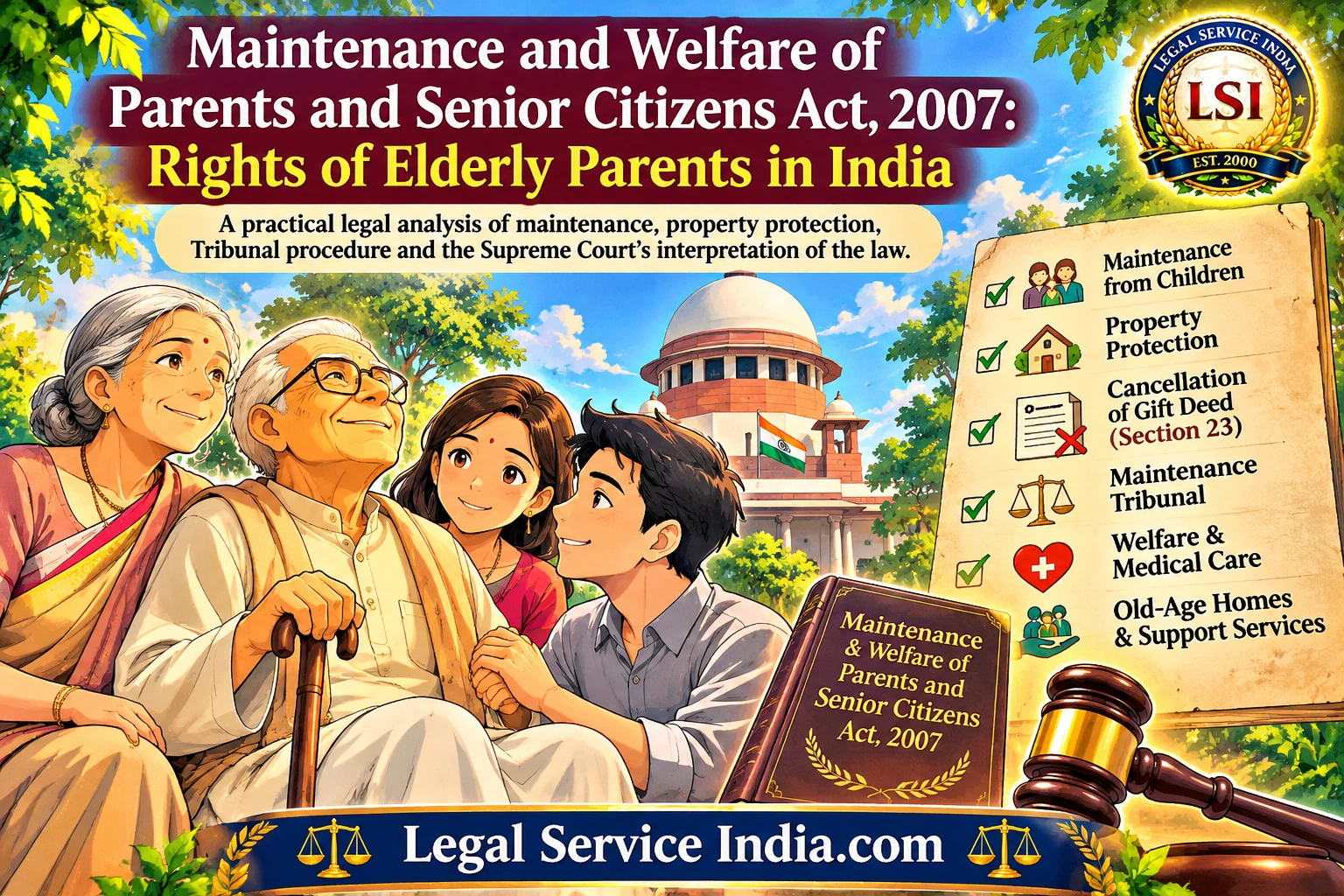
Legal Rights of Elderly Parents in India: Maintenance, Gift Deed Cancellation and Protection
A practical legal analysis of maintenance, property protection, Tribunal procedure and the Supreme Court’s interpretation of the law.
At a glance: The Act provides a statutory route for eligible parents and senior citizens who cannot maintain themselves to claim maintenance. It also addresses conditional property transfers, abandonment, welfare services, medical care and old-age homes. The exact procedure is governed by the Act and the applicable State Rules.
Introduction: When Children Forget Their Responsibility Towards Ageing Parents
Growing old should be a time of peace, security and dignity. After spending decades raising children, supporting families and often transferring hard-earned property to the next generation, some elderly parents find themselves facing neglect, financial insecurity, emotional harassment or abandonment. The situation can become particularly distressing where a parent transfers a house, land or other valuable asset in the expectation that the child will provide care and support in return.
Parliament enacted the Maintenance and Welfare of Parents and Senior Citizens Act, 2007 to provide a statutory framework for maintenance and welfare. The Act recognises that the responsibility to maintain eligible parents and senior citizens is not merely a moral expectation: in the circumstances specified by law, it is legally enforceable. It creates Maintenance Tribunals, provides for maintenance orders and addresses certain conditional transfers of property.
The legislation is not a universal mechanism for resolving every family or property dispute. Relief depends on statutory definitions, the applicant’s circumstances, the respondent’s legal relationship and means, the evidence, and the applicable State Rules. The following analysis explains the principal rights and the practical steps available.
1. Who Is Protected Under the Act?
Who is a senior citizen?
Section 2(h) defines a senior citizen as an Indian citizen who has attained the age of 60 years or above. The definition is not restricted by religion, caste or gender.
Can a parent below 60 claim maintenance?
Yes. Section 2(d) defines “parent” to include a father or mother, whether biological, adoptive or step-parent, whether or not the parent has attained 60 years. Therefore, a parent below 60 may seek maintenance under the Act if the requirements of Section 4 are satisfied—particularly inability to maintain oneself from one’s own earnings or property.
2. Who Can Be Required to Maintain a Parent or Senior Citizen?
Children
Section 2(a) includes son, daughter, grandson and granddaughter, but the obligation under Section 4 is imposed on children who are not minors. The duty is not confined to sons: daughters are included. The Tribunal can consider an application against one or more persons liable under the Act. Residence in another city or country does not, by itself, erase the statutory relationship or obligation, although service and enforcement may be more difficult in practice.
Relatives of a childless senior citizen
For a senior citizen who is childless, Section 2(g), read with Section 4, may place the obligation on a qualifying relative who is not a minor and who either possesses, or would inherit, the senior citizen’s property. Where more than one relative would inherit, liability is allocated in proportion to the inheritance share contemplated by the Act.
Important qualification: A claim is not automatic merely because a family relationship exists. Section 4 requires that the parent or senior citizen be unable to maintain himself or herself from earnings or property. The Tribunal also examines the needs of the applicant and the means of the person proceeded against.
3. What Does “Maintenance” Include?
Section 2(b) defines maintenance to include provision for food, clothing, residence and medical attendance and treatment. The concept is therefore broader than a cash contribution for groceries. Medical expenses, suitable accommodation and other basic needs may be relevant when the Tribunal assesses the claim and the appropriate allowance.
4. How to Apply Before the Maintenance Tribunal
Section 7 provides for maintenance tribunals, ordinarily constituted at the sub-divisional level. Section 8 contemplates a summary procedure. The object is to provide a comparatively accessible and less formal remedy than an ordinary civil suit, while still giving the respondent notice and an opportunity to be heard.
Who may file?
Under Section 5, an application may be made by the parent or senior citizen personally. If the person is incapable of making the application, another person or a registered voluntary organisation authorised by that person may apply. The Tribunal may also take cognisance suo motu.
Where should the application be filed?
Section 6 governs jurisdiction. Proceedings may be taken in a district where the parent or senior citizen resides or last resided, or in a district where the child or relative against whom maintenance is claimed resides. The section does not use “the parties last resided together” as a separate jurisdictional test. The applicant should confirm the appropriate tribunal and local filing practice under the applicable state rules.
Step-by-step procedure
- Prepare the application. State the applicant’s age, relationship with the respondent, income and assets, monthly needs, medical expenses, and the specific neglect or refusal to maintain.
- Identify the correct tribunal and state form. Check the State or Union Territory Rules, prescribed form, filing counter and local requirements.
- Attach supporting material. Provide identity and age proof, relationship documents, pension or bank records, medical papers, details of expenses and available evidence of the respondent’s means.
- Service of notice. The Tribunal issues a notice to the respondent and provides an opportunity to respond.
- Conciliation, where appropriate. The Tribunal may refer the matter for conciliation through the mechanism contemplated by the Act.
- Summary inquiry. If settlement is not achieved, the Tribunal conducts an inquiry and considers the parties’ evidence and circumstances.
- Interim or final order. The Tribunal may make an interim maintenance order during the proceedings and, after inquiry, determine the monthly allowance.
How long should the Tribunal take?
Section 5(4) provides that an application for a monthly allowance is to be disposed of within 90 days from the date of service of notice on the respondent. In exceptional circumstances, the Tribunal may extend the period once, by a maximum of 30 days, recording reasons in writing. This is a statutory timeline, not a guarantee that every case will conclude within that period irrespective of service or other procedural complications.
5. How Much Maintenance Can Be Awarded?
Section 9 empowers the Tribunal to order a monthly allowance where the statutory conditions are met. The amount is assessed in light of the applicant’s needs and circumstances and the respondent’s means. Section 9(2), as it stands in the Central Act, says that the maximum monthly allowance shall be such as the State Government may prescribe, subject to a ceiling of ₹10,000 per month.
The ceiling has been criticised as inadequate in light of inflation and healthcare costs. Nevertheless, a lawyer or applicant should not assume that a higher amount can be ordered under Section 9 contrary to the current statutory text. Check the applicable State Rules and any binding local judicial interpretation before advising on the amount.
Can a parent use another maintenance law?
Potentially, yes. Section 144 of the Bharatiya Nagarik Suraksha Sanhita, 2023 (BNSS), in force from 1 July 2024, empowers a Magistrate of the First Class to order maintenance for a father or mother who cannot maintain himself or herself where a person with sufficient means neglects or refuses to maintain them. It replaced the former Section 125 of the Code of Criminal Procedure, 1973. Section 144 does not reproduce the Senior Citizens Act’s ₹10,000 ceiling. The availability, forum, evidence, procedural consequences and interaction between remedies should be assessed before parallel or successive proceedings are commenced.
6. Can a Senior Citizen Cancel a Gift Deed? Section 23 Explained
Section 23 is an important property-protection provision, but it is not a general power to cancel every gift made to a child. Under Section 23(1), where a senior citizen has transferred property by gift or otherwise subject to a condition that the transferee will provide basic amenities and basic physical needs, and the transferee refuses or fails to do so, the transfer may, at the senior citizen’s option, be declared void by the Tribunal.
The statutory elements generally require attention to: (a) a transfer by the senior citizen after commencement of the Act; (b) a condition that the transferee would provide basic amenities and basic physical needs; (c) failure or refusal to fulfil that condition; and (d) the senior citizen’s election to seek the statutory declaration. Section 23(2) separately addresses enforcement of a senior citizen’s right to maintenance out of an estate transferred to another person in the circumstances stated there.
Supreme Court: Sudesh Chhikara v. Ramti Devi (2022)
In Sudesh Chhikara v. Ramti Devi, Civil Appeal No. 174 of 2021, decided on 6 December 2022, the Supreme Court explained that the two essential conditions under Section 23(1) must be established: the transfer must have been subject to the condition that the transferee provide basic amenities and basic physical needs, and the transferee must have refused or failed to provide them. Mere proof that property was transferred and the parent was later neglected does not, by itself, automatically invalidate an unconditional transfer.
Supreme Court: Urmila Dixit v. Sunil Sharan Dixit (2025)
In Urmila Dixit v. Sunil Sharan Dixit, Civil Appeal No. 10927 of 2024, 2025 INSC 20, decided on 2 January 2025, the Supreme Court applied a purposive approach to Section 23. The record included both the gift deed and a contemporaneous undertaking/promissory document concerning the mother’s maintenance. The Court held that the conditions identified in Sudesh Chhikara must be interpreted in a manner that advances the beneficial purpose of the Act, rather than so narrowly as to defeat it. The Court also clarified that a Tribunal exercising jurisdiction under Section 23 may direct transfer of possession where warranted; it is not correct to say that the Tribunal can never order possession.
Practical property advice: Before transferring a house or other asset, obtain independent legal advice. If the transfer is intended to be conditional upon food, residence, medical care or other support, record the obligation clearly in the registered instrument and, where appropriate, in a contemporaneous written undertaking. Preserve the documents and evidence of subsequent breach.
7. Eviction and the Rights of Other Residents: S. Vanitha
In S. Vanitha v. Deputy Commissioner, Bengaluru Urban District, Civil Appeal No. 3822 of 2020, 2020 INSC 701, decided on 15 December 2020, the Supreme Court considered proceedings under the Senior Citizens Act alongside a woman’s right of residence under the Protection of Women from Domestic Violence Act, 2005. The Court held that the two welfare statutes must be harmoniously construed. A residence claim under the Domestic Violence Act cannot simply be defeated by obtaining an eviction order under the Senior Citizens Act without considering the competing statutory rights.
The decision does not mean that a senior citizen can never seek protection or eviction-related relief. It means the Tribunal and reviewing court must examine the facts, the source and nature of the claimed residence right, and the applicable statutes rather than applying an automatic rule in favour of either side.
8. Abandonment of a Senior Citizen Can Be a Criminal Offence
Section 24 addresses a person who has the care or protection of a senior citizen and leaves that senior citizen in any place with the intention of wholly abandoning them. The punishment may extend to imprisonment for three months, a fine up to ₹5,000, or both. The statutory requirement of intention to wholly abandon is significant: every family disagreement, temporary stay elsewhere or failure to provide a particular service will not automatically establish this offence. Section 25 states that offences under the Act are cognizable and bailable and are to be tried summarily by a Magistrate.
9. Welfare Measures Beyond Monthly Maintenance
| Provision | Subject | What it provides |
|---|---|---|
| Section 18 | Maintenance Officers | State designation of Maintenance Officers to assist parents and senior citizens, including in proceedings as contemplated by the Act. |
| Section 19 | Old-age homes | State responsibility to establish and maintain old-age homes, beginning with at least one in each district for indigent senior citizens, subject to the statutory requirements. |
| Section 20 | Medical care | Measures for government hospitals and healthcare facilities, including beds, separate queues and facilities for chronic, geriatric and age-related needs. |
| Section 21 | Public awareness | Publicity and awareness measures to inform senior citizens of their rights and available services. |
The existence of these provisions does not mean that every service is uniformly available in every district. Their practical effectiveness depends on implementation by the relevant State or Union Territory authorities.
10. Appeal, Enforcement and High Court Remedies
Appeal under Section 16
A parent or senior citizen aggrieved by an order of the Maintenance Tribunal may ordinarily appeal to the Appellate Tribunal within 60 days from the date of the order. The Appellate Tribunal may condone delay if sufficient cause is shown. Section 16 also provides that a respondent required to pay maintenance must continue paying the amount ordered while the appeal is pending, in the manner directed by the Appellate Tribunal. The statutory appeal is framed for the parent or senior citizen; do not assume that the child/respondent has an identical appeal right under Section 16.
Enforcement of a maintenance order
Section 5(8) provides a recovery mechanism if the person ordered to pay maintenance fails, without sufficient cause, to comply. The Tribunal may issue a warrant for recovery in the manner provided for levying fines and may impose imprisonment up to one month, or until payment if sooner. An application for recovery must be made within three months from the date the amount became due, as specified in the proviso. Keep a month-wise statement of arrears and apply promptly.
Can the High Court be approached?
In an appropriate case, a party may invoke the High Court’s constitutional jurisdiction under Article 226, for example where there is a jurisdictional error, a serious breach of natural justice or another recognised public-law ground. Writ jurisdiction is discretionary and is not ordinarily a substitute for the statutory appeal or a routine re-hearing of facts. The available remedy and whether an alternative remedy should first be used depend on the case.
11. Can an Advocate Appear Before the Maintenance Tribunal?
Section 17 states that no party to a proceeding before a Maintenance Tribunal or Appellate Tribunal shall be represented by a legal practitioner. The provision is intended to keep the process accessible and less formal. There have been differing High Court approaches to the interaction between Section 17 and the right of advocates to practise under Section 30 of the Advocates Act, 1961. The position should therefore be checked in the relevant State and before the particular Tribunal. It would be unsafe to state that advocates are routinely permitted, or that one High Court’s approach automatically governs all States.
Even where formal appearance by an advocate is restricted, legal assistance before filing may help with identifying the correct forum, preparing the application, organising evidence, reviewing property documents and understanding appeal or enforcement options. A party should not misrepresent drafting assistance as a right of audience before the Tribunal.
12. Documents to Keep Ready
- Age and identity: Aadhaar, passport, voter identity card, birth certificate or other accepted proof.
- Relationship: Birth/adoption records, school documents, family records or other reliable evidence.
- Financial position: Pension details, bank statements, income records, property and asset details, and regular expenses.
- Respondent’s means: Available information about employment, business, income or assets; do not obtain it unlawfully.
- Medical needs: Prescriptions, diagnosis, hospital records, bills and estimates of recurring treatment.
- Property transfer: Registered gift deed, conveyance, settlement deed, contemporaneous undertaking and possession records.
- Neglect or refusal: Messages, letters, notices, complaint records, bank transfers or other lawful evidence.
- Address and service details: Current addresses and contact details needed for notice, subject to applicable filing rules.
The Tribunal may call for additional documents under the applicable State Rules. Submit copies as required and retain originals safely unless the Tribunal directs otherwise.
13. Twelve Important Legal Points: A Quick Checklist
- Parents below 60 may qualify because “parent” is not age-limited, subject to Section 4.
- Senior-citizen status under Section 2(h) begins at 60 years for an Indian citizen.
- Eligible non-minor sons, daughters, grandsons and granddaughters may be liable; the obligation is not limited to sons.
- A qualifying relative may be liable for a childless senior citizen under the statutory property/inheritance test.
- Maintenance includes food, clothing, residence and medical attendance and treatment.
- Applications may be made by the parent/senior citizen, an authorised person or registered voluntary organisation where the applicant is incapable, or the Tribunal may act suo motu.
- The 90-day disposal period runs from service of notice and may be extended once by up to 30 days for recorded exceptional reasons.
- Section 9(2) currently contains a ₹10,000 monthly ceiling under the Central Act, subject to the prescribed State amount.
- Section 23 is not an automatic cancellation rule: a qualifying maintenance condition attached to the transfer and its breach must be established.
- Sudesh Chhikara (2022) explains the Section 23 requirements; Urmila Dixit (2025) directs a purposive interpretation and confirms that possession may be ordered in an appropriate Section 23 case.
- S. Vanitha (2020) requires harmonious consideration of senior citizens’ remedies and a woman’s residence rights under the Domestic Violence Act.
- Appeal, recovery, abandonment, welfare and representation are governed by distinct provisions; limitation periods and local State Rules must be checked carefully.
14. Frequently Asked Questions
Can parents below 60 years approach the Maintenance Tribunal?
Yes. The definition of “parent” in Section 2(d) does not require the parent to be 60. The applicant must still satisfy the conditions for maintenance under Section 4.
Can a daughter be directed to maintain her parents?
Yes. The Act includes daughters as children. Liability depends on the statutory conditions and the facts of the case.
Can I cancel a gift deed because my child is not looking after me?
Not automatically. Section 23 requires a qualifying condition attached to the transfer that the transferee provide basic amenities and basic physical needs, followed by refusal or failure. The documents and evidence matter.
Can the Tribunal direct a child to hand back possession?
In an appropriate Section 23 case, yes. Urmila Dixit (2025) clarifies that a Tribunal exercising Section 23 jurisdiction is not barred from directing transfer of possession where warranted.
Can a senior citizen evict a daughter-in-law?
There is no automatic answer. The Tribunal must consider the circumstances and any competing legal rights. S. Vanitha requires harmonious consideration of the Senior Citizens Act and the Domestic Violence Act.
Does the Act apply if a child lives overseas?
Residence abroad does not itself create a general exemption from the statutory obligation. However, service of process, jurisdiction and enforcement may raise practical and legal issues that require case-specific advice.
Do I have to hire a lawyer?
The Act permits a parent or senior citizen to apply personally, and Section 17 restricts representation by a legal practitioner before the Tribunal and Appellate Tribunal. The local legal position should be checked. Assistance with preparing documents and understanding the law may still be useful.
Can I also claim maintenance under BNSS Section 144?
Section 144 BNSS provides a separate maintenance remedy for a father or mother unable to maintain himself or herself, subject to its conditions. A lawyer should assess the appropriate forum and the interaction of remedies before filing.
Conclusion: The Right to Live with Dignity Does Not End with Old Age
The Maintenance and Welfare of Parents and Senior Citizens Act, 2007 recognises that ageing parents should not be left without support after a lifetime of caring for their families. It provides legal routes to seek maintenance, protect certain conditional property transfers, address abandonment and obtain welfare assistance. The Act is most effective when its provisions are understood accurately and invoked with proper documents, within the applicable time limits and before the correct authority.
For parents considering transferring property, the most important practical lesson is to document any promise of care and maintenance clearly before signing. For parents already facing neglect, early advice and a properly prepared application can help avoid delay and preserve evidence. Above all, the law seeks to protect not merely a monthly payment, but the dignity, security and independence of older persons.
⚖️ Are Your Children Neglecting You? Know Your Legal Rights Before It Is Too Late.
Your lifetime of love, sacrifice and financial support deserves dignity and respect. The law does not expect senior citizens to suffer silently.
If your children or legal heirs are neglecting you, refusing to provide maintenance, denying you financial support, or attempting to take possession of property transferred by you, you may have legal remedies under the Maintenance and Welfare of Parents and Senior Citizens Act, 2007.
What Legal Remedies May Be Available to You?
You may be entitled to:
- Seek maintenance from your children or legally responsible relatives.
- Approach the Maintenance Tribunal for appropriate relief.
- Challenge certain property transfers made subject to the condition of providing care and basic amenities.
- Seek legal remedies against abandonment, neglect or exploitation.
- Protect your right to live with dignity and security.
Do not wait until the situation becomes unbearable. Early legal advice can help you understand your rights, preserve important evidence and take the appropriate legal steps.
Consult Adv. Tarun Choudhury
Supreme Court Advocate | 25+ Years of Legal Experience
For legal guidance concerning senior citizens’ maintenance, property disputes, cancellation of gift deeds, Maintenance Tribunal proceedings and protection of elderly parents’ rights, contact:
- 📞 Call: 9650499965
- 💬 WhatsApp: 8851978611
- ✉️ Email: [email protected]
Legal Service India – Serving the legal community and public since 2000.
Your dignity matters. Your rights deserve to be protected.
Legal Disclaimer
This article is for general legal information and is not a substitute for advice on the facts of an individual case. The Act, applicable State/UT Rules, subsequent notifications and binding judgments should be checked as on the date of filing. Tribunal procedure and implementation may vary by State or Union Territory.