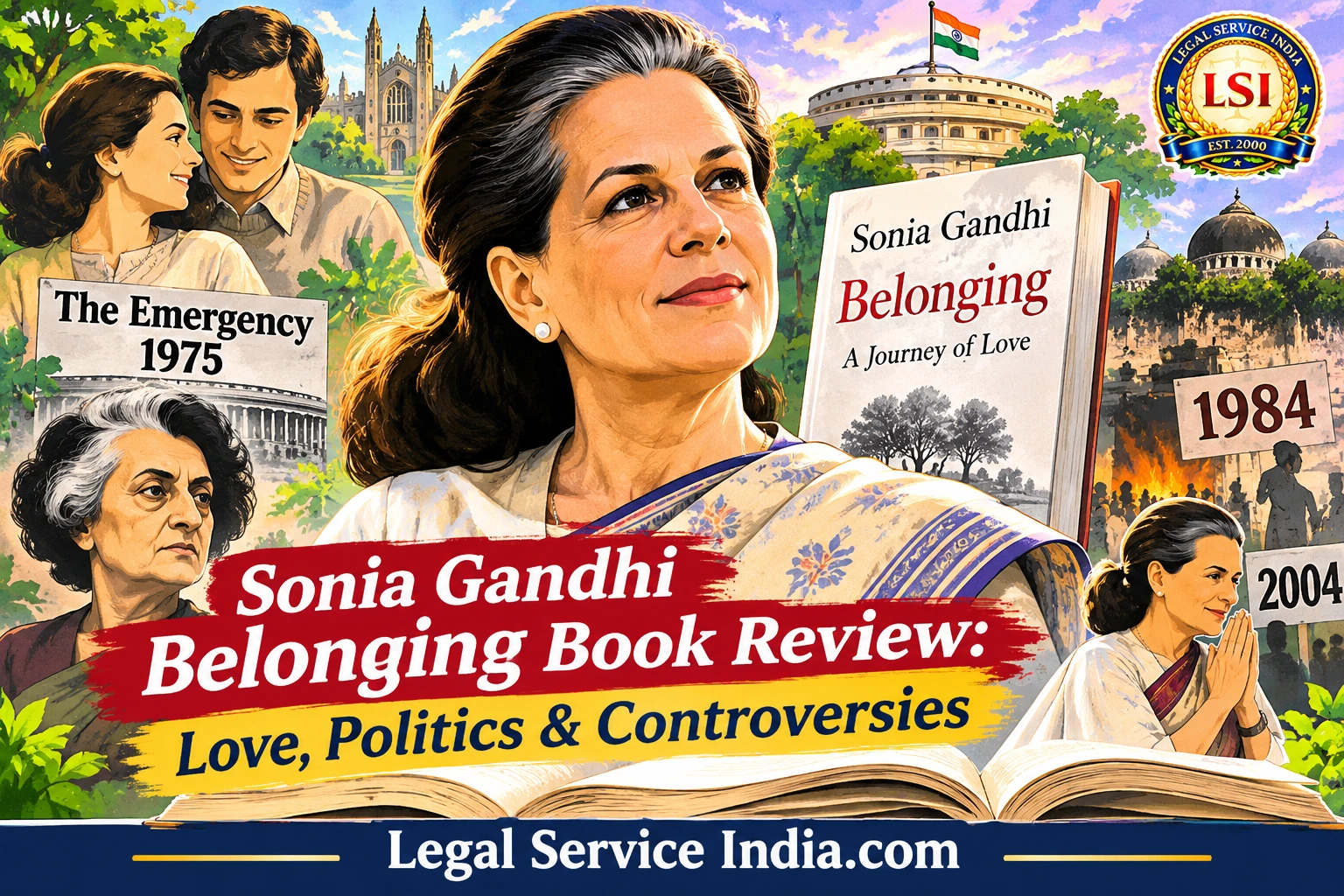
Sonia Gandhi’s Belonging: A Journey of Love – A Book Review of Love, Power and Indian Politics
Few individuals in contemporary Indian politics have attracted as much attention, criticism, admiration and curiosity as Sonia Gandhi. For decades, she remained one of the most influential yet personally reserved figures in Indian public life. Now, with her memoir, Belonging: A Journey of Love, she has chosen to tell her story in her own words.
This Sonia Gandhi Belonging book review examines the personal revelations, political recollections, historical controversies and emotional experiences contained in the memoir. It also considers the reactions of reviewers, political commentators and leaders across the political spectrum.
Released on 10 November 2026, the 544-page memoir has already generated considerable public interest. It is not merely a story about a woman who married into India’s most recognisable political family. It is also an account of love, bereavement, political power, family relationships and the extraordinary transformation of Indian politics over several decades.
Interested in reading Sonia Gandhi’s memoir?

Belonging: A Journey of Love
By Sonia Gandhi
This article contains an affiliate link. We may earn a commission from qualifying purchases at no additional cost to the buyer.
Belonging: A Journey of Love – Book Details
| Particulars | Details |
|---|---|
| Book Title | Belonging: A Journey of Love |
| Author | Sonia Gandhi |
| Genre | Memoir / Political Autobiography |
| Indian Publisher | HarperCollins India |
| International Publisher | Alfred A. Knopf |
| UK Publisher | William Collins |
| Publication Date | 10 November 2026 |
| Length | 544 pages (hardcover) |
Why Sonia Gandhi’s Memoir Matters
Sonia Gandhi has occupied a unique position in India’s political landscape. She entered the Nehru-Gandhi family through her marriage to Rajiv Gandhi in 1968, long before she became the president of the Indian National Congress.
Her journey took her from Italy to India, from private family life to the centre of national politics, and from personal tragedy to extraordinary political responsibility.
Yet, unlike many public figures, she has generally avoided extensive personal interviews and public explanations of her private experiences.
That is precisely why this memoir deserves attention. For the first time, readers have an extended opportunity to understand how she remembers the events that shaped her life and influenced India’s political history.
However, a memoir by a major political personality cannot be approached as an entirely neutral historical record. The author’s memories, interpretations and personal loyalties inevitably influence the narrative. Readers must distinguish between personal recollection, historically established facts and political interpretation.
From Italy to India: The Personal Story Behind the Politics
One of the most engaging aspects of the book is its account of Sonia Gandhi’s early life.
The narrative begins in post-war Italy and moves to Cambridge in 1965, where the nineteen-year-old Sonia Maino met Rajiv Gandhi.
Their relationship eventually led to marriage in 1968 and her relocation to India.
For a young woman entering an unfamiliar country, the adjustment involved much more than changing residence. She had to adapt to a different language, culture, food, family structure and social environment.
Her relationship with Indira Gandhi also occupies an important place in the memoir.
These passages are particularly significant because they offer a personal perspective on a family that has been at the centre of Indian public life for generations.
Love, Loss and Tragedy: The Human Side of a Political Family
Perhaps the most emotionally powerful portions of the memoir concern personal loss.
Sonia Gandhi writes about the death of her first child, the assassination of Indira Gandhi, the death of Sanjay Gandhi and, ultimately, the assassination of her husband, Rajiv Gandhi, in 1991.
These events were not simply political turning points. They were devastating personal experiences.
The memoir also describes the discovery of grenades in a room of the family residence following Operation Blue Star in 1984, illustrating the atmosphere of fear and insecurity surrounding the family during that period.
Her account of cancer treatment adds another personal dimension to the narrative.
These recollections help readers understand the human experiences behind the public image of a political leader.
The Emergency: An Admission That Invites Difficult Questions
One of the most politically significant aspects of the memoir concerns the emergency declared on 25 June 1975 under Article 352 of the Constitution of India.
Sonia Gandhi describes the Emergency as a mistake and a dark chapter in India’s history.
She recalls differences within the family, including Rajiv Gandhi’s opposition to the measure and Sanjay Gandhi’s support for it.
She also suggests that restraining Sanjay Gandhi could have prevented much of the subsequent damage.
These recollections raise important questions.
Can responsibility for the emergency be understood primarily through disagreements within one political family? What about the constitutional institutions, civil servants, political opponents and ordinary citizens who experienced its consequences?
The Emergency involved the suspension of fundamental rights, political detentions, press censorship and serious violations of democratic freedoms.
A personal memoir can explain how someone close to the political leadership remembers that period. It cannot, by itself, provide a complete assessment of institutional responsibility.
This is where readers should supplement the memoir with independent historical and constitutional accounts.
Operation Blue Star, 1984, and the Difficult Question of Political Responsibility
The memoir also revisits Operation Blue Star, the assassination of Indira Gandhi and the anti-Sikh violence that followed in 1984.
Sonia Gandhi describes the emotional impact of Operation Blue Star and recounts her memories of the events surrounding Indira Gandhi’s death.
She characterises the subsequent anti-Sikh violence as a tragic and shameful chapter.
Her account attempts to distinguish Rajiv Gandhi’s personal feelings from the breakdown of effective governance during that period.
However, these are matters of considerable historical and legal significance.
Some aspects of her account, particularly concerning the sequence of events and the Army’s deployment, have attracted criticism and been challenged by other commentators.
A reader must therefore approach these chapters with an open but questioning mind.
Babri Masjid, 2004 and the Politics of Power
Two other important subjects in the memoir are the demolition of the Babri Masjid on 6 December 1992 and Sonia Gandhi’s decision in 2004 not to become prime minister.
She describes the emotional impact of watching the Babri Masjid demolition and views it as a significant turning point in Indian politics.
Her account of the 2004 political transition is particularly interesting.
Following the Congress-led alliance’s electoral victory, Sonia Gandhi emerged as the obvious political choice for the prime minister’s office. She ultimately declined the position and supported Manmohan Singh as Prime Minister.
In the memoir, she refers to an inner voice, discussions with her children and pressure from alliance leaders before making her final decision.
This episode has been debated for years. Her account provides an opportunity to understand how she remembers that decision, although it does not eliminate the wider political debate surrounding the episode.
What Do Reviewers and Political Commentators Think?
The early reactions to Belonging: A Journey of Love have been divided. Some commentators have welcomed the personal narrative, while others have questioned the historical selectivity of certain political recollections.
The Appreciative View: A Personal Story of Love and Loss
Vir Sanghvi’s commentary in ThePrint highlights the memoir’s character as a love story, particularly its treatment of the relationship between Sonia and Rajiv Gandhi and its portrayal of Indira Gandhi.
Other appreciative reviews have noted the value of the intimate family recollections and the emotional dimension of the early chapters.
For readers interested in understanding the private experiences of a woman who spent much of her life in the public eye, these sections are likely to be the most rewarding.
The Critical View: Selective Memory or Political Defence?
The critical response focuses primarily on the memoir’s treatment of political responsibility.
Some reviewers argue that the book is more forthcoming about family relationships and personal grief than it is about difficult questions concerning Congress leadership, the Emergency and the political decisions of the Nehru-Gandhi family.
Other commentators have described portions of the political narrative as defensive. They question whether the memoir examines historical controversies with sufficient distance and self-criticism.
These criticisms should not be dismissed merely because they come from political opponents. Equally, they should not automatically invalidate the personal experiences described by the author.
Why Has the Book Provoked Such Strong Political Reactions?
The publication has produced sharply contrasting responses from India’s political establishment.
What the BJP Says
BJP spokesperson C.R. Kesavan criticised the memoir and suggested that its title should have been “Whitewashing” rather than “Belonging”.
Other BJP leaders have questioned its treatment of the Emergency, the events of 1984 and the decision not to accept the Prime Minister’s office in 2004.
What the Congress Says
Congress leaders have defended the memoir as Sonia Gandhi’s personal account of her life. Rahul Gandhi has publicly praised the book, while Sam Pitroda has argued that the author has the right to tell her own story.
Other Political Voices
The Aam Aadmi Party has questioned certain recollections, particularly those concerning Indira Gandhi’s feelings after Operation Blue Star.
The controversy illustrates a larger problem with political memoirs: the same recollection can be interpreted as an honest admission by one reader and an attempt at image management by another.
The Publishing Controversy: Why Did Penguin Step Back?
Interestingly, the book generated controversy even before its publication.
Penguin Random House India was initially associated with the publishing arrangement, but discussions eventually reached an impasse. HarperCollins India subsequently announced that it would publish the Indian edition.
The disagreement attracted considerable attention because Congress leaders alleged that political pressure was involved.
Penguin denied external pressure and stated that the circumstances surrounding the publishing decision were not accurately represented by some of the claims being made.
The precise nature of the disputed editorial issue has not been publicly established through a mutually accepted account.
Consequently, the controversy should be understood as a dispute involving competing claims rather than proof of government intervention.
My Assessment: Strengths and Weaknesses of the Memoir
What Makes the Book Worth Reading?
- A rare personal perspective: The memoir offers an extended first-person account from someone who witnessed several decades of India’s political transformation.
- Emotional depth: The passages dealing with marriage, family, bereavement and personal suffering provide a human dimension to an otherwise political narrative.
- Historical significance: The book revisits important events including the Emergency, Operation Blue Star, the 1984 anti-Sikh violence and the 2004 political transition.
- Political admissions: Her description of the Emergency as a mistake and her criticism of Congress complacency make the memoir particularly interesting.
- Understanding political relationships: The family portraits offer insight into relationships that influenced Indian politics for generations.
Where Does the Memoir Leave Questions Unanswered?
- Some historical episodes are presented primarily through personal recollection rather than extensive documentary examination.
- The political narrative has been criticised for insufficient examination of institutional responsibility.
- Readers seeking a comprehensive history of the Emergency or the 1984 violence will need to consult independent historical works.
- Certain recollections concerning political decisions and events have been challenged by other public accounts.
Is Sonia Gandhi’s Belonging Worth Reading?
The answer depends largely on what a reader expects from a political memoir.
If you are looking for a comprehensive and impartial history of the Congress party, the Emergency or India’s political institutions, this book alone will not meet that expectation.
However, if you want to understand how Sonia Gandhi remembers her life, her relationship with Rajiv Gandhi, her experiences within the Nehru-Gandhi family and her interpretation of major political events, the memoir deserves a place on your reading list.
Students of political science, constitutional law, modern Indian history and public affairs may also find it useful as a primary personal account that can be compared with other historical sources.
Its greatest value may lie not in providing the final word on India’s political history, but in adding another important voice to an ongoing national conversation.
Read the Memoir and Form Your Own Opinion
Whether you agree with Sonia Gandhi’s political interpretations or disagree with them, the memoir offers an opportunity to examine her account firsthand rather than relying entirely on political commentary.
Explore Belonging: A Journey of Love by Sonia Gandhi. View Book on Amazon
Final Verdict: A Memoir That Deserves Attention, But Also Critical Reading
This Sonia Gandhi Belonging book review arrives at a straightforward conclusion: Belonging: A Journey of Love is an important political memoir, but it should not be mistaken for a definitive historical account.
Its strongest contribution is the personal narrative. The story of a young Italian woman who entered one of India’s most influential political families, experienced extraordinary personal tragedies and eventually became a central figure in national politics is undoubtedly compelling.
Its more controversial contribution is the attempt to interpret events that remain deeply contested in India’s political memory. The Emergency, the violence of 1984, the Babri Masjid demolition and the 2004 Prime Ministerial transition are not merely family memories. They are matters of national history and public accountability.
A reader should neither accept every recollection uncritically nor reject the entire memoir because of political disagreement with its author.
The best approach is to read it with curiosity, compare its claims with independent historical accounts and form an informed opinion.
Ultimately, the book is worth reading precisely because it invites questions about memory, power, responsibility and the way political history is told.
Want to Read Sonia Gandhi’s Memoir?
Discover the personal story behind decades of Indian political history.
Belonging: A Journey of Love
By Sonia Gandhi
Purchases through this affiliate link may earn us a commission at no extra cost to you.
Frequently Asked Questions
1. What is Belonging: A Journey of Love about?
It is Sonia Gandhi’s memoir covering her early life in Italy, marriage to Rajiv Gandhi, her experiences within the Nehru-Gandhi family, personal tragedies and major developments in Indian politics.
2. When was Sonia Gandhi’s memoir released?
Belonging: A Journey of Love was released on 10 November 2026.
3. Who published Belonging in India?
HarperCollins India is the Indian publisher. Alfred A. Knopf handles the international edition, with William Collins publishing the UK edition.
4. What does Sonia Gandhi say about the Emergency?
She describes the Emergency as a mistake and a dark chapter in India’s history. She also discusses differences within the family concerning the decision.
5. Does the memoir explain why Sonia Gandhi declined to become Prime Minister in 2004?
Yes. She discusses her personal reflections, conversations with her children and the circumstances surrounding her decision to support Manmohan Singh instead.
6. Is Belonging a political book or a personal memoir?
It is primarily a personal memoir, but its treatment of important political events makes it relevant to readers interested in contemporary Indian political history.
7. Is Sonia Gandhi’s Belonging worth reading?
Readers interested in Indian politics, the Nehru-Gandhi family and the personal experiences behind major historical events may find it valuable. It is best read alongside independent historical accounts.
About the Author
Adv. Tarun Choudhury is a Supreme Court Advocate with over 25 years of legal experience. He writes on constitutional law, legal developments, public affairs and issues of national importance at Legal Service India.