




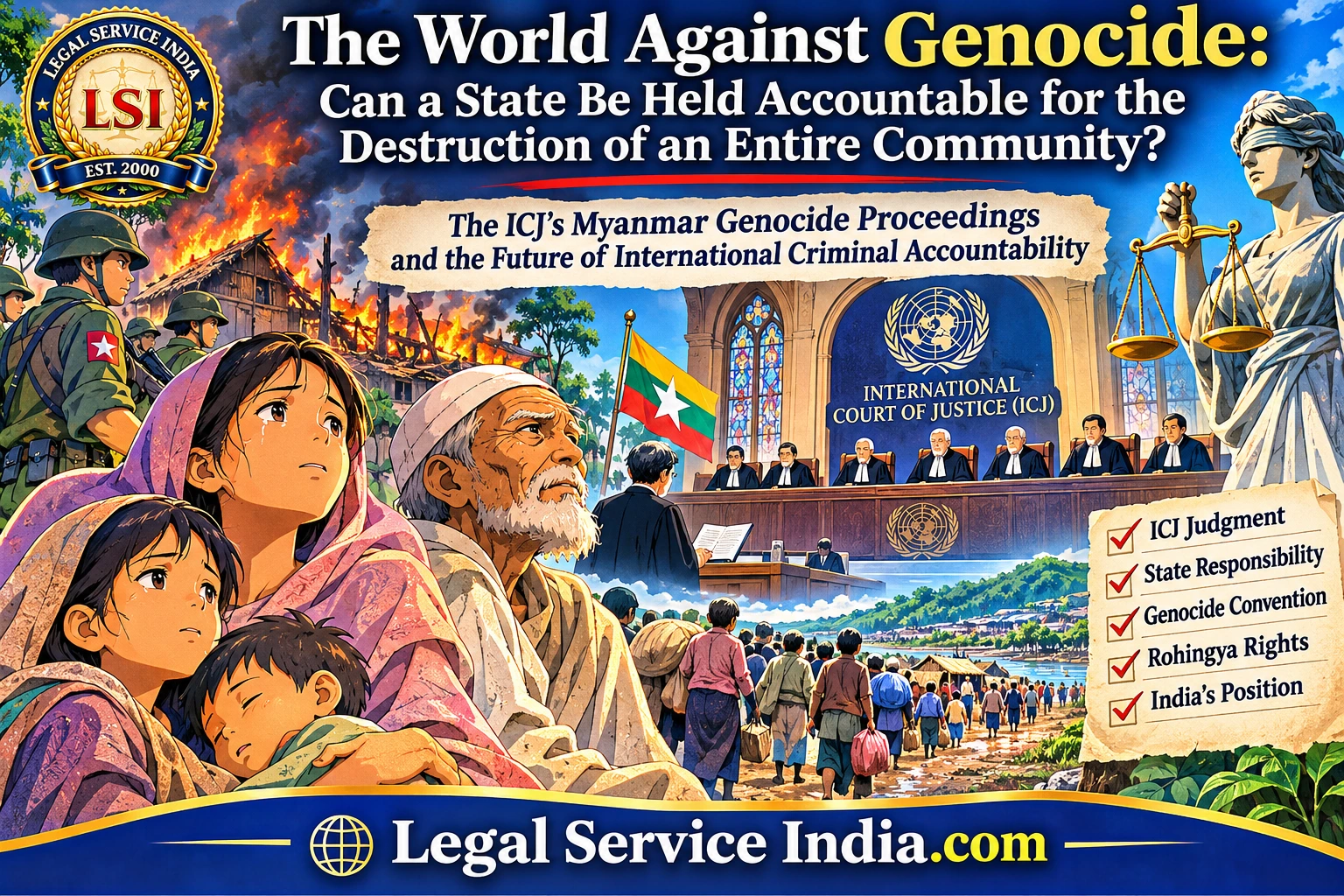
Myanmar Genocide Judgment 2026: Historic ICJ Ruling Explained
The ICJ’s Myanmar Genocide Proceedings and the Future of International Criminal Accountability
The Story – A Community Without a Homeland
On the morning of 30 August 2017, soldiers from Myanmar’s 99th Light Infantry Division entered Min Gyi, also known as Tula Toli, in Maungdaw Township, Rakhine State.
They separated men from women and children. Men were executed. Women and girls were subjected to widespread sexual violence. Civilians, homes and bodies were burned. The neighbouring settlement inhabited by the Rakhine ethnic community was left largely untouched.
The incident was not an isolated episode. Similar operations took place in Chut Pyin, Maung Nu, Inn Din and other Rohingya settlements across northern Rakhine State.
By the time the military operations had unfolded, approximately 700,000 Rohingya had fled across the border into Bangladesh. Families were separated, villages destroyed and an entire community uprooted from the land on which generations had lived.
These events would eventually become the subject of one of the most consequential international legal proceedings of the twenty-first century.
How a Community Became Stateless
The Rohingya are a predominantly Muslim ethnic community with deep historical connections to the region now known as Rakhine State.
For decades, they experienced discrimination, restrictions on movement and progressive exclusion from Myanmar’s political and social institutions.
A particularly consequential development was the Citizenship Law of 1982.
The legislation created a citizenship framework based on recognised national ethnic groups and demanding documentary requirements. The Rohingya were effectively excluded from recognition as a national ethnic group, leaving many unable to establish citizenship.
The consequences extended beyond the absence of passports.
Restrictions affected marriage, childbirth registration, education, healthcare, employment and freedom of movement.
A population that had lived in the country for generations increasingly found itself without secure legal recognition.
The 2017 Clearance Operations
On 25 August 2017, the Arakan Rohingya Salvation Army (ARSA) launched coordinated attacks against security force outposts.
Myanmar’s military responded with what it described as clearance operations.
However, the subsequent violence extended far beyond the immediate security response. United Nations investigators documented widespread killings, sexual violence, destruction of settlements and forced displacement.
The distinction between counter-insurgency and attacks directed against civilians became central to the international investigation.
The question was not simply whether military operations had occurred or whether human rights violations had taken place.
It was whether prohibited acts had been committed with the specific intention of destroying the Rohingya, in whole or in part, as a protected group.
Why The Gambia Approached the ICJ
On 11 November 2019, The Gambia instituted proceedings against Myanmar before the International Court of Justice.
Supported by the Organisation of Islamic Cooperation (OIC), The Gambia invoked the 1948 Genocide Convention.
Its action was legally significant because The Gambia did not need to establish that its own citizens had suffered the alleged atrocities.
The Convention creates obligations owed by every State party to all other States parties. These are known as erga omnes partes obligations.
Every State party has a common legal interest in preventing and punishing genocide.
On 23 January 2020, the ICJ ordered provisional measures requiring Myanmar to prevent acts falling within Article II of the Convention and preserve relevant evidence.
Eleven States subsequently intervened under Article 63 of the ICJ Statute.
On 19 November 2026, the Court delivered its final judgment on the merits.
By nine votes to six, it found that Myanmar had committed genocide against the Rohingya group in northern Rakhine State during the 2017 clearance operations.
It was the first time the ICJ had found a State responsible for committing genocide.
The judgment marked a significant development in international law: sovereignty could not shield a State from judicial findings of responsibility for the destruction of a protected community.
The Law – When International Law Confronts Genocide
The legal foundation of the proceedings is the Convention on the Prevention and Punishment of the Crime of Genocide, adopted by the United Nations General Assembly on 9 December 1948.
The Convention recognises genocide as an international crime and creates obligations to prevent and punish it.
Understanding Article II
Article II defines genocide through five categories of prohibited acts committed with the intention of destroying, in whole or in part, a national, ethnical, racial or religious group.
These are:
- Killing members of the protected group.
- Causing serious bodily or mental harm.
- Deliberately inflicting conditions of life calculated to bring about physical destruction.
- Imposing measures intended to prevent births within the group.
- Forcibly transferring children of the group to another group.
The existence of mass killings or widespread violence does not automatically establish genocide.
The law requires proof of a specific intention to destroy the protected group as such.
This is known as dolus specialis.
Why Genocidal Intent Is Difficult to Establish
Perpetrators rarely leave behind written instructions explicitly declaring an intention to destroy an ethnic or religious community.
Courts must therefore examine circumstantial evidence.
Relevant considerations include:
- Systematic targeting of a particular community.
- Statements and propaganda by political or military leaders.
- The nature and scale of violence.
- Patterns of sexual violence.
- Destruction of homes and settlements.
- Measures restricting reproduction.
- The selection of victims because of their group identity.
The ICJ has traditionally applied the test that genocidal intent inferred from circumstantial evidence must be the only reasonable inference from the evidence as a whole.
In its 2026 Myanmar judgment, the Court clarified that genocidal intent may coexist with other objectives.
For example, a military operation may have a stated counter-insurgency purpose while also being conducted with genocidal intent.
The existence of another military or political objective does not automatically exclude genocide.
The Importance of Articles I, III, IV, V and IX
Article I requires States to prevent and punish genocide.
Article III identifies punishable acts beyond completed genocide, including conspiracy, direct and public incitement, attempt and complicity.
Article IV establishes that persons committing genocide may be punished regardless of their constitutional position or official status.
Article V requires States to enact the necessary domestic legislation and provide effective penalties.
Article IX provides the jurisdictional basis for submitting disputes concerning the interpretation, application or fulfilment of the Convention, including disputes concerning State responsibility for genocide, to the ICJ.
State Responsibility Versus Individual Criminal Responsibility
International law recognises two distinct forms of accountability.
| Type of Accountability | Meaning |
|---|---|
| State Responsibility | The ICJ determines whether a State has violated its international obligations. |
| Individual Criminal Responsibility | Competent national courts and international criminal tribunals determine whether particular individuals are guilty of international crimes. |
The distinction is fundamental.
A State may be held internationally responsible even when no individual has yet been convicted.
Similarly, an individual conviction does not automatically establish the international responsibility of the State.
The International Court of Justice and the International Criminal Court therefore perform different but complementary functions.
The Legal Question – Can an Entire State Be Held Accountable?
The 19 November 2026 judgment provides a decisive answer: a State can be held internationally responsible for genocide.
The Court examined whether the conduct of Myanmar’s security forces constituted genocide and whether the required special intent could be established from the evidence.
What Did the Court Actually Find?
By nine votes to six, the Court found Myanmar responsible for committing genocide against the Rohingya.
It established three categories of prohibited acts:
- Article II(a): Killing members of the Rohingya group.
- Article II(b): Causing serious bodily or mental harm, including through widespread sexual violence and attacks on children.
- Article II(d): Imposing measures intended to prevent births within the group.
The Court did not find the material element under Article II(c) established in the specific context of the 2017 clearance operations.
This distinction is important. The Court did not need to establish all five categories of prohibited acts to find genocide.
How Did the Court Establish Intent?
The Court considered the historical treatment of the Rohingya, discriminatory laws and policies, anti-Rohingya hate speech, the selective targeting of villages, the systematic character of the violence and the destruction of community life.
It concluded that genocidal intent was the only reasonable inference from the totality of the evidence.
The judgment also addressed the argument that the military operations could be explained by counter-insurgency or forcible displacement.
The Court clarified that the existence of additional objectives does not necessarily displace genocidal intent.
The judgment contains joint dissenting opinions and several separate opinions and declarations, reflecting significant judicial disagreement over aspects of the evidence and legal reasoning.
Myanmar’s Additional Violations
The Court also found that Myanmar had:
- Failed to prevent genocide by individuals acting alongside its security forces.
- Failed to fulfil its obligation to punish genocide and other acts enumerated under Article III.
- Failed to enact the necessary domestic legislation.
- Violated its obligation to preserve evidence under the provisional measures order of 23 January 2020.
The Court did not, however, find that Myanmar had directly and publicly incited genocide by private persons against the Rohingya.
This distinction demonstrates the importance of examining each treaty obligation independently.
What Remedies Can the ICJ Impose?
The ICJ cannot imprison military commanders or impose criminal sentences.
Its remedies concern the international legal responsibility of States.
The Court ordered Myanmar to:
- Enact legislation giving full effect to the Genocide Convention.
- Investigate persons reasonably suspected of committing relevant acts and prosecute and punish them where warranted.
- Provide assurances and guarantees of non-repetition.
- Adopt restitution measures, including facilitating the safe, voluntary and dignified return of displaced Rohingya and family reunification.
- Restore or replace lost or damaged property.
- Compensate the Rohingya group and its members for damage not remedied through restitution.
The amount and modalities of compensation remain for a subsequent phase.
Myanmar must submit a report to the Court within two years.
The judgment is binding, but enforcement remains a serious challenge.
Under Article 94 of the UN Charter, the Security Council may become involved when a State fails to comply with an ICJ judgment. However, political disagreements and the veto power of permanent members can complicate enforcement.
The Myanmar case therefore exposes a fundamental weakness in international justice: the law can establish responsibility, but its implementation frequently depends on political will.
International Comparison – Four Countries, Four Experiences
The history of international accountability reveals different approaches to mass atrocities.
Germany, Rwanda, Cambodia and Myanmar illustrate the evolution of international criminal law, although their historical circumstances are not identical.
Germany – The Holocaust and Nuremberg
The Holocaust led to the systematic murder of approximately six million European Jews by Nazi Germany.
Following the Second World War, the International Military Tribunal at Nuremberg prosecuted leading Nazi officials.
The proceedings established that individuals could be held responsible under international law even when acting under State authority.
Germany subsequently developed extensive domestic accountability mechanisms, historical documentation and public memorialisation.
The process was neither immediate nor complete, but it established an important foundation for modern international criminal justice.
Rwanda – The 1994 Genocide
The 1994 genocide against the Tutsi resulted in approximately 800,000 deaths.
The International Criminal Tribunal for Rwanda (ICTR) prosecuted individuals responsible for genocide and other international crimes.
In Prosecutor v. Akayesu (1998), the Tribunal recognised that rape and sexual violence could constitute acts of genocide when accompanied by the required intent.
Rwanda also established Gacaca community courts to address the enormous volume of cases.
The experience demonstrated both the importance and limitations of international criminal institutions.
Cambodia – The Khmer Rouge
Between 1975 and 1979, the Khmer Rouge regime caused the deaths of approximately 1.7 million people through executions, starvation, forced labour and persecution.
The Extraordinary Chambers in the Courts of Cambodia (ECCC), a hybrid international-domestic tribunal, prosecuted senior leaders.
Its proceedings established important findings concerning genocide against the Cham and Vietnamese minorities, alongside other international crimes.
However, prolonged delays, political interference and limited prosecutions demonstrated the difficulties of achieving comprehensive accountability.
Myanmar – State Responsibility Before the ICJ
Myanmar presents a different legal model.
The Gambia proceedings concern the responsibility of the State under the Genocide Convention rather than the criminal guilt of individual military commanders.
Parallel accountability efforts include the work of the Independent Investigative Mechanism for Myanmar and proceedings within the jurisdiction of the International Criminal Court.
The 2026 ICJ judgment establishes a legal foundation for accountability, restitution and compensation.
Whether these remedies will translate into meaningful change remains to be seen.
The common lesson is that international condemnation must be accompanied by effective institutions, credible investigations and protection for victims.
| Country | Historical Event | Accountability Mechanism |
|---|---|---|
| Germany | The Holocaust | International Military Tribunal at Nuremberg |
| Rwanda | 1994 Genocide | ICTR and Gacaca courts |
| Cambodia | Khmer Rouge atrocities | Extraordinary Chambers in the Courts of Cambodia |
| Myanmar | Rohingya genocide proceedings | International Court of Justice proceedings |
The Indian Position – What Does Indian Law Say?
The Myanmar judgment has particular relevance for India because of its geographical proximity, regional responsibilities and constitutional framework governing the rights of non-citizens.
India’s Obligations Under the Genocide Convention
India signed the Genocide Convention in 1949 and ratified it on 27 August 1959.
India entered a reservation concerning Article IX, limiting compulsory ICJ jurisdiction without specific consent.
However, the reservation does not remove India’s substantive obligations under the Convention.
Does India Have a Separate Genocide Law?
India does not have a dedicated standalone statute comprehensively criminalising genocide in the terms of the 1948 Convention.
The Bharatiya Nyaya Sanhita, 2023, criminalises several underlying acts, including murder, sexual offences, hurt, kidnapping and other forms of violence.
However, these provisions do not collectively constitute a dedicated genocide offence incorporating the Convention’s specific intention to destroy a protected group.
This creates questions concerning legislative clarity, modes of participation, extraterritorial jurisdiction and implementation of India’s international obligations.
A comprehensive domestic genocide statute would provide greater legal certainty.
Constitutional Protection of Non-Citizens
The Constitution distinguishes between rights available to all persons and rights reserved for citizens.
Article 14 – Equality Before Law
Article 14 protects every person within India’s territory against arbitrary State action and guarantees equality before the law.
Its protection extends to foreign nationals.
Article 21 – Right to Life and Personal Liberty
Article 21 protects every person against deprivation of life or personal liberty except according to procedure established by law.
The Supreme Court has recognised that foreigners are entitled to this protection.
Article 22 – Protection Against Arrest and Detention
Article 22 provides safeguards concerning arrest and detention, subject to its constitutional exceptions and the applicable statutory framework.
Three Important Supreme Court Judgments
1. NHRC v. State of Arunachal Pradesh (1996)
In this important decision, the Supreme Court directed authorities to protect the lives and personal liberty of Chakma refugees facing threats of expulsion.
The Court made it clear that constitutional protection cannot be denied merely because a person is not an Indian citizen.
2. Louis De Raedt v. Union of India (1991)
The Supreme Court recognised that foreigners enjoy protection under Article 21.
However, it distinguished this protection from the citizen-specific right under Article 19(1)(e) to reside and settle anywhere in India.
The case demonstrates that the right to life does not automatically create an unrestricted right of permanent residence.
3. Mohammad Salimullah v. Union of India (2021)
The Supreme Court considered the proposed deportation of detained Rohingya refugees.
It declined to grant an absolute prohibition on deportation, while emphasising compliance with the applicable legal procedure.
The case remains significant in discussions concerning non-refoulement, constitutional protection and India’s treatment of Rohingya refugees.
India’s Refugee Policy
India is not a party to the 1951 Refugee Convention or its 1967 Protocol.
Nor does India have a single comprehensive national refugee statute.
The treatment of refugees is governed through constitutional principles, administrative arrangements, judicial decisions and legislation such as the Foreigners Act, 1946.
Rohingya refugees in India have therefore faced questions concerning registration, detention, documentation and possible deportation.
The 2026 ICJ judgment does not automatically bind India or create an unrestricted right of residence for Rohingya refugees.
However, the judicial finding of genocide against their community is a significant development that must be considered in assessing the risks associated with return.
The protection of life under Article 21 and the principle of non-refoulement remain important considerations.
What Should India Do?
India should consider a comprehensive refugee protection framework and examine the need for dedicated domestic legislation implementing the Genocide Convention.
It should also strengthen mechanisms for identifying and responding to early warning signs of mass atrocities.
The larger constitutional principle is straightforward: national security and immigration control are legitimate governmental concerns, but they must operate within the boundaries of constitutional protection and applicable international obligations.
Practical Implications – Why Should Ordinary People Care?
Genocide is not merely an international political issue. It has consequences for ordinary people, businesses and governments.
For Ordinary Citizens
The Rohingya experience demonstrates how discriminatory laws and withdrawal of citizenship can expose an entire population to vulnerability. Equality, dignity and legal identity are fundamental protections.
For Refugees
The judgment strengthens the legal basis for seeking restitution, compensation and safe return. Recognition of genocide, however, does not automatically provide citizenship or permanent residence.
For Businesses
Companies operating in conflict-affected jurisdictions must examine human-rights risks, military-linked business relationships, supply chains, sanctions and possible complicity in international crimes.
For Governments
The obligation to prevent genocide requires attention to warning signs before mass atrocities occur. Governments must strengthen diplomatic, legal and institutional responses.
For the International Community
The Gambia’s proceedings demonstrate that States can invoke common treaty obligations even when they are not directly affected by the alleged atrocities.
The Future – Can Genocide Be Prevented Before It Happens?
The greatest weakness of international genocide law is not the absence of legal prohibitions.
The problem is the failure to act before atrocities become irreversible.
Early-Warning Systems
Genocide is frequently preceded by discriminatory legislation, hate propaganda, systematic exclusion, organised violence and forced displacement.
International institutions must develop stronger mechanisms for identifying these patterns and responding to credible warnings.
The United Nations Security Council
The Security Council possesses significant powers under the UN Charter, including sanctions and other measures to maintain international peace and security.
However, the veto power of its permanent members can prevent effective intervention.
This remains one of the most difficult institutional challenges facing international justice.
The ICC and Universal Jurisdiction
The International Criminal Court can prosecute individuals accused of genocide and other international crimes, subject to its jurisdictional requirements.
Universal jurisdiction provides another avenue through which certain national courts can prosecute serious international crimes even when the offences occurred outside their territory.
Both mechanisms are important, particularly where domestic authorities are unwilling or unable to prosecute perpetrators.
Artificial Intelligence and Digital Evidence
Artificial intelligence, satellite imagery and open-source intelligence can assist investigators in identifying patterns of violence, destroyed settlements, population displacement and organised hate campaigns.
However, technology cannot replace judicial investigation.
Digital evidence must be authenticated, independently verified and assessed according to legal standards.
Witness protection, privacy and the prevention of misinformation remain essential.
A Stronger International Enforcement System
The Myanmar judgment raises a fundamental question: what happens when a State fails to comply with a binding international judgment?
Possible reforms include stronger monitoring of ICJ judgments, more effective international investigations, improved cooperation between international courts and national authorities, and better mechanisms for victim compensation.
The challenge is to make international accountability more effective without compromising due process or the institutional framework of the United Nations.
Conclusion – When the Law Speaks, Will the World Listen?
The 19 November 2026 judgment represents a landmark in the history of international law.
It establishes that a State can be held internationally responsible for genocide.
It also demonstrates that a small State can invoke international legal obligations against a much larger State in defence of a vulnerable community.
Yet a judicial judgment cannot rebuild a destroyed village, restore a murdered child or automatically return an entire population to its homeland.
The Rohingya case exposes the distance between recognising an international crime and delivering meaningful justice to its victims.
International law has established that genocide is prohibited. It has established that States must prevent and punish it. It has also established that sovereignty does not provide immunity from international responsibility.
But the ultimate test of international justice is not how effectively the world condemns genocide after it happens.
It is whether the world possesses the courage and institutional strength to prevent it before an entire community is destroyed.
The world must not wait for a community to disappear before recognising its right to exist.
Justice after genocide is necessary. Prevention before genocide is indispensable.
Legal Assistance – Consult an Experienced Advocate
International law, constitutional rights, refugee protection and legal remedies often involve complex questions of jurisdiction, statutory interpretation and judicial procedure.
Whether you require assistance in understanding your legal rights, evaluating a legal dispute, preparing legal documentation or exploring appropriate remedies, obtaining informed legal guidance is important.
Consult Learned Advocate Tarun Choudhury
Supreme Court Advocate | 25 Years of Legal Experience
Through Legal Service India, legal information and professional legal assistance are available in several areas of law.
For Legal Consultation and Assistance
- Phone: 9891244487
- WhatsApp: 9650499965
- Email: [email protected]
Legal Service India
Understanding Law. Protecting Rights. Advancing Justice.