




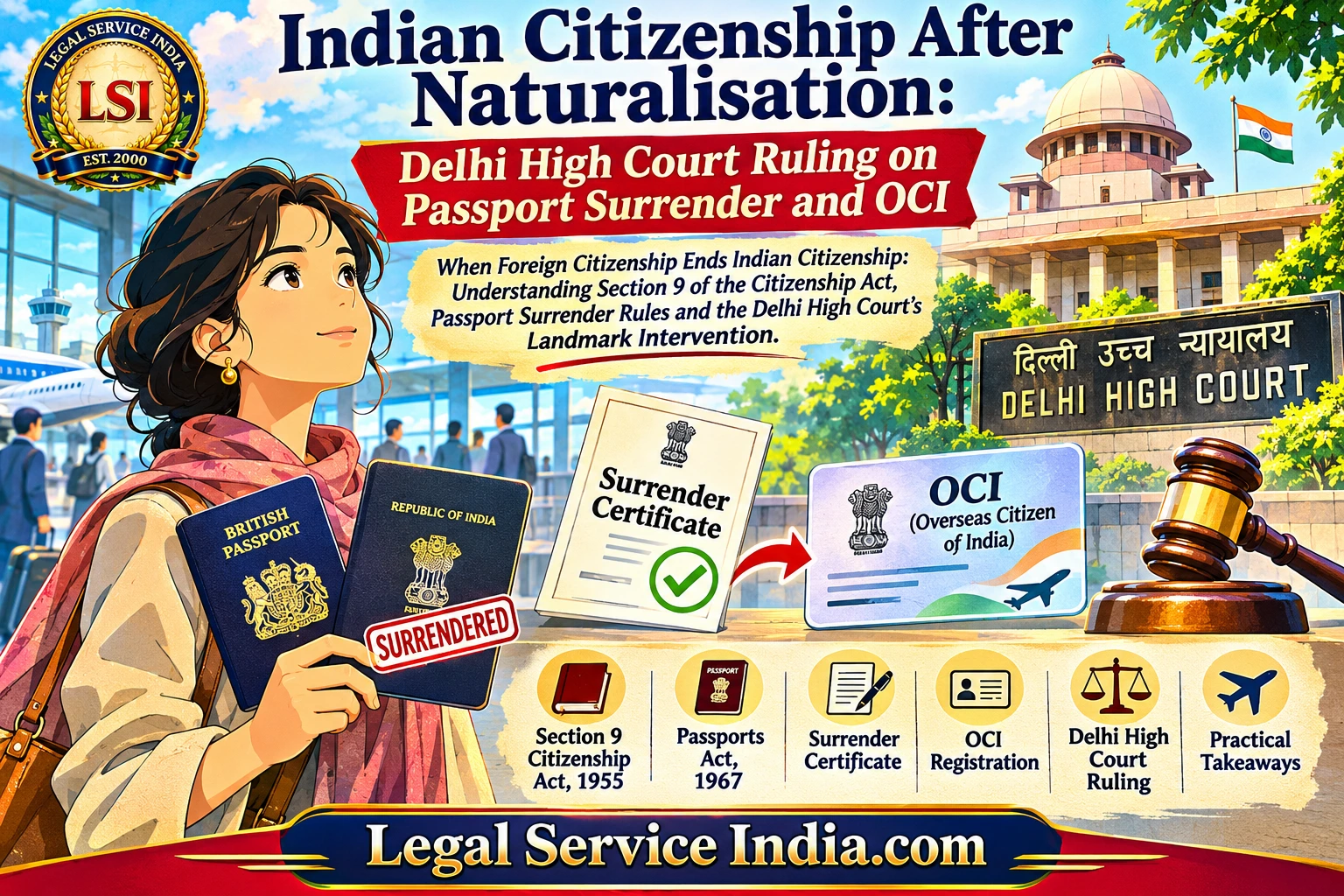
Indian Citizenship After Naturalisation: Delhi High Court Clarifies Passport Surrender and OCI Complications
When an Indian citizen voluntarily takes up another nationality, Section 9 of the Citizenship Act, 1955 cuts off Indian citizenship on that very day. No application is needed, and no officer has to pass an order. On paper, the matter is settled automatically.
In real life, paperwork rarely moves that cleanly. The old Indian passport is still sitting in a drawer, the Passports Act, 1967 treats holding or using it after naturalisation as an offence, and the Surrender Certificate—meant to close the chapter—often becomes the biggest hurdle when someone later applies for an Overseas Citizen of India (OCI) card.
A brief, five-page oral order passed by the Delhi High Court on 3 November 2026 in Hina Ketan Thakrar v. Union of India highlights what goes wrong when a former citizen stumbles while closing that file. Even though the order is short, it sits right on a fault line that thousands of former Indians eventually hit: losing citizenship by law, while getting stuck trying to finish the paperwork on the ground.
A Small Error With Large Consequences
In August 2025, a woman living in the United Kingdom became a British citizen through naturalisation. Two months later, she applied to renew her Indian passport. Her stated reason was straightforward: she wanted her maiden name replaced with her married name. Within days she had her British passport, went to the High Commission of India in London to surrender her Indian passport, and received a Surrender Certificate on 6 November 2025.
Then things took an unexpected turn. In March 2026, the High Commission revoked her Indian passport and refused to give her the Surrender Certificate, taking the stand that she had suppressed her foreign citizenship when applying for renewal. For anyone planning to apply for OCI later, losing access to that certificate is not a minor inconvenience—it can stall the entire process.
On 3 November 2026, the Delhi High Court set that refusal aside. It is easy to overlook a short oral order, yet it captures a recurring headache for people moving between legal systems.
Citizenship That Ends Without Anyone Noticing
India does not allow dual citizenship, and Section 9(1) of the Citizenship Act, 1955 puts that rule into effect. If a citizen voluntarily acquires the citizenship of another country—whether by naturalisation, registration, or otherwise—they stop being an Indian citizen on the date of acquisition. There is no waiting period for a formal declaration to take effect, and ignorance of the law does not pause it. Section 9(2) adds that whenever a dispute or question arises over whether, when, or how foreign citizenship was acquired, it is decided by the prescribed authority under prescribed evidentiary rules.
Supreme Court Interpretation of Section 9
The Supreme Court laid down the core framework decades ago. In Izhar Ahmad Khan v. Union of India (1962), it upheld the rule treating a foreign passport as conclusive proof of having voluntarily acquired foreign citizenship, viewing it as a rule of evidence under Section 9(2) rather than substantive law. More recently, in Union of India v. Pranav Srinivasan (2024), the Court examined the position of a Singapore-born individual whose parents had acquired Singaporean citizenship, holding that automatic cessation under Section 9 operates by operation of law and is distinct from voluntary renunciation under Section 8 (which carries a statutory right to resume citizenship).
| Legal Provision or Judgment | Principle |
|---|---|
| Section 9(1), Citizenship Act, 1955 | Indian citizenship ceases upon voluntary acquisition of foreign citizenship. |
| Section 9(2), Citizenship Act, 1955 | Questions concerning the acquisition of foreign citizenship are determined by the prescribed authority. |
| Izhar Ahmad Khan v. Union of India (1962) | Explains the evidentiary framework concerning foreign citizenship. |
| Union of India v. Pranav Srinivasan (2024) | Distinguishes automatic cessation under Section 9 from voluntary renunciation under Section 8. |
The Passport That Outlives the Citizenship
Even after citizenship ends under Section 9, the physical passport does not vanish. That is where the Passports Act, 1967 steps in. Under Section 10(3)(b), a passport authority can impound or revoke a passport if it was obtained by suppressing material information or on wrong information. Section 12(1)(b) goes a step further, making it an offence to knowingly give false information or suppress material information to obtain a passport.
Passport Surrender and Renunciation Requirements
Alongside the statute sits the Ministry’s guidance published across Indian mission websites. In practice, missions tell former citizens to surrender their Indian passports immediately upon acquiring foreign citizenship, warn that holding, renewing, or travelling on an Indian passport afterwards invites penalties, and state that anyone who acquired foreign citizenship on or after 1 June 2010 must formally renounce Indian citizenship (with the prescribed fee) before surrendering the passport.
That renunciation happens through a declaration in Form XXII under Rule 23 of the Citizenship Rules, 2009. Guidance also states that a Surrender Certificate is not issued unless the last held Indian passport is physically produced, and that applicable penalties cannot be waived or reduced.
The Difference Between Citizenship Cessation and Renunciation
Look closely at what happens here, and a sharp conceptual wrinkle shows up. Legally, the person already ceased to be an Indian citizen on the day they acquired foreign citizenship. So the post-2010 renunciation requirement is not actually what ends citizenship—it acts as the administrative record of a loss that Section 9 has already triggered.
Given how Pranav Srinivasan separates Section 9 cessation from Section 8 renunciation, treating the two as interchangeable in everyday administration only adds to the confusion.
Why the Surrender Certificate Matters for OCI
For most former Indian citizens who want hassle-free travel back to India, OCI registration is the practical route. Section 7A(1)(a)(i) of the Citizenship Act covers people who are now citizens of another country but were Indian citizens at—or at any time after—the commencement of the Constitution.
Documents Required for OCI Registration
In day-to-day practice, the Surrender Certificate is how Indian authorities verify that the old passport has been properly accounted for. Ministry guidance indicates that OCI applications should include the Surrender Certificate or, where unavailable, an affidavit explaining what happened to the earlier Indian passport and detailing any travel made on it after acquiring foreign citizenship.
The guidance has also said that holders who earlier obtained OCI or PIO cards without surrendering their Indian passports must surrender the last passport and obtain a certificate when the card is renewed.
Because of this, a denied or revoked Surrender Certificate does not just leave an old passport in limbo—it can block the next step people actually care about.
What the Delhi High Court Did
Justice Amit Mahajan began from undisputed facts: the petitioner had acquired British citizenship on 7 August 2025. The core issue was whether her subsequent passport renewal application justified revoking the passport and denying the Surrender Certificate without properly weighing why and how that renewal was sought.
Three Important Facts Considered by the Court
Three facts on the record carried real weight with the Court:
- Prior Written Disclosure: Before the renewal application was filed, her husband had emailed the High Commission on 23 September 2025 stating that she had become a British citizen, noting that her British passport was on hold pending an update on the Indian passport, and asking about the right procedure for a name change.
- Earlier Issuance Without Explanation: The High Commission had in fact issued a Surrender Certificate on 6 November 2025, yet neither the challenged order nor the earlier order of 27 March 2026 explained how it came to be issued and then later denied.
- No Misuse Alleged: There was no case made out by the Union that she had travelled on the renewed passport or gained any unfair benefit from it.
The Court’s Reasoning and Final Direction
While accepting that Section 10(3)(b) empowers authorities to revoke a passport for suppression of material information, the Court emphasised that statutory power is discretionary (“may revoke”) and must be exercised fairly after considering relevant material.
On these facts, the omission in the renewal form could plausibly be a bona fide mistake rather than a deliberate cover-up. The Court set aside the refusal and directed that the Surrender Certificate be issued forthwith.
How Far the Decision Goes
It would be risky to read Thakrar as a green light to renew an Indian passport after naturalisation. The Court explicitly noted that it was not diluting the duty to provide information with candour and responsibility.
Rather, it looked at the totality of circumstances—facts that will not exist in every dispute:
- An upfront written email to the mission before the renewal filing.
- No allegation of travel or benefit on the renewed passport.
- A certificate that had already been issued once.
That approach also aligns with the mental element in Section 12(1)(b), which targets someone who knowingly furnishes false details or suppresses material facts. Although the order does not dwell on Section 12, asking whether an omission was intentional gets to the heart of the same issue.
Someone who flags their new citizenship to the mission in writing weeks earlier does not look like someone trying to hide it.
At the same time, two issues were left open. The petitioner contended that her passport was revoked without a hearing; the Court noted the grievance and pointed out the missing explanation for revoking an already-issued certificate, without laying down a broad ruling on natural justice.
And because the order was brief and oral, its practical value lies more in showing how administrative discretion should be exercised on specific facts than in creating a rigid test for “suppression.”
Three Loose Ends Worth Fixing
Even after Thakrar, three friction points keep catching applicants off guard:
1. The Name-Change Squeeze
People who marry and naturalise abroad naturally want their surname to match across all their records. The problem is that renewing an Indian passport after acquiring foreign citizenship is treated as an offence, yet the surrender process offers no straightforward way to record a name change on the way out.
Letting applicants note a married name during surrender—simply by showing a marriage certificate—would stop people from getting stuck between two sets of rules.
2. Withdrawing a Certificate Already Issued
Once a Surrender Certificate has been issued, cancelling or refusing to honour it should require prior notice and clear reasons. It records a legal reality under Section 9 that people rely on for downstream filings like OCI.
3. Zero Flexibility on Penalties
Rules that treat penalties as strictly non-waivable and non-reducible offer uniformity, but leave no room for the kind of contextual fairness the Delhi High Court applied here. Re-examining whether minor, good-faith missteps need a uniform hammer is a fair policy question.
Practical Takeaways for Applicants and Practitioners
For anyone navigating this transition—or advising someone who is—a few habits save months of trouble:
- Hold Onto the Naturalisation Certificate: The exact date of acquisition controls both Section 9 cessation and any penalty calculation.
- Avoid Renewing or Travelling on the Indian Passport After Naturalisation: Even an innocent name-change goal can trigger major complications.
- Put Questions to the Mission in Writing First: If an unusual situation arises with the old passport, write to the mission ahead of time and save the correspondence.
- Get the Surrender Paperwork Right Before OCI: Keep the surrendered passport, surrender proof, and supporting attestations in order before starting an OCI application.
Conclusion
Section 9 of the Citizenship Act is unforgiving in its simplicity: Indian citizenship ends the day foreign citizenship is acquired. Everything after that is administration—and administrative friction is where genuine applicants get hurt.
Hina Ketan Thakrar does not rewrite citizenship or passport law, but it serves as a timely reminder that statutory revocation powers must be exercised with fairness and attention to the full record.
Early, written candour puts an applicant on much firmer ground than silence, though the deeper fix lies in making the surrender process practical enough that honest mistakes do not derail a person’s next legal step.