




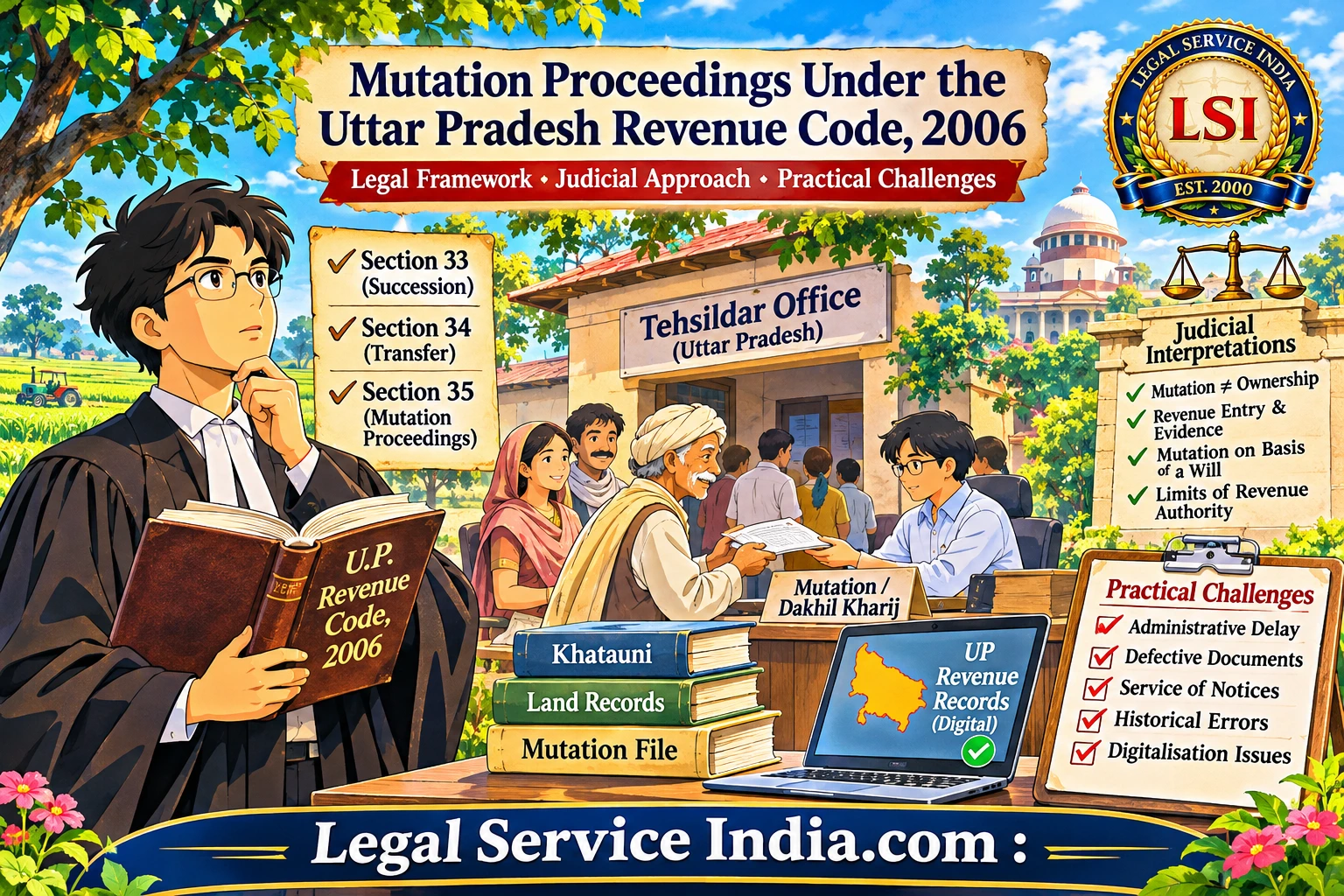
Mutation Proceedings Under the Uttar Pradesh Revenue Code, 2006: Legal Framework, Judicial Approach and Practical Challenges
Abstract
The importance of land records in revenue administration and proper management of agricultural property cannot be overemphasized. Mutation proceedings in Uttar Pradesh are an administrative process for incorporating changes in the recorded landholdings after inheritance, transfer and family settlement etc. The main statutory provisions dealing with this process are Sections 33, 34 and 35 of the Uttar Pradesh Revenue Code, 2006 read with relevant Rules.
Mutation or Dakhil Kharij is the process of recording a change in the revenue records in respect of a legally relevant event affecting a landholding. Although the rights may arise through succession or a legally effective transfer, the corresponding revenue entries might require a separate administrative process to reflect that change. Mutation thus helps in keeping the records updated, particularly the Khatauni which is very important for revenue administration. But a notation on the revenue records does not of itself create ownership or finally settle a controversy as to title.
This paper examines the legal framework of mutation under the Uttar Pradesh Revenue Code, 2006 and discusses the duties of the revenue authorities in reporting, verification and recording of changes in landholdings. It also discusses judicial principles regulating evidentiary value of mutation entries and pinpoints practical hindrances such as administrative delays, defective documentation, inadequate service of notices, inaccurate historical records and technological limitations. The paper argues that procedural fairness, the use of reliable records management, and a clear demarcation between administrative recording and judicial determination of ownership disputes are essential to an effective mutation system.
Keywords
Mutation, Uttar Pradesh Revenue Code, 2006, Dakhil Kharij, Khatauni, Revenue Authorities, Administrative Process.
Introduction
The land records form an important part of the administrative system to identify, manage and monitor agricultural holdings. They assist the revenue authorities to have information of the recorded tenure holders and landholdings. They may also be relevant, when persons effect transactions in respect of land or seek to establish the recorded status of a particular holding. Where these records do not reflect subsequent changes, this may cause difficulties for landholders, purchasers, legal heirs and other persons claiming an interest in the property.
Changes in respect of a piece of land can take place due to some legal incidents like the death of a tenant, sale of land or a family arrangement. In such cases, it becomes necessary that the changes in respect of revenue entries are effected accordingly. Mutation becomes the process by which such changes are recorded in conformity with the law.
The statutory provision of mutation is found in Section 33, 34 and 35 of the Uttar Pradesh Revenue Code, 2006. These provisions cover the reporting of changes relating to succession and transfer, the duties of the revenue authorities concerned and the amendment of the record of rights.
The significance of mutation should, however, be considered within its proper legal ambit. Just because one’s name is registered in the revenue records of a particular piece of land does not mean that he is the owner of such land. Likewise, failure to have one’s name in the record books does not mean that one cannot claim any right to such land. Thus, the legal consequences of registration must be separated from the actual proprietary rights under the applicable law.
This study will look at the law concerning mutation as applied in the State of Uttar Pradesh; the functions of revenue officers in respect of mutation; the position taken by the courts on mutation records and problems encountered in executing the process of mutation.
Meaning and Legal Nature of Mutation
Mutation is the process where a change in the revenue record is made due to an event that has happened with respect to the particulars of a land holding. In layman’s language, the process of mutation is known as Dakhil Kharij. This process can happen in cases where there has been a succession or other types of changes recognized by law.
The Khatauni is a revenue record that contains details about agricultural holdings and the particulars of the recorded tenure holder. At times, when a change happens in accordance with law, there may be a need for changing some of the entries in the revenue record. This is what happens through the process of mutation.
This is not just a simple process of changing names from one place to another. Depending on the nature of the case, there may be the need for looking at documents and also taking notice of those people who may be affected by such a change.
The legal nature of mutation is more administrative and fiscal in nature. This means that mutation is intended to record revenues and to facilitate administration of land revenue. While mutation may play an important role in the documentation of a land-holding, yet it does not by itself confer the right of ownership on the individual recorded therein.
This difference is of particular importance when there are rival claims. Two individuals, for example, can claim one piece of land through the use of conflicting succession deeds or even under conflicting wills. The revenue authority, while dealing with this case, must confine itself to its statutory jurisdiction. An issue requiring adjudication of the title may have to be decided in a competent civil court depending on law and jurisdiction.
Mutation is therefore merely a record of the administrative document of a land-holding.
Significance of Mutation in Uttar Pradesh Land Laws Administration
1. Updating Revenue Records
One of the primary purposes of mutation is to update the revenue records concerning any change that might occur in connection with the concerned land holding. In cases where there is the death of the registered tenure holder or any legal transfer has taken place, then the record will be changed according to the law.
For instance, in case of death of the registered tenure holder, the succession details will have to be inserted in the Khatauni. The record should necessarily follow the statutory requirements and not merely be used as a replacement for dispute over succession claims.
Updating of the record helps the revenue department to manage land records.
2. Decreasing Record-Related Controversies
Entries which are false or out-of-date can cause confusion among the parties who have an interest in land. The situation could be further complicated if there are many transactions which took place in succession but were not recorded in the revenue records.
Mutation process gives a chance to evaluate the proposed amendment and objections made by the interested parties. It might help in identifying the discrepancy. However, mutation cannot resolve all land controversies; especially when the issue lies in the ownership of property, authenticity of the deed, etc.
3. Help in Transactions Involving Land
The revised revenue accounts will be able to help individuals and the government in understanding the registered position of the holding. An individual who wishes to purchase land can refer to the records as part of his general examination of the land.
Nevertheless, mutation must not be seen as absolute proof of ownership. A proper investigation may be needed in the light of registered deeds, succession papers, past transactions, court orders, and other factors depending on the situation.
The importance of mutation is that it helps in record keeping and not in confirming title.
4. Protection from Any Discrepancies and Fraud
The method of structured mutation can assist the concerned authority in recognizing any inconsistencies between the current entry and the supporting documents used for changing it. The notice to be issued to interested parties and the inspection of documents may also offer chances to voice objections before making an entry.
These protections may become necessary when claims are being made based on disputed will, dubious transfer documents or conflicting succession particulars. But the whole process would only be effective if there is proper verification and adherence to procedure as well as remedies available against erroneous decisions.
Mutation cannot stop all kinds of frauds and unauthorized occupation. It can only do less but equally vital job; that of offering an administrative process for scrutiny of the proposal for changing particulars of lands.
5. Recognition of Changes Resulting from Succession
There can be changes in the revenue records on account of succession on the death of a recorded tenure holder and the new individuals entitled to succeed under the relevant law. The process of mutation helps in recording these changes administratively.
It becomes particularly necessary when the land has come into the possession of more than one individual. However, the names that are recorded should reflect the rights enjoyed according to the law and not necessarily resolve every issue of succession and ownership arising therefrom.
6. Role in Agricultural Administration
Agriculture holds considerable significance in the economy of the state of Uttar Pradesh, and therefore, any information pertaining to agricultural holdings would prove useful for the administration of revenues and other public concerns.
Mutation serves the purpose of making the information regarding agricultural holdings available by helping record changes in the same. However, its effectiveness is dependent upon the accuracy of existing records and their up-to-date maintenance.
Statutory Framework Under the Uttar Pradesh Revenue Code, 2006
Sections 33, 34, and 35 of the Uttar Pradesh Revenue Code, 2006 provide the basic legislative provisions relating to the accounting and recording of changes that arise out of succession and transfer. The above sections need to be interpreted along with the rules and the authoritative text of the Code.
| Statutory Provision | Subject | Principal Area of Application |
|---|---|---|
| Section 33 | Reporting and Recording of Succession | Changes arising from succession. |
| Section 34 | Reporting of Transfers | Reporting transfers and relevant transactions. |
| Section 35 | Mutation Proceedings | Procedure for dealing with succession and transfer cases and amendment of revenue records. |
1. Reporting and Recording of Succession
For the obligations to report succession and provides for actions to be taken by the relevant revenue authority where there is information on the occurrence of the change.
Any person who takes possession of the land by succession is to report to the Revenue Inspector of the circle in which the land is located in the prescribed manner.
It is intended that the report is to inform the revenue administration of the occurrence of the change of succession. In the absence of the required report or information, the record will continue to have particulars of the previous tenant.
The provision gives the actions to be taken by the Revenue Inspector when he receives the report or otherwise obtains the required information. The statutory procedure makes distinction based on whether the succession is in dispute or not.
Where it is undisputed, the change is to be entered in the record of rights. But in cases of disputed succession or in case of other circumstances, the revenue inspector must conduct an inquiry and make a report to the Tehsildar under the provision.
This provision offers a means whereby an application can be made to the Tehsildar by someone whose name is not registered or who feels aggrieved with the act committed by the Revenue Inspector, in accordance with the exact terms of the specific subsection involved.
The importance of Section 33 can be found in the provision of a procedure through which succession modifications can be brought to the notice of the revenue authorities.
2. Reporting of Transfers
Subject to the exceptions provided for in the Code. According to Section 34(1), where any person receives any land by way of transfer, he must report such a transfer to the Tehsildar of the Tehsil where such land lies, according to the procedure prescribed.
Explanation of the statute even takes into consideration family settlement in relation to this section. It thus means that amendments to the revenue record can result out of settlements apart from sales. The State Government has the power to make provisions for a fee for the entry in the record of rights after the transfer. According to the statutory provision, the liability to pay this fee rests on the party who is to have the entry made in his favor according to the requirement.
For instance, when the purchase makes an application for the entry of revenue in his favor after the transfer, he will have to pay the fee according to the provision of law. The purpose is accordingly to set out the system for making reports regarding covered transactions as well as the corresponding fee structure. The specific requirements to be complied with in each case will need to be decided based on the statutory provisions.
3. Mutation Proceedings in Cases of Succession or Transfer
The procedure to be followed by the Tehsildar for any matter related to succession or transfer that is presented before him under Section 35 is provided in the said section.
The process here allows the Tehsildar to publish a notice or make any necessary inquiry in the situation. The process makes distinctions among cases where there is no dispute as to the proposed change and those in which there is a dispute that must be decided by the Tehsildar. If there is no dispute regarding the matter, the Tehsildar can order the record of rights to be amended. If there is any dispute, the relevant body is bound to take care of the issue in the manner prescribed under the relevant statute and amend the record of rights where necessary.
The above-stated provision has made Tehsildar an important authority during mutation proceedings. However, the exercise of such authority should not exceed the legal limits. In other words, the administrative procedure should not necessarily amount to a determination of all issues relating to ownership.
An appeal can also be filed against an order made by the Tehsildar under Section 35. Such an appeal shall lie before the Sub-Divisional Officer within the statutory period of 30 days from the date of communicating the order.
The presence of an avenue for appeal is important since it allows for challenging of an order in line with the law. The exact details on time limit, maintainability, and procedure need to be checked against the statute and rules.
These three sections taken together form a process by which the revenue authorities are notified of any changes, and the relevant situation is investigated so that the register of rights may be amended. The efficient application of such a procedure depends on accurate information, due process, and respect for the rights of the concerned parties.
Judicial Interpretations of Mutation Entries
Courts have often highlighted the difference between mutation of revenue documents and determination of proprietary rights in relation to this question. The importance of the above distinction lies in the determination of the legal consequences of any entry made in the course of mutation.
1. Mutation Does Not Constitute Ownership in Itself
The Apex Court has held that entries made in respect of mutation are primarily for revenue purposes and do not constitute creation or extinction of title in the property concerned. Entries of that nature cannot establish ownership on the basis of mere name appearing therein.
It restricts the legal importance of mutation. While the manner in which a holding can be registered for revenue purposes can be shown in an entry, the proprietary rights on which it is based must first be proved under substantive law.
2. Revenue Entry and Evidence of Title
Judicial method clearly sets apart the administrative objective of making the revenue entry from the legal aspects of proving ownership. An individual cannot prove the ownership of a property through their name on the Khatauni or other revenue documents.
An erroneous entry in the revenue document cannot affect the independent right of an individual in accordance with the law applicable to the case. The significance of a revenue document can be evaluated legally in combination with other evidence.
3. Mutations on Basis of a Will
Controversies regarding mutation on basis of a will give rise to further controversy in light of the fact that there might be a disagreement between the parties with regard to the validity of the will or the rights conferred through it.
The Supreme Court has also examined situations where the mutation of property is claimed through the will and therefore it has to be decided through the proper civil court.
The significant aspect here is that the mutation process cannot be used as an alternative to the required judicial process of resolving a real dispute over ownership of property.
4. Implications for Revenue Administration
The separation by the courts between mutation and title has implications for both the revenue departments and landowners. Revenue entries continue to have significance as administrative records, but their legal significance should not be exaggerated.
The administrative agency must proceed in accordance with the prescribed process taking into account the intended amendment. In the same vein, the people concerned ought to know that their registration in no way ends the controversy in relation to ownership, inheritance, or the authenticity of any document.
This allows for the administrative efficiency of mutation while acknowledging the boundaries of the jurisdiction of the revenue agency.
Practical Problems in Mutation Cases
Even though the process of mutation allows one to change land records in accordance with the applicable law, its efficiency in practice is based on good administration, authenticity of evidence, and availability of the process itself. There are several factors that can affect the process of handling mutation cases.
1. Problems Related to Administration and Transparency
There may be delays in handling the application or in the process of the case itself. The lack of information about the stage of the case may cause inconvenience, especially if one needs a new record for further actions.
The problem of inaccessible information might also affect people’s trust in the system. Proper communication about the procedure, status of the case, and reasons for delays will increase transparency.
Transparency in immigration system can be achieved not only by means of introduction of online services. The maintenance of proper records, good communication, and possibility of raising procedural questions should be ensured.
2. Risks of Corruption and Inconsistent Administrative Practices
When there is limited information on the relevant procedure at the disposal of the applicant, he or she will likely face challenges in assessing whether there is justification for further documentation or delay. Inconsistent administrative practices can contribute to these uncertainties.
Such situations open up room for inappropriate behavior, even though the presence of such behavior needs to be proved by relevant evidence in each instance.
The process may be standardized, the decision-making may be documented, the grievance system may be made accessible, and there should be proper supervision in order to prevent arbitrary treatment. The goal is to make sure that applications for mutation are assessed based on the law.
3. Multiple Proceedings and Long Disputes
Dispute that arises in connection with mutation may give rise to objections, appeals, or other proceedings at a different competent forum.
The issue takes on particular significance where there is a disagreement regarding the revenue entry that is associated with a dispute regarding ownership, succession, or the authenticity of the document. It may take quite some effort to resolve the underlying dispute through several legal processes.
Distinguishing the issues of maintenance of the revenue records from the issue of adjudication will assist the parties to know what remedy is applicable. The revenue authorities have to be within their statutory authority while dealing with the disputes.
4. High Work Load and Few Administrative Capacities
Revenue departments have a number of responsibilities which include keeping record of the land, examining mutation applications, handling demarcation issues and many other revenue related responsibilities. A high number of applications may burden the administrative capacities at hand.
When there are few human and technical capacities, then examining and processing applications may take much longer than anticipated. The same may happen when information is to be retrieved physically from the records or when information is sought from various departments.
The need for administrative reform is therefore to handle work load, train human capacity and make information accessible.
5. Public Awareness Shortcomings
Some applicants might not be familiar with the requirements for submission and the type of documents needed for the mutation process, as well as the legal implications associated with the outcome of the process. This could result in incomplete applications and unnecessary delays in the process.
Another possible confusion would be if some individuals consider the mutation process as the final step towards establishing ownership of the property. This could result in misplaced perceptions and could make future problems more difficult to solve. The public needs to be made aware of the application process, the documents needed, the involvement of revenue bodies, as well as the distinction between revenue entries and ownership.
6. Historical Errors and Incorrect Information About the Holding
The current record system may include errors regarding names, size, boundaries, or any other characteristics of a holding. These errors might come to light during consideration of a new mutation request.
A new mutation request might be complicated by the need to correct some existing errors or discrepancies between historical documents. This would mean that an extra step should be taken before the new request can be processed.
In conclusion, one can see that the success of the mutation procedure is highly dependent on the quality of the record system. Its regular verification and correction of existing mistakes could improve its reliability.
7. Disputed Wills and/or Transfer Instrument and Succession Issues and Question of Validity of the Supporting Document
In cases where more than one person claims an interest in the same property, the appropriate authority should take into account the relevant documents in relation to the process concerned. The existence of the conflicting documents may mean that the case needs more scrutiny and may be seen as a dispute that cannot be sorted out by just amending the revenue record.
It is important to verify the documents and notify all the interested parties before making decisions. In case the dispute goes beyond the jurisdiction of the authority, then it is up to the parties concerned to sort it out in the competent forum.
8. Defective Service of Notices
Procedural fairness requires that persons whose interests may be affected receive notice in accordance with the governing law. Notice provides an opportunity to raise objections, submit relevant documents and explain why the proposed change should not be recorded.
Difficulties may arise when addresses are outdated, interested persons cannot readily be identified or the prescribed method of service is not followed properly. An affected person who does not receive legally adequate notice may subsequently challenge the resulting order through an available remedy.
Authorities should therefore maintain accurate particulars of interested persons, comply with the applicable service requirements and preserve appropriate records demonstrating that procedural steps have been taken.
9. Digitalisation and Technical Limitations
Digital systems can improve access to land records and facilitate the management of mutation applications. Nevertheless, their effectiveness depends upon the accuracy and completeness of the information entered into the system.
Technical interruptions, incomplete digitisation and inconsistencies between physical records and electronic databases may create difficulties for applicants and officials. Users may also require assistance when navigating online services or identifying the procedure for correcting an error.
Digitalisation should consequently be supported by reliable data verification, appropriate technical assistance and accessible mechanisms for reporting discrepancies. An electronic entry cannot, merely because it is available online, be assumed to resolve a substantive dispute concerning title.
Verification of the information provided, technical assistance, and procedures for discrepancy reporting should be provided with digitalization. Availability of the document electronically cannot simply settle the matter in case there is a title issue involved.
Suggestions to Improve the Mutation Procedure
As seen from the problems highlighted above, improving the mutation procedure is necessary for considering both administrative effectiveness and legal protection.
First, the applicant must be provided with all necessary information regarding the procedure to be followed, documents required and status of the application. This will help to avoid uncertainties and avoid unnecessary trips to the revenue office.
Second, it will be prudent for revenue officers to keep accurate documentation regarding notices, objections, inquiries and orders made. Documentation will be helpful in examining the decision making process.
Thirdly, there must be consideration given to the correctness of the existing records, since mistakes made in the historical record can hinder any further process, making verification and correction of such records a necessary part of effective land administration.
Fourth, the provision of digital services must go hand-in-hand with proper technical support and ways to solve any discrepancy between physical records and digital records. Technology must work for proper administration, but not against it.
Fifth, relevant authorities must be appropriately educated on the law, procedure, and legal difference between mutation and title. It becomes especially important in cases when applications include disputed documents.
Finally, there must be public information campaigns on the usefulness and shortcomings of mutation. Landowners must be made aware of the necessity of reporting in a timely fashion, but at the same time, they must understand that the revenue record is not the answer to all questions of ownership.
Such steps will increase the reliability of the revenue record without compromising the rights of those concerned.
Conclusion
The procedure of mutation is an integral component of land administration in Uttar Pradesh as it provides a means for registering mutations due to various reasons such as succession, transfer, etc. Sections 33, 34 and 35 of the Uttar Pradesh Revenue Code, 2006 deal primarily with the provisions regarding reporting such mutations, analyzing the situation and making necessary amendments in the record of rights as per law.
It is important to note that the importance of mutation must be seen keeping in view its proper legal limits. The decisions made by courts clearly differentiate between the administrative objective behind the entries in the revenue register and the determination of the actual rights of ownership. Mutation entries can serve as a tool for keeping record of the holding, but do not prove title or extinguish title on their own.
The efficacy of the entire procedure relies greatly on how timely, accurate and verified is the procedure adopted for the mutation. Improvements must thus be made in such a way that the system incorporates both efficient administration and correct procedures under law. The availability of adequate information, proper supervision, accurate digital record keeping, and corrective measures available to those aggrieved will improve the mutation system.
The final goal should be to ensure that proper revenue records are maintained without considering the administrative process as an alternative to determining ownership rights through the due process of law.
References
Primary Source
- Uttar Pradesh Revenue Code, 2006
Secondary Sources
Scribd
- UP Land Laws – FAIZ
Indian Kanoon
- Indian Kanoon – Reference 1
- Indian Kanoon – Reference 2
- Indian Kanoon – Reference 3
SCC Online
- Tehsildar Can’t Decide Mutation Applications Based on Disputed Testamentary Documents, Particularly a Will – MP High Court
About the Author
Written By: Suryansh Pandey
Academic Details: 5th Year, School of Law, Justice & Governance, Gautam Buddha University, Greater Noida.