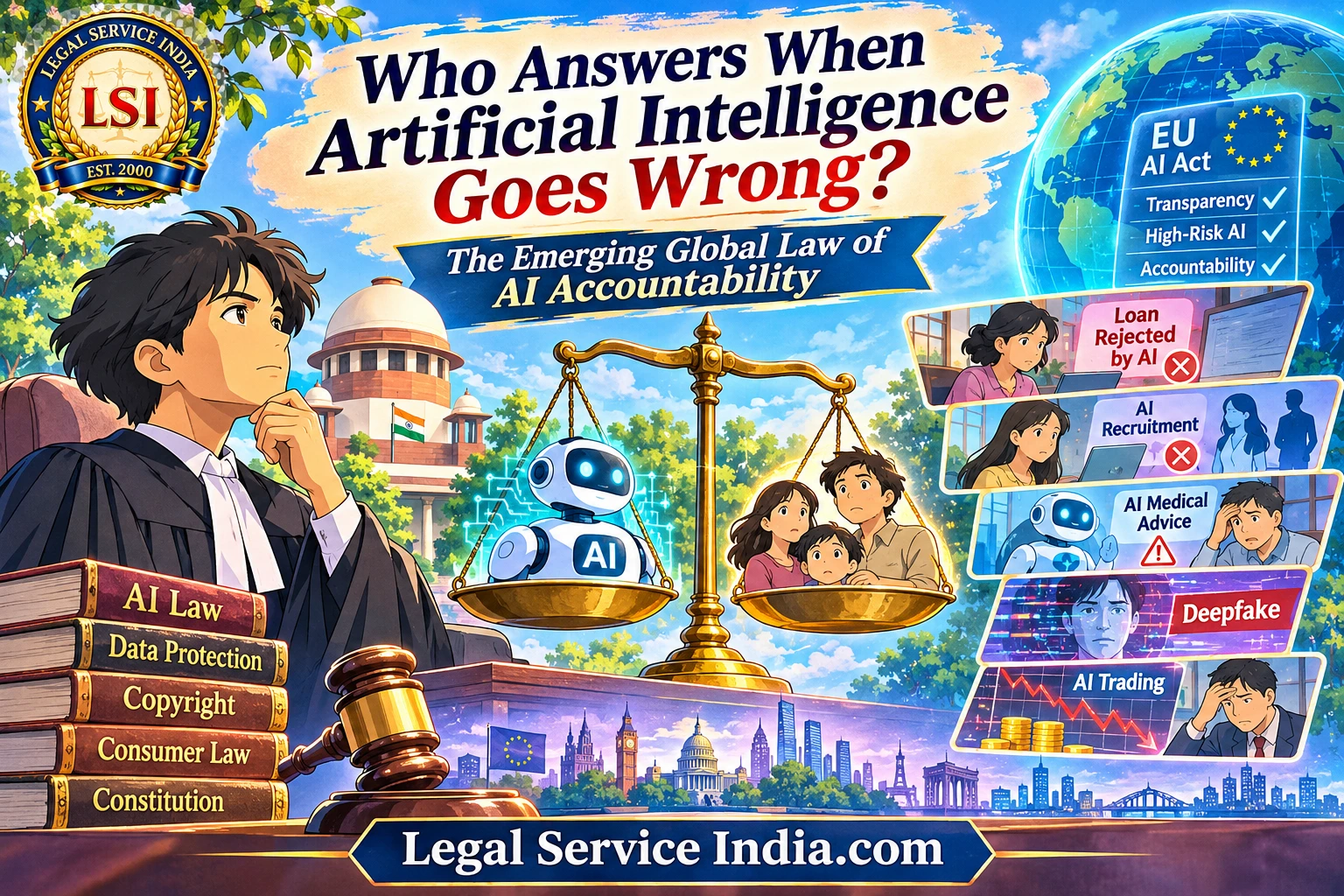
Who Answers When Artificial Intelligence Goes Wrong? The Emerging Global Law of AI Accountability
Written By a Senior Advocate practising before the Supreme Court of India
Introduction: When a Machine Makes a Decision, Who Takes Responsibility?
Imagine a bank rejecting your loan application because an artificial intelligence system has classified you as a high-risk borrower. You ask for an explanation, but the bank cannot tell you precisely why the decision was made.
Imagine a qualified candidate being rejected for employment because an automated recruitment system has learned to favour one category of applicants over another.
A patient follows medical advice generated by an AI chatbot and suffers serious injury. A business loses millions because an automated trading system makes a disastrous decision. A person’s reputation is destroyed when a sophisticated deepfake video falsely depicts them making statements they never made.
In each situation, the immediate source of the problem may be artificial intelligence. But a much more important legal question follows:
Who is responsible for the damage?
Is it the company that developed the AI system? The business that deployed it? The person who operated it? The individual who supplied incorrect information? Or should the law recognise artificial intelligence itself as an independent legal person?
These questions are no longer confined to science fiction or academic discussion. They are becoming practical issues in courts, regulatory institutions, commercial transactions and constitutional litigation.
Artificial intelligence can now perform tasks involving financial analysis, medical assistance, legal research, recruitment, surveillance, content creation and decision-making. Yet its growing capabilities have not made it a legal person.
The emerging legal principle is that the use of artificial intelligence does not automatically remove human or corporate responsibility.
The machine may generate the output, but the law must still identify the persons and organisations that designed, controlled, supplied, deployed or relied upon it.
This article examines how the law is responding to that challenge, with particular attention to the European Union, the United States and India.
1. Can Artificial Intelligence Be a Legal Person?
Before deciding who is liable for an AI-related injury, it is necessary to answer a fundamental question: can artificial intelligence itself be held legally responsible?
Under existing mainstream legal systems, artificial intelligence is not recognised as an independent legal person merely because it can communicate, analyse information or make decisions.
Legal personality carries consequences. A legal person may own property, enter enforceable obligations, sue and be sued, and bear legally recognised rights and duties.
A company possesses separate legal personality because legislation recognises it as an entity distinct from its shareholders and directors. A human being possesses legal personality by operation of law.
An AI system, by contrast, does not automatically acquire these characteristics.
It cannot ordinarily own assets in its own name, independently satisfy a judgment for damages, or be imprisoned in the manner contemplated by criminal law. Nor does its ability to produce apparently intelligent responses establish that it possesses legal intention, consciousness or moral responsibility.
This does not mean that AI-related harm is beyond the reach of law.
The law can impose responsibility upon the individuals and organisations behind an AI system.
For example:
- A developer may be liable for negligent design or inadequate safety measures.
- A manufacturer may face product liability where a defective AI-enabled product causes injury.
- A company may be responsible for deploying an unreliable system in a high-stakes environment.
- An employer may be liable under applicable principles where an employee uses AI in the course of employment.
- A person who knowingly publishes defamatory AI-generated material may face legal consequences.
- A data fiduciary may face liability for failing to comply with applicable data protection obligations.
The central distinction is between the machine that produces an outcome and the legal person whose conduct, responsibility or statutory duty is relevant to that outcome.
Artificial intelligence may be the instrument of harm without being the legal bearer of responsibility.
2. The European Union: A Major Step Towards AI Accountability
The European Union has taken one of the most significant legislative steps towards regulating artificial intelligence through Regulation (EU) 2024/1689, commonly known as the EU Artificial Intelligence Act.
The Act adopts a risk-based approach. Instead of treating every AI application in the same manner, it imposes different obligations according to the potential risks that a system may create.
2.1 The risk-based regulatory model
The framework broadly distinguishes between:
Unacceptable-risk AI: Certain practices are prohibited because they threaten fundamental rights and public safety.
High-risk AI: Systems used in areas such as employment, education, essential services, critical infrastructure and certain law-enforcement or migration contexts are subject to more demanding safeguards.
Limited-risk AI: Certain systems must comply with transparency requirements, including obligations concerning interactions with AI and the disclosure of certain AI-generated or manipulated content.
Minimal-risk AI: Many ordinary applications are not subject to the same level of mandatory regulatory intervention.
This approach recognises an important reality: an AI system recommending a film does not create the same legal risk as one influencing a person’s employment, medical treatment or access to essential services.
2.2 Transparency obligations under Article 50
Article 50 is particularly important because it addresses transparency.
It requires, in specified circumstances, that people be informed when they are interacting directly with an AI system. It also requires providers of certain generative AI systems to ensure that synthetic audio, image, video or text outputs are marked in a machine-readable format.
Deployers have additional disclosure duties in relation to certain uses, including deepfakes and specified AI-generated public-interest text.
Article 50 applies from 2 August 2026. However, Regulation (EU) 2026/1744, the Digital Omnibus on AI, introduced a transitional period until 2 December 2026 for providers of generative AI systems placed on the market before 2 August 2026 to take the necessary steps to comply with the relevant machine-readable marking obligation.
This distinction matters. The transitional provision concerns a particular category of existing systems and the marking requirement under Article 50(2). It should not be described as a general postponement of every transparency obligation.
2.3 High-risk AI obligations and implementation dates
The AI Act uses a phased implementation structure.
Following the amendments made by Regulation (EU) 2026/1744, the relevant application dates for important high-risk AI requirements include:
- 2 December 2027: Certain high-risk AI systems covered by Article 6(2) and Annex III.
- 2 August 2028: Certain high-risk AI systems covered by Article 6(1) and Annex I.
These dates are important for organisations developing or deploying AI in regulated sectors. Businesses should not assume that every provision of the AI Act became applicable on a single date.
2.4 The Product Liability Directive: Can defective AI create liability?
Another major development is Directive (EU) 2024/2853, the revised Product Liability Directive.
It expressly brings software within the modern product liability framework, subject to the Directive’s conditions and exclusions. This is important because AI-enabled software can cause physical injury, property damage and certain other recognised forms of damage.
The Directive requires Member States to bring their implementing laws into force by 9 December 2026. It applies to products placed on the market or put into service after 9 December 2026.
Its framework includes rules on disclosure of evidence and rebuttable presumptions intended to address some of the difficulties faced by injured persons when proving a defect or causal connection.
The significance is considerable. A person harmed by a defective AI-enabled product may, depending on the facts and applicable national implementing law, have a route to compensation without having to establish conventional negligence in every respect.
However, the Directive is not a universal compensation scheme for every bad AI outcome. The claimant must still satisfy the applicable legal requirements.
3. India: Can Existing Laws Hold AI Developers and Users Responsible?
India does not presently have a single comprehensive AI liability statute equivalent to the EU AI Act.
That does not mean there is a legal vacuum.
Existing Indian laws can apply when an AI system causes injury, infringes rights, processes personal data unlawfully, produces defamatory material or contributes to a contractual or commercial dispute.
The challenge is to apply established legal principles to new technological circumstances.
3.1 Constitutional protection against arbitrary algorithmic decisions
The Constitution of India provides an important foundation for AI accountability.
Article 14 guarantees equality before the law and equal protection of the laws. Articles 15 and 16 prohibit specified forms of discrimination and protect equality in relevant contexts. Article 21 protects life and personal liberty.
These constitutional guarantees become significant when public authorities use algorithmic systems to make decisions affecting individuals.
Suppose a government department uses an automated system to determine eligibility for a public benefit. If the system relies on inaccurate data, applies undisclosed discriminatory criteria or produces arbitrary outcomes, the affected person may have grounds to challenge the decision.
The State cannot avoid constitutional scrutiny merely by outsourcing a decision to a private technology provider.
A public authority remains responsible for exercising its statutory and constitutional powers lawfully. The use of an algorithm does not transform an arbitrary decision into a lawful one.
The constitutional question is not simply whether the computer produced an answer. It is whether the decision-making process satisfies the standards of legality, fairness, equality and procedural reasonableness.
3.2 The Digital Personal Data Protection Act, 2023
AI systems frequently depend upon personal data for training, testing, profiling and operation.
The Digital Personal Data Protection Act, 2023 therefore has significant implications for AI developers and organisations deploying AI systems in India.
The commencement of the Act is phased under the Central Government’s notification G.S.R. 843(E), dated 13 November 2025.
The notification brought specified institutional and enabling provisions into force immediately, provided for certain provisions to commence after one year, and scheduled a substantial group of substantive provisions to commence after eighteen months.
Accordingly, the Act should not be described as though every substantive obligation became enforceable on the date of its enactment or on 13 November 2025.
Once the relevant substantive provisions become applicable, organisations processing digital personal data through AI systems will need to examine matters such as:
- Whether personal data is being processed for a lawful purpose.
- Whether the required notice and consent or other legally recognised basis exists.
- Whether reasonable security safeguards are in place.
- Whether personal data is retained only as permitted by law.
- Whether individuals can exercise applicable data protection rights.
- Whether the organisation has complied with its obligations as a data fiduciary.
An organisation cannot assume that feeding personal information into an AI platform is legally harmless merely because the information is processed by an automated system.
3.3 The Information Technology Act, 2000
The Information Technology Act, 2000 remains relevant to several forms of technology-related misconduct.
Depending upon the facts, provisions concerning unauthorised access, damage to computer systems, identity-related offences, cheating by personation and other unlawful conduct may become relevant.
For example, the creation and circulation of a deepfake involving impersonation, identity misuse or fraudulent conduct may attract legal consequences under applicable provisions.
The precise provision will depend upon the conduct, intention, evidence and statutory ingredients of the offence. Not every AI-generated image or manipulated video automatically constitutes a criminal offence.
3.4 Defamation through AI-generated content
Imagine an AI system generating a false statement that a businessperson has committed fraud, or producing a realistic video that falsely depicts a public figure making a damaging statement.
The fact that the material was generated by software does not automatically provide immunity to the person who knowingly publishes or circulates it.
In India, civil defamation principles and Section 356 of the Bharatiya Nyaya Sanhita, 2023 may become relevant where the statutory requirements are satisfied.
The legal analysis must identify the person responsible for the publication, the nature of the imputation, the relevant intention or knowledge, the harm to reputation and any applicable defence or exception.
A person cannot necessarily escape liability by saying, “The AI generated it; I only shared it.”
At the same time, responsibility should not be imposed mechanically upon every intermediary or user without examining the applicable law and the person’s actual role.
4. ANI Media v. OpenAI: An Important Indian Copyright Development
One of the most significant Indian legal developments involving artificial intelligence and copyright is ANI Media Pvt. Ltd. v. OpenAI OpCo LLC, CS(COMM) 1028/2024, before the Delhi High Court.
The case raises difficult questions about the use of copyrighted material in training large language models.
The central issue is whether the use and storage of copyrighted news material in connection with AI training infringes the rights of copyright owners under the Copyright Act, 1957, or may fall within the statutory fair dealing framework.
4.1 The Delhi High Court’s decision of 24 July 2026
On 24 July 2026, the Delhi High Court delivered its judgment on an application seeking interim injunctive relief.
The Court examined the relevant provisions of the Copyright Act, including Sections 14, 51 and 52, and considered the competing arguments concerning reproduction, storage, AI training, fair dealing and public interest.
The Court discussed the relationship between the use of copyrighted works for training large language models and the statutory fair dealing exception.
It considered, among other matters:
- Whether the use of the works was limited to training the underlying language models.
- Whether the use caused actual or potential commercial harm to the copyright owner.
- Whether the AI system’s functions served broader public interests.
- Whether the outputs reproduced or memorised the original works.
The Court ultimately dismissed ANI’s application for an interim injunction, holding that a prima facie case for such relief had not been established on the material before it.
The judgment also made clear that its observations were for deciding the interim application and would not determine the final outcome of the suit.
4.2 Why this judgment must be understood carefully
It would be legally inaccurate to describe this decision as a final declaration that AI companies are free to train their models on any copyrighted material.
The judgment is important because it examines how Indian copyright law may apply to AI training. However, the final adjudication of the suit remains a separate matter.
The distinction between an interim finding and a final determination is fundamental.
The case also demonstrates that copyright disputes involving AI cannot be resolved merely by asking whether the technology is innovative. Courts must examine the statutory rights of copyright owners, the precise purpose of use, the nature of copying, the applicable exceptions and the evidence of harm.
For authors, publishers, news organisations, software developers and AI companies, the outcome of this litigation and the legal principles ultimately established will have considerable significance.
5. Can an AI System Be an Author Under Copyright Law?
Another difficult question concerns ownership of AI-generated creative works.
Suppose a person enters a prompt into an AI system and receives a painting, photograph, article or musical composition. Who owns the copyright?
Is it the person who supplied the prompt? The developer of the AI model? The person who selected and edited the final output? Or does copyright fail to arise because the work was generated without sufficient human authorship?
Different jurisdictions approach this issue through their respective copyright legislation.
5.1 The United States: Thaler v. Perlmutter
In Thaler v. Perlmutter, No. 23-5233, decided on 18 March 2025, the United States Court of Appeals for the District of Columbia Circuit affirmed the rejection of a copyright application in which an AI system had been identified as the sole author.
The Court held that the US Copyright Act requires human authorship.
Importantly, the judgment did not hold that every work created with AI assistance is unprotected. Human-created works using AI tools may qualify for protection where the human contribution satisfies the applicable requirements.
The distinction is between a machine being named as the sole author and a human being exercising sufficient creative control over the resulting work.
5.2 The Indian position
India’s Copyright Act, 1957 contains a specific provision concerning computer-generated literary, dramatic, musical or artistic works.
Section 2(d)(vi) identifies the person who causes the work to be created as the author of a computer-generated work.
This provision is particularly relevant to AI-generated content. However, its application to modern generative AI raises questions that the statutory language did not expressly resolve when enacted.
For example:
- Who is the person who causes the work to be created?
- Is entering a short prompt sufficient?
- Does the person need to exercise creative control over the output?
- What happens when several people contribute to the process?
- Can the developer claim authorship merely because it created the AI model?
- How should ownership be determined when the output is substantially autonomous?
These questions require careful statutory interpretation and, ultimately, authoritative judicial clarification.
The Indian provision should not be treated as automatically granting copyright to every person who enters a prompt.
6. When AI Makes a Medical, Financial or Professional Mistake
The most serious AI liability disputes may arise in fields where an incorrect answer can cause physical, financial or professional harm.
Consider three situations.
Medical advice: A patient relies upon a chatbot that gives an incorrect recommendation about medication. The patient suffers injury.
Financial services: A bank uses an algorithm to assess creditworthiness. The system incorrectly classifies an applicant and causes financial loss.
Professional services: A business relies on an AI-generated legal or technical report containing fabricated information and suffers substantial damage.
In each situation, the legal inquiry must examine the relationship between the AI output and the resulting harm.
Relevant questions may include:
- Was the AI system designed for the purpose for which it was used?
- Were its limitations properly communicated?
- Was the system tested and monitored?
- Did the organisation use reasonable safeguards?
- Was a human professional required to review the output?
- Did the user reasonably rely upon the information?
- Can the claimant establish causation and legally recognised damage?
6.1 Negligence and duty of care
Traditional principles of negligence may apply where a person or organisation owes a duty of care, breaches that duty, and causes legally recognised damage.
A developer that ignores known safety defects may face a different legal analysis from a business that deploys a system without proper testing.
Similarly, a professional who blindly relies on an AI-generated answer may have responsibilities that cannot simply be transferred to the software provider.
The central question is whether the relevant defendant failed to exercise the standard of care required by law in the circumstances.
6.2 Product liability
Where AI is incorporated into a product, product liability law may become relevant.
For example, an AI-controlled medical device, industrial machine or vehicle may cause injury because of a defect in design, manufacture, software or safety mechanisms.
The applicable legal regime will depend upon the product, jurisdiction, nature of the defect and statutory requirements.
A product liability claim is not the same as a general negligence claim. The legal basis and elements of proof may differ.
7. Deepfakes, Impersonation and the Right to Reputation
Generative AI has made it easier to create realistic images, voices and videos of people who never participated in the events being depicted.
A fabricated video may damage a person’s reputation, interfere with personal relationships, affect employment or be used to commit fraud.
The legal issues may involve:
- Defamation.
- Identity theft or impersonation.
- Privacy and data protection.
- Unauthorised use of a person’s image or voice.
- Copyright or other intellectual property rights.
- Criminal offences where the statutory ingredients are satisfied.
In India, a person affected by a deepfake should preserve the original URL, screenshots, timestamps, platform communications and available technical information.
Where appropriate, the person may consider sending a legal notice, reporting the material to the relevant platform, approaching the competent authorities or seeking urgent judicial relief.
The legal response should be proportionate to the harm and based upon the applicable statutory framework.
The mere fact that content is AI-generated does not make it lawful. Equally, not every manipulated image is automatically defamatory or criminal. Context, consent, purpose, publication and statutory ingredients remain important.
8. Can AI-Generated Evidence Be Used in Court?
Artificial intelligence creates a new challenge for courts: how should judges evaluate digital material that may have been generated, altered or manipulated by AI?
A video may appear genuine but contain synthetic elements. An audio recording may imitate a person’s voice. A document may be generated by a language model and falsely attributed to a real individual.
The issue is not simply whether digital evidence can be admitted. It is whether the evidence is authentic, relevant, reliable and properly proved.
In India, the Bharatiya Sakshya Adhiniyam, 2023 recognises electronic and digital records.
Sections 61 and 62 address electronic or digital records and the proof of their contents. Section 63 deals with the admissibility of electronic records, subject to its statutory requirements.
Courts may need to examine:
- The original source of the electronic record.
- The chain of custody.
- Metadata and timestamps.
- The method of extraction and preservation.
- Whether the material has been altered.
- The reliability of the device or system that generated it.
- Expert evidence where necessary.
A person relying upon an AI-generated or AI-manipulated record should not assume that a realistic appearance establishes authenticity.
As AI-generated evidence becomes more common, forensic examination and reliable digital preservation will become increasingly important in civil and criminal proceedings.
9. Can a Company Escape Responsibility by Blaming Its AI System?
A company may argue that an adverse decision was generated by an automated system and that no employee personally intended the result.
That argument cannot, by itself, settle the question of legal responsibility.
A company that chooses to deploy an AI system remains responsible for complying with the laws applicable to its activities.
For example, an employer cannot necessarily avoid employment-related obligations by claiming that a recruitment algorithm rejected an applicant. A bank cannot automatically avoid regulatory or contractual responsibilities by attributing a lending decision to software.
The law must examine the organisation’s role in selecting, configuring, monitoring and using the system.
This becomes particularly important where a business:
- Uses AI in a high-impact decision.
- Knows that the system has recurring accuracy problems.
- Fails to provide meaningful human review.
- Does not maintain adequate records.
- Ignores foreseeable risks.
- Cannot explain the basis of an adverse decision where the law requires an explanation.
The principle is straightforward: automation should not become a legal escape route.
10. Who Should Be Responsible? The AI Accountability Chain
AI-related harm rarely has a single technological cause. It may result from a combination of design choices, training data, deployment decisions, human reliance and inadequate supervision.
A useful legal framework is to examine the accountability chain.
| Participant | Possible legal responsibility |
|---|---|
| AI developer | Defective design, negligent development, inadequate testing or failure to address known risks |
| AI model provider | Applicable statutory, contractual, product-related or data protection obligations |
| Business deploying AI | Unlawful use, inadequate supervision, discriminatory decisions or failure to comply with sectoral duties |
| Employer | Relevant employment and vicarious liability principles |
| Professional user | Negligent reliance upon AI output or failure to exercise professional judgment |
| Data controller or fiduciary | Unlawful processing, inadequate security or breach of applicable data protection obligations |
| Individual publishing AI content | Defamation, impersonation, fraud or other unlawful publication where the legal requirements are met |
This table is not a statement that every participant is automatically liable. Responsibility depends upon the applicable law, the defendant’s conduct, causation, contractual arrangements and the evidence.
It does, however, provide a practical starting point for investigating an AI-related dispute.
11. Should AI Companies Be Required to Maintain Compulsory Insurance?
One proposal gaining importance in discussions about AI governance is compulsory insurance for certain high-risk AI applications.
The reasoning is practical.
If an autonomous system causes serious injury or financial loss, an injured person may face difficulties identifying the responsible party, obtaining technical information and proving causation.
Insurance could help ensure that compensation is available even where the legal process is complex.
However, compulsory insurance should not necessarily apply to every AI application.
A low-risk writing assistant does not create the same potential exposure as an autonomous industrial machine, medical decision-support system or AI application used in critical infrastructure.
A proportionate framework could consider:
- The seriousness of foreseeable harm.
- The degree of autonomy.
- The scale of deployment.
- The ability of a human operator to intervene.
- The financial capacity of the provider or deployer.
- The availability of reliable risk assessment and audit mechanisms.
Insurance would not replace liability. It would provide a possible financial mechanism for meeting valid claims.
12. What Should India Do? A Practical Roadmap for AI Accountability
India has an opportunity to develop a balanced framework that protects citizens without unnecessarily restricting technological innovation.
The objective should not be to regulate every algorithm in the same manner. It should be to ensure that the level of legal protection corresponds to the seriousness of the risk.
The following reforms deserve serious consideration.
12.1 Mandatory disclosure in high-impact decisions
Where AI materially influences decisions concerning employment, credit, insurance, education, public benefits or other important interests, affected individuals should receive meaningful information about the role of the system.
12.2 A right to meaningful human review
A person should have an effective mechanism to request human reconsideration of an important adverse decision where the applicable law or regulatory framework requires it.
A nominal human approval process that simply repeats the machine’s conclusion should not be treated as meaningful supervision.
12.3 Independent audits for high-risk systems
AI systems used in sensitive sectors should be subject to proportionate testing and independent audits.
Such assessments may examine accuracy, bias, security, reliability, data quality and the effectiveness of human oversight.
12.4 Preservation of technical records
Developers and organisations deploying high-impact AI systems should maintain appropriate records of system versions, relevant inputs, outputs, updates, testing and human interventions.
Without reliable records, a claimant may find it extremely difficult to establish what happened.
12.5 Clear allocation of responsibility
The law should clarify the respective obligations of developers, providers, deployers and professional users.
Contractual terms should not be permitted to defeat mandatory legal rights or statutory protections.
12.6 Protection against synthetic impersonation
India should continue strengthening its legal and institutional response to malicious deepfakes, identity misuse and non-consensual synthetic content, while preserving legitimate expression, criticism, satire and artistic freedom.
12.7 Accessible remedies for ordinary citizens
An effective AI accountability framework must be usable by ordinary people.
Individuals should not need to undertake expensive technical litigation merely to discover why an automated system denied them a service or caused a loss.
Specialised complaint mechanisms, accessible disclosure procedures and appropriate expert assistance could help bridge this gap.
13. A Practical Legal Checklist: What Should a Victim Do When AI Causes Harm?
A person who suffers loss because of an AI system should act carefully and preserve evidence.
The following steps may be useful:
- Preserve the evidence: Save the original output, screenshots, emails, messages, links and timestamps.
- Identify the responsible organisation: Determine which company, institution or individual developed, supplied or deployed the system.
- Record the harm: Preserve medical records, financial statements, employment communications or other evidence of loss.
- Request an explanation: Where legally available, seek information about the automated decision and the role played by AI.
- Avoid altering digital evidence: Preserve original files and metadata wherever possible.
- Identify the legal basis: Depending on the facts, consider negligence, contract, consumer protection, data protection, intellectual property, defamation or other applicable law.
- Seek expert assistance: Technical examination may be necessary to establish the system’s operation and the cause of the harm.
- Act within limitation periods: Legal remedies are subject to applicable limitation rules and procedural requirements.
Not every AI-related grievance will justify a lawsuit. However, where substantial harm has occurred, the matter should be assessed on its facts rather than dismissed on the assumption that a computer cannot be held accountable.
14. Frequently Asked Questions on Artificial Intelligence and Legal Liability
Can artificial intelligence be sued in India?
AI systems are not presently recognised as independent legal persons merely because they can make decisions or generate content. Legal proceedings would ordinarily be directed against the relevant individual, company or organisation, depending on the facts and applicable law.
Who is liable if an AI chatbot gives dangerous medical advice?
Liability depends on the circumstances. The developer, provider, deploying organisation or professional user may face legal scrutiny where a recognised duty, breach, causation and damage can be established. The nature of the service and applicable regulatory requirements are important.
Can an employer be held responsible for an AI recruitment system?
Potentially, yes. An employer using an automated recruitment system may remain subject to applicable employment, equality, privacy and other legal obligations. The fact that software made the initial selection does not automatically remove the employer’s responsibility.
Is AI-generated content protected by copyright in India?
The Copyright Act, 1957 contains a provision addressing computer-generated works. Section 2(d)(vi) identifies the person who causes the work to be created as its author. However, applying this provision to modern generative AI raises unresolved questions concerning human contribution, creative control and ownership.
Is AI training on copyrighted material automatically legal?
No. The legality depends upon the relevant copyright law, the nature of the material, the purpose and manner of use, applicable exceptions and the evidence. The Delhi High Court’s interim decision in ANI Media v. OpenAI should not be treated as a final, universal authorisation of AI training on copyrighted works.
Can a person be prosecuted for publishing an AI-generated deepfake?
Depending on the facts, the publication may attract laws concerning defamation, impersonation, fraud, privacy or other offences. The precise legal provision depends upon the nature of the content, the conduct and the statutory ingredients.
Does India have a separate AI liability law?
India has not yet enacted one comprehensive statute dealing with every aspect of AI liability. Existing constitutional, civil, criminal, consumer, intellectual property, information technology and data protection laws may apply to AI-related disputes.
Conclusion: The Future of AI Must Also Be a Future of Accountability
Artificial intelligence is transforming the way society works. It can improve medical research, assist lawyers, increase productivity, support scientific discovery and make essential services more accessible.
But technological progress cannot be allowed to weaken the legal rights of individuals.
A person denied employment by an algorithm, a patient injured by an unsafe AI-enabled system, a business harmed by an automated decision or an individual targeted by a defamatory deepfake must have access to an effective legal remedy.
The law does not necessarily need to treat artificial intelligence as a human being to hold someone accountable for the harm it causes.
It must instead identify the persons and organisations that design, control, deploy and benefit from these systems, and determine whether their conduct violates an existing legal duty.
The most important principle for the future is therefore not whether machines can become legal persons. It is whether human beings and corporations can be prevented from escaping responsibility by placing a machine between themselves and the consequences of their decisions.
Artificial intelligence may be capable of making decisions. But accountability must remain a human and legal responsibility.
Legal Consultation and Assistance
If you or your organisation has suffered loss because of an AI-generated decision, algorithmic discrimination, misuse of personal data, deepfake publication, copyright infringement or another technology-related legal issue, it is important to examine the facts and identify the appropriate legal remedy.
For legal consultation and professional assistance, contact:
Adv. Tarun Choudhury
Supreme Court Advocate
Legal Service India
Phone: 9891244487
Email: [email protected]
Website: https://www.legalserviceindia.com
Legal advice and remedies depend upon the facts of each case, the applicable legislation and the evidence available.
This article is intended for general legal information and academic discussion. It does not constitute legal advice on any specific dispute. Laws, regulations and judicial decisions may change, and the position should be verified before taking legal action.