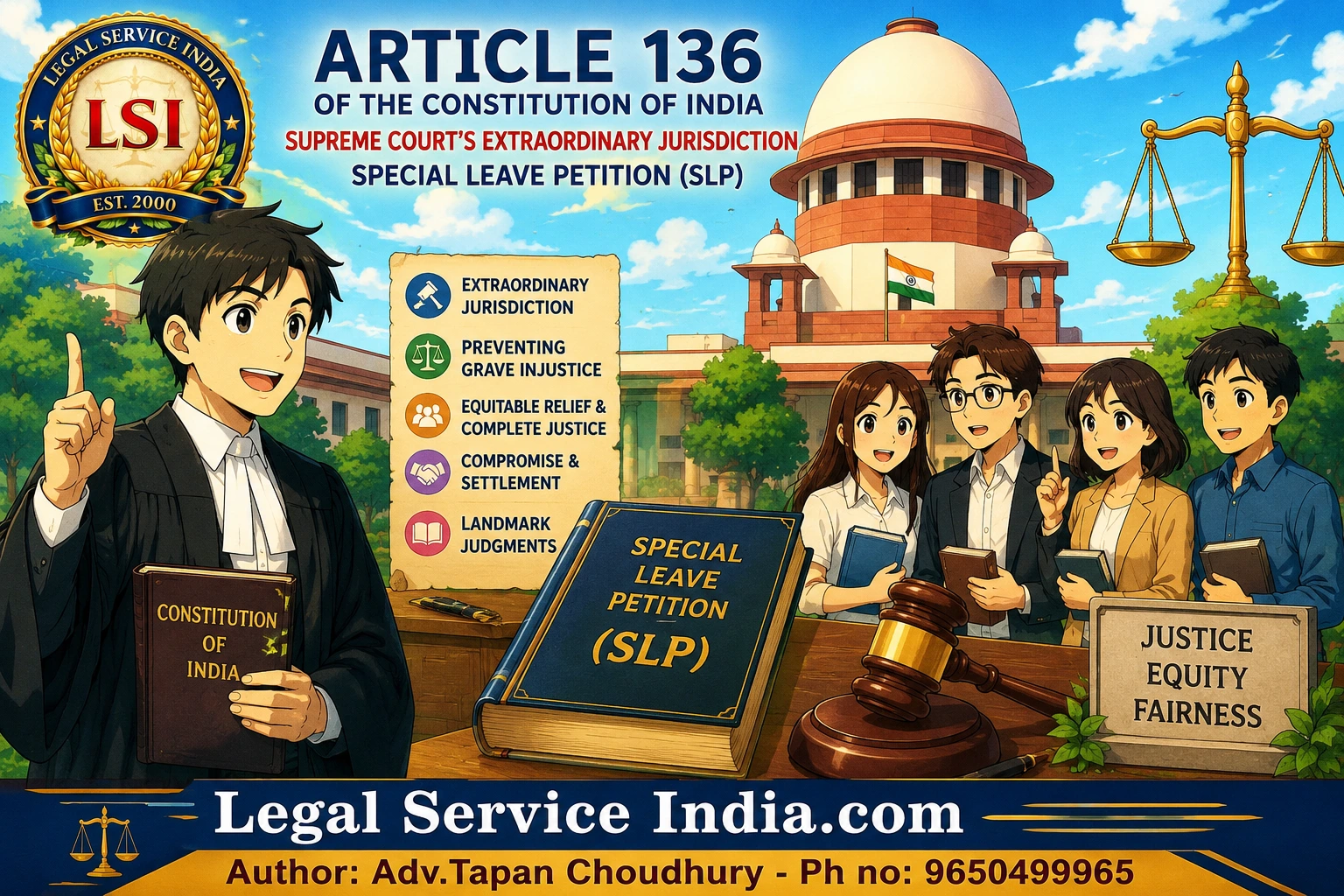
Understanding the Extraordinary Jurisdiction of the Supreme Court Under Article 136
Introduction
The Constitution of India has entrusted the Supreme Court with a unique constitutional responsibility—to ensure that justice ultimately prevails, even where ordinary legal remedies may prove inadequate. While the Constitution provides several appellate remedies, Article 136 occupies a distinct and extraordinary position. It empowers the Supreme Court to grant Special Leave to Appeal (SLP) against judgements, decrees, determinations, sentences or orders passed by any court or tribunal in India, except those specifically excluded by the Constitution.
Unlike statutory appeals, an appeal under Article 136 is not a matter of right. It is an exceptional constitutional remedy intended to correct grave injustice, substantial errors of law, jurisdictional mistakes, procedural irregularities, or decisions that shock the conscience of the court. Over the decades, the Supreme Court has repeatedly described Article 136 as a “residual reservoir of justice”, designed to ensure that technicalities do not stand in the way of substantial justice.
The Court has consistently emphasised that Article 136 is not meant to convert the Supreme Court into another regular court of appeal. Rather, it is an extraordinary discretionary jurisdiction exercised sparingly and only in cases where the interests of justice demand intervention. This constitutional philosophy has enabled the Court to evolve several important principles, including the power to record lawful compromises during the pendency of an appeal, refuse to answer hypothetical questions, declare appeals infructuous when subsequent events render them academic, and mould relief on equitable considerations.
These principles have transformed Article 136 into one of the most powerful instruments for delivering substantive justice in the Indian legal system. The judgements discussed in this article illustrate how the Supreme Court balances legal doctrine with practical realities while exercising its extraordinary appellate jurisdiction.
Key Highlights of Article 136
| Aspect | Description |
|---|---|
| Constitutional Provision | Article 136 of the Constitution of India |
| Nature of Jurisdiction | Extraordinary and discretionary appellate jurisdiction |
| Remedy | Special Leave Petition (SLP) |
| Purpose | To prevent grave injustice and correct substantial legal errors |
| Applicable To | Judgments, decrees, determinations, sentences, or orders passed by courts or tribunals in India (except those specifically excluded by the Constitution) |
| Right to Appeal | Not a matter of right; exercised solely at the discretion of the Supreme Court |
Important Principles Governing Article 136
- Article 136 provides an extraordinary constitutional remedy.
- An appeal under Article 136 is not a statutory right.
- The Supreme Court exercises this jurisdiction sparingly.
- The provision is intended to prevent grave injustice.
- It enables correction of substantial errors of law and jurisdiction.
- The Court does not function as a regular appellate court under Article 136.
- The Supreme Court may mould relief to achieve complete justice.
- The Court may record lawful compromises during pending appeals.
- Academic or hypothetical issues may not be decided.
- Appeals may become infructuous due to subsequent events.
Need Professional Assistance for Filing a Special Leave Petition (SLP)?
Adv. Tapan Choudhury, Supreme Court of India, has over 25 years of experience in Supreme Court practice. He regularly advises clients on Special Leave Petitions (SLPs), constitutional litigation and civil, criminal, commercial and service law matters before the Supreme Court of India.
For Consultation Regarding SLP Drafting, Filing and Supreme Court Litigation
- Phone: +91-9650499965
- Email: [email protected]
What Makes Article 136 Different from Ordinary Appeals?
One of the most significant distinctions between Article 136 and statutory appeals lies in the nature of the court’s jurisdiction.
Ordinary appeals arise because a statute expressly grants a right to challenge a decision. Article 136, however, confers discretionary constitutional power. Even if a party establishes that an error has occurred, the Supreme Court is not bound to entertain the appeal. The Court first examines whether the case involves a substantial miscarriage of justice, an important question of law, or exceptional circumstances warranting its intervention.
This discretionary nature has been repeatedly affirmed by the Supreme Court. The Court has observed that Article 136 is intended to be invoked only in rare and deserving cases where failure to intervene would result in grave injustice.
Consequently, every special leave petition undergoes a two-stage examination:
- Whether special leave should be granted; and
- If leave is granted, whether the appeal deserves to succeed on its merits.
This two-tier scrutiny distinguishes Article 136 from ordinary appellate proceedings and reflects the constitutional importance attached to the Supreme Court’s extraordinary jurisdiction.
Article 136 vs. Ordinary Appeals
| Ordinary Appeals | Article 136 Proceedings |
|---|---|
| Right created by statute | Discretionary constitutional power |
| An appeal generally lies as of right | Supreme Court decides whether to grant special leave |
| Focus on statutory appellate review | Focus on preventing miscarriage of justice and addressing exceptional cases |
| Single appellate process | Two-stage scrutiny before final adjudication |
Can Parties Settle Their Dispute After Filing an SLP?
A common misconception among litigants is that once a matter reaches the Supreme Court, the possibility of settlement comes to an end. The law is exactly the opposite.
The Supreme Court has consistently encouraged genuine settlements wherever they advance justice and bring finality to litigation.
Article 136 proceedings are intended to resolve disputes—not merely adjudicate them. Therefore, if the parties are able to amicably resolve their differences while an appeal or special leave petition is pending, the court generally welcomes such settlements, provided they are lawful and voluntary.
This approach reflects the broader judicial policy of encouraging alternative dispute resolution and reducing unnecessary litigation.
Compromise During Pendency of Appeal Under Article 136
The Supreme Court has repeatedly recognised that litigation should not become an obstacle to reconciliation. Even after the court grants leave and the matter is converted into a civil or criminal appeal, the parties retain the liberty to negotiate and resolve their dispute.
Where the settlement is lawful, voluntary and in the larger interests of justice, the Court possesses ample constitutional authority to record the compromise and dispose of the appeal accordingly.
This principle promotes judicial economy while simultaneously protecting the interests of litigants.
Swadeshi Cotton Mills Ltd. v. Rajeshwar Prasad: A Landmark on Compromise Before the Supreme Court
One of the leading authorities on this issue is the judgement of the Supreme Court in Swadeshi Cotton Mills Ltd, Kanpur v. Rajeshwar Prasad.
In this case, the Court examined whether parties could validly compromise their dispute after proceedings had reached the Supreme Court under Article 136.
The Supreme Court answered this question in the affirmative.
It held that the pendency of an appeal before the Supreme Court does not deprive the parties of their freedom to settle their dispute amicably.
Where a petition recording the compromise is placed before the court and the terms satisfy the requirements of legality, fairness and reasonableness, the Supreme Court may pass a decree in terms of the compromise.
More importantly, the Court recognised that such a compromise decree may substitute the decree under challenge, thereby finally resolving the dispute.
This judgement reinforces the principle that the ultimate purpose of litigation is justice—not endless adjudication.
Why Does the Supreme Court Encourage Settlements?
The constitutional philosophy behind recognising compromises under Article 136 extends beyond merely reducing the Court’s docket.
Settlement often produces better outcomes than prolonged litigation because:
- Parties Exercise Their Own Choice Unlike a judicial verdict imposed upon litigants, a negotiated settlement reflects the voluntary agreement of both sides. Consequently, compliance with compromise decrees is generally higher.
- Litigation Ends Permanently A compromise usually eliminates future rounds of litigation arising from the same dispute. This provides certainty to both parties.
- Preservation of Relationships Commercial partners, family members, employers and employees often continue interacting even after litigation. Settlement enables those relationships to survive.
- Reduction in Litigation Costs Supreme Court litigation is often expensive and time-consuming. Settlement substantially reduces legal expenses while bringing immediate closure.
- Judicial Efficiency Every successful compromise allows judicial resources to be devoted to disputes that genuinely require adjudication. This contributes to faster disposal of pending cases.
Key Benefits of Settlement
| Benefit | Practical Impact |
|---|---|
| Voluntary Resolution | Higher compliance by parties |
| Finality | Reduces future litigation |
| Relationship Preservation | Maintains commercial and personal relationships |
| Lower Costs | Saves litigation expenses and time |
| Judicial Efficiency | Allows courts to focus on deserving cases |
When Will the Supreme Court Refuse to Accept a Compromise?
Although the Supreme Court encourages settlements, it does not mechanically record every compromise presented before it.
Before accepting a compromise, the court generally examines whether the following are true:
- the settlement has been entered into voluntarily;
- the parties have acted without coercion, fraud or undue influence;
- the compromise is lawful;
- public policy is not violated;
- statutory prohibitions are not breached; and
- The settlement promotes substantial justice.
If any of these conditions are absent, the court may refuse to record the compromise and proceed to decide the appeal on its merits.
This safeguards the integrity of judicial proceedings and ensures that compromises are not used to defeat the law.
Supreme Court Checklist Before Recording a Compromise
| Requirement | Must Be Satisfied |
|---|---|
| Voluntary Consent | Yes |
| No Coercion, Fraud or Undue Influence | Yes |
| Lawful Settlement | Yes |
| Consistent with Public Policy | Yes |
| No Violation of Statutory Prohibitions | Yes |
| Promotes Substantial Justice | Yes |
Professional Assistance for Supreme Court Litigation
Whether you are challenging a High Court judgement or defending one before the Supreme Court, careful drafting of a special leave petition can significantly impact the outcome of the case. Adv. Tapan Choudhury, Supreme Court of India, with over 25 years of Supreme Court practice, advises and represents clients in special leave petitions, constitutional matters, civil appeals, criminal appeals, service disputes and commercial litigation.
- Phone: +91-9650499965
- Email: [email protected]
Compromise Under Article 136 and Order XXIII Rule 3 of the Code of Civil Procedure
The principle permitting compromise before the Supreme Court is consistent with the broader framework of Indian civil procedure.
Order XXIII Rule 3 of the Code of Civil Procedure recognises lawful compromises entered into by parties during the pendency of civil proceedings. The Supreme Court, while exercising jurisdiction under Article 136, follows the same underlying principle—that litigation should ordinarily conclude when parties voluntarily settle their disputes.
However, the Court’s powers under Article 136 are constitutional in nature and therefore considerably wider than those exercised by ordinary civil courts. The Court is not confined to a mechanical application of procedural rules. Instead, it examines whether the compromise advances the interests of justice and whether accepting it would finally resolve the controversy without offending any statutory provision or public policy.
This constitutional flexibility enables the Supreme Court to craft solutions that are both legally sound and practically effective.
Key Principles Governing Compromise Under Article 136
| Principle | Explanation |
|---|---|
| Lawful Compromise | Only lawful and voluntary settlements are recognised by the court. |
| Constitutional Jurisdiction | The Supreme Court exercises wider constitutional powers under Article 136 than ordinary civil courts. |
| Interest of Justice | The Court examines whether the settlement advances justice and finally resolves the dispute. |
| Public Policy | No compromise will be accepted if it violates statutory provisions or public policy. |
| Practical Resolution | The Court aims to craft legally sound and practically effective solutions. |
Practical Lessons for Litigants Filing Special Leave Petitions
The jurisprudence emerging from Swadeshi Cotton Mills offers valuable guidance to litigants and legal practitioners:
- Filing an SLP does not prevent negotiations between the parties.
- Settlement discussions may continue even after notice is issued or leave is granted.
- A well-drafted compromise can replace years of uncertain litigation.
- The Supreme Court generally encourages settlements that are lawful, voluntary and equitable.
- Early legal advice can help parties structure a compromise that is more likely to receive the court’s approval.
For litigants, this principle underscores that approaching the Supreme Court does not necessarily mean pursuing litigation to its bitter end. Where a fair settlement becomes possible, Article 136 provides sufficient flexibility for the court to recognise and enforce it.
Why the Supreme Court Refuses to Decide Hypothetical Questions and the Doctrine of Infructuous Appeals
So far, we have examined how Article 136 empowers the Supreme Court to entertain Special Leave Petitions (SLPs), the discretionary nature of this extraordinary jurisdiction, and the Court’s willingness to record lawful compromises even after an appeal has been admitted.
Equally important is another well-established principle governing Article 136—the Supreme Court does not function as an advisory body while exercising its appellate jurisdiction. It decides real disputes involving enforceable rights, not speculative or academic questions. This principle protects judicial discipline and ensures that constitutional courts pronounce upon issues only when they genuinely arise for adjudication.
This part explores the constitutional philosophy behind judicial restraint, the doctrine of infructuous appeals, and the leading decisions that have shaped this important aspect of Article 136.
The Supreme Court Exists to Resolve Real Disputes
One of the fundamental principles of constitutional adjudication is that courts exist to determine actual controversies affecting the legal rights of parties.
The judicial process is not intended to answer theoretical questions, settle academic debates or provide legal opinions on situations that may arise in the future.
This limitation becomes particularly significant under Article 136 because the Supreme Court exercises appellate jurisdiction, not advisory jurisdiction.
An appeal necessarily presupposes an existing dispute. If the controversy disappears, or if the court’s decision would have no practical consequence, continuing with the appeal serves little constitutional purpose.
This doctrine is rooted in judicial restraint, a principle that prevents constitutional courts from entering the domain of policy-making or rendering unnecessary legal opinions.
Core Principles of the Doctrine
| Principle | Meaning |
|---|---|
| Actual Controversy | The court decides only live disputes affecting legal rights. |
| No Academic Questions | The Court does not answer hypothetical or speculative legal issues. |
| Appellate Jurisdiction | Article 136 is meant to resolve appeals arising from actual disputes. |
| Judicial Restraint | The Court avoids unnecessary constitutional pronouncements. |
| Practical Relief | A decision should provide an effective legal remedy. |
Article 136 Is an Appellate Power, Not an Advisory Power
Many litigants mistakenly assume that once a matter reaches the Supreme Court, every legal issue raised in the pleadings will receive a definitive answer.
The law is otherwise.
The Supreme Court has repeatedly clarified that while exercising jurisdiction under Article 136, it is concerned only with questions that are necessary for deciding the dispute before it. Questions that are hypothetical, academic or merely speculative ordinarily fall outside the scope of its appellate jurisdiction.
This distinction is constitutionally significant.
The advisory jurisdiction of the Supreme Court is separately provided under Article 143 of the Constitution, where the President of India may seek the Court’s opinion on questions of law or public importance. Even under Article 143, the Court’s opinion is advisory and not the result of an adversarial appellate process.
Article 136 serves an entirely different purpose. It is designed to correct injustice in decided cases—not to provide general legal advice.
Article 136 vs. Article 143
| Aspect | Article 136 | Article 143 |
|---|---|---|
| Nature | Appellate Jurisdiction | Advisory Jurisdiction |
| Purpose | Correct injustice in decided cases | Provide advisory opinion to the President |
| Requires Live Dispute | Yes | No |
| Based on Adversarial Litigation | Yes | No |
| Focus | Real controversies affecting legal rights | Questions of law or public importance |
Judicial Restraint: Why Courts Avoid Academic Questions
The refusal to decide hypothetical issues reflects the broader doctrine of judicial restraint.
Judicial restraint requires constitutional courts to decide only those issues that are absolutely necessary for resolving the dispute before them.
There are several compelling reasons for this approach.
Avoiding Premature Decisions
Future events may unfold differently from what the parties presently anticipate.
A judicial opinion rendered on hypothetical facts may ultimately prove irrelevant or even incorrect when actual circumstances emerge.
The Supreme Court therefore prefers to wait until the controversy becomes real rather than speculate about possible future situations.
Respecting the Separation of Powers
India’s constitutional framework distributes powers among the legislature, the executive and the judiciary.
If courts begin deciding abstract legal questions disconnected from actual disputes, they risk entering areas reserved for legislative or executive decision-making.
Judicial restraint preserves the constitutional balance among these organs of the state.
Preventing Conflicting Precedents
Hypothetical questions are often argued without complete factual records.
Any legal principle evolved on incomplete facts may create confusion in future litigation.
By deciding only concrete disputes, the Supreme Court ensures that its judgements rest upon properly established factual foundations.
Efficient Use of Judicial Time
The Supreme Court carries one of the heaviest constitutional caseloads in the world.
Avoiding academic controversies enables the court to devote its limited judicial resources to disputes requiring immediate resolution.
Key Reasons for Judicial Restraint
| Reason | Why It Matters |
|---|---|
| Avoiding Premature Decisions | Ensures judgements are based on real facts rather than speculation. |
| Respecting Separation of Powers | Maintains the constitutional balance between the legislature, executive and judiciary. |
| Preventing Conflicting Precedents | Ensures legal principles develop on complete factual foundations. |
| Efficient Use of Judicial Time | Allows the Supreme Court to focus on live disputes requiring immediate adjudication. |
Central Bank of India Ltd. v. Workmen: The Leading Authority
The classic statement of this principle appears in the landmark judgement of Central Bank of India Ltd v. Workmen.
While deciding the appeals before it, the court was requested to pronounce upon legal questions that might arise in future industrial disputes after legislative amendments.
The Supreme Court firmly declined.
The Court observed that while exercising appellate jurisdiction, it was not functioning as an advisory body.
It emphasised that speculative questions concerning future situations need not be answered because they were unnecessary for deciding the appeals before it.
The court observed in substance that:
- appellate courts determine existing disputes;
- they do not deliver speculative opinions;
- Hypothetical issues should await actual litigation before being decided.
This judgement has since become one of the leading authorities explaining the limits of Article 136 jurisdiction.
Why This Principle Protects the Integrity of the Judicial System
The decision in Central Bank of India Ltd v. Workmen reflects an important constitutional philosophy.
Every judicial pronouncement becomes a precedent.
If constitutional courts begin deciding abstract questions disconnected from factual disputes, those observations may later bind courts in entirely different factual situations.
Such an approach could distort the development of law.
By insisting that legal principles evolve through real controversies, the Supreme Court ensures that its precedents remain balanced, practical and firmly grounded in evidence.
This approach also strengthens public confidence in the judicial process because courts are seen as resolving genuine grievances rather than participating in theoretical debates.
How This Principle Strengthens the Judicial System
- Ensures precedents are based on actual controversies.
- Prevents unnecessary judicial speculation.
- Maintains consistency in constitutional jurisprudence.
- Protects the separation of powers.
- Enhances public confidence in the justice delivery system.
Need Expert Assistance in a Supreme Court Matter?
Whether your case involves a challenge to a High Court judgement, a substantial question of law, or the filing of a special leave petition under Article 136, experienced legal representation is essential.
Adv. Tapan Choudhury, Supreme Court of India, has over 25 years of experience in Supreme Court practice and regularly advises clients in constitutional, civil, criminal, commercial and service matters before the Supreme Court.
- Phone: +91-9650499965
- Email: [email protected]
The Doctrine of Infructuous Appeals
Closely connected with the principle against deciding hypothetical questions is the doctrine of infructuous appeals.
An appeal becomes infructuous when subsequent events make it impossible for the court to grant any effective relief.
In such circumstances, the dispute has effectively ceased to exist.
Although the legal issues may still be intellectually interesting, the Court ordinarily declines to pronounce upon them because its decision would have no practical consequence.
The Supreme Court has consistently held that constitutional courts should not undertake exercises that merely satisfy academic curiosity.
Justice must have practical utility.
When Does an Appeal Become Infructuous?
| Situation | Result |
|---|---|
| Subsequent events eliminate the dispute | The Court cannot grant effective relief. |
| Statutory changes alter the legal framework | The original controversy loses practical significance. |
| No practical consequence remains | The appeal is ordinarily treated as infructuous. |
Motor Vehicles Permit Case: When Subsequent Events Destroy the Cause of Action
An excellent illustration of this doctrine arose under the Motor Vehicles Act, 1939.
In that case, a transport operator challenged the High Court’s decision quashing the extension of his permit.
While the appeal remained pending before the Supreme Court, an important development occurred.
The route in question was nationalised under the statutory scheme.
This fundamentally altered the legal landscape.
Even if the Supreme Court had allowed the appeal, it could no longer direct that the transport permit be granted because the statutory framework itself had changed.
Recognising this reality, the Supreme Court held that the appeal had become infructuous.
Accordingly, the Court declined to undertake an academic examination of the issues originally raised.
Key Takeaways
- Courts avoid deciding hypothetical or academic questions.
- Judicial restraint protects constitutional governance.
- Article 136 jurisdiction is exercised only for real controversies.
- Every judicial precedent should rest on established facts.
- Appeals that become incapable of granting effective relief are generally treated as infructuous.
Why the Supreme Court Does Not Decide Dead Controversies
The doctrine of infructuous appeals serves several important constitutional objectives.
1. Courts Grant Effective Relief
The principal function of courts is to provide enforceable remedies.
Where no effective relief remains possible, judicial intervention becomes unnecessary.
2. Avoiding Academic Adjudication
Courts avoid expending judicial resources on disputes that no longer affect the rights of parties.
3. Preserving Judicial Time
India’s judiciary faces an enormous backlog of cases.
Deciding appeals that have lost all practical significance diverts attention from disputes requiring urgent adjudication.
4. Preventing Unnecessary Constitutional Pronouncements
Constitutional law develops best through genuine disputes.
Academic rulings on obsolete controversies may create uncertainty in future litigation.
Summary of Constitutional Objectives
| Objective | Purpose |
|---|---|
| Courts Grant Effective Relief | Ensure enforceable remedies are available. |
| Avoiding Academic Adjudication | Prevent unnecessary adjudication of disputes that no longer affect legal rights. |
| Preserving Judicial Time | Allow courts to focus on disputes requiring immediate judicial intervention. |
| Preventing Unnecessary Constitutional Pronouncements | Ensure constitutional principles evolve through real controversies. |
Exceptions: When the Supreme Court May Still Decide a Matter
Although the Court generally avoids hypothetical or infructuous matters, there are exceptional situations where it may still proceed.
These include cases involving:
- recurring constitutional questions of public importance;
- issues capable of repetition yet repeatedly evading judicial review;
- continuing violations affecting large sections of society;
- substantial questions impacting the future administration of justice.
However, such exceptions are relatively rare and are exercised with great caution.
The guiding consideration always remains whether deciding the issue would meaningfully serve the administration of justice.
Exceptional Circumstances at a Glance
| Exceptional Situation | Reason for Judicial Consideration |
|---|---|
| Recurring constitutional questions of public importance | Provide clarity on significant constitutional issues. |
| Issues capable of repetition yet repeatedly evading judicial review | Prevent recurring legal uncertainty. |
| Continuing violations affecting large sections of society | Protect broader public interest. |
| Substantial questions impacting future administration of justice | Promote consistency in judicial administration. |
Practical Guidance for Litigants Filing SLPs
Litigants approaching the Supreme Court should keep several practical considerations in mind.
- First, prolonged delays may sometimes render the original relief impossible.
- Secondly, subsequent statutory amendments or policy changes may fundamentally alter the legal position.
- Thirdly, parties should keep the Court informed about all developments affecting the maintainability or utility of the appeal.
Failure to disclose material subsequent events may weaken the credibility of a litigant’s case.
Experienced Supreme Court practitioners therefore continuously monitor developments occurring after the filing of an SLP to ensure that appropriate applications are moved whenever circumstances change.
Practical Checklist for SLP Litigants
| Consideration | Importance |
|---|---|
| Monitor delays | Original relief may become impossible over time. |
| Track legal developments | Legislative or policy changes may affect the case. |
| Inform the Court promptly | Maintain transparency regarding subsequent events. |
| Monitor post-filing developments | Enable timely applications whenever circumstances change. |
Professional Advice on Special Leave Petitions (SLPs)
Every SLP presents unique procedural and constitutional issues. Strategic legal advice at the drafting stage can significantly improve the presentation of your case before the Supreme Court. Adv. Tapan Choudhury, Supreme Court of India, with more than 25 years of Supreme Court practice, advises clients on SLP drafting, admission strategy, interim relief, constitutional litigation and final hearing before the Supreme Court.
- Phone: +91-9650499965
- Email: [email protected]
Key Legal Principles Emerging from These Decisions
The Supreme Court’s jurisprudence under Article 136 establishes several settled propositions:
- The Court exercises appellate—not advisory—jurisdiction.
- It decides only real disputes affecting legal rights.
- Hypothetical and speculative questions are ordinarily not entertained.
- Appeals become infructuous when subsequent events make effective relief impossible.
- Judicial restraint is an essential feature of constitutional adjudication.
- The Court’s time is reserved for controversies where its judgement can produce meaningful legal consequences.
Summary of Settled Principles Under Article 136
| Legal Principle | Meaning |
|---|---|
| Appellate Jurisdiction | The Court exercises appellate—not advisory—jurisdiction. |
| Real Disputes Only | The Court decides only disputes affecting existing legal rights. |
| No Hypothetical Questions | Speculative or academic issues are ordinarily not entertained. |
| Infructuous Appeals | Appeals become infructuous when effective relief is no longer possible. |
| Judicial Restraint | Constitutional adjudication requires restraint and discipline. |
| Meaningful Relief | The court prioritises controversies capable of producing meaningful legal consequences. |
These principles ensure that Article 136 remains a powerful instrument for correcting injustice while preserving the discipline and integrity of constitutional adjudication.
The Supreme Court’s Equitable Jurisdiction Under Article 136 – Where Justice Prevails Over Technicality
Thus far, we examined the extraordinary nature of the Supreme Court’s jurisdiction under Article 136, its power to accept lawful compromises, and its refusal to decide hypothetical or academic questions.
Equally significant is another dimension of Article 136 that has made it one of the most powerful constitutional provisions in India—the Supreme Court’s ability to mould relief on equitable considerations.
Unlike ordinary appellate courts, the Supreme Court does not always confine itself to a rigid application of legal rules. While law remains the foundation of every decision, Article 136 enables the Court, in exceptional circumstances, to balance legal principles with fairness, justice, and practical realities.
This equitable jurisdiction has evolved through decades of constitutional jurisprudence and has ensured that deserving litigants are not denied justice merely because of procedural technicalities or unusual factual situations.
Equity and Justice: The Constitutional Spirit Behind Article 136
The framers of the Constitution intentionally vested the Supreme Court with wide discretionary powers so that it could intervene wherever strict adherence to legal rules would produce an unjust result.
This philosophy is reflected in numerous judgements where the court has observed that the ultimate purpose of the judicial process is not merely to apply the law mechanically but to deliver substantive justice.
Equity, however, is not a substitute for law. Rather, it complements legal principles by allowing the court to fashion remedies that address the realities of each case.
In exercising its jurisdiction under Article 136, the Supreme Court has repeatedly emphasised that justice must be tempered with fairness, compassion, and common sense.
This extraordinary power distinguishes the Supreme Court from ordinary appellate courts and underscores its constitutional role as the final guardian of justice.
What Does “Moulding Relief” Mean?
The expression “moulding relief” refers to the Supreme Court’s authority to grant a remedy different from what would ordinarily follow under a strict application of law, provided such a course is necessary to achieve complete justice between the parties.
For example, instead of:
- setting aside an entire selection process,
- cancelling appointments after many years,
- directing reinstatement with full back wages,
- or dismissing deserving claims because of procedural complications,
The Supreme Court may devise a balanced solution that protects legal rights while avoiding unnecessary hardship.
Such relief is not granted as a matter of routine. It is exercised only where the facts of the case justify the court’s intervention to prevent injustice.
I.J. Divakar v. State of Andhra Pradesh: Equity Protecting Legitimate Expectations
One of the leading authorities on equitable relief under Article 136 is I.J. Divakar v. State of Andhra Pradesh.
The appellants, all young engineering graduates, had applied for recruitment as junior engineers pursuant to an advertisement issued through the Public Service Commission.
They participated in the selection process, including the viva voce examination, and legitimately expected that the recruitment would be completed.
However, before the process concluded, the government withdrew the vacancies from the Public Service Commission.
Aggrieved candidates challenged the government’s decision before the courts.
When the matter reached the Supreme Court, the Court ultimately rejected the legal challenges raised by the appellants.
Strictly speaking, the litigation should have ended there.
But the Supreme Court did not stop at the legal analysis.
Recognising that the candidates had invested time, effort, and hope in a recruitment process initiated by the state itself, the Court considered the equities involved.
It observed that allowing the matter to end without any relief would unfairly prejudice young graduates who had done nothing wrong.
To avoid such injustice, the court directed the Public Service Commission to finalise the selection list on the basis of the interviews already conducted and forward the recommendations to the government within a specified period.
Although the appellants failed in law, they succeeded in equity.
The Broader Significance of the Divakar Judgment
The decision in I.J. Divakar demonstrates several important principles.
| Principle | Explanation |
|---|---|
| Justice Beyond Technicalities | First, the Supreme Court does not view justice as a mechanical exercise. The Court appreciates that governmental actions often affect the legitimate expectations of citizens. |
| Fairness in Public Administration | Secondly, the judgement reflects the constitutional obligation of public authorities to act fairly. Once a recruitment process has substantially progressed, arbitrary changes may produce serious hardship for candidates who have relied upon official representations. |
| Balancing Law and Equity | Finally, the case illustrates that Article 136 enables the Supreme Court to bridge the gap between strict legality and practical fairness. |
Professional Assistance in Special Leave Petitions
Drafting and arguing a special leave petition requires a clear understanding of constitutional principles, procedural requirements, and Supreme Court practice.
Adv. Tapan Choudhury, Supreme Court of India, has over 25 years of experience in Supreme Court litigation and regularly represents clients in constitutional matters, civil disputes, criminal appeals, service law, commercial litigation, and special leave petitions.
For Professional Consultation
| Phone | +91-9650499965 |
|---|---|
| [email protected] |
Municipal Board, Pratapgarh v. Mahendra Singh Chawla: Tempering Law with Equity
Another landmark illustration of the Court’s equitable jurisdiction is found in Municipal Board, Pratapgarh v. Mahendra Singh Chawla.
The High Court had ordered reinstatement of an employee whose services had been terminated.
The Municipal Board challenged this order before the Supreme Court.
Upon examining the legal issues, the Supreme Court concluded that the High Court’s reasoning was not entirely consistent with established legal principles.
Ordinarily, this finding would have resulted in the complete reversal of the High Court’s judgement.
However, the Supreme Court recognised that such an outcome would cause disproportionate hardship to the employee.
Rather than adopting an all-or-nothing approach, the Court chose to mould the relief.
The respondent was treated as continuing in service and granted continuity of service along with consequential benefits such as increments.
At the same time, the Court denied back wages, thereby balancing the interests of both parties.
“While administering law, it is to be tempered with equity.”
This observation has become a guiding principle in numerous subsequent decisions under Article 136.
Why This Judgment Remains Important
The significance of Mahendra Singh Chawla extends far beyond employment disputes.
It establishes that:
- justice is not always achieved through absolute legal victories;
- courts should consider the practical consequences of their decisions;
- remedies should minimise unnecessary hardship;
- Constitutional courts possess flexibility to achieve balanced outcomes.
The judgement continues to influence service law, labour law, administrative law, and constitutional litigation.
Key Takeaways: Equitable Jurisdiction Under Article 136
| Aspect | Key Principle |
|---|---|
| Nature of Power | Discretionary and equitable jurisdiction to achieve complete justice. |
| Purpose | Prevent injustice arising from strict application of legal rules. |
| Moulding Relief | Granting balanced remedies suited to the facts of each case. |
| Leading Cases | I.J. Divakar v. State of Andhra Pradesh; Municipal Board, Pratapgarh v. Mahendra Singh Chawla. |
| Constitutional Objective | Balancing legality, fairness, equity, and practical justice. |
The Supreme Court Is Both a Court of Law and a Court of Equity
Perhaps the clearest articulation of the Supreme Court’s equitable jurisdiction appears in Chandra Bansi Singh v. State of Bihar.
The dispute concerned compensation payable for acquired land. Because possession had been taken after considerable delay, the landowners suffered financial loss during the intervening period.
The governing statute, however, contained no provision authorising payment of compensation for this additional period.
A strict interpretation of the law would therefore have denied any further relief.
The Supreme Court declined to adopt such an approach.
Instead, it held that while the Court undoubtedly functions as the highest court of law, it is also a court of equity.
Proceeding on this principle, the Court directed payment of additional compensation to the affected landowners despite the absence of an express statutory provision.
The judgement underscores an important constitutional truth: the absence of a specific statutory remedy does not always prevent the Supreme Court from granting equitable relief where justice clearly demands it.
Equity Is Not Arbitrary
The decision in Chandra Bansi Singh does not suggest that judges may disregard statutory law whenever they perceive unfairness.
On the contrary, equitable jurisdiction operates within constitutional limits.
The court exercises this power cautiously and only where the following are true:
- Exceptional circumstances exist.
- Substantial injustice would otherwise occur.
- The remedy does not violate statutory prohibitions.
- Public interest remains protected.
Thus, Article 136 does not authorise judicial arbitrariness. It authorises judicial fairness.
Mohinder Singh Garg v. State of Punjab: Correcting Illegality Without Creating New Injustice
The Supreme Court’s pragmatic approach reached another high point in Mohinder Singh Garg v. State of Punjab.
The petitioners challenged the recruitment process for taxation inspectors and excise inspectors on the ground that allocating 25% marks for interviews was arbitrary and contrary to settled legal principles.
After examining the matter, the Supreme Court agreed.
The allocation of such a high percentage of interview marks was held to be legally unsustainable.
Ordinarily, this conclusion should have resulted in cancellation of the entire selection process.
However, the Court recognised several practical realities.
Practical Realities Considered by the Court
- The selected candidates had already joined service.
- Many years had passed.
- The selected candidates were not parties to the litigation.
- No other unsuccessful candidates had challenged the recruitment.
Cancelling the entire selection would therefore punish individuals who had accepted appointments in good faith and had served the state for years.
Rather than creating fresh injustice while correcting an existing illegality, the Supreme Court adopted a balanced approach.
It examined the written examination marks independently and concluded that three petitioners had a genuine chance of selection under a legally valid process.
The Court directed that these candidates be appointed, subject to their suitability, while allowing the appointments already made to continue.
This judgement is a classic example of the Supreme Court harmonising legal correctness with equitable justice.
Key Principles from the Judgment
| Issue | Supreme Court’s Approach |
|---|---|
| Interview marks | Held that allocating 25% interview marks was legally unsustainable. |
| Existing appointments | Allowed appointments already made to continue. |
| Relief to petitioners | Directed appointment of eligible petitioners subject to suitability. |
| Underlying principle | Balanced legal correctness with equitable justice. |
Time as an Equitable Consideration
The Supreme Court has also recognised that the passage of time itself may create equitable rights.
In one important case, the operation of the High Court’s judgement had been stayed after the grant of special leave. Consequently, the respondent continued to occupy the disputed post for several years during the pendency of the appeal.
When the matter finally came up for hearing, the Court observed that removing the respondent after such a long period would serve no useful purpose. The individual had continued in service under the protection of judicial orders, had acquired experience, and had structured his professional life accordingly.
The Supreme Court therefore declined to disturb the existing arrangement, holding that equity demanded preservation of the status quo.
This approach reflects the Court’s sensitivity to the practical consequences of prolonged litigation.
Why Time Matters in Equity
- Continuation under judicial protection.
- Experience acquired during prolonged service.
- Professional life structured around existing employment.
- Avoidance of unnecessary hardship after years of litigation.
Equity Must Always Follow Justice
Although Article 136 grants the Supreme Court broad powers, these powers are exercised with great restraint.
The Court has consistently emphasised that equity cannot be invoked to legitimise illegality or defeat statutory mandates.
Equitable relief is available only where it advances justice without undermining the rule of law.
This careful balance explains why the Supreme Court’s equitable jurisdiction has earned enduring respect within India’s constitutional framework.
Core Principles of Equitable Jurisdiction
| Principle | Application by the Supreme Court |
|---|---|
| Justice | Ensures fairness where statutory remedies are inadequate. |
| Restraint | Exercises equitable powers cautiously. |
| Rule of Law | Does not permit equity to override statutory prohibitions. |
| Public Interest | Balances individual relief with broader constitutional values. |
Limits of Equitable Jurisdiction Under Article 136
We examined so far how Article 136 empowers the Supreme Court to entertain Special Leave Petitions (SLPs), recognise lawful compromises, refuse hypothetical questions, declare appeals infructuous where no effective relief can be granted, and mould relief to ensure that justice prevails over rigid technicalities.
However, the Supreme Court has also repeatedly cautioned that its extraordinary jurisdiction under Article 136 is not unlimited. While the Court possesses wide discretionary powers, those powers are exercised within the framework of the Constitution and the rule of law. Equity supplements the law—it does not replace it.
Understanding these constitutional limitations is essential for every litigant and legal practitioner seeking relief under Article 136.
Article 136 Is an Extraordinary Jurisdiction, Not an Ordinary Right of Appeal
One of the most common misconceptions among litigants is that every judgement of a High Court can automatically be challenged before the Supreme Court through a special leave petition.
This is not the correct legal position.
The Supreme Court has consistently held that Article 136 does not create a vested right of appeal. Instead, it confers a discretionary constitutional power upon the Court to intervene only where the interests of justice require such intervention.
Consequently, thousands of special leave petitions are filed every year, but only a relatively small percentage are admitted for final hearing.
The court ordinarily looks for factors such as the following:
- substantial questions of law;
- gross miscarriage of justice;
- jurisdictional errors;
- violation of principles of natural justice;
- manifest perversity in findings;
- conflicting decisions requiring authoritative interpretation; or
- issues of significant public importance.
Mere dissatisfaction with the findings of a lower court is rarely sufficient.
Equity Cannot Override the Law
The Supreme Court has repeatedly clarified that equitable considerations cannot be invoked to defeat statutory provisions or constitutional mandates.
In other words, Article 136 does not empower the Court to ignore legislation merely because a different outcome may appear fairer.
Rather, equitable jurisdiction is exercised within the boundaries of law.
The Court may mould relief, adjust remedies, or protect legitimate interests, but it cannot validate actions that are fundamentally illegal or contrary to public policy.
This distinction preserves the rule of law while allowing sufficient flexibility to achieve substantial justice.
Difference Between Article 136 and Article 142
One of the most frequently misunderstood aspects of Supreme Court practice is the relationship between Article 136 and Article 142.
Although these constitutional provisions often operate together, they serve different purposes.
| Article 136 | Article 142 |
|---|---|
| Confers discretionary appellate jurisdiction through special leave petitions. | Empowers the Supreme Court to pass any decree or order necessary for doing complete justice in a matter before it. |
| Determines whether the Court should entertain an appeal. | Enables the Court to fashion appropriate relief after assuming jurisdiction. |
| Primarily concerned with correcting judicial errors. | Primarily concerned with ensuring complete justice between the parties. |
| Operates at the stage of granting or hearing appeals. | Operates while finally disposing of matters before the court. |
In many significant judgements, the Supreme Court has exercised jurisdiction under Article 136 while simultaneously invoking the broad remedial powers available under Article 142 to ensure complete justice.
Together, these provisions constitute one of the most powerful constitutional mechanisms for correcting injustice in India.
Practical Guidance for Filing an SLP Under Article 136
Before filing a Special Leave Petition under Article 136, litigants and legal practitioners should keep the following practical considerations in mind:
- Understand that Article 136 provides a discretionary remedy and not a statutory right of appeal.
- Identify substantial questions of law or significant constitutional issues before approaching the Supreme Court.
- Demonstrate gross miscarriage of justice, jurisdictional error, or violation of natural justice wherever applicable.
- Avoid filing an SLP merely because the High Court’s findings are unfavourable.
- Ensure that all pleadings, documents, and annexures clearly establish why the Supreme Court should exercise its extraordinary jurisdiction.
- Remember that equitable relief supplements the law and cannot be used to defeat statutory provisions.
- Where appropriate, explain how complete justice may require the court to exercise its powers after assuming jurisdiction.
Frequently Asked Questions (FAQs)
Is Article 136 a right of appeal?
No. Article 136 does not confer an automatic right of appeal. It grants the Supreme Court discretionary power to entertain special leave petitions in appropriate cases.
Can the Supreme Court ignore the law under Article 136?
No. The Supreme Court has consistently held that equitable jurisdiction cannot override statutory provisions or constitutional mandates.
When does the Supreme Court usually entertain an SLP?
The Court ordinarily considers factors such as substantial questions of law, gross miscarriage of justice, jurisdictional errors, violations of natural justice, manifest perversity, conflicting judicial decisions, and issues of significant public importance.
What is the difference between Article 136 and Article 142?
Article 136 enables the Supreme Court to entertain an appeal through special leave, whereas Article 142 empowers the Court to pass appropriate orders necessary for doing complete justice after jurisdiction has been assumed.
Can Article 136 and Article 142 be exercised together?
Yes. In several important cases, the Supreme Court has exercised jurisdiction under Article 136 and simultaneously invoked Article 142 to ensure complete justice between the parties.
Conclusion
We examined so far how Article 136 empowers the Supreme Court to entertain Special Leave Petitions (SLPs), recognise lawful compromises, refuse hypothetical questions, declare appeals infructuous where no effective relief can be granted, and mould relief to ensure that justice prevails over rigid technicalities.
At the same time, the Supreme Court has consistently emphasised that these extraordinary powers are exercised within constitutional boundaries. Article 136 is a carefully guarded discretionary jurisdiction intended to prevent miscarriage of justice rather than provide another routine stage of appeal. Equitable principles may guide the Court in moulding relief, but they cannot replace statutory law or constitutional limitations.
When read together with Article 142, Article 136 forms a unique constitutional framework that enables the Supreme Court to correct injustice while preserving the rule of law. For litigants and legal practitioners, understanding both the scope and the limits of these provisions is indispensable for effectively invoking the Supreme Court’s extraordinary jurisdiction.
Why Article 136 Continues to Be One of the Most Important Constitutional Remedies
Article 136 occupies a unique place in India’s constitutional framework because it acts as the final constitutional safeguard against miscarriage of justice.
Its importance lies in several distinctive features.
Protection Against Judicial Error
Even after exhausting ordinary appellate remedies, litigants may still approach the Supreme Court where exceptional circumstances justify intervention.
This provides an important constitutional safety valve.
Uniform Development of Law
Article 136 enables the Supreme Court to settle conflicting interpretations delivered by different high courts, thereby promoting legal certainty throughout the country.
Protection of Fundamental Fairness
Although Article 136 is not confined to fundamental rights litigation, the Court frequently invokes it where judicial or administrative decisions have resulted in manifest unfairness.
Constitutional Flexibility
No legal system can anticipate every factual situation.
Article 136 equips the Supreme Court with sufficient flexibility to respond to exceptional cases while preserving the rule of law.
Need Professional Assistance with a Special Leave Petition (SLP)?
Filing an SLP before the Supreme Court requires careful evaluation of the legal issues, limitation period, maintainability, and the grounds on which the Supreme Court may exercise its extraordinary jurisdiction under Article 136.
Adv. Tapan Choudhury, Supreme Court of India, has more than 25 years of experience in Supreme Court practice and advises clients on drafting, filing, and arguing special leave petitions in constitutional, civil, criminal, commercial, service, taxation, and arbitration matters.
| Professional Consultation | Details |
|---|---|
| Phone | +91-9650499965 |
| [email protected] |
Practical Guidance for Litigants Considering an SLP
Before filing a special leave petition, litigants should keep the following practical considerations in mind.
Examine Whether the Case Truly Warrants Supreme Court Intervention
Every adverse judgement does not justify an SLP.
An experienced legal assessment should determine whether the case raises substantial questions warranting the court’s extraordinary jurisdiction.
Focus on Legal Error Rather Than Re-Arguing Facts
The Supreme Court ordinarily does not function as a third fact-finding court.
The petition should clearly demonstrate serious legal or constitutional errors.
Act Promptly
SLPs are governed by limitation periods.
Unexplained delay may result in dismissal at the threshold.
Ensure Proper Drafting
A well-drafted special leave petition should:
- identify substantial questions of law;
- explain the miscarriage of justice;
- highlight conflicting precedents where applicable;
- present facts accurately and concisely;
- avoid unnecessary repetition.
Effective drafting often determines whether notice is issued by the court.
| Essential Drafting Requirement | Purpose |
|---|---|
| Identify substantial questions of law | Demonstrates why Supreme Court intervention is necessary. |
| Explain the miscarriage of justice | Shows exceptional circumstances warranting relief. |
| Highlight conflicting precedents where applicable | Helps establish the need for legal clarity. |
| Present facts accurately and concisely | Improves readability and judicial understanding. |
| Avoid unnecessary repetition | Keeps the petition focused and persuasive. |
Lessons for Young Lawyers
Article 136 offers valuable lessons for advocates beginning Supreme Court practice.
The most successful Supreme Court practitioners recognise that advocacy before the country’s highest court differs fundamentally from ordinary appellate practice.
Arguments should emphasise:
- constitutional principles;
- substantial injustice;
- legal significance;
- precedential value;
- practical consequences of the proposed relief.
Persuading the court requires clarity, precision, and an appreciation of the limited scope of Article 136.
Frequently Asked Questions (FAQs)
Can Every High Court Judgement Be Challenged Under Article 136?
Yes.
An SLP may be filed against many High Court judgements and certain tribunal decisions, but the Supreme Court decides, in its discretion, whether to grant special leave. There is no automatic right of appeal.
Is Article 136 Itself a Fundamental Right?
No.
Article 136 is a constitutional remedy conferring discretionary jurisdiction upon the Supreme Court. It is not a fundamental right available as a course.
Can Parties Settle a Dispute After Filing an SLP?
Yes.
If the settlement is lawful, voluntary, and fair, the Supreme Court may record the compromise and dispose of the appeal in terms of the settlement.
Can the Supreme Court Refuse to Answer a Legal Question?
Yes.
The Court ordinarily refuses to answer hypothetical, academic, or speculative questions that are unnecessary for deciding the dispute before it.
Can the Supreme Court Grant Relief Even Where Strict Legal Remedies Are Unavailable?
Yes.
In exceptional cases, the Court may mould relief on equitable considerations to prevent injustice, provided such relief does not violate statutory or constitutional limitations.
Can Subsequent Events Affect an SLP?
Certainly.
If later developments make effective relief impossible, the appeal may become infructuous and may be disposed of without deciding the original legal issues.
Key Takeaways
The jurisprudence developed under Article 136 establishes several enduring principles:
| Principle | Significance |
|---|---|
| Article 136 confers extraordinary discretionary jurisdiction. | The Supreme Court exercises this power only in exceptional circumstances. |
| Filing an SLP does not create an automatic right to a hearing. | Grant of special leave remains entirely discretionary. |
| Parties may compromise disputes even during the pendency of an appeal. | The Court may record a lawful settlement and dispose of the matter accordingly. |
| The Supreme Court does not decide hypothetical or academic questions. | Only live controversies requiring adjudication are ordinarily entertained. |
| Appeals may become infructuous due to subsequent events. | The Court may decline to decide issues where effective relief is no longer possible. |
| Equity enables the court to mould relief but does not authorise departure from the rule of law. | Equitable jurisdiction supplements but never overrides statutory or constitutional limitations. |
| Article 136 and Article 142 often operate together to secure complete justice. | The provisions complement each other in appropriate cases. |
| The ultimate objective of Article 136 is to prevent miscarriage of justice while preserving constitutional discipline. | The provision functions as an exceptional constitutional safeguard. |
Supreme Court Litigation and SLP Filing Assistance
The success of a special leave petition often depends upon identifying the correct constitutional questions and presenting them effectively before the Supreme Court. Adv. Tapan Choudhury, Supreme Court of India, with over 25 years of experience in Supreme Court practice, assists clients in evaluating, drafting, filing, and pursuing special leave petitions across a wide range of legal disciplines.
- Experience: Over 25 years of Supreme Court practice
- Practice Area: Special Leave Petitions (SLPs), Constitutional Litigation, Civil Appeals, Criminal Appeals, Service Matters, Commercial Disputes, and other Supreme Court litigation
- Phone: +91-9650499965
- Email: [email protected]
Conclusion
Article 136 is one of the most remarkable provisions of the Indian Constitution. It reflects the framers’ vision that no legal system, however comprehensive, can foresee every circumstance in which justice may require intervention by the nation’s highest court. By conferring extraordinary discretionary jurisdiction upon the Supreme Court, Article 136 acts as a constitutional safety valve against miscarriage of justice.
The decisions discussed throughout this article demonstrate that the Supreme Court’s role extends far beyond correcting legal errors. The Court encourages genuine settlements where appropriate, declines to answer hypothetical questions that lack practical significance, recognises when subsequent events render appeals infructuous, and moulds relief to ensure that justice is fair, balanced, and effective.
At the same time, the Court has consistently reaffirmed that these extraordinary powers are exercised with restraint. Equity does not replace law, nor does Article 136 convert the Supreme Court into a regular appellate forum. Instead, the provision serves as an exceptional constitutional mechanism, invoked only where intervention is necessary to uphold the rule of law and prevent substantial injustice.
For litigants, Article 136 represents an invaluable opportunity to seek redress in deserving cases. For advocates, it demands meticulous preparation, careful legal analysis, and persuasive advocacy. And for the constitutional system as a whole, it remains a testament to the enduring commitment of the Indian judiciary to ensure that justice is not merely technical but real, meaningful, and complete.
Key Takeaways: Article 136 and Special Leave Petition (SLP)
| Topic | Key Takeaway |
|---|---|
| Purpose of Article 136 | Article 136 empowers the Supreme Court of India to grant a Special Leave Petition (SLP) against judgments, orders, decrees, or decisions of courts and tribunals in exceptional cases. |
| Nature of SLP | A Special Leave Petition (SLP) is not a statutory right of appeal. It is an extraordinary discretionary constitutional remedy exercised only when justice demands Supreme Court intervention. |
| Grounds for Intervention | The Supreme Court uses Article 136 to correct grave injustice, jurisdictional errors, violations of natural justice, manifest perversity, and substantial questions of law. |
| Limited Jurisdiction | The Court has consistently held that Article 136 is not meant to convert the Supreme Court into a regular appellate court. It intervenes only in rare and deserving cases. |
| Two-Stage Scrutiny | Every SLP under Article 136 undergoes a two-stage scrutiny—first, whether special leave should be granted, and second, whether the appeal deserves to succeed on merits. |
| Settlement During Appeal | The Supreme Court may record lawful compromises and settlements even after an SLP or appeal has been admitted, provided the settlement is voluntary, lawful, fair, and consistent with public policy. |
| Benefits of Settlement | Settlement during Supreme Court proceedings promotes judicial efficiency, reduces litigation costs, preserves relationships, and brings finality to disputes. |
| Real Controversies Only | The Court refuses to decide hypothetical, speculative, or academic questions while exercising jurisdiction under Article 136, deciding only real controversies affecting legal rights. |
| Judicial Restraint | The doctrine of judicial restraint ensures that constitutional courts avoid unnecessary legal pronouncements and preserve the separation of powers. |
| Infructuous Appeals | An appeal may become infructuous if subsequent events make it impossible for the Supreme Court to grant effective relief, in which case the Court ordinarily declines to decide academic issues. |
| Exceptional Cases | Although rare, the Supreme Court may still decide otherwise infructuous matters where they involve recurring constitutional questions, issues of significant public importance, or matters capable of repetition yet evading judicial review. |
| Equitable Jurisdiction | One of the most distinctive features of Article 136 is the Supreme Court’s equitable jurisdiction, enabling it to mould relief to achieve substantial justice where strict application of law would produce an unfair result. |
| Equity and Law | The Court has repeatedly emphasized that equity complements the law but never overrides statutory provisions or constitutional limitations. |
| Landmark Principles | Landmark decisions demonstrate that the Supreme Court can balance legality with fairness, protecting legitimate expectations while maintaining the rule of law. |
| Articles 136 and 142 | Article 136 and Article 142 often work together. While Article 136 allows the Supreme Court to entertain an appeal through Special Leave, Article 142 empowers it to pass orders necessary to do complete justice. |
| When to Approach the Supreme Court | Litigants should approach the Supreme Court only when their case involves substantial legal questions, gross miscarriage of justice, jurisdictional errors, or issues of constitutional significance. |
| Drafting an Effective SLP | A well-drafted Special Leave Petition should clearly identify substantial questions of law, constitutional issues, legal errors, and exceptional circumstances warranting Supreme Court intervention. |
| Appreciation of Evidence | The Supreme Court generally does not re-appreciate evidence or re-examine factual findings unless they result in manifest injustice or legal perversity. |
| Constitutional Safety Valve | Article 136 serves as a constitutional safety valve, ensuring that technicalities do not defeat substantive justice while preserving judicial discipline. |
| Practical Importance | For lawyers and litigants alike, understanding the scope, limitations, equitable principles, and discretionary nature of Article 136 is essential for effective Supreme Court litigation and successful SLP practice. |
Quick Summary
- Article 136 is an extraordinary constitutional remedy.
- An SLP is not a matter of right but is granted at the Supreme Court’s discretion.
- The Supreme Court intervenes only in exceptional cases involving grave injustice or substantial legal questions.
- Article 136 functions alongside Article 142 to ensure complete justice.
- The Court exercises judicial restraint and avoids deciding hypothetical or academic disputes.
- Equitable jurisdiction under Article 136 enables the Court to mould relief without overriding statutory or constitutional provisions.
- A carefully drafted SLP identifying substantial questions of law significantly improves the prospects of admission.