





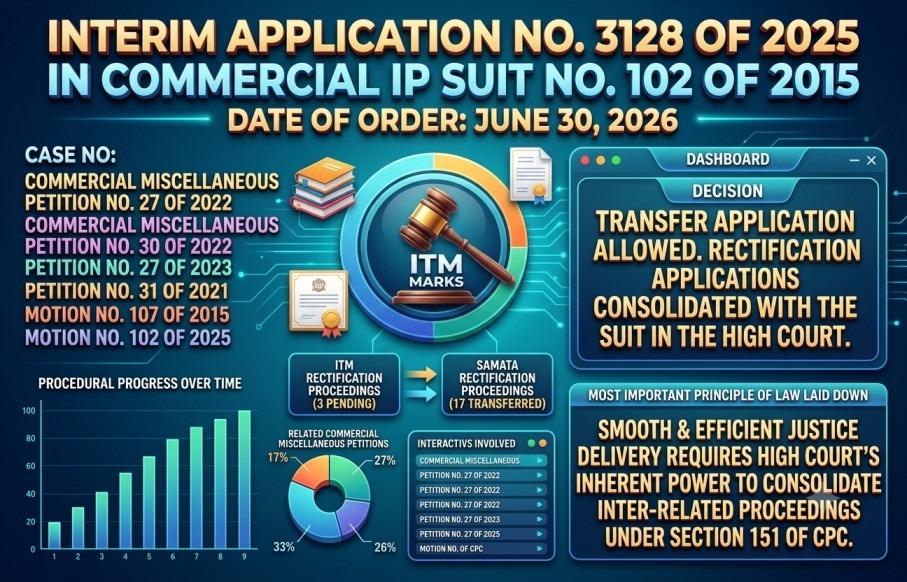
Introduction
In a significant ruling on procedural efficiency in intellectual property disputes, the Bombay High Court addressed the consolidation of parallel trademark rectification proceedings. This case underscores the challenges of fragmented litigation in trademark battles between educational institutions and highlights the judiciary’s role in ensuring coherent justice delivery.
For litigants, practitioners, and businesses involved in IP matters, the judgement clarifies pathways for transferring cases from the Registrar of Trade Marks to the High Court, promoting faster resolution and preventing inconsistent decisions in overlapping disputes. It balances statutory frameworks with practical needs in India’s evolving IP landscape.
Factual and Procedural Background
Two trusts engaged in educational activities clashed over the “ITM” marks.
- The Institute for Technology and Management Trust (ITM) filed a commercial IP suit in 2015 alleging abuse of its marks by Samata Lok Sansthan Trust.
- ITM initiated rectification proceedings before the Registrar of Trade Marks seeking cancellation of Samata’s registrations.
- Samata responded with its own rectification applications before the erstwhile IPAB against ITM’s registrations.
- Following the IPAB’s disbandment, Samata’s proceedings were transferred to the High Court and directed to be heard with the suit.
- ITM then filed an interim application seeking the transfer of its three rectification proceedings from the Registrar to the High Court for consolidation.
- Multiple miscellaneous petitions and related applications were also clubbed, involving overlapping issues of trademark validity between the same parties.
Dispute Before the Court
The central issue was whether the High Court could transfer rectification proceedings from the Registrar to itself under Section 24 of the Code of Civil Procedure for clubbing with the ongoing suit and other matters.
ITM argued for efficiency to avoid divergent outcomes in connected disputes over the same marks.
Samata opposed, contending that
- The application was misconceived, as the Registrar is not a “court” subordinate to the High Court.
- The filing should have been under Section 125 of the Trademarks Act or on the Appellate Side.
- Judicial precedents did not support the proposed transfer.
The parties debated the registrar’s status, the inherent powers of the court, and the procedural requirements governing such transfers.
Reasoning and Analysis of the Court
The Court analysed Section 24 of the Code of Civil Procedure (CPC), which empowers the High Court to transfer proceedings from subordinate courts, alongside Section 151 CPC relating to inherent powers.
It examined the Trade Marks Act, 1999, particularly Sections 47, 57, 91, 124, and 127, noting the Registrar’s broad powers akin to those of a civil court, including the following:
- Receiving evidence.
- Administering oaths.
- Compelling production of documents.
- Passing executable cost orders.
- Reviewing its own orders.
- Being subject to appeals directly before the High Court under Section 91.
This made the registrar a subordinate forum in this context for transfer purposes.
Important Precedents Considered
The Court discussed several important judicial precedents.
- It distinguished Anglo French Drug Co. (Eastern) Private Ltd v. R.D. Tinaikar (1957 SCC OnLine Bom 165) and Promoshirt SM SA v. Armassuisse (2023 SCC OnLine Del 5531), observing that they dealt with different issues such as the right of audience and second appeals.
- The court emphasised that whether a forum is a “court” depends upon legislative policy and statutory context rather than any universal rule.
- It relied upon Bhagwati Devi v. I.S. Goel (1982 SCC OnLine SC 8) and State of Haryana v. Darshana Devi, where tribunals such as the Motor Accident Claims Tribunal (MACT) were treated as civil courts for transfer purposes.
- Nahar Industrial Enterprises Ltd v. Hongkong & Shanghai Banking Corp. (2009) 8 SCC 646 was distinguished because of its different appellate framework.
- The Court also referred to Jumeirah Beach Resort LLC v. Designarch Infrastructure Pvt. Ltd (C.O. (COMM.IPD-TM) 124/2022 – Order dated 28.11.2022) and Nippon Paint (A. No. 556 of 2024 in C.S. (COMM.DIV) No. 7 of 2024 – Order dated 21.03.2024), where similar transfers had been permitted.
- Further reliance was placed on Delhi Science Forum v. Union of India (1996) 2 SCC 405 to hold that the absence of specific IPR procedural rules does not bar the exercise of substantive judicial powers.
The court stressed:
- Forum conveniens.
- Concurrent jurisdiction.
- Avoidance of conflicting judgements arising from parallel proceedings.
- Exercise of inherent powers under Section 151 CPC wherever necessary.
Final Decision of the Court
The court allowed the transfer application.
It directed the transfer of the ITM Rectification Proceedings from the Registrar to the High Court for clubbing and hearing along with the Commercial IP suit and the Samata Rectification Proceedings.
Other connected applications were disposed of accordingly to facilitate consolidated adjudication.
Point of Law Settled
The judgement clarifies that the Registrar of Trade Marks can be regarded as a court subordinate to the High Court for the purposes of transfer under Section 24 CPC in the context of rectification proceedings, considering the following:
- The Registrar’s judicial powers.
- Concurrent jurisdiction with the High Court under the Trade Marks Act.
- Appellate supervision by the High Court.
This principle promotes efficient consolidation of related intellectual property disputes while reducing multiplicity of proceedings and preventing conflicting judicial decisions.
The ruling is likely to guide future cases involving tribunal-to-High Court transfers by reinforcing the contextual interpretation of the expression “court” and recognising the inherent judicial powers necessary for effective administration of justice.
Case Details
| Particulars | Details |
|---|---|
| Title of the Case | Institute For Technology And Management Trust & Anr. vs Putch Venkata Ramana & Ors. (with Samata Lok Sansthan Trust) |
| Date of Judgment/Order | 30.06.2026 |
| Case Number | Interim Application No. 3128 of 2025 in Commercial IP Suit No. 102 of 2015 & Connected Miscellaneous Petitions |
| Name of Court | High Court of Judicature at Bombay |
| Name of the Honourable Judge | Justice Somasekhar Sundaresan |
Written By
Advocate Ajay Amitabh Suman, IP Adjutor [Patent and Trademark Attorney], High Court of Delhi
Disclaimer
Images used herein do not reflect actual images used in Judgement, and the same are for illustrative purposes only. Readers are advised not to treat this as a substitute for legal advice, as it may contain errors in perception, interpretation, and presentation.

