





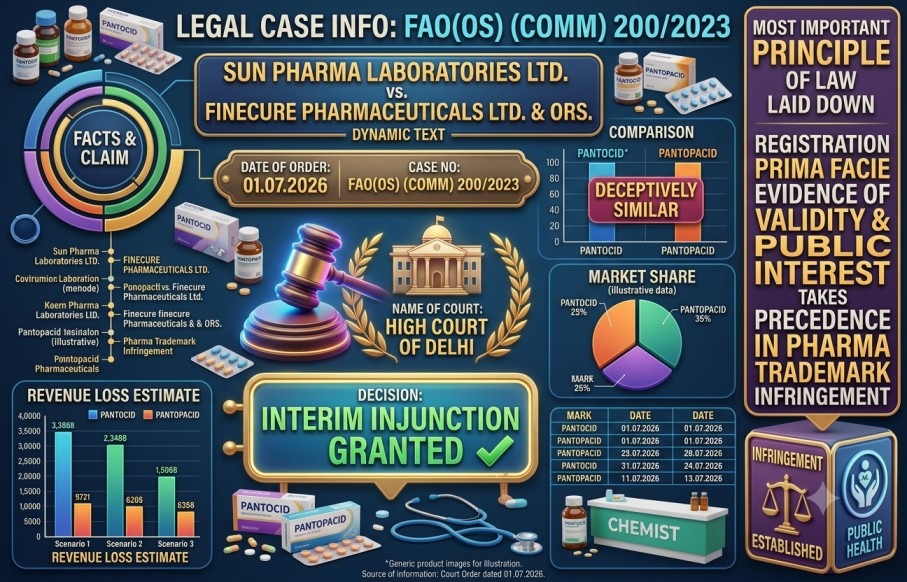
Introduction
In the highly regulated pharmaceutical sector, where brand confusion can have serious health implications, trademark protection plays a vital role in safeguarding consumer trust and business investments. This Delhi High Court Division Bench decision in a long-running battle over similar-sounding acidity drug brands underscores the strong presumptive validity of registered trademarks and the court’s preference for granting injunctions in clear cases of infringement.
Factual and Procedural Background
Sun Pharma Laboratories has been marketing Pantoprazole-based medicine under the trademark ‘PANTOCID’ since 1999, with registration dating back to an application in 1998 that was granted in 2012. The company claims substantial sales and a reputation for this Schedule H drug used in treating acidity and related conditions.
Finecure Pharmaceuticals adopted ‘PANTOPACID’ around 2007 and filed for registration in 2009, which Sun opposed. Sun discovered market presence of the rival product in April 2023 and filed a suit for permanent injunction. The single judge found deceptive similarity and infringement but refused interim relief, citing validity challenges, alleged non-disclosure, and delay. Sun appealed this order.
Dispute Before the Court
The central questions were whether Sun Pharma was entitled to an interim injunction against Finecure’s use of ‘PANTOPACID’ given the finding of infringement and whether issues like a prior similar registration by another entity (Takeda), alleged concealment of correspondence, and delay in filing the suit justified denying relief.
Sun argued:
- Its registered rights were presumptively valid.
- Infringement was clear.
- Prior proceedings had concluded in its favour.
Finecure contended:
- The registration faced a credible challenge.
- Sun suppressed material facts.
- The delay allowed Finecure to build business, tilting the balance of convenience against the injunction.
Reasoning and Analysis of the Court
The Court relied on principles from the Trade Marks Act, 1999, particularly Sections 11, 28, 29, and 31, which grant registered proprietors exclusive rights and presume validity of registration. It emphasised that civil courts should not lightly disregard registrations absent substantial challenges like fraud.
Key Legal Principles Relied Upon
- Registered trademarks enjoy statutory protection.
- Validity of registration carries a strong presumption under Section 31.
- Civil courts should not disregard a valid registration without substantial grounds.
- Consumer safety assumes greater importance in pharmaceutical trademark disputes.
Important Precedents
| Case | Principle |
|---|---|
| Midas Hygiene Industries Pvt. Ltd. v. Sudhir Bhatia (2004) 3 SCC 90 | Injunctions ordinarily follow once infringement is established. |
| Cadila Health Care Ltd. v. Cadila Pharmaceuticals Ltd. (2001) 5 SCC 73 | Public interest is paramount in pharmaceutical trademark disputes. |
The Division Bench found the single judge erred by over-relying on a lapsed Takeda registration to doubt Sun’s rights. Opposition proceedings and correspondence from 2010 were adequately disclosed through the pending opposition filing.
Delay alone does not defeat injunctions in infringement cases, especially with ongoing opposition. Sales data showed Sun’s massive turnover versus Finecure’s modest figures, negating claims of Finecure as a “formidable player”. Public interest in preventing confusion for identical drugs favoured injunction. Invoices’ genuineness was left for trial.
Final Decision of the Court
The Division Bench allowed the appeal. It set aside the single judge’s refusal of injunction, granted interim restraint against Finecure’s use of ‘PANTOPACID’ and similar marks, permitted limited sell-off of existing stock, and directed expeditious framing of issues and trial in the suit. Perjury proceedings regarding documents were left open for the single judge.
Point of Law Settled
The judgement reaffirms that a registered trademark enjoys strong presumptive validity under Section 31, and interim injunctions should ordinarily follow established infringement, particularly for pharmaceuticals, unless a substantial challenge exists.
It clarifies that lapsed prior marks or historical correspondence need not bar relief if disclosed through statutory proceedings. This will guide future pharma IP cases, discouraging frivolous validity challenges at interim stages and prioritising consumer safety.
Key Takeaways
- Registered trademarks enjoy strong presumptive validity under Section 31 of the Trade Marks Act, 1999.
- Interim injunctions should ordinarily follow where trademark infringement is established.
- Public interest carries significant weight in pharmaceutical trademark disputes.
- Delay alone does not defeat a claim for injunction in infringement cases.
- Lapsed prior registrations do not automatically weaken an existing registered trademark.
- Consumer protection remains a decisive factor where identical medicines are involved.
Case Details
| Title of the Case | Sun Pharma Laboratories Ltd vs Finecure Pharmaceuticals Ltd & Ors. |
|---|---|
| Date of Judgment/Order | 01.07.2026 |
| Case Number | FAO(OS) (COMM) 200/2023 |
| Neutral Citation | 2026:DHC:5240-DB |
| Name of Court | High Court of Delhi |
| Name of the Honourable Judge | V Kameshwar Rao and Manmeet Pritam Singh Arora |
| Written By | Advocate Ajay Amitabh Suman, IP Adjutor [Patent and Trademark Attorney], High Court of Delhi |
Disclaimer
Images used herein do not reflect actual images used in Judgement, and the same are for illustrative purposes only. Readers are advised not to treat this as a substitute for legal advice, as it may contain errors in perception, interpretation, and presentation.

