





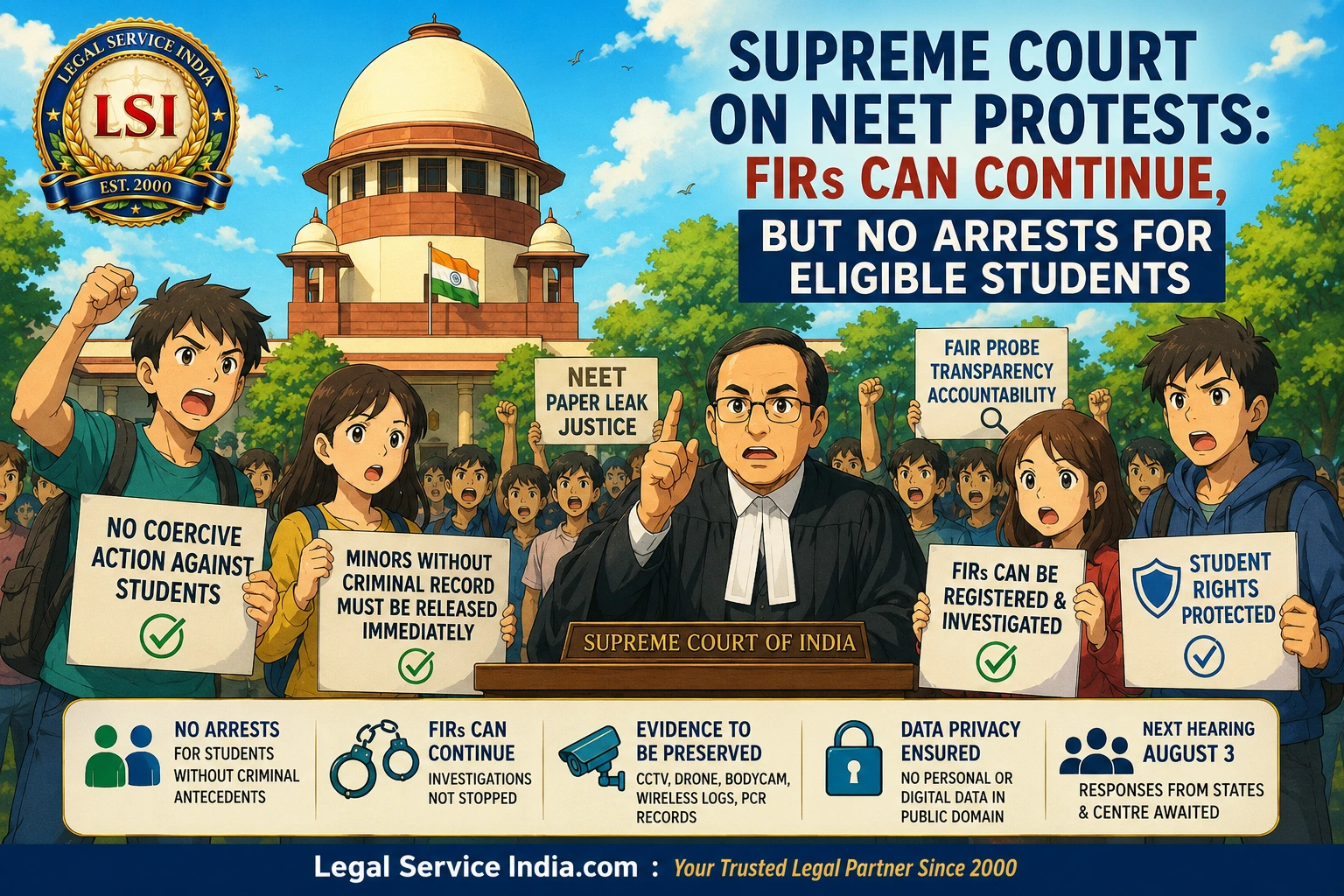
Supreme Court NEET Protest Order Explained: What the Interim Order Actually Says
If you’ve been following the student protests over the NEET paper leak, you’ve probably seen headlines saying the Supreme Court has “banned FIRs” against minors. That’s not quite right, and the actual order is worth understanding, because it does something a bit more specific—and arguably more useful.
What the Court Actually Ordered
On Tuesday, a bench led by Chief Justice of India Surya Kant was hearing petitions accusing police of using excessive force during protests organized by the Cockroach Janta Party (CJP), a student collective that’s been agitating against repeated NEET question paper leaks since June. The petitions also raised complaints about how the protests were policed in Delhi, Bihar, and a handful of other states.
The bench passed a set of interim directions. The two that matter most for protestors are
- Every detainee under 18 must be released immediately—but only if they have no prior criminal record.
- No coercive action against any protesting student, again provided they have no criminal antecedents, while the case is still being heard.
That second point is the one people are shorthanding as “no FIR.” It’s not quite that. The Court didn’t stop the police from registering or investigating FIRs—Delhi and other state governments were explicitly told they could continue those investigations.
What the Court blocked was coercive action: arrests, detentions, and similar steps against eligible students while the matter is pending.
So the FIRs can still exist and still be investigated. What can’t happen, for now, is the police using that FIR to arrest or detain a student who’s under 18 and has no criminal history.
Key Interim Directions at a Glance
| Issue | Supreme Court’s Interim Direction |
|---|---|
| Release of minors | Every detainee under 18 must be released immediately if they have no prior criminal record. |
| Police action | No coercive action against protesting students without criminal antecedents. |
| FIRs | Police may continue registering and investigating FIRs. |
| Arrests | Arrests and detentions are temporarily restrained for eligible students while the case is pending. |
Why the Court Drew the Line at Criminal Antecedents
The bench was careful to say this protection isn’t blanket.
Solicitor General Tushar Mehta, appearing for the Centre, told the Court that the government didn’t believe the students themselves had turned violent but argued that some people with existing criminal records had mixed into the crowd and were responsible for the worst of the clashes.
That’s roughly the position the Court landed on too: protect the students, but don’t extend that shield to people with criminal antecedents who may have used the protests as cover.
Court’s Approach in Brief
- Protect genuine student protestors.
- Continue police investigations into FIRs.
- Exclude persons with criminal antecedents from interim protection.
- Maintain public order while safeguarding constitutional rights.
The Backdrop: What’s Actually Been Happening
The protests trace back to a wave of NEET (the medical entrance exam) paper leaks, which triggered demonstrations led by the CJP.
Things escalated badly enough in Bihar and at Jantar Mantar in Delhi that the petitions before the court cited pellet guns, lathis, rubber bullets, and electric batons being used on protestors, some of them minors.
On the other side, the Court noted that over 200 police personnel were also injured, and their families’ concerns need to be addressed too.
That’s part of why the bench isn’t just closing the matter with these interim orders.
It’s also:
- Directing every state involved to preserve CCTV footage, drone recordings, body-camera footage, wireless communication logs, and PCR call records from the protests.
- Ordering that any personal or digital data collected on protestors stays out of the public domain.
- Seeking formal responses from the chief secretaries of Delhi, Maharashtra, Bihar, Kerala, Madhya Pradesh, and Uttar Pradesh.
- Signalling that it may set up an independent probe or a Special Investigation Team once those responses come in.
Directions Issued to Authorities
| Authority | Direction |
|---|---|
| States | Preserve CCTV, drone, body-camera, wireless logs, and PCR call records. |
| Police & Authorities | Ensure personal and digital data of protestors is not placed in the public domain. |
| Chief Secretaries | File formal responses before the Supreme Court. |
| Supreme Court | Consider constituting an independent probe or special investigation team after reviewing responses. |
The case is due back in court on August 3, when the Centre and the states named above are expected to file their versions of events.
What This Means If You’re Following the Case
If you’re a parent, student, or just someone trying to track this story, the practical takeaway is this: a minor detained in connection with these protests should be released if they have no criminal record, and no student — minor or not — should face arrest or coercive police action while this case is pending, again unless they have a prior record.
The underlying FIRs aren’t cancelled; they’re paused in terms of enforcement while the court sorts out what actually happened on the ground.
Key Takeaways
- The Supreme Court has not banned FIRs against student protestors.
- Police investigations into FIRs may continue.
- Eligible students are protected from coercive police action during the pendency of the case.
- Minors without criminal antecedents must be released immediately.
- The order is interim and not a final decision on the merits.
Next Hearing and Future Course
This is an interim order, not a final judgment.
The bigger questions—who’s responsible for the violence, whether an independent probe is needed, and what nationwide rules should govern policing of protests—are still being worked out, with the next hearing set for August 3.
Important Links
Important Links:
- Lawyers in India
- Copyright Registration in India
- Caveat Filing in Supreme Court of India
- Mutual Consent Divorce in Delhi NCR: WhatsApp 9650499965

