





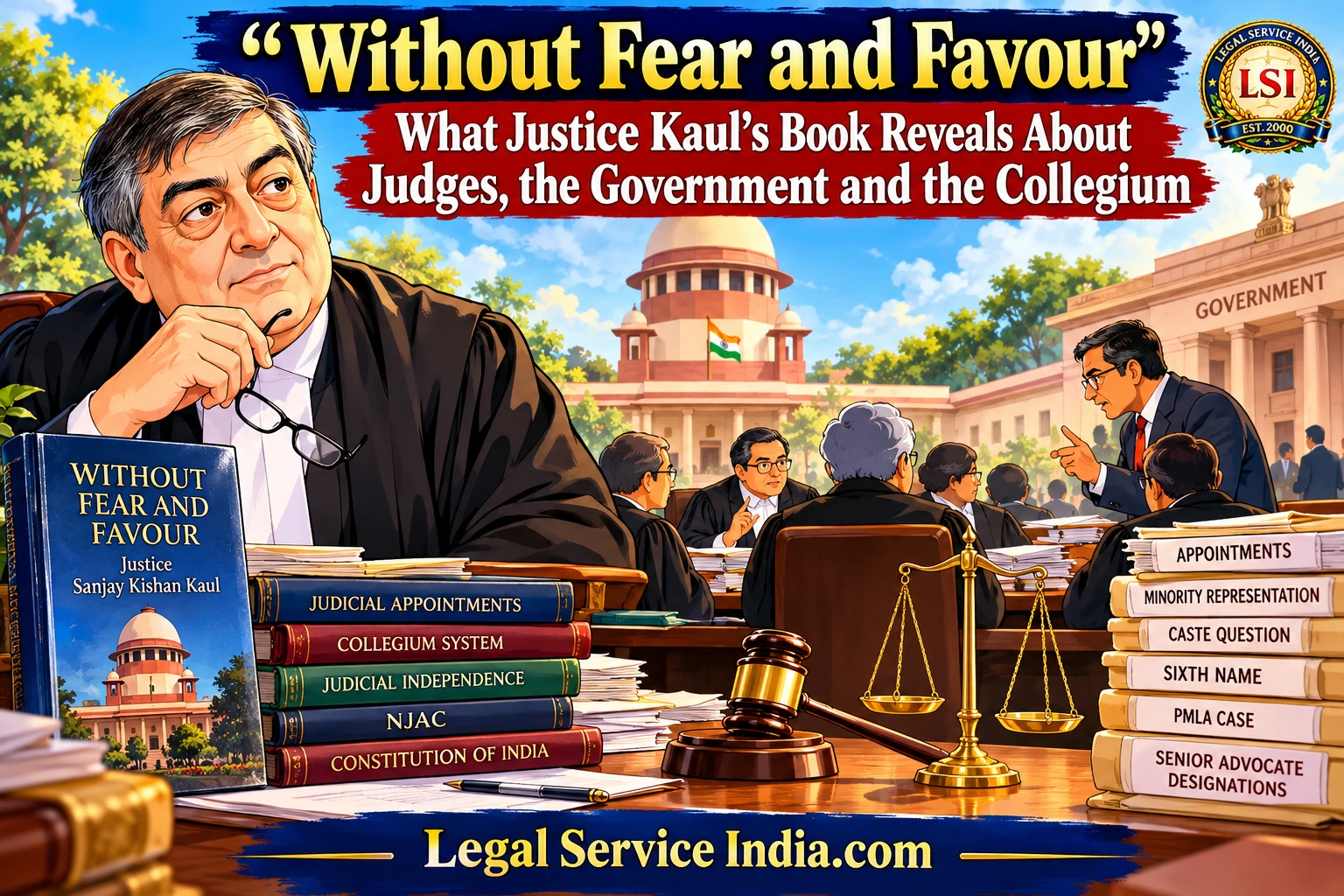
“Without Fear and Favour”: What Justice Kaul’s Book Reveals About Judges, the Government and the Collegium
Every so often, a judge steps out of the courtroom and tells the rest of us what really happened behind the closed doors of the Supreme Court. This time, it is Justice Sanjay Kishan Kaul, who retired from the Court in December 2023. His forthcoming book, Without Fear and Favour, has already set off a heated debate, thanks to a report in The Indian Express.
The book’s central question is deceptively simple: when does a government talking to the judiciary about appointments stop being healthy consultation and start becoming pressure?
A quick note before we begin: everything below reflects Justice Kaul’s own account as reported. These are one judge’s experiences, and, as you will see, the other side has responded.
The Core Complaint: Consultation Before the Collegium Meets
According to Justice Kaul, former Chief Justice D.Y. Chandrachud was, in matters of judicial appointments, more accommodating towards the government than he should have been.
His sharpest objection is about timing. Talking to the government about a name is one thing. Securing its nod before the Collegium has even formally met is quite another.
His reasoning is practical. If the executive is handed an early seat at the table, it will use that seat to widen its influence. In his words, this is not about any political party. It is about the balance between power and institutions.
The Meeting Justice Kaul Says He Walked Out Of
The most dramatic episode in the book concerns a judicial candidate from a minority religion.
Justice Kaul writes that the government questioned whether the judiciary really needed more representation from that community, given that judges from other minority faiths were already on the bench. He objected. Then came a second question, about the caste of the candidate’s family.
He found this baffling. If a family has followed a religion for generations, how would the Collegium even know its caste? And what would that have to do with whether someone should be a judge?
According to his account, Justice Chandrachud then relayed another government view (one the book does not spell out), and that is where Justice Kaul lost patience. His retort, as he tells it, was that if appointments were going to work this way, the Chief Justice might as well return to the pre-Collegium days and appoint judges alone after speaking to the government.
He says he closed his file and left the room. The meeting was adjourned, nothing was scheduled for a while, and eventually the government relented. The candidate was cleared.
The Sixth Name That Appeared on the Day
Another story involves six vacancies on the Supreme Court. Justice Kaul says the Collegium had already agreed on five names. On the day of the meeting, a sixth name was put forward.
He suspected it had come from the government. He writes that he was taken aside and asked whether the Collegium should call the government to gauge its view. He refused, arguing that you cannot phone the executive in the middle of a Collegium meeting.
The sixth name did not go ahead, and the five were finalised.
A Critic of the Collegium, Too
It would be a mistake to read the book as a defence of the system. Justice Kaul is openly critical of the Collegium. He calls it deeply flawed: opaque, with decision-making concentrated in a few hands, and still open to informal pressure.
He even goes a step further on the National Judicial Appointments Commission (NJAC), which the Supreme Court struck down in 2015. His view is that the Court should have let that experiment run rather than dismissing it so quickly. The NJAC would have given the government a bigger role in appointments, and the Court held the law unconstitutional.
That is a striking position for a former Supreme Court judge, and it will not please everyone.
“Stand Firm, and the Government Listens”
One recurring theme is that firmness works. Justice Kaul says the government often yields when it is approached with conviction. He gives examples:
- A High Court Chief Justice appointment: the government was insisting on a particular judge. Justice Kaul says he spoke directly to the concerned official, and the government eventually agreed.
- Two Delhi High Court judges: their approvals were stuck. He raised the matter with the Law Minister, and the notifications followed.
- Five Supreme Court names: he says the government kept them pending longer than needed, though seniority was ultimately respected.
He also describes a difference in style with Justice Chandrachud. After joining the Collegium in June 2022, he suggested a “good cop, bad cop” approach: the two of them would speak to the government together, with Justice Kaul, not being Chief Justice, playing the tougher role. In his telling, apart from a few exceptions, Justice Chandrachud preferred to manage the relationship his own way.
The Court Is Not the Opposition’s Ally
Justice Kaul is just as pointed about what a court should not do. Its job, he says, is not to help the opposition or take on the government. Its job is to play its independent constitutional role and keep power in check.
He uses the Rafale deal to make the point. He was on the bench that dismissed the petitions challenging it. A verdict, he argues, should not depend on whether the government likes it, and people who oppose the government often want the Court to rule their way. That is not what courts are for.
The PMLA Bench and a Case That Moved
He also recounts a matter on the money laundering law, the PMLA. A three-judge bench headed by him had listed the question of whether parts of an earlier Supreme Court ruling needed fresh consideration. He says the government saw this as a threat.
He alleges the case was later placed before a different bench without anyone speaking to him. For him, this is a matter of principle: a case should not be shifted merely because of fear about what the first bench might decide. The bench was reconstituted, but the hearing did not finish before he retired.
Senior Advocate Designations
He raises questions here too. He writes that he later heard some people had advised the then Chief Justice to keep extending the timeline so the process would not end before his term did. Justice Kaul is careful to say he does not know whether that is true.
What he does note is that the designations were completed in January 2024, right after his retirement. He also mentions that appointments of High Court Chief Justices stayed pending until the day after he retired.
What Justice Chandrachud Has Said
When The Indian Express asked for a response, the former Chief Justice said he had not yet read the book and could not comment in detail without its context.
He did offer a few general observations:
- Collegium meetings during his tenure went well.
- His relationship with Justice Kaul was respectful, with good conversation and reasoned debate.
- He does not recall any judge walking out of a Collegium meeting.
- A resolution was passed after every meeting, and he does not recall any dissent being recorded.
- The government has its own role, and the Chief Justice talks to it because, in the end, the President signs the appointments.
That last point is worth pausing on, because it frames the whole debate. Nobody disputes that some conversation between the judiciary and the executive is built into the system. The disagreement is about where it should stop.
The Man Behind the Book
Born in 1958 into a Kashmiri family, Justice Kaul studied at St. Stephen’s College and the Campus Law Centre, University of Delhi. After a career as a senior advocate, he became a Delhi High Court judge in 2001, later serving as Chief Justice of the Punjab and Haryana High Court and then the Madras High Court. He joined the Supreme Court in February 2017.
Notable Contributions
| Court | Notable Contribution |
|---|---|
| High Court | Judgments backing artistic freedom in the M.F. Husain and Perumal Murugan matters |
| Supreme Court (2017) | Separate concurring opinion in the Puttaswamy privacy judgment, referring to a right to be forgotten in certain circumstances |
| Supreme Court | Part of the bench that dismissed the Rafale petitions |
| Supreme Court (2023) | Agreed with the Chief Justice on civil unions in the same-sex marriage case |
| Supreme Court (2023) | In the Article 370 verdict, suggested a truth and reconciliation commission for Jammu and Kashmir |
Why the Timing Matters
The book lands in a charged atmosphere. Earlier, then Law Minister Kiren Rijiju and then Vice President Jagdeep Dhankhar publicly questioned the Collegium system and the NJAC verdict. In 2024, there was also debate about the Chief Justice’s role after Prime Minister Narendra Modi attended a Ganesh Puja at Justice Chandrachud’s residence.
Against that backdrop, Justice Kaul’s message is that a court must never become an institution that simply chases popularity. To protect independence, judges should keep an equal distance from both the government and the opposition.
The Takeaway
Justice Kaul does not claim the Collegium can be sealed off from the government. His point is that it must hold on to its independence and institutional dignity, and that, in his experience, the executive respects judges who stand their ground.
Whether you read his book as a warning, a grievance, or an honest insider’s account will probably depend on where you already stand. But the question it raises is a fair one, and it will outlast this particular controversy.
Over to You: Where Should the Line Be Drawn?
Over to you: how much consultation between the judiciary and the government is healthy in judicial appointments, and where should the line be drawn? Share your thoughts in the comments.
