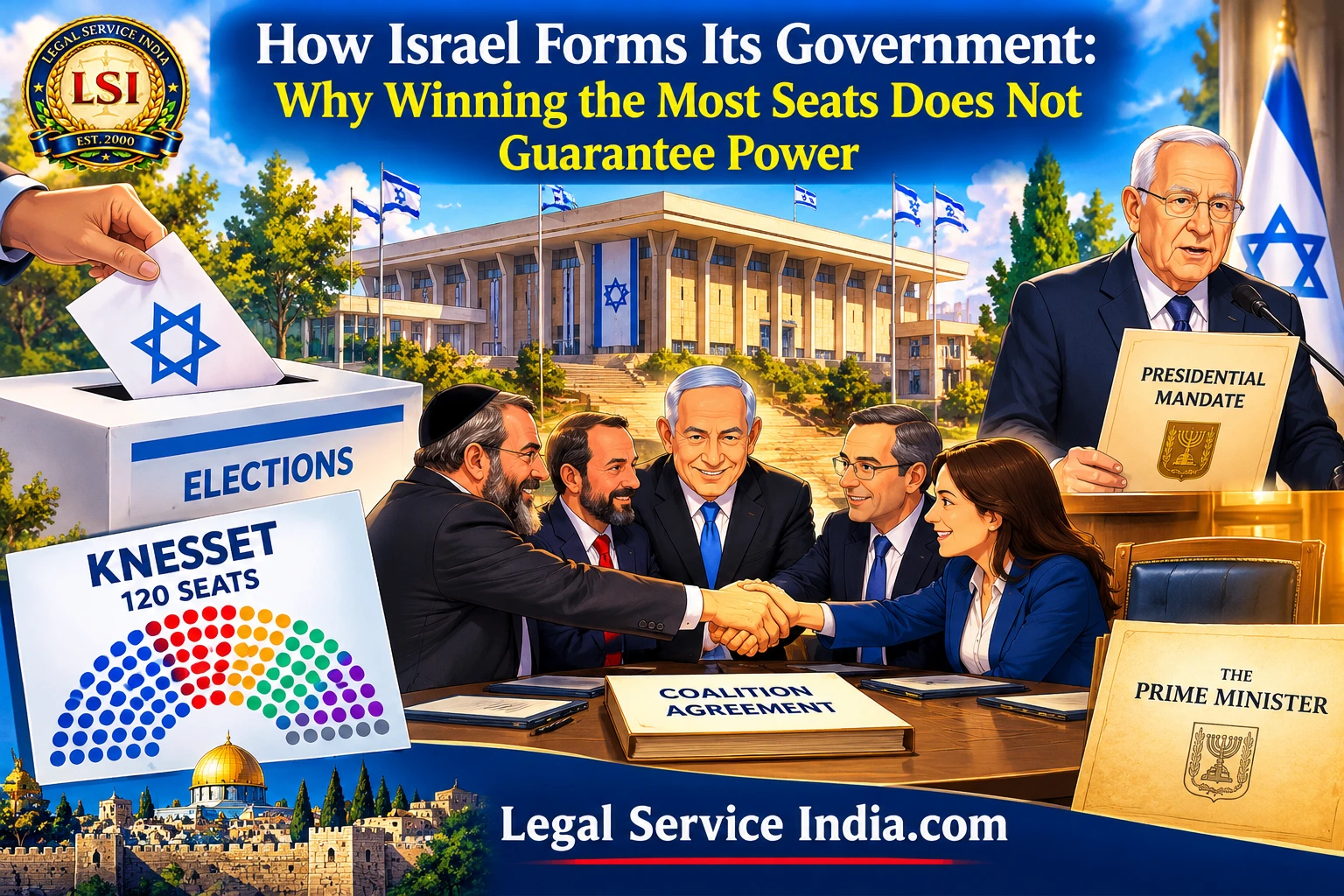
How Israel Forms Its Government: Why Winning the Most Seats Does Not Guarantee Power
Winning the most seats in an election does not always mean winning the right to govern. Israel provides one of the clearest examples of this principle in parliamentary democracy. A political party can emerge from an election as the largest party in parliament and still fail to form the government. Meanwhile, a party with fewer seats may succeed by negotiating agreements with smaller parties and assembling sufficient parliamentary support.
This outcome may appear surprising to voters accustomed to systems in which the largest party ordinarily leads the government. However, it is a consequence of Israel’s electoral system and constitutional arrangements.
Israel’s 120-member parliament, known as the Knesset, is elected through nationwide proportional representation. Because parliamentary seats are distributed among qualifying political parties, elections frequently produce a legislature in which several parties must negotiate to establish a government.
The decisive question is therefore not simply which party wins the most seats. It is which candidate can form a government that obtains the confidence of the Knesset under the applicable constitutional procedure.
Understanding this distinction reveals an important relationship between electoral representation, coalition politics and constitutional government.
1. What Is the Knesset?
The Knesset is Israel’s unicameral national legislature. It consists of 120 members, who are elected through a nationwide proportional representation system.
Unlike India, where members of the Lok Sabha are elected from individual territorial constituencies, Israel treats the entire country as a single constituency for parliamentary elections.
Voters generally select a political party’s candidate list rather than choosing an individual representative for a local constituency. The number of seats awarded to each qualifying party broadly reflects its share of the vote, subject to the electoral threshold and the rules governing seat allocation.
The Knesset ordinarily serves a four-year term, although it may be dissolved earlier under the applicable legal arrangements.
This electoral model allows a wide range of political viewpoints and communities to obtain parliamentary representation. Its corresponding consequence is that no single party may secure enough seats to govern independently.
When parliamentary representation is divided among several parties, forming a government becomes a process of negotiation.
The central distinction is that an election determines the composition of parliament, while the parliamentary and constitutional processes determine who can govern.
2. How Israel’s Proportional Representation System Works
Israel uses a closed-list proportional representation system.
Before an election, each political party submits an ordered list of candidates. Voters choose a party, and candidates enter the Knesset according to the party’s seat allocation and the order of its list.
A party list must obtain at least 3.25% of the valid votes to cross the electoral threshold and qualify for parliamentary representation.
Votes cast for lists that fail to cross the threshold do not translate into seats for those lists. Consequently, the final distribution of seats does not perfectly reproduce every party’s percentage of the total vote.
Israel also uses the Bader–Ofer method for distributing seats, including the allocation of surplus votes. Parties may enter surplus-vote agreements before an election, potentially improving their prospects of securing an additional seat.
These rules matter because small changes in voting patterns can affect the distribution of parliamentary seats. When no party has a clear majority, even one or two seats can influence coalition negotiations.
The official Knesset resources explain the electoral threshold and the distribution of Knesset seats.
3. Why the Largest Party Does Not Automatically Form the Government
This is the fundamental principle behind Israel’s government-formation process.
Consider the following hypothetical election result:
| Political Party | Seats Won |
|---|---|
| Party A | 40 |
| Party B | 32 |
| Party C | 18 |
| Party D | 12 |
| Party E | 10 |
| Party F | 8 |
| Total | 120 |
Party A has emerged as the largest party, with 40 seats. Nevertheless, it does not possess an outright majority of the Knesset.
Possible Coalition Combinations in Israel
Several governing combinations are mathematically possible:
| Possible Coalition | Total Seats |
|---|---|
| Party A + Party B | 72 |
| Party A + Party C + Party D | 70 |
| Party B + Party C + Party D | 62 |
The third combination illustrates the central point. Party B, despite finishing behind Party A, could potentially lead a government supported by Parties C and D.
If the parties can resolve their policy differences, they may negotiate a coalition agreement and agree on the composition and programme of a government.
Party A would remain the largest party in the Knesset. However, its electoral victory would not automatically entitle its leader to form the government or guarantee that it would be able to obtain parliamentary confidence.
The President of Israel consults representatives of the parliamentary groups before assigning the task of forming a government to a willing member of the Knesset. The president’s decision is not determined solely by which party has won the largest number of seats.
The practical question is whether a candidate has a realistic prospect of forming a government that can secure the necessary parliamentary support.
This example is hypothetical. It illustrates coalition arithmetic rather than the outcome of any particular Israeli election.
4. Why 61 Seats Matter—and What the Law Actually Requires
The Knesset has 120 members. Therefore, 61 seats constitute an absolute majority of its full membership.
This figure is politically significant because a coalition with 61 or more members has a numerical majority of the entire parliament. Such a coalition is generally better placed to pass legislation, approve budgets and maintain political stability.
However, 61 seats should not be confused with an automatic legal requirement for every parliamentary decision involved in forming a government.
Parliamentary Confidence and Government Formation
Under Basic Law: The Government – The government must present its composition and policy guidelines to the Knesset and request an expression of confidence. The government is established when the Knesset expresses confidence in it.
The legal requirement is therefore an expression of parliamentary confidence under the applicable constitutional framework. The existence of a coalition agreement or a claimed total of 61 seats does not, by itself, establish the government.
Equally, a candidate should not assume that a government is legally impossible merely because the supporting parties collectively hold fewer than 61 seats. The precise voting circumstances and applicable parliamentary rules matter.
A minority government may be politically possible where the relevant confidence requirements are satisfied, although it may face considerable difficulty in passing legislation and sustaining its position.
Coalition Majority and Political Stability
A coalition with 61 seats is not necessarily stable either. Members may disagree over policy, abstain from important votes, withdraw support or leave their parties’ governing arrangements.
Coalition agreements therefore serve a practical purpose. They establish negotiated commitments concerning ministerial appointments, budgets, security policy, religious affairs, legislative priorities and other matters.
The number 61 is an important benchmark for political stability, but the constitutional test is whether the government obtains the confidence required by law.
The governing framework is set out in Israel’s Basic Law: The Government.
5. The President’s Role in Forming the Israeli Government
The President of Israel is the head of state, while the Prime Minister heads the government. The president has a formal constitutional role in initiating the government-formation process.
Under Basic Law: The Government, the President consults representatives of the parliamentary groups and assigns the task of forming a government to a member of the Knesset who has agreed to undertake it.
The process ordinarily follows these stages.
Stage One: Presidential Consultations
Following an election, the president consults representatives of the parliamentary groups to assess the political situation.
These consultations help establish which candidate appears best placed to assemble a government.
The leader of the largest party may be a strong contender, but the largest party does not automatically receive the mandate.
Stage Two: The First Mandate
Under the ordinary procedure, the President must assign the task within seven days of the publication of the election results.
The designated member of the Knesset ordinarily has 28 days to form a government. The President may grant extensions, provided that the additional periods do not exceed 14 days in total.
The candidate must negotiate with potential coalition partners and establish a workable governing arrangement.
Stage Three: A Second Attempt
If the first candidate cannot form a government, announces an inability to do so, or presents a government that fails to obtain confidence, the law provides for further action by the President.
Under the ordinary procedure, the President must act within three days of the relevant triggering event. The President may assign the task to another willing member of the Knesset or inform the Speaker that no possibility of forming a government appears available.
The second candidate ordinarily has 28 days to form a government, without the extension available during the first mandate.
Stage Four: A Request Supported by a Majority of Knesset Members
The law provides another possible route if the earlier attempt or attempts fail.
Within the prescribed 21-day period, a majority of Knesset members may submit a written request asking the President to assign the task to a specified member who has agreed in writing to accept it.
If the statutory conditions are satisfied, the President must assign the task within two days. The designated candidate then has 14 days to form a government.
This procedure provides a further opportunity to identify a candidate capable of assembling parliamentary support.
Stage Five: Fresh Elections
If the prescribed procedures fail, the Knesset is deemed to have decided to dissolve itself before the end of its term, and new elections must be held within the legally specified period, ordinarily 90 days.
The outgoing government continues to perform its functions until a new government is established.
These deadlines are part of the statutory framework. They do not guarantee that negotiations will succeed or that a new government will be formed quickly.
Official Sources on Israeli Government Formation
For the official explanation, consult the President of Israel’s government-formation procedure and the Basic Law: The Government.
6. Why Coalition Negotiations Can Become Complicated
The law establishes the procedure and deadlines, but it cannot compel political parties to agree.
A party considering joining a coalition must assess whether the proposed government’s programme is compatible with its policies and electoral promises.
Negotiations may concern:
- National security and defence policy.
- Relations with the Palestinians.
- Religious and secular public policy.
- Budget allocations and taxation.
- Social welfare and education.
- Ministerial portfolios and the distribution of authority.
- Legislative priorities.
- Commitments demanded by coalition partners.
A smaller party may become particularly influential if its support is necessary to assemble a governing majority or obtain parliamentary confidence.
For example, a party with only ten seats might hold the balance of power between two larger political blocs. If neither bloc can form a government without its participation or support, that smaller party may acquire substantial bargaining power.
It may seek a particular ministry, changes to proposed legislation, additional budget allocations or commitments concerning public policy.
Nevertheless, smaller parties do not automatically possess disproportionate influence. Their bargaining power depends on the available alternatives, their compatibility with other parties and the precise distribution of seats.
A larger party may be unable to satisfy the demands of potential partners. Alternatively, a smaller party may refuse to join a government because doing so would compromise its core commitments to voters.
This explains why the largest party can struggle to form a government even when it has won a substantial number of seats.
It also explains why coalition negotiations sometimes continue for weeks.
The delay may reflect genuine disagreements over national priorities rather than any uncertainty about how the votes were counted.
7. What Happens While Negotiations Continue?
A country does not automatically become governmentless after an election.
Israel’s outgoing government continues to perform its functions until a new government is established. This provides continuity in public administration and the discharge of essential state responsibilities.
However, an outgoing government and a newly established government are not politically identical.
The outgoing administration continues under the applicable legal framework, while the prospective government may still be negotiating its programme, composition and political commitments.
Prolonged negotiations can create uncertainty about future legislation, budgetary priorities and the direction of public policy.
Political parties must therefore balance the desire to negotiate favourable agreements against the risk of exhausting the available time without reaching a workable arrangement.
The constitutional timetable provides opportunities for further attempts, but those opportunities are limited.
If the prescribed procedures fail, fresh elections may become necessary.
The important distinction is that a delay in forming a new government does not mean that Israel has no government at all.
8. Israel and India: Two Different Routes to Government Formation
Israel and India are both parliamentary democracies. In both systems, the government must operate within a constitutional framework and maintain the parliamentary support required by law.
Their electoral systems, however, create different political incentives.
India: Constituency-Based Elections
India elects members of the Lok Sabha from individual territorial constituencies using the first-past-the-post system.
In each constituency, the candidate receiving the highest number of valid votes wins the seat, even if that candidate receives less than half of the votes cast.
A political party can therefore win a majority of Lok Sabha seats without securing more than half of the nationwide vote.
When a party obtains a majority of seats, its leader will ordinarily be positioned to form the Union government. When no party has a majority, coalition negotiations and support from other parties may become necessary.
Article 75(1) of the Constitution provides that the President appoints the Prime Minister. In practice, the appointment must take account of the candidate’s ability to command the confidence of the Lok Sabha.
India’s constitutional framework therefore also distinguishes between winning an election and possessing the parliamentary support needed to govern.
The constitutional provision can be consulted in the Constitution of India, Article 75.
Israel: Nationwide Proportional Representation
Israel elects all 120 members of the Knesset through nationwide proportional representation, subject to the electoral threshold and seat-allocation rules.
This arrangement enables multiple parties to enter parliament and can make coalition negotiations central to government formation.
After consulting representatives of the parliamentary groups, the President assigns the task of forming a government to a member of the Knesset under Basic Law: The Government.
The candidate’s ability to assemble a viable government is central to the process.
The Essential Difference
| Feature | India | Israel |
|---|---|---|
| Electoral system | First-past-the-post in individual constituencies. | Nationwide proportional representation. |
| Legislature | Lok Sabha. | Knesset. |
| Number of seats discussed | Varies according to the parliamentary majority required. | 120 seats. |
| Role of coalition negotiations | May become necessary when no party has a majority. | Can be central to government formation. |
| Basis for forming the government | The ability to command the confidence of the Lok Sabha. | The ability to establish a government under Basic Law: The Government and obtain the required parliamentary confidence. |
India’s constituency-based system can produce a parliamentary majority for a party even when it receives less than half of the nationwide vote.
Israel’s proportional system distributes seats among qualifying party lists more proportionally, making it more likely that several parties will need to cooperate to form a government.
Neither system eliminates coalition politics. The difference lies in the electoral arrangements and how frequently those arrangements make coalition building indispensable.
The comparison also demonstrates a broader constitutional principle: the method of electing legislators influences the composition of parliament, while the parliamentary system determines how executive authority is established and maintained.
9. Does a Prolonged Government-Formation Process Mean Democracy Is Failing?
Not necessarily.
A prolonged government-formation process can frustrate voters, delay political decisions and reveal serious divisions within society.
It may also demonstrate the difficulty of reconciling the priorities of different political parties in a diverse parliamentary system.
Coalition government, however, is not inherently undemocratic.
Where elections are conducted according to law, parliamentary representation is respected, and the government obtains the confidence required by the constitutional framework, coalition negotiations can form a legitimate part of democratic government.
Such negotiations may require parties to accommodate competing interests and reach agreements that extend beyond their individual electoral bases.
At the same time, proportional representation has trade-offs.
Smaller parties may acquire substantial bargaining power, particularly when their support is necessary for government formation. Coalition agreements may also produce a government programme that differs from the programme preferred by the largest party.
Voters may reasonably question whether the eventual government reflects the political preferences expressed at the ballot box.
The answer requires distinguishing between the allocation of parliamentary seats and the constitutional process for establishing the executive.
The largest party has a legitimate electoral achievement. But in a parliamentary system, that achievement does not necessarily confer an exclusive right to govern.
The decisive question remains whether the government can be established in accordance with the law and maintain the parliamentary confidence required to exercise executive authority.
10. What Israel’s Electoral System Teaches Us About Parliamentary Democracy
Israel’s government-formation process illustrates three important constitutional principles.
First: Electoral Victory and Governing Authority Are Distinct
Winning more seats than any rival establishes a party’s relative strength in parliament, but it does not necessarily provide the support needed to govern.
Second: Coalition Negotiations Are Part of the Political Process
Where parliamentary representation is divided among several parties, political leaders must reconcile competing priorities and build workable agreements.
Third: Constitutional Procedures Determine How Political Negotiations Become a Government
Presidential consultations, statutory deadlines and the Knesset’s expression of confidence provide the legal framework within which a new administration can be established.
These principles are relevant beyond Israel. They help explain government formation in parliamentary democracies where no single party secures a majority.
They also demonstrate why election results cannot always be understood by looking only at which party finished first.
Conclusion: Winning the Election Is Only the Beginning
Israel’s electoral system demonstrates why election night does not always settle the question of who will govern.
The votes determine the composition of the Knesset. The distribution of seats establishes the possible combinations of political support. Coalition negotiations determine whether those combinations can become a functioning government. Finally, the constitutional process determines whether the proposed government obtains the confidence required to take office.
The largest party may lead the government, but it is not guaranteed to do so. A smaller party may lead the government if its candidate can assemble the necessary support and satisfy the applicable constitutional requirements.
This is the central lesson of Israel’s parliamentary system: winning the most seats is an electoral achievement; securing the parliamentary support needed to govern is a separate political and constitutional challenge.
For students of constitutional law and political science, Israel offers a valuable case study in the relationship between proportional representation, coalition bargaining and parliamentary government.
It shows that the rules translating votes into seats shape not only who enters parliament, but also how executive power is formed, exercised and sustained.
Frequently Asked Questions
1. How Does Israel Form Its Government After an Election?
After the election results are published, the President consults representatives of the parliamentary groups and assigns the task of forming a government to a willing member of the Knesset. The candidate negotiates with potential coalition partners and must establish a government that obtains the Knesset’s confidence.
2. Can a Party Win the Most Seats in Israel and Still Lose the Opportunity to Govern?
Yes. The largest party does not automatically receive the mandate to form the government. A candidate from another party may be better positioned to assemble a workable coalition and obtain parliamentary confidence.
3. How Many Seats Are Required for a Majority in the Knesset?
The Knesset has 120 members, so 61 seats constitute an absolute majority of its full membership. This is an important political benchmark for a stable coalition, although the precise legal requirements for individual parliamentary votes depend on the applicable rules.
4. What Is the Electoral Threshold in Israel?
A political party list must receive at least 3.25% of the valid votes to qualify for parliamentary representation. The threshold affects which party lists receive seats and therefore influences the final composition of the Knesset.
5. How Long Does the Israeli President Give a Candidate to Form a Government?
Under the ordinary procedure, the first candidate has 28 days, with possible extensions of up to 14 additional days in total. If that attempt fails, the law provides further procedures, including a possible second mandate and a route involving a written request supported by a majority of Knesset members.
6. Can Israel Have a Minority Government?
A government supported by fewer than 61 Knesset members may be politically possible if it satisfies the applicable confidence requirements. However, a minority government may face greater difficulties passing legislation, approving budgets and maintaining political support.
7. What Happens If No Candidate Can Form an Israeli Government?
The law provides additional procedures for assigning the task to another candidate or to a candidate requested by a majority of Knesset members. If the prescribed procedures fail, the Knesset is deemed to have decided to dissolve itself, and fresh elections must be held within the legally specified period.
8. Does Israel Have a Government While Coalition Negotiations Continue?
Yes. The outgoing government continues to perform its functions until a new government is established. A delay in forming a new government does not mean the country is left without an administration.
9. How Is Israel’s Electoral System Different From India’s?
India elects Lok Sabha members from individual territorial constituencies using the first-past-the-post system. Israel elects the Knesset through nationwide proportional representation. Israel’s system generally makes coalition negotiations particularly important because parliamentary seats are distributed among multiple qualifying party lists.
10. Why Can a Small Political Party Become Powerful in Israel?
A small party can hold the balance of power when its support is necessary for a larger party or political bloc to form a government. This may allow it to negotiate policy commitments or ministerial positions. Its influence depends on the parliamentary arithmetic and the available alternatives.
Key Takeaways: How Israel Forms Its Government
Israel’s parliamentary system demonstrates that winning an election and forming a government are two distinct political processes. The following key takeaways summarise how electoral representation, coalition negotiations and constitutional procedures determine who governs Israel.
- Winning the most seats does not guarantee power in Israel. The largest political party does not automatically have the right to form the government. The decisive issue is whether a candidate can establish a government that obtains the confidence of the Knesset.
- Israel follows a proportional representation system. The Knesset has 120 members elected through nationwide proportional representation, allowing multiple political parties to gain parliamentary seats.
- A majority of 61 seats is an important political benchmark. Since the Knesset has 120 members, 61 seats constitute an absolute majority of its full membership. However, the precise legal requirements for government formation and individual parliamentary votes depend on the applicable rules.
- Coalition negotiations determine the available governing options. Political parties negotiate over policy commitments, ministerial positions, budgets, national security and legislative priorities to establish a workable government.
- The President of Israel has a formal constitutional role. After consulting representatives of parliamentary groups, the President assigns the task of forming a government to a member of the Knesset under Basic Law: The Government.
- Smaller parties can influence government formation. A party with relatively few seats may become influential when its support is necessary to establish a government or secure parliamentary confidence.
- Israel has a statutory government-formation procedure. The law provides deadlines and further procedures when an initial attempt to form a government fails. If the prescribed routes fail, fresh elections may become necessary.
- Israel does not become governmentless during negotiations. The outgoing government continues performing its functions until a new government is established.
- Israel and India use different electoral systems. India elects Lok Sabha members from territorial constituencies using the first-past-the-post system, while Israel elects the Knesset through nationwide proportional representation.
- Coalition government is not inherently undemocratic. Its legitimacy depends on compliance with the constitutional framework, respect for parliamentary representation, and satisfaction of the applicable requirements for establishing a government.
The Central Lesson
In Israel, winning the most parliamentary seats is an electoral achievement, but forming a government requires the political support and constitutional confidence necessary to govern.
Authoritative References
The following official institutional sources are relevant to understanding Israel’s electoral system, parliamentary representation and government-formation procedures, alongside India’s constitutional framework.
- Knesset — Electoral Threshold
- Knesset — Distribution of Knesset Seats
- Knesset — Forming a Government
- Knesset — Basic Law: The Government
- President of Israel — The Institution of the Presidency and Government Formation
- Ministry of External Affairs, Government of India — Constitution of India, Article 75
Editorial Note
The seat-allocation example in this article is hypothetical. The article explains the general constitutional framework and does not describe the result of a particular Israeli election. Election-specific reporting should be checked against the latest official results and the applicable law.