





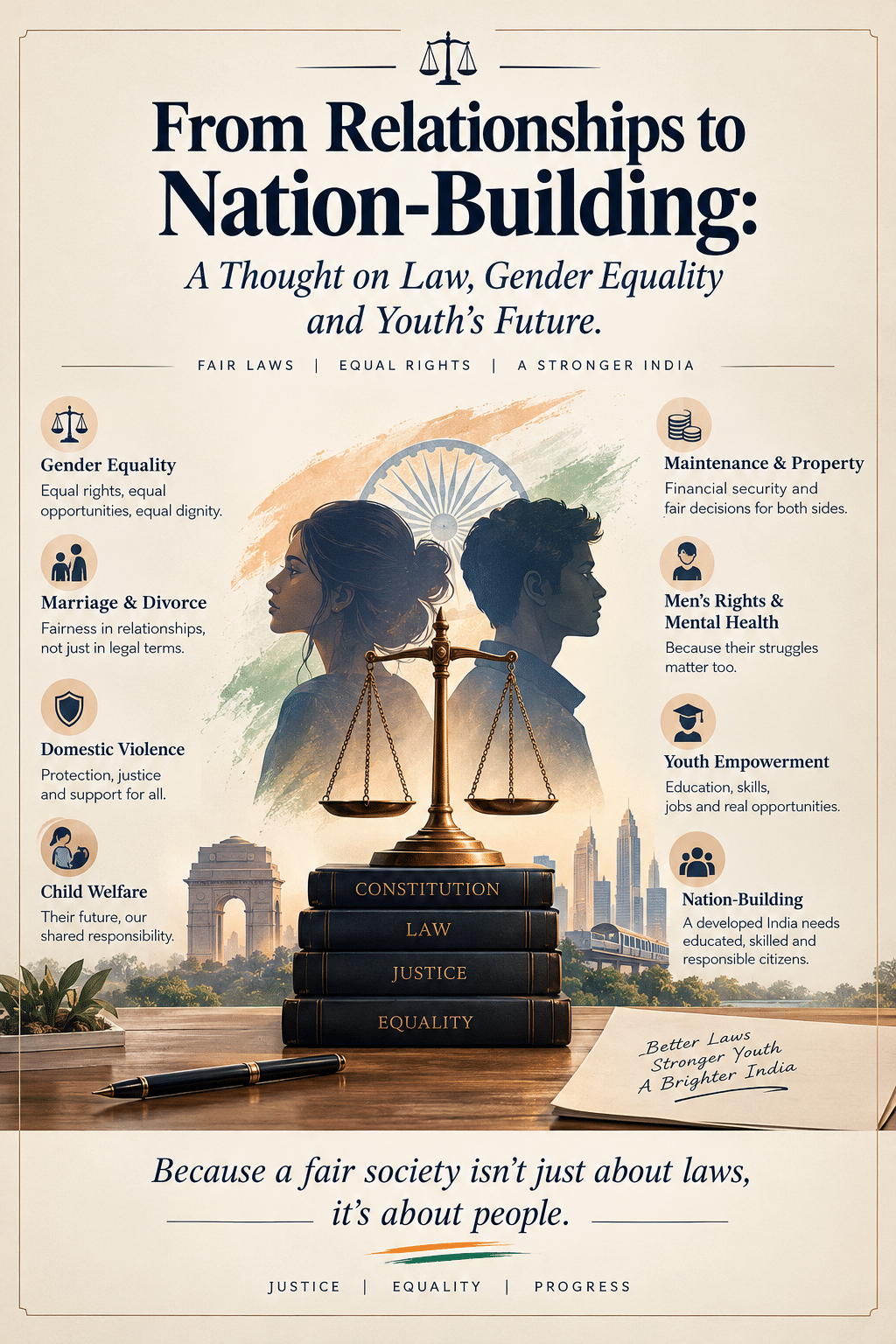
From Relationships to Nation-Building: A Thought on Law, Gender Equality and Youth’s Future.
1. Introduction: Do We Need to Change the Way We Think?
India is a country with a rich history, a strong culture, and a large number of young people. Today, our country is moving forward in education, technology, business, and many other fields. But while we talk about development, we also need to think about some important problems in our society.
Marriage, divorce, maintenance, domestic violence, women’s safety, men’s rights, unemployment, and the future of young people are some of these issues. They may seem different, but they are connected in many ways.
The real question is, are we giving enough importance to our personal lives while forgetting our responsibilities towards society and our country?
This article is about understanding both sides and finding a balance where everyone gets respect, freedom, and justice.
2. Why Do Women Need Special Protection Under the Law?
For many years, women in India have faced problems related to education, property, financial freedom, and decision-making. Many have also suffered from domestic violence, dowry harassment, and financial dependence.
This is one of the reasons why special laws were made to protect women. Article 15(3) of the Indian Constitution allows the government to make special provisions for women and children.
These laws are important because many women still face unsafe situations and need legal support. We should not forget the struggles that made these protections necessary.
At the same time, we must understand that being a woman does not automatically make someone right, just as being a man does not automatically make someone wrong.
Every case is different. The law should protect those who need protection and treat every person fairly.
Real equality means that every person gets justice, not that one gender is always right and the other is always wrong.
3. Marriage, Divorce and Maintenance: Is Fairness Given to Both Sides?
In India, maintenance is an important issue when a marriage breaks down. Laws such as Section 144 of the Bharatiya Nagarik Suraksha Sanhita, 2023, Sections 24 and 25 of the Hindu Marriage Act, 1955, and Section 20 of the Protection of Women from Domestic Violence Act, 2005, deal with different forms of financial support.
Under the relevant laws, financial support may be granted depending on the situation. Under Sections 24 and 25 of the Hindu Marriage Act, both the husband and the wife may seek maintenance or other financial relief if the legal conditions are met.
But an important question remains: When maintenance is decided, are the actual financial conditions of both people being properly considered?
Imagine a man who earns a limited salary, has to support his children, and also takes care of his elderly parents. If he has to pay a large amount after a divorce, his income and responsibilities should be considered.
Now think about a woman who left her job to take care of her family for many years. After a divorce, she may have no regular income and may find it difficult to start her career again. Her situation also deserves attention.
Both situations are real possibilities, and both deserve a fair hearing.
If someone demands ₹50 lakh or any other large amount, it does not mean that the court will automatically order the other person to pay it. The final decision depends on the law and the facts of the case.
In Rajnesh v. Neha (2020), the Supreme Court gave important guidelines for maintenance cases. These include sharing details of income, property, and financial responsibilities so that the court can make a fair decision.
The aim should not be to take away anyone’s rights. The aim should be to make sure that the amount is fair and that the genuine needs of the dependent person are not ignored.
4. Domestic Violence and the Misuse of Law
Domestic violence and dowry harassment are serious problems in India. Many women suffer silently because they fear their families, society, or the person who is harming them.
Sections 85 and 86 of the Bharatiya Nyaya Sanhita, 2023, deal with cruelty by a husband or his relatives towards a woman. The Protection of Women from Domestic Violence Act, 2005, also provides legal protection and other forms of relief.
These laws are necessary. A woman who faces violence should not have to fight for years just to be heard.
However, another important point is that the law must be used honestly. If a person deliberately makes false allegations and this is proved, appropriate action should be taken under the law.
At the same time, if a complaint cannot be proved, it does not automatically mean that it was false. Sometimes, there may not be enough evidence to prove what happened.
That is why every case should be investigated properly before reaching a conclusion.
Justice means listening to the person making the complaint and also giving the accused a fair chance to present their side.
Neither should a genuine victim be ignored nor should an innocent person be punished without proper evidence.
5. When Marriage Turns into Violence: The Need to Protect Men from Domestic Abuse Too
Marriage is often seen as a relationship based on love, trust, respect and responsibility. However, when trust breaks down and personal conflicts turn into violence, the consequences can be serious for everyone involved. While domestic violence against women remains an important social and legal concern in India, cases involving violence against husbands also raise questions about men’s safety, equal justice and the role of law in protecting every individual.
Several reported criminal cases in 2026 have brought this issue into public discussion. In Ghaziabad, Uttar Pradesh, in October, police arrested Priya Sharma and her alleged partner, Pratap Singh, in connection with an alleged attempt to kill her husband, Shashank Kantharia. He survived the attack and was hospitalised. In another case in Ghaziabad, Nisha and an alleged accomplice, Pappu, were arrested in connection with the murder of her husband, Anshul. Police alleged that the crime had been planned in advance.
In Bengaluru, Karnataka, in August 2026, Harini and Vinay Kumar were arrested in connection with the deaths of Harini’s husband, Abhinandan, and their young son. In Beed, Maharashtra, Nasreen Pathan was reportedly arrested in July over the alleged killing of her husband, Sharif Pathan, following a domestic dispute. In East Delhi, Alisha, aged 20, was arrested in July after her husband, Mustakeem, died during a domestic altercation. In Meerut, Uttar Pradesh, Ilma and her alleged partner, Aman, came under investigation after her husband, Talib, died in September. Police subsequently treated the death as a suspected murder following a post-mortem examination.
These cases involve different circumstances, and each must be examined on its own evidence. An arrest or police allegation does not automatically establish guilt. The accused are entitled to a fair trial, and the court must determine criminal responsibility according to law.
However, these incidents also raise an important question: Should the protection of a person’s life depend on whether that person is a man or a woman? The answer should be no. Every person deserves safety, dignity and equal protection under the law.
Indian law recognises the seriousness of murder and provides punishment for it under Section 103 of the Bharatiya Nyaya Sanhita, 2023. At the same time, legal protections and support systems should be accessible to anyone facing domestic abuse, threats or violence. Men who experience abuse should also be able to report it without fear of shame or social judgement.
The solution is not to weaken laws designed to protect women or to treat every marital dispute as a criminal matter. Instead, the focus should be on fair investigation, timely justice, accessible support services and accountability for anyone who commits a crime. Allegations must be investigated objectively, and neither gender should receive automatic blame or automatic sympathy without examining the facts.
Ultimately, marriage should never become a place of fear, control or violence. A fair society does not choose between protecting women and protecting men. It recognises that every life has equal value and that justice must remain fair, evidence-based and accessible to all.
Men’s Problems and Rights Also Matter
When we talk about gender equality, we often talk about women’s problems. This is important, but we should also make space to discuss the problems faced by men.
Society often expects men to earn money, support their families, hide their emotions, and remain strong in every situation. But men are also human beings. They can feel pain, fear, loneliness, and pressure.
When a marriage breaks down, a man may also face financial problems, separation from his children, pressure from his family, and long legal battles.
For a person with a limited income, these problems can become very difficult to manage. His actual financial situation should be considered while making decisions about maintenance and other responsibilities.
But this does not mean that a man’s problems should be used as a reason to deny the genuine rights of his wife or children.
Both sides should be heard, and decisions should be made after looking at the facts.
Men’s Mental Health Matters Too
Many men are taught from childhood that they should not cry or talk about their problems. They are often told to be strong, no matter what they are going through.
But staying silent does not mean that a person is not suffering.
Problems in marriage, financial pressure, family responsibilities, and separation from children can affect a man’s mental health. Men should also feel free to ask for help, speak about their problems, and seek counselling when needed.
Men can also face abuse or mistreatment, and their complaints should be taken seriously.
Talking about men’s problems does not mean ignoring women’s problems. We can understand both without comparing whose pain is greater.
Equality should not be a competition between men and women. It should be a way of making life fairer for both.
6. Stridhan, Property and Children’s Rights
Property and child custody are also important parts of marital disputes.
Stridhan refers to property that belongs to a woman in her own right. She has legal rights over her stridhan. However, the ownership of other gifts and items exchanged during marriage may depend on the facts of the case.
Similarly, when parents separate, the biggest question should not be whether the mother or the father wins. The main question should be: What is best for the child?
A child needs love, education, safety, emotional support, and financial security. These needs should come before the personal disagreements of the parents.
Children should never be used to take revenge on a former partner. They should not have to suffer because their parents could not continue their marriage.
A fair decision should protect the child’s future and consider the circumstances of both parents.
7. Is Marriage Necessary for a Happy Life?
We live in a society where people are often asked, “When are you getting married?” as if marriage is the most important achievement in life.
But is marriage really necessary for everyone?
Some people want to get married and build a family. Others want to complete their education, build a career, or become financially independent first. Some may choose not to marry at all.
All these choices deserve respect.
Marriage should be a personal decision, not a social pressure. A person’s worth should not be decided by their age, marital status, or the expectations of other people.
The problem is not marriage itself. The problem begins when people enter a marriage without understanding what it means.
Marriage is not just about ceremonies, photographs, or living together. It is about trust, honesty, respect, and responsibility.
If two people decide to share their lives, both should be honest with each other. Cheating, breaking trust, or deliberately causing emotional or financial harm can seriously affect a relationship. These responsibilities apply to both husbands and wives.
And if a marriage does not work, separation should happen through a fair and lawful process.
Marriage should be a choice made with understanding, not a decision made out of fear of what society will say.
8. Living Alone Is Also a Choice
Many people believe that everyone should get married by a certain age. If someone does not, people may start asking questions or making unnecessary comments.
But everyone has a different journey.
Some people feel happy in a marriage. Some feel happier living independently. Some want to focus on their careers, families, dreams, or personal growth before making such a decision.
There is nothing wrong with these choices.
A person should not have to marry just because their friends are getting married or because their family is worried about society’s opinion.
Being single does not mean being unsuccessful, just as being married does not automatically mean being happy.
People should have the freedom to decide what kind of life they want to live.
We need a society where people are respected for who they are, not judged by whether they are married.
9. Young People Need to Think Beyond Relationships
Today’s young generation has many dreams, but it also faces many challenges. Students worry about exams, jobs, competition, money, and their future.
At the same time, relationships have become an important part of many young people’s lives.
Love and friendship are beautiful parts of life. There is nothing wrong with caring about someone. But there should also be a balance.
If a person spends all their time worrying about a relationship and forgets their studies, career, health, and personal goals, they may regret it later.
A relationship can be a part of your life, but it should not become your entire life.
Young people should remember that their identity is not limited to the person they love or the people they spend time with. Their identity also comes from their knowledge, hard work, values, skills, and achievements.
Instead of spending all their energy comparing their lives with others, they should focus on building a future they can be proud of.
We need young people who understand emotions, respect others, make thoughtful decisions, and take responsibility for their own lives.
10. Unemployment and Financial Independence
One of the biggest challenges facing young people in India is unemployment.
Many students work hard for years to earn degrees, but after completing their education, they still struggle to find suitable jobs. This creates stress, disappointment, and uncertainty about the future.
Education should not only help students pass examinations. It should also prepare them for real-life challenges and help them develop useful skills.
Both men and women need opportunities to earn, learn, and become financially independent.
Financial Independence for Women
For women, financial independence can provide the freedom to make their own decisions and leave unsafe situations when necessary.
Financial Independence for Men
For men, it can reduce financial pressure and help them manage their responsibilities without feeling that the entire burden of the family rests on them alone.
Creating Better Employment Opportunities in India
The government, educational institutions, and private companies should work together to create better job opportunities, improve practical education, and support young entrepreneurs.
We should not simply tell young people to work hard. We should also create a system where their hard work has a fair chance of bringing results.
11. A Developed India Needs More Than Roads and Buildings
Whenever we talk about a developed India, we often think about highways, modern buildings, metro trains, technology, and large projects.
These things are important, but they are not enough.
A country is truly developed when its children receive a good education, its people can access healthcare, its young people find jobs, and its citizens receive justice on time.
A developed society should also provide clean surroundings, safe public spaces, good government schools, libraries, sports facilities, and equal opportunities.
We should be proud of India’s history and achievements. But real pride in our country also means accepting its problems and working to solve them.
A nation cannot move forward if its young people are struggling to find jobs, families cannot access basic services, or people lose faith in the justice system.
Shared Responsibility for Nation-Building
Nation-building is not only the government’s responsibility. Teachers, students, parents, workers, business owners, and ordinary citizens all have a role to play.
A better India begins when we stop asking only what the country can give us and also start asking what we can give to the country.
12. What Changes Do We Need in Our Laws and Society?
If we want a fairer society, we need to focus on some important changes.
1. Fair Maintenance Decisions
Courts should consider the income, needs, responsibilities, and financial condition of both parties.
2. Proper Investigation
Complaints of domestic violence and harassment should be taken seriously, and every accused person should have the right to a fair hearing.
3. Action Against Proven False Complaints
If deliberate falsehood is established, appropriate action should follow under the law. However, genuine complainants should never be discouraged from seeking justice.
4. Better Mediation
Where it is safe and suitable, trained mediators can help families settle disputes without unnecessary conflict. No one should be forced to accept an unsafe or unfair settlement.
5. Faster Justice
Family disputes should be resolved without unnecessary delays so that people can rebuild their lives.
6. Support for Both Men and Women
Legal advice, mental health support, and counselling should be available to everyone who needs them.
7. Awareness Among Young People
Schools and colleges should discuss consent, healthy relationships, financial responsibility, and legal rights in a practical way.
8. Better Education and Employment
Young people need real opportunities to become skilled, independent, and confident.
The Goal: Building a Fair and Equal Society
The aim of these changes should not be to support one gender against the other. It should be to build a society where rights are protected, responsibilities are understood, and justice is based on facts.
13. Conclusion: From Personal Choices to the Future of India
The future of India will not depend only on its economy, buildings, or technology. It will also depend on the way we treat each other, the opportunities we give our young people, and the fairness of our legal system.
Women deserve safety and respect. Men deserve to be heard and treated fairly. People who depend financially on others deserve proper support. Children deserve love, security, and a safe future.
Everyone should have the freedom to marry, remain unmarried, choose a career, and make personal decisions without unnecessary pressure from society.
We need a society where marriage is based on trust, separation does not become a lifelong punishment, and laws are used to provide justice rather than to settle personal scores.
Young People and Their Future
Most importantly, young people need to understand that life is much bigger than relationships. There are careers to build, knowledge to gain, problems to solve, and dreams to achieve.
Gender Equality and Equal Justice
Gender equality does not mean choosing between men and women. It means creating a world where both can live with dignity and where no one is denied justice because of their gender.
Building a Developed India
A developed India needs educated minds, independent young people, responsible citizens, and a fair legal system.
We should be a generation that knows how to love without losing itself, how to stand up for its rights without denying the rights of other people.
