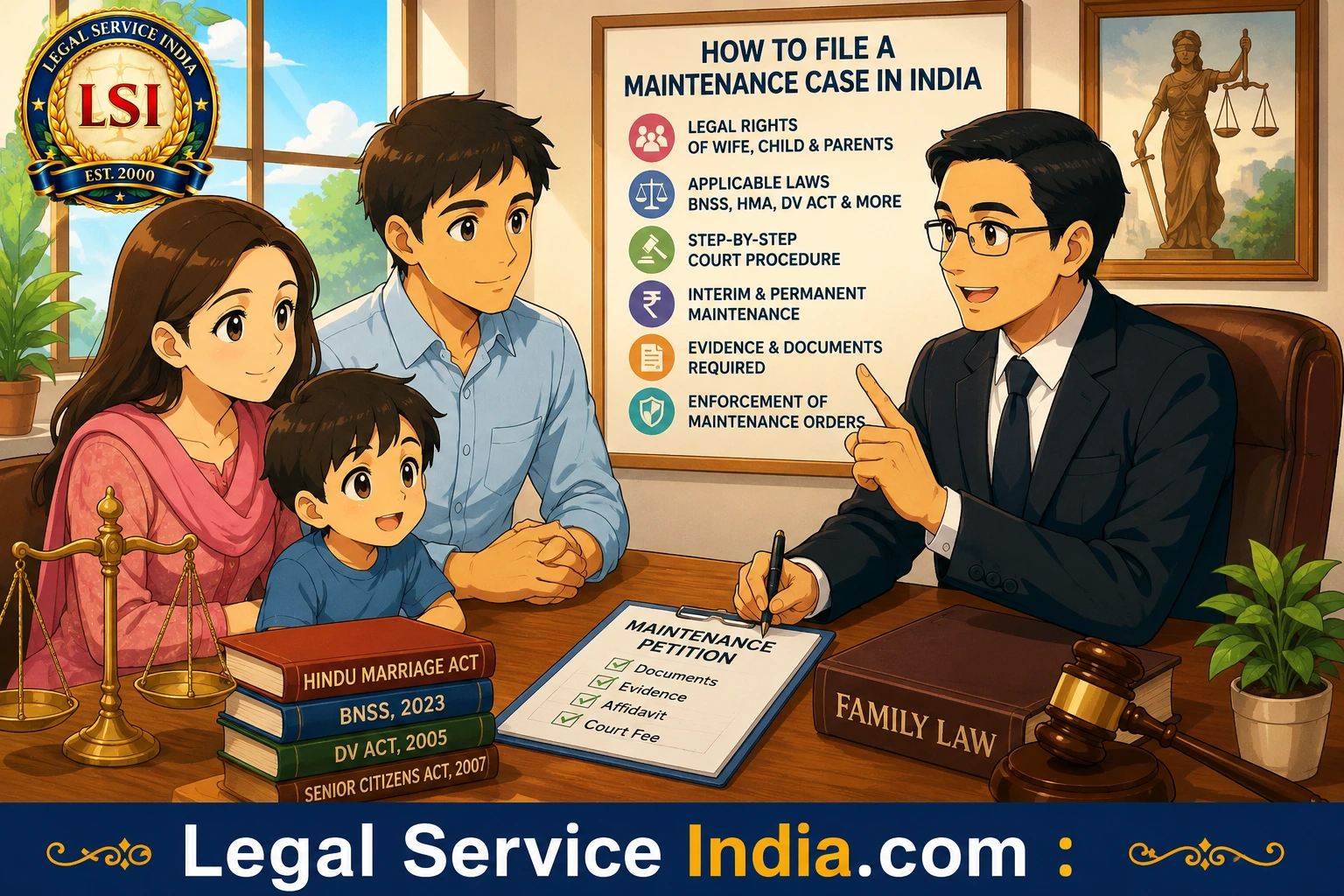
How to File a Maintenance Case in India: Complete Step-by-Step Legal Guide
Introduction
Knowing how to file a maintenance case in India is essential for anyone facing financial neglect after separation, divorce, or abandonment. Indian law recognises that a spouse, child, or dependent parent should not be left without financial support merely because a family relationship has broken down.
Maintenance is not a punishment imposed on one party; it is a legal obligation designed to ensure that dependants can live with dignity. Several statutes—including the Bharatiya Nagarik Suraksha Sanhita, 2023 (BNSS), the Hindu Marriage Act, 1955, the Hindu Adoptions and Maintenance Act, 1956, the Protection of Women from Domestic Violence Act, 2005, and the Maintenance and Welfare of Parents and Senior Citizens Act, 2007—provide remedies depending on the relationship and circumstances of the parties.
This guide explains how to file a maintenance case in India, the applicable laws, court procedure, documents required, evidence, interim relief, enforcement of orders, and practical tips to improve the chances of obtaining a fair outcome.
What Is Maintenance?
Maintenance is financial support that a person with sufficient means is legally required to provide to a dependant who cannot adequately maintain themselves.
Maintenance may include:
- Food
- Clothing
- Accommodation
- Medical expenses
- Children’s education
- Daily household expenses
- Reasonable recreation
- Transportation
- Other essential living costs
The objective is to ensure that the claimant is able to live with reasonable dignity and not fall into destitution.
Who Can Claim Maintenance?
Depending upon the applicable law, maintenance may be claimed by:
- Wife
- Divorced wife
- Minor children
- Adult-abled children
- Parents
- Senior citizens
- Certain dependants under Hindu law
- Aggrieved women under the Domestic Violence Act
Eligible Persons for Maintenance at a Glance
| Eligible Person | Can Claim Maintenance? | Relevant Law |
|---|---|---|
| Wife | Yes. | BNSS, Hindu Marriage Act, Domestic Violence Act |
| Divorced Wife | Yes (subject to law) | BNSS, Hindu Marriage Act |
| Minor Children | Yes. | BNSS, Hindu Adoptions and Maintenance Act |
| Adult-Disabled Children | Yes. | BNSS, Hindu Adoptions and Maintenance Act |
| Parents | Yes. | BNSS, Maintenance and Welfare of Parents and Senior Citizens Act |
| Senior Citizens | Yes. | Maintenance and Welfare of Parents and Senior Citizens Act |
| Certain Dependants | Yes. | Hindu Adoptions and Maintenance Act |
| Aggrieved Women | Yes. | Protection of Women from Domestic Violence Act |
Which Law Should You File Under?
Many litigants are confused because multiple laws provide maintenance.
The appropriate remedy depends upon the facts.
Appropriate Law Based on the Situation
| Situation | Appropriate Law |
|---|---|
| Wife abandoned by husband | BNSS |
| Maintenance during divorce | Hindu Marriage Act |
| Permanent alimony after divorce | Hindu Marriage Act |
| Domestic violence | Protection of Women from Domestic Violence Act |
| Hindu dependants | Hindu Adoptions and Maintenance Act |
| Parents neglected by children | Senior Citizens Act |
In some situations, more than one remedy may be available. The choice of forum should always be made after obtaining legal advice.
Which Court Has Jurisdiction?
Jurisdiction depends upon the statute invoked.
Generally, proceedings may be filed:
- where the wife resides;
- where the respondent resides;
- where the parties last lived together;
- before the Family Court, where one has been established; or
- before the competent magistrate under the BNSS, where applicable.
Filing in the correct forum at the outset avoids unnecessary delays.
Documents Required
The following documents are commonly relied upon:
- Marriage certificate (if available)
- Aadhaar Card
- Identity proof
- Address proof
- Children’s birth certificates
- Income Tax Returns
- Salary slips
- Form 16
- Bank statements
- Property papers
- Medical bills
- School fee receipts
- Rent agreement
- Utility bills
- WhatsApp chats
- Emails
- Photographs
- Police complaints, if any
Even if some documents are unavailable, the case can still proceed with other evidence.
Also Read: Judicial Separation in India: Complete Step-by-Step Filing Procedure, Grounds & Legal Rights Guide
Step-by-Step Procedure
Step 1 – Consult a Family Law Advocate
Professional advice helps determine:
- appropriate legal provision;
- jurisdiction;
- interim relief available;
- documents required;
- realistic maintenance claim.
Step 2 – Collect Evidence
Strong evidence often determines the success of a maintenance case.
Useful evidence includes:
- proof of marriage;
- proof of neglect;
- educational expenses;
- medical expenditure;
- photographs;
- bank records;
- employment records;
- lifestyle evidence.
Step 3 – Draft the Petition
The petition should clearly mention:
- relationship between parties;
- facts leading to separation;
- financial condition;
- monthly expenditure;
- respondent’s earning capacity;
- Relief claimed.
Step 4 – Filing Before the Competent Court
The petition is filed with:
- supporting documents;
- affidavit;
- vakalatnama;
- prescribed court fee, wherever applicable.
Step 5 – Issue of Notice
The court issues notice to the respondent.
The respondent files a written statement along with supporting documents.
Step 6 – Filing of Financial Disclosure
Following the Supreme Court’s decision in Rajnesh v. Neha (2020), courts increasingly require detailed disclosure of:
- income;
- movable assets;
- immovable property;
- liabilities;
- investments;
- monthly expenditure.
Transparent disclosure assists the court in determining a fair amount of maintenance.
Step 7 – Interim Maintenance
The applicant may seek interim maintenance pending disposal of the case.
This enables immediate financial support during litigation and may also include litigation expenses in appropriate cases.
Step 8 – Recording of Evidence
Both parties may produce:
- oral evidence;
- documentary evidence;
- bank statements;
- salary records;
- tax returns;
- property documents;
- educational expenses;
- medical records.
Where income is disputed, courts may examine surrounding circumstances and lifestyle indicators in addition to documentary evidence.
Step 9 – Final Hearing
The court considers:
- income of both parties;
- reasonable needs;
- standard of living;
- number of dependants;
- liabilities;
- health;
- earning capacity;
- welfare of children.
There is no fixed mathematical formula for determining maintenance.
Step 10 – Final Order
The court specifies:
- monthly maintenance;
- date from which payable;
- arrears, if any;
- mode of payment;
- future modification, if circumstances change.
How Do Courts Decide the Amount?
Courts examine numerous factors, including:
- actual income;
- earning capacity;
- assets;
- liabilities;
- standard of living during marriage;
- educational needs of children;
- medical expenses;
- inflation;
- conduct relevant under the applicable statute.
Maintenance is therefore decided individually in every case.
Interim Maintenance vs Permanent Maintenance
Many litigants confuse these concepts.
Interim maintenance is temporary financial assistance granted during the pendency of proceedings.
Permanent maintenance or alimony is awarded after the conclusion of matrimonial proceedings, where the law permits.
Both serve different legal purposes.
| Aspect | Interim Maintenance | Permanent Maintenance |
|---|---|---|
| Purpose | Temporary financial assistance during pending proceedings | Financial support awarded after conclusion of matrimonial proceedings |
| Duration | Until final disposal of the case | As directed by the court under the applicable law |
| When Awarded | During the pendency of proceedings | After the conclusion of matrimonial proceedings |
Can Maintenance Be Modified?
Yes.
A maintenance order is not always permanent.
Either party may seek modification where there has been a substantial change in circumstances, such as:
- Increase or reduction in income;
- Serious illness;
- Unemployment;
- Remarriage, where legally relevant;
- Increased educational expenses of children.
Can Maintenance Be Cancelled?
In appropriate circumstances, a court may reduce or cancel maintenance where the applicable law so permits—for example, if there is a significant change in circumstances or other legally recognised grounds. Each case depends on its own facts and the governing statute.
What Happens If the Respondent Conceals Income?
Attempts to hide income rarely succeed.
Courts may:
- Direct production of financial records;
- Examine tax documents;
- Consider bank statements;
- Assess lifestyle evidence;
- Draw appropriate adverse inferences where concealment is established.
Honest financial disclosure strengthens credibility before the court.
Enforcement of Maintenance Orders
If maintenance is not paid voluntarily, the successful party may initiate execution proceedings.
Depending upon the applicable law, the court may:
- Recover arrears;
- Attach salary;
- Attach bank accounts;
- Attach property;
- Take other coercive measures permitted by law.
Timely enforcement is essential to ensure that maintenance orders are meaningful.
Common Mistakes Litigants Make
Many cases become unnecessarily prolonged because parties:
- Exaggerate or conceal income;
- Fail to preserve financial documents;
- Ignore court notices;
- Make unrealistic maintenance claims;
- Suppress liabilities;
- Delay compliance with court directions.
Being transparent and organised often strengthens a litigant’s case.
Frequently Asked Questions
Can Maintenance Be Claimed Without Filing for Divorce?
Yes. A maintenance claim may be filed even if divorce proceedings have not been initiated, provided the relevant statutory requirements are met.
Is a Marriage Certificate Mandatory?
No. A marriage can often be proved through other admissible evidence if a certificate is unavailable.
Can a Working Wife Claim Maintenance?
Yes. Employment alone does not automatically disentitle a spouse from maintenance. Courts consider whether the income is sufficient to maintain a reasonable standard of living.
Can Parents Claim Maintenance?
Yes. Parents and senior citizens may seek maintenance under the applicable provisions of law if they are unable to maintain themselves.
Can Maintenance Orders Be Challenged?
Yes. Depending on the governing statute, an aggrieved party may challenge a maintenance order before the appropriate appellate or revisional forum.
Conclusion
Understanding how to file a maintenance case in India is the first step towards protecting the financial rights of vulnerable family members. Whether the claim is made by a spouse, child, or aged parent, the legal system seeks to balance fairness with the duty to provide financial support.
The success of a maintenance case depends not only on the applicable law but also on careful preparation, complete financial disclosure, credible evidence, and timely legal action. Since every family dispute has its own factual and legal complexities, obtaining advice from an experienced family law advocate can help ensure that the correct legal remedy is chosen and that the proceedings are conducted effectively.
By following the proper procedure and presenting accurate evidence, parties can approach the court with confidence and seek a just and legally sustainable outcome.
Need Legal Assistance in a Maintenance Case?
Whether you are seeking maintenance, defending a maintenance claim, or need guidance on your legal rights, obtaining timely advice from an experienced lawyer can make a significant difference to your case.
Adv. Tarun Choudhury
Supreme Court Advocate | 25+ Years of Legal Experience
With over two decades of legal practice, Adv. Tarun Choudhury provides practical, strategic, and result-orientated legal assistance in matters relating to:
- Maintenance Cases (BNSS, Hindu Marriage Act & Domestic Violence Act)
- Divorce & Family Disputes
- Child Custody & Visitation Rights
- Domestic Violence Matters
- Alimony & Permanent Maintenance
- Supreme Court Appeals & Special Leave Petitions (SLPs)
- Civil, Constitutional & Family Law Litigation
Why Choose Adv. Tarun Choudhury?
| Key Advantage | Benefit to Clients |
|---|---|
| 25+ Years of Legal Experience | Extensive experience in family and constitutional litigation. |
| Supreme Court Advocate | Representation in the Supreme Court and other courts across India. |
| Personalised Legal Strategy | Solutions tailored to the facts of every case. |
| Expert Drafting | Professional drafting of petitions, replies, and appeals. |
| Confidential Consultation | One-to-one legal advice with complete confidentiality. |
| Comprehensive Court Representation | Practice before the Supreme Court of India, High Courts, Family Courts, and other courts. |
If you are facing a maintenance dispute or wish to protect your legal rights, don’t wait until the situation becomes more complicated. Obtain experienced legal advice tailored to your circumstances.
Contact Today
- 📞 Call: 9891244487
- 💬 WhatsApp: 9891244487
Schedule your confidential consultation today and receive trusted legal advice, strategic case evaluation, expert drafting, and dedicated representation from an experienced Supreme Court Advocate. Your rights deserve strong legal protection.
Key Takeaways
| Topic | Key Point |
|---|---|
| Legal Right | Maintenance is a legal right, not a favour. Indian law protects financially dependent spouses, children, parents, and senior citizens by providing legal remedies to claim maintenance. |
| Applicable Laws | Multiple laws govern maintenance in India. Depending on the facts of the case, maintenance can be claimed under the Bharatiya Nagarik Suraksha Sanhita (BNSS), Hindu Marriage Act, Hindu Adoptions and Maintenance Act, Protection of Women from Domestic Violence Act, and the Maintenance and Welfare of Parents and Senior Citizens Act. |
| Choosing the Right Remedy | Choosing the correct legal remedy is crucial. The appropriate statute and forum depend on the relationship between the parties, the nature of the dispute, and the relief sought. |
| Filing the Case | A maintenance case begins with filing a properly drafted petition before the competent Family Court or Magistrate, supported by relevant documents and financial evidence. |
| Evidence | Strong documentary evidence significantly improves the chances of success. Courts consider marriage proof, income records, bank statements, medical expenses, educational costs, and other financial documents while deciding maintenance claims. |
| Interim & Permanent Maintenance | Interim maintenance provides immediate financial relief during the pendency of proceedings, while permanent maintenance or alimony may be awarded after the conclusion of matrimonial litigation where permitted by law. |
| Court Assessment | Courts determine maintenance on a case-by-case basis. Factors such as income, earning capacity, standard of living, reasonable needs, liabilities, health, and the welfare of children are carefully evaluated before fixing the amount. |
| Financial Disclosure | Full financial disclosure is essential. Following the Supreme Court’s guidelines in Rajnesh v. Neha, parties are generally required to disclose their income, assets, liabilities, and expenditure through detailed affidavits. |
| Concealment of Income | Concealing income or assets can adversely affect a case. Courts may direct production of financial records and draw appropriate inferences if deliberate concealment is established. |
| Enforcement | Maintenance orders are enforceable. If the respondent fails to comply, the successful party may initiate execution proceedings, including recovery of arrears and other enforcement measures available under law. |
| Modification | Maintenance orders can be modified. A substantial change in financial circumstances, health, employment, or family responsibilities may justify enhancement, reduction, or modification of maintenance. |
| Professional Guidance | Proper legal advice is invaluable. Understanding the applicable law, preparing accurate financial disclosures, and presenting credible evidence can significantly improve the prospects of securing a fair and legally sustainable maintenance order. |
Quick Summary
- Maintenance is a statutory legal right.
- Different laws apply depending on the relationship and facts.
- Choosing the correct forum and legal remedy is essential.
- Financial documents and supporting evidence strengthen the case.
- Interim maintenance provides immediate relief during proceedings.
- Courts assess income, needs, liabilities, and standard of living.
- Financial disclosure is mandatory in most maintenance proceedings.
- Maintenance orders can be enforced and modified when circumstances change.
- Professional legal guidance improves the likelihood of a fair outcome.
Important Links
Important Links:
- Lawyers in India
- Copyright Registration in India
- Caveat Filing in Supreme Court of India
- Mutual Consent Divorce in Delhi NCR: WhatsApp 9650499965