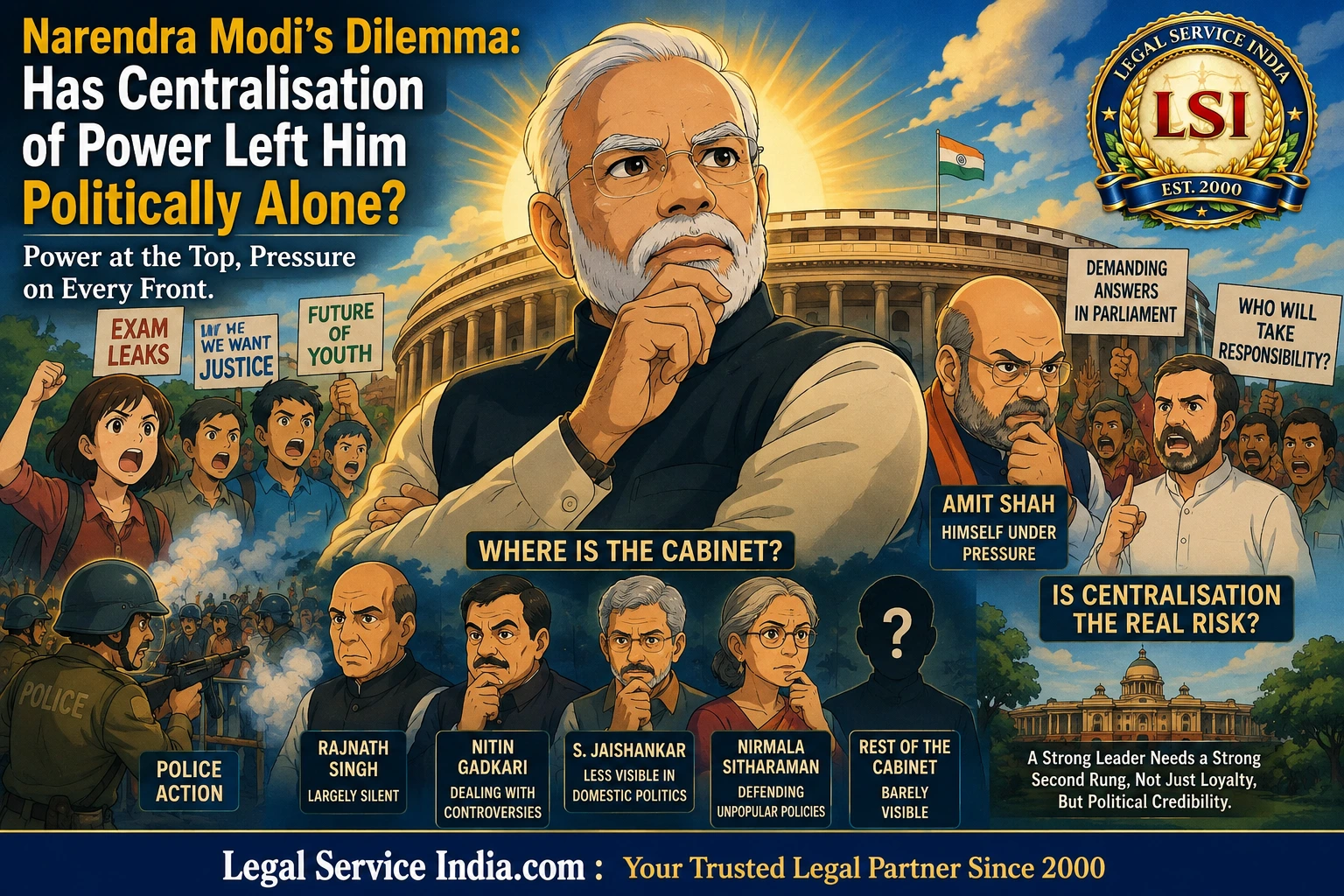
Narendra Modi’s Dilemma: Has Centralization of Power Left Him Politically Alone?
There is an interesting idea in political science known as the “dictator’s dilemma.” A powerful leader needs competent people around him because capable ministers can govern effectively. But competent ministers can also become politically influential. They build reputations, develop constituencies, question decisions, and, eventually, may emerge as alternatives to the leader himself.
The result is a dangerous paradox: the safest minister for a dominant leader may not be the strongest minister, but the one who is most dependent on the leader.
India, of course, is nowhere near a dictatorship. It remains a democracy. Yet the source material describes India as a “flawed democracy,” pointing to concerns about democratic accountability, political culture, civil liberties, and the functioning of government. It also raises questions about increasing centralization of decision-making around the Prime Minister’s Office and the perception that the Prime Minister is increasingly operating above parliamentary accountability.
This raises a provocative political question:
Did Narendra Modi’s extraordinary concentration of political authority strengthen his leadership while simultaneously weakening the political space around him?
The Modi Model: When One Leader Becomes the Government’s Face
For years, one of Narendra Modi’s greatest political strengths was precisely the absence of another equally dominant figure.
Every election appeared to revolve around Modi. Major government achievements were associated with Modi. Major announcements carried Modi’s political imprint.
That model created enormous political clarity.
But it also contained a structural weakness.
What happens when the leader himself becomes the center of a political crisis?
Who steps forward when the prime minister needs someone else to absorb the political pressure?
That is what the source material describes as Modi’s dilemma.
The Student Protests and the Education Ministry Crisis
The student protests over examination leaks became one of the major political challenges described in the source.
The agitation expanded into a national movement. The situation was further aggravated when Education Minister Dharmendra Pradhan was accused in the source of describing protesting students as terrorists.
After weeks of agitation, Pradhan resigned.
For a government portrayed as being resistant to pressure from street movements, the resignation represented an extraordinary retreat.
The controversy did not end there.
On July 20, students marching in Delhi reportedly faced police action, including baton charges and tear gas. The opposition alleged that pellet guns were also used, a claim that the source says was subsequently confirmed.
Instead of ending the agitation, the police response gave the controversy another political life.
The issue moved from the streets into Parliament. Opposition MPs demanded an explanation from Home Minister Amit Shah. By August 8, the confrontation had become serious enough to disrupt proceedings in both the Lok Sabha and the Rajya Sabha over demands for Shah’s statement.
A political figure who had long appeared to be one of Modi’s indispensable enforcers was now himself facing political pressure.
That distinction matters.
The minister who is supposed to protect the government from a crisis can become part of the crisis.
Opposition Finds Multiple Pressure Points
The source also describes another political challenge involving allegations concerning Ram temple donations.
Chandrashekhar Jori, Rahul Gandhi, and Malikarjun Kharge reportedly wrote to Modi seeking an independent investigation into the allegations.
By early August, opposition MPs were simultaneously demanding answers from Modi concerning one controversy and from Amit Shah concerning alleged police excesses.
At the same time, Rahul Gandhi was described as taking the political battle directly to students in Prayagraj, focusing on unemployment, expensive education, examination paper leaks, and the future of young Indians.
Whatever one’s political assessment of Rahul Gandhi, the source argues that a striking contrast was emerging:
Rahul Gandhi was increasingly going directly to students, while Narendra Modi was increasingly being asked why he was not coming to Parliament.
That is where an old political strength could potentially become a new political weakness.
Where Is the Cabinet?
For years, Modi’s political dominance overshadowed much of his cabinet.
But when the prime minister’s own political image comes under sustained pressure, the question becomes unavoidable:
Where are the heavyweight ministers who can take some of that pressure away from him?
The source points first to Dharmendra Pradhan, who had already left the government following the student controversy.
Amit Shah, meanwhile, was facing demands to explain the police response.
The rest of the cabinet, according to the source, appeared politically less visible.
The argument is not that these ministers are insignificant. Quite the opposite. Several are described as experienced politicians with substantial political backgrounds. The question is why that experience does not appear to translate into a stronger collective political defense of the government when the prime minister is under pressure.
What Happened to the Political Weight of Senior Ministers?
The source specifically raises questions about several senior members of the Modi cabinet.
Rajnath Singh had famously declared in 2015 that this was not the UPA and that ministers did not resign in the NDA. Yet the source asks where India’s Defence Minister is politically visible when the government is confronting multiple crises.
Nitin Gadkari, meanwhile, had strongly defended the government’s E20 policy and dismissed much of the criticism as a false narrative. But as public concerns over mileage, compatibility, and accountability increased, the source questions where that political confidence had gone.
Foreign policy presents another potential pressure point.
The source discusses US legislation allowing Donald Trump to impose tariffs of up to 100% on countries heavily dependent on Russian energy, including India. It argues that such a potentially significant foreign policy and economic confrontation should require a strong public explanation from the External Affairs Minister.
Similarly, Finance Minister Nirmala Sitharaman faces questions over changes to the legal framework surrounding zero-MDR digital payments and the implications for merchant transactions.
The broader point is not that senior ministers have disappeared.
It is that their collective political visibility appears weaker than the scale of their offices would suggest.
A Cabinet Full of Political Experience
The source names several other senior figures, including Sarbananda Sonowal, Giriraj Singh, Shivraj Singh Chouhan, Manohar Lal, Jitan Ram Manjhi, H. D. Kumaraswamy and Jyotiraditya Scindia.
These are not presented as inexperienced politicians. Some have served as chief ministers. Some have led major political organizations. Some have spent decades in public life.
Yet the central question remains:
When Narendra Modi faces his greatest political pressure, how many of these leaders are actually carrying the government politically?
This leads to an important distinction between having a powerful cabinet and having a politically independent cabinet capable of absorbing pressure.
A government may have many prominent names while still functioning politically as a one-person system.
The underlying pattern is simple:
The leader becomes stronger. The second rung becomes weaker. Institutions become less capable of correcting mistakes. And when a crisis finally reaches the leader, there may be nobody left capable of rescuing him politically.
Was Amit Shah the Exception?
For much of Modi’s political career, there appeared to be an obvious answer to the question of who stood beside him politically: Amit Shah.
The source describes Shah as disciplined, organizationally powerful, politically ruthless, and completely aligned with Modi.
If Modi was the face, Shah was the machine.
That partnership appeared to solve the second-rung problem.
But political strength is ultimately tested when things go wrong.
According to the source, when the student protests intensified, the police response generated further political controversy, Parliament became hostile, and opposition parties demanded answers.
Instead of absorbing the crisis on behalf of Modi, Shah himself became one of its central political targets.
That changes the equation.
If the person who was expected to absorb political pressure is himself under pressure, who is left?
The Loneliness at the Top
The source paints a picture of a government that still possesses enormous institutional and political power but appears increasingly dependent on one central figure.
Rajnath Singh is described as largely silent.
Gadkari is dealing with his own controversies.
S. Jaishankar is portrayed as less visible in the domestic political battle.
Nirmala Sitharaman is defending unpopular policy changes.
The remaining cabinet, according to the source, barely registers in the wider political confrontation.
This creates what may be the most important paradox of centralized leadership.
A leader can become so politically dominant that nobody around him is allowed—or able—to develop an equivalent political stature.
For as long as the leader remains politically unassailable, that can look like strength.
But when the leader comes under sustained pressure, the same structure can become a vulnerability.
Modi’s Real Dilemma
The source does not suggest that Narendra Modi has lost control of the government.
Quite the opposite.
It argues that he may still control the government while increasingly appearing politically alone.
And that may be the more significant problem.
A dominant leader does not necessarily become vulnerable when the opposition becomes stronger. The deeper vulnerability can arise when the people standing behind him no longer appear capable of protecting him politically.
For years, Modi appeared surrounded by power.
The question now is whether that power remains politically transferable when the prime minister himself needs support.
That is the essence of the “second-rung problem.”
The leader may remain extraordinarily powerful, but the political system around him may become increasingly dependent on his personal authority.
And when the crisis reaches the top, there may be nobody else strong enough to carry it.
Conclusion: Strength Can Become Vulnerability
The central argument is ultimately not about whether Narendra Modi is powerful. He clearly remains the central figure of his political system.
The more difficult question is what happens to a political system when so much authority, visibility, and accountability become concentrated around one leader.
A strong leader needs strong people around him.
- Not merely loyal people.
- Not merely efficient administrators.
- But politically credible figures who can disagree, defend decisions, answer difficult questions, take responsibility, and absorb public pressure.
Without that second rung, centralization can create an unusual paradox.
The leader becomes stronger, but the system around him becomes weaker.
And when the political storm finally reaches the leader himself, the greatest danger may not be the strength of his opponents.
It may be the absence of anyone else capable of standing beside him.
Therefore, the real dilemma confronting Narendra Modi today is not necessarily a loss of power but the growing political loneliness that can come with having too much of it.