




Understanding Section 138 of the Negotiable Instruments Act, 1881
When a cheque is dishonoured, anger is the usual first reaction and a quick message to the drawer the second. The law, however, cares less about how upset the holder is and more about dates. Section 138 of the Negotiable Instruments Act 1881 is a short provision, but it works like a relay race: each runner must receive the baton within a set time, or the race is over. This article follows those dates and the choices a cheque holder faces along the way.
What Has to Be True for Section 138 to Apply
The section deals with a cheque drawn on a bank account for payment of money, where the cheque is returned unpaid because the money in the account is insufficient or because it exceeds the amount arranged with the bank. Four conditions must be present together.
- The cheque was issued to discharge, wholly or partly, a legally enforceable debt or other liability.
- It was presented to the bank within its validity, which under banking rules is three months from the date written on it, or within the validity of the cheque if that is shorter.
- It came back unpaid, with a memo from the bank stating the reason.
- The holder then followed the notice and complaint steps within time.
A cheque given as a gift, or for a debt that has no legal enforceability, is a weaker candidate. Courts also look at whether the cheque was blank, post-dated or “security”, and the answers depend on the facts, so papers matter.
The Three Important Dates Under Section 138
Date One: The Demand Notice
After the bank returns the cheque, the payee must send a written demand to the drawer. Section 138 requires this to be done within thirty days of receiving information from the bank that the cheque is unpaid.
The notice must demand payment of the cheque amount, and it should refer to the cheque by number, date and amount, and to the return memo.
Send it to the drawer’s correct address by a method that leaves a record, such as:
- Registered post with acknowledgement.
- Courier with tracking.
- Email as well when the parties have used email before.
Many cases are lost at this point. A notice that arrives after the thirty days, is addressed wrongly, or leaves out the cheque amount gives the drawer an easy defence.
Keep the postal receipt, tracking page and the notice itself.
Date Two: Fifteen Days for the Drawer
The drawer has fifteen days from receiving the notice to pay the amount. Payment inside this window ends the criminal exposure under Section 138.
It is a window for settlement too: a short written agreement, with the payment made by bank transfer, is cleaner than cash.
What counts as a receipt can be disputed. If the notice was refused or returned as “unclaimed”, the question of when it is treated as delivered can arise. Keep the postal remarks.
Date Three: The Complaint
If the drawer does not pay within the fifteen days, the cause of action arises. Under Section 142 of the Act, the complaint must then be filed in the magistrate’s court within one month of that date.
The court has power to take up a complaint after that time if satisfied that there was sufficient cause for the delay, but depending on that is risky.
The complaint must be made by the payee or holder in due course, in writing, with the following documents:
- The cheque.
- The bank return memo.
- The legal demand notice.
- Proof of sending the notice.
The court that hears it is generally the one within whose area the payee’s bank branch is located, a rule adjusted by amendment and later decisions.
Interim Compensation and What Follows
Section 143A allows the court to order the drawer to pay interim compensation of up to twenty per cent of the cheque amount once the complaint has been filed, in appropriate cases.
If the drawer later appeals against a conviction, Section 148 permits the appellate court to ask for a deposit of a part of the amount awarded. These provisions were added to discourage delay.
Punishment for Cheque Dishonour
On conviction, Section 138 provides for:
- Imprisonment of up to two years.
- A fine of up to twice the cheque amount.
- Or both.
In practice, a very large number of cases are resolved through settlement, often with the court’s help, and the court can allow a compromise.
Common Mistakes by the Holder
A cheque holder should avoid the following mistakes while pursuing a cheque dishonour complaint:
- Presenting the cheque after its validity has passed.
- Waiting for a reply from the drawer before sending the notice.
- Sending the notice for the wrong amount or to an old address.
- Filing the complaint a day late.
- Failing to attach the bank’s return memo.
Common Mistakes by the Drawer
The drawer should also be careful when responding to a cheque dishonour notice. Common mistakes include:
- Ignoring the notice altogether.
- Paying part of the amount without a written receipt.
- Assuming that a stop-payment instruction ends liability, courts examine the reason for the stop.
- Leaving blank signed cheques with others without any record.
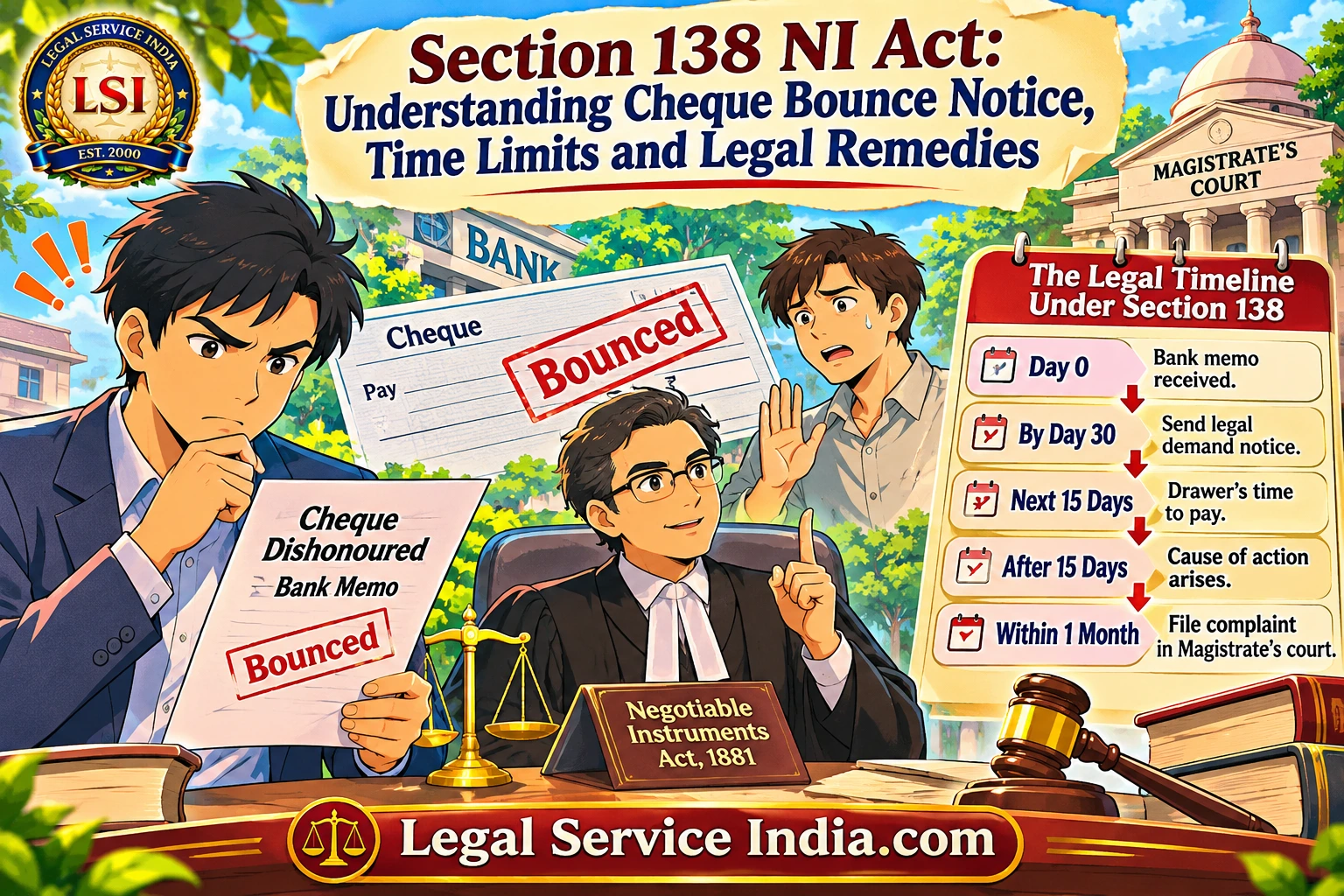
A Working Timeline Under Section 138
The following timeline summarises the important stages in a cheque dishonour case:
| Stage | Time Limit | Action Required |
|---|---|---|
| Day 0 | Bank memo received | Note the date of receiving information about dishonour. |
| By Day 30 | Within 30 days | Send the written demand notice to the drawer. |
| Notice Received | 15 days | The drawer gets fifteen days to make payment. |
| After 15 Days | Cause of action arises. | If payment is not made, the cause of action arises. |
| Complaint Filing | Within one month | File the complaint before the competent magistrate’s court. |
Important: The limitation periods under Section 138 and Section 142 must be calculated carefully. The date of receipt of the bank’s information and the date of receipt of the legal notice are particularly important.
Practical Steps to Protect Your Legal Rights
Write the dates in a notebook or a spreadsheet the day you open the memo. It is dull advice, and it is also what prevents most losses.
For a legal opinion on a particular cheque, an advocate will want the cheque copy, the bank memo, the agreement or invoice behind it, and the notice and receipts.
For the firm that prepared this note, see VIVS Legal, a law firm in Sanpada, Navi Mumbai, that takes cheque, property, family and banking matters.
Legal Disclaimer
This is general information, not legal advice.