A Story of Art, Communal Harmony, and the Law
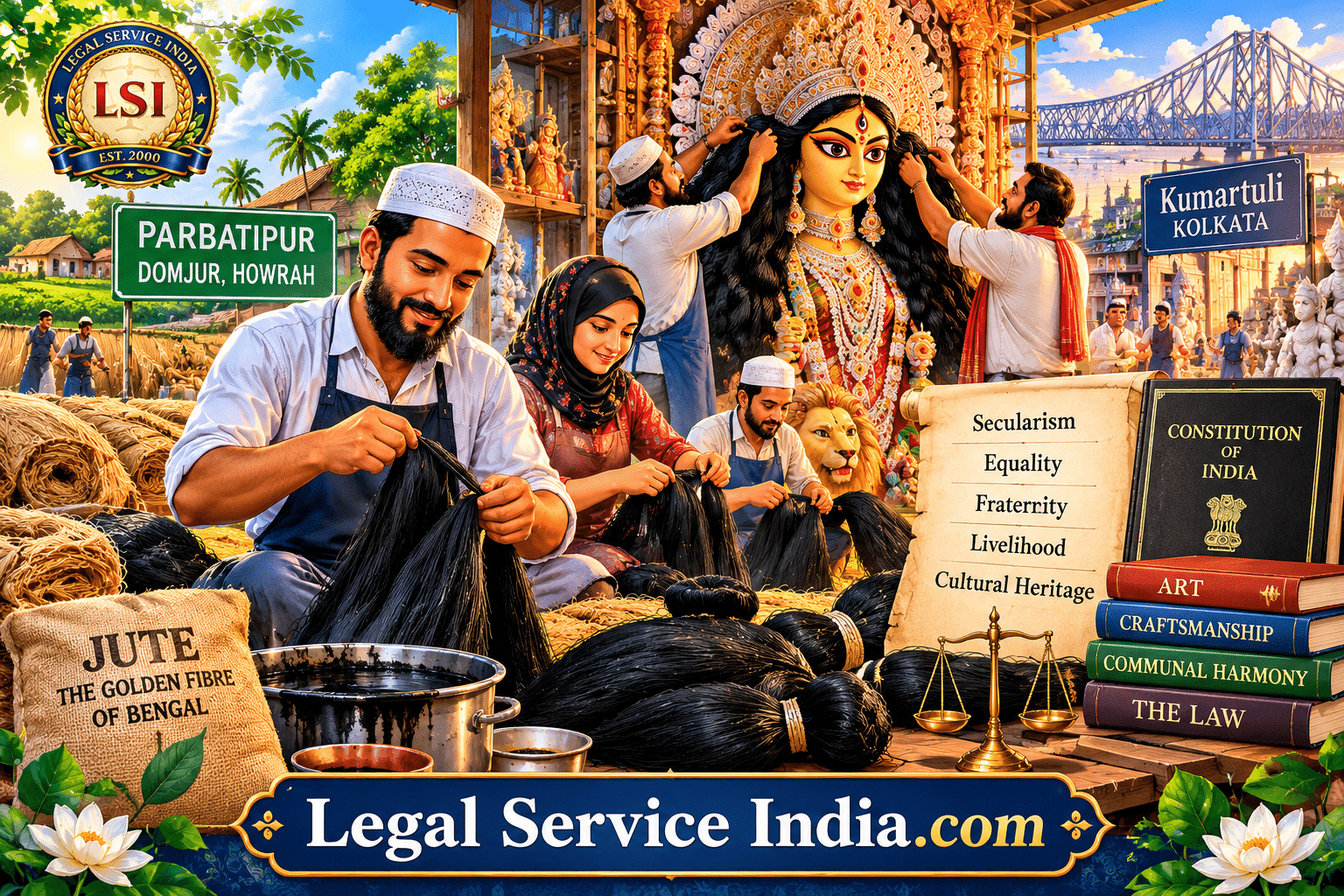
In West Bengal, Durga Puja transcends religious boundaries. It is a grand celebration of art, craftsmanship, and organic social cooperation. Behind every majestic idol of Maa Durga lies the quiet, dedicated labour of unseen artisans. One such community lives in Parbatipur, a village in the Domjur block of Howrah district, about 25–30 km west of central Kolkata along the Howrah–Amta road corridor. For generations, artisan families here have crafted the flowing black locks that adorn traditional Durga idols across Bengal and beyond.
For decades, these families—predominantly Muslim—have perfected the art of making artificial hair for the deity. Their work shows how traditional craftsmanship can cross religious lines and become part of a shared cultural heritage. Parbatipur is not only a hub of rural enterprise but also a living example of India’s pluralistic social fabric.
From Jute to the Crowning Glory of Maa Durga
The journey of the goddess’s hair begins with jute, the “golden fibre” of Bengal’s agricultural economy. Transforming raw jute into flowing tresses requires patience and skill: the fibre is selected, boiled, dyed deep black, dried, beaten, and separated into fine strands. These strands are then carefully arranged, bundled, and shaped into locks and wigs.
The finished product is supplied to idol-making centres such as Kumartuli in Kolkata and other artisan hubs across the region. As the festive season approaches, this specialised craft becomes indispensable. The regal appearance of the goddess ultimately depends on the collective efforts of these quiet workshops. What begins as a humble agricultural product ends as a sacred decorative element of Bengal’s most iconic festival—linking agriculture, cottage industry, generational knowledge, and the wider cultural economy.
Muslim Artisans and a Hindu Festival
The most compelling aspect of Parbatipur’s story is the active participation of Muslim artisan families in producing essential materials for the worship of Maa Durga. Their contribution rests not on shared religious belief but on craftsmanship, livelihood, and mutual professional trust. Hindu idol-makers, Muslim artisans, local traders, and transport workers form an interconnected ecosystem that sustains the festival.
This intercommunal reliance challenges the narrow idea that religious identity must restrict economic or cultural roles. It demonstrates that commercial collaboration and mutual respect can create lasting social bonds across faith lines. In contemporary India, such everyday cooperation gives concrete expression to the constitutional ideals of secularism, equality, and fraternity—values that are lived not only in constitutional texts but in daily acts of shared endeavour.
An Invisible Workforce
While Durga Puja receives national attention and recognition as an element of UNESCO’s Intangible Cultural Heritage, the artisans who create many of its essential components often remain in the shadows. The finished idol is celebrated; the labour that produces its crown of hair frequently goes unacknowledged.
This cottage industry provides a vital livelihood for rural households. Seasonal demand sustains family-run units, local trading networks, and the intergenerational transfer of skills. At the same time, extreme seasonality, rising raw-material costs, and competition from synthetic alternatives create ongoing economic insecurity.
Preserving this workforce requires more than seasonal appreciation. It needs structural support: fair pricing, access to institutional credit, improved working conditions, stronger market linkages, and appropriate social-security measures.
The Legal and Constitutional Perspective
Parbatipur’s craft intersects with several important constitutional principles, statutory frameworks, and policy considerations.
Right to Livelihood and Human Dignity
Article 21 of the Constitution guarantees the right to life and personal liberty. Supreme Court jurisprudence has established that this right includes the right to livelihood and human dignity. For artisan households, economic security is closely linked to dignity and social inclusion. Targeted support for rural crafts, skill development, and direct market access advances these constitutional objectives, alongside the guarantees of equality under Articles 14, 15, and 16.
Secularism, Freedom of Religion, and Fraternity
The Preamble declares India a secular republic. Articles 25 and 26 protect freedom of conscience and religious practice. The collaborative relationship between Muslim producers and Hindu idol-makers shows that occupational participation operates independently of religious doctrine. The Constitution does not restrict economic enterprise along religious lines. Such intercommunal reliance embodies the constitutional ideal of fraternity—unity amidst diversity.
Informal Labour and Social Security
Most workshops in Parbatipur function as informal or family-based enterprises. Self-employed artisans and family workers often fall outside the formal definition of “employee” under the Labour Codes. Expanding access to unorganised-worker welfare boards, occupational-safety measures, and social-security schemes remains essential for these vulnerable units.
Micro, Small, and Medium Enterprises
Jute-based craft processing falls within the MSME sector. While eligible under the Micro, Small and Medium Enterprises Development Act, 2006, informal units frequently face barriers to registration and scheme benefits. Encouraging cooperative societies, self-help groups, and direct digital-marketplace participation can strengthen their collective bargaining power and improve margins.
Environmental Responsibility
Although jute is a natural and relatively eco-friendly material, processing involves dyeing, chemical treatments, and waste disposal. Compliance with environmental norms is important. A gradual shift to non-toxic dyes and better waste-management practices would align traditional production with growing demand for sustainable cultural products.
Protection of Cultural Heritage and Traditional Knowledge
The technique of converting raw jute into idol hair is specialised traditional knowledge passed down through generations. Preserving it requires active institutional support. Exploring possibilities such as geographical indication registration or collective trademarks could help protect the authenticity and regional identity of Parbatipur’s craftsmanship against mass-produced substitutes.
Conclusion
Parbatipur’s role in Durga Puja highlights a simple truth: the grandeur of living cultural traditions rests on the unseen labour of rural artisans. The dark jute strands prepared in Howrah link rural manufacturing with urban artistry and integrate artisan livelihoods into the socio-cultural life of Bengal.
Above all, the story shows that shared economic and cultural lives can thrive across religious differences. These daily interactions give practical expression to the constitutional ideals of equality, secularism, and fraternity.
Legal frameworks have an important role in securing livelihoods, ensuring fair conditions, and safeguarding cultural heritage. Yet law alone cannot preserve a tradition. True preservation requires societal recognition—seeing Parbatipur’s artisans not merely as suppliers of raw material but as custodians of Bengal’s living heritage and India’s pluralistic spirit.