





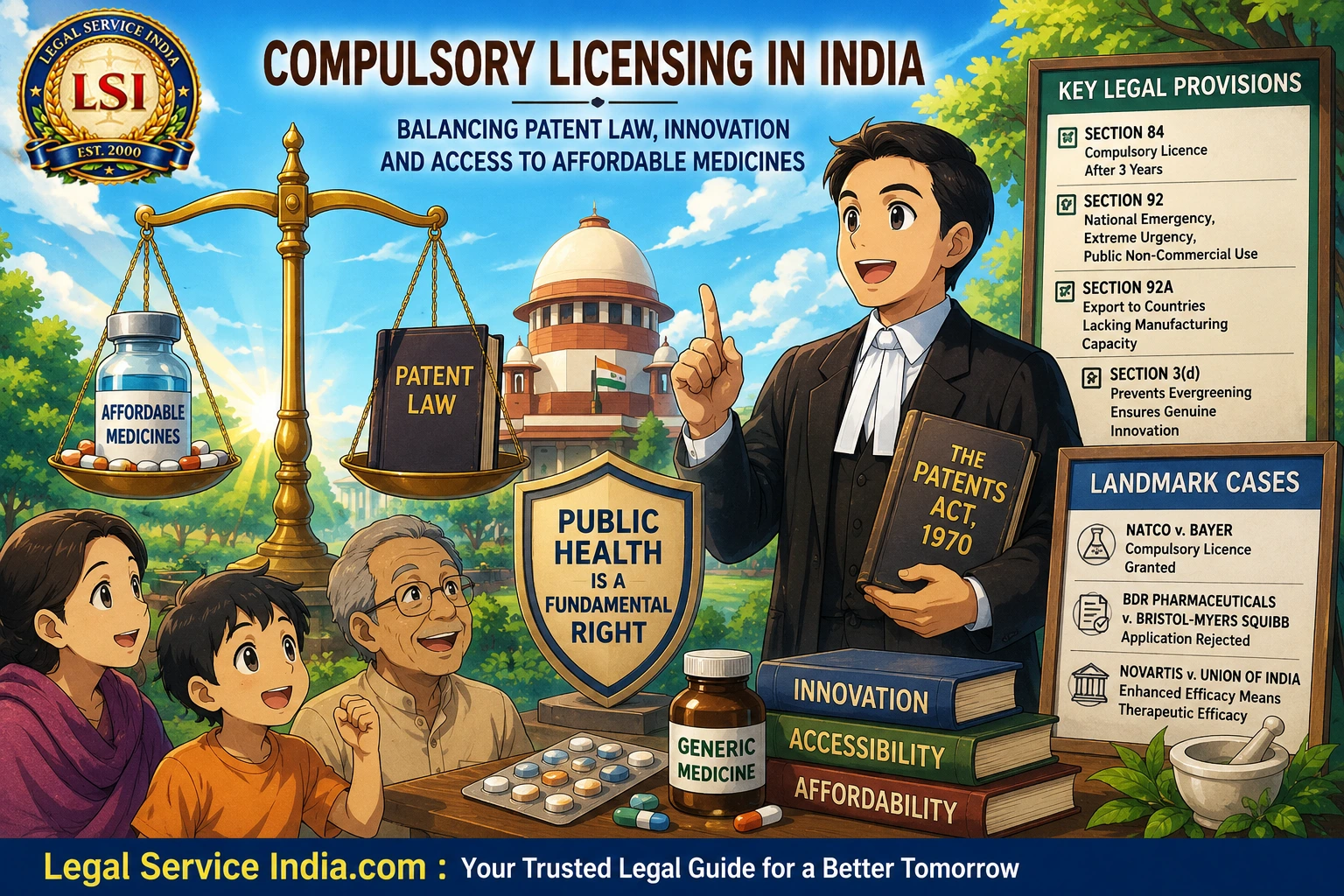
Patent law rewards inventive effort with a temporary exclusive right over an invention in exchange for disclosing it to the public. Nowhere is this bargain harder to sustain than in pharmaceuticals, particularly in a country such as India, where a very large number of people depend on affordable generic medicines to survive. An unchecked monopoly over a life-saving drug can push essential treatment beyond the reach of exactly the people the health system exists to serve. This tension between rewarding innovation and ensuring access to medicine has shaped the Indian Patents Act, 1970, and continues to guide how courts and patent authorities interpret it.
This tension sharpened after India joined the World Trade Organization and accepted the Agreement on Trade-Related Aspects of Intellectual Property Rights, or TRIPS[i], which required India to introduce product patents for pharmaceuticals by 2005, replacing the earlier regime under which Indian manufacturers could lawfully produce low-cost versions of patented drugs through alternative synthesis routes.
Parliament treated this shift as a constitutional choice rather than a technical amendment, retaining and strengthening the compulsory licensing provisions in Sections 84 to 92 of the Patents Act, along with a strict patentability threshold in Section 3(d), so that the new product-patent regime would not come at the cost of ordinary citizens’ access to affordable medicines. These provisions reflect the understanding, consistent with Article 21 of the Constitution, that the right to life includes a right to health, and that a patent monopoly over an essential drug must give way, in defined situations, to the public interest in obtaining it.
This idea also finds support internationally in the Doha Declaration on the TRIPS Agreement and Public Health, adopted by the WTO Ministerial Conference in 2001 [ii], which confirmed that TRIPS does not prevent member states from protecting public health and that each country may decide for itself when to grant a compulsory licence.
This paper explains the statutory scheme governing compulsory licensing, examines how it was applied in the Natco and Novartis disputes, and considers the continuing tension between India’s public health goals and international trade pressure, closing with suggestions for strengthening the framework without weakening patent law’s underlying incentives.
Statutory Framework for Compulsory Licensing
Section 84: Compulsory Licence
Section 84 allows any interested person to apply to the Controller of Patents for a compulsory licence once three years have passed since a patent was granted. The application may rest on any one of three grounds:
- That the public’s reasonable requirements for the invention have not been satisfied.
- That the invention is not available to the public at a ‘reasonably affordable price’.
- That the invention has not been worked within India.
These grounds need not all be proved together; satisfying even one is enough for the Controller to consider granting a licence.
Factors Considered Under Section 84
Section 84(6) directs the Controller to weigh factors such as:
- The nature of the invention.
- The steps the patentee has taken to work it.
- The applicant’s ability to work it for public benefit.
- The time elapsed since the grant.
Section 84(7) assists applicants by listing situations automatically treated as proof that the public’s reasonable requirements have not been met, such as when an existing trade is harmed or when demand for the patented product is not adequately satisfied.
| Provision | Key Function |
|---|---|
| Section 84 | Provides for compulsory licences after three years from the grant of a patent. |
| Section 84(6) | Sets out factors the controller must consider while deciding an application. |
| Section 84(7) | Identifies circumstances in which public requirements are treated as not having been satisfied. |
| Section 92 | Provides for compulsory licensing in situations involving national emergency, extreme urgency, or public non-commercial use. |
| Section 92A | Permits compulsory licensing for manufacturing and exporting patented pharmaceutical products to countries lacking sufficient manufacturing capacity. |
Sections 92 and 92A: Emergency and International Public Health Needs
Beyond this, Section 92 allows the Central Government to declare a national emergency, extreme urgency, or public non-commercial use, after which the Controller can grant a compulsory licence without waiting for the usual three-year period.
Section 92A, added to fulfil India’s obligations under the Doha Declaration, goes further and permits a compulsory licence for manufacturing and exporting patented pharmaceutical products to countries lacking sufficient manufacturing capacity of their own.
Together, these provisions make compulsory licensing an exceptional remedy rather than a routine feature of the patent system, to be used only where voluntary licensing has clearly failed to meet the reasonable needs of the Indian public.
Section 3(d): Patentability And The Problem Of Evergreening
A related safeguard operates earlier, at the point of granting a patent itself. Section 3(d) excludes from patentability the mere discovery of a new form of an already known substance, unless that new form shows ‘enhanced efficacy’ over the known substance.
This provision is aimed directly at preventing ‘evergreening’, the practice of seeking successive patents on small variations of an existing drug simply to extend control over it.
Where compulsory licensing controls the terms on which an already granted patent may be used, Section 3(d) controls whether a patent should be granted at all; both share the same underlying purpose of reserving the twenty-year patent monopoly for genuine innovation rather than incremental modification.
| Safeguard | Stage | Primary Purpose |
|---|---|---|
| Section 3(d) | Patent Grant | Prevents patents from being granted for certain new forms of known substances without enhanced efficacy. |
| Sections 84–92 | After Patent Grant | Allows compulsory licensing in defined circumstances where public needs are not adequately met. |
Judicial Application: Key Cases
Natco Pharma Ltd. v. Bayer Corporation
The first grant of a compulsory licence for a pharmaceutical product in India came in Natco Pharma Ltd. v. Bayer Corporation [iii], decided by the Controller on 9 March 2012.
The dispute concerned Bayer’s patented anti-cancer drug sorafenib tosylate, sold as Nexavar and used to treat advanced kidney and liver cancer.
Bayer priced a month’s course at roughly ₹2.8 lakh, far beyond what most Indian patients could afford, and had, on Natco’s evidence, made the drug available to only a small fraction of the patients who needed it.
After Bayer declined to grant Natco a voluntary licence, Natco applied under Section 84(1), and the Controller found that Bayer had failed to satisfy all three statutory grounds at once.
The licence allowed Natco to sell a generic version at no more than ₹8,880 for a month’s supply, a reduction of about ninety-seven per cent, in exchange for a royalty of six per cent of net sales payable to Bayer.
Bayer’s appeal was rejected by the Intellectual Property Appellate Board, which read the Controller’s findings alongside Article 21 and confirmed that the right to affordable healthcare could inform how Section 84 is interpreted.
More than a decade later, this remains the only instance in which a compulsory licence has actually been granted for a pharmaceutical patent in India.
BDR Pharmaceuticals International Pvt. Ltd. v. Bristol-Myers Squibb
A contrasting result followed in BDR Pharmaceuticals International Pvt. Ltd. v. Bristol-Myers Squibb [iv], where BDR sought a compulsory licence over the anti-cancer drug dasatinib.
The Controller rejected the application because BDR had not made a genuine, credible attempt to obtain a voluntary licence on reasonable terms first, a step Section 84(1) requires, making clear that Natco had not lowered the bar for future applicants.
Novartis AG v. Union of India
The Supreme Court’s decision in Novartis AG v. Union of India [v] dealt with patentability rather than compulsory licensing directly but is usually read together with Natco as part of the same overall approach.
Novartis sought a patent for the beta crystalline form of imatinib mesylate, marketed as Glivec and used to treat chronic myeloid leukaemia, arguing that this form had improved bioavailability over the previously known compound.
The Court held that the ‘enhanced efficacy’ required under Section 3(d) means therapeutic efficacy, and that improved physical properties such as bioavailability, without evidence of an actual therapeutic benefit, do not meet that standard.
It also observed that Section 3(d) was deliberately designed to discourage evergreening and protect access to genuinely affordable medicines, and on that basis upheld the rejection of Novartis’s application.
Key Principles Emerging From The Cases
| Case | Issue | Outcome / Principle |
|---|---|---|
| Natco Pharma Ltd. v. Bayer Corporation | Compulsory licensing of a pharmaceutical patent | Compulsory licence granted under Section 84. |
| BDR Pharmaceuticals International Pvt. Ltd. v. Bristol-Myers Squibb | Prior attempt to obtain a voluntary licence | The application was rejected because the required genuine and credible attempt was not established. |
| Novartis AG v. Union of India | Patentability under Section 3(d) | Enhanced efficacy means therapeutic efficacy; the provision operates against evergreening. |
Read together, these decisions show a consistent pattern: Indian courts and patent authorities are willing to apply the statute firmly against patent holders where the facts support it, but strictly within the evidentiary and procedural limits the Act itself sets, rather than through a broad or open-ended reading of public interest.
Challenges and Contradictions
Despite this framework’s apparent strength, Natco remains the only pharmaceutical compulsory licence India has ever granted.
Applicants face a heavy burden. They must:
- Prove a genuine prior attempt at voluntary licensing.
- Gather enough pricing and availability evidence to meet the grounds under Section 84.
- Prepare for a long appeal process through the Appellate Board and the higher courts.
Generic manufacturers may also hesitate, since pursuing a compulsory licence could damage their commercial relationships with patent holders they may need to negotiate with again in future.
TRIPS and International Trade Pressure
India’s framework fully complies with TRIPS and the Doha Declaration, yet it has repeatedly drawn criticism in the Special 301 Reports that the Office of the United States Trade Representative issues each year.
These reports have placed India on the Priority Watch List and flagged its patentability standards and compulsory licensing provisions as concerns for American pharmaceutical exporters.
This external pressure sits uneasily against India’s sovereign right, expressly preserved under the Doha Declaration, to decide for itself when a compulsory licence should be granted.
Balancing Innovation and Access to Medicine
A further difficulty lies in striking the right balance.
The framework must not discourage genuine research or deter foreign companies from launching new drugs in India in the first place.
Using compulsory licensing too often risks pushing patent holders out of the Indian market altogether, while using it too rarely risks leaving it as a largely symbolic safeguard.
Read together, the Natco and BDR outcomes suggest that Indian authorities have so far struck this balance narrowly, deciding each case on its own facts rather than building settled general principles.
This leaves real uncertainty for both patentees and future applicants.
Conclusion and Recommendations
The compulsory licensing framework, together with the heightened patentability bar in Section 3(d), reflects a deliberate and constitutionally grounded effort to balance India’s international patent obligations against its domestic commitment to affordable healthcare.
Natco showed that the framework can sharply reduce drug prices when its conditions are met, while Novartis confirmed that the patentability threshold itself can stop pharmaceutical monopolies from being extended through minor modifications.
India’s experience with compulsory licensing offers a useful example for other developing countries seeking to balance international patent obligations against their own public health needs.
The framework has shown that it can lower prices sharply when genuinely invoked, yet it has clearly been underused since Natco.
This suggests that the central challenge going forward is not to strengthen the statutory text further but to make the existing safeguards genuinely accessible to the generic manufacturers and patient groups they were designed to protect.
Key Takeaways
- Section 84 provides the principal statutory mechanism for compulsory licensing after three years from the grant of a patent.
- A compulsory licence may be considered where public requirements are not satisfied, the patented invention is not available at a reasonably affordable price, or the invention has not been worked within India.
- Section 92 provides a mechanism for compulsory licensing in cases involving national emergency, extreme urgency, or public non-commercial use.
- Section 92A facilitates compulsory licensing for manufacturing and exporting patented pharmaceutical products to countries lacking sufficient manufacturing capacity.
- Section 3(d) operates at the patent-grant stage and is designed to prevent evergreening in specified circumstances.
- Natco Pharma Ltd. v. Bayer Corporation remains the landmark pharmaceutical compulsory licensing decision in India.
- BDR Pharmaceuticals demonstrates that applicants must satisfy the statutory and procedural requirements, including a genuine and credible attempt to obtain a voluntary licence.
- Novartis AG v. Union of India clarified the meaning of enhanced efficacy under Section 3(d).
- India’s framework reflects an ongoing attempt to balance pharmaceutical innovation, patent protection, public health, and access to affordable medicines.
End Notes
- Agreement on Trade-Related Aspects of Intellectual Property Rights, Apr. 15, 1994, Marrakesh Agreement Establishing the World Trade Organization, Annex 1C, 1869 U.N.T.S. 299.
- Doha Declaration on the TRIPS Agreement and Public Health, WT/MIN(01)/DEC/2, Nov. 14, 2001.
- Natco Pharma Ltd. v. Bayer Corporation, Compulsory Licence Application No. 1 of 2011, Order dated 9 March 2012 (Controller of Patents, India).
- BDR Pharmaceuticals International Pvt. Ltd. v. Bristol-Myers Squibb, Compulsory Licence Application No. 2 of 2012, Order dated 29 November 2013 (Controller of Patents, India).
- Novartis AG v. Union of India, (2013) 6 SCC 1.

