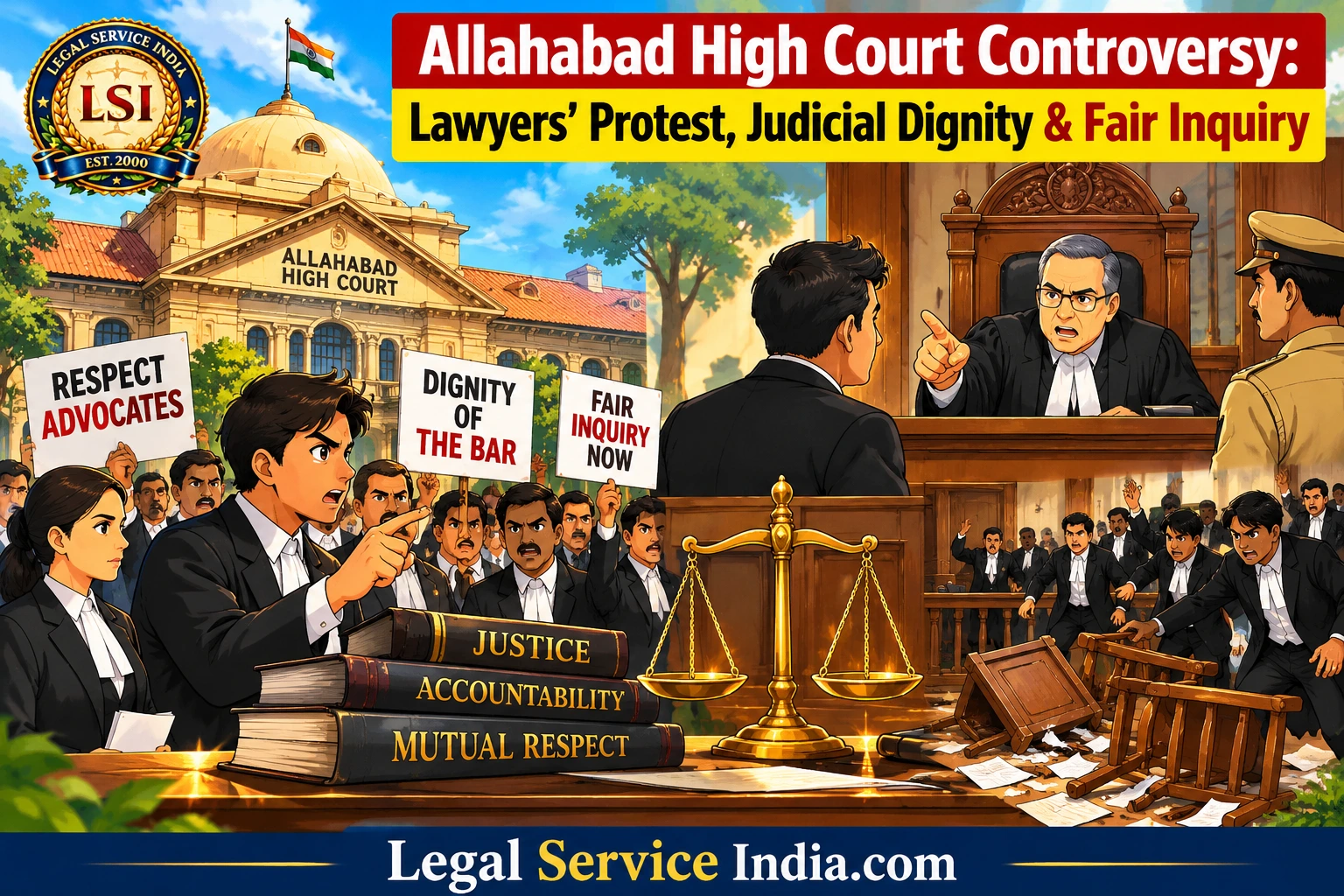
Dignity of the Bar Is Not Optional: Allahabad High Court Controversy Calls for a Fair Inquiry
The controversy surrounding the seating dispute at the Allahabad High Court and the subsequent lawyers’ protest raises an important question: how can the dignity of advocates be protected without compromising the authority of the judiciary? The answer lies in fairness, accountability and mutual respect between the Bench and the Bar.
The relationship between judges and lawyers is one of the foundations of the Indian justice system. Judges decide disputes, while advocates represent litigants, challenge arguments and assist the court in arriving at just decisions. Neither institution can function effectively without the other.
That is why the events of October 27 and 28, 2026, at the Allahabad High Court deserve serious consideration.
The controversy began with allegations by the Allahabad High Court Bar Association concerning the treatment of an advocate during court proceedings before Justice Ajay Bhanot. The following day, a lawyers’ protest reportedly disrupted proceedings, and videos and media reports showed furniture being thrown or overturned inside a courtroom.
The incident has since raised difficult questions about the dignity of advocates, the authority of judges, the limits of professional protest and the need for accountability within the legal system.
Two principles must guide any fair assessment of these events.
- First, allegations that an advocate was humiliated while performing professional duties deserve a fair and impartial examination.
- Second, the independence of the bar does not give any advocate the right to disrupt court proceedings or damage courtroom property.
Defending the legal fraternity does not mean defending every action taken by individual lawyers. It means insisting that grievances be examined fairly, responsibility be determined on evidence, and the dignity of both the Bench and the Bar be protected.
What Happened at the Allahabad High Court?
The seating dispute on October 27, 2026
According to a representation reportedly submitted by the newly elected office-bearers of the Allahabad High Court Bar Association on October 27, 2026, a dispute arose in Court No. 49 during proceedings before Justice Ajay Bhanot.
The association’s letter, attributed to its president, Senior Advocate Dr C. P. Upadhyay, and general secretary, Santosh Kumar Mishra, described a disagreement concerning the seating of a police officer in the courtroom.
According to the association, a superintendent of police was seated in a row behind the additional government advocate. An advocate reportedly asked the officer to move, taking the position that the seat was not intended for him.
The Additional Government Advocate allegedly objected to the advocate’s intervention and indicated that he would bring the matter to the judge’s attention.
What followed became the subject of the Bar Association’s complaint.
The allegations concerning the judge’s conduct
The association alleged that, after Justice Bhanot entered the courtroom and was informed about the incident, the judge addressed the advocate harshly, pointed a finger at him and ordered that he be sent to jail.
The letter further alleged that the advocate was required to apologise to the police officer and that Senior Advocate V. P. Srivastava, who was present, was subjected to mocking remarks.
The association objected to what it described as a practice of providing separate seating arrangements for police officers or other officials in a manner it considered inappropriate. It sought the intervention of the Chief Justice of the Allahabad High Court and warned that its members would boycott Justice Bhanot’s court if appropriate action was not taken.
These details must be understood for what they are: allegations made by the Bar Association. They should not be presented as established findings of judicial misconduct without an appropriate inquiry.
Nevertheless, the complaint raises a legitimate institutional question. If an advocate believes that he has been treated unfairly while discharging professional duties, what mechanism is available to secure a fair hearing without allowing the disagreement to escalate?
The answer should be found in a credible institutional process, not in confrontation or the automatic dismissal of the complaint.
Sources reporting the allegations include LiveLaw and BiharWatch, which reproduced or discussed the Bar Association’s representation.
The Protest on October 28: A Separate but Serious Issue
The controversy escalated on October 28, 2026, when lawyers protested against the alleged treatment of the advocate.
Media reports described slogans being raised and furniture being thrown, overturned or damaged inside Court No. 49. Images and videos circulated on social media showed a disrupted courtroom and overturned furniture.
Reports also described a disturbance in the corridors that affected proceedings in Court No. 66. Claims that a shoe was thrown at the judge circulated, but that particular allegation was not independently confirmed in the reporting cited here.
The disruption prompted judicial intervention.
While hearing Criminal Miscellaneous Bail Application No. 32917 of 2026, Devendra Kumar v. State of U.P., Justice Arun Kumar Singh Deshwal took note of the disturbance caused by advocates raising slogans in the corridor outside Court No. 66.
According to reports of the proceedings, the court emphasised that litigants approach the High Court seeking relief and that their cases should not be disrupted because advocates have a grievance against a particular judge.
The court directed the Registrar (Protocol) to obtain CCTV footage from the camera outside Court No. 66, identify the advocates involved in the disruption and submit a report by the next date of listing, reported as November 19, 2026.
The court also indicated that, following identification, the matter could be referred to the Bar Council of Uttar Pradesh for disciplinary proceedings and could lead to contempt proceedings.
These directions concerned the disruption of proceedings in Court No. 66. They should not be treated as a determination of the original allegations concerning the events in Court No. 49.
That distinction matters.
An inquiry into the conduct of protesting advocates does not, by itself, establish whether the original complaint against the judge was justified. Equally, the existence of a grievance does not automatically excuse unlawful conduct during a protest.
The two matters must be considered separately.
Sources: The Indian Express, Bar & Bench and the reported order in Criminal Miscellaneous Bail Application No. 32917 of 2026.
Why the Dignity of an Advocate Matters
An advocate’s dignity is not simply a question of personal pride. It is closely connected with the effective administration of justice.
A lawyer must be able to represent a client, question an official’s conduct, challenge evidence and raise legal objections without fear of personal humiliation or arbitrary treatment.
This is particularly important when an advocate appears on behalf of an ordinary citizen challenging a powerful individual, a government authority or the State itself.
If lawyers are unable to discharge their professional responsibilities independently, the consequences may extend beyond the legal profession. Litigants may find it more difficult to have their grievances heard and their rights protected.
The independence of the Bar therefore serves a broader public purpose.
At the same time, professional dignity does not mean that advocates are immune from criticism or that judges must accept every submission made before them. Courts must maintain discipline, manage proceedings and ensure that hearings are conducted efficiently.
The issue is not whether judges have authority over their courtrooms. They unquestionably do.
The issue is whether that authority is exercised consistently with the standards of fairness, restraint and professional respect expected in the administration of justice.
If the allegations made by the Bar Association are substantiated, they deserve appropriate consideration through the established institutional process. If they are not substantiated, that conclusion should also be reached on the evidence rather than on an assumption.
Respect for judicial authority and protection of an advocate’s dignity are not competing objectives. Both are necessary for public confidence in the justice system.
The Bench and the Bar Must Remain Independent, but Interdependent
The Bench and the Bar perform different functions, yet their responsibilities are closely connected.
A judge must decide cases independently, impartially and in accordance with the law. An advocate must represent the client’s interests fearlessly while observing professional ethics and the rules governing court proceedings.
The relationship is not one of personal subordination. It is a professional relationship governed by law, procedure and mutual responsibility.
An advocate should not be treated as an adversary merely because a legal submission is unwelcome or a procedural objection causes disagreement. Equally, a judge must be able to insist on order and discipline without facing intimidation.
A healthy legal system makes room for disagreement without allowing it to become personal hostility.
This is especially important in the Indian constitutional framework, where courts are expected to protect citizens against unlawful exercises of power.
The independence of the Bar helps ensure that legal representation remains effective even in difficult or sensitive cases. The authority of the Bench ensures that disputes are resolved through orderly proceedings rather than force or intimidation.
Neither function should be weakened in the name of protecting the other.
The proper objective is a professional environment in which judges can administer justice without interference and advocates can represent their clients without fear.
Can Lawyers Protest Against a Judge?
Yes, advocates can raise legitimate concerns through appropriate channels. But the form of protest matters.
The Supreme Court has repeatedly emphasised that lawyers do not possess an unrestricted right to strike or boycott courts.
In Ex-Capt. Harish Uppal v. Union of India, (2003) 2 SCC 45, the Supreme Court held that lawyers have no right to strike or call for a boycott of court proceedings. Such actions can prejudice litigants and interfere with the administration of justice.
The judgment makes clear that the interests of clients cannot simply be set aside because lawyers have a professional grievance.
This principle is directly relevant to the Allahabad High Court controversy.
The Bar Association was entitled to bring its concerns to the attention of the Chief Justice. It could seek an appropriate administrative response, pursue lawful avenues of representation and request that the allegations be examined.
However, a decision to boycott a particular court raises separate legal and professional concerns. A boycott can delay cases, inconvenience litigants and undermine the very system through which the grievance must be addressed.
The Supreme Court has not recognised an unrestricted right to strike or boycott even where advocates believe that their professional dignity is at stake.
The practical lesson is straightforward: the stronger the grievance, the greater the need to pursue it through a process that preserves the rights of litigants and the authority of the court.
Peaceful expression of professional concerns must also remain within the law and must not obstruct judicial proceedings.
Where Must the Line Be Drawn?
There is an important difference between raising a grievance and disrupting a courtroom.
An advocate who submits a representation to the Chief Justice is using an institutional channel. A Bar Association that requests an inquiry into alleged inappropriate conduct is exercising its representative function.
By contrast, throwing furniture, damaging public property, intimidating participants or obstructing proceedings, if established against particular individuals, raises serious questions of professional misconduct and interference with the administration of justice.
Such conduct cannot be justified merely by describing it as a protest.
The position should be equally clear in the other direction. The alleged misconduct of some participants should not automatically be attributed to every advocate who was present or to the legal fraternity as a whole.
Responsibility must be determined individually.
The CCTV examination directed by the High Court is therefore important, provided the resulting material is assessed fairly and in context. The identification of an individual, standing alone, should not substitute for establishing what that person actually did.
If the evidence establishes that an advocate participated in unlawful disruption, the applicable legal and disciplinary consequences may follow. If the evidence does not establish participation, the individual should not be treated as guilty merely because of association with the protest.
This approach protects the integrity of the proceedings and prevents collective blame from replacing individual accountability.
What Does the Law Say?
Several legal provisions are relevant to the issues raised by this controversy.
1. The Advocates Act, 1961
The Advocates Act provides the statutory framework governing the legal profession in India.
Section 30 recognises the right of advocates whose names are entered on a State roll to practise throughout the territories to which the Act extends, subject to the Act and other applicable laws.
Section 35 provides for disciplinary proceedings where a State Bar Council has reason to believe that an advocate on its roll has been guilty of professional or other misconduct.
These provisions reflect an important principle: the legal profession is entitled to statutory recognition and professional independence, but advocates remain accountable for misconduct.
Any disciplinary action arising from the Allahabad High Court protest must follow the applicable law and be based on evidence concerning the conduct of the individuals involved.
2. Article 19(1)(a) of the Constitution
Article 19(1)(a) guarantees citizens the freedom of speech and expression, subject to the constitutionally permitted restrictions set out in Article 19(2).
The freedom to express a grievance is an important part of democratic and professional life. Advocates must be able to raise legitimate concerns about institutional practices without every disagreement being treated as an attack on judicial authority.
However, the right is not unlimited. It does not confer a general licence to obstruct court proceedings, intimidate judicial officers or damage public property.
The legality of any particular protest depends on the conduct involved, the circumstances and the applicable legal provisions.
3. The Contempt of Courts Act, 1971
The Contempt of Courts Act addresses conduct that interferes with the administration of justice.
Section 2(c) defines criminal contempt to include specified conduct that scandalises or tends to scandalise a court, prejudices or interferes with judicial proceedings, or otherwise interferes with or obstructs the administration of justice.
Not every criticism of a judge amounts to contempt. The nature of the statement or conduct, its context and the relevant legal standards must be considered.
Nevertheless, conduct that unlawfully obstructs proceedings or interferes with the administration of justice may attract contempt proceedings.
Any such proceedings arising from the protest must follow the law and the applicable procedural safeguards.
4. Article 21 and the Interests of Litigants
Article 21 protects life and personal liberty in accordance with the procedure established by law.
The broader administration of justice also depends on courts being able to hear and decide cases without unnecessary obstruction.
When proceedings are disrupted, the consequences are often borne by litigants who have no involvement in the dispute between the Bench and the Bar.
A person seeking bail, protection from unlawful action or relief in a family or financial dispute should not have to bear the consequences of an institutional disagreement.
This is one of the strongest reasons why professional grievances must be pursued through methods that preserve access to justice.
5. Professional Conduct Under the Bar Council of India Rules
The Bar Council of India Rules prescribe standards of professional conduct and etiquette for advocates.
Advocates must maintain professional discipline, show appropriate respect towards courts and fulfil their duties to clients without compromising the administration of justice.
These obligations do not require advocates to remain silent about legitimate grievances. They require such grievances to be raised in a manner consistent with professional responsibilities.
The independence of the Bar is strengthened, not weakened, when its members insist on fair treatment while observing the standards expected of the profession.
A Fair Inquiry Is Necessary for Both the Bar and the Bench
The present controversy should not become a contest in which one institution is expected to defend itself by dismissing every concern raised by the other.
A fair inquiry into the original complaint would serve the interests of everyone involved.
- It would give the Bar Association an opportunity to substantiate its allegations.
- It would allow the judge concerned to respond through the appropriate process.
- It would also help the public distinguish between allegations, evidence and established findings.
The inquiry should consider the Bar Association’s representation, the circumstances surrounding the seating dispute, the accounts of those present and any relevant court records or other reliable material.
The same principle of fairness should govern the investigation into the protest.
The High Court’s direction to obtain CCTV footage and identify advocates involved in the disruption provides a procedural starting point. Any subsequent proceedings should focus on the actual conduct of identified individuals rather than presume that everyone present was responsible.
Neither inquiry should be used as a substitute for the other.
If the original allegations are substantiated, appropriate action should follow through the applicable institutional mechanisms. If misconduct by particular protesters is established, that conduct should be dealt with according to law.
Fairness cannot mean accountability for one side and immunity for the other.
It must operate in both directions.
What Can Be Done to Prevent Similar Incidents?
The controversy also presents an opportunity to address practical issues that can create avoidable friction in courtrooms.
Clear and Consistent Seating Arrangements
Courtroom seating protocols should be sufficiently clear to prevent unnecessary disputes over the position of advocates, government counsel, police officers and other officials.
Where seating arrangements are necessary for administrative or security reasons, consistent procedures can reduce misunderstandings and perceptions of preferential treatment.
The precise arrangements at issue in this case should be established through the available evidence rather than assumption.
A Formal Mechanism for Professional Grievances
Bar Associations should have an effective and accessible channel for raising complaints concerning courtroom treatment.
A clearly defined process, with an acknowledgement of the complaint and an appropriate response within a reasonable period, could help resolve disputes before they escalate.
Such a mechanism should respect judicial independence and must not be used to pressure judges over the merits of judicial decisions.
Clear Guidance on Lawful Protest
Bar Associations can help prevent future confrontations by informing members about the legal limits on strikes, boycotts and demonstrations.
The principles laid down in Ex-Capt. Harish Uppal v. Union of India provide important guidance on the obligations of advocates and the need to protect litigants from disruption.
Professional grievances can be expressed firmly without obstructing court proceedings.
Dialogue Between the Bench and the Bar
Regular institutional dialogue can help address concerns about courtroom procedure, professional conduct and the practical administration of hearings.
Such dialogue should not compromise judicial independence. Its purpose should be to identify problems, clarify expectations and reduce unnecessary conflict.
Accountability Based on Evidence
Where allegations of misconduct arise, the process should be transparent, fair and proportionate.
Neither a judge nor an advocate should be condemned merely because an allegation has been made. At the same time, professional standing should not shield anyone from accountability where misconduct is established.
These measures would help strengthen trust between the Bench and the Bar while keeping the interests of litigants at the centre of the justice system.
The Litigant Must Not Become the Victim of a Dispute Between the Bench and the Bar
Amid the controversy, it is easy to forget the people who depend on the courts.
For many litigants, a High Court hearing represents years of waiting, considerable expense and the hope of obtaining relief. A delayed bail hearing, a postponed family dispute or an adjourned matter can have serious consequences.
These people are not responsible for disagreements between judges and lawyers. They should not be made to bear the cost of such disagreements.
This is why the defence of lawyers’ dignity must be framed in terms of the public interest.
An advocate who is able to perform professional duties independently is better placed to represent a client effectively. A court that can function without intimidation or disruption is better placed to deliver justice.
Both are necessary.
The legal fraternity has every reason to insist that allegations of inappropriate treatment be examined fairly. It also has a professional responsibility to ensure that the pursuit of such grievances does not deprive litigants of access to justice.
The strongest defence of the Bar is one that protects its independence without losing sight of its duties.
Conclusion: The Dignity of the Bar Must Be Protected, and the Rule of Law Must Prevail
The Allahabad High Court controversy raises questions that deserve a serious institutional response.
The allegations concerning the treatment of an advocate and Senior Advocate V. P. Srivastava should be examined fairly, without presuming either their truth or their falsity. The reported disruption of court proceedings should likewise be investigated, with responsibility determined on the evidence.
The two issues are related, but they are not interchangeable.
An inquiry into the conduct of protesting advocates does not settle the original allegations. Equally, a legitimate grievance does not excuse unlawful disruption or damage to courtroom property.
The independence of the Bar must be protected because advocates play an essential role in defending the rights of citizens. The authority of the Bench must be respected because courts cannot administer justice if their proceedings are subject to intimidation or disorder.
Neither principle should be used to silence the other.
A mature justice system must be able to examine allegations against a judge without treating every complaint as an attack on the judiciary. It must also be able to hold advocates accountable for proven misconduct without condemning the entire legal fraternity.
Ultimately, the question is not whether the Bench or the Bar should prevail. It is whether both institutions can uphold the standards of fairness, dignity and accountability expected of them.
A lawyer’s dignity is not a licence to disrupt a court, just as judicial authority should not be a reason to dismiss a legitimate grievance without fair consideration.
That is the balance the rule of law demands.
Frequently Asked Questions
1. What was the Allahabad High Court controversy about?
According to the Allahabad High Court Bar Association’s reported representation, a seating dispute involving a police officer occurred in Court No. 49 on October 27, 2026. The association alleged that an advocate was subsequently treated inappropriately by Justice Ajay Bhanot. Lawyers protested the following day, when reports described courtroom disruption and furniture being thrown or overturned. The original allegations remain distinct from the subsequent protest.
2. Have the allegations against Justice Ajay Bhanot been established?
The allegations described in this article are attributed to the Bar Association’s representation. They should not be treated as established findings of judicial misconduct without an appropriate determination. The circumstances must be assessed through the relevant evidence and institutional processes.
3. What action did the High Court take after the protest?
According to reports of the proceedings in Devendra Kumar v. State of U.P., Criminal Miscellaneous Bail Application No. 32917 of 2026, Justice Arun Kumar Singh Deshwal directed the Registrar (Protocol) to obtain CCTV footage from outside Court No. 66, identify advocates involved in the disruption and submit a report. The court indicated that further disciplinary or contempt proceedings could follow.
4. Can lawyers legally boycott a judge’s court?
The Supreme Court held in Ex-Capt. Harish Uppal v. Union of India (2003) 2 SCC 45 that advocates have no right to strike or boycott court proceedings. Lawyers may raise legitimate professional grievances through appropriate channels, but such grievances do not create an unrestricted right to disrupt hearings or prevent litigants’ cases from being heard.
5. Why should the original complaint and the protest be examined separately?
The original complaint concerns allegations about the treatment of an advocate during court proceedings. The subsequent protest raises separate questions about the conduct of participating advocates. Evidence concerning one issue does not automatically establish the facts of the other. Separate consideration helps ensure fairness, individual accountability and public confidence in the justice system.
Sources and Legal References
The following sources should be consulted when assessing the reported events and the legal principles discussed in this article:
- The Indian Express: Reporting on the courtroom disruption at the Allahabad High Court.
- Ex-Capt. Harish Uppal v. Union of India, (2003) 2 SCC 45.
- Supreme Court Bar Association v. Union of India, (1998) 4 SCC 409.
- The Advocates Act, 1961, particularly Sections 30 and 35.
- The Contempt of Courts Act, 1971.
- The Constitution of India, particularly Articles 19(1)(a), 19(2) and 21.
- The Bar Council of India Rules governing professional conduct and etiquette.
Editorial Note
Editorial note: This article reflects the reported allegations and legal issues concerning the events of October 27–28, 2026. The allegations against the judge and the conduct attributed to individual protesters should be assessed on the available evidence. The article does not suggest that either set of allegations has been conclusively established.