





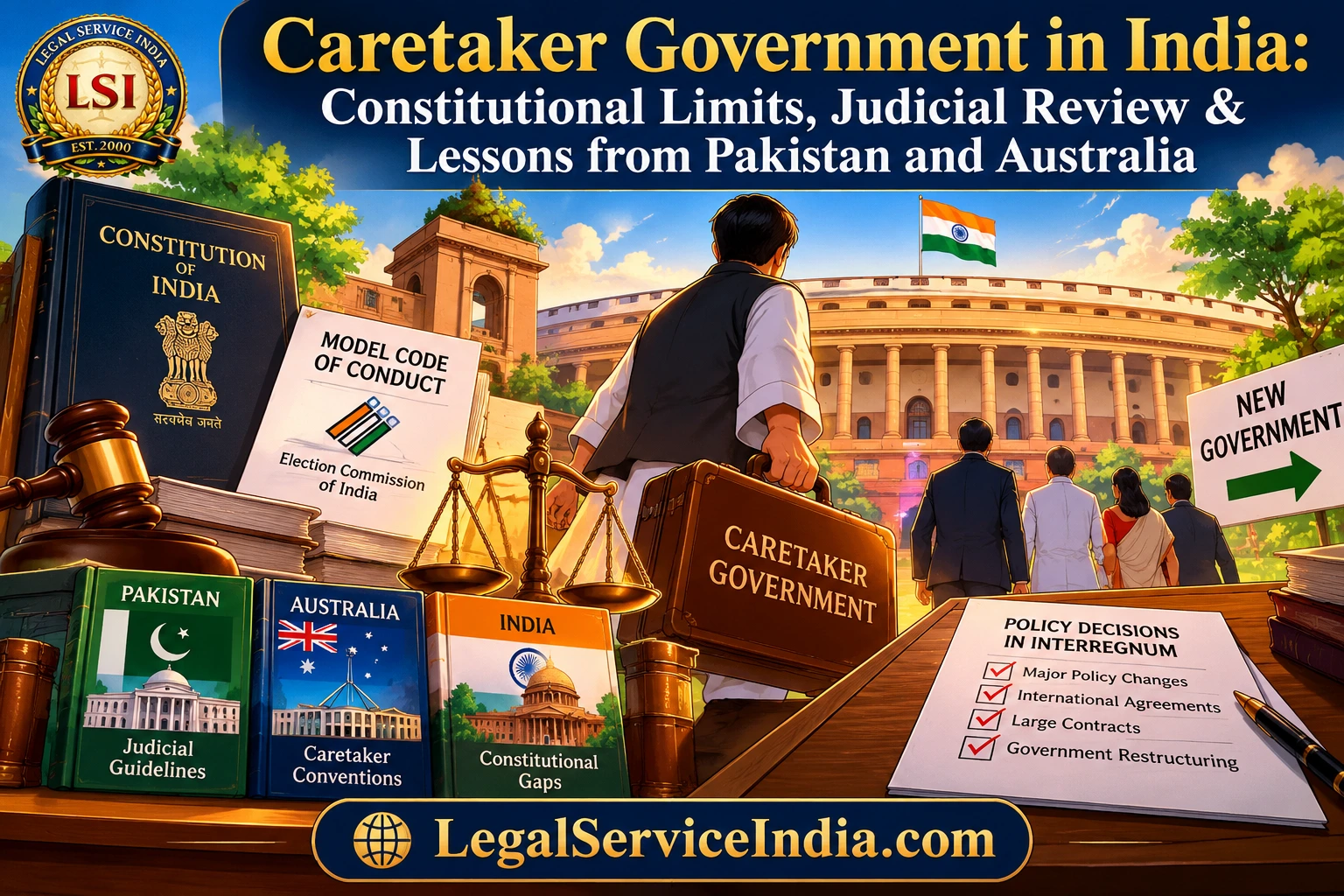
Abstract
The Indian Constitution does not prohibit an outgoing government from taking any action after the Lok Sabha is dissolved. Because of this, concerns have been raised about caretaker governments. Until a new government is formed, the Council of Ministers continues to exist and has the power to make decisions.
During the interim period, the dissolved government has no mandate to make decisions. However, the Election Commission of India has drafted a Model Code of Conduct to assist in the formation of a caretaker government.
In this paper, I will examine the ways in which India, Pakistan, and Australia have addressed the same challenge. The focus will be on the judicial and non-judicial (administrative) means to accomplish this.
Judicial restrictions are found in the decisions of the Pakistan Supreme Court in Mohammad Asif v. Federation of Pakistan. Similar limits in Australia are found in directives and standards issued by the Department of the Prime Minister and Cabinet. India has neither.
Using these limitations as a reference point, it is possible to propose judicial doctrines to limit the power of a caretaker government and administrative limits to further carry out those doctrines.
Introduction
Every parliamentary democracy faces situations between the dissolution of one parliament and the formation of a new government. There is a lapse when a new government is unrepresentative and lacks a democratic mandate to govern.
During this period, the previous government continues to exercise the formal powers of government. However, such a government lacks the democratic legitimacy to govern, and the powers exercised by it are subject to various legal and constitutional constraints.
Such constraints determine the extent to which the functions of the government are suspended or remain operative during the interregnum.
Constitutional Framework In India
The Constitution of India provides no answers to such questions. Provisions relating to the Council of Ministers and the President (Articles 75, 78) and the Election Commission (Article 324).1
However, the Indian Constitution never explains the role of the executive once the Lok Sabha is dissolved and a general election starts. In reality, this big gap has not been filled by special court decisions or written laws.
Instead, it is handled by the Model Code of Conduct, which is a set of guidelines that the Election Commission of India creates and enforces.2
The Model Code of Conduct works, and voters respect it, as it stops the ruling party from using the state machinery to gain votes.
The Model Code was made to answer one specific question: whether a decision is unfair to other political parties. It was never meant to deal with the broader constitutional issue.
That bigger question is this: when a government is no longer in power and no longer reflects the will of the people, does it still have the right to bind the country to policy changes, international agreements, contracts worth billions, or major government restructures? All these will bind the next elected government of India.
Democratic Legitimacy And Executive Restraint
Such situations and implications are very real; outgoing governments often make choices during election times, forcing the new government to either handle the results or try to undo those choices.
Since India has no legal or court-based rule explaining what a “caretaker executive” can and cannot do, the Model Code is the only check.
The Code can punish behaviour during elections, but it doesn’t solve the bigger issue of whether a government has the proper democratic support to make decisions in the first place.
Other parliamentary systems coming from the same British tradition have faced this identical structural flaw, but they have chosen completely different paths to fix it.
Pakistan’s Caretaker Government Framework
Pakistan’s Constitution, under Article 224A, lays down a strict process to set up an interim caretaker government when the prime minister and the opposition leader disagree.3
More importantly, the intervention of the Pakistani judiciary filled in the remaining blanks:
In Mohammed Asif v. Federation of Pakistan, the Supreme Court laid down a firm legal guide for caretaker administration, restricting it to merely routine governance and forbidding it from formulating major policy options unless there is a genuine national emergency.4
Australia’s Caretaker Conventions
Australia takes the other approach. They do not have any written constitutional text or court decisions on the matter.
Instead, they abide by “caretaker conventions”, unwritten rules of political conduct that have been compiled in a practical guideline document by the Department of the Prime Minister and Cabinet.5
Successive Australian governments conform to these guidelines for political tradition and peer pressure, entirely independent of the courts.
Comparative Models: India, Pakistan, and Australia
These three systems lie on a spectrum, with Pakistan having an enforceable standard of conduct mandated in court, Australia having executive self-restraint and explicit guidelines outside of the reach of the courts, and India lying somewhere in between.
India does not possess the explicit administrative guidelines which make up the Australian system. Australia also does not have the strictly enforced, judicially backed rules of the Pakistani system.
Rather, it relies heavily on an election regulatory body whose mandate was never supposed to extend this far, rendering its constitutional law completely devoid of any explicit doctrine on caretaker powers.
| Country | Approach To Caretaker Governments | Primary Mechanism |
|---|---|---|
| India | Relies heavily on election-related administrative restrictions. | Election Commission’s Model Code of Conduct. |
| Pakistan | Uses judicially articulated restrictions on caretaker administration. | Constitutional framework and judicial doctrine. |
| Australia | Relies on executive self-restraint and established political conventions. | Caretaker conventions and administrative guidelines. |
This paper provides a comparative study of the three models, seeking to chart exactly where India lies on the spectrum, expose the weaknesses of relying solely on the Model Code of Conduct, and evaluate whether India should address this lacuna of accountability via new doctrinal additions to the courts, a formalised code of conventions, or a direct constitutional amendment.
Statement Of Problem
Surprisingly, the Indian Constitution does not specify what a caretaker government may do. Articles 75 and 78 of the Indian Constitution outline the functioning of the Council of Ministers and its relationship with the President. Article 324 endows the Election Commission with authority over the conducting of elections.6
None of these articles mentions the period that is critical to this study: the time between the dissolution of the Lok Sabha and the formation of a new government.
During this time, the Council of Ministers retains its posts and makes decisions. Some of them could be decisions of a larger consequence to the nation. Even though it no longer has the electoral mandate that usually supports its power.
Limitations Of The Model Code Of Conduct
In the absence of any constitutional or judicial answer, this gap has been filled by default rather than by design. The Election Commission’s Model Code of Conduct has become the de facto standard governing executive conduct during elections.7
Still, it was built to solve a narrower problem: preventing the misuse of government machinery for electoral advantage.
It says little on whether an outgoing government may make commitments or sign international treaties and conventions that a future government that it cannot bind will have to live with.
The Model Code, in other words, protects the sanctity of the election. It does not protect the constitutional legitimacy of governance during the election.
Comparative Accountability Gap
This is not a problem exclusive to India, which is why a comparative study is so enlightening.
Pakistan has developed an articulated judicial doctrine confining caretaker executives to routine, day-to-day issues.8
Australia makes use of a convention which, though unenforceable in any court, is widely observed with a great deal of discipline.9
India possesses neither. It has borrowed the superficial form of restraint – an administrative code, seriously enforced – without the underpinning doctrine or convention which lends restraint its substance elsewhere.
This paper takes that as the central issue worth examining.
Research Questions
- What is the actual legal basis for the restraints placed on an outgoing Council of Ministers in India? Also, does the Election Commission’s Model Code of Conduct act as a genuine constitutional safeguard or merely as an electoral one?
- How has the Supreme Court of Pakistan, through its interpretation of caretaker executive power in cases such as Mohammed Asif v. Federation of Pakistan, constructed a substantive doctrine that Article 224A’s text does not itself provide? Moreover, could a similar judicial approach be developed within India’s own constitutional structure?
- How does Australia sustain a workable caretaker convention entirely outside the reach of courts, and what does the comparative success of that convention suggest about the limits of relying on unenforceable norms in a system like India’s, where such conventions do not yet exist in any documented form?
- Given the divergent approaches taken by Pakistan and Australia, should India move toward a codified or judicially recognised caretaker doctrine, or is a looser convention-based approach — if properly developed — sufficient to close the accountability gap identified in this study?
Research Objectives
- To examine the legal basis of restraints on the outgoing Council of Ministers in India and to assess whether the Model Code of Conduct actually functions as a constitutional safeguard or only as an electoral one.
- To analyse how the Supreme Court of Pakistan has, through cases like Mohammed Asif v. Federation of Pakistan, built up a substantive doctrine on caretaker power that goes beyond what Article 224A itself provides, and to consider whether a similar judicial approach could work within India’s constitutional structure.
- To study how Australia’s caretaker convention functions without any judicial enforcement, and to draw out what this suggests about relying on unenforceable norms in a system such as India, where no such convention presently exists in documented form.
- To evaluate, based on the Pakistani and Australian models, whether India should pursue a codified or judicially recognised caretaker doctrine, or whether a well-developed convention would be sufficient to bridge the accountability gap this study has identified.
Research Methodology
This paper adopts a doctrinal and comparative legal research methodology. The primary goal is to examine texts, laws and court rulings in India, Pakistan and Australia.
The focus is on how countries deal with power transference. This includes studying the rules set out in the constitutions of these countries, such as Articles 75, 78 and 324 in the Indian Constitution and Article 224A in the Pakistani Constitution.
It includes reviewing the Model Code of Conduct issued by the Election Commission of India and official guidance from Australia’s Department of the Prime Minister and Cabinet.
A key component of the study involves analysing court decisions in the case of Mohammed Asif v. Federation of Pakistan. This aids in understanding how courts have defined and limited the powers of caretaker executives. The analysis examines how judges have interpreted the scope of authority during transference.
Comparative Legal Analysis
The comparative study adheres to a structure. The paper explores where differences are similar and where differences differ, as well as why differences exist and what effects differences have in practice.
It considers both outcomes and real-world impacts. It considers what India could learn from the experiences of Pakistan and Australia.
Scope and Limitations of Research
This paper does not employ data collection or surveys. It relies solely on documents and judicial rulings.
Given that the research questions concern the interpretation of constitutional text and judicial doctrine rather than the measurement of public opinion, institutional practice, or stakeholder experience, a doctrinal and comparative approach proves more appropriate in answering them.
Empirical methods such as surveys or interviews would not contribute meaningfully to a question which, at its core, is one of constitutional interpretation.
Research Hypothesis
India does not have a codified or judicially developed caretaker doctrine. This leaves a gaping accountability deficit. The Election Commission’s Model Code partially compensates for this deficit, but it was not formulated with this purpose in mind. It addresses electoral fairness, not constitutional legitimacy.
Pakistan and Australia offer two distinct solutions to the problem. Pakistan relies on a judicial doctrine. Australia relies on a convention. Neither can be transplanted into India without adaptation.
But both offer partial answers to a question that India should face. This paper aims to show that a clear standard for Indian caretaker governance is desirable, whether this takes the form of a court-sanctioned restriction, a codified doctrine, or a properly developed convention.
And this paper, through a comparative study, attempts to answer this question.
Literature Review
Indian Literature on the Model Code of Conduct
Existing scholarship on India’s Model Code of Conduct is largely administrative in nature. It focuses on the Electoral Commission’s enforcement of the Code. It examines cases of its misuse during electoral campaigns.
It rarely explores the question: does the Model Code protect constitutional legitimacy or simply electoral fairness? This question has been largely ignored.10
Pakistani Literature on Caretaker Government
Scholarship on Pakistan’s Article 224A is largely procedural. It focuses on the process of appointing a caretaker Prime Minister. It explores the role of the parliamentary committee and the Election Commission.
Less attention is given to the judiciary’s role. Few writers connect Article 224A to the substantive doctrine built in Mohammed Asif v. Federation of Pakistan. This case is often cited. It is rarely analysed in depth.11
Australian Literature on Caretaker Conventions
Australian literature on caretaker conventions is mostly descriptive. It explains how the convention works. It describes the guidance issued by the Department of the Prime Minister and Cabinet.
It does not often compare this convention to jurisdictions where no such convention exists at all. India is one such jurisdiction.12
Research Gap in Comparative Constitutional Law
No study currently brings these three systems together. Indian legal scholarship treats the Model Code as a settled practice. It does not ask what would happen if a caretaker government exceeded it.
Comparative constitutional scholarship, more broadly, has examined caretaker conventions in single-country studies. A three-way comparison involving India, Pakistan, and Australia has not been attempted.
This gap is the starting point for this paper. The existing literature tells us what each country does. It does not tell us what India can learn from the other two.
Legal and Judicial Analysis
This section examines each jurisdiction in turn. It looks at the constitutional text first. It then looks at how that text has been used, or not used, in practice. India is examined first. Pakistan and Australia follow.
India: Constitutional Framework for Caretaker Governments
India’s Constitution creates the office of the Council of Ministers. Article 74 places it at the centre of executive power.13 Article 75 deals with its appointment and tenure. Article 78 sets out its duties to the President.14 None of these provisions mentions elections. None of them mentions government transitions. The silence is complete.
Continuation of the Outgoing Government After Dissolution
This silence becomes important once the Lok Sabha is dissolved. A general election is called. A new government has not yet formed. The existing Council of Ministers stays in office. It does not resign. It does not lose its formal powers. It simply continues to function, without the mandate that justified its formation.
India has no separate constitutional chapter for this period. It has no caretaker doctrine developed by courts. What it has instead is the Model Code of Conduct. This is not a law. It is not a constitutional provision. It is a set of guidelines issued by the Election Commission under Article 324.15
U.N.R. Rao v. Indira Gandhi (1971): Continuity of Executive Power
This absolute silence in the text has, however, received limited judicial scrutiny regarding the status of the government, if not its powers. In the landmark case of U.N.R. Rao v. Indira Gandhi (1971), the Supreme Court of India was forced to confront the literal text of Article 75(3), which mandates that the Council of Ministers shall be collectively responsible to the House of the People.
The petitioner’s view was that the dissolution of the Lok Sabha meant that collective responsibility was no longer possible, and therefore the Council of Ministers must vanish. The Supreme Court rejected this literal reading of Article 74(1), saying that the President could not wield his powers of the executive without the aid and advice of the Council of Ministers.
Therefore, even when the Lok Sabha is dissolved, the outgoing ministry must continue in office to avoid a total constitutional vacuum.16 Yet, while U.N.R. Rao settled the structural necessity of a continuing executive, it left the core accountability question entirely untouched.
The Court established that a transitional government must exist, but it failed to define the legal or constitutional limits on what that government can lawfully do while operating without an active legislature.
S.R. Bommai v. Union of India (1994): Limits on Interim Executive Power
This boundary on interim executive overreach was further expanded by the Supreme Court in the foundational federalism case of S.R. Bommai v. Union of India (1994). While Bommai primarily dealt with the invocation of Article 356 and President’s Rule, the Court extensively parsed the nature of executive power when a state legislative assembly is dissolved, but a new one is yet to be elected.
The Court clarified that during the period between the issuance of a Presidential Proclamation and its subsequent parliamentary approval, the caretaker administration or Governor cannot take irreversible, major policy actions that would present a newly elected assembly with a fait accompli.17
The Court specifically warned that caretaker authorities should not make sweeping structural alterations or long-term financial commitments that would deprive a future democratic mandate of its choice.
By virtue of this, Bommai provides a clear doctrinal precedent within Indian law that an interim, unelected executive must operate under implied restrictions.
But a glaring systemic deficit is that while Indian jurisprudence aggressively enforces this doctrine of restraint against transitional state executives for the sake of federalism, it has never made any attempt to apply these same constitutional limitations to a dissolved central executive.
The Model Code of Conduct and Caretaker Government Powers
The Model Code does important work in that it prevents ministers from using government resources for campaigning, announcing new welfare schemes in proximity to elections, or transferring staff for political ends. These are helpful restrictions, but they protect one thing only: the fairness of the election process.
The Model Code does not ask a different question, namely, whether a caretaker government signed a major international treaty. It does not ask whether it should approve a large infrastructure contract. It does not ask whether it should take a decision that will bind the next government for years. These questions fall outside its scope entirely.18
The Judicial Gap in India’s Caretaker Governance Framework
No Indian court has directly ruled on this gap. There is no equivalent of Pakistan’s Mohammed Asif judgment. There is no case that defines the outer limits of caretaker executive power in India.
The Election Commission enforces the Model Code strictly. But enforcement of an administrative code is not the same as judicial doctrine. It carries less legal weight. It answers a narrower question.
India, in short, relies on an institution built for a different purpose. The Election Commission is a strong and independent body. It is often called an independent sentinel of India’s elections. But it was never designed to police the constitutional legitimacy of caretaker governance. It was designed to police electoral fairness.
India has borrowed the appearance of restraint, but has not built the doctrine that gives restraint its strength.
Pakistan: Constitutional Framework for Caretaker Governments
Pakistan’s Constitution takes another route. It does not remain silent on the issue of caretaker governments. Article 224A addresses this issue head-on. It was inserted by the Twentieth Amendment in 2012.19
It outlines a clear process of appointment. Under Article 224A, the outgoing Prime Minister and the Leader of the Opposition must agree on a caretaker Prime Minister. If they fail to reach an agreement, then the matter goes to a parliamentary committee. If the committee also fails to agree, then the dispute is left to the Election Commission of Pakistan.20
This is a step-by-step procedure that removes ambiguity from the appointment process itself.
Article 224A: Appointment of a Caretaker Prime Minister
But Article 224A addresses only one question: how a caretaker Prime Minister is chosen. It does not speak to what the authority of a caretaker government can do once it is appointed.
The constitutional text is silent on the scope of caretaker power. This is a narrower silence that is seen in the Indian context, but it is still a silence.
Mohammed Asif v. Federation of Pakistan: Judicial Limits on Caretaker Powers
This is where the judiciary intervened. In Mohammed Asif v. Federation of Pakistan, the Supreme Court of Pakistan filled this gap.21
The Court held that a caretaker government must limit itself to day-to-day matters and could not make major policy decisions or take long-term commitments that would bind a future elected government.
The Court allowed only one exception: that a caretaker government may function beyond routine matters only in a genuine national emergency such as war or a natural disaster.22
The Development of Pakistan’s Caretaker Government Doctrine
This judgment was critical because it established a substantive doctrine that filled in a gap that the text of Article 224A left open.
The text of Article 224A deals with process only. The judiciary provided the substance. Pakistan now has two disparate sources of caretaker law, the Constitution addresses the question of appointment and the courts address the question of power.
This is a significant contrast with India which has neither a codified appointment process nor a judicial doctrine on caretaker power. Pakistan has both, but from different bodies. The constitutional text answers a narrow question, and the judiciary answers the more difficult one.
Limitations of Pakistan’s Caretaker Government Model
There are still some gaps with the Pakistani model. The Mohammed Asif standard is a broad one. The courts have not developed a rich body of case law that deals specifically with the refinement of this standard.
There is no extensive list of decided cases that can be used to apply this doctrine to specific facts. The doctrine is there, but it is relatively thin.
But this is a lesson for India as well, that it has never faced itself. Pakistan demonstrates that a judiciary can develop a substantive doctrine on the power of a caretaker government, even when the constitutional text does not specify one. This is worthy of study by India.
India and Pakistan: Comparative Legal Analysis
The constitutional and judicial approaches of India and Pakistan reveal important differences in how caretaker governments are regulated.
| Legal Issue | India | Pakistan |
|---|---|---|
| Constitutional provisions | Articles 74, 75 and 78 address the Council of Ministers but do not expressly establish a caretaker government framework. | Article 224A establishes a procedure for appointing a caretaker Prime Minister. |
| Caretaker appointment process | No separate constitutional appointment procedure is identified in the analysis. | The outgoing Prime Minister and Leader of the Opposition seek agreement, followed by a parliamentary committee and the Election Commission of Pakistan if necessary. |
| Judicial doctrine on caretaker powers | No direct judicial ruling defining the outer limits of caretaker executive power is identified in the analysis. | The Mohammed Asif judgment establishes restrictions on major policy decisions and long-term commitments. |
| Role of election authorities | The Election Commission enforces the Model Code of Conduct to protect electoral fairness. | The Election Commission of Pakistan plays a role in the caretaker Prime Minister appointment process under Article 224A. |
| Key legal gap | The limits on the powers of a caretaker central government remain insufficiently defined in the framework discussed. | The caretaker government doctrine exists, but the analysis identifies a relatively limited body of case law refining its application. |
Key Legal Findings on Caretaker Governments
- Constitutional continuity: U.N.R. Rao v. Indira Gandhi establishes the need for a continuing Council of Ministers after the dissolution of the Lok Sabha.
- Limits on executive power: The analysis identifies a gap in defining the legal limits of an outgoing central government during the election period.
- Electoral fairness: India’s Model Code of Conduct addresses electoral fairness but does not comprehensively define the constitutional limits of caretaker governance.
- Pakistan’s appointment procedure: Article 224A establishes a structured process for appointing a caretaker Prime Minister.
- Judicial oversight: The Mohammed Asif judgment demonstrates how courts can develop restrictions on caretaker executive power.
- Scope for legal reform: The comparison highlights the potential value of a clearer Indian legal framework governing caretaker governments and their powers.
Australia: Caretaker Government Convention and Guidelines
Australia takes yet another route. Its Constitution says nothing about caretaker governments. There is no equivalent with India’s Model Code either. It rests completely on convention.
A convention applies when a caretaker government is in office from the time that Parliament has been dissolved to the time that a new government has been sworn in. The convention requires that the outgoing government must observe restraint and avoid making major policy decisions, major financial commitments, significant appointments, or binding international agreements, except where there is a genuine need.23
This convention is not a statute. It is not backed by any court. It is based on a guidance document, prepared and updated by the Department of the Prime Minister and Cabinet.24 It lays out detailed practical guidelines that departments and ministers must follow during the caretaker period.
Political Convention Versus Judicial Doctrine
The convention differs from Pakistan’s model: Pakistan relies on judicial doctrine. In principle, a court can enforce the Mohammed Asif standard. But Australia relies on a political culture.
If a caretaker government violated the convention, no court will intervene. The consequences are political, not legal. It may damage the prestige of a government, or become a campaign issue, but it is not an actionable legal matter.
But the convention is one that has been observed very consistently by Australian governments, across various political lines. Part of the reason for its success is that it is guided by the existence of the guidance document itself.
It is detailed, made public, and updated regularly. This provides a reference point for officials, even if it does not have the force of law.
The Key Lesson From Australia
This is the key lesson from Australia. A convention can function effectively without judicial backing. But it needs structure to do so, as well as a written document. It needs consistent practice over time and institutional memory across different governments.
India lacks this structure entirely. It has no equivalent of the PM&C guidance document. It has no long-standing convention specific to caretaker governance, separate from the Model Code.
Australia shows what a working convention looks like. India does not yet have one.
Comparative Analysis of Caretaker Governments in India, Pakistan, and Australia
This section compares the three jurisdictions directly. It follows a clear structure. Similarities come first, and differences follow. Then the reasons behind those differences, before their practical consequences. Lastly, the lessons for India.
Similarities Between the Three Jurisdictions
All three countries face the same basic problem. An election ends the mandate of the sitting government, but the government does not disappear. It continues to function until a new one takes office.
All three systems recognise that this gap needs some form of restraint. None of them permits absolute, unrestrained power for the caretaker government. Each system, in its own way, seeks to temper major decision-making during this period.
Differences Between India, Pakistan, and Australia
The differences are stark. India relies on an administrative code, enforced by an election body. Pakistan relies on a combination of constitutional text and judicial doctrine. Australia relies solely on political convention, supported by a detailed guidance document.
India boasts no judicial doctrine at all. Pakistan has one, crafted by its Supreme Court. Australia has no doctrine, but has strong institutional practice instead. Only Pakistan’s model is bolstered by a court that can actually adjudicate specific cases.
Reasons for the Differences
These differences trace back to different constitutional histories. Pakistan’s turbulent political state is likely a factor pushing its judiciary to intervene directly. Courts intervened where multiple crises required clear guidelines.
Australia’s long, stable Westminster tradition has allowed convention to slowly develop, without needing legal enforcement. India’s relatively stable electoral cycle, coupled with a strong and trustworthy Election Commission, might be the reason why no separate doctrine felt necessary. The Model Code simply grew to fill the space.
Practical and Legal Consequences
The consequences are very real. In Pakistan, courts can be approached if a caretaker government overreaches. This offers citizens and future governments some legal recourse.
In Australia, a breach results in no legal repercussions, merely political ones. This is achievable because the convention is well-understood and consistently enforced.
In India, there is no obvious remedy at all. If a caretaker government makes a major, contentious decision, no doctrine exists to challenge it directly. The Model Code offers no answer to this particular problem.
Lessons for India
Pakistan shows that courts can construct doctrine in spite of the Constitution’s silence on substance. India’s judiciary could, in principle, do the same.
Australia exemplifies how a strong convention can work without courts, but only with a clear, detailed, and consistently applied guidance framework.
India has neither element at all. It has no judicial doctrine, and no detailed convention of its own. Both paths remain open. Either would close the current gap. Neither have been tried.
India, Pakistan, and Australia: Comparative Table of Caretaker Government Frameworks
The following table summarises the key differences between the caretaker government frameworks discussed above.
| Basis of Comparison | India | Pakistan | Australia |
|---|---|---|---|
| Primary Framework | Administrative code and the Model Code of Conduct | Constitutional text and judicial doctrine | Political convention and a detailed guidance document |
| Role of Courts | No separate caretaker government doctrine identified in the text | Judicial doctrine provides a basis for addressing caretaker government overreach | Courts do not enforce the caretaker convention as described in the text |
| Enforcement Mechanism | Administrative code enforced by an election body | Constitutional provisions and judicial intervention | Political accountability and established institutional practice |
| Written Guidance | No equivalent detailed caretaker government guidance document identified in the text | Constitutional provisions and judicial doctrine | Detailed, public, and regularly updated guidance |
| Consequences of Overreach | No obvious direct remedy under a separate caretaker government doctrine | Potential judicial recourse | Primarily political consequences |
| Key Lesson for India | Develop a clearer framework for caretaker government restraint | Judicial doctrine can address gaps in constitutional guidance | A detailed and consistently applied convention can operate without judicial enforcement |
Critical Analysis and Original Contribution
This section transcends description. It asks harder questions. Why is it that India’s system is the way it is? Is it effective? What might change?
India’s adherence to the Model Code is not accidental, but is a reflection of deeper assumptions. The assumption is that electoral fairness and constitutional restraint are equivalent things. But they are not.
A government can follow every rule of the Model Code and yet take a decision that binds the next government unfairly. The Code was never constructed to prevent this. It was constructed to prevent a narrower problem. This is the critical weakness this paper identifies.
The Election Commission deserves credit here and enforces the Model Code with true independence. It has built strong institutional credibility over decades, but credibility in one sphere does not extend automatically to another. Electoral fairness is not the same skill set as constitutional interpretation in any way. Asking the Election Commission to police the constitutional limitations of caretaker powers would overreach its mandate.
Limitations of India’s Model
Pakistan’s model is not perfect either. The Mohammed Asif standard is very broad and does not clearly delineate what counts as a genuine emergency, creating uncertainty. But uncertainty is not the same as absence.
Pakistan’s courts, at minimum, have a doctrine to work with. They can refine it case by case. India has nothing at all to start with.
Australia’s Caretaker Convention and Its Limitations
Australia presents a different problem for India. Convention works when it is consistently respected, across different governments, over a long period.
India’s political environment is more adversarial in some respects. A convention without legal backing would not survive a government determined to ignore it. This is a genuine limitation on transplanting Australia’s model directly into India.
A Proposed Hybrid Framework for India
This is the paper’s original contribution. It argues that India does not need to choose only one model. A workable path lies in combining elements of both.
Indian courts could, following Pakistan’s lead, start to articulate limits on caretaker power through public interest litigation. At the same time, the Election Commission could craft a detailed caretaker governance guideline, similar to Australia’s PM&C framework, to give the Model Code the structure it currently lacks.
Neither step demands a constitutional amendment. Both are achievable within the existing framework.
Existing scholarship treats these models as separate entities. This paper argues they are not. They are complementary tools. India can borrow from both without contradiction.
Findings, Suggestions and Conclusion
This paper set out to answer four questions. The findings are as follows.
Key Findings on Caretaker Governments
- India’s Model Code of Conduct provides an electoral safeguard. India’s restraints on caretaker governments rest upon the Model Code of Conduct. This Code acts as an electoral safeguard rather than a constitutional one, which is the first finding.
- Pakistan has developed a judicial doctrine on caretaker power. Pakistan’s judiciary has developed a substantive doctrine on caretaker power through Mohammed Asif v. Federation of Pakistan. This doctrine goes beyond what Article 224A itself provides. Similar judicial intervention is possible in India. Indian courts have the tools accomplish this through public interest litigation. This is the second finding.
- Australia relies on convention and detailed guidance. Australia’s convention operates without judicial enforcement. It works because of consistent practice and a detailed guidance document. India lacks both elements. A convention alone would not work in India without this same structure. This is the third finding.
- India can combine judicial doctrine with a structured convention. India does not need to choose between only one model. Judicial doctrine and a structured convention can work together. Neither demands a constitutional amendment. This is the fourth finding.
Comparison of Caretaker Government Models
| Country | Existing Approach | Key Limitation or Advantage | Potential Lesson for India |
|---|---|---|---|
| India | Model Code of Conduct | Primarily addresses electoral fairness rather than constitutional limits on caretaker powers. | Develop clearer caretaker governance guidelines and judicial standards. |
| Pakistan | Judicial doctrine on caretaker power | Provides a basis for judicial scrutiny, although the emergency standard may be broad. | Consider judicially articulating limits on caretaker executive power. |
| Australia | Caretaker conventions and detailed government guidance | Relies on consistent practice and established conventions. | Develop a detailed caretaker governance framework alongside existing electoral safeguards. |
Suggestions for Caretaker Governance Reform
Two suggestions stem from these findings.
1. Judicial Oversight of Caretaker Executive Power
First, Indian courts should begin to articulate clear limits on caretaker executive power. This can be started through public interest litigation, where no new legislation is necessary, but only a case with a suitable case and judicial willingness to engage with the question.
2. Detailed Guidelines from the Election Commission
Second, the Election Commission should craft a detailed caretaker governance guideline. This document should go beyond the current Model Code and tackle major policy decisions, international agreements, and large contracts specifically.
Australia’s PM&C guidance document offers a useful reference point for this.
Conclusion
It does not get filled up by the Model Code, despite the Code’s genuine worth. Pakistan and Australia each offer a partial solution. Neither can be transplanted directly. But both point towards a workable path for India. This paper has argued that judicial doctrine and structured convention are not competing options, but are complementary. India can build both within its existing constitutional framework. Doing so would close the real accountability gap and would also bring the country closer to the constitutional seriousness this transitional period really deserves.
Footnotes
- The Constitution of India, Arts. 75, 78, 324.
- Election Commission of India, Model Code of Conduct for the Guidance of Political Parties and Candidates (ECI, New Delhi, 2024).
- The Constitution of the Islamic Republic of Pakistan, 1973, Art. 224A.
- Mohammed Asif v. Federation of Pakistan, 2013 SCMR 1205 (Pakistan).
- Department of the Prime Minister and Cabinet, Caretaker Conventions Guidance (Commonwealth of Australia, Canberra, 2022).
- The Constitution of India, Arts. 75, 78, 324.
- Election Commission of India, supra note 2.
- Mohammed Asif, 2013 SCMR 1205.
- Department of the Prime Minister and Cabinet, supra note 5.
- See, e.g., Anoop Baranwal v. Union of India, (2023) 6 SCC 161 (discussing the independent constitutional mandate of the Election Commission of India under Article 324).
- Mohammed Asif, 2013 SCMR 1205.
- Department of the Prime Minister and Cabinet, supra note 5.
- The Constitution of India, Art. 74.
- Id., Arts. 75, 78.
- Election Commission of India, supra note 2.
- U.N.R. Rao v. Indira Gandhi, (1971) 2 SCC 63.
- S.R. Bommai v. Union of India, (1994) 3 SCC 1.
- Ibid.
- The Constitution of the Islamic Republic of Pakistan, 1973, Art. 224A (as amended by the Constitution (Twentieth Amendment) Act, 2012).
- Ibid.
- Mohammed Asif, 2013 SCMR 1205.
- Ibid.
- Department of the Prime Minister and Cabinet, supra note 5.
- Ibid.
Bibliography
Constitutions & Statutes
- The Constitution of India, 1950.
- The Constitution of the Islamic Republic of Pakistan, 1973.
- The Constitution (Twentieth Amendment) Act, 2012 (Pakistan).
Regulatory Codes & Manuals
- Department of the Prime Minister and Cabinet, Caretaker Conventions Guidance (Commonwealth of Australia, Canberra, 2022).
- Election Commission of India, Model Code of Conduct for the Guidance of Political Parties and Candidates (ECI, New Delhi, 2024).
Judicial Decisions
- Anoop Baranwal v. Union of India, (2023) 6 SCC 161 (India).
- U.N.R. Rao v. Indira Gandhi, (1971) 2 SCC 63 (India).
- S.R. Bommai v. Union of India, (1994) 3 SCC 1 (India).
- Mohammed Asif v. Federation of Pakistan and Others, 2013 SCMR 1205 (Pakistan).
Journal Articles & Book Chapters
- Baxi, Upendra, “On How Not to Judge the Judges: Notes Towards Evaluation of the Judicial Role” 25 Journal of the Indian Law Institute 211 (1983).
- Jain, M.P., Indian Constitutional Law (LexisNexis, Nagpur, 8th edn., 2018).

