





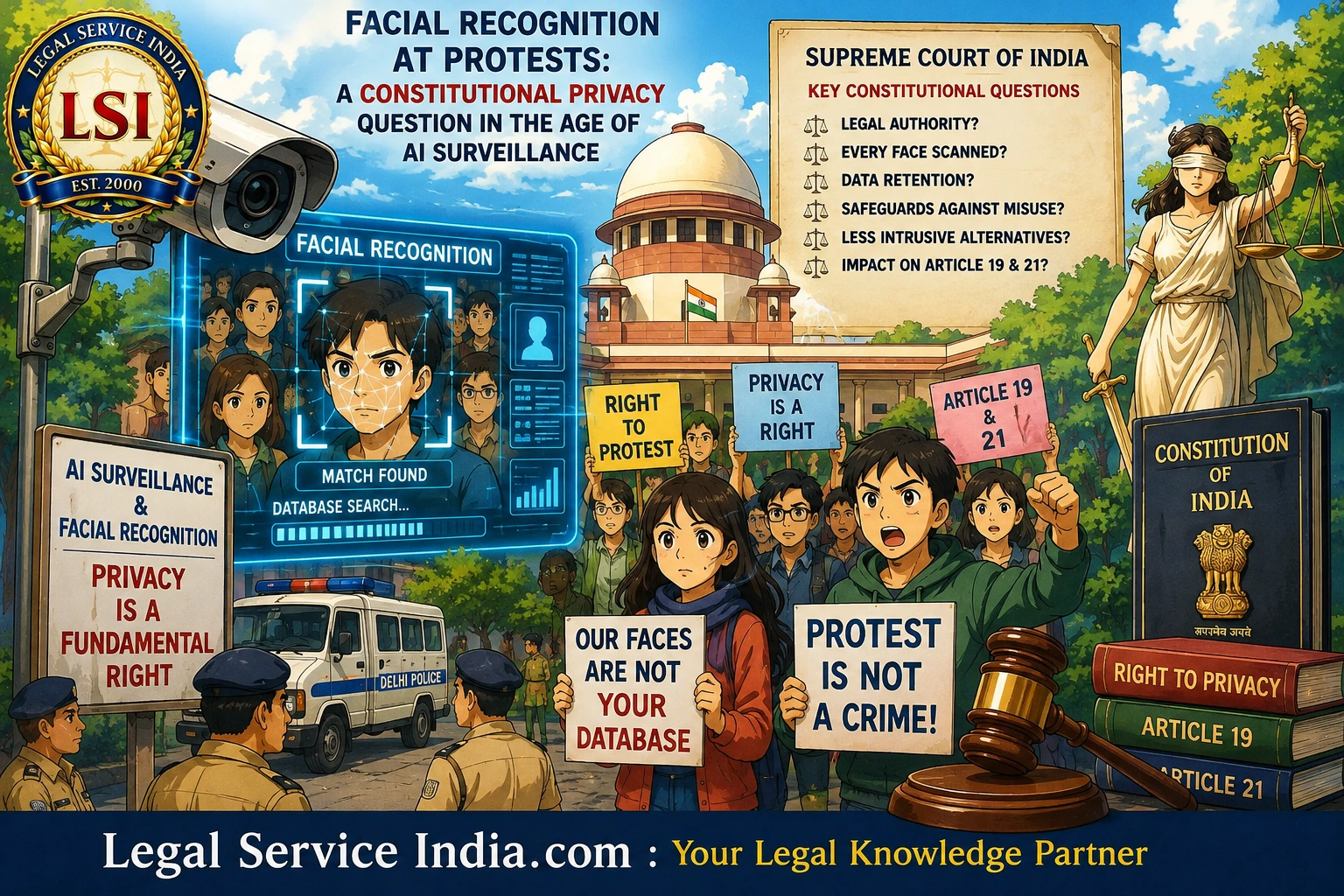
Delhi Police’s Facial Recognition Tool Only Captures Persons Having Criminal Records at Protests: A Constitutional Privacy Question in the Age of AI Surveillance
Introduction: When a Protester’s Face Becomes Police Data
A particularly important constitutional issue has now emerged before the Supreme Court of India: how far can the police go in using facial-recognition technology to identify people attending a public protest?
The Delhi Police has reportedly told the Supreme Court that its facial-recognition system deployed around the student protests did not indiscriminately capture or profile ordinary protesters. According to its affidavit, the technology was configured to identify persons whose photographs already existed in police records, particularly persons associated with serious offences, wanted persons, absconders, habitual offenders or history-sheeters.
At first sight, this may appear to answer the privacy objection.
It does not.
In my considered view, the police explanation actually brings the constitutional question into sharper focus.
The real question is not merely:
“Did the police identify criminals?”
The deeper constitutional questions are:
- What legal authority permitted the facial scanning?
- Was every face in the camera’s field of view processed before the system identified a match?
- What biometric information was collected?
- For how long was that information retained?
- Was information concerning innocent protesters deleted?
- What database was used for matching?
- Who had access to the information?
- What safeguards prevented misuse?
- Was the technology necessary for maintaining public order?
- Was there a less intrusive method available?
- Can attending a peaceful protest result in one’s biometric identity being recorded by the State?
- Does the use of AI-powered surveillance have a chilling effect on the fundamental freedoms guaranteed by Articles 19 and 21?
These are not merely technological questions.
They are constitutional questions concerning the relationship between the individual and the modern surveillance state.
The issue is therefore much larger than the particular student protests at Jantar Mantar.
Citation: Justice K.S. Puttaswamy (Retd.) v. Union of India, (2017) 10 SCC 1; Mazdoor Kisan Shakti Sangathan v. Union of India, (2018) 17 SCC 324. The immediate 2026 development concerns an affidavit/counter-affidavit filed by the Delhi Police before the Supreme Court regarding facial-recognition technology allegedly used around the Jantar Mantar student protests. It is important to clarify that this development is not itself a final Supreme Court judgement on the legality of facial recognition at protests. The constitutional issue is presently under judicial consideration.
1. What Has Delhi Police Told the Supreme Court?
The immediate controversy arises from the use of facial recognition and other surveillance technologies during student demonstrations in Delhi.
Reports indicate that Delhi Police deployed facial-recognition systems around the protest area and used them to identify persons whose images could be matched against police databases. Earlier reports had stated that thousands of individuals with criminal records were identified in connection with the protest period, although the police subsequently clarified its position regarding the nature and purpose of the facial-recognition exercise.
appearThe latest affidavit is significant because the police appears to be drawing a distinction between:
mass surveillance of ordinary citizens, and
targeted identification of persons already having serious criminal records.
According to the police position reported today, the facial-recognition software was not intended to create a database of peaceful protesters generally but to identify persons whose identities were already available in police records.
That distinction will undoubtedly be important before the Supreme Court.
But it is not necessarily decisive.
2. The Constitutional Problem Begins With the Face
A person’s face is not merely another photograph.
In the digital environment, a face can become a biometric identifier.
Once technology can convert a face into a digital representation and compare it against government databases, the state’s capacity to identify, track and associate individuals becomes substantially greater than traditional photography or ordinary CCTV surveillance.
This is precisely why facial-recognition technology creates a constitutional problem different from conventional policing.
A police officer looking at a crowd may observe individuals.
An automated facial-recognition system can potentially:
- capture faces;
- extract biometric characteristics;
- compare those characteristics against a database;
- generate a possible identity;
- associate that identity with previous police records;
- preserve the result electronically;
- enable subsequent investigation or monitoring.
The technology therefore changes the scale, speed and permanence of surveillance.
That is why the constitutional analysis cannot stop at the statement:
“The cameras were placed in a public place.”
Being physically visible in public does not necessarily mean that a citizen has surrendered every aspect of informational privacy.
3. The Supreme Court’s Landmark Privacy Judgement
The starting point is the nine-judge Constitution Bench judgement in:
Justice K.S. Puttaswamy (Retd.) v. Union of India
Citation: (2017) 10 SCC 1
The Supreme Court unanimously recognised privacy as a fundamental constitutional right and located it principally within Article 21, while also recognising its relationship with the freedoms and guarantees contained in Part III of the Constitution.
The significance of Puttaswamy cannot be overstated.
Privacy is not simply the right to close the door of one’s house.
It encompasses bodily privacy, decisional privacy and informational privacy.
In the modern digital state, informational privacy becomes increasingly important because information about an individual can reveal:
- identity;
- associations;
- movements;
- relationships;
- habits;
- political participation;
- professional activities;
- religious or ideological associations;
- social networks.
A protest can itself reveal something about a person’s exercise of constitutional freedoms.
Consequently, the State’s ability to automatically identify everyone attending a particular demonstration raises a privacy question even where the protest occurs in a public place.
4. The Puttaswamy Test: Legality, Legitimate Aim, Necessity and Proportionality
The Supreme Court’s privacy jurisprudence provides a structured constitutional framework.
Government action interfering with privacy must satisfy constitutional requirements, including:
4.1 Legality
There must be a valid legal basis for the intrusion.
This is critical in the present context.
The question is not merely whether the police possess general powers of investigation.
The question is whether specific and adequate legal authority exists for automated biometric identification of people attending a public assembly.
The Supreme Court has repeatedly emphasised the importance of legality in determining whether state action interfering with fundamental rights is constitutionally permissible.
4.2 Legitimate State Aim
Maintaining public order, preventing crime and protecting life and property are plainly legitimate governmental objectives.
There is little difficulty in accepting that proposition.
The constitutional difficulty arises at the next stage.
4.3 Necessity
Was facial recognition actually necessary?
If the police already possessed CCTV footage, photographs, eyewitness accounts and other investigative tools, was automated biometric identification required?
Could the same objective have been achieved through substantially less intrusive means?
4.4 Proportionality
Even where surveillance serves a legitimate purpose, the State cannot automatically adopt the most intrusive technological tool available.
The intrusion must bear a rational relationship to the objective and must not be excessive in relation to the public interest being pursued.
This proportionality analysis becomes particularly important where the technology operates over an entire crowd.
5. “Only Criminals Were Captured” Does Not End the Debate
This is, perhaps, the most important legal point.
Suppose the police system is designed to identify only persons whose photographs already exist in a criminal database.
That may significantly strengthen the State’s justification.
But the Court may still have to examine how the system works in practice.
For example:
Question 1: Whose faces enter the system?
If cameras are recording a crowd, the initial visual field necessarily contains many innocent persons.
Question 2: Are those faces processed?
If every face is algorithmically compared against a database before a match is generated, the privacy issue cannot simply be dismissed by saying that only criminals were ultimately identified.
Question 3: What happens to non-matches?
Are they immediately discarded?
Or are they stored?
Question 4: What happens to false matches?
Facial-recognition systems can produce erroneous matches.
A technological “match” is therefore not necessarily equivalent to proof of identity or criminal involvement.
Question 5: What happens to historical police records?
A person may have an old case, a previous accusation, an acquittal, a discharged proceeding or some other police record.
The constitutional system must distinguish carefully between:
criminal conviction
and
mere presence in a police database.
That distinction is fundamental to the rule of law.
6. A Police Record Does Not Automatically Mean a Person Is a Criminal
This issue deserves particular emphasis.
The phrase “criminal record” can sometimes obscure important legal distinctions.
A person may appear in a police database because of:
- an FIR;
- an investigation;
- an arrest;
- a previous case;
- a pending prosecution;
- a history sheet;
- an old allegation;
- a case ultimately ending in acquittal.
None of these circumstances should automatically be equated with a judicial finding of guilt.
The presumption of innocence remains a foundational principle of criminal jurisprudence.
Therefore, if facial recognition produces a database match, that match should be treated as an investigative lead, not as proof that the person committed an offence at the protest.
This distinction becomes especially important when technology is presented as an objective or infallible authority.
An algorithm is not a judge.
A database is not a conviction.
And a facial match is not proof of participation in violence.
7. The Right to Protest Under Article 19
The constitutional discussion cannot be confined to Article 21.
A peaceful protest is connected directly with the freedoms guaranteed by Article 19.
Article 19(1)(a) protects freedom of speech and expression.
Article 19(1)(b) protects the right to assemble peaceably and without arms.
The Supreme Court has recognised the constitutional importance of peaceful demonstrations.
In Mazdoor Kisan Shakti Sangathan v. Union of India, (2018) 17 SCC 324, the Court dealt specifically with demonstrations at Jantar Mantar and recognised that peaceful protest is constitutionally protected, while also emphasising the need to balance the rights of protesters with the rights and interests of others.
This principle is extremely relevant today.
The Constitution does not grant protesters an absolute immunity from police investigation.
If violence occurs, the police unquestionably have authority to investigate.
But the existence of a constitutional right to protest means that the State must be careful not to convert attendance at a peaceful protest into a surveillance event.
8. The Chilling Effect: The Most Subtle Constitutional Danger
There is another dimension which courts must consider.
Imagine a student deciding whether to attend a lawful demonstration.
Before going, the student learns:
“Police cameras equipped with facial-recognition technology are operating at the protest site.”
The student may then decide not to attend.
Why?
Not because the protest is illegal.
Not because the student intends to commit an offence.
But because the student does not want the state to know that he or she participated in a particular political or social movement.
This is known as the chilling effect.
The constitutional injury may therefore occur even without arrest.
Even without prosecution.
Even without detention.
Even without publication of the person’s identity.
The mere knowledge that participation in a lawful public assembly may automatically create a biometric record can potentially discourage citizens from exercising Article 19 freedoms.
That is why surveillance and free speech cannot always be examined separately.
9. Public Place Does Not Mean “Constitution-Free Zone”
One argument likely to arise is straightforward:
“The protest took place in a public place. People cannot expect privacy in a public place.”
That proposition is too broad.
A person standing on a public road obviously cannot claim the same physical privacy available inside a private home.
But informational privacy is different.
The question is not simply:
“Could someone see me?”
The question is:
“Can the State automatically identify, classify, store and analyse my identity and associate it with a particular exercise of my constitutional freedoms?”
Modern technology has fundamentally changed the answer.
Traditional surveillance and automated biometric surveillance are not necessarily constitutionally equivalent merely because both begin with a camera.
10. Facial Recognition Is Not Ordinary CCTV
This distinction deserves judicial attention.
Ordinary CCTV
A conventional camera may record an incident.
Investigators may later review the footage if an offence occurs.
Facial Recognition
An automated system can potentially:
- scan faces in real time;
- compare them with databases;
- identify persons automatically;
- create alerts;
- associate identities with police records;
- facilitate subsequent investigation.
The difference is therefore not merely technological.
It is constitutional.
Facial recognition can transform surveillance from observation into identification.
And identification is the gateway to much deeper forms of data processing.
11. What About Persons With Previous Criminal Cases?
The Delhi Police’s stated justification is particularly interesting because it focuses on persons already appearing in criminal databases.
The State can legitimately argue:
If a person wanted in a serious criminal case enters a protest where violence has occurred, identifying that person may be an entirely legitimate policing objective.
I would agree with that proposition in principle.
A lawful protest cannot become a safe harbour for persons wanted for serious offences.
The police have a duty to prevent crime.
But constitutional policing requires precision.
The State should be able to explain:
- Which categories of persons are included?
- What offences qualify?
- Who authorises inclusion?
- How current must the database be?
- What happens after acquittal?
- How are mistaken identities corrected?
- How long is facial data retained?
- Who can access the system?
- Is the information shared with other agencies?
- Is there an audit trail?
- Is there judicial or independent oversight?
Without answers to these questions, “we only identify criminals” remains a conclusion rather than a complete constitutional safeguard.
12. The Problem of Function Creep
There is a familiar danger whenever surveillance technology is introduced for a narrowly defined purpose.
It begins with:
“We are looking only for wanted criminals.”
Later it becomes:
“We are identifying persons connected with the investigation.”
Then:
“We are mapping protest participants.”
And eventually:
“We are maintaining a permanent intelligence database.”
This phenomenon is often described as function creep.
A constitutional framework must prevent technology introduced for one legitimate purpose from silently becoming a general-purpose surveillance infrastructure.
That is particularly important with facial-recognition systems because the same technological infrastructure can potentially be used for many different objectives.
13. The Data Protection Question
Another important issue is the handling of the information generated by the system.
A face captured by a camera is one thing.
A biometric template linked to an individual’s identity is something much more consequential.
The State should therefore be required to answer:
Data minimisation
Was only the information necessary for the policing objective collected?
Purpose limitation
Was the data used only for the purpose for which it was collected?
Retention limitation
How long was it retained?
Access control
Which officers could access it?
Security
What safeguards protect the database?
Deletion
What happens to information concerning persons who were not involved in any offence?
Correction
What mechanism exists for correcting a false identification?
Accountability
Who is responsible when the system makes a mistake?
These questions should not be treated as administrative details.
They are central to the constitutional protection of informational privacy.
14. Facial Recognition and Article 14
Article 14 should not be forgotten.
Automated decision-making can raise equality concerns if the underlying technology disproportionately produces false matches for particular categories of people.
A facial-recognition system that performs unevenly across demographic groups can create serious constitutional consequences when its output becomes the basis for police action.
Therefore, transparency concerning:
- accuracy;
- error rates;
- testing;
- independent audits;
- false-positive rates;
- database quality
may become increasingly important.
The police should not be permitted to say:
“The computer identified him.”
The constitutional state must be able to explain:
Why should the Court trust this identification, what safeguards existed, and what happened before coercive action was taken?
15. The Supreme Court’s Role Is Not to Decide Whether Technology Is Good or Bad
The constitutional question is not whether facial recognition is inherently evil.
Nor is it whether police should be prohibited from using artificial intelligence.
Technology can undoubtedly assist legitimate policing.
It can help locate:
- wanted persons;
- missing persons;
- suspects;
- persons involved in serious offences;
- individuals captured on CCTV during criminal incidents.
The Court’s task is more precise.
It must determine the constitutional conditions under which such technology may be used.
That distinction is important.
The future is not necessarily:
“No facial recognition.”
It may instead be:
“Facial recognition subject to constitutional discipline.”
16. The Missing Legal Framework Is a Serious Concern
One of the broader problems is that India does not yet have a comprehensive, dedicated statutory framework specifically regulating law-enforcement facial-recognition systems.
Commentators have therefore raised concerns about the deployment of facial recognition and algorithmic policing without sufficiently detailed statutory safeguards.
This creates a difficult constitutional situation.
Technology is moving rapidly.
The law often moves slowly.
Police departments can acquire new technological capabilities before Parliament has enacted detailed rules governing:
- purpose;
- authorisation;
- oversight;
- retention;
- deletion;
- disclosure;
- independent auditing;
- remedies.
That gap cannot simply be filled by internal police instructions.
When fundamental rights are implicated, the requirement of legality becomes particularly significant.
17. What Should a Constitutionally Sound Facial-Recognition Framework Contain?
In my view, if facial recognition is to be retained as a legitimate policing tool, India needs a clear statutory framework containing at least the following safeguards.
17.1 Specific Legal Authority
The law should expressly authorise the use of facial recognition and identify the circumstances in which it can be deployed.
17.2 Defined Purpose
The system should be restricted to clearly defined objectives such as locating persons wanted for specified serious offences.
17.3 Necessity Requirement
Deployment should require a demonstrable policing necessity.
17.4 Proportionality Assessment
Authorities should record why less intrusive alternatives are inadequate.
17.5 Independent Authorisation
For particularly intrusive deployments, independent or judicial authorisation should be considered.
17.6 Limited Databases
Only appropriately defined categories should be searchable.
17.7 Immediate Deletion of Irrelevant Data
Information relating to persons unconnected with an offence should not become a permanent police record.
17.8 Human Verification
No arrest or coercive action should be based solely upon an algorithmic facial match.
17.9 Auditability
Every search should generate an auditable record showing:
- who searched;
- when;
- why;
- against which database;
- What result was produced
- What action followed.
17.10 Remedies
Citizens must have a mechanism to challenge wrongful identification and obtain correction or deletion.
18. The Court May Have to Draw a Line Between Targeted Surveillance and Mass Surveillance
This may ultimately become one of the most important distinctions in the case.
Targeted Surveillance
Police possess credible information that a particular wanted person may attend a particular location.
Facial recognition is deployed narrowly to identify that person.
This has a stronger constitutional justification.
Mass Surveillance
Facial recognition continuously scans everyone attending a protest, generating a searchable record of their identities.
This presents a substantially greater privacy and associational concern.
The constitutional difference lies in scope, purpose, necessity and retention.
The state’s case becomes stronger as the surveillance becomes narrower.
The citizen’s constitutional objection becomes stronger as the surveillance becomes broader and more permanent.
19. The Jantar Mantar Context Makes the Case Especially Significant
There is an additional irony here.
Jantar Mantar is historically associated with democratic protest.
The Supreme Court itself has dealt with the competing interests surrounding demonstrations at Jantar Mantar in Mazdoor Kisan Shakti Sangathan.
The question before the constitutional courts today is therefore not simply whether police may maintain order at a protest site.
They plainly can.
The deeper question is:
How should constitutional democracy respond when the state acquires technological powers capable of identifying every participant in the exercise of democratic dissent?
That is a question which will become more important, not less, over the next decade.
20. AI Surveillance May Change the Meaning of “Being in Public”
This is perhaps the most profound implication.
For generations, being in public meant that other people could see you.
But people generally remained anonymous to strangers.
Artificial intelligence changes that equation.
A camera can now potentially transform:
face → identity → database → history → association → investigation.
The constitutional consequences of that transformation are immense.
The law therefore has to recognise that visibility and identifiability are not the same thing.
A citizen may reasonably expect that walking through a public place does not automatically create a permanent government-indexed record of every association and movement.
21. The Police Also Have Constitutional Duties
It would be incorrect to portray the matter as a simple conflict between police and protesters.
The police have a difficult responsibility.
During a large demonstration, officers must simultaneously protect:
- peaceful protesters;
- members of the public;
- public property;
- government buildings;
- traffic;
- police personnel;
- persons potentially targeted by violence.
If serious violence takes place, the police must investigate.
If wanted criminals enter a crowd, the police cannot simply ignore them.
Facial recognition may therefore have legitimate utility.
The constitutional challenge is to ensure that legitimate policing does not become disproportionate surveillance.
That is the essence of constitutional governance.
22. The Difference Between Investigation and Surveillance
A useful legal distinction may emerge from this controversy.
Investigation
An offence has occurred.
Police possess evidence.
They analyse CCTV footage to identify a suspect.
Surveillance
Police continuously collect information about people without a specific offence being attributed to them.
The distinction is not always absolute.
But it is constitutionally relevant.
The more an exercise moves from post-offence investigation toward continuous monitoring of an entire population or assembly, the greater the need for statutory safeguards and proportionality review.
23. Facial Recognition Should Never Become a Substitute for Evidence
This principle should be firmly established.
A facial-recognition result may provide an investigative lead.
It should not automatically establish:
- presence at the scene;
- participation in violence;
- membership of a group;
- criminal conspiracy;
- guilt.
The prosecution must still establish the legally relevant facts through admissible evidence.
Technology should assist the investigation.
It should not replace the judicial process.
24. The Presumption of Innocence Must Survive the Algorithm
There is a psychological danger in algorithmic policing.
Humans tend to give machines an appearance of objectivity.
If an officer says:
“I think this is the person,”
We instinctively understand that the officer may be mistaken.
If a computer says:
“98% match,”
People may instinctively regard the conclusion as a scientific fact.
But an algorithm is only as reliable as:
- its training;
- its database;
- its image quality;
- its threshold;
- its design;
- its operating conditions;
- its validation.
Therefore, an algorithmic output must remain subject to human scrutiny and legal proof.
25. What the Supreme Court Could Potentially Examine
The pending constitutional controversy could eventually require the Court to consider a series of questions:
A. Legal authority
Does existing law sufficiently authorise police facial recognition at protests?
B. Privacy
Does such identification constitute an interference with informational privacy?
C. Article 19
Can widespread identification of protesters chill freedom of speech and peaceful assembly?
D. Proportionality
Is the surveillance narrowly tailored to a legitimate objective?
E. Data retention
What happens to information concerning innocent citizens?
F. Accuracy
What safeguards exist against false positives?
G. Accountability
Who supervises the technology?
H. Transparency
Can courts independently verify how the system operates?
I. Function creep
Can information collected for crime prevention later be used for unrelated purposes?
J. Remedy
What happens when an innocent citizen is wrongly identified?
These questions could ultimately shape the future of AI-assisted policing throughout India.
26. My Legal Assessment
With more than 25 years of practice before the Supreme Court, I would approach the issue neither from a technology-hostile position nor from an unquestioning pro-police position.
Both extremes would be legally unsatisfactory.
The police have a legitimate constitutional responsibility to prevent crime.
At the same time, citizens have a legitimate constitutional expectation that the State will not unnecessarily convert their lawful exercise of fundamental freedoms into a permanent biometric record.
Therefore, the correct constitutional approach should be:
Targeted policing, not indiscriminate surveillance.
If the Delhi Police can demonstrate that the system was genuinely limited to identifying persons already lawfully wanted or otherwise falling within a narrowly defined category, that will materially strengthen its constitutional defence.
But the State should also demonstrate:
- the statutory basis;
- the operational safeguards;
- the exact database used;
- the categories searched;
- the retention policy;
- the deletion mechanism;
- the accuracy safeguards;
- the human verification process;
- the restrictions on further use.
That is how constitutional policing should operate in the age of artificial intelligence.
27. The Larger Principle: Technology Must Remain Under the Constitution
The Constitution does not become technologically obsolete merely because policing becomes technologically sophisticated.
Article 21 applies to the digital State just as it applies to the traditional State.
Article 19 applies when citizens communicate through modern technology just as it applies when they gather in a public square.
Article 14 applies to algorithmic decision-making just as it applies to decisions made by human officials.
The central constitutional principle remains unchanged:
Government power must remain accountable to law.
Technology may change the method of exercising state power.
It cannot eliminate constitutional limitations on that power.
28. Conclusion: The Face of Democracy Must Not Become a Police Database
The Delhi Police’s latest position before the Supreme Court is important because it narrows the factual controversy: the police says its facial-recognition system was directed at persons with criminal records rather than indiscriminately targeting peaceful protesters.
But the constitutional debate is far from over.
Indeed, the more sophisticated the technology becomes, the more sophisticated the constitutional safeguards must become.
India does not have to choose between:
public safety
and
privacy.
A mature constitutional democracy must protect both.
The police should have the technological tools necessary to investigate serious crime.
But citizens should also retain the freedom to attend a peaceful demonstration without fearing that their faces will automatically be converted into permanent government intelligence.
The Supreme Court’s decision in Puttaswamy gives us the constitutional compass: legality, legitimate purpose, necessity, proportionality and safeguards.
The jurisprudence concerning peaceful protest gives us another essential principle: fundamental freedoms cannot be extinguished merely because their exercise creates administrative inconvenience. Mazdoor Kisan Shakti Sangathan makes clear that the rights of protesters and competing public interests must be balanced rather than allowing one to completely extinguish the other.
The challenge before the constitutional courts, therefore, is not to decide whether India should use artificial intelligence in policing.
The real challenge is more fundamental:
Can India become a technologically advanced surveillance state while remaining a constitutionally limited state?
That is the question which makes the Delhi Police facial-recognition controversy much bigger than the present protests.
It concerns the future relationship between technology, privacy, police power and democratic dissent in India.
And, in my view, that is why this controversy deserves the closest constitutional scrutiny.
Key Legal Takeaways
| Issue | Constitutional Significance |
|---|---|
| Facial recognition at protests | Potential intrusion into informational privacy |
| Article 21 | Protects privacy, dignity and personal liberty |
| Article 19(1)(a) | Protects speech and expression |
| Article 19(1)(b) | Protects peaceful assembly |
| Article 14 | Requires fairness and protection against arbitrary state action |
| Puttaswamy | Establishes a constitutional privacy framework |
| Mazdoor Kisan Shakti Sangathan | Recognises peaceful protest while permitting reasonable regulation |
| Facial-match result | Should be treated as investigative intelligence, not automatic proof of guilt |
| Criminal database | Must distinguish conviction from accusation, arrest or pending proceedings |
| Data retention | Requires clear safeguards, purpose limitation and deletion rules |
| AI surveillance | Requires transparency, accountability and proportionality |
| Future significance | May influence police use of facial recognition across India |
Important Clarification
As of 18 August 2026, the reported development is a Delhi Police affidavit/counter-affidavit and an ongoing constitutional challenge, not a final Supreme Court judgement declaring facial-recognition surveillance at protests constitutional or unconstitutional. The Supreme Court has agreed to examine the challenge to facial recognition and biometric surveillance at protest sites.
That distinction is legally important. The ultimate constitutional position will depend upon the Supreme Court’s adjudication of the factual and legal issues.
Need Legal Guidance on Privacy, Facial Recognition or Police Surveillance?
The growing use of facial-recognition technology, AI-powered surveillance and biometric identification by law-enforcement agencies raises complex questions involving Article 14, Article 19, Article 21, the Right to Privacy, the Right to Protest and constitutional safeguards.
If you need professional legal guidance concerning police surveillance, facial-recognition technology, privacy rights, constitutional remedies, unlawful surveillance or protection of fundamental rights, consult an experienced Supreme Court Advocate.
Adv. Tarun Choudhury
Supreme Court Advocate | 25+ Years of Legal Experience
📞 Call: 9650499965
💬 WhatsApp: 8851978611
For legal consultation and case-specific guidance, contact Adv. Tarun Choudhury.
FAQs
1. What are the pleas against police action during CJP student protests?
The Pleas Against Police Action During CJP Student Protests are petitions before the Supreme Court challenging alleged police excesses during student demonstrations, including allegations of lathi-charge, excessive force, detention, assault and the alleged use of pellet guns. The petitions raise important issues concerning the right to protest, police powers, fundamental rights and police accountability.
2. What fundamental rights are involved in the CJP student protest case?
The CJP student protest case primarily involves Articles 14, 19 and 21 of the Constitution of India. Article 19 protects freedom of speech and peaceful assembly, while Article 21 protects life, personal liberty and dignity. The Supreme Court is examining whether restrictions and police action during the protests were lawful, necessary and proportionate.
3. Did the Supreme Court order an inquiry into police action during the CJP student protests?
The Supreme Court has indicated movement towards a high-powered inquiry or committee to examine allegations of police excesses during the CJP student protests. The proposed inquiry is expected to examine the allegations, available evidence and issues relating to police accountability. The final composition and terms of reference of the committee remain subject to the court’s formal orders.
4. What is the Supreme Court’s position on the alleged use of pellet guns against student protesters?
The alleged use of pellet guns against student protesters has become a significant issue before the Supreme Court. The Court has indicated that it may lay down safeguards or a protocol governing the use of pellet guns and other potentially harmful crowd-control measures. The central constitutional question is whether such force was necessary, lawful and proportionate in the circumstances.
5. Why is the Supreme Court case on CJP student protests legally significant?
The case is legally significant because it could establish important principles concerning the right to peaceful protest, police use of force, Article 21, police accountability, independent investigation and crowd-control procedures in India. Any broader directions issued by the Supreme Court could influence how police authorities handle future student protests and other public demonstrations across the country.
Key Takeaways
- Pleas Against Police Action During CJP Student Protests raise important constitutional questions concerning the right to peaceful protest, police powers, fundamental rights and accountability.
- The Supreme Court of India is examining allegations of police excesses against student protesters, including allegations of lathi-charge, assault, detention, excessive force and the use of pellet guns.
- The proceedings directly involve Articles 14, 19 and 21 of the Constitution of India, particularly the rights to equality, freedom of speech and peaceful assembly, life, personal liberty and dignity.
- The Supreme Court has indicated movement towards a high-powered inquiry/committee to independently examine allegations concerning police action during the protests.
- The alleged use of pellet guns against student protesters is one of the most significant issues before the Supreme Court and raises questions about the legality, necessity and proportionality of such crowd-control measures.
- The case highlights an important constitutional principle: police powers are necessary to maintain public order but are not unlimited and must remain within the boundaries of law and the Constitution.
- Any use of force by police during a protest should satisfy the principles of legality, necessity and proportionality, particularly where demonstrators are peaceful or have already been brought under police control.
- The Supreme Court proceedings also emphasise the importance of preserving CCTV footage, drone recordings, body-camera footage, wireless communications, medical records and other digital evidence for an effective investigation.
- An independent investigation into alleged police brutality can protect both protesters and police officers by ensuring that genuine violations are established while false or exaggerated allegations are fairly rejected.
- The case reinforces that the right to protest does not include a right to violence, but the existence of a public-order concern also does not give police unrestricted authority to use excessive force.
- The proceedings may ultimately lead to clearer national guidelines for police handling of student protests and public demonstrations, including safeguards concerning crowd dispersal, weapons, identification of police personnel, medical assistance and accountability.
- The protection of students, minors, women protesters and other vulnerable participants remains an important aspect of constitutional policing.
- The Supreme Court’s approach demonstrates that democratic dissent and public order must coexist. The constitutional objective is neither to favour protesters nor to weaken the police, but to ensure that both operate within the rule of law.
- The Pleas Against Police Action During CJP Student Protests could therefore have significance beyond the immediate controversy and influence future cases involving police brutality, protest rights, use of force and constitutional accountability in India.
