





Abstract
Corporate governance in India has a lot of problems. Even though people are trying to make it more transparent and accountable, there are still a lot of challenges. The Indian corporate governance landscape is mostly made up of family-controlled businesses. These family-controlled businesses often do things that help the family in charge. Hurt the other shareholders and the company’s finances.
The Indian court system is not very good. There is a lot of corruption. This makes it hard to enforce rules and prevent companies from doing things. The Securities and Exchange Board of India has made some changes to try to improve governance. These changes include making companies tell people more about what they’re doing and stopping people from cheating.
Some studies have found that even though companies are now more open about what they do and have rules, there are still some big problems. The fact that governance crises in India keep happening over again shows that corporate governance is still a big problem. Even though India has made some progress in making governance transparent and raising standards, companies are still failing.
India needs to find a way to govern its corporations and protect the interests of all shareholders, including the ones. The goal is to create a system that balances making money with managing risks and makes sure that companies are transparent and accountable to everyone, including the Securities and Exchange Board of India and corporate governance, in India.
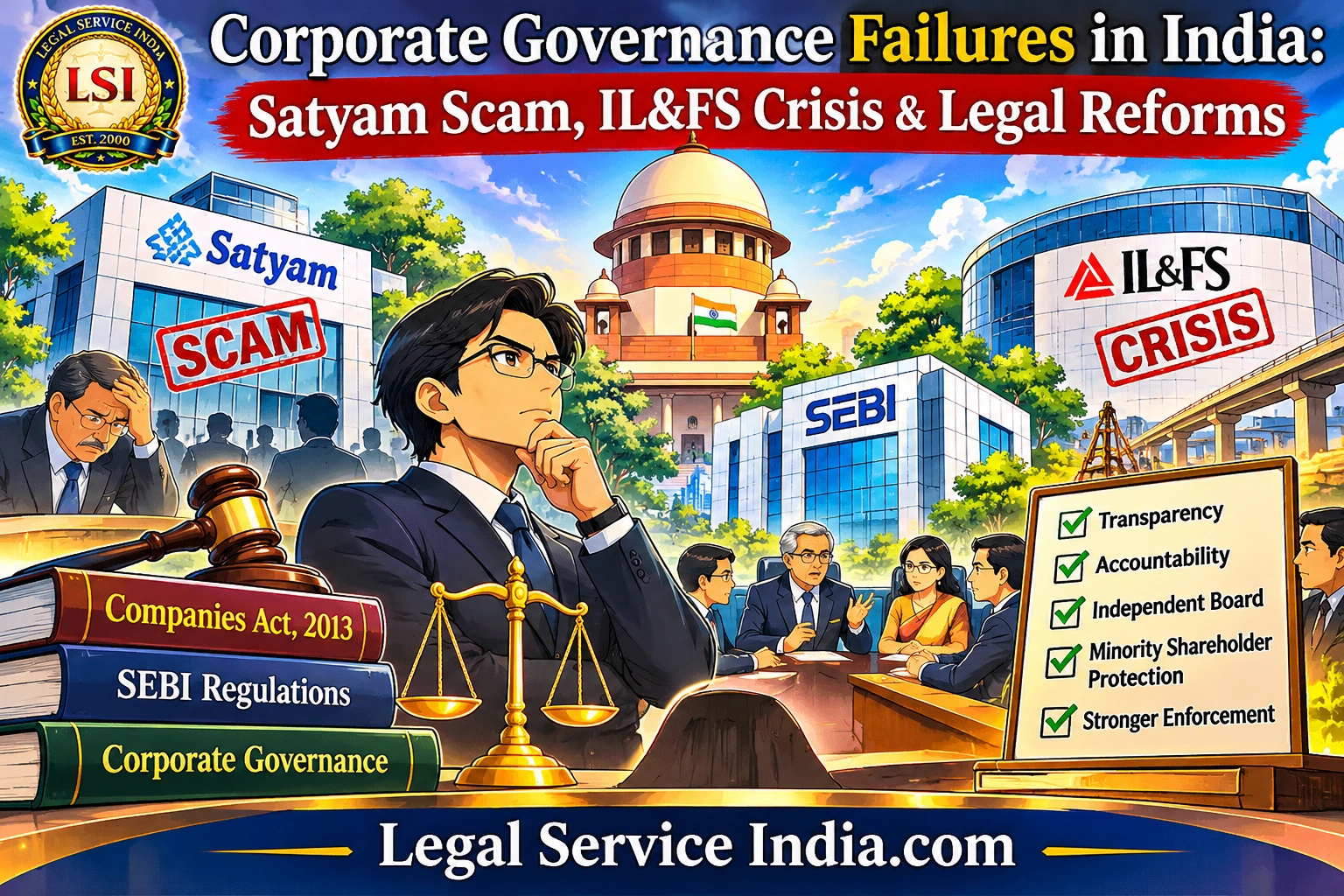
This paper critically analyzes corporate governance failures in India through the case studies of Satyam Computer Services Ltd. and Infrastructure Leasing & Financial Services (IL&FS). It evaluates the legal framework under the Companies Act, 2013 and SEBI regulations, identifies structural deficiencies, and offers reform-oriented recommendations. The study concludes that while India possesses durable laws, enforcement gaps and institutional weaknesses continue to undermine effective corporate governance.
Introduction
Meaning and Evolution of Corporate Governance
Corporate governance refers to the system of rules, practices, and processes by which a company is directed and controlled, ensuring accountability, transparency, and fairness in its relationship with stakeholders. The modern understanding of corporate governance emerged from global developments such as the recommendations of the Cadbury Committee, which emphasized the importance of board independence, financial transparency, and ethical corporate conduct.
In India, the evolution of corporate governance has been shaped by various regulatory initiatives and committee recommendations, including those of the Kumar Mangalam Birla Committee and the Narayana Murthy Committee, which laid the foundation for governance norms in listed companies.
Corporate Governance in the Global and Indian Context
Corporate governance has gained increasing importance in the context of globalization, liberalization, and the integration of financial markets. In developed economies such as the United States and the United Kingdom, corporate ownership is typically dispersed, leading to a separation between ownership and control.
In contrast, India represents a model of concentrated ownership, where a significant proportion of companies are controlled by promoters or family groups. This structural difference gives rise to unique governance challenges, particularly concerning the protection of minority shareholders and the prevention of misuse of corporate resources.
Legal and Regulatory Framework in India
Despite significant progress in strengthening the legal and regulatory framework, corporate governance in India continues to face multiple systemic challenges. The enactment of the Companies Act 2013 marked a major milestone by introducing provisions related to independent directors, audit committees, corporate social responsibility, and enhanced disclosure requirements.
Additionally, the Securities and Exchange Board of India (SEBI) has implemented various measures, including the Listing Obligations and Disclosure Requirements (LODR), to improve transparency and accountability in listed entities.
However, the existence of robust laws does not necessarily guarantee effective governance, as enforcement remains inconsistent and often inadequate.
Family-Owned Businesses and Conflicts of Interest
One of the defining features of the Indian corporate landscape is the dominance of family-owned and promoter-driven firms. While such structures can provide stability and long-term vision, they also create the risk of conflicts of interest, commonly referred to as agency problems.
In this context, the controlling shareholders may prioritize their personal or family interests over those of minority shareholders, leading to practices such as tunnelling, where resources are transferred out of the company for private benefit.
This concentration of power often weakens board independence and limits the effectiveness of internal control mechanisms.
Judicial and Institutional Challenges
Furthermore, institutional weaknesses, including delays in judicial processes and regulatory inefficiencies, exacerbate governance challenges. The Indian judiciary is burdened with a large backlog of cases, resulting in prolonged litigation and delayed resolution of corporate disputes.
This undermines the deterrent effect of legal provisions and reduces investor confidence in the enforcement of rights. Corruption and lack of transparency in certain sectors also contribute to governance failures, making it difficult to establish a culture of accountability.
Major Corporate Governance Failures in India
The persistence of corporate governance failures in India is evident from several high-profile corporate scandals. The case of Satyam Computer Services exposed significant lapses in accounting practices, auditor oversight, and board functioning, leading to one of the largest corporate frauds in India.
Similarly, the collapse of Infrastructure Leasing & Financial Services highlighted issues related to excessive leverage, poor risk management, and regulatory oversight failures. Another notable example is the fraud involving Punjab National Bank, which underscored weaknesses in internal controls and banking governance.
These cases demonstrate that governance failures are not isolated incidents but reflect deeper structural and institutional deficiencies.
Key Structural Weaknesses in Corporate Governance
In addition to these challenges, issues such as information asymmetry, inadequate disclosure practices, and lack of effective monitoring further complicate the governance landscape.
While independent directors are intended to act as watchdogs, their independence is often questioned due to their appointment by controlling shareholders. Similarly, audit committees and internal control systems sometimes fail to function effectively, either due to lack of expertise or undue influence from management.
Regulatory Reforms and Enforcement Gaps
Although several reforms have been introduced over the years, including stricter disclosure norms and enhanced regulatory oversight, gaps remain in their implementation.
The gap between regulatory intent and practical enforcement continues to hinder the development of a robust corporate governance regime in India. Moreover, the evolving nature of business, including the rise of complex financial instruments and corporate structures, poses additional challenges for regulators and policymakers.
Need for Comprehensive Corporate Governance Reforms
Against this backdrop, there is a need for a comprehensive and integrated approach to corporate governance reform in India. Strengthening enforcement mechanisms, enhancing the independence and effectiveness of boards, improving transparency, and promoting ethical corporate culture are essential steps in this direction.
Additionally, reforms in ownership structures and judicial processes are necessary to ensure timely resolution of disputes and effective protection of investor interests.
Objectives and Scope of the Study
This study seeks to examine the key issues and challenges associated with corporate governance in India, with a particular focus on structural weaknesses, enforcement gaps, and institutional inefficiencies.
It analyzes major corporate scandals to understand the underlying causes of governance failures and evaluates the effectiveness of existing legal and regulatory frameworks. The study also aims to identify gaps in the current system and propose reforms to enhance transparency, accountability, and investor protection.
By addressing these challenges, a more durable and reliable corporate governance framework can be developed, which is essential for sustaining economic growth, attracting domestic and foreign investment, and ensuring the long-term stability of the corporate sector in India.
Literature Review: Corporate Governance in India
Corporate governance has been a widely discussed subject in corporate law, especially in the Indian context where corporate failures have exposed structural weaknesses. Various scholars, committees, and regulatory bodies have examined the concept and its practical challenges.
Corporate governance aims to determine ways to reach the most effective and strategic decisions and to ensure transparency, which in return ensures a strong as well as balanced economic development for the organization.
Chatterjee Debabrata (2010): Corporate Governance and Corporate Social Responsibility
Chatterjee Debabrata (2010) did a comparative study on Corporate Governance and Corporate Social Responsibility – The case of Three Indian Companies ITC Ltd., Reliance Industries Ltd., and Infosys Technologies Ltd. He concluded that though the Corporate governance practices are exemplary, there exist differences in the way the Companies adopt the corporate governance practices. He rated Infosys better than the other two companies.
Company Law by Avtar Singh: Accountability and Transparency
Company Law by Avtar Singh explains corporate governance as a mechanism to ensure accountability and transparency in corporate functioning. The author emphasizes the importance of board structure and statutory compliance but also highlights the gap between legal provisions and their implementation.
Sharma Aparna (2012): Legal Framework and Corporate Governance
Sharma Aparna (2012), in the paper titled Legal Framework and corporate Governance: An Indian perspective found that significant efforts have been made by Indian regulators and the industry to overhaul corporate governance since 1990. The Current corporate governance regime in India straddles both voluntary and mandatory Requirements. For listed companies, requirements of clause 49 are mandatory. However The non-listed companies do not come under its preview.
SEBI Reports: Disclosure Norms and Independent Directors
Similarly, reports issued by Securities and Exchange Board of India stress the need for stricter disclosure norms and stronger roles for independent directors. SEBI has consistently pointed out that while regulatory frameworks exist, enforcement remains a key challenge.
Corporate Scandals and Governance Failures: The Satyam Case
Scholarly discussions on corporate scandals such as the Satyam fraud reveal that governance failures often arise due to ineffective oversight by the board and auditors. Many researchers argue that independent directors, though legally mandated, frequently lack true independence and fail to act as watchdogs.
IL&FS Crisis: Risk Management and Regulatory Supervision
Further, studies on the IL&FS crisis indicate that excessive leverage, poor risk management, and lack of transparency contributed significantly to the collapse. These studies suggest that regulatory supervision in India is often reactive rather than preventive.
Research Gap and Overall Assessment of Existing Literature
Overall, existing literature establishes that India has a durable legal framework for corporate governance; however, its effectiveness is undermined by weak enforcement, lack of accountability, and institutional inefficiencies.
While previous studies focus on either legal provisions or individual case analyses, this paper attempts to bridge the gap by providing a combined doctrinal and case-based analysis of corporate governance failures in India.
Research Methodology: Corporate Governance in India
This research paper adopts a doctrinal method of research, which primarily relies on secondary sources of data. The study is analytical and descriptive in nature, aiming to critically evaluate corporate governance failures in India.
Nature of Study
The research is qualitative, focusing on the analysis of legal provisions, judicial decisions, and real-world case studies. It examines how corporate governance mechanisms operate in practice and identifies the gaps between law and implementation.
Sources of Data
The study is based on secondary data, including:
- Statutory provisions such as the Companies Act, 2013
- SEBI (LODR) Regulations
- Case laws related to corporate fraud and governance failures
- Books, journals, and scholarly articles on corporate law
- Reports published by regulatory authorities
Research Approach
An analytical approach has been adopted to evaluate the effectiveness of corporate governance norms. Case study analysis of major corporate failures, such as Satyam and IL&FS, has been used to understand practical challenges in governance.
Objectives of the Study
The study is guided by the following objectives:
- To examine the legal framework governing corporate governance in India
- To analyze major corporate governance failures through case studies
- To identify key challenges in the implementation of governance norms
- To suggest reforms for strengthening corporate governance
Limitations of the Study
The research is limited to secondary data and selected case studies. It does not include empirical or field-based research, which may provide additional insights into corporate governance practices.
Legal Framework
A corporate governance framework comprises a set of rules, practices, and processes that define how a company is governed. This framework is designed to balance the interests of an organisation’s many stakeholders, including shareholders, management, customers, suppliers, financiers, government, and the community.
Because of that, the framework will always dictate how these groups should interact with each other while running the company. It’s the ultimate foundation without which a company cannot hope to function correctly.
The legal framework of corporate governance in India is primarily governed by the Companies Act, 2013, which mandates board composition, independent directors, and audit committees. It is strengthened by SEBI regulations (listing obligations and insider trading rules) for listed companies, ensuring transparency, accountability, and investor protection, alongside the Articles of Association governing internal management.
Key Pillars of This Framework
1. The Companies Act, 2013
The Government of India has recently notified Companies Act, 2013 (“New Companies Act”), which replaces the erstwhile Companies Act, 1956. The New Act has greater emphasis on corporate governance through the board and board processes. The New Act covers corporate governance through its following provisions:
- New Companies Act introduces significant changes to the composition of the boards of directors.
- Every company is required to appoint 1 (one) resident director on its board.
- Nominee directors shall no longer be treated as independent directors.
- Listed companies and specified classes of public companies are required to appoint independent directors and women directors on their boards.
- New Companies Act for the first time codifies the duties of directors.
- Listed companies and certain other public companies shall be required to appoint at least 1 (one) woman director on its board.
- New Companies Act mandates following committees to be constituted by the board for prescribed class of companies:
- Audit committee
- Nomination and remuneration committee
- Corporate social responsibility committee
2. Listing Agreement – Applicable to Listed Companies
SEBI has amended the Listing Agreement with effect from October 1, 2014 to align it with New Companies Act. Clause 49 of the Listing Agreement can be said to be a bold initiative towards strengthening corporate governance amongst the listed companies. This Clause intends to put a check over the activities of companies in order to save the interest of the shareholders.
Broadly, Clause 49 provides for the following:
2.1 Board of Directors
The Board of Directors shall comprise of such number of minimum independent directors, as prescribed. In case where the Chairman of the Board is a non-executive director, at least one-third of the Board shall comprise of independent directors and where the Chairman of the Board is an executive director, at least half of the Board shall comprise of independent directors.
A relative of a promoter or an executive director shall not be regarded as an independent director.
2.2 Audit Committee
The Audit Committee to be set up shall comprise of minimum three directors as members, two-thirds of which shall be independent.
2.3 Disclosure Requirements
Periodical disclosures relating to the financial and commercial transactions, remuneration of directors, etc, to ensure transparency.
2.4 CEO/CFO Certification
To certify to the Board that they have reviewed the financial statements and the same are fair and in compliance with the laws/regulations and accept responsibility for internal control systems.
2.5 Report and Compliance
A separate section in the annual report on compliance with Corporate Governance, quarterly compliance report to stock exchange signed by the compliance officer or CEO, company to disclose compliance with non-mandatory requirements in annual reports.
3. Securities and Exchange Board of India (SEBI) Guidelines
SEBI is a regulatory authority having jurisdiction over listed companies and which issues Regulations, rules and guidelines to companies to ensure.
4. Standard Listing Agreement of Stock Exchanges
For Companies whose shares are listed on the stock Exchanges.
5. Accounting Standards Issued by the Institute of Chartered Accountants of India (ICAI)
ICAI is an Autonomous body, which issues accounting standards Providing guidelines for disclosures of financial Information.
Section 129 of the New Companies Act inter alia provides that the financial statements shall give a true And fair view of the state of affairs of the company or Companies, comply with the accounting standards notified Under Section 133 of the New Companies Act.
It is further Provided that items contained in such financial statements Shall be in accordance with the accounting standards.
6. Secretarial Standards Issued by the Institute of Company Secretaries of India (ICSI)
ICSI is an autonomous body, Which issues secretarial standards in terms of the Provisions of the New Companies Act.
So far, the ICSI has Issued Secretarial Standard on “Meetings of the Board of Directors” (SS-1) and Secretarial Standards on “General Meetings” (SS-2).
These Secretarial Standards have come Into force w.e.f. July 1, 2015.
Section 118(10) of the New Companies Act provide that every company (other than One person company) shall observe Secretarial Standards Specified as such by the ICSI with respect to general and Board meetings.
7. Judicial Contribution
Indian courts have played a significant role in strengthening corporate governance by interpreting statutory provisions and ensuring accountability.
Judicial decisions in cases such as:
- Serious Fraud Investigation Office v. Ramalinga Raju
- Union of India v. IL&FS
Have emphasized the importance of transparency, director responsibility, and regulatory intervention.
8. Other Governance Mechanisms
Apart from statutory provisions, corporate governance is supported by:
- Corporate governance codes
- Whistle blower policies
- Corporate Social Responsibility (CSR) provisions under Section 135
Analysis
Corporate governance failure is a systemic breakdown of board oversight, internal controls, and ethical standards, leading to financial fraud, reputational ruin, and stakeholder losses. Common causes include lack of independent directors, poor risk management, conflicts of interest, and a toxic “tone at the top” that ignores transparency.
Corporate governance failures in India are not something that happens once in a while. They keep happening because of issues in the system institutions and the way people behave. India has laws like the Companies Act, 2013 and SEBI regulations but we still see many scandals. This means that the way companies are governed often does not work in life. The main reasons for this are explained below:
Causes of Corporate Governance Failures in India
1. Promoter Dominance and Concentrated Ownership
One common thing in companies is that the people who started the company called promoters have a lot of control. This is different from companies in countries where ownership is spread out among many people. In India promoters have a lot of power over the company and its decisions.
This can lead to some problems, such as:
- The people who own a part of the company’re not treated fairly.
- The company does business with companies connected to the promoters, which may not be good for the company.
- The company is not transparent in its decision-making process.
- The promoters often choose people to be on the board of the company who agree with them which means the board is not really independent. This means that corporate governance exists on paper but does not really work.
2. Ineffectiveness of Independent Directors
The idea of having directors on the board of a company is to ensure that the company is governed fairly and that the people in charge do not do anything. However in life these independent directors are not always effective.
Some reasons for this are:
- They are not really independent because they know the promoters or have worked with them before.
- They do not have all the information they need to make decisions.
- They do not want to disagree with the people in charge of the company.
- This means that they do not always catch or prevent problems with the way the company is governed which can lead to scandals.
3. Weak Enforcement of Legal Provisions
India has laws that govern companies, including the Companies Act, 2013 and SEBI regulations. However these laws are not always enforced properly.
Some problems with this are:
- It takes time to investigate and decide what to do when a company breaks the law.
- The punishments for breaking the law are not always strong enough.
- The people in charge of enforcing the laws do not always have the resources they need.
- When someone breaks the law it can take a long time to do anything about it which means that companies may not think they have to follow the rules.
4. Auditor Failures and Lack of Accountability
Auditors are supposed to ensure that a companys financial statements are accurate. However sometimes auditors do not do their job well.
Some common problems are:
- They do not check the companys statements enough.
- They rely much on what the company tells them.
- They have a conflict of interest because they have worked with the company for a time.
- In some cases auditors do not catch problems with a companys financial statements, which makes people question whether they are really independent and doing their job.
5. Lack of Transparency and Inadequate Disclosure
One important thing about governance is transparency. However some companies do not provide information to the people who own part of the company or to regulators.
This can include:
- Changing the statements to make the company look better.
- Not telling people information about the company.
- Reporting information in a way that’s misleading.
- When companies are not transparent it is hard for people to make decisions and it increases the risk of fraud.
6. Poor Risk Management Practices
Companies need to manage risk to be successful in the term. However some companies in India do not do a job of managing risk.
Some common problems are:
- Taking much financial risk without being prepared.
- Owning much debt.
- Not paying attention to warning signs that the company’s in trouble.
- When companies do not manage risk well it can lead to problems that could have been prevented.
7. Regulatory and Institutional Gaps
There are government agencies that regulate companies in India including the Ministry of Corporate Affairs and SEBI. However sometimes these agencies do not work well together.
Some problems with this are:
- The agencies have overlapping responsibilities.
- It takes time for the agencies to respond to problems.
- The agencies are reactive which means they only do something after a problem has happened.
- These weaknesses in the system mean that companies are not always governed well and it can lead to problems.
8. Ethical Deficiencies and Corporate Culture
Finally corporate governance failures can also happen because of problems within a company. When a company prioritizes making money over doing the thing it can lead to fraud and other problems.
Some other things that can contribute to this problem are:
- Lack of leadership.
- Weak internal controls.
- No protection for people who report wrongdoing.
Conclusion
Corporate governance cannot work well without an ethical foundation. Corporate governance failures in India are often caused by these issues. Corporate governance is something that’s very important for companies in India. Corporate governance failures can lead to problems for companies, in India.
Case Studies: Corporate Governance Failures in India
Corporate governance failures in India can be better understood through an analysis of major corporate scandals that have exposed significant weaknesses in governance mechanisms. These case studies highlight how structural deficiencies, lack of accountability, and ineffective oversight can lead to severe financial and reputational consequences. The following discussion examines two prominent cases—Satyam Computer Services and Infrastructure Leasing & Financial Services (IL&FS)—to illustrate the practical implications of governance failures in India.
Serious Fraud Investigation Office v. B. Ramalinga Raju & Ors (2015): Satyam Scandal
In 2009, a major accounting scandal rocked Satyam Computer Services, a prominent multinational IT services firm based in India. The crisis unfolded when Ramalinga Raju, the company’s founder and CEO, confessed to manipulating its financial records and inflating its earnings.
The scandal came to light when Raju disclosed his fraudulent activities in a letter addressed to the Securities and Exchange Board of India (SEBI) and Satyam’s board of directors. The letter revealed that Raju had been engaged in financial misconduct for several years, employing techniques such as creating fictitious bank accounts to exaggerate the company’s cash position, overstating sales, and understating liabilities.
Raju’s actions aimed to misrepresent Satyam as a flourishing, financially robust enterprise to attract investors and sustain the company’s stock price. This deception ultimately led to a severe decline in the company’s value, resulting in significant financial losses for investors and thousands of jobs. The scandal forced Satyam to restate its financial statements and had a broader impact on the Indian IT sector, prompting stricter Corporate Governance regulations and increased regulatory scrutiny.
In the aftermath, Raju and several other senior executives were arrested and charged with various crimes, including conspiracy, forgery, and cheating. Raju was convicted and sentenced to seven years in prison, along with substantial fines.
Following the scandal, Tech Mahindra acquired Satyam and rebranded it as Mahindra Satyam. Under new management, the company implemented stringent Corporate Governance reforms, regained investor confidence, and gradually stabilised. Nevertheless, the scandal left an enduring impact on the organisation and its stakeholders, serving as a crucial lesson on the importance of ethical business practices and transparency in financial reporting.
Key Lessons from the Satyam Scandal
- Lack of Ethical Leadership: The Satyam scandal highlighted the absence of ethical leadership, as Ramalinga Raju and other senior executives engaged in greed-driven, unethical practices. They manipulated financial statements and engaged in insider trading to benefit personally at the expense of shareholders.
- Weak Board Oversight: The board of directors at Satyam failed to provide effective oversight and lacked objectivity. They allowed excessive executive compensation and neglected to hold management accountable for their actions.
- Inadequate Financial Reporting: Satyam’s financial reports were falsified to hide losses and inflate profits, revealing significant financial reporting and oversight deficiencies
- Conflicts of Interest: The company’s relationship with its auditors, PricewaterhouseCoopers (PwC), was marred by conflicts of interest. PwC’s dual role as auditor and consultant compromised its objectivity, allowing aggressive accounting practices and off-balance-sheet entities to go unchecked.
- Regulatory Failures: The regulatory framework was inadequate to detect and prevent Satyam’s fraudulent activities. The failure of regulatory bodies, including the SEC, to identify and act upon the company’s dishonest accounting practices underscored the need for stronger regulatory oversight.
- Corporate Culture: The scandal revealed a corporate culture at Satyam that prioritised aggressive accounting practices and short-term profitability over ethical behaviour and long-term sustainability. This environment fostered unethical conduct and financial fraud.
- Reputational Damage: The scandal severely damaged Satyam’s reputation and eroded investor trust. Its repercussions extended to the broader IT sector and the Indian economy, leading to stricter regulations and oversight of Corporate Governance practices.
The Satyam scandal underscored the importance of an independent and effective board of directors. To ensure accountability and transparency, companies must establish a robust board that exercises rigorous control over management.
Furthermore, the scandal highlighted the necessity of implementing effective whistleblowing mechanisms. Organisations must develop and enforce robust procedures to support and protect whistleblowers who report unethical behaviour and financial irregularities.
Union of India v. Infrastructure Leasing & Financial Services Ltd. & Ors. (2018)
Infrastructure Leasing & Financial Services Ltd also known as IL&FS was a company in India that provided loans to large projects such as roads, ports and power plants. IL&FS was a Non-Banking Financial Company or NBFC for short. People in the world thought IL&FS was very safe and reliable. The thing is, IL&FS had a complicated structure with over 300 smaller companies under it. This made it really hard to keep track of money and see how well the company was doing. It was like trying to keep track of a puzzle with many pieces.
Even though IL&FS looked like it was doing well the company was actually having financial problems. It was taking on many large projects borrowing too much money and not getting paid back on time. These problems just kept getting worse and worse. But the company did not tell anyone about them so nobody knew how bad things really were. IL&FS was in trouble. It was getting harder to hide it.
In 2018 IL&FS and some of its companies started defaulting on loans. This means they could not pay back the money they owed. This caused a lot of trouble in the system. It was a deal.
Some Key Things That Happened
- IL&FS owed an amount of money way more than it could ever pay back. This was a problem for IL&FS.
- The company did not pay back its loans, which made investors lose trust in IL&FS. Investors were worried about their money.
- The people who rated the companys creditworthiness did not do their job. They kept saying IL&FS was safe even when it was not. This was not good.
- The companys financial reports were not accurate. This meant people did not know how bad things were for IL&FS.
- The companys complicated structure made it hard to govern and keep track of things. This was an issue for IL&FS.
Issues Involved
This case raised some questions about the law and how companies should be run. For example people wondered if IL&FS was being run in a way that was bad for the public and for shareholders. They also wondered if the directors of IL&FS had done a job.. They wondered if the government should have stepped in sooner to help IL&FS.
Another question was whether the collapse of IL&FS would hurt the system. This was a concern for everyone.
Judgment
The National Company Law Tribunal looked at the case of IL&FS. They decided that IL&FS was being run in a way that was bad for the public. They also said that the company was badly managed. The government needed to step right away to prevent more damage to IL&FS.
The Tribunal made some decisions. They removed the board of directors and appointed a new one. They also started a process to restructure IL&FS and deal with its debt. This was a step towards fixing the problems with IL&FS.
Lessons Learnt
There are some lessons to learn from the IL&FS case.
- Companies need to have systems in place to manage risk. They need to make sure they are not borrowing much money. This is important for companies like IL&FS.
- Companies need to be transparent and honest about their finances. This is so investors can trust them. Transparency is key.
- The boards of directors need to be more active. They need to make sure that companies are being run well. This is their job.
- The government needs to be more proactive in regulating companies. They need to prevent crises like the IL&FS crisis.
- Companies should simplify their structures. This makes it easier to govern and monitor them. Simple is better.
- Big financial companies need to be watched. They can have an impact, on the whole economy. We need to keep an eye on them.
The IL&FS crisis is an example of what can go wrong when these lessons are not learned. It is a reminder of the importance of being responsible and transparent. IL&FS is a tale.
Challenges of Corporate Governance in India
Corporate Governance is important for the long-term sustainability of a company. There are some important challenges in the Corporate Governance space that should not be lost sight of as they pose continuing challenges to corporates. These are –
- Conflict of Interest: Conflict of interest arises when a person/entity promotes his/her/its interest at the cost of that of the company. While law requires that conflict of interest should be avoided, identification and removal of conflict is not always easily.
- Disclosure and Transparency: All material issues/ eventsrelated to a company should be disclosed in a timebound manner to the stakeholders of the company. Sometimes companies do not make true and complete disclosures, and are not transparent about some important affairs of the company. Transparency is a very important element for promoting Corporate Governance.
- Separation Between Ownership and Management: Ownership and management are two different functions, and should not ideally reside in the same set of individuals. Lack of separation between these can sometimes lead to sub-optimal functioning of the management.
- Board Composition: While the arithmetic of Board composition has been given in law and regulations, an optimal Board should factor in the right balance of executives and non-executives, and diversity of skills, experience, expertise, gender, age and geography. The Board should be composed based on the requirements of the company.
- Independence of the Board: For the Board to function effectively, it should be independent, both in letter and spirit. Failing this, the Board would end up rubberstamping management proposals. True independence is a state of mind. An independent Board is necessary to objectively hold management accountable.
- Board Committees: Increasingly, the work of the Board would be done by committees, since the Board does not have adequate time to deep dive into individual items. It is important for the Board level committees to be rightly composed, and for them to meet with the frequency that is required for them to fulfil their objectives.
- Accountability: The management is accountable to the Board, and the Board in turn is accountable to the shareholders of a company. If either of them thinks of himself/herself as the owner, it will go against the grain of accountability.
- Checks and Balances: Proper checks and balances, commensurate with the size of the corporate, should be in place. This includes putting in place proper SOPs and policies.
- Compliance with Law and Regulations: A good corporate should comply with laws and regulations. Failure to do so will invite severe negative consequences, including, but not limited to, legal proceedings. This could also result in an adverse impact to the reputation of the company.
- Minority Shareholders and Other Stakeholders: A ‘controlling shareholder’ has significant powers and influence within a company. He/she/they may, at times, misuse this power, at the cost of minority shareholders and other stakeholders. While promoting the long-term interests of the company, it should be ensured that the interest of any shareholder, controlling or minority, is not oppressed. The same holds true for all the stakeholders of the company.
- Code of Conduct or Ethics: While profit-maximisation is an important goal of any company, companies should adopt ethical practices, which will promote reputation as well as the business prospects of the company.
- Risk Management: A company operates in an environment of risk. The Boards and the Risk Management Committees (RMC) often fail to anticipate risks, and provide for their mitigation. While anticipated risks may be in the radar of the Board and RMC, unanticipated risks also need to be addressed, as and when they arise.
None of these challenges can be ignored by a proactive Board. Absent the addressing of these, the Board will not be able to measure up to expectations.
Suggestions and Reforms
The problem of governance failures in India, especially in cases like Satyam and IL&FS, is not just about the laws we have. It is about how these laws are actually put into practice and the weaknesses in our institutions. So, when we talk about reforms, we need to do more than just change the laws. We have to make sure that these laws are enforced properly, that people are held accountable, and that companies behave in an ethical way.
Here are some things that we think should be done:
1. Make the Board of Directors Stronger and More Independent
The Board of Directors is very important in governance. It acts as a bridge between the people running the company and the people who have a stake in it. In many Indian companies, the board does not do its job properly. It is more like a ceremonial body than a group that makes real decisions.
To fix this, we should:
- Make the process of choosing directors more transparent. This means that directors should be chosen based on how good they are at their job, not because they know the people who own the company.
- Use a database of independent directors to find the right people for the job.
- Make sure that the performance of directors is evaluated regularly and that they are held accountable if they do not do their job properly.
- Directors should be legally responsible if they are negligent, especially if they do not do their due diligence.
If we make the board stronger and more independent, it will make sure that the decisions made by management are good for everyone involved.
2. Make Auditors More Independent and Accountable
Auditors are like the line of defence against financial irregularities. We have seen many cases where auditors have failed to detect fraud. This shows that there are problems with the way auditing is done.
To fix this, we should:
- Make sure that auditors are changed regularly so that they do not get too close to the companies they are auditing.
- Impose penalties on auditors who are found guilty of negligence or collusion.
- Make the audit committee stronger so that it can oversee the auditors’ performance properly.
- Use technologies and techniques to make auditing better.
If we make auditors more accountable, it will make financial reporting more reliable.
3. Improve Transparency, Disclosure and Reporting Standards
Transparency is the key to corporate governance. Many companies do not disclose information properly or manipulate financial data to look good.
To fix this, we should:
- Make disclosure norms stronger so that companies report operational information on time and accurately.
- Companies should disclose not only financial data but also risk factors, contingent liabilities and related party transactions in detail.
- Use reporting systems so that regulators and stakeholders can monitor companies in real time.
- Impose penalties for misrepresenting or hiding important facts.
If we improve transparency, it will reduce information asymmetry and help investors make informed decisions.
4. Strengthen Enforcement and Regulatory Mechanisms
One of the problems in India’s corporate governance framework is that laws are not enforced properly. Even though we have laws, they are not implemented effectively.
To fix this, we should:
- Create fast-track mechanisms for disputes and fraud cases.
- Increase the capacity and resources of regulatory bodies.
- Make sure that penalties are imposed strictly and on time for violations.
- Improve coordination among authorities so that they do not overlap or leave gaps.
If we enforce laws effectively, it will create a deterrent effect and ensure compliance.
5. Promote Risk Management Frameworks
The IL&FS crisis showed us what happens when risk management is poor. Companies must be proactive in identifying and mitigating risks.
To fix this, we should:
- Create risk management committees within companies.
- Conduct risk assessments and stress testing of financial positions.
- Integrate risk management into decision-making processes.
- Make sure that companies disclose their risk exposure and mitigation strategies.
If we have a risk management framework, it will prevent financial crises and ensure long-term sustainability.
6. Enhance Protection for Minority Shareholders
In companies where promoters have a lot of control, minority shareholders are often exploited.
To fix this, we should:
- Make legal remedies stronger for minority shareholders in cases of oppression and mismanagement.
- Ensure that related party transactions are fair.
- Facilitate shareholder activism through improved voting mechanisms, including voting.
If we protect minority interests, it will promote fairness and accountability in governance.
7. Encourage Whistle-Blower Mechanisms and Ethical Reporting
Whistle-blowers play a role in exposing corporate fraud and unethical practices. They are often afraid of retaliation.
To fix this, we should:
- Provide legal protection to whistle-blowers.
- Create anonymous reporting channels.
- Take action against retaliation or victimisation of whistle-blowers.
If we encourage reporting, it will strengthen internal governance mechanisms.
10. Promote Corporate Culture and Leadership
Just following the law is not enough for good corporate governance. Ethical conduct and corporate culture are crucial in preventing misconduct.
Companies should:
- Promote leadership at the top.
- Implement internal control systems.
- Conduct training on corporate ethics and compliance.
- Encourage a culture of transparency, accountability and integrity.
If we have an ethical foundation, it will ensure that governance principles are followed in spirit, not just in form.
To improve governance in India, we need to take a comprehensive approach. We need to strengthen our laws. Corporate governance in India needs to be fixed. It needs to be fixed now.
We owe it to ourselves, our companies and our country to make sure that corporate governance is done right. The future of India’s corporate sector depends on it. We must take action. We must take it now. The time for change is here. We must seize it.
Corporate governance is not about laws and regulations; it is about people, ethics and doing what is right. Let us do what is right. Let us do it now and build a future for India’s corporate sector.
Conclusion: The Future of Corporate Governance in India
Corporate governance in India has changed a lot over the years. This is especially true since the Companies Act of 2013 was introduced and the Securities and Exchange Board of India got stronger. The government wants companies to be more transparent and accountable to investors, which is a good thing.
However, we still see failures like Satyam and IL&FS. These cases show that having laws is not enough to make sure companies are governed well. It is pretty clear that there is a gap between what the law says and what actually happens.
Key Challenges in Indian Corporate Governance
Some of the problems are:
- Companies being controlled by people who do not always have the interests of the company at heart.
- Independent directors not doing their jobs properly.
- Auditors being careless and not paying attention to details.
- Companies not being transparent about their dealings.
- The courts and regulatory bodies being slow and inefficient, making it hard to enforce laws.
These problems are not one-time incidents. They are rooted in issues with the system and how people behave.
When companies are not governed well, it is often because of a combination of oversight, weak internal controls and unethical behaviour.
The Satyam case showed that the company was cooking its books. The Board of Directors was not paying attention to what was going on.
The IL&FS crisis showed that the company was taking on debt and was not managing its risks well. Regulators were not doing their jobs. This led to a big problem.
These cases highlight the need for a comprehensive approach to corporate governance. To fix these problems, we need a plan that addresses these issues.
Essential Reforms for Better Corporate Governance
This includes:
- Making sure boards of directors are independent and accountable to investors.
- Overseeing auditors closely to make sure they are doing their jobs.
- Making companies more transparent about their dealings.
- Getting regulatory bodies to work together effectively to enforce laws.
The Importance of Ethical Corporate Culture
It is also important to promote a culture of ethics and responsibility within companies. They should prioritise doing the right thing and planning for the long term over making quick profits.
In the end, the future of governance in India depends on how the laws are enforced. It also depends on whether companies are committed to doing the right thing. We need a governance framework to protect the interests of all stakeholders.
This will keep investors confident. It will ensure that the economy grows in a sustainable way.
If India can close the gap between what the laws say and how they are actually enforced, it can create an accountable and resilient corporate governance system.
Corporate governance in India needs to improve. This can happen if companies and regulatory bodies work together to make it happen. Corporate governance in India will get better if everyone does their part.
References
The following books, statutory materials, regulatory provisions, judicial decisions and research publications have been referred to for the study of corporate law and corporate governance in India.
Books and Academic Publications
- Singh, Avtar. Company Law. Eastern Book Company.
- Verma, K.K. Company Law.
- Chatterjee, Debabrata (2010). Corporate Governance and CSR Study.
- Sharma, Aparna (2012). Legal Framework and Corporate Governance: An Indian Perspective.
Statutory and Regulatory References
- Companies Act, 2013. Ministry of Corporate Affairs, Government of India. https://www.mca.gov.in/content/mca/global/en/acts-rules/ebooks/companies-act-2013.html.
- SEBI (Listing Obligations and Disclosure Requirements) Regulations, 2015. Securities and Exchange Board of India (SEBI). https://www.sebi.gov.in/legal/regulations.
Landmark Judicial Decisions
- Serious Fraud Investigation Office v. B. Ramalinga Raju & Ors. (2015). https://indiankanoon.org/.
- Union of India v. Infrastructure Leasing & Financial Services Ltd. & Ors. (2018). https://indiankanoon.org/.
Government and Regulatory Authorities
- Ministry of Corporate Affairs (MCA), Government of India. https://www.mca.gov.in/.
- Securities and Exchange Board of India (SEBI). https://www.sebi.gov.in/.
Additional Research Material
- Research articles on the Satyam Scam and IL&FS Crisis. https://www.ssrn.com/.
Written By: Sujal Sharma – 6th Semester B.A.LLB. Jagran Lakecity University Bhopal

