





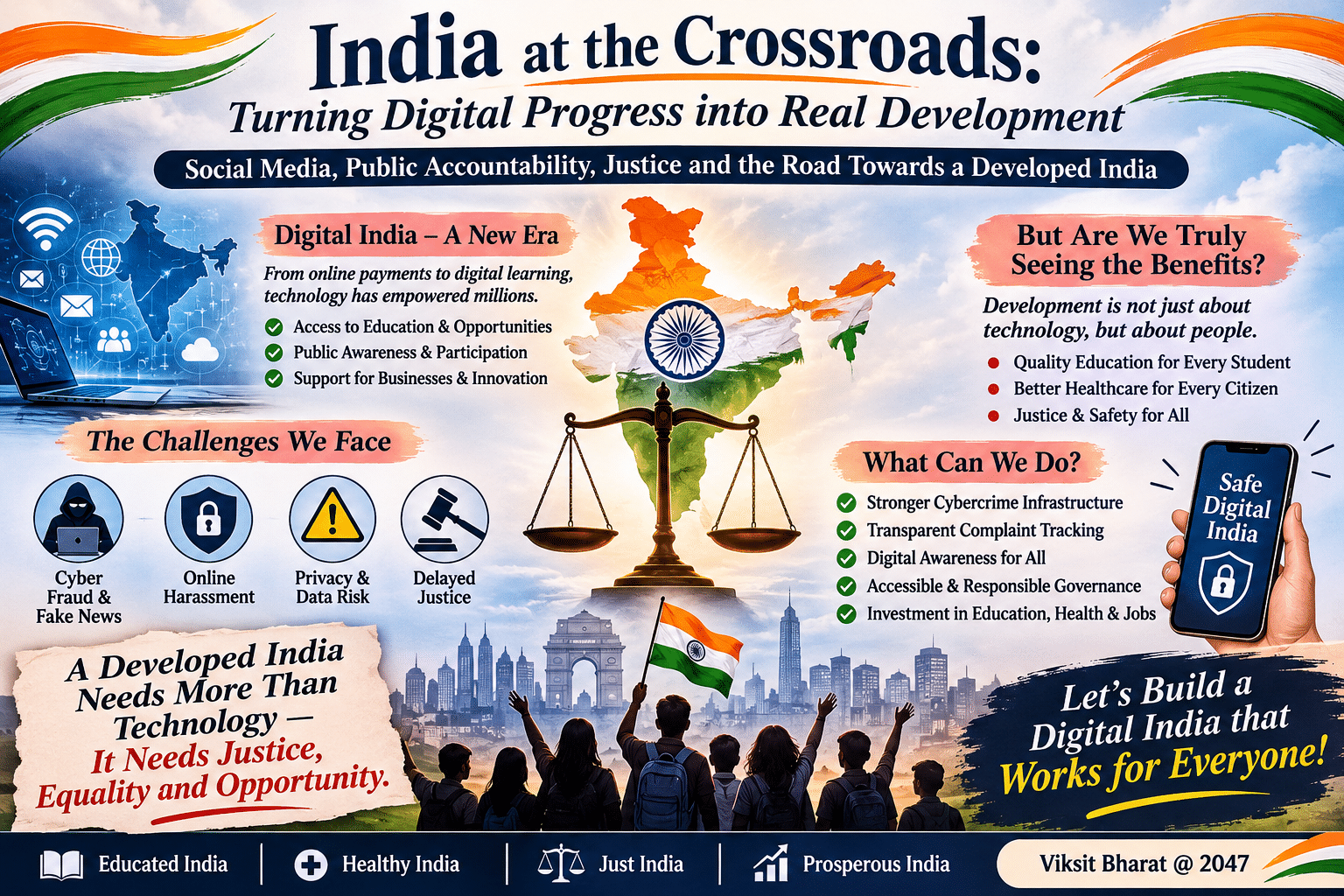
Digital India and Real Development: The Challenges of Governance, Justice and Accountability
Social Media, Public Accountability, Justice and the Road Towards a Developed India
Introduction: Is Digital Progress Enough?
India is changing rapidly. From online payments and digital education to social media and technology-driven businesses, technology has become a part of our everyday lives. Government services are increasingly moving online, businesses are finding new markets and young people are using digital platforms to explore opportunities that were not easily available to previous generations.
These changes are important, and there is no denying that India has made significant progress in the digital sector. But sometimes, looking at all this progress makes us overlook a more important question: Are ordinary citizens actually experiencing the benefits of this development?
For a student, development may mean access to quality education. For a farmer, it may mean better facilities and fair opportunities. For a person reporting a crime, it may simply mean receiving timely assistance instead of repeatedly visiting government offices.
This is why development cannot be judged only by the number of digital platforms launched, roads constructed or new technologies introduced. What matters is whether these efforts are making people’s lives easier.
Technology can certainly take a country forward, but it cannot replace effective institutions, accessible justice and basic public services. The real challenge is to ensure that the progress we see online is also visible in people’s everyday lives.
1. Social Media: More Than Just Entertainment
Social media has become much more than a platform for sharing photographs, videos and personal updates. It has created opportunities for students, professionals, small businesses and ordinary citizens to connect with the wider world.
A student sitting in a small town can attend online lectures, learn new skills and prepare for competitive examinations. A small business owner can promote products without spending large amounts on advertising. Young artists, writers and creators can showcase their talent to audiences they might never have reached otherwise.
Social media also plays an important role in spreading public awareness. Information about health, education, environmental protection and government schemes can reach thousands of people within a short time. During emergencies, digital platforms can help circulate important alerts and connect people with assistance.
Another important contribution is public accountability. Citizens can raise concerns about local problems, share their experiences and draw attention to issues that might otherwise go unnoticed.
In this sense, social media has given ordinary people a stronger platform to express themselves.
However, every opportunity comes with responsibility. The same platform that spreads useful information can also circulate false news, promote financial scams and expose people to online harassment. This brings us to a side of digital development that deserves serious attention.
2. The Growing Challenges of the Digital World
As internet access expands, the risks associated with its misuse are also becoming more visible.
Online financial fraud, fake social media accounts, identity theft, cyberbullying, online harassment and misleading information have become serious concerns. In some cases, criminals misuse private photographs, create manipulated images or threaten individuals through digital platforms. Children and vulnerable users may also face online exploitation.
These are not merely technical problems. They can affect a person’s financial security, reputation, privacy and confidence.
India has several legal provisions to address such offences, including the Information Technology Act, 2000 and the Bharatiya Nyaya Sanhita, 2023. Citizens can also report cybercrime through the National Cyber Crime Reporting Portal.
But having a law or a complaint portal is only the beginning. The real question is what happens after a person reports an offence.
Does the complaint receive proper attention? Is the victim informed about the progress? Is there enough technical expertise to investigate the matter?
The intention should not be to discourage the use of social media or limit legitimate freedom of expression. Instead, the focus should be on making digital spaces safer while protecting privacy, security and individual rights.
3. When Registering a Complaint Is Easier Than Getting Justice
Consider a situation in which someone loses their mobile phone. They approach the police station, explain the problem and expect assistance. They may also be asked to complete an online process. After submitting the complaint, however, they might have to wait for updates or visit the concerned office repeatedly.
For an ordinary citizen, this can become a frustrating experience.
India has introduced initiatives such as Sanchar Saathi and the Central Equipment Identity Register (CEIR), which allow citizens to request the blocking of lost or stolen mobile phones. These initiatives are useful, but there is an important difference between blocking a device and recovering it.
Similarly, registering a cybercrime complaint is not the same as resolving the crime.
A person who has already suffered a loss should not have to struggle simply to understand what is happening with their complaint. They need clear information, proper investigation and a reasonable explanation of the next steps.
Of course, every case is different. Some investigations require technical examination, digital evidence and coordination between several agencies. Immediate resolution is not always possible. But that should not mean that citizens are left without updates or guidance.
A digital system should not simply make it easier to report a problem; it should also help people move towards a solution.
4. The Gap Between Digital Services and Ground Reality
India’s digital transformation has created many useful facilities, but access to technology does not automatically mean access to effective services.
A person with limited digital literacy may find online portals difficult to understand. Someone living in an area with poor internet connectivity may struggle to complete even a basic application. In other situations, a complaint may remain pending without clear information about the department responsible for handling it.
Cybercrime investigations also require trained personnel, specialised equipment and proper coordination. Without these resources, even well-designed digital systems may struggle to deliver the expected results.
And this issue is not limited to cybercrime.
Similar difficulties can be seen in different areas of public administration. A person seeking healthcare may struggle to find adequate facilities. A student may have access to an online learning platform but lack proper teaching support. A citizen applying for a public service may still have to visit multiple offices to complete the process.
The purpose of digital governance should be to reduce these difficulties, not simply transfer paperwork from physical offices to online portals.
5. What Can India Learn From Other Countries?
Several countries have introduced integrated digital services, online complaint tracking and technology-based administrative systems. Their experiences offer useful lessons for India.
For example, a well-designed public service system should allow citizens to access multiple services through a simplified process. People should receive application acknowledgements, regular updates and clear information about the department responsible for their requests.
India can also learn from systems that focus on transparent complaint tracking, digital evidence management and coordination between government departments.
However, simply adopting another country’s technology will not solve India’s problems. Our population, geographical diversity, economic conditions and administrative structure are different.
What we need is not a copy of someone else’s model, but a system designed around the actual needs of Indian citizens.
6. Practical Changes That Can Make a Difference
We cannot expect every administrative problem to disappear overnight. Staff shortages, outdated infrastructure and weak coordination have existed for years. However, gradual reform does not mean that action should be delayed.
Some practical steps can make public services more effective.
- A simpler complaint system: Citizens should have a common entry point to identify the correct department and submit complaints. Where specialised portals are necessary, people should be guided to them without repeatedly entering the same information.
- Time-bound initial responses: Every complaint should receive an acknowledgement and an initial assessment within a clearly defined period. If further investigation is required, the citizen should be informed about the delay and the next steps.
- Transparent complaint tracking: A unique tracking number should allow citizens to check whether their complaint is pending, under investigation, escalated or resolved, while protecting confidential information.
- Clear administrative responsibility: Every complaint should have an identifiable department or responsible authority. Unexplained delays should be reviewed, and repeated negligence should be addressed through fair procedures.
- Better cybercrime infrastructure: Specialised cybercrime units, trained investigators, digital forensic laboratories and technical resources should be strengthened, particularly in areas where these facilities are limited.
- Safer social media platforms: Digital platforms should provide accessible reporting mechanisms and comply with applicable legal requirements. People should also receive clear guidance on reporting impersonation, harassment and fraudulent accounts.
- Digital awareness: Schools, colleges and local administrations should help people understand online privacy, fraudulent links, identity theft and misinformation. Such awareness should reach rural communities and be available in regional languages.
- Public performance reports: Government departments should regularly publish reliable information about complaints received, pending cases, disposal rates and delays. Citizens should be able to understand how effectively public services are functioning.
These reforms do not require creating endless new portals. They require making existing systems more responsible, accessible and effective.
7. India’s Development Needs More Than Technology
While digital development is important, India’s future cannot depend on technology alone. A developed nation also needs strong education, meaningful employment, accessible healthcare, reliable infrastructure and effective public institutions.
Education should prepare students not only to pass examinations but also to develop practical skills and independent thinking. Employment opportunities should grow alongside the number of educated young people. Small businesses and entrepreneurs should receive an environment in which they can grow.
Agriculture also needs attention through better irrigation, storage, transportation and access to markets. Rural healthcare facilities require trained staff and essential equipment. Women’s safety must involve effective policing, safe public transport and accessible complaint mechanisms.
Similarly, investment in research, innovation, renewable energy and environmental protection will be essential for long-term growth.
These areas are connected. Better education creates skilled workers. Better infrastructure supports businesses. Strong healthcare improves productivity. Effective administration builds public trust.
A country cannot realise its full potential by advancing one sector while leaving others behind.
8. Justice Is Also a Measure of Development
When we talk about a developed India, justice should be an essential part of the discussion.
Development is not only about economic growth or modern infrastructure. It is also about whether citizens can exercise their rights, receive protection under the law and approach institutions without unnecessary difficulty.
We should not underestimate the role of the judiciary or expect every legal matter to be resolved instantly. Judicial proceedings require proper examination of evidence, fair hearings and adherence to established procedures.
However, access to justice can be improved through stronger investigative systems, better legal awareness, appropriate infrastructure and efforts to reduce avoidable delays.
The same principle applies to public administration. Citizens should be able to seek assistance and receive a fair response, regardless of their financial position or geographical location.
Justice and development are not competing priorities. They are both necessary for building a society in which people can live with dignity and confidence.
9. What Should Development Actually Look Like?
Perhaps the simplest way to understand development is to look at everyday life.
Can a student receive a good education without facing unnecessary barriers? Can a young person find meaningful employment? Can a patient access timely medical treatment? Can a farmer receive the facilities needed to support their livelihood? Can women travel safely? Can a citizen report a crime and receive appropriate assistance?
These questions may sound ordinary, but they reflect the real experiences through which people judge the effectiveness of development.
Economic growth, infrastructure and technological achievements are important indicators. But they should be considered alongside the quality, accessibility and reliability of essential public services.
A service should not be considered successful simply because it has been launched. Its actual usefulness should be judged by whether people can access it and whether it addresses the problem it was created to solve.
That is where the difference between development on paper and development in everyday life becomes clear.
Conclusion: Turning India’s Potential Into Real Progress
India has enormous potential. It has talented young people, growing technological capabilities, natural resources, established institutions and opportunities across different sectors.
The challenge is to bring these strengths together and use them effectively.
We cannot solve every problem in a single day. But we can start by improving existing systems, filling essential vacancies, strengthening public institutions, investing in education and making public services more accountable.
Every genuine complaint deserves appropriate attention. Every unnecessary delay deserves examination. Every development initiative should be evaluated by the difference it makes in people’s lives.
Social media should remain a platform for learning, creativity and opportunity, while its misuse should be addressed through awareness, security and appropriate legal action. Digital governance should simplify people’s lives rather than create additional difficulties.
Most importantly, development should not be treated as the responsibility of one institution alone. Government, businesses, educational institutions, civil society and citizens all have a role to play.
India does not lack potential. What matters now is how effectively that potential is converted into opportunities, reliable public services and better living conditions.
We are not questioning how far India can go. We are asking how many people are able to move forward with it.
Because a truly developed India will not simply be one where everything is available online. It will be one where every citizen can access their rights, opportunities and essential services without unnecessary struggle.
The real goal is not just to build a Digital India, but to make digital progress meaningful in the everyday lives of its people.
References and Official Sources
- Ministry of Electronics and Information Technology (MeitY) – Digital India Programme.
https://www.digitalindia.gov.in/ - Government of India – Information Technology Act, 2000.
India Code – IT Act, 2000 - Government of India – Bharatiya Nyaya Sanhita, 2023.
https://www.indiacode.nic.in/ - Ministry of Home Affairs – National Cyber Crime Reporting Portal.
- Department of Telecommunications – Sanchar Saathi and CEIR.
Sanchar Saathi – CEIR - Department of Administrative Reforms and Public Grievances – CPGRAMS.
Public Grievance Redressal System - United Nations – UN E-Government Survey 2024.
UN E-Government Survey 2024 - Ministry of Education, Government of India – National Education Policy 2020.
https://www.education.gov.in/ - Ministry of Statistics and Programme Implementation – National Statistical Office (NSO).
https://www.mospi.gov.in/ - Ministry of Information and Broadcasting – Government of India.
https://mib.gov.in/
