





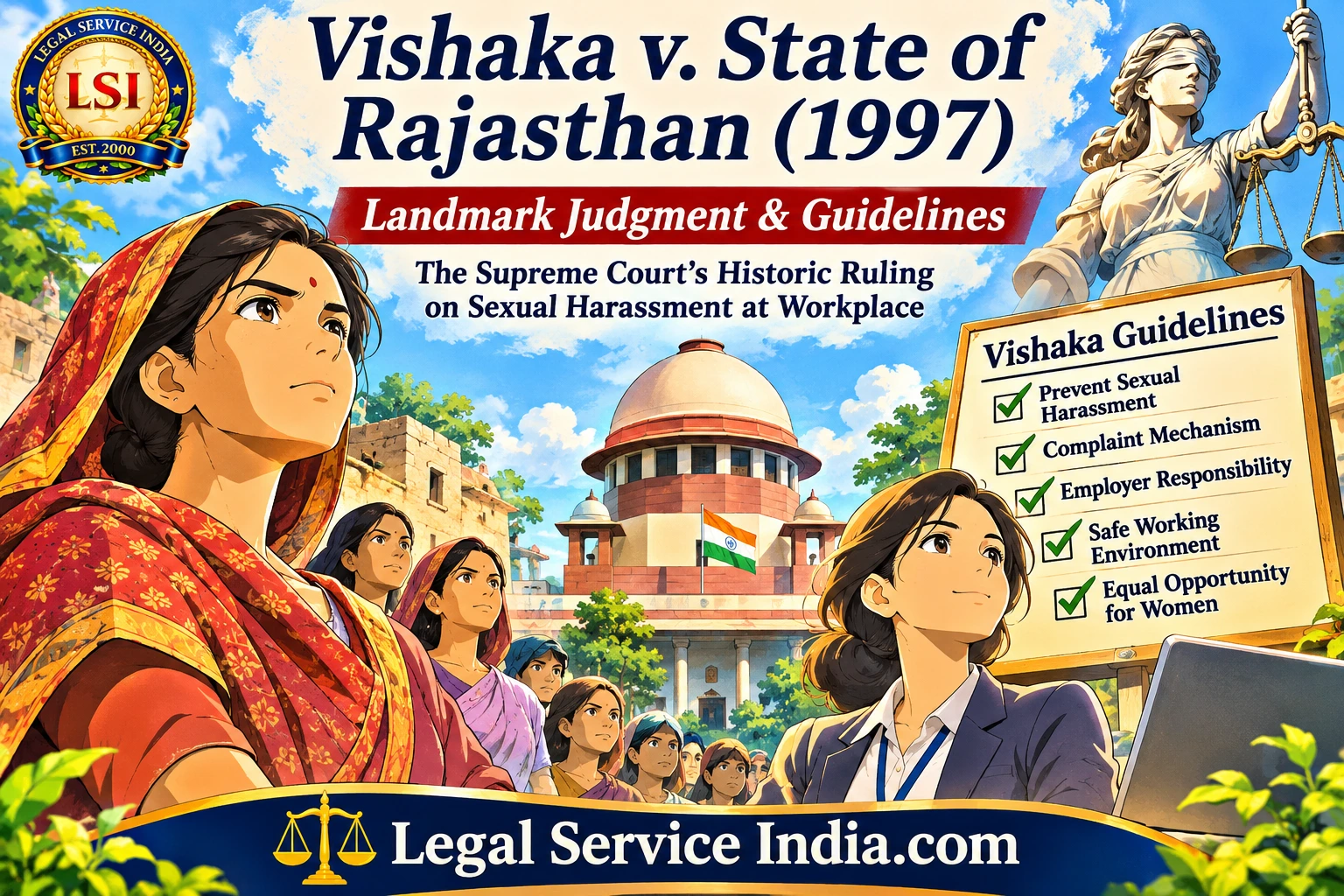
Vishaka v. State of Rajasthan & Ors. (1997): Landmark Judgement on Sexual Harassment at Workplace
Introduction
In India, before the Vishaka guideline was passed, there was no law or no provision for sexual harassment of women at the workplace. From the case of Vishaka V. State of Rajasthan 1997.
This case signifies the brutal or cruel sexual harassment of a woman at her workplace. The most important point that was raised from this case is whether a woman is safe in her workplace. , or is a woman getting a healthy and safe working environment? So, for the safety of women and equal opportunities for women, after 1997, the Vishaka guidelines were passed, which resolved such issues and provided a provision for sexual harassment of women at their workplace.
This case made changes to the Indian society by providing equal opportunities for women in their workplace. So let us know the case in detail.
Case Details
| Particulars | Details |
|---|---|
| Name of the Case | Vishaka V. State of Rajasthan & Ors. |
| Citation | (1997) 6 SCC 241. |
| Court | Honourable Supreme Court of India. |
| Petitioner | Vishaka & Ors. |
| Respondent | State of Rajasthan & ors. |
| Judges | Justice J.S. Verma, Justice Sujata V. Manohar, and Justice V.N. Kripal. |
| Judgement Date | 13th August 1997 |
Facts of the Case
A lady named Bhanwari Devi from Bhateri Rajasthan, she was a member of an NGO in 1985, which enhances the rights and opportunities for women and helps to take action against the unjust, unfair treatment of women. They also promote women’s empowerment and take legal action against discrimination or any kind of criminal activity that is performed against women in their region. The foremost objective of their organisation or group is the safety of women. In states like Rajasthan, the most common problem that was faced from ancient times is child marriage, which was very common throughout the state.
The Child Marriage Incident
In 1992, at her village, Bhanwari finds that a scheme of child marriage was there. Every person in her village was ignoring it even after knowing that child marriage was illegal in India, but no one took action against it. Bhanwari took action against it and brought up an issue to ban such types of child marriage schemes. Bhanwari Devi tries very hard to stop this child marriage, but in the result, she is unsuccessful.
Even after her lot of struggle, police visits to the house where such marriage rituals are performed, but the next day the marriage was successfully completed. After that, also, no action is taken by police officers. But with the visits of police in a village, villagers decided to boycott Bhanwari Devi and her family; by this action, Bhanwari Devi also lost her job.
The Incident of Gang Rape
On 22nd September 1992 there was an attack by 5 men against Bhanwari Devi’s husband; later, by 5 men, Bhanwari Devi was brutally gang-raped.
After this incident, police were not ready to log the FIR, but on force by Bhanwari and her husband, after many hurdles, police logged the FIR, but due to this, there was a result in a delay in the investigation.
Legal Proceedings and Filing of PIL
Further on, Bhanwari Devi and her husband wanted to seek justice, but due to political pressure, they failed, but later on, they approached the trial court of Rajasthan. The trial court held the acquittal of the 5 accused on the ground of insufficient evidence.
The organisation stood up together and focused on that issue to seek justice, which resulted in the filing of a PIL by that organisation named VISHAKA. This origination was focused on women’s safety and helps to seek justice against the discrimination or offence by an accused person.
The PIL raised by challenging articles 14, 15, 19 and 21 of the Indian Constitution and addressing the issues for the protection of the women from sexual harassment at their workplace.
From this, Bhanwari Devi, the question for the safety of women at their workplace arose, and women also have the right to get a safe and healthy working environment like men.
Issues Before the Supreme Court
- Whether the decision given by the trial court is a violation of articles 14, 15, 19 & 21 of the Indian Constitution?
- Whether the court can apply the international laws in the absence of applicable ones under the existing laws?
- Whether the head or supervisor is held liable for the safety of the employees?
Judgement of the Supreme Court
1. Violation of Fundamental Rights
The Supreme Court on the first issue held that there was a violation of a fundamental right. Like article 19(1)(g) of the Indian constitution, which states that to trade, occupy or do business of their choice, it violates it, and article 21 states that one has the right to live a life with dignity, and every person has the right to get a healthy and safe working environment. Under Article 32, they approached the Supreme Court of India, and the Supreme Court held that the decision by the trial court violated the fundamental rights of the victim and also did not address justice. The act of sexual harassment was the result of a gender inequality and also discrimination against women.
2. Application of International Laws
The Supreme Court on the second issue held that in the absence of action against such types of brutal gang rape or sexual harassment at the workplace, the court can rely upon the principle for international laws for seeking justice and gender equality. Article 51(c) as of DPSP provides for gender equality, which also includes the right to get a healthy working environment.
Also the provisions of CEDAW, 1949, articles 11, 22, 23 & 24, laid down the principles for gender equality and sexual harassment.
3. Responsibility of Heads and Supervisors
The Supreme Court on the third issue held that it is the duty of heads to take all the actions or the protective measures for the safety of employees.
Vishaka Guidelines
The Vishaka guidelines established important provisions for addressing sexual harassment at the workplace.
1. Definition of Sexual Harassment
Section 2(n) of the POSH Act defined sexual harassment as:
- One or more unwelcome actions
- Physical contacts & advances
- Demand or request for sexual favour
- Sexually coloured remark
- Showing pornography
- Other unwelcoming physical
- Verbal & non-verbal conduct of a sexual nature.
2. Employee
Section 2(f) of the POSH Act includes all the women, including permanent, temporary, and interns; customers; visitors; agents; and coworkers – all kinds of women who either work full-time or work part-time. It also includes the customers and visitors and also interns and trainees.
3. Aggrieved Women
Section 2(a) of the POSH Act defines ‘aggrieved woman’ as a woman who is a victim of sexual harassment at the workplace.
4. Workplace
Section 2(o) of the POSH Act defines ‘workplace’ to include all the private or public sectors, including NGOs, hospitals, offices, and educational institutions, as well as domestic workplaces.
5. Quasi-Judicial Committees
There are 2 committees:
A. Internal Complaint Committee
Section 4 deals with it.
Which consists of a senior-level one presiding officer: – 2 employees from social background, 1 member from a non-governmental organisation, and half of the committee must be women.
- They hold there office for 3 years.
- ICC works where 10 or more employees in an organisation
- Their primary role is to address the issues and complaints and try to resolve them.
- They had the power to make an inquiry after inquiry; within 90 days, they had to submit a report.
- They had a duty to make all the information confidential.
- They have the power to summon and witness a person and also call for the production of a document.
B. Local Committee
Section 5 deals with it.
- It works when there are fewer than 10 employees in an organisation.
- It consists of a district officer; 50% of the committee must be of women Members: a. chairperson – women in social purpose. B. local member – which must be a woman who is a local representer. C. 2 members form an NGO of the district, in which 1 must be a woman.
- They also have the same power and function as the ICC.
Conclusion
The case of Vishaka v. State of Rajasthan changed the structure of every workplace by providing an equal opportunity for a woman. It brought up the major changes, like the wider definition of workplace, employee, and sexual harassment, and made a committee for solving issues and complaints and taking essential measures or actions against the complaints filed and provided equality among all the genders in the workplace and a safe working environment for women.
Frequently Asked Questions (FAQs) About Vishaka v. State of Rajasthan
1. What Is Vishaka v. State of Rajasthan (1997)?
Vishaka v. State of Rajasthan (1997) is a landmark judgement of the Supreme Court of India concerning sexual harassment of women at the workplace. In this case, the Supreme Court recognised workplace sexual harassment as a violation of women’s fundamental rights under the Indian Constitution and laid down the Vishaka Guidelines to ensure a safe working environment for women.
2. What Are the Vishaka Guidelines on Sexual Harassment at the Workplace?
The Vishaka Guidelines were issued by the Supreme Court of India on 13th August 1997. They established preventive measures, complaint mechanisms and employer responsibilities to address sexual harassment at the workplace. These guidelines remained the primary framework for workplace sexual harassment until the enactment of the Sexual Harassment of Women at Workplace (Prevention, Prohibition and Redressal) Act, 2013, commonly known as the POSH Act.
3. Who Was Bhanwari Devi and What Was Her Role in the Vishaka Case?
Bhanwari Devi was a social worker from Rajasthan who worked to prevent child marriage in her village. After she was subjected to gang rape in 1992, her case highlighted serious concerns about women’s safety and justice. The incident inspired women’s organisations, including Vishaka, to approach the Supreme Court through a Public Interest Litigation, resulting in the landmark Vishaka judgement of 1997.
4. What Fundamental Rights Were Recognised in the Vishaka v. State of Rajasthan Judgment?
The Supreme Court recognised that sexual harassment at the workplace violates women’s fundamental rights under Articles 14, 15, 19(1)(g) and 21 of the Indian Constitution. These provisions protect equality before the law, prohibit discrimination, guarantee freedom to practise any profession and protect the right to life with dignity.
5. What Is the Difference Between the Vishaka Guidelines and the POSH Act, 2013?
The Vishaka Guidelines were issued by the Supreme Court in 1997 to prevent and address sexual harassment at the workplace in the absence of specific legislation. The POSH Act, 2013 subsequently established a statutory framework for prevention, prohibition and redressal of workplace sexual harassment. It also provides for Internal Committees and Local Committees to receive and address complaints.

