





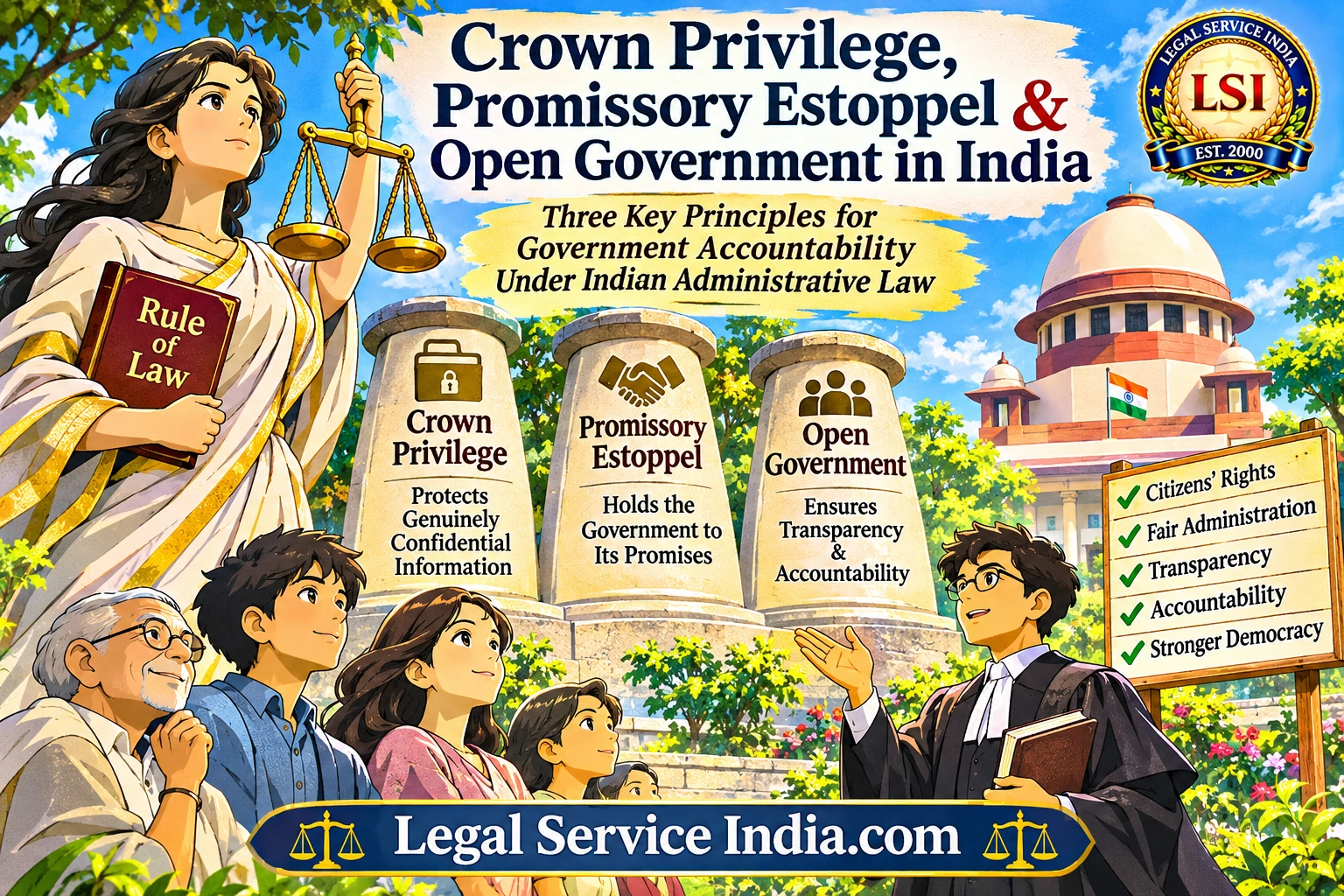
Government Accountability and Three Important Legal Principles
In a democratic country, the government must act fairly, honestly and transparently. It cannot misuse its power or avoid its responsibilities by claiming special privileges.
Three important legal principles control the government’s actions: Crown Privilege, Promissory Estoppel and the Doctrine of Open Government. These principles protect citizens’ rights, ensure fair administration and make the government accountable to the people.
1. Crown Privilege (Government Privilege Regarding Official Documents)
Crown privilege means the right claimed by the government to refuse to disclose certain official documents or information in court proceedings on the ground that their disclosure may harm public interest or national security.
In India, it is generally known as state privilege or public interest immunity. It is not an unlimited power of the government. The court has the authority to examine whether the claim of privilege is legally justified.
Main Purposes of Crown Privilege
- To protect national security and defence-related information.
- To maintain confidential government communications where necessary.
- To protect sensitive information relating to public affairs.
- To prevent disclosure that may seriously harm public interest.
Important Legal Provisions
The following provisions govern the protection of official government documents and confidential communications in India:
| Earlier Legislation | Subject | Current Legislation |
|---|---|---|
| Section 123, Indian Evidence Act, 1872 | Unpublished official records relating to affairs of the State. | Section 129, Bharatiya Sakshya Adhiniyam, 2023 |
| Section 124, Indian Evidence Act, 1872 | Official communications made in confidence. | Section 130, Bharatiya Sakshya Adhiniyam, 2023 |
Important Case Laws on Crown Privilege
1. State of Punjab v. Sodhi Sukhdev Singh (1961)
The Supreme Court recognised that the government could claim privilege over certain unpublished official documents if their disclosure would harm public interest. The court has an important role in deciding such claims.
The Supreme Court held that while the court determines whether a document relates to “affairs of the State”, it could not inspect the document itself and had to rely on the head of the department’s affidavit.
2. State of Uttar Pradesh v. Raj Narain (1975)
The Supreme Court held that the government cannot claim secrecy merely because it wishes to withhold information. The court must balance public interest in disclosure against the harm that disclosure may cause.
In this case, the Court departed from this strict view and asserted that courts have the power to inspect the document privately to verify whether the claim of privilege is genuine.
3. P. Gupta v. Union of India (1981)
The Supreme Court emphasised that open government is essential in a democracy and that secrecy should not be used unnecessarily. It recognised that disclosure is generally in the public interest unless confidentiality is justified.
Key Takeaway: Government privilege is meant to protect public interest, not to hide corruption, illegal activities or administrative failures.
2. Promissory Estoppel Against the Government
Promissory estoppel is a legal principle which prevents a person or government from going back on a clear promise when another person has relied upon that promise and changed their position.
In simple words, if the government makes a clear promise and a person acts upon it, the government may be legally bound to honour that promise.
However, promissory estoppel cannot apply against the legislature (no estoppel against a statute).
Essential Conditions of Promissory Estoppel
For the doctrine of promissory estoppel to apply, the following conditions must generally be satisfied:
- There must be a clear and definite promise.
- The promise must be intended to create a legal relationship or affect the conduct of the other party.
- The other party must rely upon the promise.
- The other party must change their position because of that promise.
- It must be unfair to allow the government to withdraw from the promise.
Application Against the Government
The doctrine can apply to government policies, tax exemptions, industrial incentives and other administrative assurances.
However, it cannot compel the government to act against the law or override statutory provisions. The government may also withdraw a promise where an overriding public interest justifies such action.
Important Case Laws on Promissory Estoppel
1. Union of India v. Anglo Afghan Agencies (1968)
The Supreme Court held that the government could not arbitrarily go back on its declared export incentive policy after the exporter had acted upon it.
2. Motilal Padampat Sugar Mills Co. Ltd. v. State of Uttar Pradesh (1979)
The Supreme Court strongly recognised the doctrine of promissory estoppel against the government. It held that the government could be bound by its promise when a person had relied upon it and changed their position.
In this case, Justice P.N. Bhagwati famously clarified that the promisee does not need to prove strict “detriment” (actual loss)—it is enough that they altered their position by acting on the promise, making it inequitable for the government to resile. Adding that one line is a classic high-scoring detail in Indian administrative law.
3. Jit Ram Shiv Kumar v. State of Haryana (1980)
The Supreme Court explained that promissory estoppel cannot prevent the government from performing its statutory duties or acting contrary to law.
4. Kasinka Trading v. Union of India (1995)
The Supreme Court held that the government may withdraw an exemption when public interest requires it, even if the promise has been relied upon.
Key Takeaway: Promissory estoppel prevents arbitrary government action and protects citizens who have reasonably relied upon government promises.
3. Doctrine of Open Government (Government Accountability and Transparency)
The Doctrine of Open Government means that the government must work openly and transparently. Citizens have the right to know how the government makes decisions, spends public money and performs its duties.
In a democracy, government information should not be kept secret without a valid reason. Secrecy should be an exception, not the general rule.
Section 8 of the RTI Act, 2005, codifies the exact exceptions to transparency (national security, cabinet papers, personal privacy, etc.)—directly bridging the Doctrine of Open Government with Crown Privilege.
Main Principles of Open Government
- Transparency: Government decisions and policies should be open to public knowledge.
- Right to Information: Citizens should have access to government records, subject to lawful exemptions.
- Accountability: Government officials must be answerable for their decisions and actions.
- Prevention of Corruption: Transparency helps prevent corruption, misuse of power and favouritism.
- Public Participation: Citizens should have opportunities to participate in government decision-making.
- Freedom of the Press: The media should be able to examine government activities and inform the public.
- Limited Secrecy: Government information should remain confidential only when there is a genuine and lawful public interest in doing so.
Constitutional and Legal Provisions
| Legal Provision | Constitutional or Legal Significance |
|---|---|
| Article 19(1)(a) | Guarantees freedom of speech and expression. The Supreme Court has recognised that the right to know is an important part of this freedom. |
| Article 21 | Protects the right to life and personal liberty. Transparency in administration also supports the protection of individual rights. |
| Right to Information Act, 2005 | Gives citizens the right to obtain information from public authorities. It promotes transparency and accountability in government administration. |
Important Case Laws on Open Government
1. State of Uttar Pradesh v. Raj Narain (1975)
The Supreme Court held that people have a right to know about public acts of government. In a democracy, secrecy cannot be claimed without proper justification.
2. P. Gupta v. Union of India (1981)
The Supreme Court strongly supported the principle of open government. It observed that disclosure of government information should generally be encouraged, and secrecy should be limited to situations where public interest requires it.
3. Secretary, Ministry of Information and Broadcasting v. Cricket Association of Bengal (1995)
The Supreme Court recognised the importance of the citizens’ right to receive information as part of freedom of speech and expression under Article 19(1)(a).
4. Central Public Information Officer, Supreme Court of India v. Subhash Chandra Agarwal (2019)
The Supreme Court recognised the importance of transparency and accountability in public institutions, while also emphasising the need to balance transparency with privacy and other protected interests.
Key Takeaway: The Doctrine of Open Government ensures that the government remains answerable to the people. It strengthens democracy, protects citizens’ rights and promotes honest and responsible administration.
4. Relationship Between the Three Legal Principles
These three principles are closely connected. Each principle performs a different function in ensuring fair government administration and protecting democratic values.
| Legal Principle | Primary Function |
|---|---|
| Crown Privilege | Protects genuinely confidential government information where disclosure may harm public interest. |
| Promissory Estoppel | Prevents the government from unfairly breaking its promises. |
| Doctrine of Open Government | Ensures transparency and makes the government accountable to citizens. |
Together, these principles maintain a balance between government secrecy, administrative fairness and public accountability.
5. Conclusion
In a democratic country like India, the government is not above the law. It must act fairly, honestly and responsibly.
Crown Privilege protects genuine public interests, Promissory Estoppel protects citizens against unfair government action, and Open Government promotes transparency and accountability.
These principles help establish the rule of law and strengthen democratic governance.

