





Model Code of Conduct in India: Powers, Rules, Enforcement & Challenges
Introduction
India is the largest democratic country in the world, where elections serve as an important mechanism for holding representative government. The effectiveness of democracy not only implies conducting elections but also ensuring that elections are held freely and fairly. Every citizen of the country has a right to exercise his or her right to vote in accordance with the Constitution of India. Therefore, it is important to guarantee equality and equal treatment of all political parties and candidates.
Political parties and candidates in India participate in elections with the purpose of getting public support and forming the government. During the election period political parties tell people about their policy, programme and promises. However, the competition in the course of electoral campaigns often leads to violations of fair elections, such as the use of governmental machines, money, intimidation, hate speech, etc. These activities violate the fairness of the elections and the integrity of democratic institutions in the country. In order to prevent such actions and maintain discipline, the Model Code of Conduct is important.
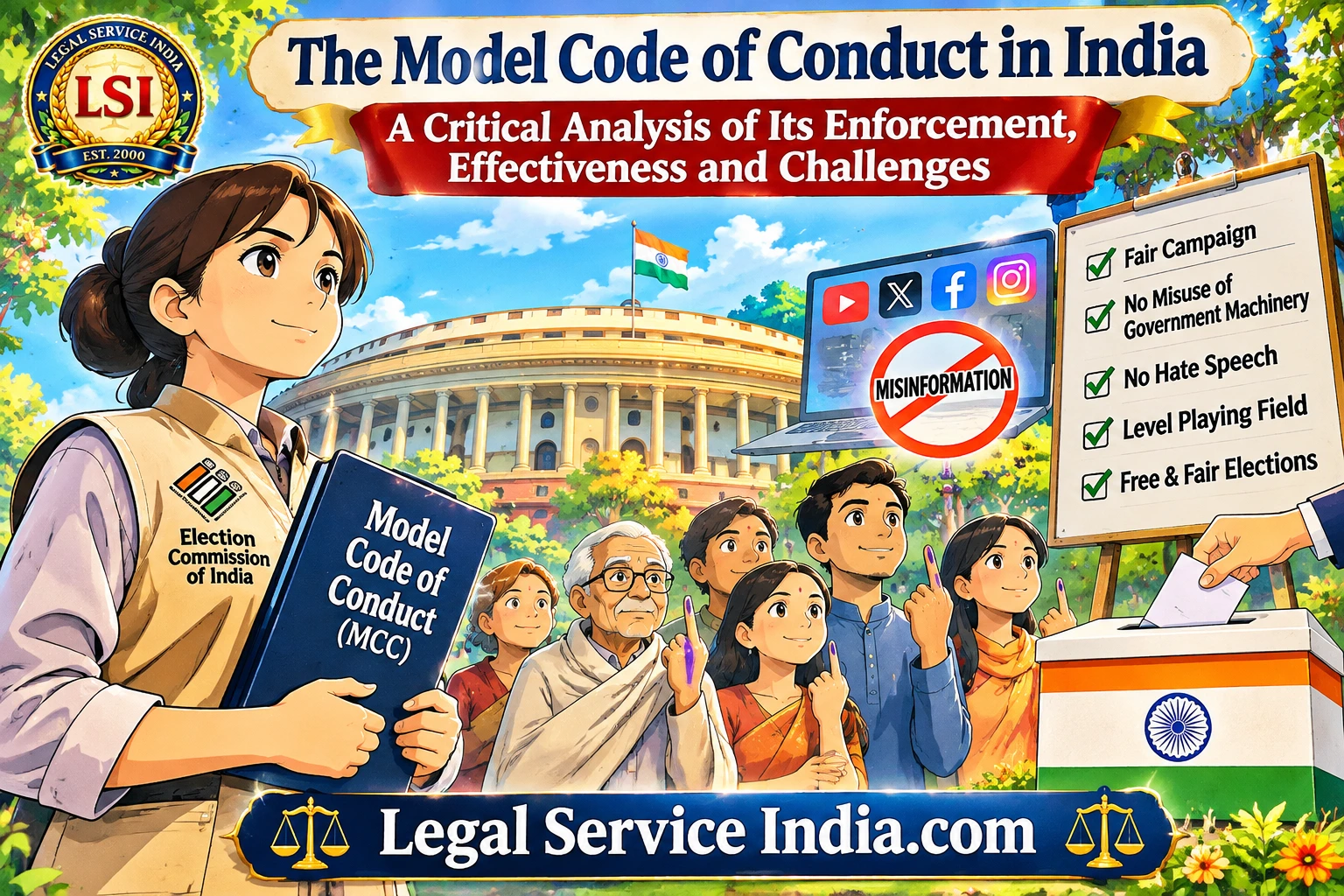
The Model Code of Conduct (MCC) represents a set of guidelines formulated by the Election Commission of India for political parties, candidates and governments during the election period. It contains instructions related to general conduct, election campaign, public meetings, processions, polling activities and the conduct of the party in power. The Code aims at providing an opportunity to all political parties and candidates for taking part in elections in a fair way.
The constitutional foundation for the implementation of the Model Code of Conduct is linked with Article 324 of the Constitution of India, which determines the obligation of the Election Commission to conduct and supervise elections to the parliament, state legislatures and the offices of the president and vice-president of the country. The Election Commission relies on this constitutional provision for the implementation of its authority.
Although the Model Code of Conduct is not a separate law, which has been adopted by the Parliament, it plays a significant role in the Indian electoral system. Certain activities prohibited by the Code are also considered crimes under the Representation of the People Act, 1951 and other laws. Therefore, the Code works together with other legislation concerning elections.
In recent times it has become more difficult to implement the Model Code of Conduct because of the proliferation of social media, the misuse of political influence and digital campaigning, including misinformation. The spread of misinformation via social media and the introduction of artificial intelligence in election campaigning have increased problems for electoral authorities.
The purpose of this article is to discuss the concept of the Model Code of Conduct, its objectives, constitutional and legal framework, key features, mechanisms for enforcement and judicial approach to the Model Code of Conduct. Also, this article will analyse practical challenges associated with the implementation of the Model Code of Conduct in India and propose ways to improve its enforcement.
Meaning, Nature and Objectives of the Model Code of Conduct
2.1 Definition of the Model Code of Conduct
The Model Code of Conduct can be described as a set of rules and regulations which are aimed at governing the conduct of political parties and their candidates and governments during elections. The Model Code of Conduct sets standards of behaviour that should be observed by political players during the whole electoral period.
According to the description of the Model Code of Conduct given by the Election Commission of India, the Code of Conduct is “a set of norms evolved through the consensus of political parties, which have agreed to observe the principles embodied in it”. The Model Code of Conduct seeks to make sure that political parties and candidates conduct their campaigns in a peaceful manner.
The Code regulates the activities of political leaders, prevents the abuse of public property during elections, fosters the atmosphere of respect between political opponents and defends voters from improper influence. The Code covers a wide range of electoral activities such as public addresses, political advertisements, meetings, processions, polling day arrangements and government facilities.
The Code puts special restrictions on the ruling party to prevent the abuse of power for electoral advantage. Thus, the Model Code of Conduct is one of the main instruments used for the maintenance of discipline and fairness during the elections.
2.2 Nature and Scope of the Code
The Model Code of Conduct cannot be called a statute because it is basically a set of guidelines rather than a law. There is no statutory backing to the Code, unlike the Representation of the People Act, 1951. However, the constitutional role of the Election Commission of India makes the code practically enforceable.
The Code applies to recognised political parties, registered political parties, contestants and the ruling party. The provisions of the Code govern the behaviour of the aforementioned groups from the declaration of the election schedule to its conclusion. The Election Commission is responsible for enforcement of the Code.
The Code covers not only the candidates but also their political parties, the leaders of the parties, their supporters and other persons associated with the parties. Restrictions are especially significant for those cases where the election campaign involves the use of government property, officials and institutions.
The Code has both preventive and regulatory character. It is designed to regulate the activities of political participants so that there will be no interference with free voting at the election day. The importance of the Code is in establishing the common standard of conduct.
2.3 Objectives of the Model Code of Conduct
The basic objective of the Code is to provide free and fair elections in India. It is supposed to guarantee that voters can use their right to vote freely without any intimidation, inducements and any other influence. In addition, it aims to give all political parties and candidates equal opportunities for conducting the election campaign.
Another objective of the Code is to limit the use of power by the ruling party. Ministers and other government officials are forbidden to use the money of the state, government transport, government media and other public means to get electoral benefits. Also, it is forbidden to announce the financial assistance, programs and projects which could influence the voters.
Finally, the objective of the Code is to establish responsible political dialogue. It limits aggressive speeches which incite inter-communal enmity and calls on religious and caste issues, false charges and personality attacks on political opponents.
2.4 Significance of the Code in the Democratic Electoral System
The principle of democracy is dependent on the participation of people in electing their representatives. An election cannot be said to be a true reflection of democracy if the process of voting is influenced by money, threats, misleading information and official power. Thus, it is essential to maintain fairness in election campaigns in order to uphold the principles of democracy.
The Model Code of Conduct ensures certain standard rules of competition for the political parties. It makes sure that the ruling party does not use government resources in order to gain advantage over the opposition parties, thus ensuring a relatively equal competition among the political parties and promoting peace in campaigns as well as showing respect for political opponents.
It helps in protecting the interest of voters from being influenced by the corrupt and violent means and practices such as bribery, intimidation and communal sentiments. It also helps in maintaining the responsible behaviour of political parties and respects the democratic rights of people.
Thus, the Model Code of Conduct is an important tool in the context of maintaining the electoral discipline in India.
Constitutional and Legal Framework of the Model Code of Conduct
The Model Code of Conduct operates within the constitutional and legislative framework for holding the elections in India. Although the Model Code of Conduct is not any separately enacted law by Parliament, its enforcement is closely linked with the constitutional mandate of the Election Commission as well as legislative provisions of various election acts. The Constitution forms the basis of the democratic elections while the laws provide the legal remedy against the electoral offences and corrupt practices.
3.1 Article 324 – Powers of the Election Commission of India
According to Article 324 of the Constitution of India, the superintendence, direction and control of the preparation of electoral rolls for, and the conduct of, elections to Parliament and to the Legislature of every State and of the offices of President and Vice-President of India shall be vested in the Election Commission.
It is the constitutional mandate of the Election Commission to superintend the process of conducting the elections. It enables the Commission to implement certain steps in order to ensure that elections are held in a free and fair manner.
The Election Commission derives its powers to give directions and instructions with regard to the implementation of the Model Code of Conduct from Article 324. It keeps a watch on the activities of political parties and candidates and acts upon the situation whenever the behaviour of the political parties and candidates undermines the fairness of the elections. At the same time, the Election Commission has the duty to prevent the misuse of official machinery and ensure that there is no undue advantage to the ruling party over other political parties.
But the powers under Article 324 have to be exercised in consonance with the provisions of the Constitution and the statute. Thus, Article 324 cannot be used in a discretionary manner or in such a way as to ignore the statutory provisions. In this connection, Article 324 forms the constitutional basis for the implementation of the Model Code of Conduct.
3.2 Article 14 – Equality Before the Law
The Article 14 of the Constitution provides for equality before the law and equal protection of laws. This constitutional value is important in the context of implementation of the Model Code of Conduct since political parties and candidates should be treated equally.
It is the responsibility of the Election Commission to see to it that the laws related to election campaigning are enforced in an unbiased manner. It would not be justifiable for the ruling political party to be given any sort of special treatment just because of the government in power. The same rule goes for the opposition political parties as well.
Another aspect of the principle of equality is the need for consistent handling of electoral law violations. It would reduce the credibility of the Election Commission in case certain political parties are targeted while ignoring similar actions of others. Article 14 plays an important role in this regard.
3.3 Article 19(1)(A) – Right to Freedom of Speech and Expression
Article 19(1)(a) grants the right to freedom of speech and expression to the citizens. Campaigning for political positions, criticizing the policy initiatives of the government and debates on issues of politics are very vital aspects of democratic elections. Political parties should be given the freedom to express their programmes and policies to the people.
But freedom of speech is not absolute in nature. Under Article 19(2), there can be reasonable restrictions on the right to freedom of speech in certain constitutional cases. Political campaigning should not be used as a platform to foment communal violence, threaten people, disseminate false information or create disturbances to public order.
The Model Code of Conduct maintains the balance between freedom of political expression and electoral behavior. The Code allows criticism of political parties on the basis of their policies, programs and performances but not personal criticism, baseless allegations or appeal to communal sentiments. Therefore, the Code aims at protecting democracy without letting political freedom disrupt electoral peace.
3.4 Representation of the People Act, 1951
Representation of the People Act, 1951 is an important legislation regarding elections in India. This includes conduct of election, qualifications and disqualifications of candidates, corrupt practices, electoral offences and disputes relating to election.
Section 123 lays down the various practices which would amount to corrupt practice. These include bribery, undue influence, appeal on prohibited communal ground, etc. Section 125 makes provision in respect of promotion of enmity between classes in relation to election. Section 126 prohibits any public meeting within 48 hours prior to the hour fixed for the close of the polls.
The above mentioned Sections have got direct link with the objectives of the Model Code of Conduct. While the Code sets out behavioural code, the Representation of the People Act lays down statutory penalties for violation of certain provisions.
3.5 Conduct of Elections Rules, 1961
The Conduct of Elections Rules, 1961 have been made under the Representation of the People Act, 1951. These rules contain details regarding the various aspects of the electoral process such as nomination, polling, voting and counting of votes and other matters incidental thereto.
They supplement the provisions of the Representation of the People Act and facilitate uniformity in the process of conducting elections. Though the Rules do not independently create the Model Code of Conduct, yet they are a part of the overall legal system governing the conduct of elections.
3.6 Legal Status of the Model Code of Conduct
One of the main problems regarding the Model Code of Conduct is its legal position. As distinct from the Representation of the People Act, 1951, the Model Code has not been separately enacted by Parliament as legislation. The Model Code is a set of instructions, which is formulated on the basis of consultations and consensuses of political parties.
Thus, each and every breach of the Model Code does not mean that a person committed a criminal offense and can be charged. If the same behavior or conduct constitutes a breach of any other election or criminal laws then legal steps can be taken against a person under those laws. Notices, warnings, reprimands and instructions can be given by the Election Commission in its constitutional capacity.
Major Provisions of the Model Code of Conduct
The Model Code of Conduct consists of guidelines pertaining to the conduct of political parties, candidates and governments during the election period. The main purpose of the code of conduct is to conduct election campaigns peacefully and provide all the political parties an equal chance to address their concerns to the electorate.
4.1 General Conduct of Political Parties and Candidates
The general conduct of the Model Code of Conduct consists of guidelines according to which political parties and candidates have to act during election campaigns. The purpose of these provisions is to maintain peace, discipline and respect amongst the political rivals. All the political parties and candidates are supposed to carry out their election campaigns without disturbing the public order and creating hostility between different sections of the community.
Activities which may result in hatred and tension between different castes, religions or linguistic groups are strictly forbidden. It is mandatory for political parties and candidates not to make personal allegations against their opponents. Their criticism should revolve around the policies, programmes, performance and activities of the other political parties.
Religious institutions like temples, mosques, churches, and other places of worship are also restricted from being used for election propaganda under the code. The political parties should not attempt to gain votes on the grounds of their religious beliefs and sentiments. These restrictions also extend to the personal property and privacy of people.
These rules are essential since politics in any state is supposed to be about the issues of governance and public policies, not animosity and discrimination.
4.2 Regulation of Election Campaigning and Public Meetings
Election campaign is one of the components of the democratic process in that it gives room to the candidates to disseminate information about their policies and programmes. Nevertheless, these processes ought to be done in the confines set by the Model Code of Conduct.
Political parties and candidates must get necessary permission before carrying out activities like public meetings, processions and campaign activities. The parties must ensure that the authorities know about the place and time of the meeting to enable the concerned authority to make adequate arrangement for law and order.
It is also required by the Code that political parties ought to conduct themselves well in regards to the campaign activities of other parties. They should not interfere in the public meeting or procession nor take down the posters of their political opponents. The organisers must also ensure that the supporters do not cause any disturbances or violence.
Restrictions regarding the use of loudspeakers, public places, advertisements and campaign materials must also be respected. The campaign and the advertisements must abide by the relevant legal requirement.
4.3 Restrictions on the Use of Government Machinery
Among the most significant stipulations of the Model Code of Conduct is the prohibition on the misuse of government machinery by the ruling party. Given the ability of the ruling party to access government resources and machinery, there can be an element of seeking advantage from governmental powers for electoral purposes.
According to the Code, ministers and other officials are supposed not to employ their official status in electioneering. The use of official cars, offices, government resources, funds, staff, and any other government property for promotion of the electoral interests of a political party or a candidate is forbidden.
In addition, the ruling party is required not to announce grants, schemes, concessions or other initiatives during the period of elections that might affect voters unless allowed to do so according to the Commission’s guidelines. Official announcements about the achievements of the government are also prohibited while the Code is in effect.
Such restrictions are necessary to keep the level of the playing field equal between the ruling party and opposition ones. Government resources belong to the public and cannot be used for private electoral benefits of the officeholders.
4.4 Conduct of Political Parties in Power
Under the Model Code of Conduct, special care needs to be taken about the conduct of the political party in power, both at Union level and State level. The party in power has to ensure that it does not gain any unfair advantage through its official status during the election period.
Ministers are forbidden from mixing their official visits with electioneering activities. They are not allowed to make use of government transport, services, and resources for election purposes. Government advertisements and publicity regarding the performance of the ruling party also have some limitations.
The code further provides guidelines regarding the use of government guesthouses and other public accommodations by the political parties and candidates. This facility should be given without giving any undue advantage to the ruling party.
This is done in order to keep politics away from government administration. The government has to do its work of administration, but it should not exercise any undue influence over the voters through its power.
4.5 Code of Conduct for Polling Day
Polling day is an extremely important phase in the entire election procedure since it is the day when people cast their votes. The Code of Conduct lays down guidelines for both the political parties and candidates so that the polling is peaceful and orderly.
Both candidates and political parties should co-operate with the election officers and refrain from doing anything that would affect the voters in the polling area. The campaigning in the prohibited area surrounding the polling station is restricted by the relevant election law. Candidates are also required to follow guidelines concerning the election agents, authorized vehicles and polling arrangements.
The Code bars bribery, intimidating voters, impersonation and any other practices. It is incumbent upon the political parties to make sure that there are no disturbances by the supporters.
The Code further stipulates that there should be discipline in the counting of the votes. Both candidates and political parties should abide by the directions issued by the election officers and not engage in anything which would disturb the election process.
Enforcement and Implementation of the Model Code of Conduct
5.1 Role of Election Commission in Enforcement
Election Commission of India is the principal agency vested with the task of monitoring and implementing the Model Code of Conduct. This obligation starts from the announcement of the election dates and lasts until the end of the process of elections.
Election Commission gives out instructions to political parties, candidates and governments on the implementation of the Code. Campaign speeches, political advertisements, public meetings and other election events are also monitored by the Commission.
The Commission acts via its Chief Electoral Officers, District Election Officers, Returning Officers and other observers during elections. Complaints, violations, etc., are reported to these agencies who then examine and act on the situation.
In case of violations, notices, warnings, advisories or reprimands can be issued by the Commission. However, if the violation amounts to a statutory offence, then it may be taken up with the law enforcement agencies for legal proceedings. It is necessary for the Election Commission to perform the task of enforcement.
5.2 Powers of Election Observers and Electoral Authorities
Election observers have the important function of observing the implementation of the Model Code of Conduct. They are appointed by the Election Commission in order to oversee activities related to the elections.
They observe the activities like public meetings, political meetings, expenditure on campaigns, polling activities and the use of government machinery. They also look into the complaints filed by candidates, political parties and ordinary citizens.
District Election Officers and Returning Officers take care of the execution of instructions issued by the Election Commission in their area. They work in collaboration with the police administration and other concerned administrations to avoid violations.
The role played by observers in the process of elections is highly significant because they increase transparency and accountability.
5.3 Complaint Mechanisms and Application of C-VIGIL
A good complaint mechanism is essential in determining cases of violation of the Model Code of Conduct. There are various approaches introduced by the Election Commission to enable citizens and political parties to file complaints regarding election malpractice.
C-VIGIL is one such initiative where citizens can report any violation of the Model Code of Conduct using photographs, video footage, or other information. Such a complaint mechanism will allow the election commission to get the information directly from the citizen.
It will facilitate public participation in ensuring that there is some kind of discipline in the elections. It will also minimize the need for following conventional complaint mechanisms to report the violations.
Other than the complaint mechanism mentioned above, there are other ways of filing the complaint which include election commission officials and others.
Therefore, the complaint mechanisms have helped in increasing public participation in the elections process.
5.4 Action Against Violations of the Code
Action to be taken depends on the nature and gravity of the violation. Once a complaint is lodged, the Commission or the election authority concerned will examine the evidence and may give a notice to explain the violation of the Code to the concerned political party/candidate.
If the explanation is not satisfactory, the Commission may take action in the form of warnings or advisories or censure. It may also direct that the objectionable material is removed or that the political party concerned discontinues some activity violating the Code.
If the conduct constitutes a statutory offence under the election laws or any other law, the matter can be referred to the appropriate agency to pursue investigations and initiate prosecutions.
Action has to be taken in a manner consistent with the principle of natural justice. Ordinarily, an opportunity to present explanation should be provided to the individual or political party before an adverse action is taken against it.
It is essential that action is taken in a proper manner at an appropriate time. Delayed action is undesirable because its impact is likely to be reduced, particularly if violation occurs near polling day.
5.5 Challenges in Effecting the Implementation of the Model Code of Conduct
Though there are guidelines in place for the implementation of the Model Code of Conduct, there exist some problems in implementing the code. One of the major challenges faced in this respect is the lack of any independent statutory penalties applicable to each and every violation of the code. In consequence, the Commission relies heavily on administrative instructions, warnings and censure for violations which do not individually amount to a statutory offense.
Another problem posed by the situation is the vastness of the geographic and population area of the country. Monitoring of the electoral activities in different states, districts and constituencies involves extensive administrative effort.
Use of social media has posed yet another problem in relation to the control of misleading materials being used in campaigns.
Political interference, recurrence of violations and delay in action might create further problems with regard to the enforcement of the Code. h2 id=”conclusion-model-code-of-conduct”>Conclusion: Importance of the Model Code of Conduct in India
The Model Code of Conduct assumes great significance within the context of democracy and elections in India. It provides a common platform for all political parties, candidates and governments in conducting their respective elections in a peaceful, disciplined and impartial way. It essentially aims at safeguarding the sanctity of the election process and providing equal opportunity to the political participants.
The legal basis of the Model Code of Conduct is related to the provision under Article 324 of the Constitution of India. Under this provision, the Election Commission has been granted the power to control and supervise all elections in the country. Even though the Model Code of Conduct lacks any statutory basis by itself, it works along with other major election laws such as the Representation of the People Act, 1951. The judiciary has also acknowledged the significance of constitutional powers vested in the Election Commission.
But there are many challenges to the implementation of the code. Use of government machinery, communal politics, distribution of money, misleading election propaganda and growing role of social media have posed problems before its implementation. There is no statutory penalty for every violation of the code.
However, the success of the Model Code of Conduct also depends on the authority of the Election Commission and responsible conduct of political parties, candidates and electorate. The political parties need to understand that the competition during elections must be based on policies and public services, not any kind of improper influence.
Improvement of monitoring mechanisms, increasing transparency, taking timely actions and considering proper legal reforms are required. However, such reforms must preserve the constitutional rights and independence of the Election Commission.
Free and fair elections are very important for the existence and development of democracy. Hence, the Model Code of Conduct should be regarded as not just election regulations but also an important tool of ensuring political responsibility.
References and Bibliography
Primary Sources
- The Constitution of India, 1950.
- The Representation of the People Act, 1950.
- The Representation of the People Act, 1951.
- Conduct of Elections Rules, 1961.
- Election Commission of India, Model Code of Conduct for the Guidance of Political Parties and Candidates.
- Election Commission of India, Manual on Model Code of Conduct.
Secondary Sources – Books
- D.D. Basu, Introduction to the Constitution of India, LexisNexis.
- M.P. Jain, Indian Constitutional Law, LexisNexis.
- V.N. Shukla, Constitution of India, Eastern Book Company.
- P.M. Bakshi, The Constitution of India, Universal Law Publishing.
Secondary Sources – Articles and Research Works
- Research articles on legal status and implementation of Model Code of Conduct.
- Research papers on constitutional powers of the Election Commission of India.
- Articles on electoral reforms and problems in conducting free and fair elections.
- Research works on political advertisements and expenditure in elections.
Reference Materials and Official Resources
- Election Commission of India – Official Website.
- Model Code of Conduct – Election Commission of India.
- Manual on Model Code of Conduct.
- Election Manifestos – Election Commission of India.
- India Code – Government of India.
- Supreme Court of India.
- Law Commission of India.

