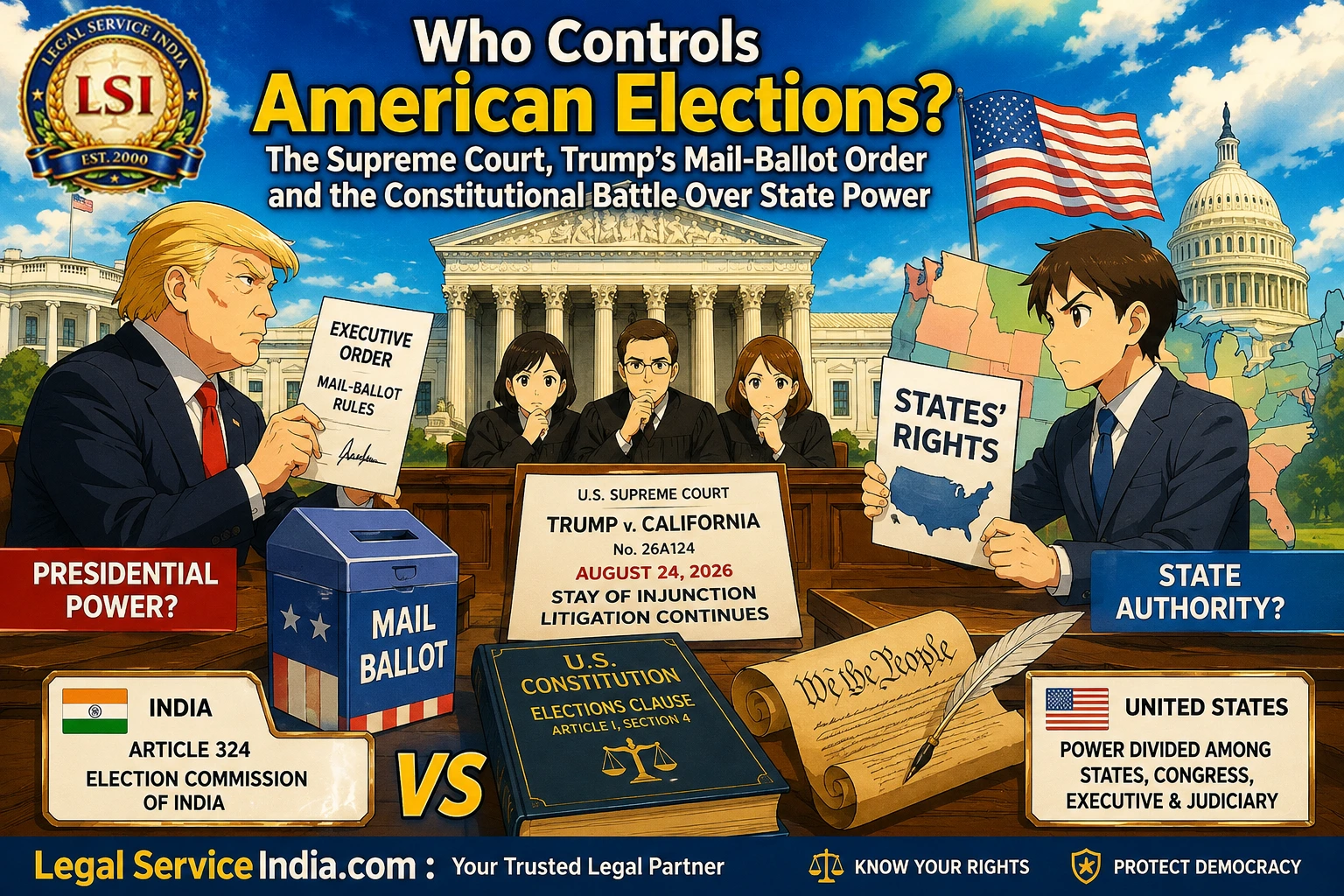
Who Controls American Elections? The U.S. Supreme Court, Trump’s Mail-Ballot Order, and the Constitutional Battle Over State Power
“An election is not truly free when those in power can control the rules of the game. Democracy begins with one simple truth: the voter must always be more powerful than the government.”
— Adv. Tarun Choudhury
Introduction: The Real Question Is Not About Mail Ballots
The most important question arising from the current American election litigation is not simply whether Americans should vote by mail.
The deeper constitutional question is
Who has the legal authority to decide how an American election is conducted—the president, Congress, or the individual states?
That question has suddenly acquired extraordinary importance ahead of the November 3, 2026, U.S. midterm elections.
On August 24, 2026, the United States Supreme Court intervened in Trump v. California, No. 26A124, and stayed a federal district court injunction that had blocked implementation of parts of President Donald Trump’s March 2026 Executive Order concerning election administration and mail-in ballots. The Supreme Court’s order was significant, but it is equally important not to misunderstand it.
The Supreme Court did not finally decide that President Trump possesses constitutional authority to control state election procedures.
The Court’s August 24 order principally concerned the stay of the lower-court injunction while the litigation proceeded. The Court did not finally adjudicate all of the underlying constitutional questions concerning presidential power over elections.
And the controversy did not end there.
A federal district court subsequently issued another temporary block concerning the Postal Service rules implementing the Trump administration’s election directive. The administration has now appealed that order, meaning that the constitutional battle remains very much alive as the midterm elections approach.
This makes the American controversy particularly interesting from an Indian constitutional perspective.
India has an express constitutional institution—the Election Commission of India (ECI)—to which Article 324 entrusts the “superintendence, direction, and control” of elections.
The United States has no constitutional equivalent of the Election Commission of India.
Instead, American election power is divided among the states, Congress, the federal executive, and the judiciary, under a constitutional structure that deliberately prevents one political actor from possessing comprehensive control over elections.
Also Read: Can America Reform the Supreme Court? Latest 5–4 Ruling Reignites Term Limits Debate
That difference provides a fascinating constitutional comparison:
| India | United States |
|---|---|
| The Indian constitution creates an Election Commission to administer elections. | The American constitutionally distributes election power so that no president simply becomes the supreme election administrator. |
1. The August 24, 2026 Supreme Court Order: What Actually Happened?
The case before the U.S. Supreme Court arose after several states challenged President Trump’s executive order relating to election integrity and mail voting.
The States argued that the President had exceeded his constitutional authority by attempting to impose nationwide requirements affecting the administration of federal elections.
A federal district judge, Judge Indira Talwani of the District of Massachusetts, had granted injunctive relief against portions of the administration’s plan.
The Trump administration then approached the Supreme Court seeking relief from that injunction.
On August 24, 2026, the Supreme Court granted the application in Trump v. California, staying the Massachusetts district court’s injunction pending further proceedings in the First Circuit and, potentially, the Supreme Court. The order was issued per curiam. Justices Sonia Sotomayor and Ketanji Brown Jackson dissented, with Justice Elena Kagan joining Justice Sotomayor’s dissent.
The official Supreme Court docket records the stay in these terms and makes clear that the litigation itself was not finally disposed of.
Why the Stay Matters
This distinction matters enormously.
A stay of an injunction is not the same thing as a final declaration that the challenged executive action is constitutional.
For a lawyer, this is the first point that must be made clear.
The Supreme Court did not simply announce:
“The President controls American elections.”
It did nothing of the sort.
Instead, the Court permitted the challenged governmental action to proceed while the procedural and substantive litigation continued.
That distinction is critical because the constitutional issue—how far presidential power extends into election administration—remains contested.
2. What Is Trump’s Executive Order Attempting to Do?
The controversy concerns an executive order issued by President Trump in March 2026 dealing with election administration and what the administration describes as election integrity.
Among other things, the order seeks federal involvement in the administration of mail-in voting, including requirements involving voter eligibility information, Postal Service procedures, and federal enforcement relating to ballots.
The administration argues that these measures are designed to prevent voting by persons who are allegedly ineligible and to increase election security.
Opponents respond that the President is attempting to accomplish through executive action what the Constitution does not permit him to accomplish unilaterally.
The legal battle therefore goes well beyond the question of whether mail voting is desirable.
It concerns the constitutional allocation of governmental power.
3. The American Constitution Does Not Give the President General Control Over Elections
This is where the American constitutional structure becomes particularly interesting.
The U.S. Constitution’s Elections Clause, Article I, Section 4, Clause 1, provides:
“The Times, Places, and Manner of holding Elections for Senators and Representatives shall be prescribed in each State by the Legislature thereof; but the Congress may at any time by Law make or alter such Regulations…”
The basic constitutional architecture is therefore straightforward.
- State legislatures have the initial authority.
- The States prescribe the times, places, and manner of congressional elections.
- Congress has overriding authority.
- Congress may “make or alter” those regulations.
The president is not given equivalent constitutional authority.
The Elections Clause does not place election administration under presidential control.
The Congressional Research Service describes the Elections Clause as giving states the initial and principal authority to administer congressional elections, while simultaneously giving Congress the power to override state regulations through federal legislation.
That is fundamentally different from a constitutional system in which the president possesses general supervisory control over elections.
4. But Does Congress Have Unlimited Power?
No.
Congress possesses substantial authority under the Elections Clause, but even congressional power operates within the constitutional framework.
The Supreme Court has long recognized that Congress can establish uniform rules for federal elections.
The important point is that the constitutional power belongs to Congress, not automatically to the President.
This creates the central problem for the Trump administration:
If Congress has not enacted a particular nationwide election rule, can the President create it by executive order?
That is the constitutional question at the heart of the controversy.
The answer cannot simply be derived from the president’s general responsibility to execute federal law.
The executive branch ordinarily needs a constitutional or statutory source of authority for the particular action it undertakes.
5. The President’s Article II Powers Are Not the Same as Election Administration Power
The president is the head of the federal executive branch under Article II.
The president is also responsible for faithfully executing federal law.
But the Constitution does not expressly vest the President with general authority to determine:
- how states conduct elections;
- how state election officials prepare ballots;
- What format state ballots must have;
- who receives state-issued mail ballots;
- how state election rolls must be maintained;
- or how state election procedures must be redesigned.
That absence of express presidential election-administration authority is central to the constitutional objection.
Justice Jackson’s dissent in Trump v. California emphasized precisely this point, arguing that the Constitution assigns the conduct of federal elections to the States under Article I, Section 4, and that the President has no express constitutional authority to require elections to be conducted according to presidential preferences.
The administration, of course, disputes the breadth of that proposition and relies upon federal statutory and executive authority.
The courts will ultimately have to determine where lawful federal administration ends and unconstitutional presidential control begins.
6. The Most Important Constitutional Question: Can the President Do Indirectly What He Cannot Do Directly?
This is perhaps the most interesting legal issue.
Suppose the president cannot simply issue an executive order saying:
“Every state must change its mail-voting law.”
Could the federal government nevertheless accomplish essentially the same result by directing the United States Postal Service to refuse to deliver ballots that fail federally prescribed requirements?
That is the constitutional tension.
The administration characterizes its actions as federal regulation of the Postal Service and election integrity.
The States characterize them as an indirect attempt to take control of election administration away from the States.
The distinction between these two characterizations may ultimately decide the case.
7. The Postal Service Has Become the Constitutional Battlefield
The United States Postal Service is a federal institution.
That fact provides the administration with a potentially powerful argument.
If the federal government controls the Postal Service, can it prescribe conditions for handling election mail?
But the counterargument is equally important.
A federal agency’s ordinary authority over postal operations cannot necessarily be transformed into unlimited authority over the substantive conduct of state elections.
Otherwise, the federal government could potentially use control over federal infrastructure to achieve what Congress itself has not legislated.
That is why the present litigation is so significant.
The question is not merely
Who controls the mail?
It is:
Can control over the federal mail system be used to control the manner in which states conduct elections?
8. The Lower Court’s New Injunction Has Kept the Constitutional Battle Alive
The litigation did not end with the Supreme Court’s August 24 order.
After the Supreme Court’s intervention, the administration moved forward with Postal Service rules connected to the executive order.
Judge Indira Talwani subsequently issued temporary relief blocking implementation of the new USPS rule. The rule was challenged by states and voting-rights organizations as an unconstitutional intrusion into state election administration and as a measure that could disrupt election preparations.
The federal court’s order has therefore created another legal obstacle for the administration.
As of September 1, 2026, the Trump administration has asked the First U.S. Circuit Court of Appeals to lift the temporary restraining order. Reuters reports that the administration argues the USPS rule falls within its statutory authority, while the states and voting-rights groups contend that it could unlawfully interfere with election administration and disenfranchise voters.
The litigation is consequently moving at extraordinary speed because election administrators cannot wait indefinitely for constitutional litigation to conclude.
9. Why Timing Matters So Much
Election law has a special characteristic.
A constitutional violation occurring after an election may be impossible to repair adequately.
Suppose a voter is prevented from receiving a ballot.
The government may later say:
“The legal issue can be decided after the election.”
But the voter may respond:
“My election opportunity has already disappeared.”
That is why election cases frequently involve emergency applications, stays, injunctions, and expedited appeals.
The Courts Must Balance Two Competing Risks
Risk No. 1: Premature Judicial Intervention
A court may block governmental action before the full factual record is developed.
Risk No. 2: Irreparable Electoral Harm
A court may wait until after the election, when the constitutional injury cannot realistically be undone.
The August 24 Supreme Court order reflects this procedural difficulty.
The Court allowed the challenged injunction to be stayed while the litigation continued, rather than finally resolving every constitutional question surrounding the executive order.
10. Who Controls American Elections?
The answer is
No single institution controls American elections.
The American Constitution distributes election authority.
| Institution | Principal Constitutional Role |
|---|---|
| State Legislatures | Initial authority over the times, places, and manner of congressional elections |
| Congress | Power to make or alter state regulations under the Elections Clause |
| President | Executes federal laws but has no general constitutional power to administer elections |
| Federal Agencies | Exercise authority delegated by Congress and applicable federal law |
| State & Local Election Officials | Administer elections under state law. |
| Federal Courts | Review constitutional and statutory legality. |
| Supreme Court | Final judicial authority on federal constitutional questions |
This division is intentional.
The United States was constructed around separation of powers and federalism.
Election administration therefore becomes a constitutional battlefield whenever one level of government attempts to occupy territory traditionally assigned to another.
11. Now Compare This With India: Article 324 Changes the Constitutional Picture
This is where the comparison with India becomes especially fascinating.
The Indian Constitution expressly provides an institutional answer to the question:
Who administers elections?
Article 324(1) provides that the superintendence, direction, and control of the preparation of electoral rolls and the conduct of elections to Parliament, State Legislatures, and the offices of President and Vice-President shall be vested in the Election Commission.
That is a remarkably powerful constitutional formulation.
The words are not merely “assist.”
They are:
- superintendence,
- direction and
- control.
The Constitution itself creates an Election Commission and gives it constitutional responsibility for the conduct of these elections.
12. Article 324 Makes the Indian Model Institution-Centric
The Indian constitutional model therefore differs fundamentally from the American model.
In India, election administration is constitutionally centralized in an independent constitutional authority.
In America, election administration is structurally decentralized.
| Country | Constitutional Election Administration Model |
|---|---|
| India’s model | Constitution → Election Commission → Election administration |
| America’s model | Constitution → States + Congress + federal law + executive enforcement + courts |
That difference explains why the American question—
“Who controls elections?”
—is structurally different from the Indian question.
In India, the first constitutional answer is
The Election Commission, subject to the Constitution and laws.
In America, the answer is
It depends upon which election, which aspect of election administration, and which constitutional or statutory power is being exercised.
13. But the Election Commission of India Is Not Above the Constitution
It would be wrong to conclude that Article 324 gives the Election Commission unlimited power.
The ECI must operate within:
- the Constitution;
- Parliamentary legislation;
- judicial review;
- principles of natural justice where applicable;
- and the statutory election framework.
The Supreme Court of India has nevertheless recognized that Article 324 confers broad powers on the Election Commission.
In Mohinder Singh Gill v. Chief Election Commissioner, (1978) 1 SCC 405, the Supreme Court explained the wide constitutional functions vested in the Commission under Article 324.
The Court recognized that the Commission possesses broad powers necessary to ensure free and fair elections where the law does not exhaustively provide for every contingency.
This is a major constitutional distinction from the American arrangement.
14. The Indian Election Commission Is Not the Equivalent of the American President
This point deserves emphasis.
The ECI is a constitutional election-management institution.
The American president is the head of the executive branch.
They occupy completely different constitutional positions.
The ECI is designed to administer elections impartially.
The president is an elected political actor who may be a candidate, party leader, or political beneficiary of an election.
Therefore, allowing the president to possess broad unilateral authority over election administration would create an obvious conflict-of-interest concern.
The American constitutional structure has historically addressed that danger through institutional fragmentation.
15. What Makes the Trump Litigation So Constitutionally Sensitive?
The controversy becomes especially sensitive because the president’s own political party and political future are inevitably connected with federal elections.
A fundamental democratic principle is therefore implicated:
The person or political institution seeking electoral advantage should not possess unchecked power to rewrite the rules under which the election is conducted.
This is not a partisan principle.
It applies equally regardless of whether the president is Republican or Democrat.
If President A can use executive power to alter election procedures in his favor, then President B may attempt the same thing later.
Constitutional law must therefore be concerned not merely with the intentions of the present office-holder but with the precedent created for future presidents.
16. Federalism Is the Hidden Constitutional Issue
The phrase “mail-in voting” can obscure the real constitutional issue.
The deeper issue is federalism.
The United States is not a unitary state.
Power is divided between:
- the federal government;
- the States;
- and local governmental institutions.
Election administration has historically involved substantial state responsibility.
The Elections Clause nevertheless gives Congress a powerful federal role.
Thus the American constitutional formula is not
“States exclusively control elections.”
Nor is it:
“The President controls elections.”
Rather:
States administer congressional elections subject to congressional authority, while the President’s role depends on powers granted by the Constitution and statutes.
The current Trump litigation tests the outer boundary of that arrangement.
17. The Supreme Court’s August 24 Order Should Not Be Misread as a Presidential Victory on the Merits
This is perhaps the most important legal caution for commentators.
Headlines can easily create the impression:
“Supreme Court approves Trump’s election order.”
That formulation can be misleading.
The Supreme Court’s August 24 order stayed the district court’s injunction pending further proceedings. The Court did not simply declare every challenged provision constitutional.
Indeed, the official docket expressly describes the relief as a stay pending disposition of the appeal and possible Supreme Court proceedings.
The Court’s decision, therefore, must be understood procedurally as well as constitutionally.
The merits remain important.
And subsequent proceedings have demonstrated precisely why.
18. The Dissents Reveal the Constitutional Stakes
The dissents from the August 24 order are especially significant for understanding the constitutional controversy.
Justice Jackson’s dissent argued that the Constitution assigns federal election conduct to the States and that the President has no express authority to impose presidential preferences concerning election procedures.
Justice Sotomayor, joined by Justice Kagan, also dissented.
These opinions do not constitute the law of the case in the same manner as the majority’s order, but they illuminate the competing constitutional interpretation.
The debate is essentially this:
| Position | Argument |
|---|---|
| Administration’s position | Federal agencies possess statutory authority to regulate federal election-related mail operations and protect election integrity. |
| States’ position | The executive order crosses the constitutional boundary between executing federal law and rewriting state election procedures. |
The judiciary must decide where that boundary lies.
19. The Indian Constitutional Question: Could an Indian President Do Something Similar?
This provides an interesting hypothetical.
Suppose the President of India issued an executive order directing the Election Commission to change the manner in which elections are conducted.
Could the president simply do so?
The answer would be fundamentally different from the American debate.
Article 324 constitutionally vests election superintendence, direction, and control in the Election Commission.
The President does have constitutional roles concerning appointments under Article 324, but that does not convert the President into the administrator of elections.
Indeed, Article 324 itself requires institutional separation between the appointing authority and the constitutional election authority.
The ECI may request governmental staff under Article 324(6), but the constitutional responsibility for election administration remains vested in the Commission.
20. An Important Indian Qualification: State Election Commissions
There is, however, an important constitutional qualification.
The Election Commission of India does not conduct every election in India.
Elections to:
- Municipalities; and
- Panchayats
are constitutionally assigned to State Election Commissions under Articles 243K and 243ZA.
Therefore, the Indian model is not absolute centralization.
It is better described as
Constitutionally structured independent election commissions operating at different levels.
This is another important distinction from America.
21. India and America: Two Different Constitutional Solutions to the Same Democratic Problem
Both constitutional systems confront the same fundamental danger:
How do you prevent the political government of the day from controlling the rules of the election that determines who will govern tomorrow?
But India and America have chosen different institutional solutions.
| Country | Constitutional Solution |
|---|---|
| India | India created a constitutional Election Commission with express supervisory authority over major elections. |
| America | America divided electoral authority among states, Congress, and federal institutions, with judicial review providing another constitutional check. |
Neither model is free from controversy.
But their constitutional architectures are fundamentally different.
22. Comparative Constitutional Table
| Issue | India | United States |
|---|---|---|
| Constitutional election authority | Election Commission under Article 324 | Primarily states, subject to Congress under the Elections Clause |
| Presidential control over election administration | No general presidential control | No general express presidential election-administration power |
| Legislative role | Parliament legislates election law. | Congress may make or alter federal election regulations. |
| State role | State legislatures operate within a constitutional/statutory framework. | Major role in administering elections |
| Independent election body | ECI: State Election Commissions for local bodies | No single constitutional equivalent of ECI |
| Judicial review | Supreme Court and High Courts | Federal courts and the Supreme Court |
| Election disputes | Constitutional/statutory election petition framework | Federal and state judicial proceedings depending on issue |
| Core constitutional principle | Independent constitutional election administration | Federalism + separation of powers |
23. The Deeper Principle: The Voter Must Be More Powerful Than the Government
Whether we examine India or America, the constitutional objective should ultimately be the same.
The government is temporary.
The electoral mandate belongs to the people.
Election machinery, therefore, should not become an instrument through which the incumbent government determines the conditions of its own continuation.
The constitutional system must ensure:
Government serves the election—not election serves the government.
That is why the present American litigation matters beyond Donald Trump.
It concerns a principle that will survive the Trump presidency.
24. What Could the Supreme Court Ultimately Have to Decide?
If the litigation reaches the Supreme Court on the merits, several questions could become critical.
Question 1: What Constitutional Provision Authorizes the President’s Action?
The government will have to identify the constitutional or statutory foundation for the challenged federal action.
Question 2: Does Existing Federal Law Authorize the USPS Requirements?
The administration may rely heavily on statutory authority concerning postal operations and federal elections.
Question 3: Does the Federal Action Regulate the Postal Service or Regulate Elections?
This characterization could become decisive.
Question 4: Can Federal Agencies Impose Election-Related Requirements Without Congress?
This raises the separation-of-powers issue.
Question 5: Does the Elections Clause Permit the Executive Branch to Exercise Congress’s “Make or Alter” Authority?
This is perhaps one of the most important structural questions.
Question 6: What Happens When Federal Election Policy Conflicts With State Election Procedures?
The answer may depend upon the source and scope of federal statutory authority.
Question 7: What Remedy Should Courts Provide?
Even if some provisions are unlawful, courts must determine whether to strike down specific provisions, issue narrower injunctions, or prevent implementation altogether.
25. Why the 2026 Midterm Elections Make This Case Extraordinary
Election litigation is always important.
But litigation immediately before an election is different.
The 2026 midterms will determine control of the U.S. House of Representatives and Senate.
Mail ballots constitute an important component of American voting.
Consequently, a last-minute change in mail-ballot requirements could affect:
- ballot design;
- voter registration information;
- ballot delivery;
- election administration;
- voter communication;
- election-official compliance;
- and the ability of voters to cast ballots successfully.
Reuters reports that the administration’s current appeal seeks to overturn the temporary block on the USPS rule, with the dispute unfolding just weeks before the November congressional elections.
This is why the courts are being asked to make constitutional decisions under intense time pressure.
26. Can the Supreme Court Become the Referee of an Election Without Becoming the Election Administrator?
This is another subtle constitutional question.
The judiciary does not conduct elections.
It interprets the Constitution and statutes.
But when election rules are challenged, judicial decisions inevitably affect the practical operation of elections.
The courts therefore must exercise particular discipline.
A court should not replace an election administrator merely because it prefers one policy over another.
Its constitutional role is narrower:
To determine whether the governmental actor possessing the power has acted within the law.
That distinction is fundamental to judicial review.
27. The American Battle Has a Lesson for India Too
The Indian constitutional system should not assume that Article 324 alone solves every problem.
An independent election commission is meaningful only if:
- Its institutional independence is protected;
- Election officials can act impartially;
- Government machinery remains neutral;
- Political parties respect electoral institutions;
- and courts remain available to enforce constitutional boundaries.
Article 324 gives the ECI formidable constitutional status.
But constitutional power must always be accompanied by constitutional accountability.
28. The American Case Also Demonstrates the Value of Institutional Friction
From an Indian constitutional perspective, the American system may sometimes appear unnecessarily complicated.
Why should election administration be divided among so many institutions?
The answer is that institutional friction can itself protect democracy.
- A president cannot simply command every state.
- A state cannot disregard valid federal law.
- Congress cannot exercise executive functions merely because it possesses legislative authority.
- The executive cannot automatically exercise Congress’s legislative power.
- And the courts can intervene when constitutional boundaries are crossed.
The result may be slow.
It may be frustrating.
It may produce litigation.
But constitutional democracy is not necessarily designed for administrative convenience.
It is designed to prevent the concentration of power.
29. Who Is Supreme in an Election?
This brings us to the larger philosophical question.
Is the president supreme?
No.
Is Congress supreme?
No.
Is the Election Commission supreme?
In India, the ECI has constitutional supremacy in its assigned sphere of election superintendence, direction, and control but remains subject to the Constitution, legislation, and judicial review.
Are the States supreme in America?
Not absolutely.
Congress possesses constitutional authority to make or alter regulations governing congressional elections.
So who is ultimately supreme?
The Constitution.
And beneath the Constitution lies the democratic principle that governmental authority ultimately derives from the people.
This is why election administration is not merely an administrative matter.
It is a constitutional matter.
30. My Legal Assessment
In my view, the most significant feature of the Trump mail-ballot litigation is not whether one agrees or disagrees with mail voting.
The constitutional issue is much broader.
If the president can unilaterally redesign important aspects of election administration without clear congressional authorization, the balance created by the Elections Clause could be materially altered.
On the other hand, if federal law clearly authorizes the Postal Service or another federal agency to regulate its own operations in a manner that incidentally affects elections, the courts must be careful not to convert every federal election-related regulation into unconstitutional presidential interference.
The dividing line must therefore be drawn by constitutional text, congressional authorization, statutory interpretation, federalism, and separation of powers—not by partisan preference.
The Supreme Court’s August 24 order did not finally answer that question.
The subsequent injunction and appeal demonstrate that the constitutional dispute remains active.
31. The Larger Democratic Lesson
There is a principle that lawyers should never forget:
The legitimacy of an election depends not merely on who wins, but on whether the rules of the contest were administered according to law.
The United States is now testing that principle in real time.
India has its own constitutional answer through Article 324 and the Election Commission.
America has a different answer through federalism, the Elections Clause, congressional power, state administration, and judicial review.
The institutional mechanisms differ.
The democratic objective is the same.
The voter must ultimately remain at the center.
Conclusion: The Election Belongs to the People, Not the Incumbent
The question “Who Controls American Elections?” cannot properly be answered with the name of a president, a political party, Congress, or even the Supreme Court.
The American constitutional answer is deliberately fragmented.
States administer. Congress may regulate and override within its constitutional sphere. The executive executes lawful federal authority. Courts interpret the Constitution.
No president is constitutionally entitled to become the sole administrator of American elections merely because he occupies the Oval Office.
That is why the Trump mail-ballot controversy is so important.
The August 24, 2026, Supreme Court order changed the immediate procedural position by staying a lower-court injunction, but it did not finally settle the underlying constitutional merits. The subsequent federal injunction concerning USPS implementation and the administration’s appeal demonstrate that the dispute remains alive immediately before the 2026 midterm elections.
For India, the comparison is equally instructive.
Our Constitution took a different route. Article 324 deliberately places the superintendence, direction, and control of major elections in a constitutional Election Commission.
America distributes election power.
India constitutionally institutionalizes election administration.
But both constitutional systems are ultimately wrestling with the same question:
How do we ensure that those who hold governmental power cannot acquire unchecked power over the electoral process through which the people decide whether they should continue to hold it?
That, in my considered view, is the real constitutional issue behind the Trump mail-ballot litigation.
And it is much bigger than Donald Trump, mail ballots, or the 2026 midterm elections.
It is a question about who controls democracy itself.
Key Legal Authorities
- Trump v. California, No. 26A124, U.S. Supreme Court, order of August 24, 2026—stay of the Massachusetts district court injunction pending appellate proceedings.
- U.S. Constitution, Article I, Section 4, Clause 1—Elections Clause—States prescribe the times, places, and manner of congressional elections, subject to Congress’s authority to make or alter regulations.
- U.S. Constitution, Article II—establishes the executive power and presidential responsibilities but does not expressly vest the President with general control over election administration.
- Constitution of India, Article 324—vests the superintendence, direction, and control of electoral rolls and specified elections in the Election Commission of India.
- Mohinder Singh Gill v. Chief Election Commissioner, (1978) 1 SCC 405—leading Indian authority on the breadth of powers under Article 324.
- Articles 243K and 243ZA, Constitution of India—constitutional basis for State Election Commissions for Panchayat and Municipal elections.
Need Expert Legal Guidance?
Adv. Tarun Choudhury
Supreme Court Advocate | 25+ Years of Legal Experience
For professional guidance on constitutional law, election law, Supreme Court matters, and complex legal disputes, consult an experienced Supreme Court advocate.
📞 Call: 9650499965
💬 WhatsApp: 8851978611
Get informed legal guidance from an experienced Supreme Court lawyer.
Frequently Asked Questions (FAQs)
1. Who Controls American Elections Under the U.S. Constitution?
American elections are not controlled by a single institution. State governments have significant authority over election administration, while Congress has power under the Elections Clause to make or alter regulations governing federal elections. The President does not have general constitutional authority to control state election procedures.
2. What Did the U.S. Supreme Court Decide About Trump’s Mail-Ballot Order?
In its August 24, 2026, order in Trump v. California, No. 26A124, the U.S. Supreme Court stayed a lower-court injunction affecting Trump’s mail-ballot executive order. Importantly, the order did not finally decide the underlying constitutional merits or establish that the President has unlimited authority over American elections.
3. Can the U.S. President Change State Mail-Ballot Rules by Executive Order?
The President’s authority to change state mail-ballot rules is constitutionally contested. The central issue is whether the president has sufficient constitutional or statutory authority to impose such requirements or whether doing so improperly intrudes upon powers assigned to states and Congress under the U.S. Constitution’s Elections Clause.
4. How Is the U.S. Election System Different From India’s Election Commission Under Article 324?
The United States has no direct constitutional equivalent of India’s Election Commission of India (ECI). In India, Article 324 vests the superintendence, direction, and control of specified elections in the Election Commission. In America, election powers are divided principally among state authorities, Congress, the federal executive, and the courts.
5. Why Is the Trump Mail-Ballot Case Important for the 2026 U.S. Midterm Elections?
The case is particularly significant because the litigation is occurring immediately before the 2026 U.S. midterm elections. Any last-minute changes to mail-ballot procedures could affect election officials and voters. The dispute therefore raises a fundamental constitutional question: can the federal executive alter election procedures without clear congressional authorization?
Key Takeaways: Who Controls American Elections?
- Who controls American elections? No single institution has complete control. Election powers are divided among state governments, Congress, the federal executive, and the courts.
- Trump’s mail-ballot order is a constitutional power dispute, not merely a debate about mail-in voting. The central issue is whether the president has legal authority to impose election-related requirements without sufficient congressional authorization.
- The U.S. Supreme Court’s August 24, 2026, order did not finally decide the merits. In Trump v. California, No. 26A124, the Court stayed a lower-court injunction while the litigation continued.
- The U.S. Constitution’s Elections Clause is central to the dispute. Article I, Section 4 gives states an initial role in prescribing the “times, places, and manner” of congressional elections while giving Congress power to make or alter those regulations.
- The President does not have an express general constitutional power to administer state elections. The scope of presidential authority therefore depends heavily on the Constitution and any applicable federal statutes.
- The U.S. Postal Service has become an important part of the legal battle. The dispute raises the question of whether federal authority over postal operations can be used to impose requirements that substantially affect state election administration.
- The litigation remains active ahead of the 2026 U.S. midterm elections. Subsequent lower-court proceedings concerning implementation of the mail-ballot policy demonstrate that the constitutional controversy has not been finally resolved.
- India follows a fundamentally different constitutional model. Under Article 324 of the Constitution of India, the Election Commission of India has the constitutional responsibility for the “superintendence, direction, and control” of specified elections.
- India has a constitutionally established Election Commission; America does not have a direct equivalent. The U.S. system instead relies on a division of electoral powers between states, Congress, and federal institutions, with courts resolving constitutional disputes.
- Article 324 does not make the Election Commission of India above the Constitution. The ECI exercises broad constitutional powers but remains subject to the Constitution, legislation, and judicial review.
- The deeper issue is separation of powers and federalism. The Trump litigation tests how far the federal executive can go before its actions become an intrusion into powers constitutionally assigned to states or Congress.
- The case has significance beyond Donald Trump. The legal precedent established in this litigation could affect the relationship between future U.S. presidents, Congress, states, and election administrators.
- The fundamental democratic principle is voter sovereignty. Election rules should not become a mechanism through which an incumbent government obtains unchecked control over the electoral process.
Summary
The Trump mail-ballot litigation raises a fundamental constitutional question: Who controls American elections? Unlike India, which gives the Election Commission constitutional responsibility under Article 324, the United States divides election authority between state governments, Congress, the federal executive, and the judiciary. The U.S. Supreme Court’s August 24, 2026, order in Trump v. California stayed a lower-court injunction but did not finally uphold the merits of Trump’s mail-ballot order. With further litigation continuing before the 2026 midterm elections, the case could become an important test of presidential power, federalism, the Elections Clause, separation of powers, and the constitutional protection of electoral democracy.
Top Lawyers in the United States – Search by City
| New York Lawyers | Los Angeles Lawyers | Chicago Lawyers |
| San Diego Lawyers | Boston Lawyers | Houston Lawyers |
| Sacramento Lawyers | Austin Lawyers | San Jose Lawyers |
| Philadelphia Lawyers | San Francisco Lawyers |