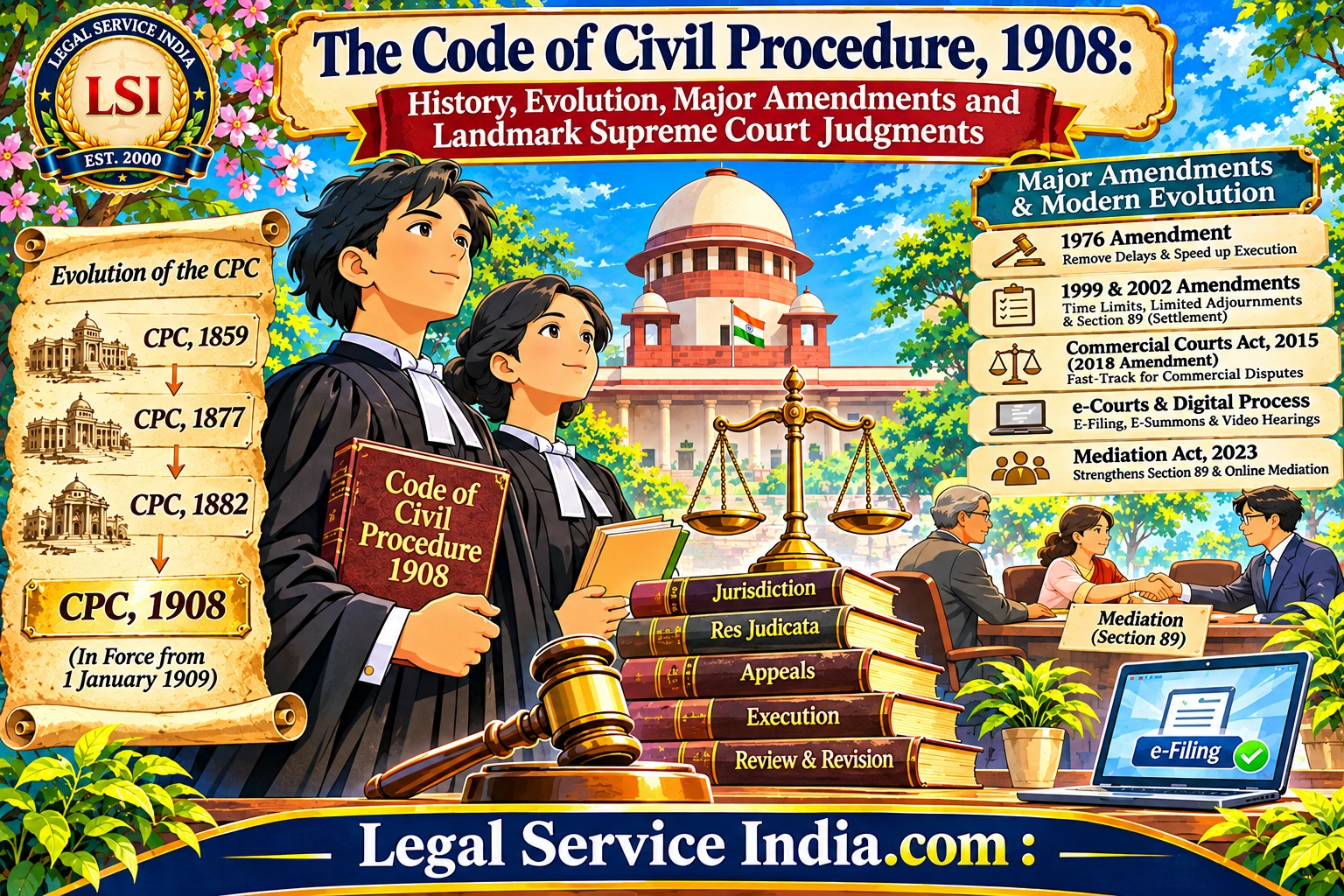
The Code of Civil Procedure, 1908 (CPC) is the main law that tells courts how to handle civil cases in India. It lays down the step-by-step process from filing a suit, deciding which court has power to hear it, and serving notices, to conducting the trial, giving judgment, and enforcing the final order. The CPC does not create new rights; it only provides the method to enforce existing rights in a fair, uniform, and reasonably quick manner.
Early Development of the Code of Civil Procedure Under British Rule
Before the British introduced a common system, different courts in India followed different and often conflicting procedures. To remove this confusion, the British government passed successive Codes:
| Code | Historical Development and Significance |
|---|---|
| Code of Civil Procedure, 1859 | This was the first attempt to create a uniform civil procedure for the whole of India. However, it did not apply to the Supreme Courts in Calcutta, Bombay, and Madras, or to the Small Cause Courts in those Presidency towns. It also did not apply to Non-Regulation Provinces initially, which explains why true uniformity wasn’t achieved until later. |
| Code of Civil Procedure, 1877 | This Code repealed the 1859 Code and introduced several improvements in structure and procedure. |
| Code of Civil Procedure, 1882 | This further revised the 1877 Code. Despite the changes, the 1882 Code remained rigid and caused practical difficulties in courts. These problems led to the enactment of the present Code in 1908. |
The Code of Civil Procedure, 1908
The present Code was enacted on 21 March 1908 as Act No. 5 of 1908 and came into force on 1 January 1909. It repealed the 1882 Code. Its main purpose was to consolidate and amend the law relating to the procedure of civil courts and to establish a single, uniform procedure for the whole of India. With necessary amendments from time to time, it continues to be the basic law governing civil courts.
Structure of the Code of Civil Procedure
The Code has two parts so that basic principles remain stable while detailed procedures can be adjusted as needed:
1. Substantive Part (Sections)
There are 158 sections that lay down the fundamental principles of civil procedure, such as jurisdiction, res judicata, place of suing, institution of suits, execution of decrees, appeals, reference, review, and revision. Since civil procedure falls under the Concurrent List, these sections can be amended only by Parliament or by State Legislatures (with the assent of the President).
2. Procedural Part (First Schedule – Orders and Rules)
There are 51 Orders containing detailed rules on how a suit is conducted—pleadings, service of summons, framing of issues, recording of evidence, judgments, injunctions, and execution. High Courts have the power to amend these rules to suit local conditions.
Major Amendments and Contemporary Evolution of the CPC
Over the years, several important amendments have been made to remove delays and modernise the procedure:
1. Code of Civil Procedure Amendment, 1976
Aimed at removing procedural bottlenecks, preventing misuse of court process, and speeding up the execution of decrees.
2. Amendments of 1999 and 2002
Made after the recommendations of the Malimath Committee. These amendments fixed time limits for filing written statements, restricted adjournments, required affidavits with pleadings, and encouraged settlement of disputes outside court under Section 89.
3. Commercial Courts Act, 2015 (and 2018 Amendment)
Created a special fast-track procedure for high-value commercial disputes. It introduced strict timelines, summary judgment under Order XIII-A, and mandatory mediation before filing a suit.
4. Recent Developments: Digital Courts and Mediation
Civil courts have increasingly adopted digital processes—such as e-filing, electronic service of summons, and video-conferencing for hearings—under the e-Courts Mission Mode Project. Additionally, the enactment of the Mediation Act, 2023 has strengthened Section 89 of the CPC by institutionalizing pre-litigation and online mediation and making mediated settlement agreements legally enforceable like court decrees.
Key Judicial Pronouncements on the Code of Civil Procedure
Courts have played an important role in interpreting the CPC so that procedure helps justice rather than becomes a technical hurdle:
1. Sangram Singh v. Election Tribunal, Kotah (1955)
The Supreme Court held that the rules of procedure are meant to advance justice and not to punish parties for minor technical mistakes. Procedure must follow the principles of natural justice and should not deprive a party of a fair hearing on the merits of the case.
2. Kailash v. Nanhku (2005)
The Court held that the 90-day time limit for filing a written statement in ordinary civil suits is not mandatory but directory. In exceptional cases beyond the defendant’s control, the court may accept a late written statement after imposing costs. (This is different from commercial suits under the Commercial Courts Act, where the 120-day limit has been held to be mandatory.)
3. Salem Advocate Bar Association, Tamil Nadu v. Union of India (2003 and 2005)
The Supreme Court upheld the 1999 and 2002 amendments and appointed a committee to frame practical rules for their implementation. The judgment supported the use of mediation under Section 89, recording of evidence by commissioners, stricter control on adjournments, and better case management.
Objectives of the Evolution of the Code of Civil Procedure
The continuous changes in the CPC have been guided by a few clear objectives:
- To create uniformity and simplicity so that the same basic procedure applies across the country.
- To ensure fairness by giving both parties a proper opportunity to be heard.
- To reduce delays through fixed timelines, limited adjournments, and effective case management.
- To prevent abuse of the court process by discouraging frivolous litigation and imposing costs where necessary.
- To ensure that the final decree can be effectively enforced.
- To modernise the system through technology and alternative dispute resolution so that justice becomes faster and more accessible.
Present Position of the Code of Civil Procedure in India
Today, the Code of Civil Procedure, 1908 remains the foundational procedural law governing civil courts across India. While it sets out the general framework for the institution, trial, disposal, and execution of civil suits, it operates in tandem with allied legislation such as the Limitation Act, 1963, the Commercial Courts Act, 2015, the Mediation Act, 2023, and various special statutes that prescribe their own specialized procedures.
Through legislative reforms and technological integration under the e-Courts framework, the CPC continues to adapt to contemporary demands—balancing strict timelines and alternative dispute resolution with the core principles of natural justice.
Conclusion: Evolution of Civil Procedure in India
The evolution of the Code of Civil Procedure reflects the steady maturation of India’s civil justice system—from the fragmented colonial codes of 1859, 1877, and 1882 to the consolidated Code of 1908, and onward into the digital era.
Ultimately, the CPC is far more than a collection of technical rules; it is the primary instrument through which substantive rights are realized. Guided by both legislative foresight and judicial interpretation, its ongoing evolution serves a single enduring purpose: to ensure that every litigant receives a fair, accessible, and timely remedy without procedural technicalities becoming an obstacle to justice.