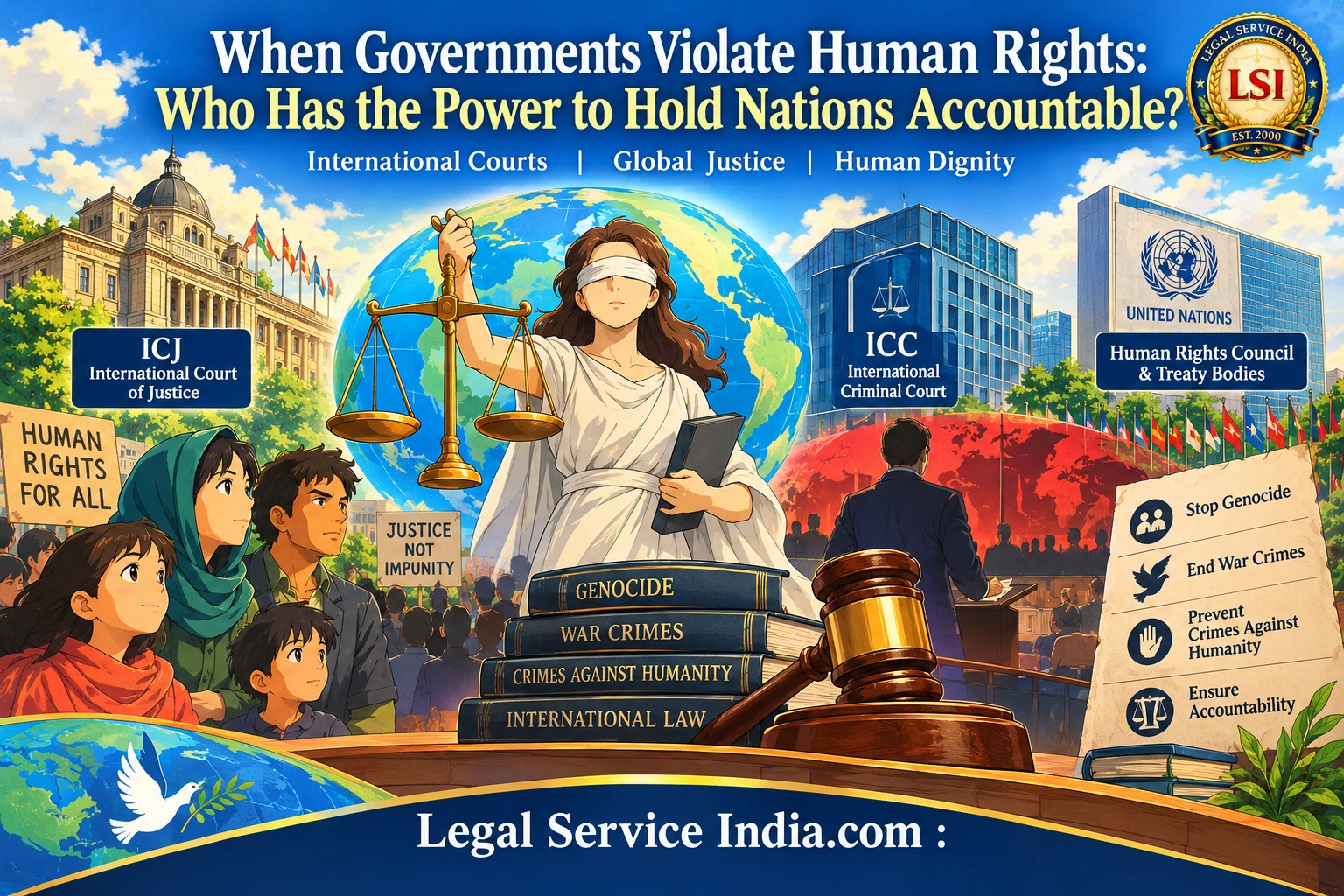
When Governments Violate Human Rights: Who Has the Power to Hold Nations Accountable?
Can International Courts Force Governments to Respect Human Rights?
Introduction: When the State Becomes the Violator
A government is expected to protect its citizens. It maintains law and order, safeguards constitutional rights and ensures that people can live with dignity and security. But what happens when the government itself becomes responsible for violating those rights?
What happens when peaceful protesters are imprisoned, journalists are silenced, minorities are persecuted, civilians are deliberately targeted or an entire community is forced to leave its homeland?
In such circumstances, approaching the very institutions responsible for the violations may be ineffective or even dangerous. Domestic courts may be unable to act independently, law-enforcement agencies may be acting under political instructions, and the government may refuse to acknowledge that any wrongdoing has occurred.
This raises a difficult question: Can international law do anything when a government violates the human rights of its own people?
The answer is yes, but with an important qualification. International law provides courts, treaties, investigative bodies and accountability mechanisms through which States and individuals may be held responsible. However, these institutions do not possess the same enforcement powers as a national government.
An international court may declare that a State has violated international law. It may order the State to stop the violation, provide reparation or comply with its treaty obligations. A criminal court may issue an arrest warrant against an individual accused of genocide, war crimes or crimes against humanity.
But making a judgment is one thing. Ensuring that a powerful government obeys it is another.
That distinction lies at the heart of international human rights accountability.
1. Human Rights Are Not Merely Political Promises
The modern international human rights framework developed substantially after the Second World War. The atrocities committed during that period demonstrated that the treatment of individuals could no longer be regarded as a matter exclusively within the domestic jurisdiction of a State.
The adoption of the United Nations Charter in 1945 established the promotion of human rights as one of the purposes of the international organisation.
Three years later, on 10 December 1948, the United Nations General Assembly adopted the Universal Declaration of Human Rights (UDHR).
The Declaration recognised fundamental rights including:
- The right to life, liberty and security of person.
- Freedom from torture and cruel, inhuman or degrading treatment.
- Freedom from slavery.
- Equality before the law.
- Freedom of thought, conscience and religion.
- Freedom of expression.
- The right to a fair hearing.
- The right to education and an adequate standard of living.
The UDHR is not itself a treaty imposing the same binding obligations as a ratified convention. Nevertheless, it became the foundation of modern international human rights law and influenced numerous national constitutions and international treaties.
Two important treaties subsequently gave binding legal form to many of these rights:
The International Covenant on Civil and Political Rights (ICCPR) protects rights such as life, liberty, fair trial, freedom of expression and freedom from torture.
The International Covenant on Economic, Social and Cultural Rights (ICESCR) addresses rights relating to education, health, work, social security and an adequate standard of living.
States that become parties to these treaties undertake international legal obligations. Their governments cannot simply dismiss those obligations as political recommendations.
However, the existence of an international obligation does not automatically mean that an international court can hear every complaint against the State. Jurisdiction depends on the relevant treaty, the State’s consent and the applicable procedural requirements.
2. The International Court of Justice: Can a Country Be Held Responsible?
The International Court of Justice (ICJ), based in The Hague, is the principal judicial organ of the United Nations.
It decides legal disputes between States. Unlike a domestic constitutional court, it does not ordinarily hear individual citizens’ complaints against their governments.
This distinction is important.
Suppose one country accuses another of violating an international treaty by committing genocide, mistreating a minority population or failing to protect a vulnerable community. If the ICJ has jurisdiction, it may examine the dispute and determine whether the respondent State has breached its international obligations.
The Court’s jurisdiction, however, is not unlimited. It generally depends on the consent of the States concerned, whether through a special agreement, a treaty clause or another recognised basis of jurisdiction.
The Gambia v. Myanmar: A Significant Example
The proceedings brought by The Gambia against Myanmar are particularly important in understanding how international human rights obligations can be enforced at the State level.
The Gambia instituted proceedings before the ICJ in November 2019, alleging violations of the Genocide Convention in relation to the treatment of the Rohingya population in Myanmar.
The case demonstrated that a State need not necessarily be the direct victim of an alleged treaty violation to bring proceedings where the treaty obligations are owed to all parties collectively.
On 23 January 2020, the ICJ indicated provisional measures requiring Myanmar to take steps to prevent acts prohibited by the Genocide Convention, preserve evidence and report to the Court on its compliance.
On 22 July 2022, the Court rejected Myanmar’s preliminary objections and held that it had jurisdiction to entertain the case and that The Gambia’s application was admissible.
These decisions were legally significant because they demonstrated that allegations of genocide could be examined by an international court even where the applicant State was not itself the direct victim of the alleged conduct.
The proceedings also illustrate an important principle: obligations under the Genocide Convention are not simply bilateral promises between individual States. They concern the international community as a whole.
The precise procedural status of the case should always be checked against the ICJ’s official case record before publication. A reported development or an AI-generated summary should not be treated as a final judicial finding unless supported by the actual judgment or an official Court announcement.
The larger lesson is that international law can impose responsibility on a State, but the Court’s ability to enforce its decisions remains dependent on the international legal and political system.
3. The ICJ and the International Criminal Court Are Not the Same
One of the most common misunderstandings in discussions about international justice is the failure to distinguish between the International Court of Justice and the International Criminal Court.
Both are based in The Hague, but their functions are fundamentally different.
| International Court of Justice (ICJ) | International Criminal Court (ICC) |
|---|---|
| Deals primarily with disputes between States. | Prosecutes individuals accused of specified international crimes. |
| Determines whether a State has violated international law. | Determines individual criminal responsibility. |
| May order cessation of wrongful conduct and reparation. | May impose criminal punishment, including imprisonment. |
| Its jurisdiction generally depends on State consent or an applicable treaty basis. | Exercises jurisdiction under the Rome Statute and other recognised jurisdictional bases. |
| Does not conduct criminal trials of political leaders. | Can prosecute individuals, including political and military leaders, subject to its jurisdiction and applicable immunities. |
Consider a situation in which a government is accused of committing genocide.
The ICJ may determine whether the State has violated the Genocide Convention. The ICC, where it has jurisdiction, may prosecute individuals alleged to have planned, ordered or participated in the crime.
The two forms of accountability can operate alongside each other.
A State may be internationally responsible for failing to prevent genocide, while particular political or military leaders may face individual criminal responsibility for their own conduct.
The responsibility of a State and the criminal responsibility of an individual are separate legal questions. One does not automatically establish the other.
4. Can International Courts Prosecute Presidents and Prime Ministers?
A difficult question arises when the person accused of serious international crimes is not an ordinary official but a sitting President, Prime Minister or head of government.
Can such a person be prosecuted?
The Rome Statute, which established the ICC, provides an important answer.
Article 27 states that official capacity, including the position of Head of State or Government, does not exempt a person from criminal responsibility under the Statute. It also provides that immunities or special procedural rules attached to official capacity do not bar the Court from exercising its jurisdiction.
This reflects a fundamental principle of international criminal law: holding the highest political office does not, by itself, place an individual beyond the reach of criminal responsibility.
However, the legal position is more complicated than simply stating that all immunity disappears.
The Arrest Warrant Judgment: Democratic Accountability and Legal Immunity
In Arrest Warrant of 11 April 2000 (Democratic Republic of the Congo v. Belgium), the ICJ examined the immunity of a serving foreign minister before the national courts of another State.
In its 2002 judgment, the Court held that certain high-ranking State officials enjoy immunity from foreign criminal jurisdiction while in office. This immunity protects the functioning of the State and is procedural in nature; it does not mean that the individual can never be held criminally responsible.
The Court also identified circumstances in which criminal proceedings may be possible, including before certain international criminal courts where they have jurisdiction.
It is important not to confuse this judgment with the ICC’s jurisdiction under the Rome Statute. The ICJ was addressing immunity before the national courts of another State, not deciding the full scope of the ICC’s authority.
Articles 27 and 98 of the Rome Statute also require careful reading. Article 27 addresses official capacity and immunity before the Court. Article 98 concerns certain cooperation requests involving immunities and the consent of third States.
The relationship between these provisions has generated significant legal debate, particularly in cases involving officials of States that are not parties to the Rome Statute.
The principle is clear, but its practical application can be legally and politically contested.
5. The International Criminal Court: Individual Responsibility for International Crimes
The International Criminal Court was established under the Rome Statute, which entered into force on 1 July 2002.
Unlike the ICJ, the ICC prosecutes individuals rather than States.
Its jurisdiction covers four principal categories of crimes:
- Genocide.
- Crimes against humanity.
- War crimes.
- The crime of aggression.
The Court is not intended to replace national criminal justice systems. Its jurisdiction is complementary to national jurisdictions.
This means that national authorities ordinarily have the primary responsibility to investigate and prosecute. The ICC may intervene where the relevant State is unwilling or genuinely unable to carry out the proceedings, subject to the requirements of the Rome Statute.
This principle is known as complementarity.
Why an ICC Arrest Warrant Does Not Automatically Lead to Arrest
An arrest warrant is not the same as an arrest.
The ICC does not have its own international police force capable of entering a country and taking a suspect into custody. It depends substantially on States to execute arrest warrants and surrender individuals.
If the person is located in a country that refuses to cooperate, the Court may face serious practical difficulties.
The situation becomes even more complicated when the person accused of crimes is the head of a powerful State.
The cases involving Vladimir Putin and Benjamin Netanyahu demonstrate the international attention surrounding ICC arrest warrants. The legal implications and cooperation obligations differ according to the relevant jurisdictional basis, the status of the State concerned and the applicable rules on immunity.
The case of former Philippine President Rodrigo Duterte also illustrates how international criminal proceedings may proceed even when the accused is no longer in office.
The broader point is that international criminal law recognises individual responsibility, but the actual arrest and surrender of an accused person often depend on political cooperation.
6. Universal Jurisdiction: Can a National Court Prosecute Crimes Committed Abroad?
International justice does not depend exclusively on international courts.
Under the principle of universal jurisdiction, certain particularly serious international crimes may be prosecuted by national courts even when the crime was committed outside the prosecuting State’s territory and neither the accused nor the victim is necessarily a national of that State.
The precise scope of universal jurisdiction depends on the crime, the applicable treaty obligations and the national legislation of the prosecuting country.
The principle is especially relevant to genocide, war crimes, torture and certain other grave international crimes.
For example, a national court may, where its domestic law permits, investigate allegations of torture committed abroad.
Universal jurisdiction is important because it reduces the possibility that individuals accused of grave crimes can escape accountability simply by leaving the country where the alleged offences occurred.
However, it is not an unlimited power. National courts must respect applicable rules of immunity, jurisdiction, evidence and criminal procedure.
Universal jurisdiction is therefore an additional route to accountability, not a substitute for a properly functioning international criminal justice system.
7. Erga Omnes Obligations: When a Violation Concerns the Whole International Community
Some international obligations are not merely obligations owed by one State to another.
They are obligations owed to the international community as a whole. These are commonly described as erga omnes obligations.
The ICJ discussed this concept in its 1970 judgment in Barcelona Traction, Light and Power Company, Limited (Belgium v. Spain).
The Court distinguished between obligations owed to individual States and obligations owed to the international community as a whole.
The prohibition of genocide, slavery and racial discrimination are commonly recognised as examples of obligations of this character.
The practical significance is considerable.
Where an obligation is owed to the international community as a whole, States other than the directly injured State may have a legal interest in its observance.
This does not mean that every State can automatically file a case before the ICJ. The Court must still possess jurisdiction under the applicable legal framework.
Nevertheless, the principle challenges the argument that serious human rights violations are always an exclusively domestic matter.
8. Jus Cogens: Are There Rules That No Government Can Legally Override?
International law recognises certain fundamental rules from which no derogation is permitted.
These are known as jus cogens norms, or peremptory norms of general international law.
Article 53 of the Vienna Convention on the Law of Treaties provides that a treaty is void if, at the time of its conclusion, it conflicts with a peremptory norm of general international law.
The prohibition of genocide, slavery and torture are widely recognised as examples of peremptory norms.
The importance of this principle is that a government cannot justify certain conduct merely by relying on domestic legislation, political convenience or an agreement with another State.
A national law cannot make genocide lawful under international law.
However, the existence of a jus cogens prohibition does not automatically create an international court with jurisdiction over every alleged violation. Questions of jurisdiction, immunity, evidence and enforcement must still be addressed.
The distinction between the existence of a legal prohibition and the availability of a judicial remedy is essential.
9. The Security Council: The Political Weakness of International Enforcement
If international courts can issue judgments and international treaties impose legal obligations, why do serious violations continue?
One major reason is the political structure of the United Nations Security Council.
Under Article 24 of the UN Charter, the Security Council has primary responsibility for the maintenance of international peace and security.
Under Article 25, UN Member States agree to accept and carry out the decisions of the Security Council in accordance with the Charter.
The Council may impose sanctions, establish investigative mechanisms and authorise other measures under Chapter VII.
However, the five permanent members — China, France, Russia, the United Kingdom and the United States — possess veto power on substantive matters.
This creates a serious structural difficulty.
Where a permanent member or its close ally is involved in a conflict, political considerations may prevent the Security Council from adopting meaningful action.
The result is a troubling imbalance: international law may clearly prohibit a particular act, yet the political institution most capable of authorising collective enforcement may be unable or unwilling to act.
This is not necessarily a failure of the law itself. It is often a failure of the political machinery through which the law is expected to operate.
10. The Responsibility to Protect: Does the International Community Have a Duty to Act?
The Responsibility to Protect, commonly known as R2P, emerged from international discussions on preventing mass atrocities.
It was endorsed by UN Member States at the 2005 World Summit.
The principle rests on three broad ideas:
- Every State has the primary responsibility to protect its population from genocide, war crimes, ethnic cleansing and crimes against humanity.
- The international community should assist States in meeting that responsibility.
- Where national authorities are manifestly failing to protect their populations, the international community should be prepared to take collective action through the United Nations, in accordance with the UN Charter.
R2P is important because it rejects the idea that sovereignty should be used as an unrestricted shield for mass atrocities.
However, it does not create an automatic legal licence for military intervention. Any coercive collective action must comply with the UN Charter, including the applicable Security Council framework.
R2P is therefore a framework for prevention, assistance and collective response, not a simple mechanism for bypassing State sovereignty.
11. A New International Convention on Crimes Against Humanity
One important development in international law is the ongoing effort to establish a comprehensive treaty on the prevention and punishment of crimes against humanity.
Unlike genocide and war crimes, crimes against humanity do not yet have a standalone global convention comparable to the Genocide Convention.
The International Law Commission prepared draft articles on the prevention and punishment of crimes against humanity in 2019.
On 4 December 2024, the UN General Assembly adopted Resolution 79/122, deciding to convene a diplomatic conference to negotiate a legally binding instrument.
The United Nations has scheduled the conference to meet for three consecutive weeks in early 2028 and three consecutive weeks in 2029, unless otherwise agreed by the Preparatory Committee.
The Preparatory Committee held its first session from 19 to 30 January 2026. Its second session is scheduled for 12 to 15 April 2027.
The proposed convention is significant because it aims to strengthen international cooperation in preventing, investigating and punishing crimes against humanity.
It may also help address gaps in domestic criminal laws and improve cooperation between States.
However, it is important to understand that the convention is still under negotiation. It should not be described as an adopted treaty already in force.
The real test will be whether States agree on effective obligations and whether they are prepared to implement them in practice.
12. Can Indian Courts Protect Human Rights Through International Law?
India has a significant constitutional framework for the protection of human rights.
Articles 14 and 21 of the Constitution guarantee equality before the law and protection of life and personal liberty. Article 19 protects specified freedoms, subject to constitutional restrictions.
Article 32 empowers individuals to approach the Supreme Court for enforcement of fundamental rights, while Article 226 gives High Courts broad writ jurisdiction.
Article 51(c) directs the State to foster respect for international law and treaty obligations. Article 253 empowers Parliament to make laws for implementing international treaties and international decisions.
Indian courts have also recognised the relevance of international human rights principles.
Vishaka v. State of Rajasthan
In Vishaka v. State of Rajasthan, (1997) 6 SCC 241, the Supreme Court considered the absence of an adequate domestic legal framework addressing sexual harassment at the workplace.
The Court relied on international standards, including the Convention on the Elimination of All Forms of Discrimination against Women (CEDAW), while developing guidelines to protect women’s constitutional rights.
The Court explained that international conventions consistent with fundamental rights and not inconsistent with existing domestic law could be read into those rights to fill a legislative gap.
The judgment became a landmark in Indian constitutional law and demonstrated how international human rights principles can influence domestic legal protection.
However, India follows a constitutional framework in which international treaties do not automatically become enforceable domestic law merely because the country has signed or ratified them. Legislative implementation may be necessary, depending on the nature of the treaty obligation.
India is not a party to the Rome Statute. Consequently, it is not bound by the ICC’s treaty-based cooperation obligations simply by virtue of that Statute.
Nevertheless, India’s constitutional commitments, domestic legislation and applicable customary international law remain relevant to its international legal responsibilities.
13. Why International Justice Still Struggles
Despite the development of international courts, treaties and accountability mechanisms, serious violations continue.
There are several reasons.
First, international courts have limited enforcement machinery. They generally depend on States to cooperate, provide evidence, arrest suspects and implement judgments.
Second, political power influences enforcement. Powerful States may resist international scrutiny, while political alliances can weaken collective action.
Third, jurisdiction is not universal. Not every State has accepted the jurisdiction of every international court or treaty mechanism.
Fourth, evidence is difficult to obtain. In conflict situations, witnesses may be threatened, records destroyed and investigators denied access.
Fifth, accountability is often delayed. International proceedings can take years, sometimes decades, before reaching a final outcome.
Finally, international justice may be selective in practice. The law may apply equally in principle, but the willingness and ability to enforce it can vary considerably depending on political circumstances.
These difficulties should not be mistaken for proof that international law has no value. International judgments can establish facts, clarify legal obligations, preserve evidence, influence national proceedings and create diplomatic pressure.
They can also provide recognition and a measure of justice to victims who might otherwise have no effective remedy.
14. What Needs to Change?
If international human rights accountability is to become more effective, the international community must address the gap between legal recognition and practical enforcement.
Several reforms deserve serious consideration.
1. Strengthening Compliance with International Judgments
States should face greater institutional and diplomatic pressure to comply with binding international judgments. Reporting obligations and transparent monitoring can help identify non-compliance.
2. Improving International Criminal Cooperation
States should strengthen arrangements for evidence-sharing, witness protection, extradition and surrender of accused persons, consistent with their legal obligations.
3. Addressing the Security Council Veto
The use of the veto in situations involving mass atrocities deserves greater scrutiny. Proposals for voluntary restraint in such circumstances should receive serious consideration.
4. Strengthening Universal Jurisdiction
States should examine whether their domestic criminal laws provide effective jurisdiction over serious international crimes, while maintaining safeguards against politically motivated prosecutions.
5. Protecting Human Rights Defenders and Witnesses
Victims, journalists, lawyers, investigators and human rights defenders must be protected from intimidation and retaliation.
6. Building Effective Domestic Institutions
International justice cannot replace independent national courts, professional investigative agencies and constitutional protections. Strong domestic institutions remain the first line of defence against human rights abuses.
Conclusion: International Law Can Hold Governments Accountable, But Can It Make Them Obey?
The international legal system has come a long way since the end of the Second World War.
Today, governments are subject to international human rights obligations. States may be held responsible before the International Court of Justice. Individuals may be prosecuted before the International Criminal Court where jurisdiction exists. National courts may exercise universal jurisdiction over certain serious crimes. International institutions can investigate violations, preserve evidence and exert pressure on governments.
Yet the central problem remains unresolved.
An international court may declare that a government has violated international law, but it cannot always compel that government to change its conduct. An arrest warrant may be legally valid, but the accused may remain beyond the reach of the Court. A treaty may prohibit torture or genocide, but the people responsible may never face prosecution.
This is the uncomfortable reality of international human rights enforcement.
The weakness is not that international law has failed to recognise human dignity or establish legal obligations. The weakness lies in the gap between those obligations and the political will required to enforce them.
Sovereignty cannot be a permanent shield for governments that commit atrocities. Nor should political influence determine whether victims receive justice.
The true measure of international law will not be the number of treaties signed or judgments delivered. It will be whether those instruments can protect people when their own governments refuse to do so.
Ultimately, the question is not simply whether international courts have the power to hold governments accountable.
The more important question is whether the international community has the courage and political will to ensure that the law applies equally to the powerful and the powerless.
Important Legal Authorities and References
- Charter of the United Nations, 1945 — particularly Articles 1, 2, 24 and 25.
- Universal Declaration of Human Rights, 1948.
- International Covenant on Civil and Political Rights, 1966.
- International Covenant on Economic, Social and Cultural Rights, 1966.
- Convention on the Prevention and Punishment of the Crime of Genocide, 1948.
- Rome Statute of the International Criminal Court, 1998 — particularly Articles 5, 12, 17, 27, 86, 89 and 98.
- Vienna Convention on the Law of Treaties, 1969 — particularly Article 53.
- ICJ, Barcelona Traction, Light and Power Company, Limited (Belgium v. Spain), Judgment, 1970.
- ICJ, Arrest Warrant of 11 April 2000 (Democratic Republic of the Congo v. Belgium), Judgment, 2002.
- ICJ, Application of the Convention on the Prevention and Punishment of the Crime of Genocide (The Gambia v. Myanmar), Provisional Measures Order, 23 January 2020.
- ICJ, The Gambia v. Myanmar, Preliminary Objections Judgment, 22 July 2022.
- ICJ, Application of the Genocide Convention in the Gaza Strip (South Africa v. Israel), proceedings and provisional measures orders, 2024.
- ICTY, Prosecutor v. Tadić, Decision on the Defence Motion for Interlocutory Appeal on Jurisdiction, 1995.
- Supreme Court of India, Vishaka v. State of Rajasthan, (1997) 6 SCC 241.
- UN General Assembly Resolution 79/122, 4 December 2024 — United Nations Conference of Plenipotentiaries on Prevention and Punishment of Crimes against Humanity.
Further Reading
- United Nations Charter and international human rights instruments.
- International Court of Justice — official case records and judgments.
- International Criminal Court — Rome Statute and official case information.
- United Nations International Law Commission — draft articles on prevention and punishment of crimes against humanity.
- United Nations General Assembly Resolution 79/122 and the official preparatory documents for the proposed Crimes Against Humanity Convention.
Editorial Note: The reported claim that the ICJ delivered a final merits judgment in The Gambia v. Myanmar on 19 November 2026 has not been independently verified against an official judgment or Court announcement in the research available for this article. It has therefore not been presented as an established legal development. The official ICJ case record should be checked again immediately before publication.