





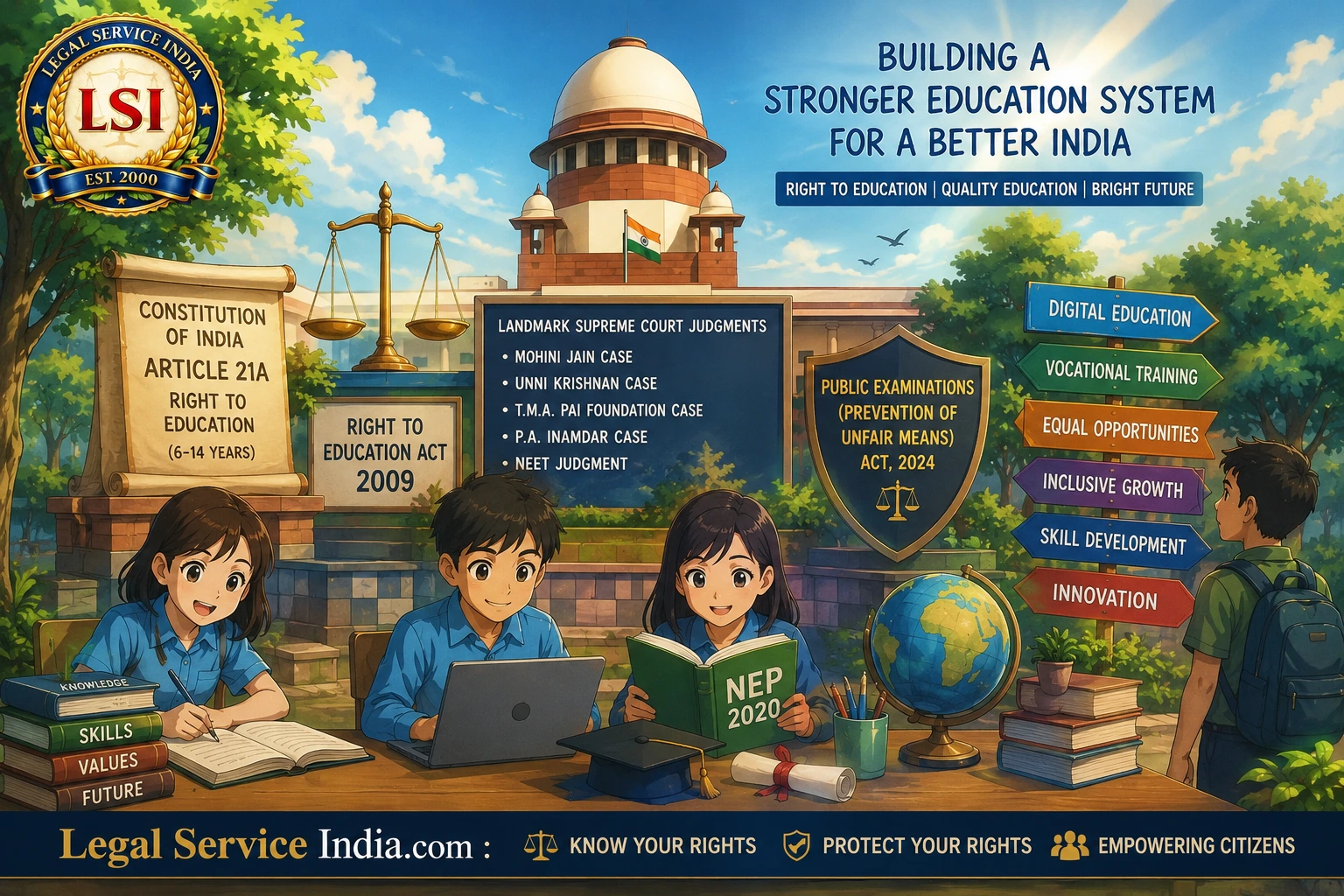
Importance of Education
Education is one of the most powerful tools in shaping the future of an individual as well as society. It helps us gain knowledge, develop skills, and build confidence to face the challenges of life.
Education not only teaches us how to read and write but also helps us to differentiate between right and wrong, making us responsible citizens. It plays a vital role in personal growth, career development, and achieving success.
A well-educated person contributes positively to the progress of family, community, and the nation. In today’s modern world, education is the key to innovation and development, as it opens the doors of opportunities and helps in building a better society.
Education System in India: An Overview
The education system in India has evolved since ancient times. It includes primary, secondary, and higher education.
- Schools follow CBSE, ICSE, and State Board curricula.
- The government provides free and compulsory education up to Class 8th.
- This is implemented under the “Right to Education Act, 2009”.
- Higher education is available through colleges and universities.
- Digital education is expanding rapidly.
- Vocational and technical courses are gaining importance.
- The New Education Policy 2020 introduced several reforms.
- Quality education brings positive change.
Key Features of the Indian Education System
| Aspect | Details |
|---|---|
| School Education | Primary, Secondary, and Higher Secondary |
| Curriculum | CBSE, ICSE, and State Boards |
| Free Education | Up to Class 8th under the Right to Education Act, 2009 |
| Higher Education | Colleges and Universities |
| Emerging Trends | Digital, Vocational, and Technical Education |
| Recent Reform | New Education Policy 2020 |
Hence, education is not just a right but a necessity for everyone to live a dignified and meaningful life.
Introduction
“Education is the key which happens to be the rich treasure hidden in the man and material of the country.” “An education system is the type of structural form through which a country provides education to its people.”
India’s education system is not entirely declining, but while some areas have improved, new challenges have also emerged.
Initially, education was a State List subject under the Constitution of India. In 1976, through the 42nd Constitutional Amendment, education was transferred to the Concurrent List. Since then, the responsibility for providing and regulating education has been shared by both the Central Government and the State Governments.
In today’s generation, education means developing the knowledge, skills, values, and practical abilities needed to succeed in life, not just earning degrees or scoring marks.
Today, there have been several positive changes in education, such as the growth of digital learning, online courses, skill-based programmes, and the increased use of technology. However, in many places, several challenges still remain:
Current Challenges in Education
- Greater emphasis is placed on marks and examinations.
- rote learning (memorisation) is still common.
- Critical thinking and practical skills receive less attention.
- Not all students have access to quality education and equal opportunities.
Therefore, it is fair to say that the education system is gradually evolving, but in many places its primary focus remains on marks and examinations rather than on knowledge and real-life skills.
Is the Present Education System Achieving Its Goals?
“In our country is this really happening in today’s education system?”
Why Do Children Lose Interest in Studies?
Children in today’s generation often lose interest in studying.
Many children today find it difficult to stay interested in studies because of factors such as excessive screen time, social media distractions, academic pressure, lack of practical and engaging teaching methods, mental stress, and an education system that often emphasises marks over understanding and real-life skills.
Advantages and Disadvantages of Today’s Education Environment
| Advantages | Disadvantages |
|---|---|
| Easy access to information | Social media distractions |
| Flexible online learning | Reduced focus on studies |
| Development of digital skills | Overdependence on technology |
| Greater career choices | Academic pressure |
| Technology-enabled education | Mental stress |
| Access to skill-based programmes | Excessive emphasis on marks rather than practical knowledge and critical thinking |
Today’s education environment has both advantages and disadvantages. It provides easy access to information, flexible online learning, opportunities to develop digital skills, and greater career choices. However, it also brings challenges such as social media distractions, reduced focus on studies, overdependence on technology, academic pressure, mental stress, and an excessive emphasis on marks rather than practical knowledge and critical thinking.
Role of the Constitution of India in Education
The Constitution of India provides the legal and policy framework for education. It guarantees the right to education, ensures equality and non-discrimination, protects minority and linguistic rights, promotes educational opportunities for weaker sections, and guides both the Central and State Governments in making education laws and policies.
Fundamental Rights Related to Education
| Article | Constitutional Provision | Role in Education |
|---|---|---|
| Article 15 | Prohibits discrimination on the grounds of religion, race, caste, sex, or place of birth. It also allows the State to make special provisions for women, children, and socially and educationally backward classes, SCs, and STs in education. | Promotes equality and affirmative action in education. |
| Article 21A | Guarantees free and compulsory education to all children aged 6–14 years. Inserted by the 86th Constitutional Amendment Act, 2002. Implemented through the Right of Children to Free and Compulsory Education (RTE) Act, 2009. | Recognises education as a fundamental right. |
| Article 28 | Regulates religious instruction in educational institutions. No religious instruction can be provided in educational institutions wholly funded by the State. | Ensures secular education in state-funded institutions. |
| Article 29(1) | Protects the right of citizens to conserve their language, script, and culture. | Safeguards cultural and linguistic identity. |
| Article 29(2) | No citizen can be denied admission to a state-maintained or state-aided educational institution on the grounds of religion, race, caste, language, or any of them. | Ensures equal access to educational institutions. |
| Article 30(1) | Grants religious and linguistic minorities the right to establish and administer educational institutions of their choice. | Protects minority educational institutions. |
| Article 30(2) | The State cannot discriminate against minority educational institutions while granting financial aid. | Ensures equal treatment in financial assistance. |
Directive Principles of State Policy (DPSP)
The Directive Principles guide the State in formulating educational policies.
- Article 41 – Directs the State to make effective provisions for education, work, and public assistance within its economic capacity.
- Article 45 – Directs the State to provide early childhood care and education for all children below six years of age.
- Article 46 – Directs the State to promote the educational and economic interests of Scheduled Castes (SCs), Scheduled Tribes (STs), and other weaker sections and protect them from exploitation.
Fundamental Duties Related to Education
- Article 51A(k) – It is the duty of every parent or guardian to provide educational opportunities to children between 6 and 14 years of age.
Language and Education Under the Constitution
| Article | Provision |
|---|---|
| Article 343 | Declares Hindi in the Devanagari script as the official language of the Union, influencing language policy in education. |
| Article 350A | Directs the State to provide facilities for instruction in the mother tongue at the primary stage for children belonging to linguistic minorities. |
| Article 350B | Provides for a special officer for linguistic minorities to safeguard their educational and language rights. |
Legislative and Financial Provisions for Education
| Article | Educational Significance |
|---|---|
| Article 246 | Distributes legislative powers between the Union and the States. After the 42nd Constitutional Amendment Act, 1976, education was moved to the Concurrent List, allowing both the Central and State Governments to make laws on education. |
| Article 275 | Provides grants-in-aid to states, including financial assistance for the educational development of Scheduled Tribes and tribal areas. |
Important Constitutional Amendment in Education
86th Constitutional Amendment Act, 2002
- Inserted Article 21A (Right to Education).
- Modified Article 45.
- Added Article 51A(k) (Fundamental Duty of Parents).
Right of Children to Free and Compulsory Education (RTE) Act, 2009
- Implemented Article 21A.
- Made free and compulsory education a legal right for children aged 6–14 years.
Overall Role of the Constitution in Education
The Constitution ensures that education is a fundamental right, promotes equality, inclusion, and quality education, protects the rights of minorities and disadvantaged groups, and provides the legal foundation for India’s educational system.
Landmark Legal Cases Related to the Indian Education System
Here are some of the most significant ones:
| Case | Year | Significance |
|---|---|---|
| Mohini Jain v. State of Karnataka | 1992 | Held that the right to education is a fundamental right and challenged the practice of capitation fees. |
| Unni Krishnan, J.P. v. State of Andhra Pradesh | 1993 | Recognised the right to free education for children up to the age of 14, paving the way for Article 21A (Right to Education). |
| T.M.A. Pai Foundation v. State of Karnataka | 2002 | A landmark judgement on the rights of private and minority educational institutions. |
| P.A. Inamdar v. State of Maharashtra | 2005 | Dealt with admissions and fee regulation in private professional educational institutions. |
| Society for Unaided Private Schools of Rajasthan v. Union of India | 2012 | Upheld the constitutional validity of the Right of Children to Free and Compulsory Education (RTE) Act, 2009. |
| Pramati Educational & Cultural Trust v. Union of India | 2014 | Ruled that the RTE Act does not apply to minority educational institutions. |
| Modern Dental College and Research Centre v. State of Madhya Pradesh | 2016 | Uphold the government’s power to regulate admissions and fees in private medical and dental colleges. |
| Christian Medical College Vellore Association v. Union of India | 2020 | Upheld the validity of the NEET examination for medical admissions. |
Key Constitutional Provisions at a Glance
- Fundamental Right to Education under Article 21A.
- Equality in educational access through Articles 15 and 29(2).
- Protection of minority educational institutions under Article 30.
- Promotion of education for weaker sections through Articles 41, 45, and 46.
- Mother-tongue education is protected under Article 350A.
- Shared legislative responsibility through Article 246.
- Financial support for tribal education under Article 275.
- Parental responsibility under Article 51A(k).
Conclusion
The Constitution ensures that education is a fundamental right, promotes equality, inclusion, and quality education, protects the rights of minorities and disadvantaged groups, and provides the legal foundation for India’s educational system.
These landmark cases are essential for understanding the Indian education system, particularly in relation to the right to education, private educational institutions, admission policies, fee regulation, and educational reforms.
Role of Political Authority in the Education System
Political authority plays a vital role in shaping the education system of a country. Governments are responsible for formulating education policies, allocating funds, developing curricula, establishing educational institutions, recruiting teachers, and ensuring equal access to quality education. Political decisions also influence examination systems, educational reforms, and the implementation of laws such as the Right to Education (RTE) Act. When policies are based on research and the long-term needs of students, they can improve educational standards. However, excessive political interference may lead to frequent policy changes, curriculum controversies, and administrative challenges, affecting the stability and quality of education.
Key Functions of Political Authority in Education
- Formulating national and state education policies
- Allocating budgets and financial resources
- Developing and revising educational curricula
- Establishing schools, colleges, and universities
- Recruiting and training teachers
- Ensuring equal access to quality education
- Implementing education laws such as the Right to Education (RTE) Act
- Overseeing examination systems and educational reforms
Education System During the Congress Governance Era
The Indian National Congress (INC) and its coalitions established over 30 central universities during their decades in power. While there is no single official tally for all Congress-led state and central universities throughout India’s history, the UPA government (2004–2014) alone established 16 new Central Universities via the Central University Act 2009.
The University Grants Commission recognises over 50 central universities and hundreds of state universities that have been established by various governments since independence. The Congress government was foundational in creating many of India’s premier public institutions, including numerous early central universities, Indian Institutes of Technology (IITs), and Indian Institutes of Management (IIMs).
Major Educational Institutions Established and Strengthened
The establishment of the University Grants Commission (UGC) in 1956 helped ensure the quality and standards of higher education in India. Policies were introduced to support the development of central, state, deemed, and private universities. The Indira Gandhi National Open University (IGNOU) was established in 1985 to promote distance education and expand access to learning.
The first Indian Institute of Technology (IIT) was set up at Kharagpur in 1951, followed by IITs in Mumbai, Madras, Kanpur, Delhi, and other cities. The Indian Institutes of Management (IIMs) were established to provide world-class management education, while the All India Institute of Medical Sciences (AIIMS), founded in 1956, strengthened medical education and healthcare.
Institutions such as the National Institute of Fashion Technology (NIFT), the Film and Television Institute of India (FTII), and the National School of Drama (NSD) promoted education in design, film, theatre, and the arts. Agricultural universities and the National Dairy Research Institute (NDRI) advanced agricultural and livestock education, while NCERT’s Regional Institutes of Education (RIEs) were created to improve teacher training and school education.
The Congress Party states that these institutions and policies have played a significant role in making India an important global hub for higher education.
Notable Institutions and Initiatives
| Institution / Initiative | Role in Indian Education |
|---|---|
| University Grants Commission (UGC) | Ensured quality and standards of higher education. |
| Central Universities | Expanded access to higher education across India. |
| Indian Institutes of Technology (IITs) | Promoted excellence in engineering and technology education. |
| Indian Institutes of Management (IIMs) | Provided world-class management education. |
| All India Institute of Medical Sciences (AIIMS) | Strengthened medical education and healthcare. |
| Indira Gandhi National Open University (IGNOU) | Expanded distance education and lifelong learning opportunities. |
| National Institute of Fashion Technology (NIFT) | Promoted education in fashion and design. |
| Film and Television Institute of India (FTII) | Advanced education in film and television. |
| National School of Drama (NSD) | Supported theatre and performing arts education. |
| National Dairy Research Institute (NDRI) | Promoted dairy science and livestock education. |
| NCERT Regional Institutes of Education (RIEs) | Improved teacher education and school education. |
Key Highlights
- Over 30 Central Universities established during Congress-led governments.
- The UPA Government (2004–2014) established 16 new Central Universities through the Central University Act, 2009.
- UGC strengthened higher education quality and standards.
- IITs and IIMs expanded technical and management education.
- AIIMS enhanced medical education and healthcare.
- IGNOU significantly increased access to distance education.
- NIFT, FTII and NSD promoted specialised education in arts, fashion and media.
- Agricultural universities, NDRI and NCERT RIEs supported agricultural research, teacher training and school education.
Education System During BJP Governance Era
National Education Policy (NEP) 2020 is a transformative reform aimed at improving the quality, accessibility, and global competitiveness of India’s education system.
They maintain that the policy promotes holistic, multidisciplinary, and skill-based learning through measures such as the four-year undergraduate programme, Academic Bank of Credits, and multiple entry and exit options.
Supporters also contend that the National Curriculum Framework (NCF) 2023 and revisions to NCERT textbooks seek to modernise the curriculum, reduce academic burden, and incorporate Indian knowledge systems while aligning education with the needs of the 21st century.
They further argue that strengthening institutions such as the UGC, NCERT, ICHR, and NTA has improved standardisation, transparency, and academic quality, and that these reforms aim to make Indian education more flexible, inclusive, and globally competitive.
Supporters’ View of NEP 2020
| Area | Supporters’ Perspective |
|---|---|
| National Education Policy (NEP) 2020 | Transformative reform to improve quality, accessibility, and global competitiveness. |
| Teaching Approach | Promotes holistic, multidisciplinary, and skill-based learning. |
| Higher Education Reforms | Introduces the four-year undergraduate programme, Academic Bank of Credits, and multiple entry and exit options. |
| National Curriculum Framework (NCF) 2023 | Modernises the curriculum, reduces academic burden, and incorporates Indian knowledge systems. |
| Institutional Reforms | Strengthens UGC, NCERT, ICHR, and NTA to improve standardisation, transparency, and academic quality. |
| Overall Objective | Make Indian education more flexible, inclusive, and globally competitive. |
After the BJP came to power in 2014, critics argue that the saffronisation of India’s education system accelerated and was further advanced through the National Education Policy (NEP) 2020.
They contend that the policy promotes centralisation, privatisation, and communalisation while reducing the role of state governments in education.
According to critics, the National Curriculum Framework (NCF) 2023 seeks to introduce a uniform curriculum across the country, and NCERT textbooks have removed or reduced content related to the Mughals, Mahatma Gandhi’s assassination, the ban on the RSS, the Gujarat riots, democracy, and Darwin’s theory of evolution.
They also allege that ideological influence has increased in institutions such as the UGC, NCERT, ICHR, and NAAC, while reforms including the four-year undergraduate programme, Multiple Exit, CBCS, and centralised NTA entrance examinations have significantly reshaped higher education.
Critics further claim that there has been greater political influence in the appointment of vice-chancellors and faculty members, attempts to reinterpret Indian history from a Hindutva perspective, and the promotion of subjects such as astrology, Vastu, and rituals in some universities.
Critics’ View of NEP 2020
| Issue | Critics’ Perspective |
|---|---|
| Education Policy | Promotes centralisation, privatisation, and communalisation. |
| Role of States | Reduces the role of state governments in education. |
| NCF 2023 | Introduces a uniform curriculum across the country. |
| NCERT Textbooks | Removes or reduces content relating to the Mughals, Mahatma Gandhi’s assassination, the ban on the RSS, the Gujarat riots, democracy, and Darwin’s theory of evolution. |
| Higher Education | The four-year undergraduate programme, multiple exits, CBCS, and centralised NTA entrance examinations have significantly reshaped higher education. |
| Academic Institutions | Alleges increased ideological influence in UGC, NCERT, ICHR, and NAAC. |
| Appointments | Claims greater political influence in appointing vice-chancellors and faculty members. |
| Curriculum and History | Alleges attempts to reinterpret Indian history from a Hindutva perspective and promote subjects such as astrology, Vastu, and rituals in some universities. |
Legal Provisions to Prevent Examination Malpractice
To address the growing problem of exam paper leaks, the Indian government enacted the Public Examinations (Prevention of Unfair Means) Act, 2024.
The law applies to examinations conducted by central agencies such as UPSC, SSC, NTA, and central ministries.
It prescribes 3–5 years’ imprisonment and a fine of up to ₹10 lakh for using unfair means, while organised paper leak offences carry 5–10 years’ imprisonment and a minimum fine of ₹1 crore.
The Act also holds examination service providers accountable with fines of up to ₹1 crore and recovery of examination costs.
All offences under the Act are cognisable, non-bailable, and non-compoundable.
Key Provisions of the Public Examinations (Prevention of Unfair Means) Act, 2024
| Provision | Details |
|---|---|
| Applicable Examinations | Examinations conducted by UPSC, SSC, NTA, and central ministries. |
| Using Unfair Means | 3–5 years’ imprisonment and a fine of up to ₹10 lakh. |
| Organised Paper Leak Offences | 5–10 years’ imprisonment and a minimum fine of ₹1 crore. |
| Examination Service Providers | Fines of up to ₹1 crore and recovery of examination costs. |
| Nature of Offences | All offences are cognisable, non-bailable, and non-compoundable. |
Key Highlights
- NEP 2020 introduced major reforms in school and higher education.
- Supporters believe the reforms improve flexibility, quality, and global competitiveness.
- Critics argue that the reforms increase centralisation and ideological influence.
- NCF 2023 and NCERT textbook revisions remain subjects of public debate.
- The Public Examinations (Prevention of Unfair Means) Act, 2024, introduces strict penalties for examination malpractice and paper leaks.
Current Issues in the Indian Education System
The Indian education system has made significant progress over the years. However, several structural, administrative, and policy-related challenges continue to affect the quality of education. The following sections highlight the major issues currently impacting students, teachers, institutions, and policymakers.
Rote Learning and Exam-Orientated Education
The Indian education system often emphasises memorisation rather than understanding. Students are encouraged to score high marks instead of developing critical thinking, creativity, and problem-solving skills.
Lack of Practical and Skill-Based Learning
Many schools and colleges focus mainly on theoretical knowledge, while practical training, internships, vocational education, and real-world applications receive limited attention.
Unequal Access (Rural vs Urban)
Students in rural areas often have fewer educational opportunities due to inadequate schools, lack of qualified teachers, poor internet connectivity, and limited learning resources compared to urban students.
Poor School Infrastructure
Many government schools still face shortages of classrooms, laboratories, libraries, toilets, electricity, drinking water, and digital facilities, affecting the quality of education.
Teacher Shortage and Training Issues
A shortage of qualified teachers, especially in rural areas, and inadequate teacher training reduce the effectiveness of classroom teaching and student learning.
Digital Divide
Although online learning has expanded, many students lack access to smartphones, computers, reliable internet, and digital literacy, creating unequal learning opportunities.
High Cost of Quality Education
Private schools, coaching institutes, and higher education institutions often charge high fees, making quality education unaffordable for many families.
Examination Pressure and Mental Health
Excessive academic pressure, competition, and parental expectations contribute to stress, anxiety, depression, and burnout among students.
Paper Leaks and Unfair Recruitment
Frequent examination paper leaks, cheating, and irregularities in recruitment examinations undermine trust in the education system and delay students’ careers.
Political Influence on Education
Educational policies, curriculum changes, and appointments are sometimes influenced by political considerations, leading to debates over academic independence and continuity of reforms.
Low Research and Innovation
Many universities invest insufficiently in research, innovation, and scientific development, limiting India’s global competitiveness in higher education.
Graduate Unemployability
A significant number of graduates lack industry-relevant skills, communication abilities, and practical experience, making it difficult to secure suitable employment.
Language-Related Challenges
India’s multilingual education system creates challenges in balancing regional languages, Hindi, and English, affecting learning outcomes and equal opportunities for students.
Quality Differences Between Government and Private Schools
Private schools generally have better infrastructure, teaching methods, and resources, while many government schools continue to struggle with funding, facilities, and learning outcomes, creating educational inequality.
Summary of Major Challenges
| Issue | Impact on Education |
|---|---|
| Rote Learning | Limits critical thinking and creativity |
| Skill-Based Learning | Reduces practical and employability skills |
| Rural-Urban Gap | Creates unequal educational opportunities |
| Infrastructure | Affects teaching quality and learning environment |
| Teacher Shortage | Reduces classroom effectiveness |
| Digital Divide | Creates unequal access to online education |
| High Education Costs | Limits access to quality education |
| Mental Health | Increases stress and burnout among students |
| Paper Leaks | Undermines trust in examinations |
| Political Influence | Affects academic independence |
| Research Deficit | Weakens innovation and global competitiveness |
| Graduate Unemployability | Creates employment challenges |
| Language Challenges | Affects learning outcomes and equal opportunities |
| Government vs Private Schools | Widens educational inequality |
Paper Leaks in India’s Examination System
Central and state-level examinations in India have repeatedly faced paper leak scandals, raising concerns about the integrity of the recruitment and admission system.
Major cases include the NEET-UG 2024 paper leak, CBSE Class 10 and 12 paper leaks (2018), SSC CGL 2017, and the cancellation of the AIPMT 2015 examination by the Supreme Court.
At the state level, the Uttar Pradesh Police Constable Exam (2024), RO/ARO Exam (2024), BPSC 67th Combined Examination (2022), REET 2021, the Vyapam Scam, and the West Bengal SSC Recruitment Scam exposed serious irregularities, leading to cancelled examinations, investigations, and legal action.
These incidents have highlighted persistent challenges in ensuring transparency and security in India’s examination system.
Major Paper Leak Cases in India
| Examination / Scam | Year | Outcome |
|---|---|---|
| NEET-UG | 2024 | Nationwide investigation and legal proceedings |
| CBSE Class 10 & 12 | 2018 | Paper leak controversy and investigations |
| SSC CGL | 2017 | Large-scale protests and inquiry |
| AIPMT | 2015 | Examination cancelled by the Supreme Court |
| Uttar Pradesh Police Constable Exam | 2024 | Examination cancelled |
| RO/ARO Examination | 2024 | Cancelled following irregularities |
| BPSC 67th Combined Examination | 2022 | Investigation and legal action |
| REET | 2021 | Investigation into paper leak allegations |
| Vyapam Scam | Multiple Years | Major recruitment and admission scam |
| West Bengal SSC Recruitment Scam | Multiple Years | Court-monitored investigations and legal proceedings |
Major Educational Reforms in India: Achievements and Limitations
India has introduced several major educational reforms to improve the quality, accessibility, and relevance of education.
The Right to Education (RTE) Act, 2009, made free and compulsory education a fundamental right for children aged 6–14 years.
The National Education Policy (NEP) 2020 aims to transform education through a flexible, multidisciplinary, and skill-based approach while promoting critical thinking and holistic learning.
The Foundational Literacy and Numeracy (FLN) Mission focuses on ensuring that every child acquires basic reading and mathematical skills in the early years.
Digital initiatives such as SWAYAM, DIKSHA, and PM eVIDYA have expanded access to online learning resources, while Skill India and vocational education seek to improve employability by developing practical skills.
The Academic Bank of Credits (ABC) allows students to store and transfer academic credits, making higher education more flexible, and the National Curriculum Framework (NCF) provides updated guidelines for curriculum development aligned with NEP goals.
Major Educational Reforms at a Glance
| Reform | Primary Objective |
|---|---|
| Right to Education (RTE) Act, 2009 | Free and compulsory education for children aged 6–14 years |
| National Education Policy (NEP) 2020 | Flexible, multidisciplinary, and skill-based education |
| Foundational Literacy and Numeracy (FLN) Mission | Universal foundational reading and numeracy skills |
| SWAYAM | Online learning platform |
| DIKSHA | Digital learning resources for teachers and students |
| PM EVIDENCE | Digital education initiatives |
| Skill India | Practical skill development and employability |
| Academic Bank of Credits (ABC) | Flexible transfer and storage of academic credits |
| National Curriculum Framework (NCF) | Curriculum aligned with NEP objectives |
Achievements of Educational Reforms
- Higher school enrolment.
- Improved access to education.
- Greater emphasis on skill development.
- Expansion of digital learning.
- More flexible and multidisciplinary education.
- Inclusion of vocational education.
- Increased recognition of early childhood education.
Limitations and Implementation Challenges
- Uneven implementation across states.
- Inadequate funding.
- Shortages of well-trained teachers.
- Weak educational infrastructure.
- Continued dependence on examination-orientated learning.
- Digital divide between urban and rural areas.
- Limited institutional autonomy.
- A significant gap between policy and practice.
- Weak monitoring and accountability.
Overall Assessment of Education Reforms
As a result, although these reforms have laid a strong foundation for improving India’s education system, their long-term success depends on effective implementation, adequate investment, and continuous evaluation.
Comparative Study: Education Reforms in Foreign Countries
Education systems around the world adopt different approaches to improve learning outcomes, develop skills, and prepare students for the future. The following comparative study highlights the key features of successful education models across various countries.
| Country | Key Focus | Major Strengths |
|---|---|---|
| Finland | Student-Centred Learning | Creativity, critical thinking, minimal examinations |
| Singapore | STEM & Skills-Based Education | Future-ready curriculum and teacher development |
| Japan | Academic & Character Development | Moral education, discipline, teamwork |
| South Korea | Technology-Driven Education | Digital classrooms and high academic standards |
| Germany | Vocational Education | Industry-linked apprenticeship system |
| Canada | Inclusive Education | Mental health support and flexible learning |
1. Finland
Finland is regarded as one of the world’s best education systems because it focuses on learning rather than examinations. Students face very few standardised tests, reducing academic pressure. Teachers are highly qualified, professionally trained, and enjoy considerable autonomy in the classroom. The system emphasises student-centred learning, creativity, collaboration, and critical thinking instead of rote memorisation.
- Focus on learning rather than examinations.
- Very few standardised tests.
- Highly qualified and professionally trained teachers.
- Strong emphasis on creativity, collaboration, and critical thinking.
2. Singapore
Singapore has built a globally competitive education system through a skill-based curriculum and a strong emphasis on Science, Technology, Engineering, and Mathematics (STEM). The curriculum is regularly updated to meet future workforce needs. Teachers receive continuous professional training, ensuring high teaching standards and effective classroom practices.
- Skill-based curriculum.
- Strong focus on STEM education.
- Regular curriculum updates.
- Continuous teacher professional development.
3. Japan
Japan’s education system places equal importance on academic achievement and character development. Moral education is a compulsory part of the curriculum, helping students develop values such as honesty, respect, and responsibility. Schools also focus on discipline, teamwork, cleanliness, and essential life skills. The government ensures relatively equal quality of education across schools, minimising regional disparities.
- Balanced focus on academics and character development.
- Compulsory moral education.
- Emphasis on discipline, teamwork, and cleanliness.
- Equal quality of education across schools.
4. South Korea
South Korea has achieved remarkable educational success through significant government investment in education. Schools are equipped with advanced digital classrooms and modern learning technologies. The country maintains high academic standards and encourages strong student performance, particularly in mathematics, science, and technology, although the system is also known for its intense academic competition.
- Significant investment in education.
- Advanced digital classrooms.
- High academic standards.
- Strong performance in mathematics, science, and technology.
5. Germany
Germany is internationally recognised for its vocational education and training (VET) system. Through the dual apprenticeship model, students combine classroom education with practical training in industries and businesses. This close link between education and employment helps develop job-ready skills and contributes to low youth unemployment.
- World-renowned vocational education system.
- Dual apprenticeship model.
- Industry-integrated practical training.
- Strong employment outcomes.
6. Canada
Canada’s education system emphasises inclusivity, ensuring equal educational opportunities for students from diverse backgrounds and those with special needs. It follows a flexible curriculum that encourages critical thinking, creativity, and individualised learning. Schools also prioritise students’ mental health and well-being by providing counselling services, psychological support, and a positive learning environment.
- Inclusive education for all learners.
- Flexible curriculum.
- Critical thinking and creativity.
- Mental health and well-being support.
How Can the Education System Be Improved?
A strong education system needs long-term planning, transparency, and quality, with reforms based on research and public interest rather than political considerations. Key measures include ensuring fair and leak-proof examinations, merit-based teacher recruitment and training, modern school infrastructure, updated curricula, and a shift from rote learning to critical thinking, creativity, and practical skills. Education should be accessible, affordable, and inclusive for all, while greater investment in research, innovation, digital learning, and vocational education should be encouraged. Schools should also provide career guidance, mental health support, and value-based education, strengthen collaboration with industry and research institutions, involve parents and communities, and maintain an independent, transparent, and accountable governance system. These reforms can create an education system that develops knowledgeable, skilled, ethical, and responsible citizens.
Key Reforms Needed
- Ensure fair and leak-proof examinations.
- Implement merit-based teacher recruitment and continuous professional training.
- Develop modern school infrastructure.
- Regularly update curricula.
- Shift from rote learning to critical thinking, creativity, and practical skills.
- Make education accessible, affordable, and inclusive.
- Increase investment in research, innovation, and digital learning.
- Strengthen vocational education and skill development.
- Provide career guidance and mental health support.
- Promote value-based education.
- Enhance collaboration with industry and research institutions.
- Encourage active participation of parents and local communities.
- Ensure independent, transparent, and accountable educational governance.
Conclusion
Education is the most important thing. in our life. It improves our knowledge. skills and develops the overall personality and attitude. It brings a great change. in our life. It makes our life prosperous and meaningful. It is the foundation of human development. It prepares us to face the world. It is said that education is the third eye of human beings. Education teaches us to be polite. When you are educated, you know. when to speak and when to remain silent. Education is the most powerful weapon to change the world. Education is that property that cannot be stolen. We can take this property of ours wherever we go. It is light in the darkness. It is a hope for my ray of darkness. It certainly is good to have no Education is the only thing that disadvantages you, while getting education, you lose nothing. It is the single door to prosperity and is the key to success. Education brings happiness in our person’s life. An educated ted everywhere. People treat him well in the society.
Key Takeaways
The following key takeaways summarise the most significant constitutional, legal, policy, and governance developments shaping India’s education system. These highlights also cover the latest education reforms, landmark Supreme Court judgements, examination reforms, and future priorities for improving educational quality and accessibility.
- India’s education system is undergoing significant transformation, driven by constitutional guarantees, the Right to Education (RTE) Act, 2009, the National Education Policy (NEP) 2020, and emerging digital learning initiatives.
- Article 21A of the Constitution makes education a fundamental right for children aged 6–14 years, while several constitutional provisions protect equality, minority rights, mother-tongue education, and educational opportunities for disadvantaged communities.
- Landmark Supreme Court judgements, including Mohini Jain, Unni Krishnan, T.M.A. Pai Foundation, P.A. Inamdar, and the NEET judgement, have significantly shaped India’s educational framework and admission policies.
- The National Education Policy (NEP) 2020 remains one of India’s most debated education reforms, with supporters praising its flexibility and skill-based learning, while critics raise concerns over centralisation, curriculum changes, and ideological influence.
- The Public Examinations (Prevention of Unfair Means) Act, 2024 introduces stringent criminal penalties for paper leaks and examination fraud, signalling stronger legal action to restore public confidence in competitive examinations.
- Major challenges continue to affect India’s education system, including rote learning, unequal rural-urban access, inadequate infrastructure, teacher shortages, digital inequality, examination stress, paper leaks, graduate unemployability, and political interference.
- Recurring examination paper leaks, including NEET-UG 2024, SSC CGL, CBSE, Vyapam, and state recruitment exams, highlight the urgent need for transparent, secure, and technology-driven examination systems.
- India’s major education reforms—including the RTE Act, NEP 2020, Foundational Literacy and Numeracy Mission, SWAYAM, DIKSHA, Skill India, and the Academic Bank of Credits—aim to improve access, flexibility, employability, and digital learning, although implementation gaps remain.
- Global education models from Finland, Singapore, Japan, South Korea, Germany, and Canada demonstrate that student-centred learning, vocational education, teacher quality, technology integration, and mental health support can significantly improve educational outcomes.
- The future of India’s education system depends on transparent governance, research-driven policymaking, modern infrastructure, merit-based teacher recruitment, practical learning, vocational education, and independent educational institutions that prioritise students over politics.
Education System Key Highlights
| Topic | Key Highlight |
|---|---|
| Constitutional Protection | Article 21A guarantees free and compulsory education as a fundamental right for children aged 6–14 years. |
| Major Education Reforms | RTE Act, 2009, NEP 2020, Foundational Literacy and Numeracy Mission, Academic Bank of Credits, SWAYAM, DIKSHA, and Skill India. |
| Landmark Supreme Court Cases | Mohini Jain, Unni Krishnan, T.M.A. Pai Foundation, P.A. Inamdar, and the NEET judgement. |
| Recent Legislation | Public Examinations (Prevention of Unfair Means) Act, 2024. |
| Major Challenges | Rote learning, digital divide, teacher shortages, paper leaks, graduate unemployability, infrastructure gaps, and political influence. |
| International Best Practices | Finland, Singapore, Japan, South Korea, Germany, and Canada provide successful education models. |
| Future Priorities | Transparent governance, practical learning, vocational education, independent institutions, and research-driven policymaking. |
Why These Key Takeaways Matter
These key takeaways highlight the constitutional foundations, landmark judicial decisions, major policy reforms, ongoing challenges, and future priorities that continue to shape India’s education system. Together, they provide a concise overview of the legal, policy, and governance framework influencing education in India while emphasising the importance of transparency, quality, accessibility, skill development, and educational reforms for long-term national development.
Important Links
Important Links:
- Lawyers in India
- Copyright Registration in India
- Caveat Filing in Supreme Court of India
- Mutual Consent Divorce in Delhi NCR: WhatsApp 9650499965
