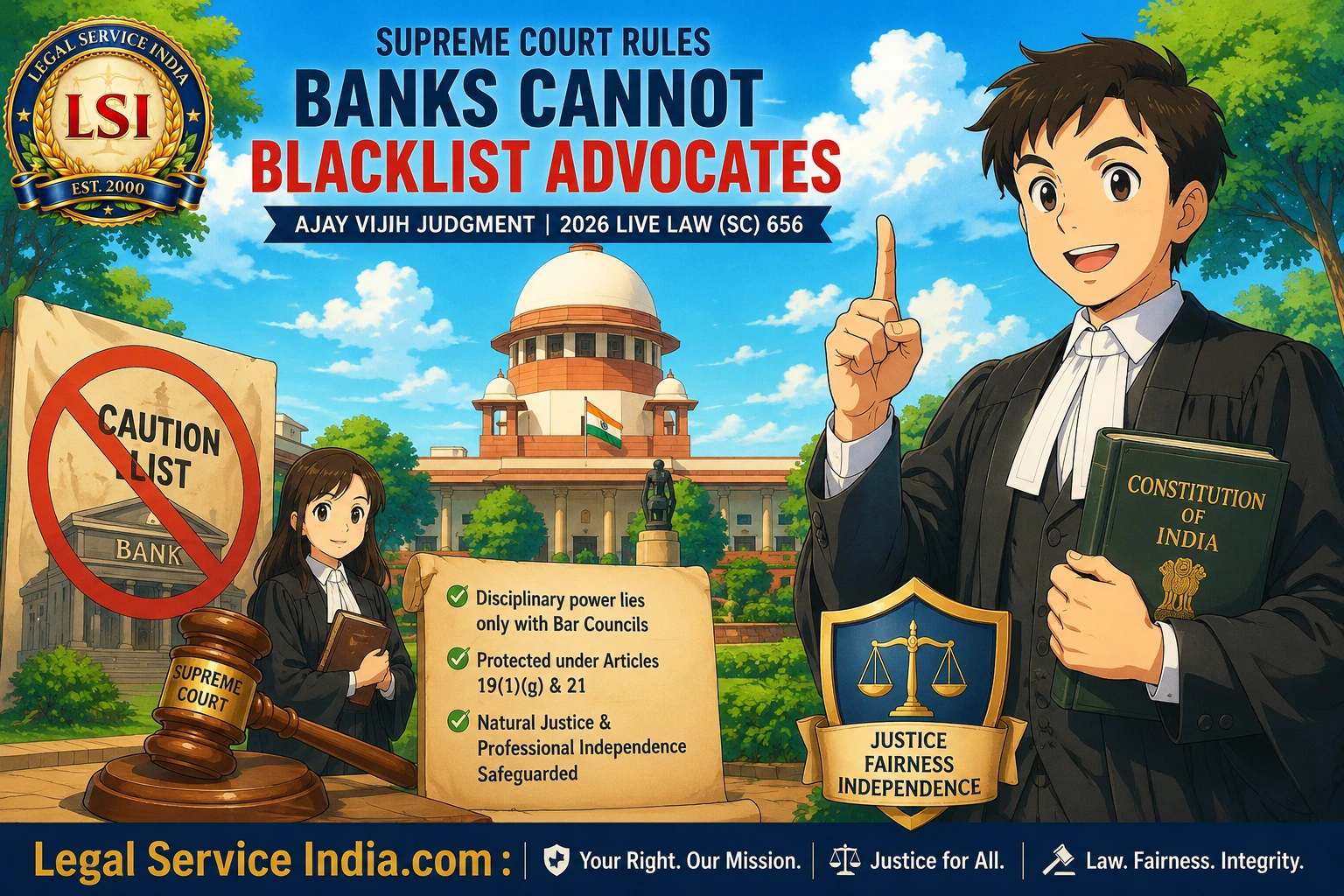
Introduction
The legal profession occupies a unique and indispensable position in India’s constitutional framework. Advocates are not merely professionals engaged by clients for legal services; they are officers of the Court, integral to the administration of justice and the preservation of the rule of law. Their professional independence is closely linked with the independence of the judiciary itself. Any attempt by executive authorities, corporations, or private institutions to undermine that independence strikes at the very foundation of the justice delivery system.
Against this constitutional backdrop, the Supreme Court of India has delivered a landmark judgment in Ajay Vijh v. Indian Banks Association & Others, holding that banks and the Indian Banks’ Association (IBA) cannot blacklist advocates by placing their names on an industry-wide “Caution List.” The Court categorically ruled that allegations of professional negligence or misconduct against advocates fall exclusively within the disciplinary jurisdiction of the Bar Councils established under the Advocates Act, 1961. Neither banks nor the IBA possess statutory authority to pronounce upon an advocate’s professional competence or impose what effectively amounts to a nationwide professional embargo.
Although the dispute arose in the context of banking and loan transactions, the judgment extends far beyond that sector. It addresses fundamental constitutional principles relating to the right to practise a profession under Article 19(1)(g), the right to dignity and reputation under Article 21, the doctrine of natural justice, and the statutory scheme governing professional regulation in India.
In practical terms, the ruling ensures that while banks remain free to choose their panel advocates and discontinue engagements where considered appropriate, they cannot assume the role of disciplinary regulators by circulating caution lists that stigmatise advocates across the banking industry. Such actions, the Court held, have serious civil consequences and can irreparably damage an advocate’s professional reputation and livelihood without any authority of law.
The judgment therefore reinforces a vital constitutional message: disciplinary control over advocates is a matter of statutory regulation, not administrative discretion. It preserves the autonomy of the legal profession, protects advocates from extra-legal sanctions, and draws a clear line between contractual decision-making and professional discipline.
For advocates, banks, financial institutions, regulatory authorities, and the legal community at large, this decision is likely to become one of the most significant precedents on the relationship between institutional accountability and professional independence.
Key Highlights of the Judgment
- Banks and the Indian Banks’ Association (IBA) cannot blacklist advocates through an industry-wide “Caution List.”
- Professional misconduct by advocates falls exclusively within the disciplinary jurisdiction of the Bar Councils under the Advocates Act, 1961.
- Banks may appoint or remove panel advocates but cannot impose industry-wide professional sanctions.
- The judgment safeguards advocates’ rights under Articles 19(1)(g) and 21 of the Constitution of India.
- The Supreme Court reaffirmed the importance of natural justice and statutory regulation over administrative discretion.
Constitutional Principles Involved
| Constitutional Principle | Relevance in the Judgment |
|---|---|
| Article 19(1)(g) | Protects the advocate’s right to practise the legal profession. |
| Article 21 | Safeguards dignity, reputation, and livelihood. |
| Natural Justice | Prevents professional stigma without lawful authority or due process. |
| Advocates Act, 1961 | Confers exclusive disciplinary jurisdiction upon the Bar Councils. |
Citation
Ajay Vijh v. Indian Banks Association & Others, 2026 LiveLaw (SC) 656 – (Supreme Court of India)
Why This Judgment Matters
At first glance, the case may appear to concern only the empanelment of advocates by banks. In reality, however, it raises questions of far greater constitutional importance.
If banks, insurance companies, public sector undertakings, government departments, or private corporations were permitted to maintain and circulate lists branding advocates as negligent or professionally unreliable, they would effectively exercise disciplinary powers that Parliament has entrusted exclusively to the Bar Councils under the Advocates Act, 1961.
Such a practice would have far-reaching consequences. An advocate whose name is circulated on an industry-wide caution list may not be formally suspended from practice, yet the practical effect could be equally devastating. The advocate may lose existing clients, be denied future professional engagements, suffer reputational harm, and face severe financial hardship without any adjudication by the competent statutory authority.
The Supreme Court has recognised this distinction. It has reaffirmed that there is a fundamental difference between a client’s contractual decision not to engage a lawyer and an institutional declaration that effectively blacklists the lawyer throughout an entire sector.
The former is permissible; the latter is not.
This distinction is likely to influence not only banking law but also future disputes involving professionals such as chartered accountants, company secretaries, architects, engineers, doctors, and other regulated professions.
Key Takeaways from the Judgment
| Issue | Supreme Court’s Position |
|---|---|
| Client’s right to choose a lawyer | Permissible |
| Industry-wide blacklist of advocates | Not permissible |
| Disciplinary power over advocates | Vested exclusively in the Bar Councils under the Advocates Act, 1961 |
| Professional reputation and livelihood | Protected under constitutional and statutory principles |
Background of the Dispute
Banks routinely engage advocates for a variety of legal functions, including:
- examining title deeds;
- verifying ownership documents;
- issuing legal opinions on immovable properties offered as security;
- conducting due diligence before sanctioning loans;
- advising on mortgage documentation;
- assisting in recovery proceedings; and
- representing banks before courts and tribunals.
These legal opinions often form an important part of the bank’s decision-making process before advancing substantial financial assistance.
In several cases across the country, however, loan accounts subsequently turned into Non-Performing Assets (NPAs) or were found to involve fraudulent transactions. During internal investigations, banks occasionally attributed responsibility to the panel advocates who had issued legal opinions relating to the security documents.
To address what it perceived as a recurring risk, the Indian Banks’ Association (IBA) introduced a mechanism whereby the names of certain advocates could be placed on a “Caution List.”
The purpose of the list was ostensibly to alert member banks regarding advocates whose legal opinions had allegedly contributed to irregularities in loan transactions.
In practice, however, inclusion in the caution list had consequences extending far beyond a single banking relationship.
Once an advocate’s name appeared on the list, numerous banks across India would decline to empanel or engage that advocate. Although there was no formal order of suspension or debarment under any statute, the advocate effectively became unemployable within a significant segment of legal practice connected with banking and financial institutions.
Many advocates contended that the caution list functioned as an informal but highly effective blacklist. It imposed serious professional consequences without any statutory framework, disciplinary inquiry, or adjudication by the competent authority.
One such advocate challenged the legality of this practice before the Supreme Court.
Banking Functions Performed by Panel Advocates
| Legal Function | Purpose |
|---|---|
| Examination of title deeds | Verify ownership and legal title |
| Verification of ownership documents | Confirm authenticity of records |
| Legal opinions on secured properties | Assess legal validity of collateral |
| Due diligence | Evaluate legal risks before loan sanction |
| Mortgage documentation advice | Ensure legally compliant documentation |
| Recovery proceedings | Assist banks in recovery of dues |
| Representation before courts and tribunals | Conduct litigation on behalf of banks |
The Facts of Ajay Vijh v. Indian Banks Association
The petitioner, Advocate Ajay Vijh, was a practising lawyer who had been empanelled by banks to provide legal opinions concerning properties offered as collateral for loans.
Subsequently, allegations arose regarding certain loan transactions in which legal opinions issued by the petitioner were questioned. Acting upon these allegations, the Indian Banks’ Association placed the petitioner’s name on its caution list, which was circulated among member banks.
The consequences were immediate and far-reaching.
The petitioner alleged that his professional standing suffered immense damage. Banks became reluctant to engage him, existing opportunities diminished, and his reputation within the banking sector was adversely affected.
Importantly, the petitioner was not facing any disciplinary proceedings before the Bar Council. Nor had any statutory authority declared him guilty of professional misconduct.
Yet, by virtue of the caution list, he was effectively treated as professionally unreliable across the banking industry.
Aggrieved by this action, the petitioner approached the Supreme Court contending that:
- the Indian Banks’ Association had no statutory authority to blacklist advocates;
- the caution list amounted to an unlawful exercise of disciplinary power;
- the action violated the Advocates Act, 1961;
- it infringed his fundamental right to practise his profession under Article 19(1)(g) of the Constitution;
- it damaged his reputation, dignity, and livelihood protected under Article 21; and
- it violated the principles of natural justice.
The case therefore presented an important constitutional question concerning the limits of administrative authority and the autonomy of the legal profession.
Constitutional and Legal Issues Raised
| Issue Raised | Legal Basis |
|---|---|
| Authority to blacklist advocates | Advocates Act, 1961 |
| Exercise of disciplinary powers | Exclusive jurisdiction of the Bar Councils |
| Right to practise profession | Article 19(1)(g) of the Constitution |
| Reputation, dignity and livelihood | Article 21 of the Constitution |
| Natural justice | Fair hearing and procedural safeguards |
The Principal Legal Issues Before the Supreme Court
The Supreme Court was called upon to answer several significant questions of law:
- Can banks or the Indian Banks’ Association determine that an advocate has committed professional negligence or misconduct?
- Does the Indian Banks’ Association possess statutory authority to circulate caution lists naming advocates?
- Whether maintaining and circulating such caution lists amounts to blacklisting?
- Whether such action violates the statutory scheme contained in the Advocates Act, 1961?
- Whether such action infringes the advocate’s constitutional rights under Articles 19(1)(g) and 21?
- Whether allegations of professional misconduct against advocates can be examined by bodies other than the Bar Councils?
The answers to these questions would determine not merely the legality of the caution list but also the broader relationship between professional regulation and administrative decision-making.
The Supreme Court’s Decision
The Supreme Court unequivocally held that the Indian Banks’ Association and individual banks have no statutory authority to blacklist advocates by placing their names on caution lists that are circulated throughout the banking industry.
The Court observed that allegations regarding an advocate’s professional misconduct, negligence, or ethical breach fall exclusively within the disciplinary framework established under the Advocates Act, 1961.
Banks undoubtedly possess the freedom to choose the advocates whom they wish to engage. They may empanel lawyers based on their own criteria and may also discontinue an advocate’s empanelment if circumstances warrant.
However, what they cannot do is issue declarations or circulate lists that effectively determine an advocate’s professional competence for the entire banking sector.
The Court recognised that such caution lists have consequences extending well beyond the contractual relationship between one bank and one advocate. They carry a stigma that may prevent an advocate from obtaining work from numerous institutions, thereby affecting reputation, professional standing, and livelihood.
In essence, the Court held that administrative convenience cannot override statutory safeguards enacted by Parliament.
The disciplinary control of advocates has been entrusted by law to the Bar Councils. Neither the IBA nor banks can assume powers that the legislature has deliberately vested elsewhere.
Key Findings of the Supreme Court
| Issue | Supreme Court’s Finding |
|---|---|
| Authority to blacklist advocates | Neither the Indian Banks’ Association nor banks possess statutory authority. |
| Professional misconduct | Can only be examined under the disciplinary framework of the Advocates Act, 1961. |
| Empanelment decisions | Banks may choose or discontinue empanelment based on their own criteria. |
| Industry-wide caution lists | Cannot be used to determine an advocate’s professional competence. |
| Disciplinary powers | Remain exclusively with the Bar Councils. |
The Constitutional Dimension: More Than a Banking Dispute
One of the most significant aspects of the judgment is that the Supreme Court treated the matter not merely as a contractual dispute but as one involving fundamental constitutional values.
The Court recognised that the legal profession occupies a unique position in India’s constitutional democracy. Unlike ordinary commercial service providers, advocates are indispensable participants in the administration of justice.
Their independence is essential because lawyers act as intermediaries between citizens and the justice system. They defend constitutional rights, challenge executive excesses, assist courts in interpreting the law, and ensure that justice is accessible to all.
If institutions such as banks were permitted to unilaterally declare advocates professionally unreliable without statutory authority, the consequences would extend far beyond individual careers. It would create a parallel disciplinary mechanism outside the framework enacted by Parliament, undermining the institutional independence of the Bar.
The Court therefore reaffirmed a fundamental constitutional principle: the independence of the legal profession is inseparable from the independence of the judiciary.
An independent judiciary cannot function effectively without an independent Bar. Equally, the independence of advocates cannot be compromised by administrative bodies exercising powers that belong exclusively to statutory regulators.
Constitutional Principles Reaffirmed
- The legal profession is an essential pillar of India’s constitutional democracy.
- The independence of advocates is closely linked to the independence of the judiciary.
- Administrative bodies cannot create parallel disciplinary mechanisms outside the Advocates Act, 1961.
- Only statutory regulators can exercise disciplinary control over advocates.
Article 19(1)(g): Freedom to Practise the Legal Profession
Although public attention has largely focused on the banking implications of the judgment, its constitutional significance lies equally in its affirmation of Article 19(1)(g) of the Constitution.
Article 19(1)(g) guarantees every citizen the fundamental right to practise any profession or to carry on any occupation, trade, or business.
The practice of law is not merely a source of livelihood. It is a constitutionally protected profession regulated by statute.
When an advocate’s name is circulated across the banking sector as professionally unreliable, the practical effect is to substantially impair that advocate’s ability to earn a livelihood in a specialised area of legal practice.
Such restrictions cannot be imposed by executive or administrative bodies acting without statutory authority.
The Supreme Court’s decision therefore reinforces an important constitutional safeguard: while professional conduct may be regulated by law, restrictions on the right to practise a profession must have legal sanction and follow the procedure established by the governing statute.
The IBA’s caution list, lacking any statutory foundation under the Advocates Act, could not be permitted to operate as an industry-wide mechanism restricting an advocate’s professional opportunities.
Impact on Advocates’ Right to Practise
| Constitutional Protection | Significance |
|---|---|
| Article 19(1)(g) | Protects the fundamental right to practise the legal profession. |
| Statutory Regulation | Professional conduct must be governed by the Advocates Act, 1961. |
| Administrative Restrictions | Cannot be imposed without statutory authority. |
| IBA Caution List | Cannot function as an industry-wide restriction on professional opportunities. |
The Advocates Act, 1961: Why Parliament Entrusted Professional Discipline Exclusively to the Bar Councils
One of the greatest strengths of the Supreme Court’s judgment lies in its faithful interpretation of the Advocates Act, 1961. Rather than treating the controversy as a simple dispute between an advocate and a bank, the Court examined the statutory framework governing the legal profession and reaffirmed that Parliament has created a complete code regulating advocates.
The decision reminds us of a fundamental principle of administrative law: where a statute creates a specific authority to exercise a particular power, no other authority can assume that power merely because it considers it expedient to do so.
The Advocates Act is precisely such a statute. It regulates every important aspect of the legal profession—from enrolment and qualifications to ethics, discipline, suspension, and removal from practice. Nowhere does it authorise banks, financial institutions, or industry associations to determine whether an advocate has committed professional misconduct.
This statutory scheme formed the foundation of the Supreme Court’s reasoning.
The Advocates Act Is a Complete Code
The Advocates Act, 1961 was enacted to create a unified legal profession throughout India and to establish independent Bar Councils responsible for maintaining professional standards.
The Act performs several important functions:
- Prescribes qualifications for enrolment as an advocate;
- Regulates the right to practise law;
- Establishes State Bar Councils and the Bar Council of India;
- Lays down standards of professional conduct and etiquette;
- Creates disciplinary committees;
- Provides appellate remedies; and
- Empowers the Bar Council of India to frame rules governing professional ethics.
| Function Under the Advocates Act | Purpose |
|---|---|
| Enrolment of Advocates | Determines eligibility to practise law. |
| Professional Conduct | Prescribes ethical standards for advocates. |
| Disciplinary Committees | Examines complaints of misconduct. |
| Appeals | Provides statutory remedies against disciplinary orders. |
| Rule-Making Powers | Authorises the Bar Council of India to frame professional ethics rules. |
This comprehensive statutory framework leaves little room for external agencies to impose parallel systems of professional regulation.
The Supreme Court recognised that allowing banks to maintain caution lists would effectively create an alternative disciplinary mechanism entirely outside the statutory architecture enacted by Parliament.
Sections 35 and 36: The Exclusive Disciplinary Jurisdiction
The judgment must be understood alongside Sections 35 and 36 of the Advocates Act, 1961, which are central to the regulation of advocates.
Section 35
Section 35 empowers the State Bar Council to inquire into complaints of professional or other misconduct against advocates enrolled on its rolls.
If, after conducting an inquiry consistent with the principles of natural justice, the disciplinary committee finds the advocate guilty, it may:
- Dismiss the complaint;
- Reprimand the advocate;
- Suspend the advocate from practice for a specified period; or
- Remove the advocate’s name from the roll of advocates.
These are serious statutory consequences, but Parliament deliberately entrusted them only to an independent professional regulator.
Section 36
Section 36 confers disciplinary jurisdiction upon the Bar Council of India in specified situations, including transfer of proceedings and matters directly falling within its jurisdiction.
Together, Sections 35 and 36 establish an exclusive disciplinary mechanism for advocates.
The significance of these provisions cannot be overstated.
They demonstrate Parliament’s clear intention that allegations affecting an advocate’s professional standing should be determined only by bodies specifically constituted under the Advocates Act.
Banks are not among those bodies.
| Provision | Authority | Primary Role |
|---|---|---|
| Section 35 | State Bar Council | Conducts inquiries into professional or other misconduct and imposes statutory disciplinary measures. |
| Section 36 | Bar Council of India | Exercises disciplinary jurisdiction in specified cases, including transferred proceedings. |
Section 36B: Time-Bound Disposal
Section 36B further strengthens this statutory framework by prescribing timelines for disposal of disciplinary proceedings.
This reflects Parliament’s intention that allegations against advocates should not remain pending indefinitely, while ensuring that proper procedural safeguards are maintained.
If banks were permitted to circulate caution lists independently, these statutory protections would become largely meaningless.
An advocate could effectively suffer professional ruin long before the competent authority even commenced disciplinary proceedings.
The Supreme Court’s judgment prevents precisely this result.
Key Takeaways
- The Advocates Act, 1961 is a complete statutory code governing the legal profession.
- Parliament vested disciplinary authority exclusively in the State Bar Councils and the Bar Council of India.
- Sections 35 and 36 establish the exclusive mechanism for professional discipline.
- Section 36B ensures disciplinary proceedings are concluded within prescribed timelines.
- Banks, financial institutions, and industry associations have no statutory authority to determine professional misconduct by advocates.
- The Supreme Court reaffirmed that parallel disciplinary systems outside the Advocates Act cannot be created.
Section 49: Rule-Making Power
Another significant provision is Section 49, which authorises the Bar Council of India to frame rules regarding:
- standards of professional conduct;
- professional etiquette;
- duties of advocates;
- disciplinary procedure; and
- regulation of legal practice.
The Bar Council Rules framed under this provision constitute the ethical code governing advocates throughout India.
Significantly, neither the Advocates Act nor the Rules contemplate any disciplinary role for banks or financial institutions.
The absence of such a provision is not accidental.
It reflects a conscious legislative choice.
Professional regulation has been entrusted exclusively to the institutions created under the Act.
Why Parliament Chose Independent Bar Councils
The Supreme Court’s reasoning reflects an important constitutional philosophy.
Professional regulation cannot be left to individual clients.
Imagine the consequences if every dissatisfied client could officially declare an advocate professionally negligent.
- Government departments could blacklist lawyers.
- Large corporations could maintain industry-wide caution lists.
- Insurance companies could circulate names of advocates whom they considered incompetent.
- Public sector undertakings could effectively prevent advocates from obtaining work.
The legal profession would become dependent upon the opinions of clients rather than the rule of law.
That is precisely what Parliament sought to avoid.
Instead, it created independent Bar Councils capable of objectively evaluating allegations through structured disciplinary proceedings.
Constitutional Philosophy Behind Independent Regulation
| Issue | Parliament’s Approach |
|---|---|
| Professional misconduct | Decided through independent Bar Councils |
| Disciplinary proceedings | Conducted under the Advocates Act and Bar Council Rules |
| Role of banks and financial institutions | No disciplinary authority |
| Objective | Protect independence of the legal profession |
The Independence of the Bar Is a Constitutional Value
One of the most important observations in the judgment is that the independence of the Bar forms an essential part of the constitutional justice system.
Lawyers occupy a unique position.
Unlike ordinary consultants, advocates:
- represent citizens against the State;
- challenge executive action;
- question governmental policies;
- defend constitutional rights;
- assist constitutional courts; and
- act as officers of the court.
If clients could effectively punish advocates by circulating caution lists, professional independence would gradually disappear.
Advocates might begin tailoring legal advice to satisfy influential clients rather than providing objective legal opinions.
Such a system would undermine public confidence in legal advice itself.
The Supreme Court’s judgment therefore protects not merely individual advocates but the institutional integrity of the legal profession.
Importance of an Independent Bar
| Role of Advocates | Constitutional Significance |
|---|---|
| Represent citizens against the State | Protects access to justice |
| Challenge executive action | Maintains constitutional accountability |
| Defend constitutional rights | Safeguards fundamental freedoms |
| Assist constitutional courts | Supports the administration of justice |
| Act as officers of the court | Preserves integrity of the judicial system |
A Lawyer’s Duty Is to Give an Independent Opinion
An important practical aspect often overlooked is that advocates are expected to exercise independent professional judgment.
When a bank seeks a title opinion, the advocate is expected to:
- examine title deeds;
- analyse statutory records;
- identify legal defects;
- assess risks;
- interpret applicable laws; and
- provide an independent legal opinion.
A legal opinion is exactly that—an opinion.
It is not a guarantee of future events.
Subsequent litigation, forged documents, concealed facts, or fraudulent conduct by borrowers may later expose defects that were impossible to detect during the original examination.
If every unsuccessful loan automatically resulted in accusations of professional negligence against the advocate, no lawyer would be willing to provide independent legal advice.
Instead, legal opinions would become defensive documents designed merely to avoid future allegations.
The Supreme Court has rightly recognised that such an approach would damage the administration of justice itself.
Scope of an Independent Legal Opinion
| Advocate’s Responsibility | Nature of Duty |
|---|---|
| Examine title deeds | Professional assessment |
| Analyse statutory records | Legal evaluation |
| Identify legal defects | Risk identification |
| Assess risks | Professional judgment |
| Interpret applicable laws | Legal analysis |
| Provide an independent legal opinion | Opinion, not a guarantee of future events |
Negligence Is Not the Same as Professional Misconduct
Perhaps the most significant legal clarification emerging from the judgment is the distinction between professional negligence and professional misconduct.
These concepts are often incorrectly treated as identical.
They are not.
Why a Legal Opinion May Ultimately Prove Incorrect
A legal opinion may ultimately prove incorrect for numerous reasons:
- incomplete documents supplied by the client;
- forged records;
- hidden encumbrances;
- conflicting judicial precedents;
- subsequent changes in law;
- differing legal interpretations.
None of these automatically establish professional misconduct.
Professional misconduct generally requires conduct inconsistent with professional ethics, deliberate disregard of legal duties, gross dereliction, or dishonest behaviour.
Similarly, allegations of fraud require evidence of intentional participation in wrongdoing.
The Supreme Court observed that merely because a loan later becomes irregular does not automatically justify branding the advocate dishonest or professionally incompetent.
This is an important safeguard for independent legal practice.
Professional Negligence vs Professional Misconduct
| Professional Negligence | Professional Misconduct |
|---|---|
| A legal opinion may ultimately prove incorrect for various legitimate reasons. | Generally requires conduct inconsistent with professional ethics, deliberate disregard of legal duties, gross dereliction, or dishonest behaviour. |
| May result from incomplete documents, forged records, hidden encumbrances, conflicting judicial precedents, subsequent changes in law, or differing legal interpretations. | Requires conduct going beyond mere error or incorrect legal opinion. |
| Does not automatically establish professional misconduct. | May justify disciplinary action where legally established. |
Can Banks Take Action Against Advocates?
An important misconception requires clarification.
The Supreme Court has not held that banks are powerless against advocates.
Banks continue to possess several legitimate remedies.
Legitimate Remedies Available to Banks
If dissatisfied with an advocate’s services, a bank may:
- discontinue empanelment;
- refuse future assignments;
- terminate contractual engagement;
- institute civil proceedings where damages are legally recoverable;
- lodge criminal complaints where criminal offences are genuinely disclosed; and
- file disciplinary complaints before the appropriate State Bar Council.
These remedies remain fully available.
What banks cannot do is substitute themselves for the statutory disciplinary authority.
That distinction lies at the heart of the judgment.
Bank Remedies at a Glance
| Available Remedy | Purpose |
|---|---|
| Discontinue empanelment | End future professional engagement. |
| Refuse future assignments | Decline to allocate additional legal work. |
| Terminate contractual engagement | End the contractual relationship. |
| Institute civil proceedings | Seek legally recoverable damages. |
| Lodge criminal complaints | Pursue action where criminal offences are genuinely disclosed. |
| File disciplinary complaints | Approach the appropriate State Bar Council. |
Removal from a Bank Panel Is Not the Same as Blacklisting
This is perhaps the most important legal distinction in the entire case.
The Supreme Court carefully differentiated between:
Removal from a Panel
A bank may legitimately decide:
- not to renew empanelment;
- reduce the size of its panel;
- adopt new eligibility criteria;
- discontinue assigning work to a particular advocate.
These decisions relate to contractual relationships.
Every client has freedom to choose its legal representatives.
Blacklisting
Blacklisting is fundamentally different.
- Blacklisting extends beyond one contractual relationship.
- It carries stigma.
- It communicates to other institutions that the advocate is professionally unreliable.
- It effectively restricts future employment opportunities.
- It creates serious civil consequences.
The Supreme Court recognised that the IBA’s caution list functioned as precisely such a blacklist.
Removal from a Panel vs Blacklisting
| Removal from a Panel | Blacklisting |
|---|---|
| Relates to a contractual relationship. | Extends beyond one contractual relationship. |
| A bank may decide not to renew empanelment or discontinue assigning work. | Communicates to other institutions that the advocate is professionally unreliable. |
| Every client has freedom to choose its legal representatives. | Effectively restricts future employment opportunities. |
| Concerns engagement decisions. | Creates serious civil consequences and carries stigma. |
Blacklisting in Indian Administrative Law
Indian administrative law has consistently regarded blacklisting as one of the most serious administrative actions.
The Supreme Court has repeatedly held that blacklisting:
- affects civil rights;
- damages commercial reputation;
- restricts future business opportunities;
- has long-term economic consequences; and
- therefore requires strict adherence to natural justice.
Judicial Recognition of Fair Procedure
Earlier decisions such as Erusian Equipment & Chemicals Ltd. v. State of West Bengal, Patel Engineering Ltd. v. Union of India, UMC Technologies Pvt. Ltd. v. Food Corporation of India, and Vetindia Pharmaceuticals Ltd. v. State of Uttar Pradesh have consistently recognised that blacklisting cannot be imposed arbitrarily and must follow a fair procedure.
Although those cases largely concerned government contracts, the principle underlying them is equally applicable here: an action that effectively excludes a person from future professional opportunities attracts heightened procedural safeguards.
The present judgment extends that constitutional reasoning to advocates engaged by banks.
The Principle of Natural Justice
The doctrine of natural justice forms the backbone of Indian administrative law.
It is founded upon two basic rules:
- No person should be condemned unheard (audi alteram partem).
- No person should be a judge in his own cause (nemo judex in causa sua).
Questions Raised by Bank Caution Lists
When banks prepared caution lists, serious questions arose.
Was there:
- an independent inquiry?
- oral evidence?
- cross-examination?
- reasoned findings?
- appellate review?
- statutory authority?
In most cases, the answer was no.
The Supreme Court recognised that imposing industry-wide professional consequences without these safeguards violates fundamental principles of fairness.
Administrative convenience cannot replace due process.
Civil Consequences Demand Greater Fairness
Indian constitutional jurisprudence has consistently held that where an administrative action carries civil consequences, fairness becomes indispensable.
Civil consequences extend beyond financial loss.
They include:
- damage to reputation;
- loss of employment opportunities;
- impairment of professional standing;
- denial of future contracts;
- adverse impact on livelihood.
Impact of the IBA Caution List
The IBA caution list clearly produced these consequences.
The Supreme Court therefore insisted that such actions cannot exist outside the statutory framework created by Parliament.
Professional Reputation Is a Constitutional Asset
For an advocate, reputation is not merely a matter of personal pride.
It is the foundation of professional practice.
Unlike salaried employment, legal practice depends almost entirely upon public confidence.
Years—even decades—may be required to build a reputation.
A single industry-wide caution list may destroy it within days.
Constitutional Protection of the Legal Profession
The Supreme Court’s decision therefore protects something far more valuable than contractual rights—it safeguards the constitutional dignity, credibility, and independence of the legal profession.
Key Principles at a Glance
| Principle | Position Recognised by the Supreme Court |
|---|---|
| Nature of Blacklisting | One of the most serious administrative actions. |
| Natural Justice | Strict adherence to fair procedure is mandatory. |
| Civil Consequences | Require heightened procedural safeguards. |
| Professional Reputation | A constitutional asset deserving protection. |
| Administrative Action | Cannot replace due process with administrative convenience. |
Article 21, Professional Reputation, and the Supreme Court’s Broader Constitutional Vision
The Supreme Court’s judgment in Ajay Vijh v. Indian Banks Association & Others is not confined to the interpretation of the Advocates Act, 1961. Beneath the statutory analysis lies a broader constitutional philosophy: the law protects not only an advocate’s licence to practise but also the dignity, reputation, and professional independence that make meaningful legal practice possible.
Constitutional Protection of Professional Life
While Article 19(1)(g) guarantees the freedom to practise a profession, Article 21 protects the quality of that professional life. Over the past several decades, the Supreme Court has consistently expanded Article 21 beyond mere physical existence to include the right to live with dignity, the right to reputation, and the right to pursue a livelihood free from arbitrary State action.
Key Constitutional Principles
- Article 19(1)(g) guarantees the freedom to practise a profession.
- Article 21 protects the quality and dignity of professional life.
- The right to reputation forms an integral part of Article 21.
- The Constitution safeguards livelihood against arbitrary State action.
- Professional independence is essential for meaningful legal practice.
Constitutional Framework at a Glance
| Constitutional Provision | Protection Recognised |
|---|---|
| Article 19(1)(g) | Freedom to practise a profession. |
| Article 21 | Protection of dignity, reputation, and livelihood against arbitrary State action. |
The Judgment’s Place in Constitutional Evolution
The present judgment fits squarely within that constitutional evolution.
Reputation Is More Than Personal Prestige
For most professionals, reputation is valuable. For advocates, it is indispensable.
A lawyer does not manufacture a product or sell a commodity. Clients engage advocates because they trust their competence, integrity, independence, and judgment. Once that trust is eroded by an official or quasi-official declaration, rebuilding it can take years—if it is possible at all.
The Court recognised that an advocate’s reputation is a professional asset earned through years of education, ethical conduct, courtroom experience, and public confidence. A caution list circulated among banks has consequences far beyond one contractual relationship; it casts a shadow over the advocate’s credibility in the wider legal market.
Such consequences cannot be imposed casually or by bodies lacking statutory authority.
| Why Reputation Matters for Advocates | Impact |
|---|---|
| Professional Trust | Clients rely on competence, integrity, independence, and sound judgment. |
| Years of Effort | Built through education, ethical conduct, courtroom experience, and public confidence. |
| Effect of a Caution List | Can damage credibility across the legal profession, extending well beyond one contractual relationship. |
| Legal Principle | Such consequences cannot be imposed casually or by bodies lacking statutory authority. |
Article 21 and the Right to Reputation
The Supreme Court has repeatedly held that reputation is an intrinsic component of the right to life under Article 21. Although the Constitution does not expressly mention reputation, judicial interpretation has recognised that dignity and honour are essential elements of a meaningful life.
For an advocate, injury to reputation often translates into:
- loss of existing clients;
- refusal of future engagements;
- diminished standing among peers;
- financial hardship;
- reduced opportunities for professional growth; and
- long-term damage to career prospects.
The Court’s reasoning acknowledges that administrative actions carrying such grave consequences cannot be sustained without legal authority and procedural fairness.
| Consequences of Damage to an Advocate’s Reputation |
|---|
| Loss of existing clients |
| Refusal of future engagements |
| Diminished standing among peers |
| Financial hardship |
| Reduced opportunities for professional growth |
| Long-term damage to career prospects |
The Link Between Articles 19(1)(g) and 21
One of the most significant constitutional aspects of the judgment is the interplay between Articles 19(1)(g) and 21.
- Article 19(1)(g) protects the freedom to practise law.
- Article 21 protects the dignity and reputation with which that profession is practised.
Together, they ensure that an advocate is not only free to appear before courts but is also protected from arbitrary actions that substantially impair professional opportunities.
The caution list mechanism affected both rights simultaneously.
Although it did not formally prohibit advocates from practising law, it significantly curtailed their ability to undertake banking and financial legal work, thereby affecting livelihood and professional standing.
The Court’s decision therefore reinforces both constitutional guarantees.
| Constitutional Provision | Protection Provided |
|---|---|
| Article 19(1)(g) | Protects the freedom to practise law. |
| Article 21 | Protects dignity and professional reputation. |
| Combined Effect | Safeguards advocates from arbitrary actions that substantially impair professional opportunities. |
Judicial Independence Depends Upon an Independent Bar
Perhaps the most enduring aspect of the judgment is its reaffirmation of a principle often stated but rarely explained in detail—that the independence of the judiciary cannot exist without an independent Bar.
Judges decide disputes, but advocates present facts, interpret statutes, challenge executive action, and defend constitutional freedoms. Without fearless lawyers, constitutional courts cannot effectively discharge their role.
The relationship between Bench and Bar is therefore institutional rather than contractual.
If powerful clients could indirectly discipline advocates by circulating adverse lists whenever legal opinions proved inconvenient or commercially disadvantageous, the independence of legal advice would inevitably suffer.
Lawyers might begin drafting opinions designed to avoid criticism rather than to reflect their honest assessment of the law.
The Supreme Court’s judgment protects against precisely this danger.
Key Takeaways
- Reputation is an indispensable professional asset for advocates.
- Article 21 protects dignity and reputation as part of the right to life.
- Article 19(1)(g) safeguards the freedom to practise law.
- The caution list mechanism affected both constitutional rights simultaneously.
- The judgment strengthens the independence of advocates and, consequently, the independence of the judiciary.
Why Independent Legal Advice Matters
Banks engage advocates because they require objective legal advice.
That advice often concerns:
- title verification;
- interpretation of property documents;
- applicability of statutory restrictions;
- validity of mortgages;
- succession disputes;
- pending litigation; and
- regulatory compliance.
Importance of Independent Legal Opinions
The value of legal advice lies in its independence.
An advocate’s responsibility is to provide an honest legal opinion based on available material—not to guarantee that future disputes will never arise.
Property transactions frequently involve concealed defects, forged documents, undisclosed litigation, fraudulent mutations, fabricated revenue records, or later judicial interpretations that could not reasonably have been anticipated.
Holding advocates automatically responsible whenever a loan subsequently turns into an NPA would fundamentally misunderstand the nature of legal practice.
The Court’s judgment restores this balance.
Every Incorrect Legal Opinion Is Not Professional Misconduct
An important implication of the decision is that professional errors and professional misconduct are not synonymous.
Legal practice inherently involves interpretation.
Different advocates may honestly arrive at different conclusions while examining identical documents.
Courts themselves often disagree before larger Benches settle legal questions.
Therefore, merely because a legal opinion later proves incorrect does not establish misconduct.
Professional Misconduct Generally Involves
| Professional Misconduct |
|---|
| deliberate concealment of material facts; |
| collusion with borrowers; |
| dishonest certification; |
| knowingly certifying forged documents; |
| conflict of interest; |
| gross ethical violations; or |
| intentional abuse of professional responsibility. |
These allegations require evidence and must be examined by the statutory disciplinary authority—not by banks.
The judgment preserves this distinction.
The Supreme Court Does Not Grant Immunity to Advocates
A careful reading of the judgment reveals that the Court has not insulated advocates from accountability.
The Court has merely clarified the proper forum and procedure.
If a bank believes that an advocate has acted dishonestly or negligently, it may still:
- remove the advocate from its own panel;
- refuse future assignments;
- file a complaint before the appropriate State Bar Council;
- initiate civil proceedings where legal requirements are satisfied; or
- pursue criminal remedies where evidence discloses criminal conduct.
Balancing Independence and Accountability
| Protected Interest | Purpose |
|---|---|
| protecting the independence of advocates | Ensures advocates provide objective legal opinions without external pressure. |
| preserving legitimate remedies available to banks | Allows banks to pursue lawful remedies where misconduct is supported by evidence. |
The judgment therefore balances two competing interests:
- protecting the independence of advocates; and
- preserving legitimate remedies available to banks.
What is prohibited is the creation of an extra-statutory disciplinary mechanism through caution lists.
The Supreme Court’s Direction to Establish a National Legal Academy
One of the least discussed yet potentially transformative aspects of the judgment is the Court’s direction to the Bar Council of India to establish a National Legal Academy for Advocates.
The Court recognised that legal practice is evolving rapidly.
Advocates today deal with increasingly complex areas including:
- digital banking;
- fintech regulation;
- cybercrime;
- insolvency law;
- artificial intelligence;
- cross-border commercial transactions;
- data protection;
- environmental compliance; and
- international arbitration.
Continuous professional education is therefore becoming indispensable.
Potential Benefits of the National Legal Academy
The proposed National Legal Academy has the potential to institutionalise structured continuing legal education for advocates across India.
If implemented effectively, it could:
| Potential Benefit |
|---|
| enhance professional competence; |
| encourage ethical standards; |
| promote specialised legal training; |
| improve advocacy skills; |
| facilitate research; |
| strengthen legal aid initiatives; and |
| bridge the gap between legal education and professional practice. |
The Court’s suggestion reflects a forward-looking vision—professional excellence should be achieved through education and regulation, not through informal blacklisting.
Impact on Banks and Financial Institutions
The judgment will require banks, housing finance companies, NBFCs, cooperative banks, and other financial institutions to revisit existing policies governing empanelled advocates.
Several practical consequences are likely to follow.
| Area | Likely Impact |
|---|---|
| Existing Policies | Review of caution-list mechanisms affecting empanelled advocates. |
| Empanelment Process | Strengthening of advocate selection and evaluation procedures. |
| Professional Misconduct | Greater reliance on statutory Bar Council proceedings. |
| Documentation | Better record-keeping to reduce future disputes. |
1. Review of Existing Caution Lists
Banks and the Indian Banks’ Association may need to review, modify, or discontinue existing caution-list mechanisms that effectively stigmatise advocates across the banking sector.
2. Revision of Empanelment Guidelines
Banks are likely to strengthen internal procedures governing:
- selection of panel advocates;
- quality review of legal opinions;
- conflict-of-interest declarations;
- periodic performance evaluation; and
- renewal of empanelment.
Such measures remain legally permissible because they relate to contractual engagement rather than professional discipline.
3. Increased Reliance on Bar Council Proceedings
Where allegations genuinely involve professional misconduct, banks may increasingly approach the State Bar Councils rather than attempting to resolve such issues administratively.
This aligns disciplinary action with the statutory framework.
4. Improved Documentation
Banks are also likely to improve documentation relating to:
- instructions given to advocates;
- documents supplied for legal scrutiny;
- scope of legal opinions;
- limitations of title verification; and
- allocation of professional responsibility.
Clear documentation may reduce future disputes.
Implications for Public Sector Undertakings and Government Departments
The reasoning adopted by the Supreme Court extends beyond banks.
Government departments, statutory authorities, municipal corporations, development authorities, and public sector undertakings frequently maintain panels of advocates.
Following this judgment, such bodies should carefully distinguish between:
- removal from a panel; and
- actions that effectively amount to blacklisting.
Any attempt to circulate adverse professional declarations beyond their own contractual relationship may now be vulnerable to judicial review.
Lessons for Corporate India
Large corporations also engage external legal counsel for specialised advice.
The judgment serves as a reminder that private contractual autonomy does not authorise corporations to assume disciplinary powers over regulated professionals.
Companies remain free to change legal advisers.
They are not free to create unofficial industry-wide mechanisms damaging an advocate’s professional reputation.
| Permissible Corporate Actions | Actions That May Invite Legal Challenge |
|---|---|
| Changing legal advisers | Creating unofficial industry-wide mechanisms damaging an advocate’s professional reputation |
| Managing contractual relationships | Assuming disciplinary powers over regulated professionals |
Implications for Property Due Diligence Practice
The decision is particularly significant for advocates engaged in property verification.
Legal opinions relating to title involve careful examination of:
- revenue records;
- sale deeds;
- mutation entries;
- encumbrance certificates;
- municipal permissions;
- court records;
- succession documents; and
- statutory restrictions.
Scope of Legal Due Diligence
Despite diligent scrutiny, hidden defects may remain undiscovered.
The judgment recognises that legal due diligence cannot be equated with an insurance policy against every future dispute.
Advocates are expected to exercise reasonable professional skill—not guarantee absolute certainty.
This clarification provides much-needed reassurance to lawyers practising in banking and property law.
| Professional Expectation | Not Required |
|---|---|
| Exercise reasonable professional skill | Guarantee absolute certainty |
| Conduct diligent legal due diligence | Provide an insurance policy against every future dispute |
A Judgment That Reinforces Institutional Balance
Viewed in its entirety, the decision does much more than resolve an individual grievance. It restores the institutional balance carefully designed by Parliament.
The judgment reinforces the following institutional principles:
- Banks retain the freedom to protect their commercial interests.
- The Bar Councils retain exclusive authority over professional discipline.
- Advocates retain their constitutional right to practise independently.
- And the judiciary reaffirms that statutory regulators—not administrative bodies—must determine questions of professional misconduct.
This balanced approach is likely to influence future disputes involving not only advocates but also other regulated professions where clients may seek to impose extra-statutory
Critical Analysis: A Senior Supreme Court Lawyer’s Perspective
Viewed through the lens of constitutional law, this judgment is not merely about the rights of an individual advocate. It is a reaffirmation of the constitutional architecture governing the legal profession in India. The Supreme Court has correctly drawn a distinction between contractual autonomy and statutory disciplinary jurisdiction, ensuring that neither public bodies nor private institutions can assume powers that Parliament has expressly entrusted to the Bar Councils.
However, the judgment should not be misunderstood as conferring immunity upon advocates. The legal profession enjoys constitutional protection precisely because it carries corresponding responsibilities. Independence must be matched by integrity, competence, diligence, and accountability.
In my opinion, speaking from the perspective of a practitioner before the Supreme Court for over two decades, the judgment strengthens three institutions simultaneously:
Three Institutions Strengthened by the Judgment
- The Bar, by protecting its independence from external administrative control.
- The Judiciary, by preserving the institutional relationship between Bench and Bar.
- The Banking Sector, by directing it towards legally sustainable mechanisms for addressing professional lapses rather than relying upon extra-statutory caution lists.
| Institution | How the Judgment Strengthens It |
|---|---|
| The Bar | Protects its independence from external administrative control. |
| The Judiciary | Preserves the institutional relationship between the Bench and the Bar. |
| The Banking Sector | Encourages legally sustainable mechanisms instead of extra-statutory caution lists. |
The Court has not weakened accountability; rather, it has redirected it to the legally competent authority.
What Banks Should Do After This Judgment
Banks should not interpret the judgment as limiting their ability to protect public funds. Instead, they should adopt legally robust and transparent mechanisms.
Strengthen Due Diligence Procedures
Rather than relying solely on one legal opinion, banks should consider:
- obtaining dual legal opinions for high-value transactions;
- introducing peer review for complex title matters;
- using digital land record verification wherever available;
- strengthening document authentication procedures; and
- maintaining detailed records of documents supplied to advocates.
Such measures reduce institutional risk without infringing upon professional independence.
Clearly Define the Scope of Legal Opinions
Many disputes arise because banks expect advocates to guarantee facts that are beyond their control.
Engagement letters should clearly specify:
- documents examined;
- assumptions made;
- limitations of verification;
- matters requiring independent investigation;
- exclusions from the opinion.
This protects both banks and advocates.
Refer Genuine Misconduct to the Appropriate Bar Council
Where evidence suggests:
- collusion,
- deliberate fraud,
- forged certifications,
- conflict of interest,
- dishonest conduct, or
- unethical professional behaviour,
banks should file complaints before the competent State Bar Council rather than attempting to impose independent sanctions.
That is precisely the mechanism Parliament intended.
| Recommended Bank Action | Purpose |
|---|---|
| Strengthen due diligence | Reduce institutional risk through improved verification. |
| Clearly define legal opinion scope | Avoid disputes regarding advocate responsibilities. |
| Refer misconduct to the State Bar Council | Ensure accountability through the competent statutory authority. |
Practical Lessons for Advocates
The judgment also offers important lessons for practising lawyers.
Maintain Comprehensive Records
Every advocate issuing title reports should preserve:
- copies of documents examined;
- search reports;
- revenue records;
- correspondence with the bank;
- instructions received;
- site inspection notes (if any); and
- copies of the legal opinion.
Good documentation is often the strongest defence against future allegations.
Clearly State Limitations
Legal opinions should expressly record:
- the documents relied upon;
- assumptions regarding authenticity;
- matters not independently verified;
- limitations of the examination; and
- recommendations for further verification where appropriate.
Such disclosures reduce misunderstanding and improve professional standards.
Continue Professional Education
Property law, banking regulations, land records, digital documentation, cyber fraud, and financial crimes are evolving rapidly.
The Supreme Court’s suggestion regarding a National Legal Academy highlights the importance of continuing legal education.
Professional competence today requires constant learning.
| Best Practice for Advocates | Benefit |
|---|---|
| Maintain comprehensive records | Provides strong evidence in case of future allegations. |
| Clearly state limitations | Reduces misunderstandings and manages expectations. |
| Continue professional education | Ensures competence in rapidly evolving legal and financial sectors. |
Frequently Asked Questions (FAQs)
1. Does This Judgment Prevent Banks from Removing Advocates from Their Panels?
No.
Banks remain free to appoint or discontinue panel advocates based on contractual considerations. What they cannot do is circulate caution lists that effectively blacklist advocates throughout the banking industry.
2. Can Banks Still File Complaints Against Advocates?
Yes.
Where professional misconduct is suspected, banks may file complaints before the appropriate State Bar Council under the Advocates Act, 1961.
3. Does Every Incorrect Legal Opinion Amount to Professional Misconduct?
No.
A legal opinion may later prove incorrect due to concealed facts, forged documents, subsequent judicial decisions, or differing legal interpretations.
Professional misconduct requires much more than an error of judgment.
4. Can Banks Sue Advocates for Negligence?
Where legally maintainable and supported by evidence, banks may pursue civil remedies.
However, civil liability and professional discipline are distinct legal concepts.
5. What Happens to Existing Caution Lists?
Although the Supreme Court has declared that banks cannot maintain industry-wide caution lists for advocates in the manner challenged before it, individual institutions should review their existing policies to ensure compliance with the principles laid down in this judgment.
6. Does the Judgment Apply Only to Banks?
The immediate dispute concerned banks and the Indian Banks’ Association.
However, the reasoning may influence future cases involving government departments, public sector undertakings, regulatory authorities, insurance companies, and other institutions dealing with regulated professionals.
Key Legal Principles Emerging from the Judgment
The decision establishes several important principles of law:
- Professional misconduct of advocates can be determined only under the Advocates Act, 1961.
- Bar Councils possess exclusive disciplinary jurisdiction over advocates.
- Banks cannot create parallel disciplinary mechanisms through caution lists.
- Removal from a panel is legally distinct from professional blacklisting.
- Administrative convenience cannot override statutory safeguards.
- Actions carrying serious civil consequences require procedural fairness.
- Professional reputation forms an important aspect of constitutional dignity.
- Independence of the Bar is an essential feature of the justice delivery system.
- Honest legal opinions cannot be judged solely by the commercial outcome of a transaction.
These principles are likely to influence future litigation involving other regulated professions as well.
Summary of Key Legal Principles
| Legal Principle | Position Established by the Judgment |
|---|---|
| Professional Misconduct | Can be determined only under the Advocates Act, 1961. |
| Disciplinary Authority | Bar Councils have exclusive jurisdiction over advocates. |
| Caution Lists | Banks cannot operate parallel disciplinary mechanisms. |
| Panel Removal | Different from professional blacklisting. |
| Administrative Powers | Cannot override statutory safeguards. |
| Procedural Fairness | Required whenever serious civil consequences arise. |
| Professional Reputation | Protected as an aspect of constitutional dignity. |
| Independence of the Bar | An essential feature of the justice delivery system. |
| Legal Opinions | Cannot be judged solely by the commercial outcome of a transaction. |
Broader Impact on the Legal Profession
This judgment will likely become a leading precedent in several areas of law.
It strengthens:
- constitutional law;
- administrative law;
- professional ethics;
- banking law;
- legal regulation;
- principles of natural justice; and
- institutional independence.
Its significance extends beyond advocates.
The reasoning adopted by the Court may eventually influence disputes concerning chartered accountants, company secretaries, insolvency professionals, architects, engineers, valuers, and other statutory professionals whose work often affects commercial transactions.
Professional Groups Likely to Be Affected
| Profession | Potential Relevance of the Judgment |
|---|---|
| Chartered Accountants | Professional disciplinary safeguards. |
| Company Secretaries | Protection against parallel disciplinary mechanisms. |
| Insolvency Professionals | Application of procedural fairness principles. |
| Architects | Recognition of statutory disciplinary frameworks. |
| Engineers | Protection of professional reputation. |
| Valuers | Fair treatment in institutional decision-making. |
| Other Statutory Professionals | Possible extension of the judgment’s reasoning in future litigation. |
Why This Judgment Will Be Frequently Cited
Several features make this decision particularly important.
- First, it clarifies the relationship between private contractual rights and statutory disciplinary powers.
- Secondly, it reinforces Parliament’s intention that professional discipline should remain with independent statutory regulators.
- Thirdly, it protects advocates against extra-legal sanctions capable of destroying professional reputation without due process.
- Finally, it strengthens constitutional values by recognising that an independent Bar is indispensable to an independent judiciary.
For these reasons, the judgment is likely to become a significant precedent in future disputes involving professional regulation.
Key Reasons for Frequent Citation
| Reason | Legal Significance |
|---|---|
| Private Contract vs. Statutory Powers | Clarifies the limits of contractual rights where statutory disciplinary authority exists. |
| Role of Parliament | Affirms that independent statutory regulators alone exercise professional disciplinary powers. |
| Protection of Advocates | Safeguards advocates from extra-legal sanctions affecting professional reputation. |
| Constitutional Values | Recognises that an independent Bar is essential for an independent judiciary. |
Conclusion
The Supreme Court’s decision in Ajay Vijh v. Indian Banks Association & Others, 2026 LiveLaw (SC) 656, is far more than a judgment concerning banking procedures. It is a reaffirmation of the constitutional and statutory framework that governs the legal profession in India.
The Court has drawn a clear constitutional boundary between a client’s commercial freedom and the State’s regulatory framework. Banks undoubtedly retain the right to select, evaluate, or discontinue panel advocates. What they cannot do is exercise disciplinary authority by branding advocates as professionally negligent through industry-wide caution lists. Such powers belong exclusively to the Bar Councils established under the Advocates Act, 1961.
Equally significant is the Court’s recognition that an advocate’s professional reputation and ability to practise are not matters of administrative convenience but constitutional concern. Arbitrary actions that impair professional standing engage the guarantees of Articles 19(1)(g) and 21 and must therefore conform to statutory authority, fairness, and due process.
The judgment also carries an important institutional message. The independence of the legal profession cannot be preserved if clients—however large or influential—are permitted to regulate advocates through informal sanctions. Professional discipline must remain within the framework created by Parliament, administered by independent Bar Councils, and guided by the principles of natural justice.
At the same time, the decision should not be viewed as diminishing accountability. Banks continue to possess ample legal remedies where genuine misconduct is suspected, including:
- Contractual action.
- Civil proceedings.
- Criminal complaints where warranted.
- Disciplinary proceedings before the competent Bar Council.
The judgment simply insists that accountability must operate through lawful channels rather than extra-statutory mechanisms.
In the years to come, Ajay Vijh is likely to stand alongside the Supreme Court’s leading decisions on professional independence, natural justice, and administrative fairness. Its influence may well extend beyond the legal profession to other regulated occupations where the balance between institutional autonomy and statutory discipline is equally critical.
Ultimately, the ruling reinforces a foundational principle of constitutional democracy: the rule of law demands that power be exercised only by those upon whom the law has conferred it. By preventing banks from assuming disciplinary powers over advocates, the Supreme Court has protected not merely one profession but the integrity of the justice delivery system itself.
Major Principles Established by the Judgment
| Principle | Effect |
|---|---|
| Commercial Freedom | Banks may appoint or remove panel advocates. |
| Disciplinary Jurisdiction | Only the Bar Councils constituted under the Advocates Act, 1961, may determine professional misconduct. |
| Constitutional Protection | Professional reputation is protected under Articles 19(1)(g) and 21. |
| Natural Justice | Actions having civil consequences must follow statutory authority and due process. |
| Institutional Independence | Preserves the independence of the legal profession and the justice delivery system. |
Ratio Decidendi
Banks and the Indian Banks’ Association have no statutory authority under the Advocates Act, 1961, to determine professional misconduct or effectively blacklist advocates by placing their names on industry-wide caution lists. While banks may regulate their contractual relationship with panel advocates, disciplinary jurisdiction over advocates vests exclusively in the Bar Councils constituted under the Advocates Act. Any action carrying serious civil consequences must be supported by statutory authority and comply with the principles of natural justice.
Ratio Decidendi at a Glance
| Issue | Supreme Court’s Holding |
|---|---|
| Power to determine professional misconduct | Exclusively vested in the Bar Councils under the Advocates Act, 1961. |
| Authority of Banks and the Indian Banks’ Association | No statutory power to blacklist advocates through industry-wide caution lists. |
| Contractual Rights | Banks may regulate contractual relationships with panel advocates. |
| Requirement for Civil Consequences | Must be backed by statutory authority and comply with the principles of natural justice. |
Need Legal Help?
Connect instantly with a verified Supreme lawyer from your city through LegalServiceIndia.com.
📱 Or WhatsApp 9891244487 for immediate assistance.