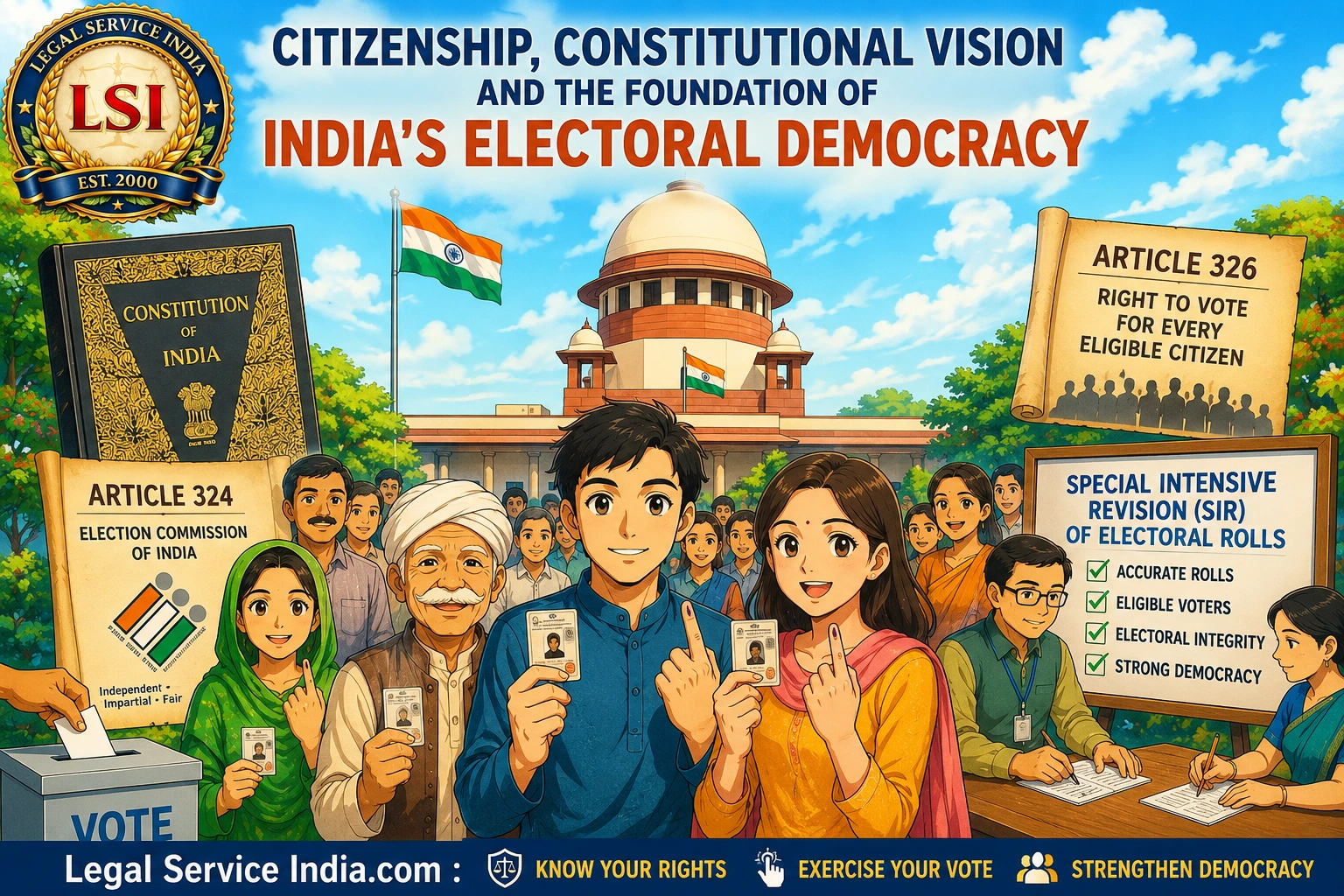
Citizenship, Constitutional Vision and the Foundation of India’s Electoral Democracy
India’s democracy rests on a simple yet profound principle: every eligible citizen has the right to participate in choosing those who govern the country. This right is exercised through elections, making citizenship the cornerstone of the democratic process. For over seven decades, India’s electoral system has functioned on the assumption that those enrolled as voters are citizens unless there is credible evidence proving otherwise. Recently, however, debates surrounding the Election Commission’s Special Intensive Revision (SIR) of electoral rolls have reignited important constitutional questions about citizenship, electoral integrity, and the balance between inclusion and verification.
Former Election Commissioner Ashok Lavasa, while speaking at a public discussion on citizenship and elections, reflected on these issues by examining India’s constitutional framework, the historical development of electoral rolls, and the recent judicial developments concerning voter verification. His observations raise significant questions about how citizenship should be understood in a constitutional democracy and whether long-standing democratic presumptions are undergoing a fundamental shift.
The Spirit of Democracy: Rights Before Proof
Lavasa began by drawing an interesting historical parallel. Speaking on 4 July, the anniversary of the United States Declaration of Independence (1776), he recalled its timeless declaration that every individual possesses certain inalienable rights, including the right to life, liberty, and the pursuit of happiness.
He contrasted this ideal with what he described as a growing concern in contemporary India. Instead of freely exercising constitutional rights, many citizens increasingly find themselves occupied with establishing documentary proof of their identity or citizenship. According to him, the focus appears to be shifting from protecting rights to demanding evidence before those rights can be enjoyed.
This observation serves as the backdrop for a broader constitutional discussion: Should citizenship be presumed unless disproved, or must every citizen continuously prove it?
When the Constitution Was Framed, Citizenship Was Intended to Bring Certainty
The framers of the Indian Constitution were acutely aware of the extraordinary circumstances surrounding independence. The Partition had displaced millions; families were migrating across newly created borders, and documentary records were often incomplete or entirely absent.
Against this backdrop, Articles 5 to 11 of the Constitution laid down the initial framework governing citizenship. Rather than creating uncertainty, these provisions were intended to provide stability and clarity at a time of immense national upheaval.
When the Constitution came into force on 26 January 1950, hundreds of princely states had already merged into the Union of India. Individuals who had previously been subjects of different rulers became citizens of one democratic republic. Citizenship was not conceived merely as a legal status; it became the basis upon which every individual could participate in governing the nation.
A citizen, therefore, is not simply someone residing within a geographical territory. In a constitutional democracy, a citizen is a person entitled to participate in public affairs by electing representatives through free and fair elections.
According to Lavasa, the constitutional vision rested on two interconnected assumptions:
- Citizenship was presumed rather than doubted.
- That presumption continued unless credible evidence demonstrated otherwise.
This approach reflected the inclusive philosophy adopted by the Constitution’s framers during one of the most difficult periods in India’s history.
Key Constitutional Principles
| Constitutional Principle | Explanation |
|---|---|
| Articles 5–11 | Established the original framework governing citizenship after independence. |
| Constitution Effective | 26 January 1950 marked the beginning of citizenship under one democratic republic. |
| Core Constitutional Vision | Citizenship was presumed unless credible evidence established otherwise. |
| Democratic Purpose | Citizenship enables participation in governance through free and fair elections. |
The Election Commission: A Unique Constitutional Institution
One of the Constitution’s most remarkable innovations was the establishment of the Election Commission of India under Article 324.
Unlike many other constitutional bodies, the Election Commission was designed to function independently of the executive while maintaining a direct constitutional relationship with citizens themselves.
Courts primarily adjudicate disputes. The comptroller and auditor general audits government expenditure. The Finance Commission advises on financial distribution between the centre and states. Each of these institutions interacts largely with governmental structures.
The Election Commission, however, performs a fundamentally different role. Its principal relationship is with the electorate rather than the government.
Its constitutional responsibilities can broadly be summarised into two essential functions:
- Preparing and maintaining electoral rolls containing eligible voters.
- Conducting elections that are free, fair, transparent, and credible.
Constitutional Functions of the Election Commission
| Function | Purpose |
|---|---|
| Preparation of Electoral Rolls | Ensure that eligible voters are accurately enrolled. |
| Conduct of Elections | Ensure elections remain free, fair, transparent, and credible. |
| Constitutional Basis | Article 324 of the Constitution of India. |
Citizenship and Electoral Rolls
These responsibilities are straightforward in principle but become legally significant because only Indian citizens are entitled to be enrolled as electors under Article 326 of the Constitution. Consequently, voter registration necessarily intersects with the question of citizenship.
Quick Key Takeaways
- Citizenship forms the constitutional foundation of India’s electoral democracy.
- India’s electoral system has historically presumed citizenship unless credible evidence proves otherwise.
- Articles 5 to 11 established the original constitutional framework governing citizenship.
- Article 324 created the Election Commission as an independent constitutional institution.
- The Election Commission’s primary constitutional responsibilities are maintaining electoral rolls and conducting free and fair elections.
- Article 326 links voter registration directly with Indian citizenship.
- Current debates surrounding the Special Intensive Revision (SIR) have renewed constitutional discussions on citizenship verification and electoral integrity.
Article 326 and the Constitutional Basis of Electoral Rolls
Article 326 provides that elections to the House of the People and State Legislative Assemblies shall be conducted on the basis of adult suffrage.
A person is ordinarily entitled to be registered as a voter if he or she:
- Is a citizen of India;
- Has attained the prescribed age;
- Is ordinarily resident in the concerned constituency; and
- Is not disqualified under any law.
| Eligibility Requirement | Requirement Under Article 326 Framework |
|---|---|
| Citizenship | Must be a citizen of India |
| Age | Must have attained the prescribed age |
| Residence | Must ordinarily reside in the concerned constituency |
| Disqualification | Must not be disqualified under any applicable law |
For over seventy years, India’s electoral machinery has operated on the assumption that persons seeking registration honestly declare their citizenship, while authorities verify supporting information such as age, residence, and identity.
Lavasa argues that this framework has historically emphasised inclusion, ensuring that eligible citizens are not excluded merely because of documentary deficiencies.
The burden traditionally rested on identifying genuine cases of ineligibility rather than treating every applicant as presumptively suspect.
Building the First Electoral Roll Without Modern Documentation
One of the strongest illustrations of this inclusive approach lies in India’s first general election.
Preparing the country’s inaugural electoral roll was an unprecedented administrative exercise. The Election Commission had to identify millions of eligible voters despite the absence of today’s digital records, Aadhaar databases, or integrated civil registration systems.
Even the 1951 Census had not yet been completed when preparations began.
Despite these challenges, the Election Commission successfully prepared electoral rolls containing approximately 173 million electors. When the Census figures later became available, the difference between the estimated eligible adult population and the number actually enrolled proved remarkably small.
For Lavasa, this achievement demonstrated not merely administrative efficiency but the constitutional philosophy guiding the exercise. The objective was to ensure that every eligible citizen found a place on the electoral roll rather than to exclude people because they lacked extensive documentary evidence.
The success of India’s first elections became one of the world’s largest democratic accomplishments precisely because inclusion remained the guiding principle.
| Historic Achievement | Significance |
|---|---|
| First General Election | Largest democratic electoral exercise of its time |
| Electoral Roll | Approximately 173 million electors enrolled |
| Documentation | Prepared without Aadhaar, digital databases, or integrated civil registration systems |
| Constitutional Objective | Maximise inclusion of eligible citizens |
“Democratic Imagination”: Why Inclusiveness Became India’s Electoral Strength
Lavasa referred to the work of political historian Ornit Shani, who described the preparation of India’s first electoral rolls as an exercise driven by “democratic imagination”.
According to this interpretation, the Election Commission recognised that newly independent India could not demand perfect documentation from every individual.
Many citizens were poor.
Many had migrated.
Many lacked formal records.
Yet they remained citizens deserving political participation.
Historical accounts describe instances where even residents occupying informal settlements without conventional proof of ownership were included in electoral rolls because electoral authorities prioritised democratic participation over bureaucratic rigidity.
This inclusive philosophy helped India achieve exceptionally high levels of voter registration over subsequent decades, with electoral participation expanding steadily across every region of the country.
Key Principles of Democratic Inclusion
- Citizenship was not denied merely because of inadequate documentation.
- Electoral participation was prioritised over bureaucratic rigidity.
- Marginalised and migrant populations were included wherever possible.
- Inclusive voter registration strengthened India’s democratic institutions.
The Presumption of Citizenship: An Established Democratic Practice
Even today, the voter registration process reflects this constitutional philosophy.
A first-time voter applying through Form 6 is ordinarily required to declare that he or she is an Indian citizen. Supporting documents generally relate to the following:
- Proof of age;
- Proof of identity; and
- Proof of ordinary residence within the relevant constituency.
| Supporting Document | Purpose |
|---|---|
| Proof of Age | Establishes eligibility based on the prescribed age |
| Proof of Identity | Verifies the applicant’s identity |
| Proof of Ordinary Residence | Determines the appropriate constituency for enrolment |
These documents enable election officials to determine where an individual should be enrolled rather than requiring every applicant to independently establish citizenship through extensive documentary evidence.
According to Lavasa, this practice reflects a long-standing constitutional understanding that citizenship is presumed, while allegations of non-citizenship must be supported by credible evidence.
It is this traditional approach, he suggests, that forms the backdrop against which recent debates over electoral roll revisions must now be understood.
Constitutional Philosophy and the Emerging Debate
For more than seven decades, India’s electoral system has evolved around an inclusive constitutional philosophy—one that presumes citizenship, encourages participation, and treats disenfranchisement as an exception rather than the norm. The framers of the Constitution, confronted with the unprecedented challenges of partition and nation-building, deliberately chose a framework that favoured democratic inclusion over documentary rigidity.
However, recent developments concerning the Special Intensive Revision of electoral rolls suggest that this long-established understanding may be facing significant constitutional scrutiny. The next part examines how the Election Commission’s 2025 Special Intensive Revision has altered the debate and why it has generated legal and constitutional controversy.
The Special Intensive Revision (SIR) and the Constitutional Questions It Raises
A Sudden Shift in India’s Electoral Verification Process
For decades, revisions of electoral rolls in India have been carried out through a well-established legal framework under the Representation of the People Act, 1950, and the Registration of Electors Rules, 1960.
These revisions typically involve:
- Adding newly eligible voters
- Removing the names of deceased persons
- Correcting errors
- Deleting duplicate entries
However, according to former Election Commissioner Ashok Lavasa, the Special Intensive Revision (SIR) initiated by the Election Commission in June 2025 represents a significant departure from this traditional approach.
In his view, the exercise is not merely another routine revision but raises important constitutional and legal questions regarding the manner in which citizenship is treated during voter verification.
Why Was a Special Intensive Revision Ordered?
The immediate question raised by Lavasa concerns the timing of the exercise.
The Election Commission had already completed and published the electoral rolls for Bihar in January 2025 following the ordinary statutory procedure prescribed by law.
Yet, within less than six months, a fresh notification dated 24 June 2025 announced a special intensive revision.
Naturally, this raises an important constitutional question.
If the electoral rolls had already been revised through the regular legal process, what extraordinary circumstances justified reopening the entire exercise so soon?
Lavasa argues that the Election Commission has not publicly explained what significant developments occurred during those six months to warrant such an extensive re-verification of voters.
This lack of publicly available reasoning, he suggests, has contributed to uncertainty and public anxiety.
Creation of Two Categories of Voters
One of the most debated features of the SIR, according to Lavasa, is the classification of already registered electors into two distinct groups.
The exercise broadly separates voters into the following:
| Category | Treatment under SIR |
|---|---|
| Voters enrolled before 2003 | Their existing enrolment carries probative value regarding eligibility. |
| Voters enrolled after 2003 | They may be required to undergo additional verification processes depending upon the revision exercise. |
Lavasa questions the rationale behind this distinction.
Every voter, whether enrolled before or after 2003, entered the electoral roll through procedures prescribed by the Election Commission itself.
The statutory framework governing voter registration remained substantially the same.
If the original enrolment process was legally valid in both cases, he asks, why should one class of voters now be treated differently from another?
According to him, creating separate categories among already registered electors introduces an entirely new dimension into electoral administration that had not previously existed.
From Presumption of Citizenship to Verification of Citizenship
Perhaps the most significant constitutional issue identified by Lavasa concerns the language used in the notification itself.
Historically, electoral revisions have focused on verifying whether a person remains eligible to vote within a particular constituency.
The emphasis has been on correcting the electoral roll—not reopening questions of citizenship unless there is credible evidence suggesting otherwise.
The SIR notification, however, repeatedly refers to citizenship.
According to Lavasa, this marks an important conceptual shift.
Traditionally, electoral law recognised that a person’s name appearing on the electoral roll carried a presumption that he or she satisfied the eligibility requirements, including citizenship.
The burden generally rested upon anyone challenging that status to produce evidence showing that the individual was not an Indian citizen.
Lavasa argues that the new approach appears to move away from this long-standing constitutional presumption by making citizenship itself a central subject of verification during a large-scale electoral revision.
Whether this represents a justified administrative reform or an unnecessary departure from established practice remains one of the principal issues under public discussion.
Citizenship Verification Has Always Been an Exception
Lavasa acknowledges that Indian electoral law has always permitted the removal of non-citizens from electoral rolls.
However, he emphasises an important distinction.
The legal framework has never treated every voter as potentially ineligible merely because their citizenship might require fresh verification.
Instead, the process has generally operated on the following principle:
- A specific allegation is made.
- Supporting material is produced.
- Authorities examine the evidence.
- If the allegation is established, the individual’s name may be removed from the electoral roll.
This safeguards both electoral integrity and the constitutional rights of genuine citizens.
In other words, suspicion alone has traditionally been insufficient.
There must be some objective material indicating that a particular individual is not entitled to remain registered as an elector.
According to Lavasa, this distinction is fundamental because constitutional democracies generally protect existing legal rights unless credible evidence justifies restricting them.
Key Constitutional Issues Raised by the SIR
| Issue | Question Raised |
|---|---|
| Timing of SIR | Why was a fresh statewide revision initiated within six months of the regular electoral roll revision? |
| Classification of Voters | Why are voters enrolled before and after 2003 treated differently? |
| Citizenship Verification | Does the SIR shift from the traditional presumption of citizenship to mandatory verification? |
| Burden of Proof | Should already registered voters be required to establish their eligibility again? |
| Constitutional Concerns | Does the exercise depart from long-established electoral practices without sufficient justification? |
Summary of Lavasa’s Observations
- The SIR represents a significant departure from previous electoral revision practices.
- The timing of the June 2025 notification has generated constitutional questions.
- The distinction between voters enrolled before and after 2003 is widely debated.
- The notification places unusual emphasis on citizenship verification.
- Historically, citizenship verification has been an exception rather than the norm.
- The traditional legal framework required credible evidence before questioning an elector’s eligibility.
The Supreme Court’s Observations and Emerging Questions
The constitutional debate became even more significant after the Supreme Court considered challenges relating to the Special Intensive Revision.
Referring to the Court’s observations, Lavasa notes that the judgement accepted that there existed sufficient material suggesting that an ordinary, piecemeal revision would not have adequately addressed the issues facing the electoral rolls.
The Court observed that a comprehensive revision appeared necessary.
However, Lavasa raises an important question.
What exactly was this “material on record”?
Has it been placed before the public?
Is it available for independent scrutiny?
Can citizens examine the evidence that persuaded both the Election Commission and ultimately the Court that such an extraordinary exercise was required?
According to him, transparency regarding this material is essential because public confidence in electoral administration depends upon openness and accountability.
Without access to the underlying evidence, many citizens may find it difficult to understand why an exceptional revision became necessary despite the recent completion of ordinary revisions.
Key Questions Raised by Lavasa
- What exactly was the “material on record”?
- Has this material been placed before the public?
- Is it available for independent scrutiny?
- Can citizens examine the evidence that justified such an extraordinary exercise?
The Objectives Declared by the Election Commission
The Election Commission explained that the Special Intensive Revision was intended to achieve two principal objectives:
- To ensure that no ineligible person remains on the electoral roll.
- To purify the electoral rolls by improving their accuracy.
Lavasa makes it clear that these objectives are entirely legitimate.
Every democratic system has a responsibility to ensure that only eligible persons vote and that electoral rolls remain accurate.
The real issue, however, is whether the implementation of the exercise successfully achieved these stated objectives and whether sufficient evidence has been made available to demonstrate its effectiveness.
He argues that constitutional accountability requires not only announcing objectives but also showing measurable outcomes.
Declared Objectives at a Glance
| Objective | Purpose |
|---|---|
| Ensure no ineligible person remains on the electoral roll | Maintain constitutional eligibility for voting |
| Purify the electoral rolls | Improve the overall accuracy of electoral rolls |
How Should Success Be Measured?
According to Lavasa, the effectiveness of any nationwide electoral revision should be capable of objective evaluation.
If the primary objective was to identify persons who were legally ineligible to remain on the electoral rolls, then citizens are entitled to know the following:
- How many individuals were actually found to be legally ineligible?
- How many names were removed solely because they failed to satisfy constitutional eligibility requirements?
- What categories of ineligibility were identified?
- What evidence supported those conclusions?
Similarly, if the purpose was to “purify” the electoral rolls, measurable indicators should demonstrate the extent to which the quality of the rolls has improved.
Public institutions derive legitimacy not merely from exercising statutory powers but also from explaining how those powers have achieved their intended results.
Lavasa therefore argues that greater transparency would strengthen public confidence rather than weaken it.
Possible Measures of Success
| Evaluation Area | Information Citizens May Seek |
|---|---|
| Constitutional ineligibility | Number of legally ineligible persons identified |
| Removal of names | Names removed solely for constitutional ineligibility |
| Categories identified | Types of constitutional ineligibility found |
| Supporting evidence | Evidence relied upon for each conclusion |
| Quality of electoral rolls | Measurable improvement in roll accuracy |
Routine Deletions Are Different from Constitutional Ineligibility
Another distinction highlighted by Lavasa concerns the reasons why names are ordinarily removed from electoral rolls.
Every electoral revision routinely deletes names because:
- A voter has passed away.
- A voter has shifted residence to another constituency.
- Duplicate registrations have been detected.
- Clerical or administrative corrections are required.
These deletions do not necessarily imply that an individual was constitutionally ineligible to vote.
A person who changes residence remains fully entitled to vote after registration in the new constituency.
Similarly, removing duplicate entries merely improves administrative accuracy.
Lavasa argues that these routine corrections should not be confused with identifying individuals who were never legally entitled to be registered in the first place.
Maintaining this distinction is important for understanding the true purpose and impact of electoral roll revisions.
Difference Between Routine Deletions and Constitutional Ineligibility
| Routine Deletions | Constitutional Ineligibility |
|---|---|
| Death of a voter | Person not legally entitled to be registered |
| Change of residence | Failure to satisfy constitutional eligibility requirements |
| Duplicate registration | Questions regarding legal entitlement to remain on the roll |
| Administrative or clerical corrections | Requires constitutional and legal justification |
Broader Constitutional Questions
The debate over the special intensive revision is not merely about updating voter lists. It raises broader constitutional questions concerning the presumption of citizenship, the scope of the Election Commission’s powers, and the level of transparency expected from institutions entrusted with safeguarding democracy.
While the Election Commission has asserted that the exercise is necessary to improve the accuracy of electoral rolls, critics such as former Election Commissioner Ashok Lavasa argue that the constitutional basis, methodology, and public disclosure surrounding the exercise deserve closer examination.
The discussion therefore extends beyond administrative procedure and enters the larger domain of constitutional accountability and democratic trust.
Constitutional Issues at a Glance
- Presumption of citizenship.
- Scope of the Election Commission’s powers.
- Transparency in electoral administration.
- Public disclosure of supporting material.
- Constitutional accountability.
- Democratic trust and confidence.
Transparency, Constitutional Accountability and the Future of Electoral Democracy
Should the Basis of the Special Intensive Revision Be Publicly Disclosed?
A central concern raised by former Election Commissioner Ashok Lavasa is the importance of transparency in a democratic system. While the Election Commission possesses broad constitutional powers to supervise elections under Article 324, those powers must inspire public confidence through openness and accountability.
Lavasa argues that if the Special Intensive Revision (SIR) was initiated because existing electoral rolls contained serious deficiencies, then the public deserves to know the factual basis for that conclusion.
According to the Supreme Court’s observations, there existed sufficient material indicating that a routine revision would not have adequately addressed the perceived problems. However, an obvious question arises:
Key Questions About the Basis of the SIR
- What was that material?
- Was it based on comprehensive studies?
- Did it reveal large numbers of ineligible voters?
- Were there reports demonstrating systemic flaws in electoral rolls?
- Or was the decision based on administrative inputs that have not yet entered the public domain?
Lavasa suggests that greater transparency regarding these issues would strengthen, rather than weaken, public trust in India’s electoral institutions. In a constitutional democracy, extraordinary measures generally command greater legitimacy when supported by publicly available reasons.
Public Confidence Depends Upon Institutional Transparency
The Election Commission occupies a unique constitutional position. Unlike most public authorities, its legitimacy depends almost entirely upon public confidence in the fairness and neutrality of elections.
Citizens participate in elections believing that:
- electoral rolls are prepared impartially;
- every eligible voter is included;
- ineligible entries are removed through lawful procedures, and
- Political neutrality governs every stage of the process.
Lavasa argues that transparency becomes even more important when the Commission undertakes an exercise that differs substantially from previous practice.
If constitutional institutions explain both the reasons behind their decisions and the evidence supporting them, public debate becomes informed rather than speculative.
This is particularly important in matters affecting the constitutional right to vote, which forms the foundation of representative democracy.
Evaluating the Outcome Instead of Merely Announcing the Objective
Lavasa accepts that the Election Commission’s declared objectives are legitimate.
Every democracy must ensure that:
- only eligible persons remain on electoral rolls;
- duplicate registrations are removed
- deceased voters are deleted; and
- Electoral rolls remain accurate and updated.
The question, however, is whether the outcome of the Special Intensive Revision can objectively demonstrate that these goals have been achieved.
According to him, constitutional accountability requires institutions to evaluate the effectiveness of major public exercises through measurable outcomes rather than broad assertions.
For example, if the purpose were to identify persons who were constitutionally ineligible to vote, citizens are entitled to know:
Information Citizens Are Entitled to Know
| Area of Transparency | Question Raised |
|---|---|
| Identification | How many such persons were identified? |
| Legal Basis | Under what legal provisions were they found ineligible? |
| Evidence | What evidence supported those conclusions? |
| Citizenship Issues | How many cases involved questions relating to citizenship rather than ordinary administrative corrections? |
Publishing such information would enable the public to understand whether the exercise achieved its stated objectives.
Democratic legitimacy, Lavasa suggests, is strengthened when institutions explain not only what they did but also what they accomplished.
Understanding Constitutional Ineligibility
An important distinction highlighted by Lavasa relates to the meaning of “ineligible voter”.
Under Article 326 of the Constitution, a person is entitled to vote if he or she satisfies the prescribed qualifications and is not disqualified under law.
In practice, however, names may disappear from electoral rolls for several entirely ordinary reasons.
These include:
| Administrative Reason | Constitutional Consequence |
|---|---|
| Death of the elector | Name removed from roll |
| Change of residence | Fresh registration required elsewhere |
| Duplicate registration | One valid entry retained |
| Clerical correction | Electoral record updated |
None of these situations necessarily indicate that the individual lacked the constitutional right to vote.
Accordingly, Lavasa cautions against equating routine administrative corrections with findings that a person was legally or constitutionally ineligible to be registered as an elector.
The distinction is important because public discussions often combine both categories under the single expression “deleted voters”, even though the legal implications are entirely different.
Questions Regarding References to Foreign Tribunals
Another issue discussed by Lavasa concerns the Supreme Court’s observation that where individuals are removed from electoral rolls on the ground of ineligibility relating to citizenship, such cases may subsequently be referred to the appropriate Foreigners Tribunal within the prescribed period.
According to Lavasa, if this mechanism has been invoked, it would be useful for the Election Commission to disclose relevant data, including the following:
- How many individuals have actually been referred?
- On what legal grounds were the referrals made?
- How many cases involve citizenship-related disputes?
- How many removals were based solely upon ordinary administrative reasons?
Such information would assist citizens in understanding the practical consequences of the Special Intensive Revision.
He emphasises that transparency regarding these figures would also help distinguish between ordinary electoral maintenance and cases involving disputed citizenship.
Without publicly available information, it becomes difficult to assess the true impact of the exercise.
Democratic Accountability Does Not End with Judicial Approval
Lavasa acknowledges that the Supreme Court has recognised the Election Commission’s constitutional authority to undertake the Special Intensive Revision.
From a legal perspective, the Commission possesses wide powers under the Constitution to supervise electoral processes.
However, he points out that judicial recognition of statutory power does not eliminate the importance of continued public accountability.
Even after a constitutional authority acts within its jurisdiction, citizens remain entitled to ask reasonable questions regarding the following:
- the manner in which powers are exercised;
- the safeguards adopted during implementation;
- the data supporting administrative decisions; and
- lessons learned for future electoral revisions.
In a mature constitutional democracy, institutional accountability continues even after litigation concludes.
Transparency and public explanation complement judicial review rather than replace it.
Human Consequences Beyond Legal Principles
Beyond legal doctrine, Lavasa also highlights the practical impact of large-scale verification exercises on ordinary citizens.
He notes that following the commencement of similar exercises in Delhi and Haryana, many individuals began contacting him with concerns about missing names and documentation.
One example involved a retired colonel of the Indian Army.
According to Lavasa, the officer explained that his wife’s name had disappeared from the electoral records despite decades of continuous voting. The issue reportedly arose because officials experienced difficulty matching records relating to her father’s name after marriage.
Whether or not such cases ultimately result in correction, they illustrate an important reality.
For ordinary citizens, electoral registration is not merely an administrative procedure.
It represents recognition of their place within the democratic process.
Consequently, uncertainty surrounding voter registration often creates significant anxiety, particularly among:
- elderly voters;
- women whose records may have changed after marriage;
- migrants; and
- individuals with historical documentation inconsistencies.
Documentation Alone Cannot Define Democratic Inclusion
India today possesses numerous official documents capable of establishing identity and residence.
Among them are:
- Aadhaar;
- Permanent Account Number (PAN);
- Passports;
- School certificates;
- Birth certificates;
- Tax records;
- Utility bills; and
- Various government-issued identity documents.
Yet Lavasa suggests that democratic participation ultimately depends upon more than paperwork.
The Constitution was drafted during a period when many citizens possessed little or no formal documentation.
Despite those limitations, India succeeded in conducting one of the world’s largest democratic exercises through an inclusive constitutional philosophy that prioritised participation while permitting targeted action against genuine cases of ineligibility.
The contemporary challenge, therefore, lies in maintaining electoral integrity without weakening that constitutional commitment to democratic inclusion.
Constitutional Principles at Stake
The debate surrounding the special intensive revision extends beyond electoral administration.
It touches several constitutional principles simultaneously, including:
- Universal Adult Suffrage under Article 326.
- Equality Before Law under Article 14.
- Free and fair elections, recognised as part of the Constitution’s basic structure.
- Independent Functioning of the Election Commission under Article 324.
- Rule of Law, requiring administrative decisions to be supported by legal authority and objective criteria.
Balancing Constitutional Values
How these principles are balanced will continue to influence future debates on electoral reforms and voter registration.
The controversy surrounding the Special Intensive Revision demonstrates that electoral administration is not merely a technical exercise; it lies at the heart of constitutional democracy. While the Election Commission bears the responsibility of maintaining accurate electoral rolls, constitutional legitimacy also requires transparency, fairness, and public confidence.
Ashok Lavasa’s observations do not question the importance of clean electoral rolls. Instead, they invite a broader constitutional conversation about how democratic institutions should exercise their powers, what standards of transparency should apply, and how India can preserve both electoral integrity and the inclusive spirit envisioned by the framers of the Constitution.
Electoral Integrity, Constitutional Values and the Road Ahead
Balancing Electoral Purity with Democratic Inclusion
Every constitutional democracy faces a common challenge: ensuring that electoral rolls remain accurate while safeguarding the voting rights of genuine citizens. These objectives are not mutually exclusive. In fact, both are essential for preserving public confidence in the electoral process.
There is little disagreement that electoral rolls should be free from duplicate entries, the names of deceased persons, or individuals who are legally disqualified from voting. Accurate voter lists strengthen the credibility of elections and protect the principle of one person, one vote.
At the same time, India’s constitutional tradition has consistently emphasised that administrative efficiency should never come at the cost of excluding eligible citizens. The challenge, therefore, lies in maintaining electoral integrity while ensuring that lawful voters are not deprived of their democratic rights because of procedural or documentary difficulties.
Former Election Commissioner Ashok Lavasa argues that this balance has been one of the defining strengths of India’s electoral democracy since independence. The constitutional debate surrounding the Special Intensive Revision ultimately revolves around how this balance should be maintained in contemporary India.
Key Principles of Electoral Integrity
| Objective | Constitutional Purpose |
|---|---|
| Accurate Electoral Rolls | Prevent duplicate or invalid voting |
| Protection of Eligible Voters | Safeguard democratic participation |
| Administrative Fairness | Ensure equal treatment under the law. |
| Public Confidence | Strengthen trust in elections |
The Election Commission’s Constitutional Responsibility
The Election Commission of India occupies a unique constitutional position.
Unlike many public institutions, its credibility depends almost entirely upon the confidence that citizens place in its neutrality, fairness and independence.
Its constitutional responsibilities extend beyond merely conducting elections. The Commission must also ensure that:
- every eligible citizen has an opportunity to vote;
- electoral rolls remain accurate and updated;
- political parties compete on a level playing field; and
- Elections are conducted freely and fairly.
These responsibilities require a delicate balance between administrative vigilance and constitutional restraint.
Public confidence grows when electoral institutions are perceived as both efficient and transparent. Consequently, every major reform or revision undertaken by the Commission inevitably attracts close constitutional scrutiny.
That scrutiny, however, should not be viewed as criticism of the institution itself. Rather, it reflects the importance of the Commission within India’s democratic framework.
Core Constitutional Duties of the Election Commission
| Responsibility | Purpose |
|---|---|
| Conduct Elections | Ensure free and fair democratic processes |
| Maintain Electoral Rolls | Keep voter databases accurate and current |
| Protect Neutrality | Maintain public confidence |
| Ensure Equal Opportunity | Provide every eligible citizen the opportunity to vote |
Citizenship Is More Than an Administrative Status
The debate surrounding voter registration also highlights a larger constitutional truth.
Citizenship is not merely a bureaucratic label recorded in government files.
It is the legal foundation upon which numerous constitutional rights rest.
Among these rights are:
- participation in democratic governance;
- the right to vote;
- eligibility to contest elections;
- equal protection of laws; and
- participation in public institutions.
When questions arise concerning citizenship, they therefore affect far more than electoral administration.
They concern the relationship between the individual and the Republic itself.
For this reason, constitutional systems traditionally insist that any determination affecting citizenship must be supported by fair procedures, objective evidence and due process.
Why Transparency Strengthens Institutions
One recurring theme in Lavasa’s observations is transparency.
According to him, public institutions gain strength—not weakness—by explaining the basis of significant administrative decisions.
When institutions disclose:
- the reasons behind their actions;
- the legal framework governing those actions;
- the evidence supporting their conclusions; and
- the measurable outcomes achieved,
They enhance public trust and reduce unnecessary speculation.
Electoral administration is no exception.
If citizens understand why reforms are introduced, how they are implemented and what results they produce, confidence in democratic institutions is likely to increase.
Conversely, uncertainty often gives rise to misunderstanding, misinformation and avoidable public anxiety.
Transparency, therefore, is not merely an administrative virtue—it is a democratic necessity.
Lessons from India’s Democratic Journey
India’s first general election remains one of the greatest achievements in democratic history.
At a time when literacy levels were low, communication infrastructure was limited and millions lacked formal documentation, the country nevertheless succeeded in conducting elections on an unprecedented scale.
This accomplishment was possible because the electoral process was guided by several enduring constitutional principles:
- inclusiveness;
- equality;
- accessibility;
- administrative neutrality; and
- respect for universal adult suffrage.
These principles transformed India into the world’s largest democracy.
More importantly, they demonstrated that democracy flourishes when institutions seek to include citizens rather than exclude them, while still maintaining legal safeguards against abuse.
The continuing challenge for contemporary electoral administration is to preserve these foundational values while adapting to changing social and technological realities.
Foundational Constitutional Principles
| Principle | Significance |
|---|---|
| Inclusiveness | Broad democratic participation |
| Equality | Equal treatment of all citizens |
| Accessibility | Ease of voter participation |
| Administrative Neutrality | Impartial electoral management |
| Universal Adult Suffrage | Protection of voting rights |
Electoral Reforms Must Continue to Evolve
India’s electoral system has never remained static.
Over the decades, numerous reforms have strengthened the electoral process, including:
- introduction of Electronic Voting Machines (EVMs);
- Voter Verifiable Paper Audit Trail (VVPAT);
- photo electoral rolls;
- online voter registration;
- continuous updating of electoral databases;
- stronger expenditure monitoring; and
- technological improvements in election management.
Each reform has generated debate before eventually becoming part of India’s democratic framework.
Similarly, future reforms relating to voter registration, electoral roll verification and citizenship documentation will continue to evolve.
The constitutional challenge is to ensure that reforms remain consistent with the principles of fairness, proportionality, transparency and equal treatment under law.
The Larger Constitutional Conversation
The issues raised by the special intensive revision extend well beyond Bihar or any individual state.
They invite broader constitutional reflection on questions such as the following:
- How should citizenship be verified in a modern democracy?
- What degree of documentary proof is appropriate?
- Should long-standing electoral registration carry a stronger presumption of validity?
- How should administrative efficiency be balanced with constitutional rights?
- What level of transparency should accompany large-scale electoral revisions?
- How should independent constitutional institutions communicate with citizens during major reforms?
These questions do not admit simple answers.
Their resolution will shape the future relationship between citizens, electoral institutions and the Constitution itself.
The Importance of Public Trust
Ultimately, elections derive legitimacy not merely from legal compliance but from public confidence.
Citizens participate willingly in democratic processes when they believe:
- the rules are applied fairly;
- institutions remain politically neutral;
- decisions are transparent;
- every eligible voter receives equal treatment; and
- Constitutional rights are respected.
Public trust is therefore one of the most valuable assets of any electoral democracy.
Maintaining that trust requires continuous dialogue between institutions, courts, policymakers and citizens.
Conclusion
India’s constitutional journey has always been characterised by an ongoing effort to reconcile two equally important objectives—protecting the integrity of elections while preserving the democratic rights of every eligible citizen. The debate surrounding the Special Intensive Revision reflects this enduring constitutional challenge.
Former Election Commissioner Ashok Lavasa’s observations encourage a broader discussion about transparency, constitutional accountability and the evolving relationship between citizenship and electoral participation. His central argument is not that electoral rolls should remain beyond scrutiny, but that any large-scale verification exercise should be accompanied by clear legal reasoning, objective standards and public disclosure sufficient to inspire confidence in the process.
As India continues to refine its electoral framework, the Constitution remains the guiding compass. Its vision is one of an inclusive democracy governed by the rule of law, where institutions exercise their powers fairly, transparently and in accordance with constitutional values. Whether future reforms involve voter registration, citizenship verification or technological innovation, their lasting legitimacy will depend upon maintaining this delicate balance between electoral integrity and democratic inclusion.
The discussion generated by the Special Intensive Revision is therefore not simply about electoral rolls. It is about reaffirming the constitutional promise that every eligible citizen should be able to participate in the democratic life of the Republic while ensuring that the electoral process remains free, fair and worthy of the trust placed in it by the people of India.