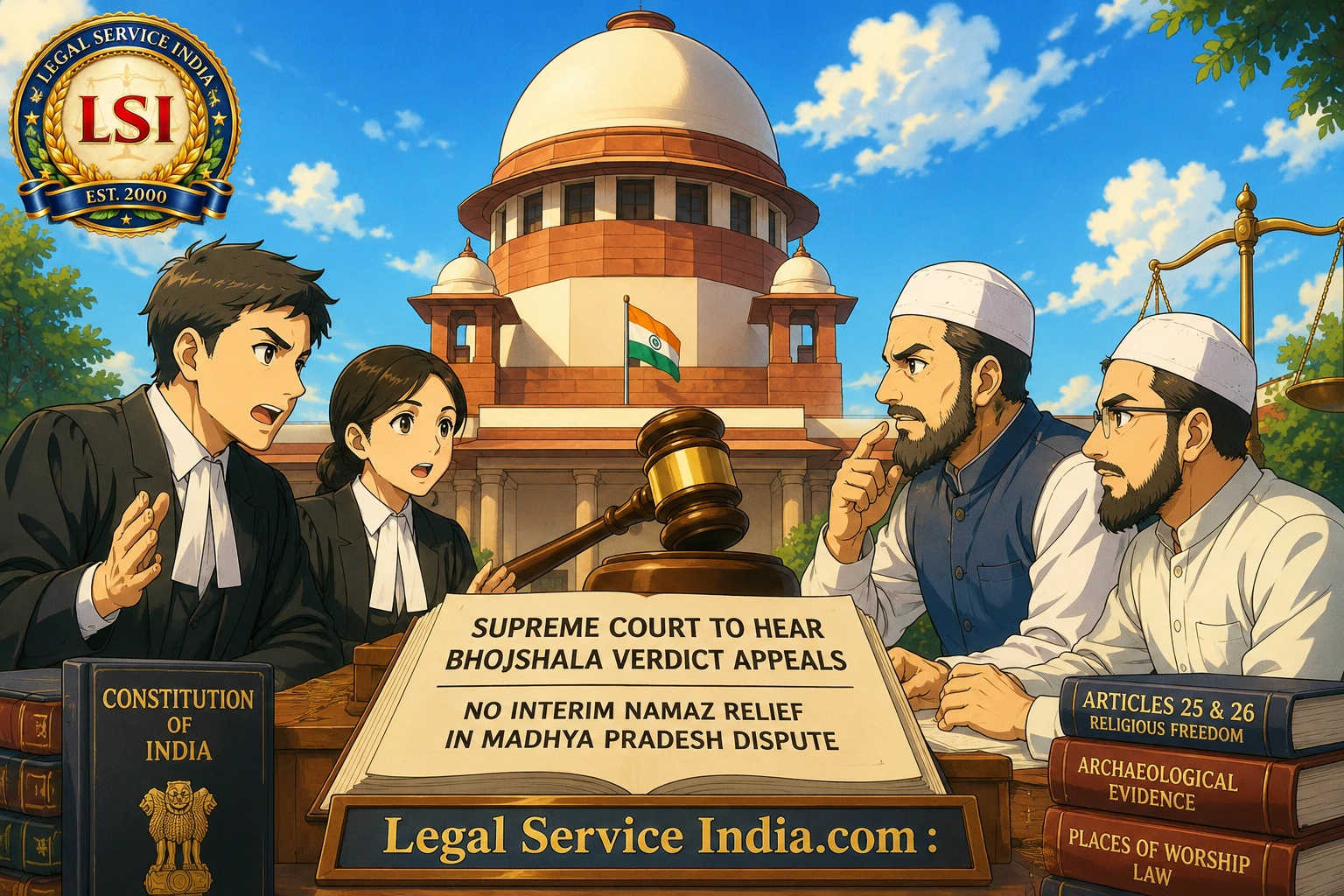
Supreme Court to Examine Madhya Pradesh High Court’s Bhojshala Verdict: Muslims’ Appeals Admitted, Interim Prayer Request Declined
Introduction
The Supreme Court of India has taken up one of the most sensitive religious property disputes currently pending before the judiciary by agreeing to hear appeals filed by members of the Muslim community against the Madhya Pradesh High Court’s landmark judgment declaring the historic Bhojshala complex in Dhar to be a Hindu temple dedicated to Goddess Saraswati. At the same time, the Court declined to grant interim permission for offering namaz inside the disputed premises during the pendency of the appeals.
Although the order is purely interlocutory, it is legally significant because the Supreme Court has agreed to judicially examine the correctness of a judgment that has profound implications for religious freedom, historical evidence, archaeological interpretation, and the law governing disputed places of worship.
The litigation now moves from the factual findings of the High Court to constitutional scrutiny before the country’s highest court.
Citation: Special Leave Petitions (SLPs) against the Madhya Pradesh High Court judgment dated 15 May 2026 in the Bhojshala-Kamal Maula Mosque dispute, Supreme Court proceedings dated 14 July 2026.
Background of the Bhojshala Dispute
The Bhojshala-Kamal Maula complex is situated in the Dhar district of Madhya Pradesh and has remained a subject of dispute for decades.
The Hindu side asserts that the structure is the ancient Bhojshala, a celebrated temple and center of Sanskrit learning established during the reign of King Bhoja and dedicated to Goddess Saraswati.
The Muslim side, on the other hand, claims that the structure has functioned as the Kamal Maula Mosque for centuries and that Muslims possess the right to offer prayers there.
Because of competing claims, the Archaeological Survey of India (ASI), which manages the monument, had evolved an administrative arrangement in 2003 permitting Hindus and Muslims to worship on different days under specified conditions.
This arrangement continued for many years while litigation remained pending.
The Madhya Pradesh High Court Judgment
On 15 May 2026, the Indore Bench of the Madhya Pradesh High Court delivered an extensive judgment running into hundreds of pages.
The court concluded that:
- Bhojshala is fundamentally a Hindu temple dedicated to Goddess Saraswati.
- Historical material and archaeological evidence supported the Hindu claim.
- The 2003 ASI administrative arrangement permitting Friday namaz was unsustainable.
- The ASI circular allowing Muslim prayers deserved to be quashed.
- Future management of the monument would be governed in accordance with the Court’s directions.
The judgment relied upon archaeological findings, historical records, inscriptions, expert reports, and documentary evidence produced during the proceedings.
Appeals Before the Supreme Court
Aggrieved by the High Court decision, Muslim appellants approached the Supreme Court through Special Leave Petitions under Article 136 of the Constitution.
The appeals challenge both the factual conclusions and the legal reasoning adopted by the High Court.
The principal grievances include the following:
- alleged misappreciation of archaeological evidence;
- improper evaluation of historical documents;
- interference with long-standing worship arrangements;
- violation of constitutional guarantees relating to religious freedom;
- consequences flowing from setting aside the ASI’s 2003 administrative order.
Supreme Court’s Order
A bench of the Supreme Court agreed to entertain the appeals and issued notice.
However, while doing so, the court declined to grant immediate interim relief permitting Muslims to resume namaz inside the disputed structure.
The Court chose not to alter the prevailing legal position pending a detailed examination of the issues raised in the appeals.
This reflects a well-established judicial principle that appellate courts generally avoid disturbing the existing position unless a strong case for interim intervention is demonstrated.
Why the Interim Refusal Matters
The refusal to grant interim relief should not be misunderstood as an endorsement of the High Court judgment.
Indian appellate jurisprudence consistently distinguishes between the following:
- admission of an appeal;
- grant of interim relief; and
- final adjudication.
When the Supreme Court admits a matter but refuses interim relief, it merely indicates that the Court considers the issues worthy of examination while preferring not to modify the operative situation until arguments are fully heard.
Such orders do not prejudge the merits of either side.
Constitutional Questions Before the Supreme Court
The appeals are expected to raise several important constitutional questions.
1. Religious Freedom under Articles 25 and 26
The Muslim appellants are likely to contend that denial of access for worship affects their fundamental rights guaranteed under Articles 25 and 26.
Conversely, the Hindu parties may argue that recognition of the temple merely restores the historical religious character of the site.
The Supreme Court will have to reconcile competing claims to religious freedom.
2. Scope of Appellate Review
Another important issue concerns the extent to which the Supreme Court should interfere with detailed factual findings rendered by the High Court after evaluating extensive documentary and archaeological evidence.
Ordinarily, appellate courts exercise caution before disturbing such findings unless they are shown to be perverse or legally unsustainable.
3. Evidentiary Value of Archaeological Material
One of the central issues will concern the following:
- archaeological reports;
- inscriptions;
- historical literature;
- architectural features;
- expert testimony.
The Court may have to examine the evidentiary standards applicable where historical and archaeological evidence forms the basis of judicial determination.
4. Administrative Powers of the Archaeological Survey of India
The validity of the ASI’s 2003 administrative arrangement allowing separate worship schedules may also come under scrutiny.
The court may examine the following:
- whether ASI possessed statutory authority to create such an arrangement;
- whether executive directions can determine worship rights;
- whether such arrangements can override judicial findings regarding title or religious character.
Relationship with Earlier Supreme Court Orders
It is important to note that the Supreme Court has previously dealt with interim aspects of the Bhojshala dispute.
Earlier proceedings ensured that the status quo of the monument was protected while archaeological surveys continued and that no irreversible alteration of the site’s character would take place without the Court’s permission.
The present appeals arise after the High Court’s final judgment, placing the substantive issues before the Supreme Court for authoritative determination.
Wider Legal Significance
This litigation extends beyond the Bhojshala complex.
The eventual judgment may influence future cases involving:
- disputed historical religious structures;
- interpretation of archaeological evidence;
- management of protected monuments;
- competing worship rites;
- constitutional balancing between different religious communities.
Given the continuing national debate over religious heritage sites, the Supreme Court’s reasoning is likely to be closely examined by constitutional scholars, historians, archaeologists, and legal practitioners alike.
Judicial Restraint at the Interim Stage
From a litigation perspective, the Supreme Court’s approach demonstrates judicial restraint.
Instead of issuing immediate directions affecting worship rights, the Court has preferred to first hear the parties comprehensively.
Such restraint serves multiple purposes:
- preserving institutional neutrality;
- avoiding irreversible consequences;
- ensuring that sensitive constitutional issues are decided only after full arguments;
- maintaining public confidence in the judicial process.
Possible Issues During Final Hearing
| Issue | Likely Question |
|---|---|
| Historical Character | What was the original religious nature of the structure? |
| Archaeology | How should ASI findings be interpreted? |
| Religious Rights | Do both communities possess legally enforceable worship rights? |
| Executive Orders | Was the 2003 ASI arrangement legally valid? |
| Constitutional Principles | How should Articles 25 and 26 be balanced in a disputed heritage site? |
| Appellate Review | Should the High Court’s factual conclusions be disturbed? |
Legal Analysis
As a practitioner before the Supreme Court, one important aspect deserves emphasis.
The present order is procedural rather than determinative. By admitting the appeals, the Supreme Court has recognized that substantial questions of law and fact merit examination. Equally, by declining interim relief, it has refrained from expressing any opinion on the correctness of the High Court’s conclusions.
This distinction is vital. Interim orders are governed by considerations such as balance of convenience, irreparable injury, and preservation of the status quo, whereas the final decision will rest on a comprehensive assessment of constitutional principles, historical evidence, archaeological material, and applicable law.
The Supreme Court’s ultimate judgment is therefore expected to become the definitive precedent governing the Bhojshala-Kamal Maula dispute.
The Supreme Court’s decision to hear the Muslim appellants’ challenge marks the beginning of the final chapter in one of India’s most closely watched religious property disputes. While the Court has declined interim permission for namaz within the disputed premises, it has left every substantive issue open for adjudication.
The final verdict will likely clarify the legal principles governing the evidentiary value of archaeological findings, the scope of executive arrangements concerning protected monuments, and the constitutional balance between competing claims of religious worship. Given the sensitivity of the dispute and its broader implications, the judgment is expected to become an important addition to India’s constitutional and religious property jurisprudence.
Key Takeaways
The following are the key takeaways from the Supreme Court proceedings concerning the Bhojshala- Kamal Maula dispute:
- Supreme Court admits appeals: The Supreme Court has agreed to hear the appeals filed by Muslim petitioners challenging the Madhya Pradesh High Court’s judgment declaring the Bhojshala complex in Dhar as a Hindu temple.
- No interim permission for namaz: While issuing notice in the appeals, the Supreme Court declined to grant interim permission for offering namaz at the disputed Bhojshala-Kamal Maula complex, leaving the High Court’s directions operative for now.
- High Court’s landmark ruling under challenge: The appeals challenge the Madhya Pradesh High Court’s 15 May 2026 judgment, which held that Bhojshala is a temple dedicated to Goddess Saraswati and quashed the 2003 ASI arrangement permitting Friday namaz.
- Constitutional issues to be examined: The Supreme Court will consider significant questions relating to Articles 25 and 26 of the Constitution, religious freedom, competing worship rights, and the legal status of disputed religious sites.
- Archaeological evidence at the center: The final verdict is expected to clarify the evidentiary value of archaeological reports, inscriptions, historical records, and expert testimony in determining the religious character of ancient monuments.
- ASI’s powers under scrutiny: The court will also examine whether the Archaeological Survey of India (ASI) had the legal authority to create a shared worship arrangement through its 2003 administrative order.
- Interim order is not a final verdict: The Supreme Court’s refusal to grant interim relief does not amount to an affirmation of the High Court’s findings. The Court has kept all legal and factual issues open for final adjudication.
- Potential precedent for future disputes: The final judgment is likely to become a significant precedent on religious property disputes, management of protected monuments, archaeological evidence, and constitutional rights relating to places of worship.
- Status quo to continue: Until the Supreme Court decides the appeals, the existing legal position established by the Madhya Pradesh High Court will continue, ensuring that no interim changes are made to the disputed site’s management.
- Why this case matters: The Bhojshala dispute is one of India’s most closely watched religious heritage cases. The Supreme Court’s eventual decision could shape future litigation involving historical religious structures, temple-mosque disputes, and the interpretation of constitutional protections for religious freedom.
Quick Reference Summary
| Issue | Key Point |
|---|---|
| Appeals | The Supreme Court has agreed to hear the Muslim petitioners’ appeals. |
| Interim Relief | No interim permission for offering namaz has been granted. |
| High Court Judgment | The 15 May 2026 Madhya Pradesh High Court judgment is under challenge. |
| Constitutional Questions | Articles 25 and 26, religious freedom, and competing worship rights will be examined. |
| Evidence | Archaeological reports, historical records, inscriptions, and expert testimony will be scrutinized. |
| ASI’s Role | The legality of the ASI’s 2003 shared worship arrangement will be reviewed. |
| Interim Order | The refusal of interim relief is not a final decision on the merits. |
| Legal Significance | The judgment may become an important precedent for future religious property disputes. |
| Present Position | The status quo established by the Madhya Pradesh High Court will continue. |
| Why It Matters | The final verdict could influence future litigation concerning historical religious structures and constitutional protections for religious freedom. |
Frequently Asked Questions (FAQs)
Why did the Supreme Court agree to hear the appeals?
The Supreme Court agreed to examine the Muslim appellants’ challenge to the Madhya Pradesh High Court’s judgment because the appeals raise substantial questions relating to constitutional rights, archaeological evidence, historical findings, and religious freedom.
Did the Supreme Court allow namaz at the Bhojshala complex?
No. While issuing notice in the appeals, the Supreme Court declined to grant interim permission for offering namaz inside the disputed premises.
Is the Madhya Pradesh High Court judgment final?
No. The High Court judgment is presently under challenge before the Supreme Court through special leave petitions.
What issues will the Supreme Court examine?
The Court is expected to examine constitutional questions concerning Articles 25 and 26, archaeological evidence, competing worship rights, the legality of the ASI’s 2003 arrangement, and the correctness of the High Court’s findings.
Why is the Bhojshala dispute legally significant?
The final judgment may become an important precedent governing religious property disputes, archaeological evidence, protected monuments, and constitutional rights relating to places of worship.
Final Word
The Supreme Court’s eventual judgment in the Bhojshala-Kamal Maula dispute is expected to provide authoritative guidance on constitutional protections for religious freedom, the evidentiary value of archaeological material, competing worship rights, and the legal framework governing protected heritage monuments in India.