





Abstract
In 2024–25 alone, over 56% of advertisements reviewed in India were found to be misleading, revealing a marketplace where consumer perception is not merely influenced but systematically engineered. [1] In contemporary markets, branding no longer merely identifies products; it constructs consumer perception itself.
The increasing commodification of visual and experiential branding has exposed a structural gap in Indian commercial law: the absence of a coherent framework governing the transition of customary market practices into proprietary rights.
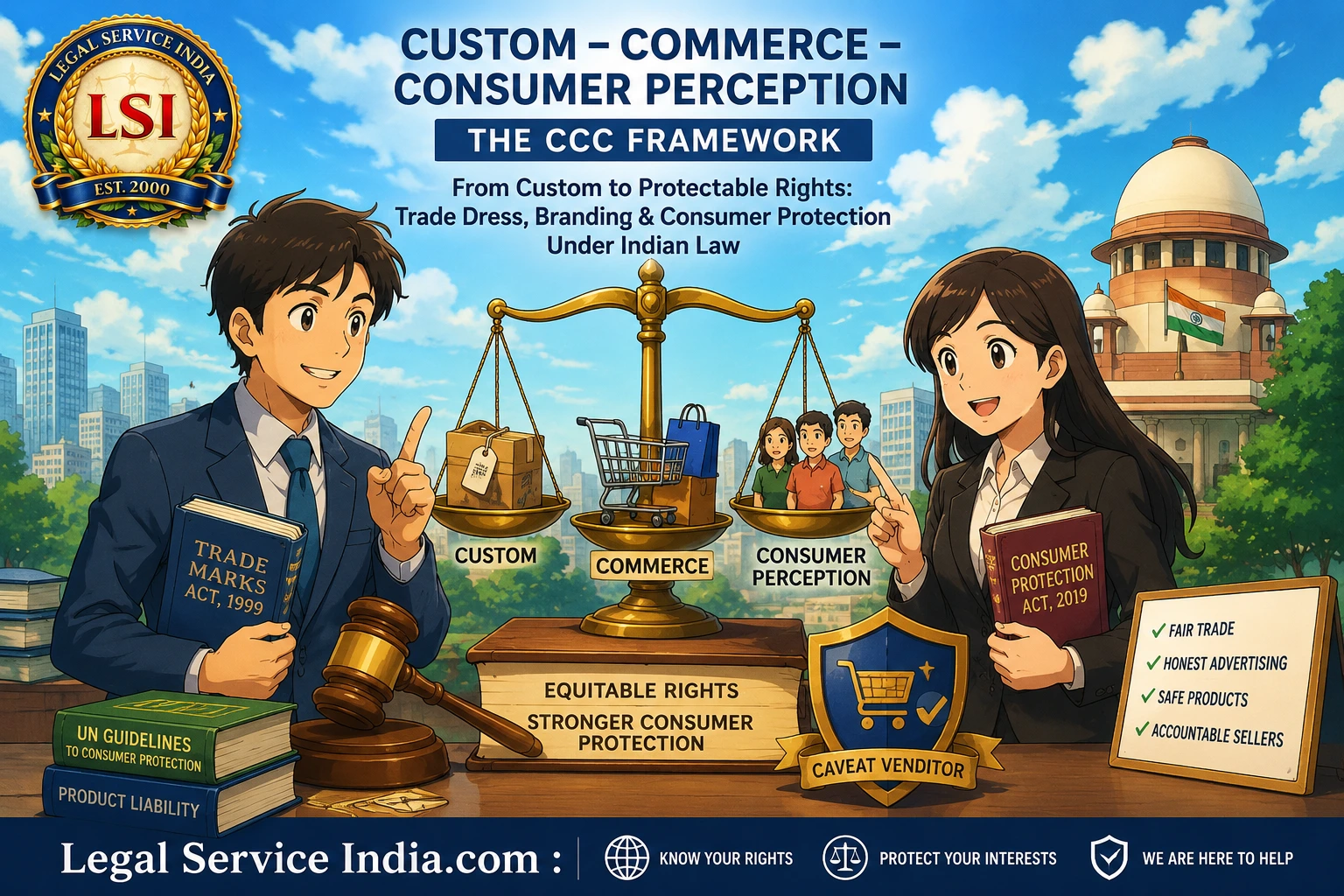
This paper develops the Custom–Commerce–Consumer Perception (CCC) framework to explain how elements traditionally considered publici juris evolve into protectable trade dress through sustained commercial use and consumer association.
Drawing on doctrinal analysis of the Trade Marks Act, 1999 [2], Indian Contract Act, 1872 [3], and Consumer Protection Act, 2019, alongside key judicial precedents such as Colgate Palmolive Co. v. Anchor Health and Beauty Care Pvt. Ltd [4], the paper demonstrates the fragmented and reactive nature of the existing regime.
It argues that neither trademark law, contract law, nor consumer protection law [5] independently captures the psychological and commercial realities of modern branding, particularly in digital markets.
To address this lacuna, the paper proposes a unified “Trade Dress and Experiential Branding Bill” that integrates proprietary protection with consumer-centric regulation.
By situating the CCC framework within comparative and international trends, the study contributes to emerging global debates on the propertisation of commercial aesthetics and the regulation of consumer perception.
Keywords
- Trade Dress
- Consumer Perception
- Customary Law
- Trademark Law
- Comparative Law
- Consumer Protection
Evolution by Law from Caveat Emptor to Caveat Venditor
Consumer Protection Act, 1986 [6] to Consumer Protection Act, 2019
The shift in the jurisprudential perspective of caveat emptor (buyer beware) to caveat venditor (seller be accountable). It has been observed that although the 1986 Act formulated basic consumer rights and a three-tier quasi-judicial redressal structure, it failed to provide the structure to deal with the digital complexities in the market.
The 2019 Act extended statutory definitions of a consumer (Section 2(7)) and service (Section 2(42)) to specifically apply to e-commerce and online transactions.
In the case of the contemporary consumer dispute, the practitioners should circumvent the constraints of the reactive nature of the previous regime and invoke the Central Consumer Protection Authority (CCPA) of Section 10 of the 2019 Act to bring a class action suit, parody, and mandatory product recall. [7]
Major Legislative Reforms Under the 2019 Act
| Aspect | Consumer Protection Act, 1986 | Consumer Protection Act, 2019 |
|---|---|---|
| Consumer Rights | Basic consumer rights framework | Expanded framework covering digital and e-commerce transactions |
| Definition of Consumer | Traditional transactions | Extended under Section 2(7) to e-commerce and online transactions |
| Definition of Service | General services | Expanded under Section 2(42) |
| Regulatory Authority | Three-tier quasi-judicial mechanism | Central Consumer Protection Authority (CCPA) empowered under Section 10 |
| Consumer Remedies | Primarily reactive | Class action suits, mandatory product recall, and stronger enforcement |
United Nations Guidelines to Consumer Protection (UNGCP) and Indian Consumer Law
The United Nations Guidelines to Consumer Protection (UNGCP) was the main template of the 2019 Indian legislative overhaul.
Under the influence of the UNGCP, the 2019 Act allowed the State and National Commissions to invalidate standardised, alienated and arbitrary clauses, with the concept of unfair contracts, under Section 2(46). [8]
In the case of problematic one-sided builder-buyer contracts or digital contracts under standard terms, expressly assert Section 2(46) of the 2019 Act. [9]
Key Features of the Consumer Protection Act, 2019
- Recognition of e-commerce and online consumers.
- Expanded statutory definitions of consumer and service.
- Creation of the Central Consumer Protection Authority (CCPA).
- Recognition of unfair contracts under Section 2(46).
- Provision for class action remedies and mandatory product recalls.
- Enhanced protection against unfair trade practices in digital markets.
Landmark Judicial Precedent
Cases like Lucknow Development Authority v. M.K. Gupta [10], where the Supreme Court made the decision that “the statutory authorities that provide housing, construction or development services are squarely in the definition of service in the Consumer Protection Act. This ruling forever abrogated the veil of sovereign immunity of public entities.”
It has set the binding precedent, which allows consumer courts to grant damages on the grounds of harassment and mental torture due to the non-malicious but arbitrary and capricious actions of the public servants.
Legislative Intent, Product Liability and E-Commerce
In 2018-2019, the parliamentary debates revealed the vexing regulatory gap about e-commerce manipulations and flawed products under the 1986 Act. The arguments led to the formulation of stringent product liability in Section 84 of the 2019 Act, whereby the manufacturer, seller and service providers were held liable without the consumer proving tortious negligence. When it concerns the faulty goods that lead to injuries or even death, claims should be made within Chapter VI of the 2019 Act. [11] Exploit the graduated penalty system elaborated in the legislature, which can impose harsh penalties, such as huge financial fines and imprisonment for serious damages.
Key Features of Product Liability Under the 2019 Act
| Aspect | Details |
|---|---|
| Legislative Background | Parliamentary debates during 2018-2019 highlighted regulatory gaps in e-commerce and defective products. |
| Statutory Provision | Section 84 of the Consumer Protection Act, 2019. |
| Persons Liable | Manufacturer, seller and service providers. |
| Consumer Requirement | No requirement to prove tortious negligence. |
| Applicable Claims | Faulty goods causing injuries or death under Chapter VI of the 2019 Act. |
| Possible Penalties | Huge financial fines and imprisonment for serious damages. |
Lex Mercatoria and Indian Business Law
Indian business law has been effective in balancing statutory laws with the international trade practices (lex mercatoria). The Indian Contract Act, 1872, in Section 1 expressly saves any usage or custom of trade not inconsistent with the Act. [12] Section 28(2) of the Arbitration and Conciliation Act, 1996, allows tribunals to make decisions on disputes according to transnational commercial principles and trade usages provided that the parties agree. [13] The Supreme Court case Cox and Kings Ltd vs SAP India Pvt. Ltd and another approved the application of the doctrine of the Lex Mercatoria-derived group of companies that allowed non-signatories to be subject to arbitration due to mutual intent and composite transactions. In writing cross-border arbitration clauses, make express reference to trade usages. [14] In the process of enforcement, use Cox and Kings to seize affiliate corporate persons engaging in composite transactions and defeating any hard corporate veil defences.
Statutory Framework Supporting Lex Mercatoria
| Legal Provision | Purpose |
|---|---|
| Section 1, Indian Contract Act, 1872 | Recognises trade usages and customs that are not inconsistent with the Act. |
| Section 28(2), Arbitration and Conciliation Act, 1996 | Permits arbitral tribunals to apply transnational commercial principles and trade usages with party consent. |
| Cox and Kings’ Judgement | Recognised the Group of Companies doctrine and application of Lex Mercatoria principles. |
Practical Considerations for Cross-Border Disputes
- Make express reference to trade usages while drafting cross-border arbitration clauses.
- Use Cox and Kings to seize affiliate corporate persons engaging in composite transactions.
- Defeat hard corporate veil defences by relying upon mutual intent and composite transactions.
Justice Wadhwa Committee and Unfair Trade Practices
The Justice Wadhwa Committee, which was constituted by the Supreme Court, probed into systemic malpractices in the Targeted Public Distribution System (TPDS). Findings of the committee specifically touched on the practice of hoarding, shortage or diversion, now squarely covered by the definition of unfair trade practices in Section 2(47) of the Act. [15] In any case of litigation that includes distribution of important commodities or lack of a systemic provision of services, apply the framework of the committee to prove deficiency in service in the consumer forums. Use these results to insist on accountability and grievance-redressing measures against state-appointed dealers. [16]
Application of the Justice Wadhwa Committee Framework
- Hoarding.
- Shortage of essential commodities.
- Diversion of goods under the TPDS.
- Deficiency in service before consumer forums.
- Accountability of state-appointed dealers.
- Grievance redressing measures.
False Advertisements and Consumers
Subsection 2(28) of the 2019 Act expressly forbids misleading advertisements that mislead the consumer, which are determined on a test of reasonable perception of an objective, reasonable consumer of an advertisement of the advertiser. [17] New Supreme Court instructions in the Patanjali case (Indian Medical Association) [18]. The enforcement has been radically increased by the union of India and requires self-disclosure by advertisers before publication and equal liability on celebrity endorsers and influencers.
Requirements for Advertisers and Endorsers
| Requirement | Description |
|---|---|
| Misleading Advertisements | Prohibited under Subsection 2(28) of the 2019 Act. |
| Consumer Test | Objective: reasonable consumer perception. |
| Supreme Court Directions | Enhanced enforcement following the Patanjali case (Indian Medical Association). [18] |
| Self-Disclosure | Mandatory before publication. |
| Liability | Equal liability on celebrity endorsers and influencers. |
Compliance for FMCG and Healthcare Brands
In the case of FMCG or healthcare brands, it is obligatory that all the 2022 CCPA guidelines are followed and that self-declarations are uploaded prior to the release of the advertisement. In cases with complainants, file directly before the CCPA under Section 21 of the 2019 Act to seek penalties of 50 lakh and product bans of false claims in case of penalties on public health. [19]
Recommended Compliance Checklist
- Follow all the 2022 CCPA Guidelines.
- Upload self-declarations before advertisement release.
- Ensure claims are capable of substantiation.
- Avoid misleading advertisements and false claims.
- Where appropriate, file complaints before the CCPA under Section 21 of the 2019 Act.
- Seek penalties up to 50 lakh and product bans in matters affecting public health.
Research Gap
Over the past two decades, particularly in the post-liberalisation and digital expansion phase between 2000 and 2025, Indian commercial law has witnessed an exponential transformation in the way brands operate, compete, and influence consumer behaviour. [20] Corporations, digital platforms, and advertisers have increasingly shifted from selling products to curating immersive brand experiences, where visual identity, packaging, interface design, and narrative collectively shape consumer perception. [21] However, this evolution has not been matched by a corresponding doctrinal or legislative response. [22] The regulation of such experiential branding remains dispersed across the Trade Marks Act, 1999 [23] and the Consumer Protection Act, 2019 [24], resulting in a fragmented legal response to what is, in practice, a unified commercial phenomenon.
Key Dimensions of the Research Gap
| Aspect | Description |
|---|---|
| When | 2000–2025, post-liberalisation, digital expansion. |
| Who | Corporations, platforms, advertisers, courts, and consumers. |
| What | Experiential branding, trade dress, and the perception economy. |
| Where | The Indian legal framework, including statutory regimes and digital marketplaces. |
| Why the Problem Exists | Structural fragmentation and doctrinal lag. |
| How It Manifests | Judicial inconsistency, over-propertisation, and remedial inefficiency. |
| So What | The absence of an integrated legal framework capable of coherently regulating the transformation of custom into proprietary brand identity. |
Fragmentation and Judicial Uncertainty
This fragmentation creates uncertainty for courts, businesses, and consumers alike, particularly in digital marketplaces where the boundaries between information, persuasion, and manipulation are increasingly blurred. [25] Judicial reliance on indeterminate, multi-factor tests of distinctiveness and deceptive similarity further compounds this uncertainty [26], producing inconsistent outcomes and enabling dominant market actors to incrementally appropriate elements of the commercial commons. [27]
Theoretical and Practical Implications
From a theoretical standpoint, this raises a deeper tension between incentivising brand investment and preserving competitive market access, echoing concerns of a tragedy of the anticommons. [28] Additionally, the bifurcation of enforcement between private trademark litigation and regulatory intervention leads to procedural inefficiencies and incomplete remedies. [29]
Core Research Gap Addressed
Accordingly, the central gap addressed by this study lies in the absence of a coherent, integrated framework that reconciles proprietary rights, consumer protection, and evolving commercial practices. [30]
Introduction
The Development of Custom into Property
The modern trademark law environment is more and more struggling with one of its most fundamental questions: at what point does a customary practice, formerly a member of the commercial commons, become a proprietary object? This shift is the core of the Custom, Commerce, and Consumer Perception (CCC) model. In the past, the elements of the public domain, which are referred to as publici juris, were regarded to be not monopolisable by a person. Nevertheless, recent jurisprudence has been moving toward the appreciation of the fact that even customary features may obtain protection as long as the features extend beyond their functional or descriptive origins to evoke a particular source of commerce.
The law specifically acknowledges under the Trade Marks Act, 1999, that marks originally descriptive or customary can defeat grounds of refusal on the basis of sustained use.
Section 9 of the Trade Marks Act, 1999
Section 9(1) of the Trade Marks Act, 1999, does not allow registration of marks that solely comprise marks or indications that have become customary in the contemporary language or that have established practices in the trade. The law contains a severe exception:
“Provided that a trade mark shall not be refused registration if before the date of application for registration it has acquired a distinctive character as a result of the use made of it or is a well-known trade mark.”[31]
This legislative practice reflects international practices on the World Trade Organization-managed TRIPS Agreement. The Trade Marks Act of 1999 in India was adopted in order to be in line with TRIPS. In making the case that non-traditional marks have statutory validity, reference the following international specifications:
Relevant TRIPS Agreement Provisions
| Provision | Key Principle |
|---|---|
| Article 15(1) | “Any sign, or any combination of signs, capable of distinguishing the goods or services of one undertaking from those of other undertakings, shall be capable of constituting a trademark.” |
| Article 15(3) | Permits member states to condition registrability on distinctiveness acquired through use. |
| Article 16(1) | “The owner of a registered trademark shall have the exclusive right to prevent all third parties not having the owner’s consent from using in the course of trade identical or similar signs…”[32] |
The collective effect of these provisions is to strengthen the CCC framework by putting consumer perception in the centre of converting a traditional commercial aspect into the legally enforceable proprietary right. In order to assert exclusive title to a customary feature, a proprietor needs to prove that the feature has taken a secondary meaning.
The test mentioned in Mahendra and Mahendra Paper Mills Ltd. v. Mahindra and Mahindra Ltd. (2002) is that the concerned section of the population has come to know that the goods or services have a specific origin owing to the long and continuous commercial application.[33]
United Kingdom Position Under the Trade Marks Act 1994
A similar doctrinal stance in the United Kingdom is under the Trade Marks Act 1994. Section 3(1)(d) of the Act states that:
“(d) trade marks which consist exclusively of signs or indications which have become customary in the current language or in the bona fide and established practices of the trade:
Provided that, a trademark shall not be refused registration by virtue of paragraph (b), (c) or (d) above if, before the date of application for registration, it has in fact acquired a distinctive character as a result of the use made of it.”[34]
But, like the Indian law, this bar is not subject to the essential exception of acquired distinctiveness. So the similarity between the two jurisdictions is that both follow a structurally parallel approach: the commercial commons should not be susceptible to an untimely monopolisation but active use which can produce a consumer association can warrant proprietary protection.
This parallelism builds on the normative authority of the CCC framework as a transnational paradigm of doctrines and not a strictly domestic creation.
The Transformation Theory
The Transformation Theory describes how the transition from shared custom to individual property takes place, and it has three stages:
| Stage | Description |
|---|---|
| Stage I: Traditional Practice | As publici juris. An example is the adoption of a certain design of packaging containers or even the colour schemes that are common within a certain industry. |
| Stage II: Commercial Appropriation | A company invests a lot in marketing, making the practice a part of its own brand story. |
| Stage III: Consumer Association | This is where the overall look and feel is an identifier of source. |
In the Indian case, Colgate Palmolive Company v. Anchor Health and Beauty Care Pvt., it was quoted:
“Trade dress is the soul of every corporation… it is the visual representation that creates an immediate impression on the consumer’s mind.”[35]
Comparative Jurisprudence on Aesthetic Features
The tension of commoditising aesthetic features is also shed more light on through comparative jurisprudence.
United States Approach
In the United States Supreme Court case of Qualitex Co. v Jacobson Products Co., the court stated that:
“There is no objection to the use of colour alone as a trademark when that colour has attained a secondary meaning and therefore identifies and distinguishes a particular brand.”[36]
European Union Approach
Conversely, the European Commission Court of Justice in Libertel Groep BV v Benelux-Merkenbureau warned that
“Where registration of a trademark may be refused or the trademark declared invalid – Trademark devoid of distinctive character – Determination whether a trademark has a distinctive character – Examination by reference to the actual situation, including use made of the mark.”
Alongside,
“A colour per se is capable of constituting a trademark within the meaning of Article 2 of First Directive 89/104 relating to trademarks provided that it is a sign which is capable of graphic representation and of distinguishing the goods or services of one undertaking from those of other undertakings.”[37]
Comparative Analysis
| Jurisdiction | Position on Customary Features |
|---|---|
| India | Protection is available when acquired distinctiveness and consumer association are established. |
| United Kingdom | Follows a similar statutory framework with the exception of acquired distinctiveness. |
| United States | Recognises protection for colours and other non-traditional marks upon proof of secondary meaning. |
| European Union | Permits registration only where the mark possesses distinctive character and satisfies graphical representation requirements. |
Conclusion
These inconsistent strategies show that whereas the CCC framework resonates well all over the globe, jurisdictions vary widely in the level at which custom is crossed to exclusive property.
Historical Background: The Tradition of Merchant to Statute
The trademark law has developed in a history akin to that of the Indian commercial law in general, with unwritten customs being codified. Before the formal enactment of law, most devices, such as hundis, were regulated by the law merchant or local practice.
Section 1 of the Indian Contract Act, 1872, specifically conserves any usage or custom of trade that is not against the Act. This brings out a legal principle on which commercial law does not displace custom but tends to internalise and codify it.[38]
Competition and Goodwill in the CCC Framework
The CCC framework—Custom, Commerce and Consumer Perception—is an analysis model used to establish the point of proprietary conversion.
The legislation has to strike a balance between the safeguarding of the hard-earned goodwill of a brand and the necessity to maintain the openness of the so-called commercial commons to healthy competition.
Core Elements of the CCC Framework
| Element | Role in Trademark Law |
|---|---|
| Custom | Represents long-standing commercial practices and trade usage. |
| Commerce | Reflects the business environment in which trademarks acquire value. |
| Consumer Perception | Determines whether a mark has acquired proprietary significance and legal protection. |
This is stated as the Supreme Court of India put it in Laxmikant V. Patel v. Chetanbhat Shah (2002):
“The law does not permit anyone to carry on his business in such a way as would persuade the customers or clients to believe that the goods or services belonging to someone else are his or are associated therewith.”[39]
Analysing the conflict of publici juris and gained distinctiveness, the given paper answers the major question: at what point should a custom no longer be a part of the marketplace but rather the uniqueness of a brand?
The solution to this is evidenced by the consumer perception—the ultimate adjudicator of the common usage on the trademark protection road.
Key Issues Examined
- Conflict between publici juris and gained distinctiveness.
- Protection of goodwill versus preservation of fair market competition.
- The role of consumer perception in determining trademark protection.
- The transition from common commercial usage to proprietary brand identity.
Research Methodology
The research takes a mixed research design of law research, combining doctrinal, empirical, historical, and comparative methods.
The paper examines the overlapping of the trademark law, contract law, and consumer protection so that the traditional commercial practices turn into the legally binding brand identity under the framework of such doctrines as secondary meaning and trade dress.
Research Approach
| Research Method | Purpose |
|---|---|
| Doctrinal | Examines statutes, judicial precedents, and legal doctrines. |
| Empirical | Evaluates practical implications of trademark protection. |
| Historical | Studies the evolution of commercial customs into statutory law. |
| Comparative | Compares overlapping principles of trademark law, contract law, and consumer protection. |
Doctrinal Legal Research
The chief approach is a logical examination of precise legal statutes and stipulations:
Key Statutory Framework
- The Trade Marks Act, 1999: Particularly, Section 9 (Absolute grounds of refusal of registration) and Section 11 (Relative grounds of refusal), which dwell on the acquired distinctiveness. [40]
- The Indian Contract Act, 1872: Section 1 in particular, which preserves valid usages or customs of trade against the operation of the Act. [41]
- The Consumer Protection Act, 2019: Particularly accords with 2(28) (misleading advertisement) and 2(47) (unfair trade practice). [42]
Summary of Primary Legislation
| Legislation | Relevant Provision(s) | Purpose in Research |
|---|---|---|
| The Trade Marks Act, 1999 | Section 9, Section 11 | Examines absolute and relative grounds of refusal and acquired distinctiveness. |
| The Indian Contract Act, 1872 | Section 1 | Preserves valid usages or customs of trade. |
| The Consumer Protection Act, 2019 | Section 2(28), Section 2(47) | Addresses misleading advertisements and unfair trade practices. |
Primary Sources
Primary Sources: Parliamentary debates and Law Commission reports reached through PRS Legislative Research.
Judicial Analysis and Case Study Method
The paper employs a reviewed qualitative analysis of particular judicial rulings to determine the development of trade dress and attained distinctiveness.
Indian Precedents
- Cadila Health Care Ltd v Cadila Pharmaceuticals Ltd – The test of deceptive similarity was established. [43]
- Shree Nath Heritage Liquor Pvt. Ltd. v. Allied Blender and Distillers Pvt. Ltd. – trade dress and consumer confusion. [44]
Foreign Precedents
- The Qualitex Co. v. Jacobson Products Co., Inc. case was a decision by the US Supreme Court on the use of colour as a trademark. [45]
- Reckitt and Colman Products Ltd. – The “Classic Trinity” test of passing off – The House of Lords in the UK having established the test. [46]
Judicial Precedents Overview
| Category | Case | Legal Principle |
|---|---|---|
| Indian | Cadila Health Care Ltd v Cadila Pharmaceuticals Ltd | Test of deceptive similarity. |
| Indian | Shree Nath Heritage Liquor Pvt. Ltd. v. Allied Blender and Distillers Pvt. Ltd. | Trade dress and consumer confusion. |
| Foreign | The Qualitex Co. v. Jacobson Products Co., Inc. | Recognition of colour as a trademark. |
| Foreign | Reckitt and Colman Products Ltd. | “Classic Trinity” test of passing off. |
Analysis of Historical and Customary Law
This way follows the process of the unwritten mercantile customs evolving into written law.
The historical mercantile instruments such as Hundis that were maintained under the Negotiable Instruments Act, 1881, were analysed. [47]
The research is on the impact of traditional commercial practice on the principles established by the modern Indian law on the contract and trade.
Empirical and Statistical Analysis
The study uses quantitative data to evaluate the effectiveness of consumer grievance redressal mechanisms:
| Research Component | Details |
|---|---|
| Datasets | Statistical reports of 2000-2023. |
| Data Sources | National Consumer Disputes Redressal Commission (NCDRC) Portal, e-JAGRITI (CONFONET 2.0). [48] |
| Data Scope | The cumulative analysis of more than 28.57 lakh cases of consumers in order to identify the trend in unfair trade, disposal rates, and pendency rates in district, state, and national commissions. [49] |
Graphical and Data Visualization
In order to offer a clear understanding of what is empirical, the research paper uses visual aids that are built out of official data.
- Visualising the number of consumer dispute filings.
- Heatmap (regions of Maharashtra, Delhi and Uttar Pradesh) based on the data provided by the Department of Consumer Affairs.
The mapping of the doctrinal change between publici juris (public right) and proprietary trade dress and legal avenues on finding the secondary meaning.
Consumer Perception and Survey-Based Indicators
The study incorporates the data on market perception to assess the extent to which visual design elements can determine the capability of the consumer to recognise a commercial source:
- Trademark registry journals.
- Brand recognition survey.
- Public search data to follow brand opposition proceedings.
Case Study: Development of Corporate Brands
The practical implementation of CCC is demonstrated via a case study approach to certain organisations in the world:
| Case Study Element | Details |
|---|---|
| Topic | The branding of Starbucks (e.g., the look of the stores, the colour schemes of green and white, the cup sleeves, etc.). |
| Evidence | Visual brand analysis and trademark filings registered with the Indian Trademark Registry of the manner of how generic features transform into distinctive trade dress. IP India E-Register |
Analysis of Policy and Committee Report
The study examines regulatory measures against market manipulation.
| Source | Description |
|---|---|
| Guidelines to Prevention of Misleading Advertising and Endorsement to Misleading Advertising 2022 | Issued by the Central Consumer Protection Authority (CCPA). |
| Parliamentary Reports | Findings on digital marketplace manipulation by parliamentary standing committees. |
Research Limitations
- The old statistical data (before the year 2000) is usually fragmented, and hence there is a need to use aggregated institutional dashboards such as CONFONET.
- Some market perception databases are proprietary to individual companies, and thus, there are no raw consumer survey data.
- The overlap of the law of domestic contracts and the law of transnational commerce needs special attention to some narrow meanings of national delimitations.
Section 1 of the ICA 1872
Section 1 of the ICA 1872 states the following:
“Nothing herein contained shall affect the provisions of any statute, act or regulation not hereby expressly repealed, nor any usage or custom of trade, nor any incident of any contract not inconsistent with the provisions of this act.” [50]
UK Mercantile Customs and Their Enforceability in India
A UK mercantile custom that should be enforced in India undergoes an Indian evidentiary test of being local, uniform, and notorious and cannot give way to express contractual provisions or statutory prohibitions. Purely domestic contracts (Indian Code) do not have any direct binding force under the Lex Mercatoria (transnational commercial law), as under Section 1 of the ICA.
Application of Lex Mercatoria in Cross-Border Disputes
But, in intercountry disputes, these principles are put in place convincingly in the arbitration processes by the Indian courts. In Cox and Kings Ltd vs SAP India Pvt. Ltd, the Supreme Court accepted the use of transnational commercial principles (such as the Group of Companies doctrine) in cases where the parties have their mutual intent. Section 1 ICA should not be used to automatically import Lex Mercatoria when writing cross-border agreements. To make the governing law clause enforceable, you need to clearly include transnational principles (e.g., UNIDROIT principles) in the governing law clause.[51]
Key Principles for Cross-Border Commercial Contracts
- UK mercantile customs must satisfy the Indian evidentiary test of being local, uniform, and notorious.
- Express contractual provisions and statutory prohibitions prevail over mercantile customs.
- Section 1 of the ICA does not automatically incorporate Lex Mercatoria into domestic contracts.
- Cross-border agreements should expressly incorporate transnational principles such as the UNIDROIT Principles to strengthen the governing law clause.
| Aspect | Position in India |
|---|---|
| UK Mercantile Custom | Subject to Indian evidentiary requirements before enforcement. |
| Domestic Contracts | Lex Mercatoria has no direct binding force under Section 1 ICA. |
| Cross-Border Arbitration | Indian courts may recognise transnational commercial principles where mutual intent exists. |
| Governing Law Clause | Should expressly include transnational principles such as the UNIDROIT Principles. |
Consumer Protection Laws in the UK and India
In the UK, the Consumer Rights Act 2015 has combined consumer rights in the area of satisfactory quality of products, fitness and consumer remedies in case of flawed digital content. Although this statute of the UK is not enforced directly by Indian courts, the CPA 2019 reflects rigorous standards by introducing the strong product liability (Sections 82-87) and the nullification of malicious terms of contracts.[52]
Comparison Between the UK and Indian Consumer Protection Frameworks
| UK Consumer Rights Act 2015 | Consumer Protection Act, 2019 (India) |
|---|---|
| Consumer rights relating to satisfactory quality of products. | Strong product liability under Sections 82–87. |
| Fitness for purpose. | Protection against unfair contractual practices. |
| Remedies for defective digital content. | Nullification of malicious terms of contracts. |
EU Unfair Commercial Practices Directive and Indian Law
The directive (EU Directive 2005/29/EC (Unfair Commercial Practices)) contains a general unfairness ban and a list of 31 deceptive practices (including false reviews and bait advertising). Section 2(47) of CPA, 2019, consists of a list of deceptive practices which define the concept of unfair trade practice and does not contain a European-style catch-all clause.[53]
Comparison of Unfair Commercial Practices Frameworks
| EU Directive 2005/29/EC | Consumer Protection Act, 2019 (India) |
|---|---|
| General prohibition on unfair commercial practices. | Defines unfair trade practices under Section 2(47). |
| Includes a list of 31 deceptive practices. | Lists deceptive practices without a European-style catch-all clause. |
| Covers false reviews and bait advertising. | Addresses deceptive trade practices through statutory definitions. |
Persuasive Value of the EU Directive in India
Although the EU Directive is persuasive in India, it is not binding. One of the main references that the Central Consumer Protection Authority (CCPA) utilizes to sustain a contemporary digital problem such as dark patterns and greenwashing Digital fairness is strongly linked to the EU-style models.[54]
Key Takeaways
- EU consumer protection standards are persuasive but not legally binding in India.
- Section 2(47) of the Consumer Protection Act, 2019, defines unfair trade practices.
- The CCPA draws guidance from EU-style regulatory models while addressing emerging digital issues.
- Dark patterns and greenwashing are examples of contemporary consumer protection concerns influenced by international best practices.
Chapter I: The CCC Doctrine: A Proposal to Introduce a Custom-Commerce-Consumer Perception Framework to the Trade Dress Recognition Under the Trade Marks Act, 1999
Trade dress protection in India is based on the statutory meanings as defined by the Trade Marks Act, 1999. The Act has chosen to take a very wide and encompassing view of what is considered a protectable identifier.
Meaning of “Mark” Under Section 2(1)(m)
“Mark”, as laid down under Section 2(1)(m):
The statute includes a mark as the device, brand, heading, label, ticket, name, signature, word, letter, numeral, shape of goods, packaging or combination of colours. [55]
This broad definition directly accommodates non-traditional marks, which constitute the statutory framework of protecting trade dress by the recognition that visual and sensory cues have a commercial value.
Meaning of the Term ‘Trademark’ (Section 2(1)(zb))
The trade mark should be a mark which can be graphically represented and one which can make a distinction between the goods or services of one individual and the others. [56]
The definition clearly goes to the form of goods, the way they are packaged and the colour combination of goods, which are the fundamental elements of trade dress. Trade dress can be registered under protection in case it meets the following two requirements:
- Graphical representability.
- Distinctive capacity.
Trade Dress Protection Under the TRIPS Agreement
The Indian statutory framework is also aligned with the international standard, that is, the TRIPS Agreement, which defines the minimum standards of trademark distinctiveness and protection.
Article 15.1 states that any sign or a combination of signs which has the ability to differentiate goods or services must be able to be a trademark. Where the signs are not necessarily distinctive, Article 15.3 allows member states to stipulate that the distinctiveness has been obtained by use as a precondition of registration. [57]
India is adhering to this by taking into consideration Section 9 and Section 11 of the Trade Marks Act, 1999, in which registration of trade dress which has acquired secondary meaning through its use is permitted. [58]
Article 16.1 provides the trademark owner with the negative right to exclude the right of other unjustified parties to use the same and similar signs in the instances in which such use would lead to chances of confusion.
Article 16.3 offers more protection to famous trademarks, which offers protection beyond identical/similar goods.
Trade Marks Act and TRIPS Agreement: Key Provisions
| Provision | Key Principle | Relevance to Trade Dress |
|---|---|---|
| Section 2(1)(m) | Broad definition of “Mark” | Includes shape of goods, packaging and colour combinations. |
| Section 2(1)(zb) | Definition of Trade Mark | Requires graphical representation and distinctiveness. |
| Section 9 | Registration Requirements | Permits registration of trade dress acquiring distinctiveness through use. |
| Section 11 | Relative Grounds for Refusal | Protects earlier rights and acquired secondary meaning. |
| TRIPS Article 15.1 | Trademark Eligibility | Recognises any distinctive sign capable of distinguishing goods or services. |
| TRIPS Article 15.3 | Distinctiveness Through Use | Allows acquired distinctiveness before registration. |
| TRIPS Article 16.1 | Exclusive Rights | Protects against confusingly similar use. |
| TRIPS Article 16.3 | Well-Known Marks | Provides protection beyond identical or similar goods. |
Commercial Customs and Their Legal Enforceability
To qualify as a commercial use which is legally enforceable under Section 1, a commercial practice previously in use as merely a habit must meet strict jurisprudential requirements.
The courts that assess the enforceability of a custom use the following criteria:
- Non-Repugnancy Requirement: The convention should be not contrary to the express contract of the parties. The practice should not be inconsistent with the very essence of the transaction. Statutory expressions will tend to prevail over customary options, unless the statutory expression conveys to the contrary.
- General Acceptance and Consistency: The practice should be more accepted in the trade community in which it applies so that contracting parties could have reasonable knowledge of the practice. The custom has to be specific enough such that it can be judicially applied predictably. [59]
Key Takeaways
- The Trade Marks Act, 1999, adopts a broad definition of “mark”, enabling the protection of trade dress.
- Trade dress protection depends upon graphical representability and distinctive capacity.
- The Indian legal framework is harmonised with the TRIPS Agreement regarding trademark protection.
- Sections 9 and 11 recognise trade dress that has acquired distinctiveness through use.
- TRIPS Articles 15 and 16 provide the international basis for registration and enforcement of trade dress rights.
- Commercial customs become legally enforceable only when they satisfy judicially recognised standards such as non-repugnancy, general acceptance, and consistency.
History of the Development out of Passing Off to Statutory Trade Dress Protection
Indian jurisprudence differentiates between the common law action of passing off and the statutory trade infringement, which is a very important distinction in the CCC framework. Passing off safeguards the commercial goodwill in unregistered indicia, such as overall get-up, packaging and trade dress, against misrepresentations which are deceptive. To prove the existence of goodwill, misrepresentation by the defendant, and actual or potential damage, the plaintiff is required to prove these actions. User rights of priority take priority, so a prior user may protect a passing-off action against a registered proprietor.
Passing Off vs. Statutory Trade Infringement
| Passing Off | Statutory Trade Infringement |
|---|---|
| Protects unregistered goodwill and trade dress. | Protects registered trademarks and statutory rights. |
| Requires proof of: Goodwill Misrepresentation Actual or likely damage | Does not require proof of actual confusion if infringement is established. |
| Prior user rights can prevail over registration. | Registration provides statutory protection. |
In Ruston and Hornsby Ltd, the Supreme Court of India has provided that protection under statutory means is absolute, and in case of action relating to infringement, a defendant cannot avoid liability by simply demonstrating that it added distinguishing characteristics to the actual mark. Contrary to passing off, statutory trade dress infringement does not require that it be demonstrated that a person has misrepresented or actually confused with the trademark; the infringement is accomplished by utilising a deceptively similar trademark which is registered under a registered trademark. [60]
Expansion of Trade Dress Protection in India
The Indian courts have increasingly widened the protection of the trade dress in view of the realisation that perception by the consumer is greatly affected by the visual and ambient business features. In the landmark case of Colgate Palmolive Co., the Delhi High Court ruled that the overall impression a consumer forms as a result of the visual impression of the colour combination, shape of the container and packaging is what would constitute infringement of trade dress. The court acknowledged that the similarity of a trade dress, whether deceptive or not, without textual trademark similarity is passing off. [61]
Classical Trinity Test of Passing Off
Reckitt and Colman Products Ltd vs Borden Inc., The common law history of trade dress protection can be said to have originated in this landmark case. Here, Lord Bridge defined the classical Trinity test of passing off as follows: that the plaintiff needs to prove the following:
- First, he must establish goodwill or a reputation attached to the goods or services.
- Second, he must demonstrate a misrepresentation by the defendant to the public.
- Third, he must demonstrate that he suffers or that he is likely to suffer damage.
This framework has always been adopted and modified by the Indian courts, especially in those cases when trade dress and visual similarity are in question. The fact that consumer perception has a high focus on the basis of this test is directly related to the CCC model, where the custom into property is eventually proven by the consumer association perspective. [62]
Recognition of Colour as Trade Dress
The Delhi High Court in Christian Louboutin acknowledged the presence in the designer of the so-called red sole as a famous trademark and a specific trade dress and provided that the secondary meaning could be obtained by extensive usage of a single colour on the particular feature of the product. This option allows you to restrict access to the format of your documents or other files to unauthorised individuals. Format protection: You can use this option to control access to the format of your documents or other files by unauthorised parties. [63]
Visual Presentation of Products as Protectable Trade Dress
In a case involving the Eastern Book Company, the Delhi High Court safeguarded the red and black coat-pocket magazine format of legal books, holding that a mere visual appearance of the physical product presentation could undermine an ordinary consumer. [64]
Mercantile Customs as the Groundwork (Indian Contract Act, 1872)
The Indian contract law has a historical background of changing custom into protectable commerce.
Preservation of Trade Usage
Subsection 1 of the Indian Contract Act, 1872, upholds any usage or custom of trade not inconsistent with the provision of the Act.³ This confirms the accepted commercial practices, which prove that mercantile habits have and always have been implied conditions in commercial relationships.
Performance Standards
Section 62, which regulates a contract’s performance, works alongside Section 1. The common quality criteria, visual displays and delivery systems of certain business communities are often worked out across trade customs, which acts as the initial level of the CCC doctrine. [65]
Relationship Between Trade Custom and the CCC Framework
| Legal Principle | Role in the CCC Framework |
|---|---|
| Trade Usage | Recognises established commercial customs. |
| Commercial Practice | Creates implied contractual standards. |
| Visual Displays | Contributes to trade dress recognition. |
| Consumer Perception | Transforms commercial custom into legally protectable goodwill. |
Chapter II: Theoretical Foundation and Legislative Framework
Building on the theoretical foundation of the CCC (Custom–Commerce–Consumer Perception) framework established in Chapter I, this section provides the comprehensive, empirically backed final draft for Chapter II. It synthesises recent litigation statistics, trademark jurisprudence, contract law, and consumer protection statutes to propose a unified legislative framework.
Beyond Passing Off: A Proposal for a Dedicated “Trade Dress and Experiential Branding Bill” Integrating Trademark, Contract, and Consumer Protection Law in India
While Chapter I established the doctrinal evolution of customary practices into proprietary rights through the CCC framework, this chapter empirically evaluates the breaking point of current statutory mechanisms.
By analysing a decade of consumer disputes and branding litigation (2015–2024), this chapter demonstrates that the fragmented application of the Trade Marks Act, 1999, the Indian Contract Act, 1872, and the Consumer Protection Act, 2019, is inadequate for modern experiential branding.
Consequently, it proposes a unified legislative solution.
The Empirical Reality of Brand Litigation and Consumer Disputes (2015–2024)
The necessity for a dedicated experiential branding framework is underscored by recent statistical trends in Indian intellectual property and consumer litigation.
The commercial value of trade dress and the corresponding legal conflicts have surged exponentially.
Surge in Filings and Misleading Representations
Trademark filings in India witnessed a 6.1% increase in 2023 alone, reflecting an aggressive market push toward brand monopolisation.
The Advertising Standards Council of India (ASCI) Annual Complaints Report reveals that 56% of processed advertisements were misleading due to a lack of honest representations.
Notably, 90% of advertisers processed for these violations were digital brands, highlighting the vulnerability of modern digital experiential marketing to deceptive practices. [66]
Key Findings at a Glance
- Trademark filings in India increased by 6.1% in 2023.
- 56% of processed advertisements were found to be misleading.
- 90% of advertisers processed for such violations were digital brands.
- The data highlights increasing legal challenges in experiential branding and consumer protection.
Statistical Overview
| Indicator | Observation | Significance |
|---|---|---|
| Trademark Filings | 6.1% increase in 2023 | Reflects growing efforts toward brand monopolisation. |
| Misleading Advertisements | 56% of processed advertisements | Demonstrates the prevalence of misleading commercial representations. |
| Digital Brand Violations | 90% of processed advertisers | Highlights the vulnerability of digital experiential marketing to deceptive practices. |
Chapter Observation
The empirical data demonstrates a significant rise in branding-related disputes and misleading commercial representations between 2015 and 2024. These trends reinforce the argument that the existing fragmented statutory framework under the Trade Marks Act, 1999, the Indian Contract Act, 1872, and the Consumer Protection Act, 2019, is increasingly inadequate for regulating modern experiential branding. The findings support the need for a unified legislative framework dedicated to trade dress and experiential branding.
Protracted Litigation and Enhanced Damages
The inadequacy of the current framework is evident in the lifespan of branding disputes. For instance, the trademark battle in Lacoste v. Crocodile International spanned 23 years before concluding in 2024 with a permanent injunction. Courts are increasingly recognising the immense financial value of brand goodwill through punitive damages. [67]
In the MILMA v. MILNNA dispute (2025), the Kerala court awarded ₹1 crore in damages for trademark infringement. Similarly, the Delhi High Court awarded ₹14.22 lakh in damages to Adidas AG against deceptive marketing practices. [68]
Key Judicial Developments in Brand Protection
| Case | Year | Key Development |
|---|---|---|
| Lacoste v. Crocodile International | 2024 | The trademark dispute concluded after 23 years with a permanent injunction. |
| MILMA v. MILNNA | 2025 | ₹1 crore in damages was awarded for trademark infringement. |
| Adidas AG Case | — | Delhi High Court awarded ₹14.22 lakh for deceptive marketing practices. |
Trade Dress Protection Under the Trade Marks Act, 1999
Trade dress protection in India is currently shoehorned into the Trade Marks Act, 1999. Under Section 2(m), a “mark” includes the shape of goods, packaging, and colour combinations, which are protectable under Section 2(zb) if capable of distinguishing goods by law. However, courts have had to rely on a complex, judicially crafted “three-prong test” focusing on inherent versus acquired distinctiveness (secondary meaning) to protect experiential elements.
The judicial approach has evolved from restrictive formalism to a holistic consumer-centric analysis.
The Restrictive Era
In Kellogg Co. v. Pravin Kumar Badabhai, the Delhi High Court initially adopted a narrow approach, denying injunctions where word marks were distinct, even if packaging colour combinations were similar. [69]
The Watershed Shift
The jurisprudence transformed with Colgate Palmolive Co. v. Anchor Health and Beauty Care Pvt. Ltd. (2003). The Delhi High Court recognised that the “overall impression” of a red and white colour combination could constitute protectable trade dress.
Crucially, the court established the “illiterate, unwary, and gullible customer” test, ruling that identical colour schemes could confuse average buyers despite different word marks. [70]
Single-Colour and Aesthetic Protection
The protection expanded further in Christian Louboutin SAS v. Pawan Kumar & Ors (2016), where the Delhi Court protected a single colour (the iconic “Red Sole”) as a well-known trade dress. [71]
The Holistic Assessment Doctrine
Recent cases like ITC v. Britannia (involving blue wrapper packaging for cookies) [72] and Pernod Ricard India v. Gagan Wine Trade & Financiers Ltd (involving blue, white, and gold liquor packaging) solidify the rule that trade dress must be assessed as a whole, focusing on “deceptive similarity” rather than identical replication. [73]
Major Principles Developed by the Courts
- Recognition of overall visual impression as protectable trade dress.
- Acceptance of secondary meaning and acquired distinctiveness.
- Protection for single-colour trademarks in appropriate cases.
- Consumer-centric assessment based on deceptive similarity.
- Focus on the perception of ordinary purchasers rather than technical distinctions.
Despite these progressive rulings, relying purely on common law passing off and stretched statutory definitions creates unpredictability and risks granting perpetual monopolies over basic commercial aesthetics.
Consumer Protection Act, 2019 and Branding Regulation
While trademark law protects the brand owner, the Consumer Protection Act, 2019 (CPA) shifted the focus to the psychological impact of branding on the consumer. The CPA provides the regulatory teeth missing from traditional trademark law.
Section 10 of the CPA established the Central Consumer Protection Authority (CCPA), granting it sweeping suo moto powers to investigate deceptive advertisements and false representations. Under Section 21, the CCPA can issue direct orders to manufacturers, publishers, and endorsers to halt or alter misleading trade dress and advertising. [74]
Key Powers Under the Consumer Protection Act
| Provision | Purpose |
|---|---|
| Section 10 | Establishes the Central Consumer Protection Authority (CCPA). |
| Section 21 | Empowers the CCPA to halt or modify misleading advertisements and trade dress. |
| Section 89 | Provides criminal penalties for misleading branding. |
Penalties for Misleading Branding
Section 89 introduces severe criminal penalties for misleading branding, including imprisonment up to 2 years and fines up to ₹10 lakhs for first offences, escalating to 5 years and ₹50 lakhs for repeat violations.
The Act shifts the burden of proof to the manufacturer to defend the validity of their claims and guarantees, fundamentally altering the litigation dynamics of brand disputes.
Expanding beyond the manufacturer, the CPA imposes fines up to ₹50 lakhs and potential bans on celebrity endorsers who fail to exercise due diligence before promoting misleadingly branded products. [75]
Digital Platform Liability and Safe Harbour Limitations
Recent cases have mercilessly raised compliance costs on the digital platforms, moving a departure of the intermediary safe harbours.
The Supreme Court has stated that e-commerce platforms cannot arbitrarily claim immunity of the safe harbour in the Information Technology Act, 2000, Section 79, when they do not ensure high levels of regulatory compliance.
There is strict liability on platforms to promote counterfeit products, and they should be in active progression to discourage circulation of look-alike products that violate intellectual property rights. [76]
In the case of public health and misleading advertisements (like the recent orders of Patanjali products), the Supreme Court ordered that platforms should immediately remove suspended products and cannot leave the full implementation of such rules to a third-party seller. [77]
Judicial Expectations from E-Commerce Platforms
- Ensure high levels of regulatory compliance.
- Prevent the circulation of counterfeit products.
- Discourage look-alike products that infringe intellectual property rights.
- Promptly remove suspended or misleading products.
- Avoid relying solely on intermediary safe harbour protections.
Contractual Foundations: Preserving Custom Under the Indian Contract Act, 1872
To fully conceptualise experiential branding, we must recognise its roots in mercantile custom. Section 1 of the Indian Contract Act, 1872, explicitly preserves “any usage or custom of trade” that is not inconsistent with the Act.
Statutory Preservation of Mercantile Trade Usages
This statutory preservation establishes that mercantile trade usages operate concurrently with codified law. In the context of the CCC framework, when a brand aesthetic or experiential practice becomes an established trade usage within a specific mercantile community, it inherently influences the interpretation of commercial contracts and consumer expectations (Scribd). Section 1 proves that Indian commercial law has always accommodated evolving market practices, providing a historical justification for codifying modern trade dress customs.
Balancing Proprietary Rights and Public Interest
Although the CCC framework has reasoned why custom should be transformed into proprietary rights due to the perception of the consumer, it also brings up the issue of over-privatisation of collective commercial aesthetics.
In a theoretical perspective, Locke’s defence of property, on the conflux of labour with common assets, lends credence to the defence of trade dress, which has evolved over years of commercial investment. Nonetheless, the utilitarian theory requires such protection to increase the efficiency and innovation of the overall market.
Conversely, commons-based theories warn against too much enclosure of shared resources, noting the danger of the so-called anti-commons, a scenario when numerous rights holders of a particular resource have the power to prevent others from using that resource, leading to underutilisation or inefficient use.
Unlike the tragedy of the commons, which involves overuse of a resource due to insufficient ownership, the tragedy of the anticommons involves too many owners, each of whom has the right to exclude others, consequently hindering the effective use or development of that resource.
In the Indian context, these issues take constitutional importance, where the state is supposed to avoid the concentration of economic power and provide equal opportunities in accessing the market. Any increase of the protection of trade dress should, therefore, be coupled with some doctrinal protection, such as restrictions on the basis of functionality, consumer confusion, and time restrictions on non-traditional marks.
Comparison: Tragedy of the Commons vs. Tragedy of the Anticommons
| Aspect | Tragedy of the Commons | Tragedy of the Anticommons |
|---|---|---|
| Nature of the Problem | Overuse of shared resources | Underutilization due to excessive ownership rights |
| Ownership | Insufficient ownership or regulation | Too many exclusive rights holders |
| Commercial Impact | Resource depletion | Innovation and market access are hindered |
| Relevance to Trade Dress | Limited protection may weaken brand identity | Excessive protection may restrict competition and creativity |
Key Constitutional Considerations
- Avoid concentration of economic power.
- Ensure equal opportunities for market access.
- Protect legitimate brand goodwill.
- Prevent excessive privatisation of commercial aesthetics.
- Maintain balance through functionality, consumer confusion, and time-based limitations.
Proposing the “Trade Dress and Experiential Branding Bill”
The current reliance on fragmented statutes—the TMA 1999 [78] for proprietary rights, the CPA 2019 [79] for consumer deception, and the ICA 1872 [80] for trade custom—creates systemic inefficiencies.
To resolve this, this paper proposes a dedicated “Trade Dress and Experiential Branding Bill”. This proposed legislation would statutorily define the exact threshold at which a public domain custom transitions into a proprietary experiential brand, eliminating the unpredictable “three-prong” common law tests.
Core Features of the Proposed Bill
| Proposed Reform | Purpose |
|---|---|
| Standardize the Consumer Confusion Metric | Integrate the TMA’s “deceptive similarity” test with the CPA’s “average consumer” metric, creating a unified standard for evaluating brand infringement. |
| Limit Perpetual Monopolies | Introduce statutory sunset clauses for non-traditional aesthetic marks to balance the protection of legitimate brand goodwill against the preservation of the public domain, addressing the monopolistic concerns raised by Indian courts’ law. |
| Unified Remedial Mechanism | Combine the civil injunctions and damages typical of trademark courts Storyboard18 with the CCPA’s rapid recall orders and punitive fines into a single specialised commercial tribunal. |
Expected Benefits of the Bill
- Reduce legal uncertainty regarding experiential branding.
- Create a uniform framework for trade dress protection.
- Improve consistency in judicial interpretation.
- Strengthen consumer protection while preserving market competition.
- Balance innovation with public domain interests.
Conclusion
By integrating trademark exclusivity, contractual custom, and consumer protection, India can pioneer a legislative model that accurately reflects the psychological and commercial realities of the modern experiential economy.
References
Table of Cases
| Case Name | Citation |
|---|---|
| Adidas AG v Unknown | Delhi High Court, 2024 |
| Cadila Health Care Ltd v Cadila Pharmaceuticals Ltd | (2001) 5 SCC 73 |
| Christian Louboutin SAS v Pawan Kumar | 2016 SCC OnLine Del 4810 |
| Colgate Palmolive Co v Anchor Health and Beauty Care Pvt Ltd | 2003 (27) PTC 478 (Del) |
| Cox and Kings Ltd v SAP India Pvt Ltd | 2023 SCC OnLine SC 1634 |
| Eastern Book Company v DB Modak | (2008) 1 SCC 1 |
| ITC Ltd v Britannia Industries Ltd | Delhi High Court |
| Kellogg Co v Pravin Kumar Badabhai | 1996 PTC 187 (Del) |
| Lacoste SA v Crocodile International Pte Ltd | 2024 |
| Laxmikant V Patel v Chetanbhai Shah | (2002) 3 SCC 65 |
| Libertel Groep BV v Benelux-Merkenbureau | Case C-104/01 [2003] ECR I-3793 |
| Lucknow Development Authority v MK Gupta | (1994) 1 SCC 243 |
| Mahendra and Mahendra Paper Mills Ltd v Mahindra and Mahindra Ltd | (2002) 2 SCC 147 |
| MILMA v MILNNA | Kerala High Court, 2025 |
| Pernod Ricard India Pvt Ltd v Gagan Wine Trade & Financiers Ltd | Delhi High Court |
| Qualitex Co v Jacobson Products Co | 514 US 159 (1995) |
| Reckitt & Colman Products Ltd v Borden Inc | [1990] 1 All ER 873 (HL) |
| Ruston & Hornsby Ltd v Zamindara Engineering Co | AIR 1970 SC 1649 |
| Shree Nath Heritage Liquor Pvt Ltd v Allied Blender and Distillers Pvt Ltd | 221 (2015) DLT 359 |
Table of Legislation
- Arbitration and Conciliation Act 1996.
- Consumer Protection Act 1986.
- Consumer Protection Act 2019.
- Indian Contract Act 1872.
- Information Technology Act 2000.
- Negotiable Instruments Act 1881.
- Trade Marks Act 1999.
- Trade Marks Act 1994 (UK).
- Consumer Rights Act 2015 (UK).
International Instruments
- Agreement on Trade-Related Aspects of Intellectual Property Rights (TRIPS Agreement).
- Directive 2005/29/EC (Unfair Commercial Practices Directive) (European Union).
- United Nations, Guidelines for Consumer Protection (2015).
Reports & Policy Documents
- Advertising Standards Council of India, Annual Complaints Report 2024–25.
- Central Consumer Protection Authority, Guidelines for Prevention of Misleading Advertisements and Endorsements (2022).
- Justice Wadhwa Committee Report on Targeted Public Distribution System.
- National Consumer Disputes Redressal Commission (NCDRC), Annual Reports.
- PRS Legislative Research, Parliamentary Debates and Legislative Briefs.
- Department of Consumer Affairs, e-JAGRITI (CONFONET 2.0) Dashboard.
Books & Scholarly Works
- John Locke, Second Treatise of Government (1689).
Journal Articles
- Garrett Hardin, ‘The Tragedy of the Commons’ (1968) 162 Science 1243.
- Michael A Heller, ‘The Tragedy of the Anticommons: Property in the Transition from Marx to Markets’ (1998) 111 Harvard Law Review 621.
Endnotes:
- Advertising Standards Council of India, Annual Complaints Report 2024–25 (ASCI 2025).
URL: https://ascionline.in - Trade Marks Act, 1999.
- Indian Contract Act, 1872.
- Colgate Palmolive Co v Anchor Health and Beauty Care Pvt Ltd 2003 (27) PTC 478 (Del).
- Consumer Protection Act, 2019.
- Consumer Protection Act, 1986.
- Consumer Protection Act, 2019, ss 2(7), 2(42), 10.
- Consumer Protection Act, 2019, s. 2(46).
- United Nations, Guidelines for Consumer Protection (UNGCP, 2015).
URL: https://unctad.org/topic/competition-and-consumer-protection/un-guidelines-for-consumer-protection - Lucknow Development Authority v M.K. Gupta (1994) 1 SCC 243.
- Consumer Protection Act, 2019, s. 84, Chapter VI.
- Indian Contract Act, 1872, s 1.
- Arbitration and Conciliation Act, 1996, s. 28(2).
- Cox and Kings Ltd v SAP India Pvt Ltd (2023) SCC OnLine SC 1634.
- Consumer Protection Act, 2019, s. 2(47).
- Justice Wadhwa Committee Report on TPDS (Supreme Court of India).
URL: https://main.sci.gov.in - Consumer Protection Act, 2019, ss 2(28), 21.
- Indian Medical Association v Union of India (Patanjali Case) (2024) SCC OnLine SC.
- Central Consumer Protection Authority, Guidelines for Prevention of Misleading Advertisements and Endorsements (2022).
URL: https://consumeraffairs.nic.in - World Intellectual Property Organization (WIPO), World Intellectual Property Indicators 2023.
URL: https://www.wipo.int/publications/en/details.jsp?id=4671 - OECD, Consumer Policy and the Digital Economy (2019).
URL: https://www.oecd.org - UNCTAD, Digital Economy Report 2021.
URL: https://unctad.org/publication/digital-economy-report-2021 - Trade Marks Act, 1999.
- Consumer Protection Act, 2019.
- European Commission, New Consumer Agenda (2020).
URL: https://commission.europa.eu - Cadila Health Care Ltd v Cadila Pharmaceuticals Ltd (2001) 5 SCC 73.
- Colgate Palmolive Co v Anchor Health and Beauty Care Pvt Ltd, Delhi High Court, 2003.
- Michael A. Heller, “The Tragedy of the Anticommons” (1998) 111 Harvard Law Review 621.
- Consumer Protection Act, 2019, s. 21.
- William M. Landes & Richard A. Posner, The Economic Structure of Intellectual Property Law (Harvard University Press, 2003).
- Trade Marks Act, 1999, s. 9(1) proviso.
- Agreement on Trade-Related Aspects of Intellectual Property Rights (TRIPS), arts 15(1), 15(3), and 16(1).
URL: https://www.wto.org/english/docs_e/legal_e/27-trips.pdf - Mahendra and Mahendra Paper Mills Ltd v Mahindra and Mahindra Ltd (2002) 2 SCC 147.
- Trade Marks Act 1994 (UK), s 3(1)(d).
URL: https://www.legislation.gov.uk/ukpga/1994/26 - Ibid.
- Qualitex Co v Jacobson Products Co, 514 U.S. 159 (1995).
- Libertel Groep BV v Benelux-Merkenbureau, Case C-104/01 [2003] ECR I-3793.
- Ibid.
- Laxmikant V. Patel v Chetanbhai Shah (2002) 3 SCC 65.
- Trade Marks Act, 1999, ss. 9, 11.
- Ibid.
- Consumer Protection Act, 2019, ss 2(28), 2(47).
- Ibid.
- Shree Nath Heritage Liquor Pvt Ltd v Allied Blender and Distillers Pvt Ltd 221 (2015) DLT 359.
- Qualitex Co v Jacobson Products Co, 514 U.S. 159 (1995).
- Reckitt & Colman Products Ltd v Borden Inc [1990] 1 All ER 873 (HL).
- Negotiable Instruments Act, 1881.
- National Consumer Disputes Redressal Commission (NCDRC), Annual Statistics Reports.
URL: https://ncdrc.nic.in - e-JAGRITI (CONFONET 2.0) Dashboard, Department of Consumer Affairs.
URL: https://e-jagriti.gov.in - Ibid.
- Ibid.
- Consumer Rights Act 2015 (UK).
URL: https://www.legislation.gov.uk/ukpga/2015/15 - Ibid.
- Directive 2005/29/EC (Unfair Commercial Practices Directive).
URL: https://eur-lex.europa.eu/legal-content/EN/TXT/?uri=CELEX:32005L0029 - Trade Marks Act, 1999, s. 2(1)(m).
- Trade Marks Act, 1999, s. 2(1)(zb).
- Agreement on Trade-Related Aspects of Intellectual Property Rights (TRIPS), arts 15.1, 15.3, 16.1, 16.2. 3.
URL: https://www.wto.org/english/docs_e/legal_e/27-trips.pdf - Ibid.
- Ibid.
- Ruston & Hornsby Ltd v Zamindara Engineering Co, AIR 1970 SC 1649.
- Ibid.
- Ibid.
- Christian Louboutin SAS v Pawan Kumar, 2016 SCC OnLine Del 4810.
- Eastern Book Company v D.B. Modak (2008) 1 SCC 1.
- Indian Contract Act, 1872, s 62.
- Advertising Standards Council of India, Annual Report 2024–25.
URL: https://ascionline.in - Lacoste SA v Crocodile International Pte Ltd (2024 decision).
- MILMA v MILNNA (Kerala High Court, 2025).
- Kellogg Co v Pravin Kumar Badabhai, 1996 PTC 187 (Del).
- Ibid.
- Christian Louboutin SAS v Pawan Kumar, 2016 SCC OnLine Del 4810.
- ITC Ltd v Britannia Industries Ltd (Delhi High Court).
- Pernod Ricard India Pvt Ltd v Gagan Wine Trade (Delhi High Court).
- Consumer Protection Act, 2019, s. 21.
- Consumer Protection Act, 2019, ss. 10, 21, 89.
- Information Technology Act, 2000, s. 79.
- Ibid.
- Ibid.
- Ibid.
- Ibid.

