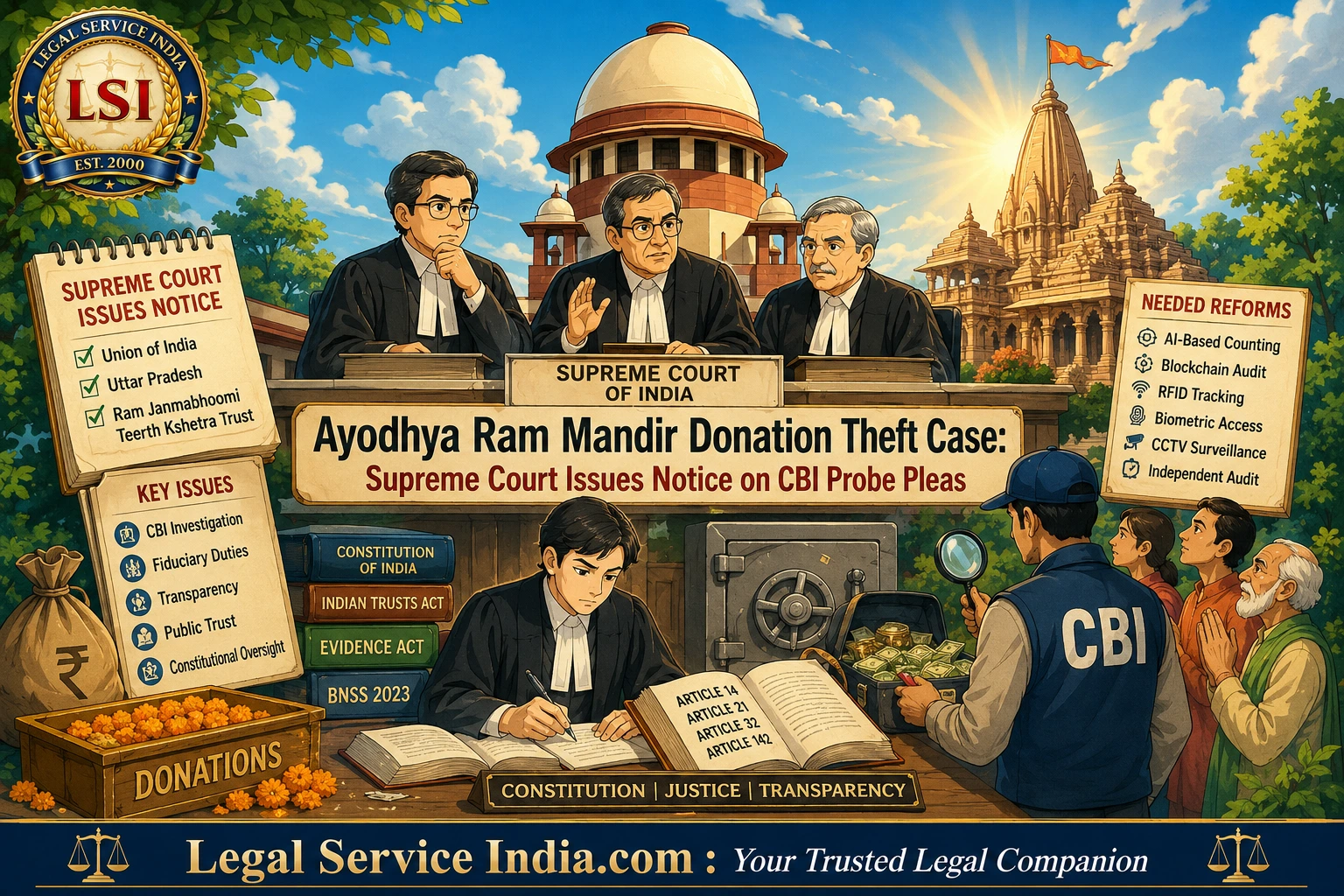
Supreme Court Issues Notice on Ayodhya Ram Mandir Donation Theft: Constitutional Questions Behind the CBI Probe Pleas
Abstract
The Supreme Court’s decision to issue notice to the Union of India, the State of Uttar Pradesh, and the Shri Ram Janmabhoomi Teerth Kshetra Trust on petitions seeking a Central Bureau of Investigation (CBI) probe into the alleged theft of donations from the Ayodhya Ram Mandir has emerged as one of the most significant constitutional developments concerning the governance of religious institutions in recent years.
At this stage, the Court has not ordered a CBI investigation. Equally important, it has not recorded any finding that the allegations are true. The issuance of notice merely signifies that the Court considers the issues raised in the petitions worthy of a judicial response from the concerned authorities.
Yet, the legal significance of the proceedings extends far beyond the immediate allegations. The case presents important questions about the accountability of public religious trusts, the fiduciary obligations of those entrusted with devotees’ offerings, the standards for transferring an investigation to the CBI, and the constitutional responsibility of courts to preserve public confidence in institutions that command immense religious and cultural reverence.
Unlike many news reports that focus solely on the allegations, this article examines the matter through the lens of constitutional law, criminal jurisprudence, public trust principles, and judicial precedent. It also explores the possible legal outcomes and the broader reforms that may emerge from the litigation.
Key Highlights
- The Supreme Court has issued notice but has not ordered a CBI investigation.
- No judicial finding has been recorded regarding the truth of the allegations.
- The petitions raise constitutional issues relating to accountability, transparency, and governance of religious trusts.
- The case examines the standards governing the transfer of investigations to the CBI.
- The litigation may shape future jurisprudence concerning public religious institutions and fiduciary responsibility.
Introduction
Few institutions in modern India embody the convergence of faith, history, law, and constitutional governance as profoundly as the Ram Mandir at Ayodhya.
The temple is not merely a place of worship. It is the culmination of one of the longest and most consequential legal disputes in Indian history. The judgment delivered by the Supreme Court in M. Siddiq (D) Thr. Lrs. v. Mahant Suresh Das & Ors. (2019), popularly known as the Ayodhya Verdict, settled a centuries-old title dispute and directed the establishment of a trust for the construction and management of the temple. That judgment marked the end of one constitutional chapter and the beginning of another—one centered on governance, stewardship, and public confidence.
Today, the institution receives offerings from millions of devotees across India and the world. These donations are made not as commercial transactions but as voluntary expressions of faith. Consequently, any allegation concerning the handling of such offerings naturally attracts heightened public attention.
Recent allegations that donations were siphoned during the counting process, leading to criminal investigations and arrests, have now reached the Supreme Court in the form of public interest petitions seeking an independent investigation by the CBI. While the allegations remain under investigation and no judicial finding has been returned, the petitions have raised fundamental questions regarding institutional accountability, transparency, and the role of constitutional courts in safeguarding public confidence.
The Court’s issuance of notice does not indicate agreement with the allegations. It reflects judicial recognition that the issues raised deserve examination after hearing all affected stakeholders. That distinction is central to understanding the proceedings and avoiding premature conclusions.
This article, therefore, seeks not merely to report the litigation but to examine its constitutional implications, analyze the applicable legal principles, and place the controversy within the broader framework of Indian public law.
From the Ayodhya Verdict to the Temple Trust: Constitutional Background
To appreciate the significance of the present proceedings, one must first understand the legal foundation of the Shri Ram Janmabhoomi Teerth Kshetra Trust.
On 9 November 2019, a Constitution Bench of the Supreme Court delivered its unanimous judgment in the Ayodhya title dispute. Exercising its powers under Article 142 of the Constitution, the court directed the central government to establish a trust to oversee the construction and management of a temple at the disputed site.
Pursuant to this direction, the union government constituted the Shri Ram Janmabhoomi Teerth Kshetra Trust in February 2020. The Trust was entrusted with responsibilities extending far beyond construction. It became responsible for managing donations, maintaining temple property, overseeing administration, preserving records, ensuring financial integrity, and fulfilling the confidence reposed in it by millions of devotees.
This constitutional origin distinguishes the Trust from many other religious bodies. While it is not a government department, its creation followed a direct judicial mandate implemented through governmental action. Consequently, questions concerning its functioning may attract a higher degree of public scrutiny than those involving purely private religious entities.
That distinction does not diminish the autonomy of the Trust. Rather, it underscores the importance of maintaining public confidence through robust governance and transparent financial administration.
Constitutional Timeline
| Year/Date | Development | Constitutional Significance |
|---|---|---|
| 9 November 2019 | The Supreme Court delivered the Ayodhya Verdict. | Resolved the title dispute and invoked Article 142. |
| February 2020 | The union government constituted the Shri Ram Janmabhoomi Teerth Kshetra Trust. | Implemented the Supreme Court’s directions. |
| Present Proceedings | Petitions seek CBI investigation into alleged donation theft. | Raises questions regarding governance, accountability, and judicial oversight. |
The Allegations That Sparked the Present Litigation
The present proceedings arise from allegations that cash donations offered by devotees at the Ram Mandir were diverted during the counting process.
According to publicly reported investigative developments, criminal cases were registered after discrepancies came to light. Several individuals associated with the handling of donations were arrested, recoveries of cash and valuables were reportedly made, and investigators began examining financial transactions connected with the accused.
Reports have further suggested that investigators identified weaknesses in internal security protocols governing the receipt, storage, transport, and counting of donations. Among the concerns publicly reported were alleged shortcomings in surveillance, access control, supervision, and procedural safeguards within the donation management system.
It is important to distinguish between investigative findings and judicial findings. Investigative observations remain subject to verification through the criminal justice process. They do not amount to conclusions of law, nor do they establish criminal liability.
This distinction is particularly important because allegations involving institutions of great public importance often generate intense public debate. Constitutional adjudication, however, proceeds on evidence and legal principles—not on public sentiment.
Reported Issues Under Investigation
- Alleged diversion of devotees’ cash donations.
- Registration of criminal cases.
- Arrests of persons allegedly involved.
- Reported recovery of cash and valuables.
- Examination of financial transactions.
- Alleged weaknesses in surveillance and access control.
- Review of donation counting procedures.
- Assessment of institutional safeguards and internal controls.
Why Were Public Interest Litigations Filed?
The petitioners contend that the matter transcends an ordinary case of theft.
Their principal argument is that the alleged diversion of donations concerns offerings made by millions of devotees to a nationally significant religious institution created pursuant to a Supreme Court judgment. According to the petitions, such allegations affect not only criminal law but also public confidence in the administration of religious charities.
The petitions reportedly seek several directions, including:
- transfer of the investigation to the Central Bureau of Investigation (CBI);
- a court-monitored investigation to ensure impartiality;
- an independent forensic audit of donation records;
- examination of systemic failures in the management of temple donations; and
- appropriate directions to strengthen transparency and accountability.
The petitioners argue that an investigation by an agency independent of the state machinery would better serve the interests of justice and reinforce public confidence.
Whether such relief is legally justified remains the central issue before the Supreme Court.
Reliefs Sought Before the Supreme Court
| Relief Sought | Purpose |
|---|---|
| Transfer of investigation to the CBI | To seek an independent investigation. |
| Court-monitored investigation | To ensure impartiality and judicial oversight. |
| Independent forensic audit | To examine donation records and financial transactions. |
| Examination of systemic failures | To identify weaknesses in donation management. |
| Directions for institutional reforms | To strengthen transparency and accountability. |
Proceedings Before the Supreme Court
A bench comprising the Chief Justice of India and companion judges considered the petitions and issued notice to:
- the Union of India;
- the State of Uttar Pradesh; and
- the Shri Ram Janmabhoomi Teerth Kshetra Trust.
At this preliminary stage, the Court has called upon the respondents to present their respective positions before any substantive orders are passed.
The order assumes importance because the Supreme Court exercises great restraint while entertaining requests for transfer of investigations. The issuance of notice, therefore, indicates that the Court considers the issues raised sufficiently substantial to merit a response from the concerned authorities.
However, the legal effect of the order must not be misunderstood.
The Court has not:
- directed a CBI investigation;
- expressed dissatisfaction with the ongoing investigation;
- recorded any finding regarding the truth of the allegations;
- held the Trust responsible for any irregularity; or
- expressed any opinion on criminal liability.
The proceedings remain at an initial stage, and every respondent is entitled to place its version before the court.
What the Supreme Court Has and Has Not Done
| Action | Status |
|---|---|
| Issued notice to respondents | ✔ Yes |
| Ordered a CBI investigation | ✘ No |
| Held allegations to be true | ✘ No |
| Found the Trust guilty of irregularities | ✘ No |
| Recorded any finding on criminal liability | ✘ No |
| Called for responses from all parties | ✔ Yes |
Why the Issuance of Notice Matters
In constitutional litigation, the issuance of notice is often misunderstood by the general public.
Many assume that once notice is issued, the court has accepted the allegations. That assumption is legally incorrect.
A notice simply signifies that, on a prima facie examination, the Court considers the issues raised worthy of hearing. It ensures adherence to the principles of natural justice by giving every affected party an opportunity to respond before any determination is made.
The Supreme Court routinely dismisses petitions even after issuing notice if, upon hearing all parties, it concludes that no further intervention is warranted.
Conversely, in appropriate cases, notice may eventually culminate in far-reaching constitutional directions.
Thus, the present order neither vindicates the petitioners nor implicates the respondents. It merely opens the judicial process through which competing legal claims will be examined.
Legal Importance of Issuing Notice
- Notice does not amount to acceptance of allegations.
- Notice does not determine criminal liability.
- Notice ensures compliance with the principles of natural justice.
- Every respondent receives an opportunity to present its case.
- The Court retains complete discretion to dismiss or allow the petitions after hearing all parties.
Constitutional Questions Raised by the Case
Although the immediate controversy concerns alleged theft of donations, the litigation raises several broader constitutional questions that may have lasting implications for the governance of religious institutions in India.
Among the principal issues are the following:
- What degree of judicial oversight is appropriate when allegations concern a religious trust created pursuant to a Supreme Court judgment?
- Under what circumstances should the Supreme Court invoke its extraordinary jurisdiction to direct a CBI investigation?
- Does the fiduciary responsibility of trustees assume greater significance when donations are made by millions of members of the public?
- How should constitutional courts balance the autonomy of religious institutions with the need for transparency and accountability?
- Can structural reforms be directed even if criminal liability is ultimately not established?
- Should religious institutions handling large public donations be subjected to modern governance standards comparable to those applicable to major public charities?
These questions demonstrate why the present litigation extends far beyond a conventional criminal investigation. It has the potential to shape future jurisprudence on institutional accountability, public trust, and constitutional oversight.
The next part of this commentary will examine the Supreme Court’s constitutional power to order a CBI investigation, the legal framework governing such transfers, the Delhi Special Police Establishment Act, and the landmark judgments that define when and why constitutional courts intervene in ongoing investigations.
Major Constitutional Issues at a Glance
| Constitutional Issue | Why It Matters |
|---|---|
| Judicial oversight of religious trusts | Defines the extent of constitutional supervision. |
| Transfer of investigation to the CBI | Determines when extraordinary judicial intervention is justified. |
| Fiduciary duties of trustees | Protects public confidence in charitable institutions. |
| Institutional transparency | Promotes accountability in managing public donations. |
| Possible structural reforms | May influence governance standards for religious institutions nationwide. |
The Central Constitutional Question
The principal issue before the Supreme Court is not whether a theft occurred inside the Ram Mandir premises. That determination will ultimately depend upon evidence gathered during the criminal investigation and, if charges are framed, upon the findings of the competent criminal court.
The immediate constitutional question is considerably narrower, yet legally far more significant:
Should the Supreme Court exercise its extraordinary constitutional jurisdiction to transfer the investigation from the existing investigating agency to the Central Bureau of Investigation (CBI)?
This question has repeatedly engaged constitutional courts over the past three decades. The Supreme Court has developed a consistent body of jurisprudence laying down the principles governing the transfer of investigations from State Police or Special Investigation Teams (SITs) to the CBI.
The present litigation concerning the Ayodhya Ram Mandir donation theft must therefore be analyzed against this well-established constitutional framework rather than through the lens of public sentiment or media speculation.
CBI Is Not a Default Investigating Agency
One of the most common misconceptions among the public is that whenever a matter attracts widespread attention or political controversy, the investigation should automatically be entrusted to the CBI.
The law is precisely the opposite.
The CBI is not intended to function as an appellate investigating authority over every State Police investigation. Criminal law and policing primarily fall within the legislative competence of the States under Entry 2 of List II (State List) of the Seventh Schedule to the Constitution. Consequently, investigation of offenses ordinarily remains the responsibility of the State Police.
The Supreme Court has repeatedly cautioned that indiscriminate transfer of investigations to the CBI would undermine the federal structure envisaged by the Constitution.
Therefore, every request for a CBI investigation must satisfy a high constitutional threshold.
Key Takeaways
- CBI is not the default investigating agency.
- State police ordinarily investigate criminal offenses.
- Criminal investigation primarily falls within the legislative competence of the states.
- The Supreme Court exercises restraint while ordering CBI investigations.
- A constitutional threshold must be satisfied before transferring an investigation.
Constitutional Provisions Relevant to the Present Case
The petitions invoke the extraordinary jurisdiction of the Supreme Court under the Constitution.
Several constitutional provisions become relevant.
Article 32: The Guardian of Fundamental Rights
Article 32 empowers every citizen to approach the Supreme Court for enforcement of fundamental rights.
Dr. B.R. Ambedkar famously described Article 32 as the “heart and soul” of the Constitution because it guarantees an effective constitutional remedy against violations of fundamental rights.
Where petitioners demonstrate that a deficient investigation threatens constitutional guarantees—particularly the right to equality under Article 14 or the right to a fair investigation implicit in Article 21—the Supreme Court may issue appropriate directions.
However, Article 32 is not intended to substitute ordinary criminal procedure. Judicial intervention occurs only in exceptional circumstances where constitutional concerns are genuinely implicated.
Key Constitutional Principles Under Article 32
- Protects the enforcement of fundamental rights.
- Acts as a direct constitutional remedy before the Supreme Court.
- Permits judicial intervention only in exceptional circumstances.
- May be invoked where a deficient investigation affects Articles 14 and 21.
Article 142: Doing Complete Justice
Perhaps the most significant constitutional provision in this litigation is Article 142.
Article 142 empowers the Supreme Court to pass any decree or order necessary for “doing complete justice” in any matter pending before it.
This extraordinary power has enabled the court to:
- constitute Special Investigation Teams,
- transfer criminal trials,
- appoint monitoring committees,
- supervise investigations,
- direct investigations by specialised agencies,
- frame institutional guidelines, and
- fashion remedies where statutory provisions alone would not provide complete justice.
The Ayodhya judgment itself is a notable example of the Court’s exercise of Article 142, under which it directed the creation of the Shri Ram Janmabhoomi Teerth Kshetra Trust.
The present petitions may therefore require the Court to consider whether Article 142 should again be invoked—not to resolve a title dispute, but to ensure institutional integrity if circumstances so warrant.
How Article 142 Has Been Used
| Judicial Power | Purpose |
|---|---|
| Special Investigation Teams (SITs) | Independent investigation |
| Transfer of criminal trials | Ensure fairness |
| Court monitoring | Maintain transparency |
| Institutional guidelines | Fill legal gaps |
| Creation of Trusts | Complete justice (Ayodhya Judgment) |
Article 136: Extraordinary Appellate Jurisdiction
Although the present proceedings arise through writ petitions rather than appeals, Article 136 illustrates the Supreme Court’s broad supervisory role over the administration of justice.
The Court has repeatedly observed that its constitutional responsibilities extend beyond correcting individual errors and include preserving public confidence in the justice delivery system.
That philosophy often informs decisions concerning the transfer of investigations.
Important Points
- Illustrates the Supreme Court’s broad supervisory jurisdiction.
- Emphasises maintaining public confidence in the justice system.
- Supports judicial oversight in exceptional investigations.
Articles 141 and 144
Article 141 provides that the law declared by the Supreme Court is binding on all courts throughout India.
Consequently, every previous judgment laying down principles governing CBI investigations constitutes binding precedent.
Article 144 further requires all civil and judicial authorities in India to act in aid of the Supreme Court.
Should the court ultimately direct a CBI investigation or issue structural reforms, every authority concerned would be constitutionally obliged to comply.
Summary of Articles 141 & 144
| Article | Purpose |
|---|---|
| Article 141 | Supreme Court judgments are binding on all courts. |
| Article 144 | All civil and judicial authorities must assist the Supreme Court. |
The Delhi Special Police Establishment Act: Statutory Framework Governing the CBI
The Central Bureau of Investigation derives its investigative authority primarily from the Delhi Special Police Establishment Act, 1946 (DSPE Act).
Section 5 authorizes the Central Government to extend the powers and jurisdiction of the DSPE to States.
However, Section 6 ordinarily requires the consent of the state government before the CBI can exercise jurisdiction within that state.
This statutory requirement reflects the constitutional balance between the Union and the States.
At first glance, Section 6 may appear to prevent the CBI from investigating offenses within a state unless that state consents.
However, constitutional jurisprudence has clarified that the Supreme Court and High Courts are not constrained by Section 6 when exercising their powers under Articles 32 and 226.
This distinction became one of the most important constitutional developments concerning criminal investigations in India.
Key Provisions of the DSPE Act
| Provision | Legal Significance |
|---|---|
| Section 5 | Authorizes the Central Government to extend the powers and jurisdiction of the DSPE to States. |
| Section 6 | Ordinarily requires the consent of the state government before the CBI exercises jurisdiction within a state. |
| Constitutional Position | Articles 32 and 226 empower constitutional courts to direct a CBI investigation even without state consent. |
Landmark Judgment: State of West Bengal v. Committee for Protection of Democratic Rights (2010) 3 SCC 571
This Constitution Bench decision is the cornerstone of Indian law governing judicially directed CBI investigations.
The principal question before the Court was whether constitutional courts could direct a CBI investigation without obtaining the consent of the concerned state government under Section 6 of the DSPE Act.
The Constitution Bench answered the question unequivocally in the affirmative.
The court held that:
- Articles 32 and 226 constitute part of the Constitution’s basic structure;
- statutory provisions cannot curtail constitutional powers;
- where justice demands, constitutional courts may direct a CBI investigation even without State consent; and
- Such power must be exercised sparingly, cautiously, and only in exceptional situations.
The Court simultaneously warned that routine transfer of investigations would be inconsistent with India’s federal framework.
This judgment is likely to form the legal foundation of arguments advanced in the present case.
Legal Principles Emerging from the CPDR Judgment
| Principle | Position of Law |
|---|---|
| Constitutional Powers | Articles 32 and 226 override statutory limitations where justice so requires. |
| State Consent | Not mandatory when constitutional courts order a CBI investigation. |
| Exercise of Power | Must be exercised sparingly and only in exceptional circumstances. |
| Federalism | Routine transfer of investigations is discouraged. |
Vineet Narain v. Union of India (1998) 1 SCC 226
Few decisions have shaped investigative independence as profoundly as Vineet Narain.
Commonly associated with the “Hawala Case,” the judgment transformed the institutional functioning of investigative agencies by insulating them from executive interference.
The Supreme Court emphasized that the rule of law requires investigative agencies to function independently, particularly where allegations concern matters of public importance.
The Court also demonstrated its willingness to monitor investigations directly where public confidence had been seriously undermined.
Although the factual context differed substantially, the principles articulated in Vineet Narain continue to influence every case involving requests for court-monitored investigations.
Importance of Vineet Narain
- Strengthened the independence of investigative agencies.
- Reduced executive interference.
- Recognized court-monitored investigations where necessary.
- Reinforced the rule of law.
Rubabbuddin Sheikh v. State of Gujarat (2010) 2 SCC 200
This decision arose from the investigation into the alleged fake encounter killing of Sohrabuddin Sheikh.
The Supreme Court concluded that circumstances justified transfer of the investigation to the CBI because maintaining public confidence in the fairness of the investigative process was of paramount importance.
The judgment reaffirmed that the Court’s concern is not merely whether an investigation exists but whether the investigation inspires confidence among reasonable observers.
That principle may assume significance in the present litigation if the petitioners contend that institutional credibility requires an independent agency.
Principle Laid Down
- Fairness of the investigation is as important as the investigation itself.
- Public confidence is a key constitutional consideration.
- CBI investigation may be justified where institutional credibility is questioned.
Pooja Pal v. Union of India (2016) 3 SCC 135
This judgment further clarified the constitutional principles governing the transfer of investigations.
The Supreme Court observed that a fair investigation constitutes an integral component of Article 21.
Where circumstances create a genuine apprehension that justice may not be served through the existing investigative mechanism, constitutional courts possess ample authority to intervene.
The Court nevertheless reiterated that transfer to the CBI remains an exceptional remedy rather than an ordinary procedural step.
Important Observations
- A fair investigation is part of Article 21.
- Constitutional courts may intervene where justice appears threatened.
- Transfer to the CBI is an exceptional constitutional remedy.
Babubhai v. State of Gujarat (2010) 12 SCC 254
In Babubhai, the Supreme Court emphasized that a fair investigation is inseparable from the constitutional guarantee of a fair trial.
An investigation tainted by bias, mala fides, arbitrariness, or serious procedural irregularities undermines the administration of criminal justice itself.
The court recognized that constitutional intervention becomes necessary where investigative deficiencies threaten the integrity of the criminal process.
Key Takeaways
- Fair investigation and fair trial are inseparable.
- Bias or arbitrariness can justify judicial intervention.
- Constitutional courts protect the integrity of the criminal justice system.
Principles Emerging from Supreme Court Precedents
A combined reading of the leading authorities reveals several settled propositions:
- The Supreme Court possesses constitutional authority to direct a CBI investigation.
- Such authority flows from the Constitution rather than the DSPE Act.
- State consent is not necessary when constitutional courts exercise powers under Articles 32 or 226.
- Transfer of investigation is an exceptional remedy.
- Public confidence in the administration of justice is an important consideration.
- Mere political controversy or media attention is insufficient.
- Courts intervene only where credible material indicates that justice may otherwise be compromised.
Summary of Constitutional Principles
| Constitutional Principle | Legal Position |
|---|---|
| Power to Order CBI Investigation | Derived from the Constitution, particularly Articles 32 and 226. |
| Need for State Consent | Not required when constitutional courts exercise their extraordinary jurisdiction. |
| Nature of the Remedy | Transfer to the CBI is an exceptional constitutional remedy. |
| Public Confidence | A significant consideration while deciding transfer petitions. |
| Political or Media Attention | By itself, insufficient to justify transfer. |
| Judicial Intervention | Permitted only where credible material indicates justice may otherwise be compromised. |
Difference Between State Police, SIT, and CBI
The present controversy has generated considerable public confusion regarding the respective roles of different investigative agencies.
State Police
The State Police constitute the ordinary investigating authority under the Code of Criminal Procedure (now substantially replaced by the Bharatiya Nagarik Suraksha Sanhita, 2023). They investigate the overwhelming majority of criminal offenses committed within the territorial jurisdiction of the state.
Their proximity to the scene of occurrence often enables prompt collection of evidence. At the same time, in matters involving allegations of institutional influence or exceptional public importance, questions are sometimes raised regarding perceived independence, even where no actual bias exists.
Key Features of State Police
- Primary investigating agency for criminal offenses within the state.
- Functions under the state government.
- Possesses local knowledge and immediate access to evidence.
- Ordinarily investigates offenses under the Bharatiya Nagarik Suraksha Sanhita, 2023.
Special Investigation Team (SIT)
An SIT is not a separate statutory police force. It is a specially constituted investigative team created either administratively by the government or pursuant to judicial directions.
Its purpose is to bring together experienced investigators and specialized expertise for complex or sensitive matters.
The existence of an SIT does not automatically preclude judicial review. Constitutional courts may still examine whether the investigation is adequate, fair, and capable of commanding public confidence.
Key Features of an SIT
- Not a separate statutory investigative agency.
- Created administratively or by judicial order.
- Handles sensitive or complex investigations.
- Remains subject to judicial scrutiny.
Central Bureau of Investigation (CBI)
The CBI is India’s premier central investigative agency.
Because of its specialized resources, nationwide jurisdiction (subject to legal requirements), forensic capabilities, and institutional experience, constitutional courts sometimes consider it appropriate for investigations involving:
- interstate ramifications;
- allegations affecting multiple jurisdictions;
- serious institutional misconduct;
- exceptionally sensitive matters; or
- issues where maintaining public confidence requires an agency independent of the local administration.
However, the Supreme Court has consistently emphasized that the CBI should not be viewed as a universal solution for every controversial criminal case.
When Courts Generally Consider a CBI Investigation
| Situation | Reason |
|---|---|
| Interstate ramifications | Requires coordination across multiple states. |
| Multiple jurisdictions | Investigation extends beyond one state. |
| Serious institutional misconduct | Ensures greater independence. |
| Exceptionally sensitive matters | Maintains credibility of the investigation. |
| Public confidence concerns | Independent agency may inspire greater confidence. |
Comparison: State Police vs SIT vs CBI
| Aspect | State Police | SIT | CBI |
|---|---|---|---|
| Legal Status | Regular State Police Force | Specially Constituted Team | Central Investigative Agency |
| Created By | State Government | Government or Court | DSPE Act, 1946 |
| Primary Jurisdiction | Within the State | Specific Investigation | Across India (subject to law) |
| Nature of Cases | Ordinary Criminal Cases | Complex or Sensitive Matters | High-Profile, Multi-State, or Institutionally Sensitive Cases |
| Judicial Oversight | Possible | Possible | Frequently Ordered or Monitored by Constitutional Courts |
Does the Present Case Meet the Constitutional Threshold?
This is the question the Supreme Court will ultimately determine after considering the responses of all parties.
The petitioners are expected to argue that
- the Ram Mandir occupies unparalleled national significance;
- donations were contributed by millions of devotees;
- allegations concern institutional integrity rather than isolated theft;
- Independent investigation is essential for preserving public confidence.
Conversely, the respondents may contend that
- criminal cases have already been registered;
- arrests have been made;
- recoveries have reportedly been effected;
- an SIT is actively investigating the matter;
- There is presently no material demonstrating investigative bias or failure warranting transfer to the CBI.
The Court’s eventual decision will likely depend not on the emotional or political dimensions of the controversy, but on whether the petitioners establish the exceptional circumstances required by constitutional precedent.
Likely Arguments Before the Supreme Court
| Petitioners’ Likely Contentions | Respondents’ Likely Contentions |
|---|---|
| Ram Mandir holds unparalleled national significance. | Criminal cases have already been registered. |
| Millions of devotees contributed donations. | Arrests have already been made. |
| The allegations concern institutional integrity. | Recoveries have reportedly been effected. |
| An independent investigation is necessary to preserve public confidence. | An SIT is actively investigating the matter. |
| Exceptional circumstances justify a CBI probe. | No material presently demonstrates investigative bias or failure warranting transfer to the CBI. |
Constitutional Test Before the Supreme Court
Based on the precedents discussed above, the Supreme Court is likely to examine whether the following constitutional considerations have been satisfied before directing a CBI investigation:
- Whether exceptional circumstances exist.
- Whether the existing investigation suffers from credible allegations of bias or inadequacy.
- Whether public confidence in the administration of justice has been substantially undermined.
- Whether transfer of the investigation is necessary to secure a fair investigation under Article 21.
- Whether constitutional intervention is warranted despite the ongoing investigation by the SIT.
Looking Ahead
The next part of this commentary will move beyond the question of investigation and examine the legal status of the Shri Ram Janmabhoomi Teerth Kshetra Trust itself.
It will analyze the fiduciary obligations of trustees, the legal nature of temple donations, the accountability of religious institutions under Indian law, the distinction between civil and criminal liability, comparative jurisprudence involving major temples and religious endowments, and the constitutional principles governing transparency in institutions that hold property and funds on behalf of the public.
Topics Covered in the Next Part
- Legal status of the Shri Ram Janmabhoomi Teerth Kshetra Trust.
- Fiduciary obligations of trustees.
- Legal character of temple donations under Indian law.
- Accountability of religious institutions.
- Distinction between civil and criminal liability.
- Comparative jurisprudence relating to major temples and religious endowments.
- Constitutional principles governing transparency in institutions holding public funds and property.
Key Takeaways
| Issue | Position Emerging from Constitutional Jurisprudence |
|---|---|
| Can the Supreme Court order a CBI investigation? | Yes, in exceptional cases under its constitutional powers. |
| Is state consent mandatory? | No, where the Supreme Court or High Courts exercise powers under Articles 32 or 226. |
| Is media attention alone sufficient? | No. Courts require credible material indicating that justice may otherwise be compromised. |
| What is the primary constitutional consideration? | Ensuring a fair investigation while maintaining public confidence in the administration of justice. |
| What will determine the outcome of the present petitions? | Whether the petitioners establish the exceptional circumstances required by constitutional precedent. |
Constitutional Accountability of Temple Trusts and Judicial Oversight
The controversy surrounding the alleged theft of donations from the Ayodhya Ram Mandir raises issues that extend far beyond the alleged commission of criminal offenses. It invites a broader constitutional discussion on the legal duties, fiduciary obligations, and financial accountability of religious institutions entrusted with managing donations offered by millions of devotees.
One of the most significant legal questions concerns the extent to which religious trusts remain accountable under Indian law while enjoying constitutional protection for religious affairs. The distinction between religious autonomy and secular administration lies at the core of the present litigation before the Supreme Court.
Financial Accountability of Religious Institutions Under Indian Law
The controversy surrounding the alleged theft of donations from the Ayodhya Ram Mandir is not merely a question of criminal investigation. It also compels a deeper examination of the legal responsibilities of those who administer one of India’s most significant religious institutions.
A recurring misconception in public discourse is that because a temple trust is a religious body, it enjoys immunity from judicial scrutiny in matters concerning financial administration. That assumption has no basis in Indian constitutional jurisprudence.
Indian courts have consistently distinguished religious autonomy from administrative accountability. The Constitution zealously protects matters of faith, doctrine, and essential religious practices under Articles 25 and 26. However, the administration of property, finances, charitable assets, and public donations has always remained subject to the rule of law.
This distinction lies at the heart of the present litigation.
The Legal Status of the Shri Ram Janmabhoomi Teerth Kshetra Trust
Unlike many ancient temple trusts that evolved through historical custom or local legislation, the Shri Ram Janmabhoomi Teerth Kshetra Trust has a unique constitutional origin.
Following the Supreme Court’s unanimous judgment in M. Siddiq (D) Thr. Lrs. v. Mahant Suresh Das & Ors. (2019), the Union government constituted the Trust in February 2020 pursuant to the Court’s directions under Article 142 of the Constitution and the statutory framework governing the acquired land at Ayodhya.
This constitutional lineage distinguishes the Trust from ordinary private religious bodies.
The Trust is not:
- a Government department;
- a statutory corporation;
- an instrumentality of the State under Article 12 merely because it was constituted following judicial directions; or
- a public authority in every respect by default.
At the same time, it is equally inaccurate to regard the Trust as a purely private institution.
It administers a place of worship of immense national importance, receives donations from millions of devotees across India and abroad, and performs functions that carry a substantial public dimension. Consequently, its financial administration inevitably attracts a higher degree of public interest and legal scrutiny.
This does not diminish the Trust’s autonomy in religious affairs. Rather, it reinforces the principle that institutions entrusted with public confidence must demonstrate exemplary standards of governance.
Key Legal Characteristics of the Trust
| Aspect | Legal Position |
|---|---|
| Origin | Constituted pursuant to Supreme Court directions following the Ayodhya judgment. |
| Nature | Religious trust with significant public functions. |
| Article 12 Status | Not automatically a state instrumentality. |
| Judicial Scrutiny | Financial administration remains subject to the rule of law. |
| Religious Autonomy | Protected under Articles 25 and 26 regarding matters of religion. |
Temple Donations: Are They “Public Money”?
One of the most frequently debated legal questions is whether donations made to temples constitute public money.
Strictly speaking, the answer is no.
Temple donations are voluntary offerings made by devotees. They do not become government revenue, nor do they form part of the Consolidated Fund of India or the Consolidated Fund of a State.
However, the legal analysis cannot end there.
Once donations are received by a public religious trust, they become trust property. The trustees no longer hold the funds for their personal benefit. They hold them in a fiduciary capacity for the purposes for which the donations were made.
Thus, although temple donations are not “public funds” in the constitutional sense, they are nevertheless publicly entrusted charitable assets.
That distinction is extremely important.
Millions of devotees contribute, believing that their offerings will be utilized for religious, charitable, and administrative purposes associated with the temple. The law therefore imposes stringent fiduciary obligations upon those responsible for receiving, preserving, accounting for, and applying such donations.
Legal Status of Temple Donations at a Glance
| Question | Legal Answer |
|---|---|
| Are temple donations Government revenue? | No. |
| Do they form part of the Consolidated Fund? | No. |
| Do they become trust property? | Yes. |
| Are trustees fiduciaries? | Yes. |
| Can courts examine misuse of donations? | Yes, as part of secular financial administration. |
Fiduciary Duties of Trustees
The concept of fiduciary responsibility is among the oldest principles recognized by courts of equity.
A fiduciary relationship exists whenever one person places confidence in another, and the latter undertakes to act in the former’s interests with utmost honesty, loyalty, and diligence.
Trustees occupy one of the highest fiduciary positions recognized by law.
Their responsibilities extend beyond ordinary financial management and include:
- safeguarding trust property;
- maintaining accurate financial records;
- preventing misappropriation;
- implementing effective internal controls;
- ensuring transparency;
- avoiding conflicts of interest;
- exercising due diligence in supervision; and
- acting solely for the benefit of the trust’s objects.
Where trustees knowingly permit financial irregularities or fail to exercise reasonable supervision, questions may arise regarding both civil responsibility and, in appropriate cases, criminal liability.
It is therefore insufficient for trustees merely to express concern after an irregularity has occurred. Modern governance requires preventive systems capable of minimizing opportunities for misconduct.
Core Fiduciary Obligations of Trustees
| Duty | Purpose |
|---|---|
| Safeguard Trust Property | Protect charitable assets from misuse. |
| Maintain Proper Records | Ensure accountability and transparency. |
| Prevent Misappropriation | Reduce financial irregularities. |
| Implement Internal Controls | Strengthen governance systems. |
| Avoid Conflicts of Interest | Protect fiduciary integrity. |
| Exercise Due Diligence | Ensure proper supervision and oversight. |
| Act for Trust Objects | Use donations solely for intended charitable and religious purposes. |
Civil Liability and Criminal Liability: An Important Distinction
Public debate often conflates administrative lapses with criminal misconduct.
The law carefully distinguishes between the two.
Civil Liability
Civil liability generally concerns breach of trust, negligence, maladministration, or failure to discharge fiduciary duties.
Such liability may result in:
- restitution of losses;
- removal of trustees;
- appointment of administrators;
- directions for improved governance;
- mandatory audits; or
- other remedial measures.
Civil proceedings focus primarily upon restoring the integrity of trust administration rather than punishing individuals.
Criminal Liability
Criminal liability, by contrast, requires proof of specific statutory offenses and the requisite mental element.
Depending upon the evidence, allegations concerning the diversion of temple donations could potentially attract provisions relating to:
- criminal breach of trust;
- theft;
- cheating;
- criminal conspiracy;
- destruction of evidence;
- falsification of accounts; or
- offenses under the Bharatiya Nyaya Sanhita, 2023 (or, where applicable, the erstwhile Indian Penal Code).
Importantly, criminal liability cannot be inferred merely because an institution experiences financial irregularities.
The prosecution must establish each ingredient of the alleged offense beyond reasonable doubt.
Difference Between Civil and Criminal Liability
| Aspect | Civil Liability | Criminal Liability |
|---|---|---|
| Primary Objective | Restore trust administration | Punish criminal conduct |
| Nature of Proceedings | Remedial | Penal |
| Standard | Breach of fiduciary duty or negligence | Proof of statutory offence beyond reasonable doubt |
| Possible Consequences | Removal, restitution, audits, governance reforms | Conviction, imprisonment, fines and other criminal penalties |
Can Trustees Be Criminally Liable?
The answer depends entirely upon evidence.
If investigators establish that a trustee personally participated in criminal conduct or intentionally facilitated it, ordinary principles of criminal law would apply.
Conversely, if trustees implemented reasonable safeguards, acted promptly upon discovering irregularities, cooperated fully with investigators, and themselves became victims of deception by subordinate employees, criminal liability may not arise.
The law recognizes a significant distinction between
- deliberate participation in criminal activity;
- wilful blindness;
- gross negligence; and
- honest administrative error.
Determining where a particular case falls within this spectrum requires careful examination of evidence rather than assumptions.
Judicial Test for Criminal Liability of Trustees
| Situation | Possible Legal Consequence |
|---|---|
| Intentional participation in wrongdoing | Criminal liability may arise. |
| Knowingly facilitating misappropriation | Criminal prosecution may be maintainable. |
| Failure despite reasonable safeguards | May not constitute criminal liability. |
| Victim of employee deception | Evidence may negate criminal intent. |
| Administrative oversight without mens rea | May attract civil consequences instead. |
Religious Freedom Does Not Exclude Financial Accountability
Articles 25 and 26 guarantee religious freedom.
Article 26, in particular, grants religious denominations the right to manage their own affairs in matters of religion.
However, constitutional jurisprudence has consistently recognized an equally important principle.
The autonomy guaranteed by Article 26 primarily concerns religious affairs.
Financial administration, management of property, utilization of donations, employment practices, accounting procedures, and protection of trust assets constitute secular activities associated with religion.
These secular aspects have always remained amenable to legislative regulation and judicial scrutiny.
The Supreme Court has repeatedly affirmed that while courts do not interfere with religious doctrine, they may intervene to ensure lawful administration of institutions managing substantial public resources.
Constitutional Position Under Articles 25 and 26
| Protected Religious Matters | Secular Matters Subject to Judicial Review |
|---|---|
| Faith | Financial administration |
| Doctrine | Management of trust property |
| Essential religious practices | Accounting procedures |
| Religious rituals | Utilisation of donations |
| Religious customs | Employment and governance practices |
Judicial Oversight of Religious Institutions: A Consistent Constitutional Principle
The present controversy is not the first occasion on which constitutional courts have examined the administration of prominent religious institutions.
Across several decades, courts have intervened where questions arose concerning the following:
- financial mismanagement;
- appointment of administrators;
- accounting irregularities;
- property disputes;
- governance reforms; and
- protection of temple assets.
Such intervention has never been regarded as interference with religion itself.
Rather, it reflects the constitutional distinction between protecting faith and ensuring lawful administration.
The judiciary has consistently maintained that transparency strengthens religious institutions by enhancing public confidence rather than diminishing religious autonomy.
Why Courts Intervene in Temple Administration
- To safeguard charitable and trust property.
- To ensure financial transparency.
- To protect donations made by devotees.
- To improve governance mechanisms.
- To enforce fiduciary responsibilities.
- To uphold the rule of law without interfering in matters of religion.
Comparative Perspective: Lessons from Other Major Religious Institutions
Although every institution functions within its own statutory and historical framework, valuable lessons may be drawn from governance practices adopted elsewhere.
Tirumala Tirupati Devasthanams (TTD)
The Tirumala Tirupati Devasthanams administer one of the wealthiest temples in the world.
Its governance structure incorporates:
- extensive accounting procedures;
- multilayered internal audits;
- external audits;
- controlled counting centres;
- electronic surveillance;
- strict access protocols; and
- detailed financial documentation.
While no governance system is infallible, multiple institutional safeguards substantially reduce opportunities for financial irregularities.
Shri Mata Vaishno Devi Shrine Board
The Vaishno Devi Shrine Board has progressively modernized financial administration through digitization, structured accounting systems, professional management practices, and enhanced transparency.
Its experience demonstrates that large-scale religious institutions can preserve spiritual traditions while simultaneously adopting contemporary governance standards.
Sree Padmanabhaswamy Temple
Judicial proceedings concerning the administration of the Sree Padmanabhaswamy Temple illustrate another important constitutional principle.
The Supreme Court recognized the religious character of the institution while simultaneously emphasizing the importance of accountable management, preservation of assets, and structured administration.
The judgment reinforced the proposition that effective governance complements rather than compromises religious freedom.
Comparison of Governance Practices
| Religious Institution | Governance Measures Highlighted |
|---|---|
| Tirumala Tirupati Devasthanams (TTD) | Internal audits, electronic surveillance, controlled counting centers, and strict access protocols. |
| Shri Mata Vaishno Devi Shrine Board | Digitization, professional management, structured accounting, and transparency. |
| Sree Padmanabhaswamy Temple | Judicial emphasis on accountable management and preservation of assets. |
Public Trust Doctrine and Religious Institutions
Although traditionally applied to natural resources and governmental obligations, the underlying philosophy of the Public Trust Doctrine offers valuable guidance in understanding the responsibilities of institutions entrusted with assets contributed by the public.
The doctrine is founded upon a simple principle:
Those entrusted with property held for the benefit of others must exercise the highest standards of care, honesty, and accountability.
Temple trustees may not technically function as public trustees in the constitutional sense.
Nevertheless, the ethical and fiduciary expectations imposed upon them closely resemble the underlying philosophy of the doctrine.
Core Principles of the Public Trust Doctrine
| Principle | Application to Religious Institutions |
|---|---|
| Care | Assets and donations must be protected with utmost diligence. |
| Honesty | Financial dealings should remain truthful and transparent. |
| Accountability | Trustees must remain answerable to the institution and its devotees. |
| Fiduciary Responsibility | Temple administration should prioritize the interests of the institution and the public it serves. |
Accountability Enhances Faith
Some commentators have suggested that judicial scrutiny of temple administration may undermine religious sentiments.
The constitutional position is precisely the opposite.
Public confidence in religious institutions is strengthened—not weakened—when allegations of financial misconduct are investigated impartially and transparently.
Millions of devotees contribute offerings because they repose confidence in the institution.
Protecting that confidence through lawful administration ultimately safeguards both the institution and the faith it represents.
Transparency should therefore be viewed not as an external imposition but as an integral component of responsible religious stewardship.
Why Transparency Strengthens Religious Institutions
- Enhances public confidence in temple administration.
- Protects donations contributed by millions of devotees.
- Supports lawful and accountable governance.
- Strengthens institutional credibility.
- Preserves faith through transparent administration.
Likely Arguments Before the Supreme Court
Arguments Expected from the Petitioners
The petitioners are likely to contend that
- the Ram Mandir is an institution of unparalleled national significance;
- donations represent the collective faith of millions of devotees;
- reported investigative findings suggest systemic failures rather than isolated misconduct;
- an independent investigation alone can restore public confidence;
- Structural reforms are required irrespective of individual criminal liability.
Arguments Expected from the Union Government and the State of Uttar Pradesh
The governments may argue that:
- criminal investigations commenced promptly after the allegations surfaced;
- arrests and recoveries demonstrate that the investigative machinery is functioning;
- the Special Investigation Team continues to investigate comprehensively;
- transfer to the CBI at this stage would unnecessarily disrupt the ongoing investigation;
- Constitutional precedents require exceptional circumstances before replacing the existing investigating agency.
Arguments Likely to be Advanced by the Temple Trust
The Trust may contend that
- it has cooperated fully with investigators.
- administrative action has already been taken against individuals suspected of wrongdoing;
- internal procedures have been reviewed and strengthened;
- isolated criminal acts by individuals cannot automatically establish institutional failure;
- The trust itself is committed to transparency and accountability.
Comparison of the Likely Positions Before the Supreme Court
| Stakeholder | Likely Position |
|---|---|
| Petitioners | Independent investigation and structural reforms are necessary to restore public confidence. |
| Union Government & State of Uttar Pradesh | Existing investigations are progressing effectively, and CBI transfer is presently unwarranted. |
| Temple Trust | The Trust has cooperated fully, strengthened internal procedures, and remains committed to accountability. |
The Larger Constitutional Issue
Ultimately, the Supreme Court may find that the present litigation extends beyond determining whether the investigation should be transferred to the CBI.
The Court may instead examine whether India’s largest religious institutions require stronger governance mechanisms capable of preventing future controversies.
Constitutional adjudication often transforms individual disputes into opportunities for institutional reform.
Whether the present case ultimately results in such structural directions remains to be seen.
What is already evident, however, is that the litigation has reopened an important national conversation about accountability, fiduciary responsibility, and the governance of institutions sustained by the faith and generosity of millions of citizens.
Key Constitutional Questions Raised
- Should governance standards for major religious institutions be strengthened?
- How should fiduciary responsibility over public donations be enforced?
- What level of judicial oversight is appropriate in cases involving religious trusts?
- Can institutional reforms enhance both accountability and public faith?
- How should constitutional principles balance religious autonomy with financial transparency?
Critical Legal Analysis: Does the Present Case Justify Supreme Court Intervention?
Every case seeking a transfer of investigation to the Central Bureau of Investigation presents the Supreme Court with a delicate constitutional dilemma. On one hand lies the autonomy of the state investigative machinery, which forms an integral component of India’s federal structure. On the other lies the constitutional obligation of the court to ensure that justice is not only done but is also perceived to have been done.
The Ayodhya Ram Mandir donation theft case represents an especially difficult instance of this balancing exercise.
Unlike conventional criminal cases involving theft or breach of trust, the present controversy concerns an institution that occupies an unparalleled position in India’s religious, cultural, and constitutional landscape. Millions of devotees contribute offerings to the temple in the belief that those contributions will be utilized exclusively for the purposes of worship, maintenance, charity, and the preservation of the sacred institution.
The controversy therefore transcends the value of the allegedly misappropriated funds.
The real question before the Court is whether the existing investigative framework is sufficient to restore public confidence or whether circumstances require the intervention of an independent national agency.
That determination cannot be made on emotion or political rhetoric. It must be based upon constitutional principles, evidence, and settled judicial precedents.
Why Courts Exercise Extreme Caution Before Ordering a CBI Probe
Public discourse frequently assumes that transferring a case to the CBI is synonymous with ensuring justice.
The Supreme Court has repeatedly rejected that assumption.
A CBI investigation is not a constitutional reward for public outrage, nor is it a judicial response to media attention.
Every transfer of investigation carries constitutional consequences.
If constitutional courts routinely replace state investigations merely because allegations involve prominent institutions or attract public attention, two adverse consequences would follow.
| Potential Constitutional Consequence | Explanation |
|---|---|
| Undermining Federalism | It would undermine the constitutional distribution of powers between the Union and the States. |
| Loss of Public Confidence in State Agencies | It would create an unhealthy perception that state investigative agencies are inherently incapable of conducting impartial investigations. |
Neither proposition is consistent with constitutional governance.
Consequently, the Supreme Court has consistently insisted that transfer to the CBI must remain an exceptional constitutional remedy.
Does National Importance Alone Justify a CBI Investigation?
One of the principal arguments advanced by the petitioners is likely to be that the Ram Mandir occupies extraordinary national significance.
That proposition is difficult to dispute.
However, constitutional jurisprudence indicates that national importance alone is insufficient.
If every nationally significant institution automatically became subject to CBI investigation whenever allegations arose, constitutional courts would effectively replace the ordinary criminal justice system.
The Supreme Court has never accepted such an approach.
Instead, national importance constitutes only one factor among many.
The court will likely examine questions such as
- Has the investigation already progressed substantially?
- Have arrests been made?
- Has material evidence been recovered?
- Is there any indication that investigators are acting unfairly?
- Is there credible material suggesting institutional influence over the investigation?
- Would continuation of the existing investigation seriously erode public confidence?
Only after considering the cumulative effect of these circumstances can the court determine whether constitutional intervention is warranted.
The Importance of Institutional Credibility
An important feature distinguishing the present litigation from ordinary criminal proceedings is the institutional character of the Ram Mandir.
The Supreme Court’s 2019 judgment transformed the Ayodhya dispute from one concerning title to one concerning institutional governance.
Today, the Trust administers not merely land or buildings but the collective faith of millions.
That reality imposes responsibilities extending beyond minimum legal compliance.
Modern governance increasingly recognizes that institutions possessing exceptional public significance must satisfy standards of accountability proportionate to the confidence reposed in them.
This principle applies equally to the following:
- Constitutional authorities
- Universities
- Charitable foundations
- Public corporations
- Religious institutions
Consequently, even if criminal liability is ultimately confined to a few individuals, broader institutional reforms may still become necessary.
Judicial Review Is Not Judicial Management
Another misconception requires clarification.
Should the Supreme Court issue directions concerning investigation or governance, such intervention would not amount to the Court assuming day-to-day management of the temple.
Indian constitutional jurisprudence has consistently distinguished between the following:
| Judicial Function | Meaning |
|---|---|
| Ensuring Legality | Ensuring that actions comply with constitutional and statutory requirements. |
| Administering Institutions | Managing the routine day-to-day affairs of an institution. |
The judiciary ordinarily refrains from assuming administrative responsibilities.
Its role is to ensure that lawful systems exist, constitutional standards are respected, and institutional accountability is maintained.
Any directions issued in the present case would therefore likely focus upon systemic reforms rather than routine administration.
Court-Monitored Investigation: When Is It Appropriate?
The petitioners have sought not merely a CBI investigation but also judicial monitoring.
Court-monitored investigations occupy a distinctive place within Indian constitutional law.
Under such an arrangement:
- investigators continue to perform their statutory functions;
- evidence is collected by the investigating agency;
- prosecutions remain governed by criminal procedure;
- However, periodic status reports are submitted to the Court.
Judicial monitoring does not mean that judges investigate crimes.
Nor does it imply judicial supervision over every investigative decision.
Instead, monitoring serves several constitutional purposes.
- It promotes public confidence.
- It discourages external interference.
- It ensures accountability.
- It enables constitutional courts to verify that investigations proceed diligently.
Such monitoring has been adopted in several matters involving exceptional public importance, including corruption investigations and cases involving allegations against influential individuals.
Whether similar monitoring is appropriate here will depend upon the material ultimately placed before the Court.
The Distinction Between Individual Criminality and Institutional Failure
One of the most important legal distinctions likely to emerge during the proceedings concerns the difference between individual wrongdoing and systemic failure.
Suppose investigators establish that a small number of employees diverted donations without the knowledge of senior administrators.
In such circumstances, criminal liability may remain confined to those individuals.
Institutional reforms may nevertheless become appropriate if the offenses became possible because internal safeguards were inadequate.
Conversely, if evidence reveals organized misconduct facilitated by structural deficiencies or deliberate administrative inaction, considerably broader legal consequences may arise.
The Court will therefore likely examine not merely who committed the alleged offenses but how the institutional systems responded before, during, and after the alleged misconduct.
Possible Outcomes Before the Supreme Court
Several outcomes remain constitutionally possible.
| Possible Outcome | Explanation |
|---|---|
| Dismissal of the Petitions | The Court may conclude that the existing investigation is fair, adequate progress has already been achieved, and no exceptional circumstances exist. |
| Continuation of the Existing SIT Investigation | The Court may allow the SIT to continue while directing periodic progress reports or prescribing timelines. |
| Transfer to the CBI | If exceptional circumstances exist, the Court may transfer the investigation to the CBI under Articles 32 and 142. |
| Court-Monitored CBI Investigation | The court may combine a CBI transfer with periodic judicial monitoring. |
| Fresh Special Investigation Team | A new independent SIT comprising senior officers from multiple agencies may be constituted. |
| Structural Governance Directions | The Court may issue governance guidelines for major religious institutions. |
1. Dismissal of the Petitions
The court may conclude that:
- the existing investigation is fair;
- adequate progress has already been achieved;
- no exceptional circumstances exist.
In that event, the petitions seeking transfer to the CBI may be dismissed.
2. Continuation of the Existing SIT Investigation
The Court may permit the Special Investigation Team to continue while directing periodic progress reports or prescribing timelines.
This approach would preserve investigative continuity while reinforcing accountability.
3. Transfer to the CBI
If the Court concludes that exceptional circumstances exist and that public confidence requires an independent national agency, it may direct the CBI to assume the investigation.
Such directions would likely rely upon Articles 32 and 142 together with the Constitution Bench judgment in Committee for Protection of Democratic Rights.
4. Court-Monitored CBI Investigation
The court may combine transfer with periodic judicial monitoring.
This would represent the most intensive form of constitutional supervision.
Historically, the Supreme Court has adopted such an approach only in matters of exceptional public importance.
5. Constitution of a Fresh Special Investigation Team
Rather than transferring the matter to the CBI, the court could direct the constitution of a new independent SIT comprising senior officers drawn from multiple agencies.
Such an approach may preserve investigative independence while avoiding jurisdictional complications.
6. Structural Governance Directions
Perhaps the most significant long-term outcome would involve issuance of guidelines governing administration of large religious institutions.
Even if no transfer of investigation ultimately occurs, the court may still direct improvements concerning the following:
- accounting systems;
- financial audits;
- surveillance;
- internal controls;
- transparency;
- reporting obligations.
Such directions could influence governance practices across religious institutions throughout India.
Lessons from Corporate Governance
Modern corporate governance has undergone dramatic transformation during the past two decades.
Companies handling public investments now operate under elaborate frameworks governing:
- internal audit;
- external audit;
- independent directors;
- whistleblower mechanisms;
- fraud prevention;
- risk management;
- digital accounting.
Ironically, many religious institutions handling donations amounting to hundreds or even thousands of crores annually continue to rely substantially upon procedures developed decades ago.
This contrast deserves serious reflection.
Faith and tradition need not conflict with technological advancement.
Indeed, modern governance can strengthen public confidence without compromising religious values.
A Blueprint for Future Governance: Beyond Criminal Investigation
Irrespective of the outcome of the present litigation, India should begin considering comprehensive governance standards for major religious institutions.
The following reforms deserve serious examination.
| Reform | Primary Objective |
|---|---|
| AI-Assisted Cash Counting | Reduce human error and manipulation |
| Blockchain-Based Audit Trails | Create immutable financial records |
| RFID-Based Donation Bag Tracking | Track movement of donation bags |
| Biometric Multi-Person Access Control | Prevent unauthorized access |
| Continuous CCTV Recording | Strengthen surveillance and evidence preservation |
| Independent Annual Forensic Audits | Detect hidden fraud and control failures |
| Public Transparency Reports | Enhance accountability |
| National Governance Guidelines | Standardize governance practices |
1. AI-Assisted Cash Counting
Artificial intelligence integrated with high-speed currency-counting machines can instantly detect discrepancies, identify duplicate entries, generate digital audit logs, and significantly reduce opportunities for manipulation.
Every counting session could automatically produce encrypted records available for subsequent verification.
2. Blockchain-Based Audit Trails
Blockchain technology offers one of the most promising solutions for institutional transparency.
Each donation batch could receive a unique encrypted digital identifier.
Every movement—from collection to counting, verification, banking, and accounting—could be permanently recorded in an immutable ledger.
Unauthorized alteration would become virtually impossible without leaving an electronic trace.
Such technology has already attracted interest globally in sectors requiring high levels of financial integrity.
3. RFID-Based Donation Bag Tracking
Each sealed donation bag could be equipped with a Radio Frequency Identification (RFID) tag.
Its movement through every stage of collection, transportation, storage, counting, and deposit could be digitally tracked.
Loss, substitution, or unauthorized movement would trigger immediate alerts.
4. Biometric Multi-Person Access Control
No individual should possess exclusive access to donation vaults.
Access should require:
- biometric authentication;
- dual or triple authorisation;
- automatic video recording;
- electronic access logs.
Such safeguards substantially reduce opportunities for collusion.
5. Continuous CCTV Recording with Independent Storage
Every stage of donation handling should be continuously recorded.
More importantly, recordings should be stored simultaneously on independent encrypted servers inaccessible to local administrators.
Tampering with surveillance records should itself generate automatic alerts.
6. Independent Annual Forensic Audits
Beyond conventional financial audits, institutions handling substantial public donations should undergo periodic forensic audits conducted by independent experts.
Unlike routine accounting, forensic audits focus specifically upon detecting concealed fraud, diversion of funds, manipulation of records, and internal control weaknesses.
7. Public Transparency Reports
Annual reports should include:
- total donations received;
- expenditure categories;
- charitable activities;
- infrastructure projects;
- audit observations;
- compliance status.
Such disclosures would significantly strengthen public confidence.
8. National Guidelines for Religious Institution Governance
Parliament or appropriate regulatory authorities may consider framing model governance standards applicable to major religious institutions receiving substantial public donations.
These standards need not interfere with religious practices.
They would instead focus exclusively upon:
- financial integrity;
- accounting;
- auditing;
- security;
- digital record maintenance;
- governance.
Such reforms would protect both institutions and devotees.
Transparency Is the Strongest Guardian of Faith
History demonstrates that institutions commanding immense public respect remain strong not because they avoid scrutiny but because they welcome accountability.
The greatest protection for any religious institution is not secrecy.
It is transparent administration.
The true beneficiaries of stronger governance are not governments or investigating agencies.
They are the millions of devotees whose faith sustains these institutions generation after generation.
A Senior Supreme Court Lawyer’s Perspective
Having practiced before the Supreme Court for over two decades, one develops an appreciation for an enduring constitutional truth: the most important cases are often those that redefine institutional standards rather than merely determine individual liability.
The Ayodhya Ram Mandir donation theft case appears to belong to that category.
At first glance, the controversy concerns allegations of theft during the counting of donations. However, viewed through a constitutional lens, the litigation is fundamentally about institutional trust. The legal system is being asked to answer a broader question: How should the law protect public confidence when an institution sustained by the faith of millions faces allegations affecting its financial integrity?
It is essential to remember that the Supreme Court is not presently adjudicating guilt or innocence. The Court has only issued notice and called upon the respondents to answer the petitions. That procedural step must not be misunderstood as an expression of opinion on the merits of the allegations.
Unfortunately, public discourse frequently collapses the distinction between allegation, investigation, and adjudication. The Constitution does not.
Stages of Criminal Law Proceedings
Criminal law proceeds in carefully defined stages:
- Allegation.
- Registration of a criminal case.
- Investigation.
- Filing of a police report or charge sheet.
- Judicial scrutiny.
- Trial.
- Judgment.
Each stage exists to ensure fairness not only to complainants but also to those against whom allegations are made.
The Supreme Court’s constitutional responsibility is therefore twofold: to preserve public confidence while simultaneously protecting the principles of due process and fairness.
Faith and the Rule of Law Must Reinforce Each Other
The Ram Mandir occupies an extraordinary place in India’s civilizational history. For millions, it represents devotion, cultural identity, and the culmination of a long legal journey.
Precisely because of that significance, its administration must satisfy the highest standards of integrity.
Transparency should never be viewed as a burden imposed upon a religious institution. It should be regarded as one of its greatest strengths.
Public confidence flourishes where institutions voluntarily embrace accountability.
History repeatedly demonstrates that institutions become vulnerable not because they are examined by independent authorities, but because they resist systems capable of detecting and preventing irregularities.
The constitutional promise of the rule of law requires that every institution—whether governmental, charitable, corporate, educational, or religious—remain accountable for the lawful administration of its affairs.
That principle strengthens institutions; it does not weaken them.
The Presumption of Innocence Must Be Preserved
Another principle deserves equal emphasis.
The seriousness of an allegation cannot justify abandoning the presumption of innocence.
Investigative reports, media coverage, public debate, and even judicial observations made at preliminary stages cannot substitute for proof established through lawful investigation and judicial proceedings.
Those against whom allegations are made remain entitled to every protection guaranteed by the Constitution, including:
- Equality before the law under Article 14.
- Protection of life and personal liberty under Article 21.
- A fair investigation.
- A fair trial.
- The presumption of innocence until guilt is established according to law.
This constitutional discipline distinguishes a society governed by the rule of law from one governed by public opinion.
Judicial Restraint Is as Important as Judicial Activism
The Supreme Court is often called upon to intervene in matters attracting intense public attention.
Yet some of its greatest constitutional contributions have emerged not from activism alone but from principled restraint.
If the existing investigation proves to be fair, comprehensive, and independent, judicial restraint may itself become the constitutionally correct course.
Conversely, if credible material demonstrates that the investigation cannot command public confidence or suffers from structural deficiencies incapable of correction through ordinary means, constitutional intervention may become necessary.
The Court’s legitimacy lies in making that determination on evidence and constitutional principle—not on popularity or pressure.
Beyond Criminal Liability: The Opportunity for Institutional Reform
Whatever the eventual outcome of the criminal proceedings, the present litigation presents a rare opportunity for institutional reform.
Many of India’s largest religious institutions administer the following:
- Substantial financial resources.
- Valuable movable and immovable property.
- Charitable activities.
- Educational institutions.
- Hospitals.
- Cultural programs.
- Social welfare initiatives.
Their governance has become increasingly complex.
Traditional administrative practices, although developed with sincerity, may no longer be sufficient to address the operational realities of institutions receiving millions of visitors and handling substantial donations each year.
The objective should not be greater governmental control.
The objective should be stronger institutional governance.
Modern governance is compatible with religious autonomy.
Indeed, the two can reinforce each other.
The Need for a National Conversation
The Ayodhya proceedings should encourage a broader national discussion extending beyond one temple or one investigation.
Several important questions deserve consideration:
- Should every major religious institution voluntarily publish annual governance reports?
- Should independent audits become standard practice for institutions receiving substantial public donations?
- Should donation counting procedures be standardized across major temples, mosques, churches, gurdwaras, monasteries, and other charitable religious bodies?
- Should technology be more widely employed to minimize opportunities for human error and financial misconduct?
- Should whistleblower protection mechanisms be introduced within religious charitable organizations?
These questions are neither political nor theological.
They concern institutional governance.
Comparative International Perspective
Across several jurisdictions, religious and charitable organizations have progressively adopted stronger governance frameworks.
Common Features Include
- Independent financial oversight.
- Mandatory external audits.
- Conflict-of-interest disclosures.
- Digital accounting systems.
- Periodic public reporting.
- Professional risk management.
- Internal ethics committees.
These measures have generally strengthened public confidence without interfering with religious doctrine.
India, with its extraordinary diversity of religious institutions, can develop a governance framework reflecting its own constitutional traditions while benefiting from international best practices.
Such reforms should emerge through consultation with religious bodies, legal experts, accountants, technology specialists, and civil society rather than through unilateral administrative action.
Constitutional Morality and Institutional Integrity
The Supreme Court has repeatedly referred to the concept of constitutional morality.
Although the phrase most commonly arises in cases concerning fundamental rights, its underlying philosophy offers valuable guidance here as well.
Constitutional morality requires public institutions to act in a manner consistent with the following:
- Integrity.
- Accountability.
- Transparency.
- Fairness.
- Equality before the law.
- Public confidence.
Religious institutions exercising significant public functions are not exempt from these values.
On the contrary, institutions sustained by voluntary public faith should aspire to exemplify them.
Possible Long-Term Impact of the Case
Regardless of the immediate outcome, this litigation may influence several areas of Indian law and public administration.
It could encourage:
- Stronger governance standards for religious trusts.
- Greater reliance on digital financial management.
- Enhanced internal control mechanisms.
- Wider acceptance of independent forensic audits.
- More detailed judicial guidance regarding court-monitored investigations.
- Renewed examination of fiduciary responsibilities in charitable institutions.
It may also prompt religious organizations across India to review their existing administrative systems proactively rather than waiting for judicial intervention.
Such voluntary reform would be the most constructive outcome of all.
Lessons for Religious and Charitable Institutions
The present controversy offers several broader lessons applicable beyond Ayodhya.
Every institution receiving substantial public donations should regularly evaluate:
- Whether financial controls remain adequate.
- Whether internal audits are sufficiently independent.
- Whether surveillance systems require modernization.
- Whether segregation of duties reduces opportunities for fraud.
- Whether employees receive ethics and compliance training.
- Whether reporting mechanisms encourage early detection of irregularities.
Good governance is not merely a legal obligation.
It is an ongoing institutional discipline.
Lessons for Investigative Agencies
The litigation also underscores the importance of public communication by investigating authorities.
In cases involving nationally significant institutions, investigators should strive to ensure that:
- Investigative steps are prompt and professional.
- Recoveries and procedural developments are documented carefully.
- Unnecessary speculation is avoided.
- Official information is communicated accurately and responsibly.
- Confidentiality of the investigation is balanced with legitimate public interest.
Professionalism enhances both investigative effectiveness and public confidence.
Lessons for the Judiciary
For constitutional courts, the present proceedings illustrate the continuing challenge of balancing competing constitutional values:
- Federalism.
- Investigative independence.
- Judicial restraint.
- Public confidence.
- Institutional accountability.
- Religious autonomy.
- Due process.
The Court’s eventual decision will likely be studied not only for its immediate outcome but also for the principles it articulates regarding governance of public religious institutions.
Key Takeaways
| Key Legal Principle | Explanation |
|---|---|
| The Supreme Court has not ordered a CBI investigation. | It has only issued notice and sought responses from the concerned authorities. |
| Issuance of notice | Does not amount to a judicial finding that the allegations are true. |
| CBI investigation | The Court’s constitutional power is exercised only in exceptional circumstances. |
| Religious autonomy | Does not exclude judicial scrutiny of financial administration or compliance with criminal law. |
| Temple donations | Become trust property subject to fiduciary obligations. |
| Trustees | Must maintain the highest standards of integrity, transparency, and financial stewardship. |
| Institutional reforms | May become necessary even where criminal liability is ultimately confined to particular individuals. |
| Technology | AI-assisted accounting, blockchain-based audit trails, biometric access systems, and independent forensic audits can strengthen governance without interfering with religious autonomy. |
| Constitutional objective | Preserve public confidence through transparent, accountable, and lawful administration rather than increasing governmental control. |
Looking Ahead
When future generations examine this litigation, they may remember it for more than the allegations that brought it before the Supreme Court.
Its enduring significance may lie in whether it prompted a new era of governance standards for India’s religious and charitable institutions—standards that protect faith by strengthening accountability, uphold constitutional values without intruding upon religious freedom, and ensure that institutions sustained by the devotion of millions remain worthy of that trust.
The final section of this commentary answers the most frequently asked legal questions arising from the case, provides a consolidated list of authorities and statutory references, and concludes with an assessment of the broader constitutional legacy that this litigation may ultimately leave behind.
Frequently Asked Questions (FAQs)
- Has the Supreme Court ordered a CBI investigation into the Ayodhya Ram Mandir donation theft case? No. As of the present stage of the proceedings, the Supreme Court has only issued notice to the Union of India, the State of Uttar Pradesh, and the Shri Ram Janmabhoomi Teerth Kshetra Trust. The Court has not directed a CBI investigation. It has merely sought responses from the concerned authorities before deciding whether further intervention is warranted.
- Does issuing notice mean that the Supreme Court believes the allegations are true? Absolutely not. Issuing notice is a routine judicial procedure. It simply indicates that the Court considers the legal issues raised in the petitions worthy of examination after hearing all parties. No finding regarding guilt, negligence, or institutional failure has been recorded.
- Can the Supreme Court transfer an investigation to the CBI without the consent of the state government? Yes. The Constitution Bench judgment in State of West Bengal v. Committee for Protection of Democratic Rights (2010) 3 SCC 571 authoritatively holds that the Supreme Court and High Courts may direct a CBI investigation under Articles 32 and 226 even without state consent where exceptional circumstances justify such intervention.
- What factors does the Supreme Court ordinarily consider before directing a CBI investigation? The court generally examines the following:
- The seriousness of the allegations, the credibility of the existing investigation, whether there is material suggesting bias or interference, the need to preserve public confidence, whether the matter has wider national or constitutional implications, and whether ordinary investigative mechanisms appear inadequate.
- Why are the allegations concerning temple donations considered legally significant? Temple donations represent voluntary offerings made by devotees in trust. Although they are not government funds, they constitute trust property held for specified religious and charitable purposes. Misuse of such property raises questions of fiduciary responsibility, criminal law, and institutional governance.
- Are temple donations treated as “public money”? Not in the constitutional sense. They do not become part of the Consolidated Fund of India or a state. However, once accepted by a public religious trust, they become assets held in trust for the benefit of the institution and its lawful objects.
- Can trustees be held personally liable for financial irregularities? Yes, if evidence establishes personal involvement, deliberate misconduct, or breach of legal duties. However, liability cannot be presumed merely because irregularities occur. Each person’s responsibility must be established through lawful investigation and, where appropriate, trial.
- Does Article 26 prevent courts from examining the administration of religious institutions? No. Article 26 protects the autonomy of religious denominations in matters of religion. The Supreme Court has consistently distinguished between religious affairs and secular administration, including financial management, property administration, and compliance with criminal law.
- What is a court-monitored investigation? In a court-monitored investigation:
- investigators continue to perform their statutory functions;
- the investigating agency periodically reports progress to the Court;
- The court does not itself investigate the case but oversees the process to ensure fairness and accountability.
- Could the Supreme Court issue governance guidelines even without ordering a CBI investigation? Yes. Under Articles 32 and 142, the Court possesses wide powers to issue directions necessary to ensure complete justice, including structural reforms where appropriate.
- What is the legal significance of Article 142 in this case? Article 142 empowers the Supreme Court to pass orders necessary for doing “complete justice.” It has previously been invoked to constitute the Shri Ram Janmabhoomi Teerth Kshetra Trust following the Ayodhya judgment. The provision could also be relevant if the court considers institutional reforms or other extraordinary directions.
- What role does the Delhi Special Police Establishment Act, 1946, play? The DSPE Act governs the powers of the CBI. Ordinarily, the CBI requires state consent to investigate offenses within a state. However, constitutional courts may direct a CBI investigation notwithstanding this requirement in appropriate cases.
- Does the existence of an SIT prevent transfer of the investigation to the CBI? No. An SIT investigation and a CBI investigation are distinct mechanisms. The court will examine whether the existing investigation satisfies constitutional standards before deciding whether a transfer is necessary.
- Can institutional reforms be ordered even if criminal liability is limited to individuals? Yes. The Supreme Court has, in several contexts, distinguished between individual culpability and systemic deficiencies. Institutional safeguards may require strengthening even where wrongdoing is confined to a few persons.
- Why is transparency important for religious institutions? Transparency protects the following:
- public confidence, institutional credibility, financial integrity, donor trust, and long-term sustainability.
- Can technology improve governance in religious institutions? Yes. AI-assisted accounting, blockchain-based audit trails, biometric access controls, RFID tracking, forensic audits, and digital record management can substantially reduce opportunities for financial irregularities while preserving institutional autonomy.
- What happens after the respondents file their replies? The Supreme Court will consider:
- the pleadings, investigative developments, legal submissions, relevant precedents, and the overall factual record.
- Does public sentiment influence judicial decisions? Public concern may explain why litigation arises. However, judicial decisions must ultimately rest upon constitutional principles, statutory law, evidence, and binding precedent—not public opinion.
- Why is this case important beyond Ayodhya? The litigation may influence governance standards applicable to religious and charitable institutions across India. Its significance extends beyond the immediate allegations.
- What is the most important legal lesson emerging from this litigation? Faith and accountability are complementary, not contradictory. Strong governance enhances public confidence and protects the long-term credibility of religious institutions.
Chronology of Events
| Date | Event |
|---|---|
| 9 November 2019 | The Supreme Court delivers the Ayodhya title judgment in M. Siddiq (D) Thr. Lrs. v. Mahant Suresh Das & Ors. |
| 5 February 2020 | The union government constitutes the Shri Ram Janmabhoomi Teerth Kshetra Trust pursuant to the Supreme Court’s directions. |
| 22 January 2024 | Consecration (Pran Pratishtha) of the Ram Mandir takes place, followed by substantial public donations. |
| 2026 | Allegations emerge regarding theft of donations during the counting process. Criminal cases are registered, and investigations commence. |
| 13 July 2026 | The Supreme Court issues a notice to the Union of India, the State of Uttar Pradesh, and the Temple Trust on petitions seeking a CBI investigation. |
Leading Constitutional Provisions
| Constitutional Provision | Legal Significance |
|---|---|
| Article 14 | Equality before the law. |
| Article 21 | Protection of life and personal liberty; fair investigation as an aspect of due process. |
| Article 25 | Freedom of conscience and free profession, practice, and propagation of religion. |
| Article 26 | Freedom to manage religious affairs, subject to public order, morality, health, and regulation of secular activities. |
| Article 32 | Right to constitutional remedies. |
| Article 136 | Special leave to appeal. |
| Article 141 | Law declared by the Supreme Court binding on all courts. |
| Article 142 | Power to do complete justice. |
| Article 144 | All authorities are to act in aid of the Supreme Court. |
Important Statutory References
- Delhi Special Police Establishment Act, 1946.
- Bharatiya Nyaya Sanhita, 2023 (as applicable).
- Bharatiya Nagarik Suraksha Sanhita, 2023.
- Bharatiya Sakshya Adhiniyam, 2023.
- Acquisition of Certain Area at Ayodhya Act, 1993.
Leading Supreme Court Authorities
| Case | Legal Principle |
|---|---|
| M. Siddiq (D) Thr. Lrs. v. Mahant Suresh Das & Ors. (2019) | Ayodhya title judgment; direction for constitution of the Trust under Article 142. |
| State of West Bengal v. Committee for Protection of Democratic Rights (2010) 3 SCC 571 | Constitutional courts may direct CBI investigations without state consent. |
| Vineet Narain v. Union of India (1998) 1 SCC 226 | Investigative independence and court-monitored investigations. |
| Rubabbuddin Sheikh v. State of Gujarat (2010) 2 SCC 200 | Transfer of investigation to preserve public confidence. |
| Pooja Pal v. Union of India (2016) 3 SCC 135 | Fair investigation as part of Article 21. |
| Babubhai v. State of Gujarat (2010) 12 SCC 254 | Fair investigation as an essential component of criminal justice. |
Concluding Reflections
The Ayodhya Ram Mandir donation theft case arrives before the Supreme Court at the intersection of criminal law, constitutional governance, religious freedom, and public accountability.
It is imperative to remember that the litigation remains at a preliminary stage. The Court has not determined the truth of the allegations, fixed liability, or directed a CBI investigation. Every party before the Court remains entitled to due process, and the issues will be decided on the basis of evidence and law rather than speculation or public perception.
Yet the constitutional significance of the proceedings cannot be underestimated.
The case provides the Supreme Court with an opportunity to reaffirm foundational principles that have guided Indian constitutional jurisprudence for decades:
- that faith and the rule of law are complementary;
- that transparency strengthens, rather than diminishes, public institutions;
- that fiduciary responsibility is inseparable from the administration of charitable assets; and
- that judicial intervention, where necessary, is aimed not at managing religious institutions but at ensuring that their governance remains consistent with constitutional values.
Whatever the outcome of the petitions, the litigation has already initiated an important national conversation about the future governance of institutions sustained by the devotion and generosity of millions.
If that conversation ultimately leads to stronger internal controls, independent audits, greater transparency, adoption of modern technology, and enhanced public confidence, the lasting legacy of this case may extend far beyond the courtroom.
The Constitution does not demand perfection from institutions. It demands accountability.
Religious faith does not diminish because institutions embrace transparency; it is strengthened when devotees know that every offering entrusted in reverence is protected by systems worthy of that trust.
For that reason, the true importance of this case lies not merely in whether the investigation is conducted by the State Police, an SIT, or the CBI. Its enduring significance will be measured by whether it inspires governance reforms that preserve both the sanctity of religious institutions and the constitutional promise that every institution in a democracy remains accountable under the rule of law.
Author’s Note
This article is a legal commentary intended to explain the constitutional and legal issues arising from the proceedings before the Supreme Court. It does not express any opinion on the guilt or innocence of any individual or institution. The allegations discussed remain subject to investigation and judicial determination. Readers should distinguish between reported allegations, investigative findings, and final judicial conclusions.