





Affirmative Consent in Indian Rape Law: Has India Truly Moved Beyond “No Means No”?
Modern rape jurisprudence has undergone a significant transformation over the last decade. The legal discourse has shifted from examining whether a victim resisted to determining whether there was clear, voluntary, and unequivocal consent. While India’s Criminal Law (Amendment) Act, 2013, introduced an affirmative understanding of consent, an important question remains—has judicial interpretation kept pace with legislative reform?
This article examines the evolution of consent under Indian rape law, compares it with emerging international standards, and analyses whether Indian courts have fully embraced the affirmative consent model.
Introduction
Modern rape jurisprudence is increasingly focused on consent rather than resistance. While the traditional rape laws often focused on whether the victim resisted. However, contemporary understanding of sexual violence recognizes that the absence of resistance does not necessarily imply consent. Any sexual activity that occurs without consent amounts to rape, as the law focuses not merely on physical acts but on whether the complainant willingly participated in the act.
In India, this shift became prominent after the enactment of the Criminal Law (Amendment) Act 2013, implemented in consonance with the recommendations of the Justice Verma Committee. The amendment introduced a new understanding of consent by inserting Explanation 2 to section 375 of the Indian Penal Code, presently section 63 of Bharatiya Nyaya Sanhita, which defined consent as “unequivocal voluntary agreement when the woman, by words, gestures, or any form of verbal or non-verbal communication, communicates willingness to participate in specific sexual activity.” It further provided that the absence of physical resistance does not by itself imply consent, thus indicating a movement towards an affirmative understanding of consent in Indian rape law.
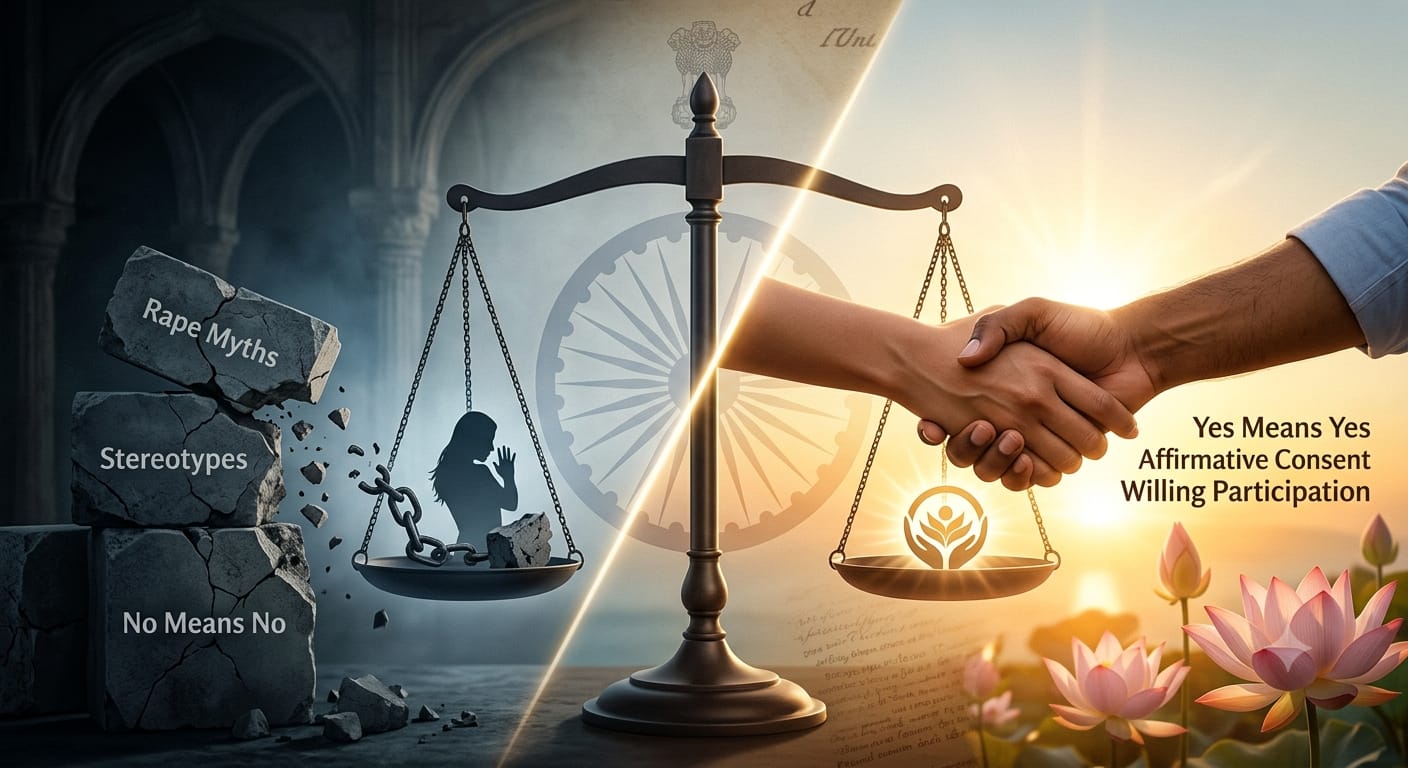
Traditionally, rape laws were primarily enforced within the framework of the “No Means No” model, where emphasis was placed on the victim’s refusal or resistance to the act. Under this concept, the absence of a clear “no” or physical resistance was often interpreted as implied consent. However, modern rape jurisprudence has gradually shifted towards the “Yes Means Yes” or affirmative consent standards, which necessitate clear, voluntary, and affirmative participation in the sexual act rather than mere absence of objection. This means consent must be a proactive, conscious decision rather than the mere absence of “no.”
International Recognition of Affirmative Consent
This advanced understanding of consent has gained increasing international recognition. Recently, Members of the European Parliament urged the proposal of consent-based rape legislation, thereby strongly endorsing the affirmative consent standards. MEPs said consent must be assessed in context, including in cases involving fear, intimidation, unconsciousness, intoxication, chemical submission, sleep, illness, disability, or vulnerability, while also recognizing trauma responses such as “freeze and fawn.” Parliament also urged that silence, lack of resistance, the absence of a “no,” previous consent, past sexual conduct, or any current or previous relationship must not be interpreted as consent. This new legal framework strongly endorses the affirmative consent standards, i.e., “Only Yes Means Yes.”
Key Principles of the Emerging Affirmative Consent Standard
| Principle | Meaning |
|---|---|
| Affirmative Consent | Consent must be clear, voluntary, and unequivocal. |
| Silence | Silence cannot be treated as consent. |
| No Resistance | Absence of resistance does not amount to consent. |
| Previous Relationship | Past intimacy does not imply present consent. |
| Trauma Responses | Fear, freezing, intimidation, or vulnerability cannot be interpreted as willingness. |
Has Indian Rape Law Truly Shifted?
This raises an important question within our Indian context. While the legislative definition of consent introduced through the 2013 amendment appears to reflect elements of the affirmative consent concept, has Indian rape law jurisprudence truly shifted beyond the “No Means No” standards in practice?
Judicial Interpretation and the Persistence of Traditional Consent Standards
Although the 2013 Amendment introduced an affirmative understanding of consent into Indian rape law jurisprudence, the judiciary has not applied this shift consistently. One of the most debated cases in this regard is the Delhi High Court decision in Mahmood Farooqui v. State (NCT of Delhi), which drew heavy criticism for its application of consent despite the post-statutory interpretation of consent under the 2013 Amendment.
The amendment was widely viewed as a progressive shift towards an affirmative consent model, focusing on voluntary participation rather than resistance. However, while deciding the Farooqui case, the court relied on Section 90 of IPC, currently Section 28 of BNS, which provides that consent given under fear of injury or misconception of facts would not amount to valid consent if the accused knew or had reason to believe that such consent was given under that fear of injury or misconception of fact.
Consequently, the court examined whether the prosecutrix had effectively communicated her unwillingness or fear to the accused and whether the accused had knowledge of the same. To find out, the court started analyzing the facts and found out that, at one point, the prosecutrix had feigned orgasm to bring the ordeal to an end. The court interpreted this conduct to conclude that there was insufficient communication of fear or unwillingness to the accused. The court held that the appellant (accused) had no opportunity to understand that the prosecutrix was acting under fear or pressure. Here, the burden once again shifted towards the victim (prosecutrix) to prove not merely the absence of consent but also adequate communication of such absence to the accused.
The Court further argues that determining consent may sometimes be difficult, depending on the nature of the relationship between the parties. This means that whether a “no” means “no” depends heavily on the context and the individuals involved. Further stating that a feeble NO from a stranger would indicate absence of consent, the same situation may appear more complex when the individuals are already known persons, are educated, and have shared physical intimacy in the past. In such circumstances, a hesitant response, or a feeble no, may create uncertainty about whether the person genuinely intended to refuse consent.
However, such an interpretation attracted widespread criticism because it neglected the post-2013 statutory understanding of consent. Legal and women’s rights advocates widely contended that a ‘no’ is an unequivocal denial of consent, regardless of how it is spoken or who is speaking it.
The affirmative consent framework introduced through explanation 2 of section 375 IPC shifted the focus away from resistance and victim conduct towards clear and voluntary participation. By observing that a “feeble No” may mean yes in certain situations, the judgment once again emphasized how strongly the victim resisted, how clearly she communicated refusal, and how the accused subjectively understood her conduct.
This reasoning raises serious concerns within the framework of affirmative consent. Under the “yes means yes” standard, the absence of a clear refusal cannot by itself be treated as consent, particularly in situations involving fear, pressure, psychological submission, misconception of facts, or hesitations. The emphasis is not on whether the victim clearly resisted or not, but on whether there existed a clear, voluntary, and unequivocal agreement to participate in sexual activity. Therefore, the reasoning of Farooqui appeared to reintroduce traditional assumptions regarding the “ideal victim behavior,” despite the legislative shift introduced under the 2013 Amendment.
Rape Myths, Stereotypes and the “Ideal Victim” in Rape Adjudication
The reasoning followed in Mahmood Farooqui v. State (NCT of Delhi) is not an isolated judgment within Indian rape jurisprudence. The interpretation of consent in rape laws has been historically influenced by several stereotypical assumptions regarding how a “real victim” of rape is expected to behave before, during, or after the incident. These assumptions often shift the focus from the conduct of the accused to the conduct of the prosecutrix (victim), thereby making the victim’s conduct a decisive factor in determining consent.
In due course, courts have examined factors like physical resistance, past sexual history, the relationship between the parties, delay in FIR, and post-incident conduct of the victim while determining whether consent existed. These assumptions, commonly referred to as “rape myths,” have a detrimental impact on rape adjudication in India.
Landmark Case: The Mathura Rape Case
The first and most criticized judgment of stereotype-driven reasoning can be seen in Tukaram v. State of Maharashtra, popularly known as the Mathura Rape case. The case involved a teenage tribal girl, who was alleged to have been raped by policemen in a police station. While acquitting both the accused (2 policemen), the Supreme Court heavily relied on the absence of injuries on the body of the prosecutrix and the lack of evidence showing that the girl resisted during the act.
The court further observed that the prosecutrix was “habituated to sexual intercourse,” thereby implying that the absence of physical injuries on the victim, no sufficient resistance by the victim, and her past sexual activity were decisive factors in determining whether she consented to the sexual act. The judgment appeared to proceed on the reasoning that a genuine rape victim would necessarily resist physically, sustain physical injuries, raise an alarm during the incident, and immediately complain about that incident. In the absence of such conduct, it is treated as if the victim consented to the act and it was a peaceful affair.
This verdict led to a massive public outcry and demanded legal reform in rape laws. In response to these demands, the legislature introduced the Criminal Law (Amendment) Act, 1983, a landmark piece of legislation that introduced the presumption of no consent in rape cases in India by incorporating Section 114A to the Indian Evidence Act, 1872. This shifted the legal burden on the accused, allowing the courts to presume that a woman did not consent to the sexual act if she states in her testimony in court that she did not consent.
Common Rape Myths That Influenced Judicial Interpretation
Here are some assumptions that influenced the judicial mind over several judgments:
| Rape Myth | Traditional Assumption | Modern Legal Position |
|---|---|---|
| No physical resistance | Absence of resistance indicates consent. | Absence of resistance does not amount to consent. |
| Past sexual history | Sexually active women are more likely to consent. | Past sexual conduct is legally irrelevant. |
| Relationship between parties | Prior intimacy creates ambiguity regarding consent. | Every sexual act requires fresh and voluntary consent. |
A. No Physical Resistance = Consent
Historically, courts have given considerable importance to the presence or absence of injuries while determining consent. The assumption is that a woman who did not consent to the act would physically resist, and in the absence of that, it is taken as if she consented to the act.
However, such an assumption fails to recognize that victims of sexual violation may react differently under different circumstances, such as fear, coercion, intimidation, psychological shock, or helplessness. Passive submission under fear cannot be equated with consent.
Key Takeaway: Passive submission under fear cannot be equated with consent.
B. Past Sexual History or Moral Character of a Victim
Most of the judgments frequently treated prior sexual history as a relevant factor in determining consent. Such an assumption is based on the reasoning that a woman who is sexually active, or perceived as “immoral,” is more likely to have consented to the sexual act in question.
Over time, such reasoning came to be widely criticized for mistaking a woman’s past sexual conduct with the willingness to consent to a specific sexual act.
However, there are cases where the court held that no such inference must be drawn from the circumstances. One among those is State of Punjab v. Gurmit Singh, where the court held that a victim’s prior sexual history is completely irrelevant to the issue of consent in a rape case and further held that “she has a right to refuse to submit herself to sexual intercourse with anyone and everyone because she is not a vulnerable object or prey for being sexually assaulted by anyone and everyone.”
The court established that if the victim’s testimony is credible and inspires confidence, a conviction can be sustained solely on her testimony without requiring any material corroboration.
Even legislative reforms subsequently attempted to move away from this approach by incorporating Section 53A of the Indian Evidence Act 1872, through the Criminal Law (Amendment) Act, 2013, which states that in cases of rape, evidence of the moral character of the victim or past sexual experiences with any person shall not be a relevant factor while determining the issue of consent or quality of consent.
C. Relationship Between the Parties
In several cases, prior acquaintance, friendship, previous intimacy, or familiarity between the parties has been treated as creating ambiguity regarding consent or refusal. This reasoning is particularly visible in Mahmood Farooqui v. State (NCT of Delhi), where the court observed that where parties are known to each other, a feeble no or a lack of strong resistance may create uncertainty regarding consent.
Such reasoning attracted criticism. The affirmative consent framework introduced through the 2013 amendment shifted the focus away from assumptions arising out of relationships or surrounding circumstances towards the existence of unequivocal consent. However, an interpretation such as “feeble no may mean yes” reintroduced ambiguity in determining consent by emphasizing how refusal was communicated rather than whether genuine consent existed.
Progressive Supreme Court Judgments That Rejected Rape Myths
Over the years, the Supreme Court has delivered several landmark judgments that moved Indian rape jurisprudence away from patriarchal stereotypes and towards a victim-centric understanding of consent.
| Judgment | Key Principle Laid Down |
|---|---|
| Bharwada Bhoginbhai Hirjibhai v. State of Gujarat | The victim is not an accomplice; corroboration is not mandatory if testimony is credible. |
| State of Punjab v. Gurmit Singh | Past sexual history is irrelevant; conviction can rest solely on trustworthy testimony. |
| Aparna Bhat v. State of Madhya Pradesh | Courts must avoid gender stereotypes and patriarchal assumptions while deciding rape cases. |
Bharwada Bhoginbhai Hirjibhai v. State of Gujarat
In the landmark judgment Bharwada Bhoginbhai Hirjibhai v. State of Gujarat, the Supreme Court delivered a judgment that challenged traditional patriarchal biases in the evaluation of evidence. The court ruled that a victim of a sexual offense is a witness of necessity and a victim of a crime, not an accomplice.
Therefore, insisting on corroboration degrades the victim and holds that while examining, courts must look at the ‘fringe’ versus the ‘core’ of the testimony. If the core of the testimony remains unshaken, minor contradictions in the fringe details must be ignored.
State of Punjab v. Gurmit Singh
The judgment of State of Punjab v. Gurmit Singh marked an important shift towards a more sensitive and realistic understanding of victim behavior in rape cases by holding that rape causes deep psychological and emotional trauma and observing that the absence of injuries, delay in reporting, or minor inconsistencies cannot by themselves discredit the testimony of the prosecutrix.
Important Principle: The testimony of the prosecutrix, if trustworthy and credible, can by itself form the basis of conviction.
Aparna Bhat v. State of Madhya Pradesh
Another landmark ruling in this regard is Aparna Bhat v. State of Madhya Pradesh, in which the Supreme Court expressly condemned the use of gender stereotypes in judicial decision-making.
The court observed that assumptions regarding the victim’s morality, behavior, clothing, or conduct have no place in rape adjudication and directed the courts to avoid reasoning based on patriarchal notions and preconceived expectations of victim behavior.
Continuing Impact of Rape Myths on Judicial Reasoning
Despite these significant legislative reforms and progressive judicial observations, rape myths and stereotypical assumptions continue to influence the judicial mind in subtle yet significant ways. The persistence of such reasoning often shifts focus and the inquiry from the conduct of the accused to whether the victim behaved in a manner considered consistent with the societal expectations of a “real ideal victim.”
Key Observation: Modern rape jurisprudence requires courts to evaluate whether there was clear and voluntary consent, not whether the victim behaved according to preconceived notions of an “ideal victim.”
Conclusion
There is a clear, gradual shift in the evolution of the rape law in India from resistance-based standards to consent-based. The 2013 amendment was a landmark change in the law, as it established a new concept of consent: an unequivocal and voluntary agreement, which sought to bring rape laws into line with the contemporary notions of body autonomy and sexual agency.
Recent changes in the EU support this shift by incorporating the adoption of a more robust affirmative consent approach, which holds that any participation that is not voluntary and informed is not considered consent. But as we can see from the judicial interpretation in the case of Mahmood Farooqui v. State (NCT of Delhi), the shift from traditional standards to affirmative consent is not fully effected in practice. Despite the statutory framework set out by the 2013 amendment, issues of consent remain unclear due to judicial consideration of factors including the prior relationship between the parties, the nature or extent of resistance offered, victim behavior, and surrounding circumstances.
Meanwhile, in the case of State of Punjab v. Gurmit Singh and Aparna Bhat v. State of Madhya Pradesh, progressive decisions have been taken by the courts to dispel the stereotypical notions relating to the victimization of women and warn against relying upon gender-based myths while dealing with sexual offenses. This is an important recognition that one should not judge a response to sexual violence based on any preconceived notion about what one expects a “real victim” to do.
Therefore, the statutory definition of consent under Indian rape law as it stands today reflects elements of the affirmative consent model. Still, there is a need to increase consistency in judicial interpretation to achieve the object behind the 2013 amendment. Changes in European legislation suggest a growing international understanding that a lack of resistance and a lack of consent, whether by silence, hesitation, or prior intimacy, is not consent in its own right. In this context, Indian rape jurisprudence should continue to progress in a way that ensures unequivocal consent as the cornerstone of the determination of sexual offenses, while ensuring that myths and stereotypes do not nullify the laws applicable to sexual offenses.
Key Takeaways
- The Criminal Law (Amendment) Act, 2013, shifted Indian rape law from a resistance-based approach towards an affirmative consent model.
- Explanation 2 to Section 375 IPC (now Section 63 of the Bharatiya Nyaya Sanhita) recognizes consent as an unequivocal and voluntary agreement.
- The absence of physical resistance, silence, hesitation, or passive submission does not amount to consent.
- The reasoning adopted in Mahmood Farooqui v. State (NCT of Delhi) continues to generate debate regarding the practical implementation of affirmative consent principles.
- Progressive Supreme Court decisions such as Bharwada Bhoginbhai Hirjibhai, State of Punjab v. Gurmit Singh, and Aparna Bhat v. State of Madhya Pradesh have rejected gender stereotypes and rape myths.
- International developments, particularly within the European Union, indicate an increasing acceptance of the principle that “Only Yes Means Yes.”
- Greater consistency in judicial interpretation is essential to fully realize the legislative intent behind the 2013 reforms.
Summary Table
| Aspect | Traditional Approach | Modern Affirmative Consent Approach |
|---|---|---|
| Consent | Focus on resistance or refusal | Focus on voluntary and unequivocal agreement |
| Silence | May imply consent | Cannot be treated as consent |
| Physical Resistance | Expected from the victim | Not required to establish absence of consent |
| Past Sexual History | Frequently considered relevant | Legally irrelevant to determining consent |
| Previous Relationship | Could create ambiguity regarding consent | Each sexual act requires fresh, voluntary consent |
| Judicial Focus | Victim’s conduct | Existence of clear and affirmative consent |
Final Thoughts
The evolution of Indian rape jurisprudence demonstrates a conscious legislative effort to place consent, rather than resistance, at the heart of sexual offense adjudication. While statutory reforms have embraced the principles of affirmative consent, judicial interpretation continues to evolve. As comparative international jurisprudence increasingly recognizes that silence, hesitation, fear, or prior intimacy can never substitute for voluntary agreement, Indian courts are likely to continue moving towards a more consistent application of the affirmative consent standard, ensuring that the autonomy, dignity, and bodily integrity of every individual remain the central focus of rape law.

