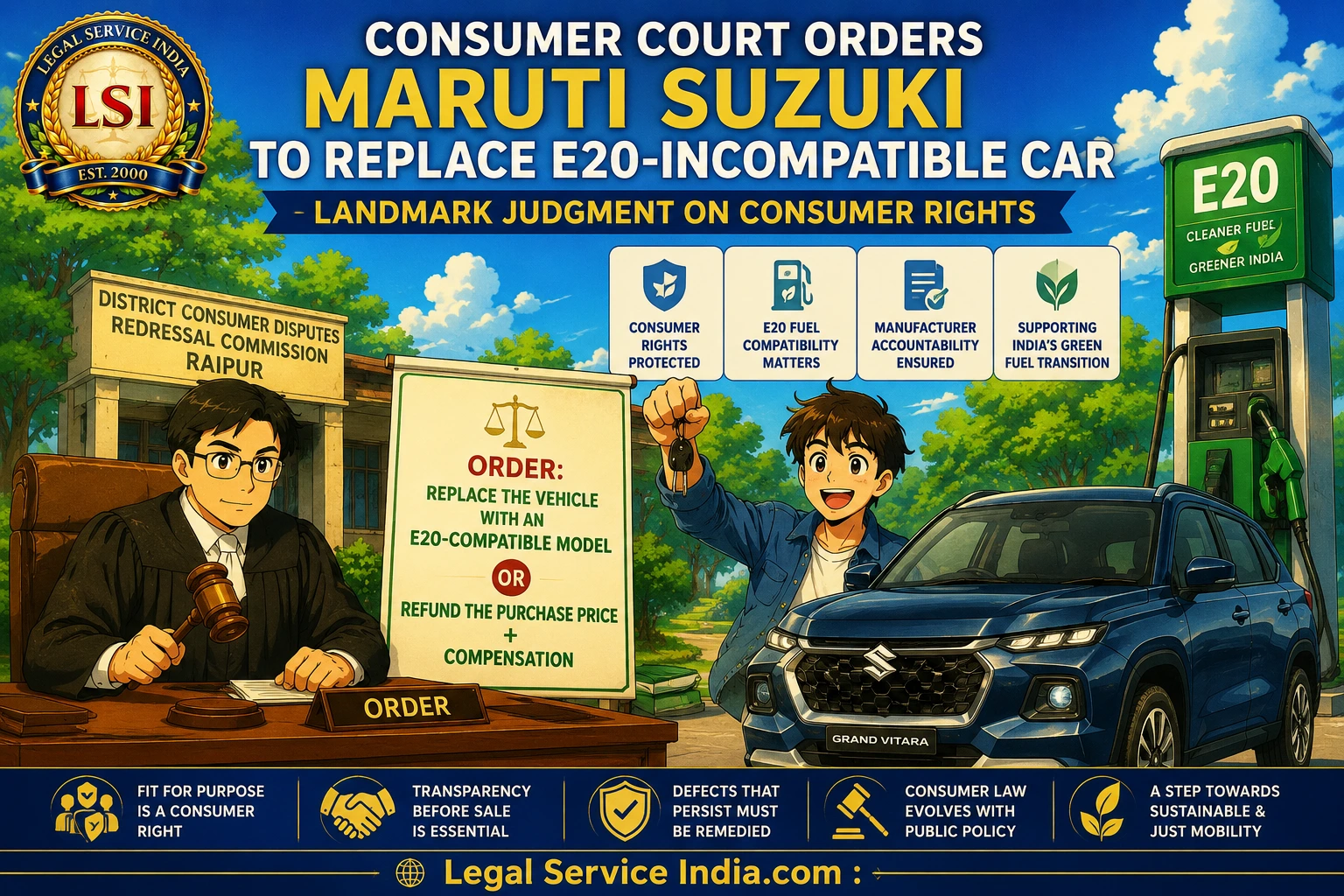
Consumer Court Directs Maruti Suzuki to Replace Car with E20-Compatible Model: A Landmark Judgment on Consumer Rights, Product Liability and India’s Green Fuel Transition
Introduction
India’s ambitious transition towards cleaner fuels has reached an important legal milestone. In what is widely regarded as the country’s first significant consumer dispute involving E20 fuel compatibility, the District Consumer Disputes Redressal Commission (Additional Bench), Raipur, directed Maruti Suzuki India Ltd. to replace a customer’s vehicle with an E20-compatible model or, alternatively, refund the purchase price along with compensation.
Although the dispute concerns a single Maruti Grand Vitara Strong Hybrid, its implications extend far beyond one dissatisfied customer. The decision raises complex legal questions at the intersection of consumer protection law, product liability, automobile manufacturing standards, environmental policy, warranty obligations, and India’s National Ethanol Blending Programme. As India steadily expands the supply of E20 petrol across the country, the judgment is likely to influence future disputes involving not only Maruti Suzuki but also other automobile manufacturers operating in India.
From a legal standpoint, this case is much more than an ordinary complaint about a defective vehicle. It touches upon a fundamental principle of consumer jurisprudence: Can a manufacturer sell a vehicle that is not fully compatible with the fuel increasingly supplied by government-authorized petrol pumps without clearly informing consumers of its limitations? The answer to that question has profound consequences for millions of existing and prospective vehicle owners.
The order also serves as a reminder that consumer protection law is dynamic. It must evolve alongside technological innovation and public policy. As governments encourage cleaner fuels and sustainable mobility, manufacturers are expected to ensure that their products remain reasonably fit for their intended purpose. If a gap emerges between public policy and product design, consumer forums may be called upon to determine who should bear the resulting burden—the manufacturer or the consumer.
This article undertakes a comprehensive legal analysis of the Raipur Consumer Commission’s decision, examines its implications under the Consumer Protection Act, 2019, analyses the broader policy context of India’s ethanol-blending initiative, and explores how this landmark ruling could shape the future of automobile litigation in India.
Citation: Dr. Premraj Debta v. Maruti Suzuki India Ltd. & Anr., District Consumer Disputes Redressal Commission (Additional Bench), Raipur, Chhattisgarh, Order dated 14 July 2026 (Reported).
India’s Green Fuel Revolution and the Rise of E20 Petrol
To appreciate the significance of this judgment, one must first understand the broader policy framework within which it arose.
Over the past decade, India has embarked upon one of the world’s most ambitious biofuel programs. The government has progressively increased the blending of ethanol with petrol as part of its strategy to reduce dependence on imported crude oil, improve energy security, lower vehicular emissions, and promote sustainable agricultural growth. Ethanol, primarily produced from sugarcane and agricultural feedstock, is considered a renewable fuel capable of reducing greenhouse gas emissions when blended with conventional petrol.
Initially, India adopted E10 petrol, containing ten percent ethanol. The success of this program encouraged policymakers to accelerate the transition towards E20 petrol, a blend consisting of twenty percent ethanol and eighty percent petrol. The National Policy on Biofuels and the Ethanol Blending Programme envisage the widespread adoption of E20 fuel across the country in a phased manner.
National Objectives of the E20 Policy
The policy is driven by several important national objectives:
- Reducing India’s dependence on imported fossil fuels.
- Conserving valuable foreign exchange.
- Lowering carbon emissions from the transport sector.
- Improving air quality.
- Enhancing energy security.
- Providing additional income opportunities for Indian farmers engaged in sugarcane cultivation and other biofuel feedstock production.
| National Objective | Expected Benefit |
|---|---|
| Reduced crude oil imports | Improves energy security and reduces import dependence |
| Foreign exchange savings | Lowers expenditure on imported petroleum products |
| Cleaner environment | Helps reduce vehicular emissions and carbon footprint |
| Support for agriculture | Creates additional demand for ethanol feedstock |
| Sustainable mobility | Promotes cleaner transportation across India |
As fuel stations across India gradually begin supplying E20 petrol, consumers increasingly have little practical choice regarding the type of petrol available in the market. Unlike premium fuels, E20 is intended to become part of the country’s mainstream fuel infrastructure.
This shift has significant legal consequences. If consumers are expected to use E20 petrol as part of the government’s national fuel policy, automobile manufacturers must ensure that vehicles sold to the public are capable of safely operating on that fuel—or clearly disclose any limitations before sale. Failure to do so could expose manufacturers to claims of product defect, deficiency in service, unfair trade practice, or even product liability under the Consumer Protection Act, 2019.
Thus, the Raipur Consumer Commission’s decision arrives at a pivotal moment in India’s transition towards greener transportation. It is one of the first judicial attempts to reconcile evolving environmental policy with established principles of consumer protection law.
What Is E20 Petrol?
E20 petrol is a fuel blend containing 20% ethanol and 80% petrol.
Ethanol is an alcohol-based renewable fuel produced from biomass, including sugarcane, maize, damaged food grains, and other agricultural products. Because ethanol contains oxygen, it promotes more complete combustion, thereby reducing certain harmful emissions compared to conventional petrol.
Environmental Benefits of E20 Petrol
From an environmental perspective, E20 offers several potential advantages:
- Lower carbon monoxide emissions.
- Reduced greenhouse gas emissions over the fuel’s life cycle.
- Decreased dependence on imported crude oil.
- Improved utilization of agricultural resources.
- Support for India’s renewable energy objectives.
Technical Characteristics of E20 Petrol
However, ethanol also possesses different chemical characteristics from conventional petrol. It is more corrosive, absorbs moisture more readily, and may affect certain rubber components, seals, fuel lines, engine calibration, and fuel injection systems if the vehicle has not been specifically engineered for higher ethanol blends.
For this reason, automobile manufacturers generally certify whether particular vehicle models are compatible with E20 fuel. Compatibility depends on factors such as engine design, fuel system materials, electronic calibration, emission control systems, and long-term durability testing.
| Feature | E20 Petrol |
|---|---|
| Ethanol Content | 20% |
| Petrol Content | 80% |
| Environmental Impact | Lower emissions and reduced dependence on fossil fuels |
| Vehicle Requirement | The engine and fuel system must be E20 compatible |
| Potential Risk for Non-Compatible Vehicles | Possible impact on fuel system components and engine performance |
This technical distinction became the central issue in the present consumer dispute.
Why This Case Matters to Every Car Owner in India
At first glance, the dispute may appear to concern only one consumer and one manufacturer. In reality, its implications are national in scope.
Millions of vehicles currently operating on Indian roads were manufactured during the transitional period between E10 and E20 fuel standards. Many owners remain uncertain whether their vehicles are fully compatible with higher ethanol blends. As E20 petrol becomes increasingly available at fuel stations, questions regarding compatibility, warranty coverage, engine performance, and manufacturer responsibility are likely to become more frequent.
Possible Impact on Future Disputes
The Raipur Consumer Commission’s order, therefore, has the potential to influence disputes involving:
- Vehicle manufacturers.
- Authorized dealerships.
- Warranty claims.
- Insurance disputes.
- Product liability actions.
- Consumer compensation claims.
- Regulatory oversight by government agencies.
| Stakeholder | Possible Legal Impact |
|---|---|
| Consumers | Greater protection and enhanced right to disclosure |
| Automobile Manufacturers | Higher compliance and disclosure obligations |
| Dealerships | Need for accurate pre-sale information |
| Insurance Companies | Potential disputes involving fuel compatibility issues |
| Regulators | Improved oversight of evolving fuel standards |
An Evolving Principle of Consumer Protection Law
The judgment also reinforces an important legal principle that extends beyond the automobile industry. Whenever governments introduce new technological or environmental standards that directly affect consumer products, manufacturers must adapt their products—or adequately warn consumers of any limitations. The cost of regulatory transition cannot automatically be shifted onto consumers who purchase products in good faith.
From that perspective, this decision is not merely about E20 petrol. It represents an evolving understanding of consumer rights in an era of rapid technological and environmental change.
Facts of the Case, Arguments of the Parties, Findings of the Consumer Commission, and Relief Granted
Facts of the Case
The dispute before the District Consumer Disputes Redressal Commission (Additional Bench), Raipur, Chhattisgarh, arose from the purchase of a Maruti Suzuki Grand Vitara Strong Hybrid Zeta Plus, a premium hybrid sport utility vehicle marketed as a technologically advanced, fuel-efficient, and environmentally friendly automobile.
The complainant, Dr. Premraj Debta, purchased the vehicle with the legitimate expectation that it would perform reliably under ordinary Indian driving conditions and would be compatible with the fuel being lawfully supplied through authorized petrol pumps. Like any reasonable consumer, he relied upon the reputation of one of India’s largest automobile manufacturers and expected that the vehicle would be fit for its intended purpose.
According to the complaint, problems began to surface after the vehicle was fueled with E20 petrol, the ethanol-blended fuel that the Government of India has been actively promoting under its National Ethanol Blending Programme. The complainant alleged that the vehicle developed persistent engine-related issues and malfunctioned repeatedly. Despite several visits to the authorized service center, the defects allegedly continued to recur.
The complainant asserted that the recurring problems were not isolated mechanical glitches capable of being rectified through routine servicing. Instead, they reflected a fundamental incompatibility between the vehicle and E20 fuel, rendering the vehicle unsuitable for normal use in a market where E20 petrol was becoming increasingly prevalent.
Another significant allegation related to the age of the vehicle. It was contended that although the car was sold as a new vehicle in 2024, it had actually been manufactured in January 2023. The complainant argued that this fact was not adequately disclosed before the sale. While the mere sale of an older manufactured vehicle does not automatically amount to a deficiency in service, the issue assumed importance because it raised questions regarding transparency, disclosure obligations, and consumer expectations.
Having failed to obtain a satisfactory resolution through repeated servicing and correspondence with the dealer and manufacturer, the complainant approached the Consumer Commission seeking appropriate relief under the Consumer Protection Act, 2019.
Facts at a Glance
| Particular | Details |
|---|---|
| Complainant | Dr. Premraj Debta |
| Vehicle | Maruti Suzuki Grand Vitara Strong Hybrid Zeta Plus |
| Main Allegation | Recurring engine problems after using E20 petrol |
| Additional Issue | Vehicle manufactured in January 2023 but sold as new in 2024 |
| Relief Sought | Appropriate relief under the Consumer Protection Act, 2019 |
The Core Legal Issue Before the Consumer Commission
Although the factual dispute centered on a single vehicle, the legal issues before the Commission were considerably broader.
The Commission was essentially required to determine the following questions:
- Whether a vehicle sold to an ordinary consumer could reasonably be expected to operate safely on E20 petrol supplied through authorized fuel stations.
- Whether repeated engine problems constituted evidence of a manufacturing defect or deficiency in service.
- Whether the manufacturer had adequately informed the consumer regarding any limitations concerning E20 fuel compatibility.
- Whether repeated repairs were sufficient to discharge the manufacturer’s obligations, or whether replacement of the vehicle was the appropriate remedy.
- Whether selling a vehicle allegedly incompatible with increasingly available E20 fuel amounted to an unfair trade practice.
These issues are of national significance because similar questions may arise in thousands of future disputes involving different automobile manufacturers as India’s transition to E20 petrol accelerates.
Summary of the Legal Issues
| Issue | Question Before the Commission |
|---|---|
| E20 Compatibility | Should vehicles safely operate on E20 petrol available through authorized fuel stations? |
| Manufacturing Defect | Did repeated engine failures indicate a manufacturing defect or deficiency in service? |
| Disclosure | Was the consumer adequately informed about any E20-related limitations? |
| Appropriate Remedy | Were repeated repairs sufficient, or was replacement justified? |
| Consumer Protection | Did the conduct amount to an unfair trade practice? |
Arguments Advanced by the Complainant
The complainant’s case was founded upon the principle that a consumer purchasing a modern passenger vehicle in India is entitled to expect that it will safely function with fuel legally supplied by authorized petrol pumps.
According to the complainant:
1. The Vehicle Was Not Fit for Ordinary Use
The complainant alleged that the vehicle repeatedly malfunctioned after using E20 petrol, thereby rendering it unsuitable for its normal purpose.
Consumer law recognizes that every purchaser has the legitimate expectation that goods sold in the ordinary course of business will be reasonably fit for the purpose for which they are purchased. A passenger vehicle incapable of reliably operating on fuel commonly available in the market may fail this fundamental test.
2. Repeated Repairs Failed to Rectify the Defect
The complainant pointed out that despite several visits to the authorized service center, the underlying problem persisted.
Repeated unsuccessful repairs often indicate that the issue is not merely routine wear and tear but may involve an inherent defect or design-related problem. Consumer forums across India have consistently viewed repeated repair attempts with caution, particularly where the same defect continues to recur.
3. Failure to Disclose Material Information
Another important contention concerned disclosure.
The complainant argued that neither the manufacturer nor the dealer adequately informed him that the vehicle might experience operational issues when fuelled with E20 petrol.
If a product possesses a limitation that materially affects its ordinary use, the consumer has a right to be informed before making the purchase. The absence of such disclosure may amount to an unfair trade practice under the Consumer Protection Act, 2019.
4. Sale of an Older Manufactured Vehicle
The complainant also questioned the circumstances in which a vehicle manufactured in January 2023 was sold as a new vehicle in 2024.
Although there is nothing inherently unlawful in selling an unsold vehicle manufactured during an earlier year, consumers are entitled to complete and accurate disclosure regarding the manufacturing date. The issue assumes particular significance where the timing of manufacture may affect technical specifications or compatibility with evolving regulatory standards.
5. Entitlement to Replacement
Given the repeated failures and alleged incompatibility with E20 fuel, the complainant argued that mere repairs could no longer provide an effective remedy.
Instead, the only meaningful relief would be replacement of the vehicle with one fully compatible with E20 petrol or, alternatively, refund of the purchase price together with compensation.
Defence of Maruti Suzuki and the Dealer
Maruti Suzuki India Ltd. and the authorized dealer contested the complaint and denied liability.
According to media reports, the manufacturer disputed the allegation that E20 petrol was responsible for the engine-related issues. The company maintained that there was no manufacturing defect warranting replacement of the vehicle.
While the complete pleadings are not publicly available, the defense appears to have been based on several broad propositions commonly raised in automobile consumer disputes.
1. Denial of Manufacturing Defect
The manufacturer denied that the vehicle suffered from any inherent manufacturing defect.
Automobile manufacturers frequently argue that isolated operational problems cannot automatically establish a design defect or manufacturing deficiency without supporting technical evidence.
2. Dispute Regarding the Cause of Damage
The manufacturer also questioned whether the alleged engine problems were actually attributable to E20 petrol.
Engine performance may be influenced by several variables, including:
- Fuel quality
- Maintenance practices
- Driving conditions
- Servicing history
- External contamination
- Mechanical wear unrelated to design
Consequently, establishing a direct causal relationship between fuel composition and engine damage generally requires technical evidence.
3. Repairs Were Undertaken
Like many manufacturers defending consumer complaints, Maruti Suzuki relied upon the fact that authorized service facilities had attended to the vehicle whenever complaints were raised.
Manufacturers often argue that warranty obligations primarily require repair of defects and that replacement should remain an exceptional remedy reserved for cases involving irremediable defects.
4. Sale of an Older Manufactured Vehicle
With respect to the manufacturing date, manufacturers generally contend that a vehicle does not cease to be “new” merely because it was manufactured several months before its sale, provided it has not previously been registered or used.
Whether non-disclosure of the manufacturing date amounts to a deficiency depends upon the facts of each individual case.
Findings of the Consumer Commission
After considering the material placed before it, the Consumer Commission reportedly accepted the complainant’s case.
The Commission found that the recurring defects experienced by the complainant were serious enough to warrant intervention under the Consumer Protection Act.
Most significantly, the Commission concluded that the vehicle supplied to the complainant was not compatible with E20 petrol, which was increasingly available across India pursuant to the government’s ethanol blending policy.
The Commission also appears to have recognized an important practical reality.
An ordinary consumer visiting a petrol station cannot reasonably be expected to investigate whether the fuel being dispensed contains 10% or 20% ethanol. Nor can consumers be expected to identify specialized fuel outlets merely to avoid damaging their vehicles.
Once E20 petrol becomes part of mainstream fuel distribution, compatibility with that fuel assumes considerable importance in determining whether a vehicle is fit for ordinary use.
The Commission further held that the conduct of the manufacturer and dealer amounted to a deficiency in service and, in the circumstances of the case, also attracted allegations of unfair trade practice because the consumer had not been adequately protected against the consequences of the vehicle’s alleged incompatibility.
Although the detailed reasoning of the Commission extends across its 23-page order, the essential principle emerging from the decision is that manufacturers cannot ignore evolving market realities while continuing to market products intended for ordinary consumers.
Relief Granted by the Consumer Commission
Having found in favor of the complainant, the Commission granted substantial relief.
The Commission directed Maruti Suzuki to:
- Replace the complainant’s vehicle with a new E20-compatible model within the stipulated period; or
- Alternatively, refund the purchase price of the vehicle if replacement was not provided.
In addition, the Commission awarded compensation for the mental agony, inconvenience, and harassment allegedly suffered by the complainant, along with litigation costs.
The award of replacement, rather than merely directing repairs, is particularly significant.
Consumer forums generally prefer repairs where defects can be effectively rectified. Replacement is ordinarily ordered only where the defect is so fundamental that continued repairs would not provide adequate relief or where the product fails to perform its essential purpose.
The Commission’s choice of replacement therefore suggests that it regarded the alleged incompatibility with E20 fuel as going to the very root of the consumer’s grievance rather than being a minor mechanical issue capable of permanent correction through routine servicing.
Legal Analysis Under the Consumer Protection Act, 2019 – Why This Judgment Could Become a Landmark in Indian Consumer Jurisprudence
The Raipur Consumer Commission’s decision is significant not merely because it granted relief to an individual consumer but because it raises several foundational questions under the Consumer Protection Act, 2019.
At its core, the dispute concerns the legal responsibilities of manufacturers when evolving government policy changes the practical conditions under which consumers use their products.
Viewed through the lens of consumer jurisprudence, the case is not simply about a defective automobile. It concerns the statutory rights of consumers to receive products that are safe, fit for their intended purpose, accompanied by adequate information, and supported by fair warranty practices. It also underscores that manufacturers cannot remain passive when public policy transforms the marketplace in which their products operate.
This section examines the legal principles that underpin the Commission’s reasoning and explains why the decision may influence consumer litigation far beyond the automobile sector.
Consumer Rights Under the Consumer Protection Act, 2019
The Consumer Protection Act, 2019, was enacted to strengthen consumer rights in India by providing more effective mechanisms for redressal and by recognizing the changing nature of commerce, technology, and product liability.
Section 2(9) of the Act enumerates several fundamental consumer rights, including:
- The right to be protected against goods and services hazardous to life and property.
- The right to be informed about the quality, quantity, potency, purity, standard, and price of goods or services.
- The right to access a variety of goods and services at competitive prices.
- The right to seek redressal against unfair trade practices or restrictive trade practices.
- The right to consumer awareness.
Among these, three rights assume particular importance in the present case.
Right to Safety
A consumer purchasing a motor vehicle is entitled to expect that it can be operated safely under ordinary road conditions using legally available fuel.
If the widespread availability of E20 petrol creates a foreseeable risk of engine malfunction in a particular vehicle, questions naturally arise regarding the manufacturer’s obligation to protect consumers from such risks.
The right to safety extends beyond protection against accidents. It also encompasses protection against products that may become unsuitable or hazardous because of foreseeable changes in the marketplace.
Right to Information
The Consumer Protection Act places considerable emphasis on transparency.
Consumers cannot make informed purchasing decisions unless manufacturers disclose all material facts relating to the product.
If a vehicle has limitations regarding fuel compatibility, the question is whether those limitations were adequately communicated before the sale.
Merely including technical information in lengthy owner’s manuals may not always satisfy the broader statutory obligation of meaningful disclosure, particularly where the information affects the ordinary use of the product.
This issue may become central in future litigation involving E20 compatibility.
Right to Seek Redressal
The Act guarantees consumers an effective remedy where goods suffer from defects or where manufacturers engage in unfair trade practices.
The Raipur Commission’s order demonstrates that consumer forums are prepared to grant substantial relief—including replacement of expensive automobiles—where circumstances justify such intervention.
Consumer Rights Relevant to This Case
| Consumer Right | Relevance in This Judgment |
|---|---|
| Right to Safety | The vehicle should safely operate using legally available fuel. |
| Right to Information | Manufacturers must adequately disclose fuel compatibility limitations. |
| Right to Seek Redressal | Consumer forums may grant replacement where justified. |
The Doctrine of “Fitness for Purpose”
One of the most important legal principles underlying this case is the doctrine commonly referred to as fitness for intended purpose.
Although frequently associated with contract and sales law, this doctrine has become an integral component of modern consumer protection jurisprudence.
The principle is simple:
When a consumer purchases goods for their ordinary and obvious purpose, the goods must be reasonably capable of performing that purpose.
In the context of automobiles, this means that a passenger vehicle sold in India should ordinarily be capable of operating using fuel lawfully supplied by authorized petrol pumps, unless the manufacturer clearly informs the purchaser of any limitations before the sale.
The present dispute brings this doctrine into sharp focus.
As India transitions towards E20 petrol, consumers cannot reasonably be expected to search for specialized fuel or investigate the ethanol percentage before refueling their vehicles.
If E20 becomes part of ordinary commercial fuel distribution, compatibility with that fuel may itself become an essential characteristic of a vehicle’s fitness for purpose.
The commission’s reasoning appears to recognize this practical reality.
Defective Goods Under the Consumer Protection Act
The Consumer Protection Act permits consumers to seek remedies where goods suffer from defects.
A defect may arise from:
- Manufacturing deficiencies.
- Design defects.
- Quality failures.
- Shortcomings in performance.
- Deviations from expected standards.
Importantly, not every defect is visible at the time of purchase.
Many product defects become apparent only after prolonged use under ordinary operating conditions. Such defects are commonly described as latent defects.
If a vehicle repeatedly develops engine-related problems while being used in the ordinary manner contemplated by both the manufacturer and the purchaser, a consumer forum may examine whether the defect is inherent in the product rather than attributable to misuse.
In the present case, the Commission appears to have concluded that the recurring problems were sufficiently serious to justify replacement rather than continued repairs.
That conclusion distinguishes the dispute from routine warranty claims involving isolated mechanical failures.
Deficiency in Service: Beyond Mere Repairs
The concept of deficiency in service occupies a central place in Indian consumer law.
Manufacturers and authorized dealers do not discharge their obligations merely by accepting vehicles for servicing.
The true test is whether the consumer ultimately receives effective and lasting relief.
Consumer forums have repeatedly held that repeated repairs of the same defect may themselves become evidence that the service provided is inadequate.
If a customer is compelled to visit authorized service centers again and again for the same recurring problem, the inconvenience suffered may amount to a deficiency in service, particularly where the defect substantially affects the utility of the product.
In the present case, the Commission appears to have accepted that repeated repair attempts failed to resolve the underlying grievance.
This finding significantly strengthened the complainant’s claim for replacement.
Unfair Trade Practice and the Duty of Disclosure
One of the most significant aspects of the judgment concerns the broader obligation of manufacturers to disclose material information.
The Consumer Protection Act prohibits unfair trade practices that mislead consumers or withhold information necessary for informed decision-making.
The legal issue is not confined to whether E20 compatibility was technically discussed somewhere in the owner’s manual.
Rather, the question is whether an ordinary purchaser received clear and meaningful information before purchasing the vehicle.
Several questions arise:
- Was the purchaser expressly informed that the vehicle might face operational issues with E20 petrol?
- Was the information prominently disclosed at the dealership?
- Were sales representatives adequately trained to explain fuel compatibility?
- Would an average consumer have understood the practical implications of the vehicle’s fuel limitations?
If the answer to these questions is negative, future consumer forums may increasingly examine whether manufacturers have complied with their duty of disclosure.
Transparency is not merely a matter of good business practice; it is increasingly becoming a statutory obligation.
Product Liability: A New Dimension Under the Consumer Protection Act, 2019
One of the most transformative features of the Consumer Protection Act, 2019, is the introduction of a comprehensive product liability regime.
Unlike the earlier legislation, the 2019 Act recognizes that manufacturers, service providers, and sellers may all be held accountable where defective products cause harm.
Product liability may arise where:
- A product contains a manufacturing defect.
- The product suffers from a design defect.
- The product deviates from manufacturing specifications.
- Adequate warnings or instructions were not provided.
- The product fails to conform to express warranties.
Although the present complaint appears to have been decided primarily as a consumer dispute involving defective goods and deficiency in service, its reasoning has important implications for future product liability litigation.
Suppose, for instance, a consumer establishes that
- A vehicle was marketed without adequate disclosure regarding E20 compatibility.
- Engine failure resulted from foreseeable use of E20 petrol.
- The manufacturer knew or ought reasonably to have known of the compatibility issue.
In such circumstances, future claims may increasingly invoke the product liability provisions of the Consumer Protection Act.
This represents a potentially significant expansion of manufacturer responsibility in India’s evolving automobile sector.
Manufacturer’s Duty to Warn Consumers
Modern product liability law recognizes that safety does not depend solely upon product design.
Manufacturers must also provide adequate warnings regarding reasonably foreseeable risks.
The duty to warn is particularly important where
- Risks are not obvious.
- Consumers lack technical expertise.
- Misuse is foreseeable.
- Evolving market conditions affect product performance.
Fuel compatibility arguably falls within this category.
Most consumers cannot be expected to understand complex engineering distinctions relating to ethanol concentration, engine calibration, fuel injection systems, or material compatibility.
If higher ethanol blends become common in the marketplace, manufacturers may need to ensure that warnings regarding compatibility are
- Clear.
- Prominent.
- Understandable.
- Communicated before purchase rather than discovered after engine problems arise.
Failure to provide adequate warnings has become a recognized basis for liability in many product liability jurisdictions worldwide.
Indian consumer jurisprudence may increasingly move in the same direction.
Why Replacement Rather Than Repair Is Legally Significant
Perhaps the most striking aspect of the Raipur Commission’s order is its decision to direct replacement of the vehicle instead of merely requiring further repairs.
Under consumer law, replacement is generally considered an extraordinary remedy.
Consumer forums ordinarily prefer:
- Repair of defects.
- Rectification under warranty.
- Reimbursement of repair costs.
Replacement is usually ordered only where the defect is fundamental, recurring, or incapable of satisfactory correction.
By directing replacement, the Commission appears to have concluded that continued repairs would not adequately protect the consumer’s rights.
This aspect of the judgment may prove highly influential in future automobile litigation involving repeated defects and evolving technical standards.
Constitutional Dimensions, Environmental Policy, Regulatory Implications, Impact on the Automobile Industry, International Perspective, and Possible Grounds of Appeal
The Raipur Consumer Commission’s decision should not be viewed merely as a dispute between one customer and an automobile manufacturer. Its significance lies in the broader legal and policy questions it raises. The case sits at the convergence of constitutional values, environmental governance, consumer protection, industrial regulation, and India’s transition to cleaner fuels.
As India moves towards a low-carbon economy, disputes of this nature are likely to become increasingly common. Courts and consumer forums will be required to balance competing interests:
- The rights of consumers;
- The obligations of manufacturers;
- The objectives of environmental policy; and
- The realities of technological transition.
This judgment therefore offers an opportunity to examine how consumer law adapts to changing national priorities.
The Constitutional Dimensions of the Judgment
Although the Consumer Commission decided the dispute under the Consumer Protection Act, 2019, the issues involved have an undeniable constitutional backdrop.
The Constitution of India does not expressly guarantee consumer rights. Nevertheless, judicial interpretation over the years has expanded constitutional protections in a manner that indirectly safeguards consumers.
Article 21 – Right to Life and Safe Living
Article 21 guarantees that no person shall be deprived of his life or personal liberty except according to procedure established by law.
The Supreme Court has consistently interpreted this provision expansively to include the right to live with dignity, the right to health, the right to a clean environment, and the right to safety.
Although the present dispute concerns engine performance rather than personal injury, the principle underlying Article 21 remains relevant.
Consumers are entitled to expect that products sold for everyday use are reasonably safe, reliable, and suitable for their intended purpose. A motor vehicle that allegedly cannot safely operate on fuel widely supplied across the country raises concerns that extend beyond mere commercial inconvenience.
Consumer protection, therefore, contributes to the broader constitutional objective of protecting human welfare.
Directive Principles and Environmental Responsibility
India’s transition towards E20 fuel is rooted in the constitutional philosophy reflected in the Directive Principles of State Policy.
Articles 48A and 51A(g) encourage environmental protection and impose a collective responsibility upon both the state and citizens to protect and improve the natural environment.
The government’s ethanol blending program seeks to:
- Reduce greenhouse gas emissions;
- Lower dependence on imported petroleum;
- Encourage renewable energy, and
- Promote sustainable development.
However, constitutional governance requires that environmental objectives be implemented in a manner that does not unfairly burden consumers.
The transition to cleaner fuels must therefore be accompanied by corresponding technological readiness on the part of manufacturers.
Sustainable Development and Consumer Protection
One of the most interesting legal aspects of this case is that it illustrates the practical application of the principle of sustainable development.
Traditionally, sustainable development has been discussed in environmental litigation involving forests, mining, pollution, or natural resources.
However, the concept is equally applicable to consumer markets.
A successful transition towards sustainable transportation requires three stakeholders to move together:
- Government policy;
- Fuel suppliers; and
- Automobile manufacturers.
If any one component lags behind, consumers become the unintended victims.
The Raipur Commission’s decision reflects an implicit recognition that sustainable development cannot be achieved at the expense of consumer rights.
Environmental progress and consumer protection are complementary—not competing—objectives.
India’s National Ethanol Blending Programme
To appreciate the broader significance of the judgment, it is necessary to understand India’s ethanol policy.
India imports a substantial proportion of its crude oil requirements, making the country vulnerable to fluctuations in international energy prices and geopolitical instability.
The government, therefore, introduced the Ethanol Blending Program (EBP) with multiple objectives:
| Objective | Purpose |
|---|---|
| Reducing Crude Oil Imports | Lower dependence on imported petroleum enhances national energy security. |
| Supporting Farmers | Ethanol production creates additional demand for agricultural products such as sugarcane and maize, thereby generating supplementary income for farmers. |
| Reducing Carbon Emissions | Ethanol burns more cleanly than conventional petrol, contributing to lower greenhouse gas emissions and improved air quality. |
| Achieving Climate Commitments | The program supports India’s international commitments relating to climate change mitigation and sustainable development. |
As E20 petrol gradually becomes the standard fuel supplied at petrol stations, vehicle compatibility assumes growing legal importance.
The consumer in the present case argued, in essence, that if the State encourages citizens to use E20 fuel, manufacturers should ensure that vehicles sold in the market are capable of safely using that fuel or, at the very least, clearly disclose any limitations.
Impact on Automobile Manufacturers
The implications of the Raipur decision extend well beyond Maruti Suzuki.
Every automobile manufacturer operating in India may now need to carefully examine several aspects of its product strategy.
1. Vehicle Design
Manufacturers may need to ensure that newly launched vehicles are fully compatible with E20 fuel.
Future litigation could increasingly focus upon whether manufacturers exercised reasonable care while designing vehicles for the evolving Indian fuel market.
2. Product Testing
Automobile companies may be required to undertake more extensive testing under real-world Indian operating conditions before certifying compatibility.
Technical compliance on paper may no longer be sufficient if repeated consumer complaints suggest practical incompatibility.
3. Consumer Disclosure
Manufacturers may also need to revisit their disclosure practices.
Important information concerning fuel compatibility should ideally be the following:
- Prominently disclosed;
- Communicated before purchase;
- Explained by dealership staff; and
- Reflected in sales documentation.
Transparency reduces litigation and strengthens consumer confidence.
4. Warranty Policies
Manufacturers may increasingly need to clarify:
- Whether warranty remains valid when E20 fuel is used;
- Whether particular models have any operational limitations; and
- How consumers should respond if E20 fuel is the only fuel available.
Ambiguous warranty conditions may become fertile ground for future consumer disputes.
Responsibilities of Automobile Dealers
Dealerships occupy a unique position in consumer transactions.
Although manufacturers design the product, dealers interact directly with purchasers.
Consumer forums have frequently held that dealers cannot completely escape liability by merely attributing responsibility to manufacturers.
Dealers are expected to:
- Provide accurate information;
- Avoid misleading representations;
- Explain material limitations affecting product use; and
- Ensure that consumers understand important operational requirements.
In cases involving fuel compatibility, dealers may increasingly be expected to explain whether the vehicle is suitable for E20 petrol before the sale is concluded.
Failure to provide such information could expose dealers to allegations of deficiency in service or unfair trade practices.
Could This Judgment Lead to Vehicle Recalls?
One important question arising from this decision is whether widespread E20-related complaints could eventually lead to vehicle recalls.
India’s automobile regulatory framework already contemplates voluntary recalls by manufacturers where safety-related defects are identified.
If multiple consumers report similar problems involving E20 compatibility, regulatory authorities may begin examining whether broader corrective measures are required.
Although the present case concerns an individual consumer complaint, it highlights the importance of continuous monitoring by manufacturers.
Large-scale recurring complaints may ultimately require:
- Technical modifications;
- Software updates;
- Replacement of defective components;
- Recall campaigns; and
- Revised warranty programs.
While no such direction has been issued in the present matter, the possibility cannot be entirely ruled out if similar complaints multiply.
Role of the Central Consumer Protection Authority (CCPA)
The Central Consumer Protection Authority (CCPA) was established under the Consumer Protection Act, 2019, to safeguard consumer interests at a systemic level.
Unlike individual consumer forums, the CCPA possesses wider regulatory powers.
If recurring complaints emerge regarding fuel compatibility, the Authority could potentially examine issues such as the following:
- Misleading advertisements;
- Inadequate disclosures;
- Unfair trade practices; and
- Consumer safety concerns.
Although the present dispute has been decided by a District Consumer Commission, it may prompt greater regulatory attention if similar grievances arise nationwide.
International Experience: What Other Countries Teach Us
India is not the first country to adopt ethanol-blended fuel.
Several nations have decades of experience in balancing environmental objectives with consumer protection.
| Country | Key Learning |
|---|---|
| Brazil | Most vehicles are designed as flex-fuel vehicles. Manufacturers openly advertise compatibility, and consumers are well informed regarding vehicle specifications. |
| United States | Vehicle manufacturers clearly indicate approved ethanol concentrations, warranty conditions, and recommended fuel types. Consumer information requirements minimize confusion. |
| Thailand | Manufacturers certify compatibility with different fuel blends before marketing vehicles. |
The common feature across these jurisdictions is transparency.
Consumers are rarely left uncertain regarding the fuels their vehicles can safely use.
India may gradually move towards similar disclosure standards as ethanol blending expands.
Possible Grounds of Appeal
The Raipur Consumer Commission’s order is not final. Under the Consumer Protection Act, an aggrieved party has the statutory right to challenge the decision before the State Consumer Disputes Redressal Commission.
Given the commercial importance of the issues involved, appellate scrutiny appears likely.
Several legal questions may arise during appeal.
1. Sufficiency of Technical Evidence
An appellate forum may examine whether adequate expert evidence established that E20 fuel directly caused the alleged engine problems.
Automobile disputes often involve highly technical engineering questions requiring expert analysis.
2. Causal Connection
The manufacturer may argue that the complainant failed to prove a direct causal relationship between E20 petrol and the recurring defects.
Other factors such as fuel contamination, maintenance history, or unrelated mechanical failures may be raised as alternative explanations.
3. Appropriateness of Replacement
The appellate authority may also examine whether replacement was the appropriate remedy.
Generally, replacement is reserved for cases involving substantial or irremediable defects.
Whether the evidence justified such extraordinary relief may become a central issue in appeal.
4. Interpretation of Consumer Rights
Higher forums may also consider broader legal questions concerning:
- Fitness for purpose;
- Adequacy of disclosure;
- Evolving fuel standards; and
- Obligations of manufacturers during periods of regulatory transition.
Whatever the outcome of the appeal, the legal issues identified by this case are unlikely to disappear.
Instead, they are likely to become increasingly important as India’s ethanol blending program expands.
Why This Judgment Could Become a Landmark in Indian Consumer Law
Although this decision has been delivered by a District Consumer Disputes Redressal Commission, its significance extends well beyond the parties involved. Some judgments become influential not because of the level of the court that delivers them, but because they address a new legal question arising from changing economic, technological, or social conditions.
The present case is one such example.
India has witnessed a rapid transition from conventional petrol to ethanol-blended fuel as part of its national energy strategy. Millions of consumers have already purchased vehicles during this transitional period, while millions more are expected to do so in the coming years. Inevitably, questions concerning fuel compatibility, manufacturer disclosures, warranty obligations, and consumer remedies are likely to arise with increasing frequency.
The Raipur Consumer Commission’s order is among the first reported decisions to examine these issues through the lens of consumer protection law. If upheld on appeal—or if similar reasoning is adopted by higher consumer fora—it could become an important reference point for future disputes involving vehicle compatibility with evolving fuel standards.
The judgment also reflects a broader principle that transcends the automobile industry:
When public policy changes the marketplace, consumers should not be compelled to bear the financial consequences of that transition without adequate disclosure or protection.
This principle could influence disputes involving electric vehicles, hydrogen-powered vehicles, renewable energy technologies, battery systems, and other emerging sectors where government policy and technological innovation evolve simultaneously.
Key Legal Significance
| Aspect | Importance |
|---|---|
| Consumer Protection | Examines fuel compatibility issues through the Consumer Protection Act. |
| Manufacturer Responsibility | Highlights disclosure obligations regarding evolving fuel standards. |
| Future Litigation | May serve as persuasive precedent in similar disputes if upheld. |
| Emerging Technologies | Potentially influences disputes involving EVs, hydrogen vehicles, batteries, and renewable technologies. |
Practical Lessons for Vehicle Owners
Regardless of the ultimate outcome of any appeal, the judgment offers several important lessons for consumers.
1. Verify Fuel Compatibility Before Purchase
Prospective buyers should ascertain whether the vehicle they intend to purchase is certified for E20 petrol.
Important questions include:
- Is the vehicle fully E20 compatible?
- Since when has the model been certified?
- Does compatibility extend to all variants?
- Are there any operating restrictions?
Obtaining written clarification from the dealer may help avoid future disputes.
Fuel Compatibility Checklist
| Question to Ask | Why It Matters |
|---|---|
| Is the vehicle E20 compatible? | Ensures suitability for ethanol-blended fuel. |
| When was certification obtained? | Helps determine compliance with current standards. |
| Are all variants compatible? | Avoids assumptions based on model name alone. |
| Are there operating restrictions? | Clarifies any usage limitations before purchase. |
2. Preserve All Purchase Documents
Consumers should retain:
- invoice;
- booking documents;
- delivery note;
- warranty booklet;
- owner’s manual;
- dealership communications;
- promotional brochures.
These documents may become important evidence if litigation arises.
Essential Documents to Retain
| Document | Purpose |
|---|---|
| Invoice | Proof of purchase |
| Booking Documents | Evidence of transaction history |
| Delivery Note | Confirms vehicle delivery |
| Warranty Booklet | Defines warranty coverage |
| Owner’s Manual | Contains manufacturer guidelines |
| Dealership Communications | Evidence of representations made |
| Promotional Brochures | Supports claims regarding advertised features |
3. Maintain Complete Service Records
Whenever a vehicle develops recurring defects, consumers should ensure that every complaint is recorded in writing.
Service invoices should clearly describe:
- symptoms reported;
- diagnostic findings;
- repairs undertaken;
- replacement of components;
- observations of the service engineer.
A detailed service history often becomes the most persuasive evidence before consumer forums.
Service Record Checklist
| Record | Importance in Consumer Disputes |
|---|---|
| Symptoms Reported | Documents recurring issues |
| Diagnostic Findings | Shows technical assessment |
| Repairs Undertaken | Establishes repair history |
| Replacement of Components | Demonstrates repeated attempts to rectify defects |
| Service Engineer’s Observations | Provides expert evidence |
4. Preserve Fuel Receipts
Where disputes concern fuel compatibility, fuel purchase receipts may assist in establishing the following:
- the type of fuel used;
- the date of refuelling;
- continuity of vehicle usage.
Such evidence may become relevant if causation is disputed.
5. Seek Independent Technical Evaluation
Where repeated defects continue despite authorized servicing, obtaining an independent technical opinion from a qualified automobile engineer may strengthen the consumer’s case.
Expert evidence often assists consumer forums in understanding complex engineering issues.
Key Takeaways for Vehicle Owners
| Action | Benefit |
|---|---|
| Verify E20 Compatibility | Reduces the risk of purchasing an unsuitable vehicle. |
| Preserve Purchase Documents | Creates documentary evidence for future claims. |
| Maintain Service Records | Strengthens proof of recurring defects. |
| Retain Fuel Receipts | Helps establish fuel usage in compatibility disputes. |
| Obtain Independent Expert Opinion | Provides technical support in consumer litigation. |
Lessons for Automobile Manufacturers
The decision also carries important implications for manufacturers.
Greater Transparency
Manufacturers may need to ensure that information regarding fuel compatibility is communicated clearly before the sale rather than being buried within technical manuals.
Stronger Consumer Communication
Sales personnel should receive appropriate training regarding the following:
- E20 compatibility;
- fuel recommendations;
- warranty implications;
- operating precautions.
Consumers should not be left to discover important limitations after purchasing the vehicle.
Review of Warranty Policies
Warranty documents should clearly explain:
- approved fuel specifications;
- compatibility standards;
- circumstances that may affect warranty coverage.
Ambiguous warranty language often becomes the source of avoidable litigation.
Enhanced Product Testing
Manufacturers may increasingly be expected to test vehicles under actual Indian operating conditions involving widespread use of E20 fuel.
Product design must evolve alongside changing regulatory requirements.
Key Implications for Manufacturers
| Area | Expected Improvement |
|---|---|
| Consumer Disclosure | Provide clear pre-sale information regarding E20 compatibility. |
| Dealer Training | Ensure sales staff understand fuel compatibility and warranty issues. |
| Warranty Documentation | Clearly explain approved fuels and warranty limitations. |
| Vehicle Testing | Test products under real Indian operating conditions using E20 fuel. |
Broader Implications for India’s Automobile Industry
The consequences of this judgment may extend beyond Maruti Suzuki.
Other automobile manufacturers may also face similar questions regarding the following:
- older vehicle models;
- transitional fuel standards;
- disclosure practices;
- warranty obligations;
- product design.
The automobile industry may therefore witness the following:
- revised consumer disclosures;
- updated owner’s manuals;
- enhanced dealership training;
- greater emphasis on fuel compatibility certification;
- closer coordination with government agencies.
The decision could accelerate industry-wide improvements in consumer communication and product standardization.
Possible Industry-Wide Impact
| Industry Area | Potential Impact |
|---|---|
| Vehicle Manufacturing | Improved compatibility with evolving fuel standards. |
| Consumer Disclosures | Greater transparency before vehicle purchase. |
| Warranty Practices | More detailed and consumer-friendly warranty terms. |
| Dealership Operations | Better training and customer guidance. |
| Government Coordination | Closer alignment between regulatory policy and industry practices. |
Could Class Action Litigation Follow?
One interesting possibility arising from this judgment is the emergence of class or representative consumer actions.
If numerous consumers experience similar difficulties involving the same vehicle model, representative proceedings may become a practical mechanism for seeking relief.
Although Indian consumer jurisprudence has witnessed relatively few large-scale automobile class actions, the evolving framework of the Consumer Protection Act provides greater scope for collective consumer remedies where systemic issues affect numerous purchasers.
Whether such litigation emerges will depend upon:
- the number of similar complaints;
- technical evidence;
- manufacturer response;
- future judicial developments.
Factors That May Influence Class Action Litigation
| Factor | Why It Matters |
|---|---|
| Number of Similar Complaints | Indicates whether the issue is widespread. |
| Technical Evidence | Helps establish common defects or compatibility issues. |
| Manufacturer Response | May influence whether disputes escalate into representative actions. |
| Future Judicial Developments | Higher court decisions may shape the scope of collective consumer remedies. |
Quick Summary
| Section | Main Takeaway |
|---|---|
| Manufacturers | Need greater transparency, stronger disclosures, improved warranty practices, and better product testing. |
| Automobile Industry | The ruling could drive industry-wide improvements in consumer communication and compliance. |
| Class Actions | Representative consumer litigation may increase where numerous purchasers face similar issues. |
Frequently Asked Questions (FAQ)
The following frequently asked questions explain some of the most common issues arising from the judgment and India’s transition towards E20 ethanol-blended fuel.
| Question | Short Answer |
|---|---|
| Is E20 petrol mandatory in India? | E20 petrol is being introduced in phases under the ethanol blending program. |
| Can E20 petrol damage older vehicles? | It depends upon the vehicle’s design and certification. |
| Can consumers sue for non-E20-compatible vehicles? | Yes, subject to the Consumer Protection Act and the facts of each case. |
| Does this judgment apply to every Maruti Suzuki vehicle? | No. The decision is confined to the facts of the particular complaint. |
| Can manufacturers deny a warranty for using E20 petrol? | It depends on the warranty terms, compatibility, and manufacturer guidelines. |
| Can consumers demand replacement instead of repair? | Replacement is generally granted only in exceptional circumstances. |
Is E20 petrol mandatory in India?
The Government of India is progressively expanding the availability of E20 petrol under its Ethanol Blending Program. Availability varies across regions as implementation continues in phases.
Can E20 Petrol Damage Older Vehicles?
Compatibility depends on the design and certification of the specific vehicle. Consumers should refer to the manufacturer’s recommendations and owner’s manual regarding approved fuel specifications.
Can a Consumer Sue if a Vehicle Is Not E20 Compatible?
A consumer may seek relief under the Consumer Protection Act if there is evidence of a manufacturing defect, deficiency in service, inadequate disclosure, or unfair trade practice. Each case will depend upon its own facts and evidence.
Possible Grounds for Consumer Claims
- Manufacturing defect
- Deficiency in service
- Inadequate disclosure
- Unfair trade practice
Does This Judgment Apply to Every Maruti Suzuki Vehicle?
No.
The decision concerns the specific facts of the complaint before the Consumer Commission. It should not be interpreted as automatically applying to all vehicles or all models manufactured by Maruti Suzuki or any other automobile company.
Can Manufacturers Refuse Warranty if E20 Petrol Is Used?
Warranty disputes depend upon the terms of the warranty, vehicle compatibility, manufacturer guidelines, and the facts of each case. Courts and consumer forums will examine whether the manufacturer adequately informed consumers regarding any operational limitations.
Factors Considered in Warranty Disputes
- Terms of the warranty
- Vehicle compatibility
- Manufacturer guidelines
- Adequacy of consumer disclosure
- Facts and evidence of the particular case
Can Consumers Demand Replacement Instead of Repair?
Replacement is an exceptional remedy.
Consumer forums generally order replacement only where defects are serious, recurring, or incapable of satisfactory rectification through repairs.
When Replacement May Be Ordered
| Situation | Likely Position |
|---|---|
| Minor repairable defect | Repair is generally preferred. |
| Recurring defects | Replacement may be considered. |
| Serious manufacturing defect | Replacement may be ordered. |
| Defect incapable of satisfactory repair | Replacement becomes a possible remedy. |
FAQ Key Takeaways
- E20 petrol is being introduced gradually across India.
- Vehicle compatibility depends upon manufacturer certification.
- Consumer claims depend upon evidence and the facts of each case.
- This judgment is confined to the specific dispute before the Consumer Commission.
- Warranty disputes are determined by warranty terms, manufacturer disclosures, and applicable law.
- Replacement remains an exceptional remedy under consumer law.
Future Litigation Trends
The Raipur decision may represent only the beginning of a new phase in Indian consumer litigation.
Over the next decade, courts and consumer forums are likely to encounter disputes involving:
- E20 fuel compatibility;
- hybrid vehicle technology;
- electric vehicle battery performance;
- charging infrastructure;
- software defects in automobiles;
- autonomous driving systems;
- connected vehicle technologies;
- artificial intelligence-based automotive features.
The principles emerging from this judgment—particularly those relating to transparency, consumer expectations, product fitness, and manufacturer accountability—may influence these future disputes.
Consumer law has always evolved alongside technological progress.
As mobility becomes increasingly sophisticated, the legal obligations of manufacturers will continue to expand.
Areas Likely to Generate Future Consumer Disputes
| Emerging Area | Potential Consumer Issues |
|---|---|
| E20 Fuel Compatibility | Fuel compatibility, disclosure obligations, and product defects. |
| Hybrid Vehicle Technology | Performance standards, component failures, and warranty claims. |
| Electric Vehicle Battery Performance | Battery degradation, range issues, and replacement obligations. |
| Charging Infrastructure | Compatibility, accessibility, and operational reliability. |
| Software Defects in Automobiles | Software failures, updates, and cybersecurity concerns. |
| Autonomous Driving Systems | Safety standards, liability, and regulatory compliance. |
| Connected Vehicle Technologies | Data privacy, connectivity failures, and system reliability. |
| Artificial Intelligence-Based Automotive Features | Algorithmic decision-making, safety, and manufacturer accountability. |
Key Principles Likely to Shape Future Litigation
- Transparency.
- Consumer expectations.
- Product fitness.
- Manufacturer accountability.
Future Outlook
| Trend | Expected Development |
|---|---|
| Consumer Protection | Increasing focus on emerging technologies and evolving fuel standards. |
| Product Liability | Greater scrutiny of manufacturer disclosures and technical compliance. |
| Judicial Interpretation | Expansion of consumer rights in response to technological innovation. |
| Automobile Industry | Higher expectations regarding transparency, testing, and customer communication. |
Expert Analysis
From the perspective of a practitioner before the Supreme Court of India, the most significant contribution of this judgment lies not in the monetary relief granted but in the legal philosophy it reflects.
The Commission appears to have recognized that consumer rights cannot remain static while markets undergo rapid transformation. Government policy, environmental objectives, technological innovation, and consumer protection must evolve together.
The decision also reinforces a long-standing principle of commercial fairness:
A manufacturer possessing superior technical knowledge bears a corresponding responsibility to communicate material information to consumers in a clear and meaningful manner.
Ordinary purchasers cannot reasonably be expected to possess specialized engineering expertise concerning ethanol concentration, engine calibration, fuel injection systems, or material compatibility.
The burden of technical complexity should rest upon manufacturers—not consumers.
At the same time, it is equally important to recognize that this judgment is presently a decision of a District Consumer Commission. It remains open to appellate scrutiny, and the legal principles discussed herein may be refined by higher consumer fora or constitutional courts. Until then, the decision should be viewed as a significant and persuasive development rather than a final declaration of law.
Core Legal Principles Highlighted by the Judgment
| Legal Principle | Significance |
|---|---|
| Consumer Rights | Must evolve alongside technological and regulatory developments. |
| Commercial Fairness | Manufacturers have a duty to disclose material information clearly. |
| Technical Knowledge | The burden of technical complexity should rest upon manufacturers rather than consumers. |
| Judicial Status | The ruling remains subject to appellate scrutiny and future judicial refinement. |
Expert Observations
- Consumer protection law continues to evolve alongside technological progress.
- Transparency remains central to modern manufacturer obligations.
- Environmental policy and consumer rights must develop together.
- The judgment may influence future disputes involving emerging automotive technologies.
- Its persuasive value could increase if similar reasoning is adopted by higher consumer fora.
Conclusion
The decision of the District Consumer Disputes Redressal Commission, Raipur, directing Maruti Suzuki India Ltd. to replace an allegedly E20-incompatible vehicle or refund its purchase price marks a significant moment in the evolution of Indian consumer jurisprudence. It is among the first reported consumer rulings to confront the legal consequences of India’s transition to E20 ethanol-blended fuel, placing consumer rights at the center of the country’s green mobility agenda.
Beyond the immediate dispute, the judgment underscores several enduring legal principles. Consumers are entitled to receive products that are reasonably fit for their intended purpose. Manufacturers and dealers owe a duty of transparency regarding material limitations that could affect the safe and ordinary use of their products. Repeated repairs cannot always substitute for an effective remedy where an alleged defect goes to the root of the product’s functionality. Most importantly, the costs of technological and regulatory change should not be shifted onto consumers who purchase products in good faith based on the representations of manufacturers.
For the automobile industry, the ruling is a timely reminder that evolving fuel standards require corresponding advances in product design, consumer disclosures, warranty practices, and dealer communication. For policymakers, it highlights the need for seamless coordination between environmental objectives and market readiness. For consumers, it affirms that the protections of the Consumer Protection Act, 2019, remain robust even as technology and public policy continue to evolve.
Whether the order ultimately withstands appellate scrutiny or is modified by higher consumer fora, its broader significance is unlikely to diminish. As India accelerates its transition toward cleaner fuels and sustainable transportation, this case is poised to become an important milestone in defining the legal relationship between consumer rights, product liability, environmental policy, and corporate accountability.
In the years ahead, lawyers, manufacturers, regulators, and consumer forums may well look back at this decision as the point at which Indian consumer law began to address the challenges of the nation’s green fuel revolution.
Key Takeaways
| Topic | Key Takeaway |
|---|---|
| Consumer Rights | Consumers are entitled to products that are reasonably fit for their intended purpose. |
| Manufacturer Duty | Manufacturers and dealers must provide clear disclosures regarding material product limitations. |
| E20 Fuel Transition | The shift to E20 petrol creates new legal responsibilities for manufacturers and new rights for consumers. |
| Consumer Protection Act | The Act continues to provide effective remedies for manufacturing defects, deficient service, and unfair trade practices. |
| Industry Impact | The ruling may encourage better product design, improved disclosures, enhanced testing, and clearer warranty policies. |
| Future Litigation | The judgment could influence future disputes involving electric vehicles, hybrid vehicles, AI-enabled automobiles, and other emerging technologies. |
| Legal Significance | Although subject to appellate scrutiny, the decision has the potential to become a persuasive precedent in future consumer disputes. |
Final Thoughts
This judgment demonstrates how consumer protection law continues to evolve alongside technological innovation, environmental policy, and changing market conditions. While its ultimate legal authority will depend upon future appellate decisions, the principles discussed in the ruling may shape the next generation of consumer disputes involving automobiles and other rapidly evolving technologies.
Key Takeaways: Consumer Court Directs Maruti Suzuki to Replace E20-Incompatible Car – Landmark Judgment on Consumer Rights
The following key takeaways summarize the important legal principles emerging from the landmark Consumer Court judgment involving Maruti Suzuki, E20 fuel compatibility, consumer rights, product liability, and the Consumer Protection Act, 2019.
Quick Summary of Key Takeaways
| Topic | Key Takeaway |
|---|---|
| Vehicle Replacement | The consumer court ordered the replacement or refund of an allegedly E20-incompatible vehicle. |
| Consumer Rights | Consumers are entitled to products that are fit for their intended purpose. |
| E20 Fuel Compatibility | Manufacturers may face greater legal scrutiny regarding E20-compatible vehicles. |
| Manufacturer Disclosure | Automobile companies must clearly disclose fuel compatibility and warranty limitations. |
| Repeated Repairs | Consumer forums may order replacement where repeated repairs fail. |
| Consumer Protection Act, 2019 | The Act strengthens remedies for defective goods and unfair trade practices. |
| Product Liability | Manufacturers could face increased product liability claims. |
| Industry Impact | The ruling may influence the entire Indian automobile industry. |
| Green Fuel Transition | Consumers should not bear the burden of technological transition. |
| Guidance for Buyers | Consumers should verify E20 compatibility and preserve important records. |
| Future Consumer Law | The judgment could become a persuasive precedent if upheld on appeal. |
Consumer Court Orders Vehicle Replacement
In a landmark ruling, the Raipur Consumer Commission directed Maruti Suzuki to replace an allegedly E20-incompatible vehicle or refund the purchase price, marking one of India’s first major consumer law decisions involving E20 petrol compatibility.
Landmark Judgment on Consumer Rights
The decision reinforces that consumers have the right to receive products that are fit for their intended purpose, especially when government policies promote widespread use of E20 fuel.
E20 Fuel Compatibility Is Becoming a Legal Issue
As India expands its E20 ethanol-blended petrol program, automobile manufacturers may face increased legal scrutiny if vehicles are not compatible with the fuel available at authorized petrol pumps.
Manufacturers Have a Duty to Disclose Material Information
The judgment highlights that automobile companies and dealers must clearly inform buyers about fuel compatibility limitations, warranty implications, and operational restrictions before the sale.
Repeated Repairs May Not Be Enough
Consumer forums can order replacement instead of repeated repairs when recurring defects indicate that a product suffers from a fundamental design or manufacturing problem.
Consumer Protection Act, 2019, Strengthens Buyer Rights
The ruling demonstrates how the Consumer Protection Act, 2019, provides remedies against defective goods, deficiency in service, unfair trade practices, and inadequate product disclosures.
Product Liability Risks May Increase
The judgment signals that automobile manufacturers could face future product liability claims if they fail to provide safe products or adequate warnings regarding evolving fuel standards such as E20 petrol.
Broader Impact Beyond Maruti Suzuki
Although the ruling concerns one vehicle, its legal reasoning could influence disputes involving other car manufacturers, hybrid vehicles, electric vehicles, and future green mobility technologies.
Green Fuel Transition Must Protect Consumers
The judgment recognizes that India’s transition to cleaner fuels should not shift the burden of technological change onto consumers who purchase vehicles in good faith.
Potential Industry-Wide Changes
Automobile manufacturers may need to improve vehicle testing, E20 compatibility certification, dealer training, warranty policies, and pre-sale consumer disclosures to reduce future litigation.
Important Guidance for Car Buyers
Consumers should verify whether a vehicle is E20-compatible, preserve purchase documents and service records, retain fuel receipts, and seek expert opinions if recurring defects arise.
- Verify whether the vehicle is E20-compatible.
- Preserve purchase documents and service records.
- Retain fuel receipts.
- Seek expert opinions if recurring defects arise.
Judgment Could Shape Future Consumer Law
If upheld on appeal, this decision could become a persuasive precedent in cases involving automobile defects, fuel compatibility, product liability, AI-enabled vehicles, battery technologies, and emerging automotive innovations.