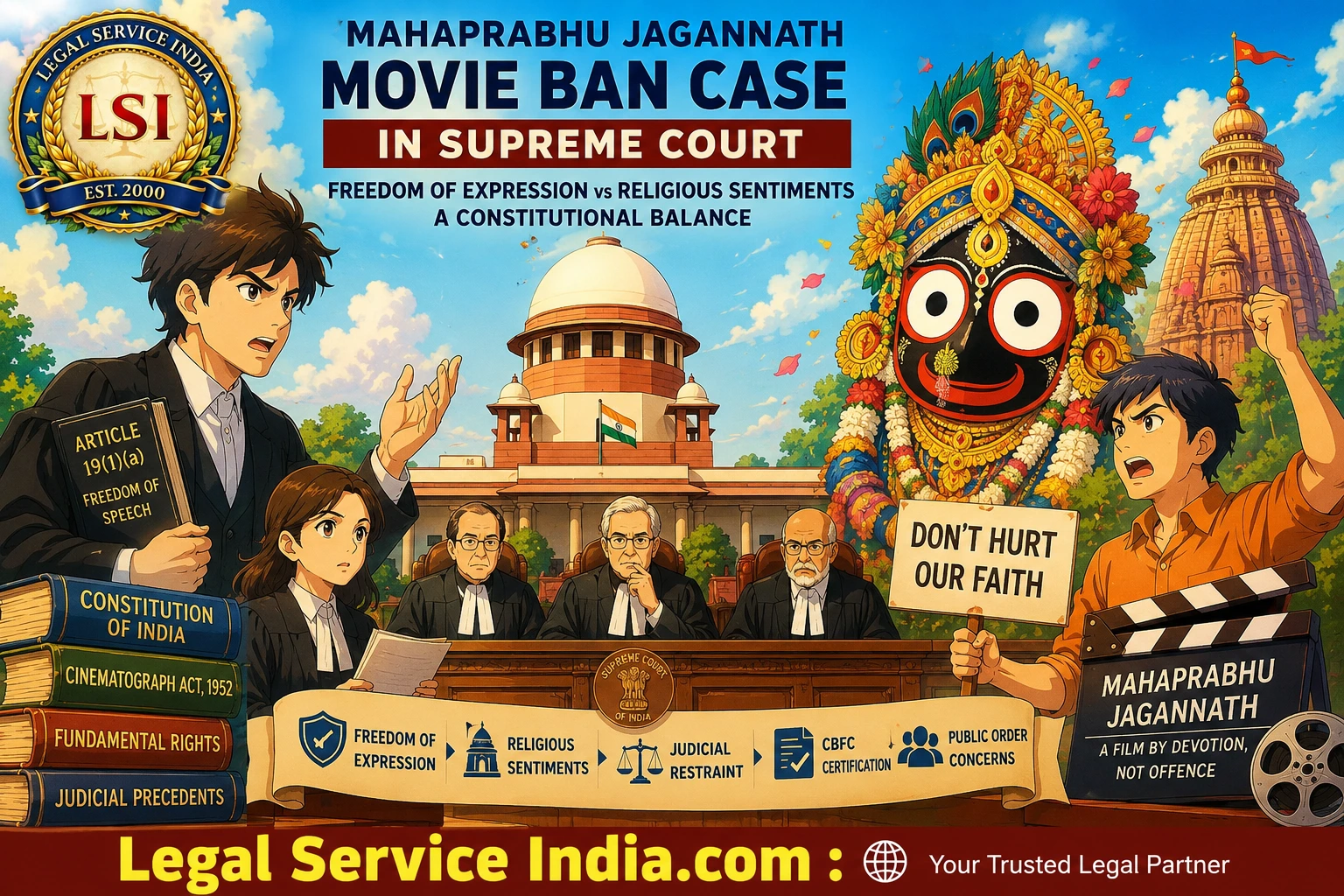
Mahaprabhu Jagannath Movie Ban Reaches Supreme Court: Can Courts Stop the Release of a Certified Film on Religious Sentiment Grounds? A Constitutional Analysis
Written By: Adv. Tarun Choudhury, Learned Supreme Court Advocate
Introduction
The Constitution of India guarantees every citizen the right to freedom of speech and expression. Cinema, as one of the most influential forms of artistic expression, enjoys this constitutional protection under Article 19(1)(a). At the same time, India is a deeply religious and culturally diverse nation where faith occupies a central place in public life. Whenever a film portrays revered religious figures or sacred traditions, an inevitable constitutional question arises: Where should the law draw the line between artistic freedom and protection of religious sentiments?
This very question has once again reached the Supreme Court of India through the controversy surrounding the animated film “Mahaprabhu Jagannath”.
The producers of the film have challenged an interim order passed by the Orissa High Court staying its release after objections were raised regarding the depiction of Lord Jagannath, one of Hinduism’s most revered deities and the presiding deity of the famous Jagannath Temple at Puri. The dispute has transformed what initially appeared to be a disagreement over a film into a significant constitutional battle involving freedom of speech, judicial restraint, religious sensitivity, statutory film certification, and the limits of judicial intervention before publication.
Although the Supreme Court has yet to decide the merits of the controversy, the issues raised in this case are of immense constitutional significance. The Court’s eventual ruling is likely to influence future litigation involving films, documentaries, OTT platforms, historical dramas, religious adaptations, and other creative works across India.
This case also revives a constitutional debate that has occupied Indian courts for more than five decades: Can a court prevent the release of a film merely because some sections of society believe it may hurt their religious sentiments? Or must constitutional courts lean in favour of protecting artistic expression unless the restrictions squarely fall within Article 19(2) of the Constitution?
The answers to these questions will not only determine the fate of Mahaprabhu Jagannath but may also redefine the contours of free speech jurisprudence in India.
Citation
Makers of “Mahaprabhu Jagannath” v. State of Odisha & Others (SLP filed before the Supreme Court of India challenging the interim order of the Orissa High Court staying the release of the film Mahaprabhu Jagannath, July 2026) (Matter Pending).
Why This Case Matters
At first glance, the dispute concerns only the release of a single animated film. However, from a constitutional perspective, it raises questions that extend far beyond the entertainment industry.
The Supreme Court’s decision may clarify:
- Whether High Courts can suspend the release of a film that has already undergone the statutory certification process.
- The extent to which courts should defer to the expertise of the Central Board of Film Certification (CBFC).
- Whether anticipated public outrage is sufficient to justify judicial intervention before a film reaches audiences.
- How courts should balance Articles 19(1)(a), 19(2), 25 and 26 of the Constitution.
- Whether judicial orders preventing the release of films amount to unconstitutional prior restraint.
- Whether India’s constitutional jurisprudence permits what legal scholars describe as the “heckler’s veto”—where threats of protests or public disorder effectively silence lawful expression.
| Key Constitutional Issues | Importance |
|---|---|
| Film Certification | Scope of judicial review after CBFC approval. |
| Freedom of Speech | Extent of protection under Article 19(1)(a). |
| Prior Restraint | Whether courts can stop publication before public viewing. |
| Religious Sentiments | Balancing faith with artistic expression. |
| Public Order | Whether anticipated protests justify restrictions. |
For filmmakers, writers, historians, artists, and constitutional lawyers alike, the outcome of this case could become a defining precedent.
Background Of The Dispute
The animated feature film Mahaprabhu Jagannath was conceived as a cinematic portrayal inspired by the life, teachings, and spiritual significance of Lord Jagannath. Lord Jagannath occupies a unique place within Hindu religious tradition and is worshipped by millions of devotees across India and abroad.
The deity is particularly revered in Odisha, where the Jagannath Temple at Puri has, for centuries, been one of Hinduism’s holiest pilgrimage sites. The annual Rath Yatra attracts millions of devotees and represents one of India’s most celebrated religious festivals.
Given this profound religious significance, any visual depiction of Lord Jagannath naturally attracts close public scrutiny.
Prior to the scheduled release of the film, objections were raised by certain devotees, organisations, and individuals alleging that portions of the film:
- inaccurately portrayed sacred traditions;
- distorted accepted religious narratives;
- departed from established scriptural accounts;
- commercialised a deeply revered deity; and
- had the potential to hurt the religious sentiments of millions of devotees.
Several petitions were subsequently filed before the Orissa High Court seeking an immediate stay on the release of the film.
The petitioners argued that permitting the film’s release could cause widespread public unrest and irreparably damage the sanctity associated with Lord Jagannath.
Proceedings Before The Orissa High Court
The Orissa High Court considered the grievances raised by the petitioners and, as an interim measure, directed that the release of the film be stayed until further consideration of the issues involved.
Although the High Court’s order is interim in nature, its practical effect is significant. In the film industry, delays in release often result in substantial financial losses, disruption of distribution agreements, marketing setbacks, and diminished commercial prospects. Consequently, even a temporary stay may effectively operate as a restraint on the exercise of the filmmakers’ right to exhibit their work.
| Impact of the Interim Stay | Possible Consequences |
|---|---|
| Film Release | Postponement of theatrical release. |
| Commercial Impact | Substantial financial losses. |
| Distribution | Disruption of distribution agreements. |
| Marketing | Loss of promotional momentum. |
| Constitutional Concern | Potential restraint on artistic expression. |
It is this interim order that has now been challenged before the Supreme Court of India.
The Special Leave Petition Before the Supreme Court
Aggrieved by the interim stay, the producers of Mahaprabhu Jagannath have approached the Supreme Court by filing a Special Leave Petition (SLP) under Article 136 of the Constitution of India.
The petitioners are expected to contend that the High Court’s order suffers from serious constitutional infirmities.
Among the principal grounds likely to be urged are:
1. Violation of Article 19(1) (a)
The petitioners may argue that the High Court’s order directly restrains their constitutionally protected freedom of speech and artistic expression.
Freedom of expression extends not only to political speech but also to literature, theatre, cinema, animation, and artistic interpretation.
2. Judicial Prior Restraint
Another central argument is likely to be that the stay amounts to prior restraint, namely, suppression of expression before it reaches the public.
Indian constitutional jurisprudence has consistently treated prior restraint with extreme caution because it prevents citizens from accessing ideas even before any alleged harm has occurred.
3. Statutory Film Certification Cannot Be Ignored
The petitioners are also expected to emphasise that Parliament has created a specialised statutory mechanism under the Cinematograph Act for examining films before public exhibition.
The Central Board of Film Certification consists of experts entrusted with evaluating films against statutory guidelines.
Once this specialised authority has performed its statutory function, judicial interference should ordinarily remain exceptional.
4. Artistic Interpretation Is Not Scriptural Commentary
The filmmakers may further argue that cinema is a creative medium.
A film inspired by mythology or religion does not necessarily claim to be an authoritative theological treatise.
Creative interpretation has always been an integral part of literature, theatre, painting, sculpture, dance, and cinema.
Treating every artistic variation as legally impermissible would impose an impossible burden upon creators.
5. Irreparable Commercial Injury
The petitioners may also submit that postponement of a theatrical release causes losses that cannot be adequately compensated by monetary damages.
Film releases involve coordinated agreements among distributors, exhibitors, digital platforms, advertisers, and investors.
A prolonged judicial stay may permanently undermine the commercial viability of the project.
| Principal Grounds in the SLP | Core Constitutional Issue |
|---|---|
| Violation of Article 19(1)(a) | Freedom of speech and artistic expression. |
| Judicial Prior Restraint | Suppression of expression before publication. |
| CBFC Certification | Judicial deference to statutory expert authority. |
| Creative Interpretation | Difference between artistic expression and theology. |
| Commercial Injury | Irreparable financial and business losses. |
Core Constitutional Questions Before the Supreme Court
Although the immediate dispute concerns only one film, the Supreme Court’s decision is likely to answer several foundational constitutional questions.
These include:
Can A Constitutional Court Stop The Release Of A Film Before The Public Watches It?
This is perhaps the most significant issue.
Indian constitutional law has generally discouraged prior censorship by courts except in exceptional circumstances.
The Supreme Court will likely examine whether the High Court’s interim order satisfies the constitutional standards applicable to restrictions on speech.
Does Hurtful Religious Sentiment Automatically Justify a Ban?
Another important issue concerns the threshold required for restricting artistic expression.
Must there be a clear and proximate threat to public order?
Or is the possibility that some individuals may feel offended sufficient to justify judicial intervention?
These questions have repeatedly arisen in Indian constitutional jurisprudence.
Should Courts Substitute Their Own Opinion For The CBFC?
The Court may also consider the proper institutional role of constitutional courts.
Should judges independently evaluate artistic merit?
Or should they ordinarily defer to the specialised statutory authority established by Parliament?
Can Threats of Public Protest Determine Constitutional Rights?
One recurring issue in film censorship cases is whether anticipated protests justify restricting speech.
If public threats become sufficient to prevent publication, constitutional freedoms may gradually become hostage to organised opposition.
This concern has led courts to evolve important constitutional doctrines that will likely feature prominently in the present litigation.
| Key Constitutional Questions | Issue Before the Supreme Court |
|---|---|
| Prior Restraint | Can courts stop a film before public viewing? |
| Religious Sentiments | Is mere offence sufficient to justify a ban? |
| Role of CBFC | Should courts defer to statutory certification? |
| Public Protest | Can threats override constitutional freedoms? |
Constitutional Framework Governing The Dispute
The controversy surrounding Mahaprabhu Jagannath cannot be understood merely as a dispute about a film.
It lies at the intersection of several constitutional guarantees that often coexist in delicate balance.
The principal constitutional provisions include:
| Constitutional Provision | Subject Matter | Relevance to the Case |
|---|---|---|
| Article 19(1)(a) | Freedom of speech and expression. | Protects artistic and cinematic expression. |
| Article 19(2) | Reasonable restrictions on free speech. | Defines the constitutional limits on free expression. |
| Article 25 | Freedom of conscience and free profession, practice and propagation of religion. | Protects the religious rights of devotees. |
| Article 26 | Rights of religious denominations to manage their religious affairs. | Safeguards the autonomy of religious institutions. |
| Article 14 | Equality before the law and protection against arbitrary state action. | Ensures fairness and non-arbitrariness in judicial action. |
| Article 21 | Protection of life and personal liberty, which has been interpreted to include dignity and autonomy in several contexts. | Supports broader constitutional values of dignity and individual liberty. |
The Supreme Court will ultimately have to harmonise these constitutional guarantees rather than elevate one right at the complete expense of another.
The challenge to the Orissa High Court’s interim order is not merely a dispute over a film’s release; it is a constitutional test of the limits of judicial intervention in matters of artistic expression. At its core lies a fundamental question: can courts restrain speech before the public has had an opportunity to see, understand, and evaluate it?
As the litigation progresses, the Supreme Court will be called upon to reconcile the constitutional commitment to free expression with the equally important need to preserve public order and respect for religious beliefs. The principles it lays down may well shape the future of film censorship, creative freedom, and constitutional adjudication in India.
Freedom of Speech Under Article 19(1)(a): The Constitutional Foundation of Artistic Expression
Article 19(1)(a) of the Constitution guarantees to every citizen the fundamental right to freedom of speech and expression. This guarantee lies at the heart of India’s democratic structure, enabling individuals to express ideas, beliefs, opinions, artistic creations, and cultural narratives without undue interference by the State.
Cinema is one of the most powerful forms of such expression. A film combines literature, music, painting, theatre, photography, architecture, and technology into a single medium capable of reaching millions of people. It is not merely a commercial product but also a vehicle for storytelling, education, historical interpretation, social criticism, and cultural preservation.
The Supreme Court has repeatedly recognised that films enjoy constitutional protection under Article 19(1)(a), even though they may also be subject to reasonable regulation. The protection extends not only to works that are popular or uncontroversial but also to those that provoke debate, challenge conventional thinking, or present alternative interpretations of history, religion, or culture.
This principle is particularly important in a pluralistic society like India, where differing viewpoints on mythology, religion, and history are common. Constitutional protection exists precisely because freedom of expression would have little meaning if it extended only to speech that everyone agrees with.
Freedom of Expression Is Not Absolute
Although Article 19(1)(a) grants a broad guarantee, it is not an unrestricted licence. The Constitution itself recognises that certain forms of expression may legitimately be regulated in the interests of society.
This balance is reflected in Article 19(2), which permits the State to impose reasonable restrictions on the exercise of free speech.
The grounds specified in Article 19(2) include:
- The sovereignty and integrity of India
- The security of the State
- Friendly relations with foreign states
- Public order
- Decency or morality
- Contempt of court
- Defamation
- Incitement to an offence
- The interests of the integrity of the nation
Article 19(2): Constitutional Grounds for Reasonable Restrictions
| Ground | Permitted Restriction Under Article 19(2) |
|---|---|
| Sovereignty and Integrity | Protection of India’s unity and integrity |
| Security of the State | Protection against threats to national security |
| Friendly Relations | Maintaining relations with foreign states |
| Public Order | Preventing serious public disorder |
| Decency or Morality | Protecting accepted standards of morality |
| Contempt of Court | Preserving the authority of courts |
| Defamation | Protecting individual reputation |
| Incitement to an Offence | Preventing criminal acts |
| Integrity of the Nation | Safeguarding national integrity |
Importantly, the Constitution does not permit restrictions merely because a section of society dislikes a particular viewpoint. Any restriction must fall squarely within one of the constitutionally recognised grounds and must satisfy the test of reasonableness.
The Supreme Court has consistently held that restrictions on free speech must be interpreted narrowly because they operate as exceptions to a fundamental right.
Public Order and the Constitutional Threshold
One of the principal grounds that may be relied upon in cases involving controversial films is public order.
However, constitutional jurisprudence makes it clear that not every possibility of public unrest is sufficient to justify restricting speech.
The Supreme Court has repeatedly distinguished between:
- Actual threats to public order.
- Mere anticipation of public opposition.
The constitutional threshold requires a proximate and direct connection between the expression and the likelihood of serious public disorder.
Speculative fears, vague apprehensions, or the possibility that some groups may organise protests ordinarily do not satisfy this standard.
If courts were to prohibit every work that might offend some section of society, artistic freedom would gradually disappear.
Articles 25 and 26: Freedom of Religion
The controversy also involves the constitutional guarantee of religious freedom.
Article 25 protects the freedom of conscience and the right freely to profess, practise, and propagate religion.
Article 26 grants religious denominations the right to manage their own religious affairs, establish institutions, and administer religious property.
These rights occupy a central position within India’s constitutional philosophy.
However, Articles 25 and 26 do not automatically create a legal right to prohibit every artistic depiction relating to a religion.
The Constitution protects religious practice, but it does not create a general constitutional immunity against criticism, interpretation, artistic adaptation, or historical analysis.
The challenge before the Supreme Court therefore lies in harmonising these constitutional rights rather than allowing one to extinguish another.
Constitutional Rights Involved
| Constitutional Provision | Protection Guaranteed |
|---|---|
| Article 19(1)(a) | Freedom of speech and expression |
| Article 19(2) | Reasonable restrictions on free speech |
| Article 25 | Freedom of conscience and religion |
| Article 26 | Rights of religious denominations |
Constitutional Balancing Rather Than Constitutional Supremacy
A recurring principle in Indian constitutional law is that fundamental rights must be harmoniously interpreted.
No single constitutional right ordinarily enjoys absolute supremacy over another.
Accordingly, the Supreme Court will likely attempt to balance:
- Freedom of artistic expression
- Religious liberty
- Maintenance of public order
- Constitutional morality
- Democratic pluralism
The Court has consistently recognised that constitutional adjudication requires balancing competing interests rather than mechanically preferring one right over another.
The Doctrine of Prior Restraint
The most significant constitutional issue in the Mahaprabhu Jagannath litigation is likely to be the doctrine of prior restraint.
Prior restraint refers to any governmental or judicial action that suppresses expression before it reaches the public.
Examples include:
- Prohibiting publication of books
- Restraining newspaper reports
- Preventing the release of films
- Blocking documentaries before exhibition
- Restraining digital publication
Common Examples of Prior Restraint
| Type of Expression | Example of Prior Restraint |
|---|---|
| Books | Prohibiting publication |
| Newspapers | Restraining reports before publication |
| Films | Preventing theatrical release |
| Documentaries | Blocking exhibition |
| Digital Content | Restraining online publication |
Constitutional democracies have traditionally regarded prior restraint as one of the most serious forms of interference with free speech.
The reason is simple.
Once expression is prevented from reaching the public, the opportunity for democratic discussion is permanently lost.
The public cannot evaluate ideas that have never been allowed to circulate.
Why Prior Restraint Is Viewed With Extreme Caution
The Supreme Court has repeatedly recognised that prior restraint is constitutionally suspect because:
- It suppresses speech before any actual harm occurs.
- It prevents citizens from forming independent opinions.
- It places excessive discretionary power in governmental authorities.
- It may produce a chilling effect on artists, publishers, writers, and filmmakers.
- It discourages innovation and creative expression.
Constitutional Concerns With Prior Restraint
| Concern | Constitutional Impact |
|---|---|
| Suppression Before Harm | Speech is restricted before any proven injury. |
| Independent Thought | Citizens lose the opportunity to evaluate competing ideas. |
| Government Discretion | Authorities gain excessive control over expression. |
| Chilling Effect | Artists and creators may avoid controversial subjects. |
| Creative Freedom | Innovation and artistic experimentation are discouraged |
Consequently, restrictions imposed before publication generally attract stricter constitutional scrutiny than penalties imposed after publication for unlawful conduct.
Does the High Court’s Interim Stay Amount to Prior Restraint?
Although the Supreme Court has not yet expressed any opinion on the merits, one important question will likely be whether the interim stay granted by the Orissa High Court effectively constitutes judicial prior restraint.
The petitioners are expected to argue that:
- The film has not yet been viewed by the public.
- No actual disturbance has occurred.
- No evidence has been produced demonstrating imminent public disorder.
- The restraint therefore prevents constitutionally protected expression before any legally established harm has arisen.
The respondents, on the other hand, are likely to contend that constitutional courts possess inherent authority to prevent serious public injury where credible material demonstrates an imminent threat.
The Supreme Court’s eventual reasoning on this issue may become one of the most significant aspects of the case.
The “Heckler’s Veto”: A Threat to Constitutional Democracy
Closely related to prior restraint is the doctrine commonly known as the heckler’s veto.
This doctrine refers to a situation where the threat of hostile reactions from opponents becomes the reason for suppressing lawful speech.
In practical terms, the heckler’s veto allows those who threaten protests, demonstrations, or violence to determine what others may say or publish.
Constitutional democracies generally reject this approach because it rewards intimidation rather than protecting lawful expression.
If the state suppresses speech simply because opponents threaten disorder, constitutional rights effectively become dependent upon the tolerance of the most easily offended groups.
Such an approach undermines democracy itself.
Key Features of the Heckler’s Veto
| Aspect | Explanation |
|---|---|
| Cause | Threat of protests or hostile reactions |
| Effect | Suppression of otherwise lawful expression |
| Constitutional Concern | Rewards intimidation instead of protecting free speech |
| Democratic Impact | Allows opponents to determine what may be expressed |
The Supreme Court’s Approach to the Heckler’s Veto
Indian constitutional jurisprudence has repeatedly emphasised that the State has a positive obligation to maintain law and order.
The responsibility of maintaining public peace lies with the State—not with artists, authors, publishers, or filmmakers.
Where expression is otherwise lawful, the proper constitutional response is generally to protect the speaker rather than silence the speech.
This principle has assumed increasing importance in recent decades as organised protests have become a common feature of disputes involving films, books, and digital media.
Judicial Review Is Different From Judicial Censorship
Another important constitutional distinction deserves careful attention.
Courts unquestionably possess the power of judicial review.
They may examine whether executive authorities have acted lawfully, whether statutory procedures have been followed, and whether constitutional rights have been violated.
However, judicial review does not ordinarily transform courts into artistic censors.
The judiciary is not expected to determine:
- Whether a screenplay is historically accurate.
- Whether a painting reflects correct theology.
- Whether a novel conforms to religious orthodoxy.
- Whether an animated film faithfully reproduces scriptural narratives.
Scope of Judicial Review
| Judicial Review Permits | Judicial Review Does Not Ordinarily Permit |
|---|---|
| Examining the legality of executive action | Determining whether a screenplay is historically accurate |
| Reviewing compliance with statutory procedures | Deciding whether a painting reflects correct theology |
| Protecting constitutional rights | Assessing whether a novel conforms to religious orthodoxy |
| Ensuring constitutional compliance | Judging whether an animated film faithfully reproduces scriptural narratives |
Those questions often involve subjective artistic judgements rather than legal determinations.
Accordingly, courts generally exercise restraint before substituting their own views for those of expert statutory authorities.
Why Constitutional Restraint Is Essential
India is a civilisation with extraordinary religious, linguistic, cultural, and philosophical diversity.
Every historical event, religious tradition, and mythological narrative has multiple interpretations.
If courts begin evaluating the theological correctness of artistic works, constitutional adjudication may gradually shift from resolving legal disputes to deciding matters of faith.
The Constitution deliberately avoids assigning such a role to the judiciary.
Instead, constitutional courts are expected to determine whether legal limits established by the Constitution have been crossed—not whether every citizen agrees with an artistic interpretation.
Why Constitutional Restraint Matters
| Principle | Constitutional Significance |
|---|---|
| Religious Diversity | India accommodates multiple faiths and interpretations. |
| Cultural Diversity | Historical and mythological narratives may have differing perspectives. |
| Judicial Restraint | Courts resolve legal disputes rather than theological questions. |
| Constitutional Adjudication | Focus remains on legality and constitutional limits. |
Constitutional Questions at the Heart of India’s Democracy
The constitutional questions arising from the Mahaprabhu Jagannath controversy lie at the very heart of India’s democratic order. Articles 19(1)(a), 19(2), 25, and 26 do not exist in isolation; they form an integrated framework requiring courts to balance free expression with religious liberty while preserving public order and constitutional values. Equally significant are the doctrines of prior restraint and the heckler’s veto, both of which caution against suppressing lawful expression merely because it may provoke opposition.
As the Supreme Court considers the challenge to the Orissa High Court’s interim order, it will not only decide the fate of a single film but also reaffirm the constitutional principles that govern artistic freedom in a diverse democracy.
Key Constitutional Principles at a Glance
| Constitutional Principle | Key Takeaway |
|---|---|
| Article 19(1)(a) | Protects freedom of speech and artistic expression. |
| Article 19(2) | Allows only reasonable restrictions on specified constitutional grounds. |
| Articles 25 & 26 | Protect religious freedom while requiring harmonious interpretation with other fundamental rights. |
| Prior Restraint | Pre-publication restrictions receive strict constitutional scrutiny. |
| Heckler’s Veto | Lawful speech should not be suppressed merely because of threatened opposition. |
| Judicial Review | Courts examine legality, not artistic or theological correctness. |
| Constitutional Balancing | Fundamental rights should be harmoniously interpreted rather than treated as absolute. |
The constitutional principles discussed in the previous part provide the broad framework for resolving the Mahaprabhu Jagannath dispute. However, constitutional rights do not operate in a vacuum. Parliament has enacted a detailed statutory mechanism to regulate the public exhibition of films, and over the past five decades, the Supreme Court has developed a rich body of jurisprudence defining the limits of censorship, judicial intervention, and artistic freedom.
The challenge before the Supreme Court in the present case cannot, therefore, be examined without considering the statutory role of the Central Board of Film Certification (CBFC), the law governing interim injunctions, and the constitutional precedents that have shaped India’s approach to film censorship.
The Cinematograph Act: Parliament’s Framework for Film Regulation
India is one of the few constitutional democracies that has historically adopted a system of pre-certification for films intended for public exhibition.
This regulatory framework is primarily governed by the Cinematograph Act, 1952, as amended, including significant changes introduced through the Cinematograph (Amendment) Act, 2023.
The object of the legislation is not to suppress artistic freedom but to ensure that films intended for public exhibition are examined in light of constitutional values and statutory guidelines before reaching audiences.
Unlike books or newspapers, films combine visual imagery, sound, music, dialogue, and dramatic effect, making them uniquely influential. Parliament has therefore considered it appropriate to subject films to a specialised certification process.
However, this statutory system is not intended to become an instrument of arbitrary censorship. Rather, it seeks to balance freedom of expression with the interests recognised under Article 19(2) of the Constitution.
The Role of the Central Board of Film Certification (CBFC)
The Central Board of Film Certification (CBFC) is the statutory authority entrusted with examining films before public exhibition.
Its responsibilities include:
- viewing the film in its entirety;
- assessing whether it complies with the Cinematograph Act and applicable guidelines;
- considering issues relating to public order, decency, morality, national security, and other constitutional concerns;
- suggesting modifications where necessary; and
- granting an appropriate certificate for exhibition.
The Board functions through committees comprising individuals drawn from diverse professional and social backgrounds.
The legislative intent is clear: questions relating to the suitability of films for public exhibition should ordinarily be examined by a specialised statutory body possessing expertise in evaluating cinematic works.
This institutional design assumes particular importance in cases where courts are asked to intervene before a film is released.
Why the CBFC’s Decision Commands Judicial Respect
Although the decisions of the CBFC are subject to judicial review, courts have repeatedly recognised that the Board performs a specialised statutory function.
A constitutional court may interfere where:
| Ground for Judicial Review |
|---|
| The Board acts arbitrarily; |
| statutory provisions are violated; |
| constitutional rights are infringed; |
| procedural fairness is denied; or |
| The decision is manifestly unreasonable. |
However, courts generally refrain from substituting their own artistic assessment for that of the statutory authority merely because another view is possible.
This principle reflects judicial restraint rather than judicial abdication.
Can High Courts Stay the Release of a Certified Film?
One of the most important questions likely to arise in the Mahaprabhu Jagannath litigation is whether a High Court should ordinarily restrain the exhibition of a film after it has undergone the statutory certification process.
Indian constitutional jurisprudence does not suggest that certified films enjoy absolute immunity from judicial scrutiny.
However, judicial intervention is expected to remain exceptional.
The reason is straightforward.
If every certified film can be restrained through interim orders merely because objections are raised before release, the statutory certification process itself may become largely ineffective.
The Supreme Court has consistently emphasised that constitutional courts should exercise great caution before preventing the exhibition of certified films.
Interim Injunctions: Legal Principles
The Orissa High Court’s order is an interim order, not a final adjudication.
Nevertheless, interim relief often determines the practical outcome of disputes involving films because delayed release may substantially diminish commercial value.
Indian courts ordinarily apply three well-established principles while considering interim injunctions.
1. Prima Facie Case
The applicant must establish that there exists a serious legal question requiring adjudication.
A mere assertion of hurt sentiment is ordinarily insufficient.
The court must examine whether the claim raises a genuine constitutional or legal issue deserving interim protection.
2. Balance of Convenience
The court must compare the inconvenience likely to be caused to each side.
In film-release disputes, relevant considerations include:
- commercial losses;
- contractual obligations;
- artistic freedom;
- public interest;
- potential law- and order- concerns.
The court must determine which course would cause the lesser injustice pending final adjudication.
3. Irreparable Injury
Interim relief is generally granted only where refusal would cause injury that cannot later be adequately compensated.
Film releases are particularly sensitive because postponement often results in:
- cancellation of theatrical schedules;
- loss of distribution opportunities;
- marketing disruption;
- financial losses;
- diminished audience interest.
These factors frequently become central to injunction proceedings.
Should Religious Sentiments Alone Constitute Irreparable Injury?
An important constitutional issue likely to arise is whether alleged injury to religious sentiments, without more, justifies restraining artistic expression before public exhibition.
Indian jurisprudence suggests that courts ordinarily examine:
- the actual content of the work;
- its overall message;
- the likelihood of serious public disorder;
- whether objections arise from isolated scenes viewed out of context.
The Supreme Court has repeatedly cautioned against evaluating films based upon disconnected excerpts.
Landmark Supreme Court Judgements That Will Shape the Present Case
The Mahaprabhu Jagannath dispute cannot be analysed without reference to the leading constitutional precedents governing film censorship.
These judgements collectively define the contours of artistic freedom in India.
| Landmark Judgement | Primary Constitutional Principle |
|---|---|
| K.A. Abbas v. Union of India (1970) | Validity of pre-certification with constitutional safeguards. |
| S. Rangarajan v. P. Jagjivan Ram (1989) | Freedom of expression cannot be curtailed merely because of anticipated protests. |
| Anand Patwardhan Cases | Films must be viewed as a whole, not through isolated scenes. |
| Prakash Jha Productions v. Union of India (2011) | Respect for the statutory certification mechanism. |
| Indibility Creative Pvt. Ltd. v. Government of West Bengal (2019) | Certified films cannot be suppressed through unofficial pressure. |
1. K.A. Abbas v. Union of India (1970)
Citation: K.A. Abbas v. Union of India, (1971) 2 SCC 446.
This landmark decision remains the foundation of Indian film censorship jurisprudence.
Facts
Renowned filmmaker Khwaja Ahmad Abbas challenged the constitutional validity of pre-censorship of films.
He argued that compulsory certification before public exhibition violated Article 19(1)(a).
Supreme Court’s Decision
The Court upheld the constitutional validity of pre-certification.
However, it simultaneously imposed important constitutional safeguards.
The Court observed that:
- Films enjoy constitutional protection;
- Censorship must operate within narrow constitutional limits;
- Statutory discretion cannot become arbitrary;
- Certification procedures must be fair and reasonable.
Importance for the Present Case
The judgement recognises that although films may be regulated, censorship cannot become an instrument for suppressing legitimate artistic expression.
2. S. Rangarajan v. P. Jagjivan Ram (1989)
Citation: S. Rangarajan v. P. Jagjivan Ram, (1989) 2 SCC 574.
This is perhaps the most significant precedent governing controversies like Mahaprabhu Jagannath.
Facts
A certified Tamil film faced objections from political groups.
Its exhibition was restrained because protests were anticipated.
Supreme Court’s Landmark Observations
“Freedom of expression cannot be suppressed on account of the threat of demonstration and processions or threats of violence. That would amount to surrendering the rule of law and to blackmail and intimidation.”
The Court further observed that:
“The anticipated danger should not be remote, conjectural or far-fetched. It should have a proximate and direct nexus with the expression.”
Constitutional Principle
This judgement rejects the notion that anticipated protests alone justify suppressing speech.
Instead, it places responsibility upon the State to maintain law and order.
Relevance to Mahaprabhu Jagannath
If objections to the film are primarily based upon anticipated public reaction rather than demonstrable constitutional violations, S. Rangarajan is likely to assume considerable significance.
3. Anand Patwardhan Cases
Over several decisions involving documentary filmmaker Anand Patwardhan, constitutional courts repeatedly reinforced the principle that films must be evaluated as a whole rather than through isolated scenes.
The judiciary recognised that documentaries frequently deal with sensitive political, religious, and social issues.
Suppressing such works merely because they provoke disagreement would undermine democratic discourse.
This approach is directly relevant where objections focus upon selected portions of a film rather than its overall narrative.
4. Prakash Jha Productions v. Union of India (2011)
Citation: Prakash Jha Productions v. Union of India, (2011) 8 SCC 372.
Facts
Despite obtaining CBFC certification, the film Aarakshan faced restrictions imposed by certain state governments.
Supreme Court’s Decision
The Court reiterated that once Parliament has established a statutory certification mechanism, executive authorities should not ordinarily frustrate its operation.
The judgement reinforces institutional respect for the statutory framework created under the Cinematograph Act.
Relevance
The decision highlights that certification is not an empty formality.
It carries legal significance that courts ordinarily respect.
5. Indibility Creative Pvt. Ltd. v. Government of West Bengal (2019)
Citation: Indibility Creative Pvt. Ltd. v. Government of West Bengal, (2020) 12 SCC 436.
This case concerned the Hindi film Bhobishyoter Bhoot.
Although the film had received certification, its exhibition was effectively prevented.
Supreme Court’s Observations
The Court strongly reaffirmed that:
- Freedom of expression cannot be defeated by unofficial pressure;
- The State has a constitutional duty to facilitate lawful exhibition;
- Certified films cannot be suppressed merely because some groups oppose them.
Perhaps more importantly, the Court warned against indirect censorship through administrative inaction.
Importance
This judgement may become one of the most persuasive precedents in the Mahaprabhu Jagannath litigation.
Emerging Constitutional Principles
A reading of these landmark decisions reveals a remarkably consistent constitutional philosophy.
The Supreme Court has repeatedly held that:
- Films are protected speech under Article 19(1)(a);
- Restrictions must strictly comply with Article 19(2);
- Prior restraint is constitutionally suspect;
- Anticipated protests cannot ordinarily justify suppression;
- The State must protect lawful expression rather than surrender to threats;
- Courts should ordinarily respect the statutory certification process;
- Artistic works must be viewed as a whole.
| Constitutional Principle | Judicial Position |
|---|---|
| Freedom of Speech | Films are protected under Article 19(1)(a). |
| Reasonable Restrictions | Restrictions must strictly satisfy Article 19(2). |
| Prior Restraint | Prior restraint is constitutionally suspect. |
| Public Protests | Anticipated protests alone ordinarily cannot justify suppression. |
| State’s Duty | The State must maintain law and order and protect lawful expression. |
| CBFC Certification | Courts ordinarily respect the statutory certification process. |
| Evaluation of Films | Films must be viewed as a whole and not through isolated scenes. |
These principles collectively form the constitutional backdrop against which the Supreme Court is likely to examine the present controversy.
The statutory framework under the Cinematograph Act and the Supreme Court’s landmark judgements reveal a consistent constitutional commitment to protecting artistic freedom while permitting only narrowly tailored restrictions justified under Article 19(2). The CBFC exists as Parliament’s expert body to evaluate films before release, and judicial intervention is generally expected to remain exceptional, particularly when it takes the form of an interim restraint.
Cases such as K.A. Abbas, S. Rangarajan, Prakash Jha Productions, and Indibility Creative collectively underscore that freedom of expression cannot be sacrificed merely because a work is controversial or may provoke opposition. They also reinforce the principle that maintaining public order is primarily the responsibility of the state, not the artist.
Applying the Law to the Present Case
The challenge before the Supreme Court is not simply whether the film should be released. The more fundamental question is whether the interim order of the Orissa High Court conforms to the constitutional standards governing restrictions on free speech and artistic expression.
Several legal issues are likely to guide the court’s consideration.
Issue 1: Was the Interim Stay Constitutionally Justified?
The first question is whether the interim stay satisfies the settled principles governing injunctions.
An interim injunction is an extraordinary remedy. Courts ordinarily grant such relief only where:
- A strong prima facie case exists;
- the balance of convenience favours intervention; and
- Refusal would result in irreparable injury.
Principles Governing Interim Injunctions
| Requirement | Legal Principle |
|---|---|
| Prima Facie Case | A strong initial case must exist. |
| Balance of Convenience | The hardship of granting relief must outweigh the hardship of refusing it. |
| Irreparable Injury | The applicant must face harm that cannot be adequately compensated later. |
When the injunction restrains a fundamental right under Article 19(1)(a), courts generally exercise even greater caution because the restraint affects constitutional freedoms before the dispute has been finally decided.
The Supreme Court may therefore examine whether the High Court had before it sufficient material demonstrating that immediate judicial intervention was indispensable.
If the stay is based primarily upon apprehended public reaction without concrete evidence of imminent and serious disorder, the petitioners may argue that the constitutional threshold required under S. Rangarajan has not been met.
Conversely, the respondents may contend that where the subject matter concerns one of India’s most revered deities, even a temporary restraint is justified to prevent irreversible public consequences pending judicial examination.
Issue 2: Should the Court Independently Examine the Film?
A second question concerns the institutional role of constitutional courts.
Judges are constitutional adjudicators.
They are not film critics, historians, theologians, or literary reviewers.
The Supreme Court has consistently recognised that artistic works should ordinarily be evaluated by the specialised statutory authority created by Parliament.
Therefore, one important issue may be:
To what extent should constitutional courts undertake their own assessment of artistic content once the statutory certification process has been completed?
Judicial review certainly permits examination of legality.
It does not ordinarily require courts to substitute their own artistic preferences for those of filmmakers.
Issue 3: Does the Film Actually Threaten Public Order?
One of the central constitutional questions will likely concern the relationship between artistic expression and public order.
Article 19(2) undoubtedly permits restrictions in the interests of public order.
However, constitutional jurisprudence consistently requires a proximate and direct nexus between the expression and the anticipated disturbance.
The Supreme Court has repeatedly rejected restrictions founded upon speculative fears or remote possibilities.
If evidence before the Court demonstrates merely that certain groups disagree with the portrayal, without showing a genuine likelihood of serious disorder, the constitutional justification for prior restraint becomes considerably weaker.
Issue 4: Can Religious Sentiments Alone Justify Judicial Intervention?
No constitutional democracy can ignore genuine concerns relating to religious harmony.
India’s constitutional philosophy recognises religion as an integral aspect of individual dignity and social life.
Yet constitutional rights cannot depend solely upon subjective perceptions of offence.
If mere assertion of hurt sentiment becomes sufficient to restrain films, books, paintings, theatre, or digital content, constitutional protection for artistic expression may gradually lose practical significance.
The Supreme Court may therefore attempt to distinguish between:
- legitimate protection of religious harmony; and
- suppression of constitutionally protected expression merely because differing interpretations exist.
Issue 5: Does This Case Raise the Problem of the “Heckler’s Veto”?
Another question likely to receive close attention is whether the dispute reflects the constitutional danger commonly described as the heckler’s veto.
If opposition groups are able to secure judicial restraints merely by demonstrating that protests may occur, constitutional rights risk becoming dependent upon organised pressure rather than legal principle.
The Supreme Court has repeatedly emphasised that maintaining public order is the responsibility of the State.
Otherwise, those willing to threaten disruption acquire an effective power to determine what the rest of society may watch, read, or discuss.
This principle assumes particular importance in matters involving films based upon religion, history, or politics.
Arguments Likely to Be Advanced Before the Supreme Court
Although the pleadings may evolve during the hearing, the broad legal positions are reasonably foreseeable.
Likely Arguments of the Petitioners (Film Producers)
The petitioners are expected to contend that:
- The film represents constitutionally protected artistic expression under Article 19(1)(a);
- The statutory certification mechanism exists precisely to evaluate such works
- Judicial intervention should remain exceptional after certification;
- Anticipated protests cannot justify suppression of lawful expression;
- The interim stay amounts to an unconstitutional prior restraint
- Postponement of release causes irreparable commercial injury;
- The State is constitutionally obliged to maintain law and order rather than silence artistic works.
Likely Arguments of the Respondents
The respondents may argue that:
- Lord Jagannath occupies an exceptionally sacred position in Hindu tradition;
- Inaccurate depictions could deeply wound the faith of millions of devotees;
- Constitutional freedoms remain subject to Article 19(2);
- Preventing avoidable communal tension serves an important public interest;
- Interim protection merely preserves the status quo until the issues are fully examined.
Comparative Constitutional Perspectives
Although Indian constitutional law is unique, comparative jurisprudence often provides valuable guidance.
United States
The First Amendment provides exceptionally strong protection for freedom of expression.
Prior restraint is generally viewed with profound constitutional suspicion.
Courts ordinarily require an extraordinarily compelling justification before preventing publication.
United Kingdom
The United Kingdom traditionally permits greater regulatory flexibility than the United States.
Nevertheless, modern human rights jurisprudence under the Human Rights Act strongly protects artistic freedom while permitting proportionate restrictions where genuinely necessary.
India’s Distinct Constitutional Approach
India occupies a middle position.
Unlike the United States, Article 19(2) expressly authorises reasonable restrictions.
At the same time, Indian constitutional jurisprudence has consistently warned against allowing those restrictions to swallow the fundamental guarantee contained in Article 19(1)(a).
The Supreme Court has therefore attempted to maintain a careful equilibrium between liberty and social harmony.
Comparison of Constitutional Approaches
| Country | Approach to Freedom of Expression |
|---|---|
| United States | Strong constitutional protection with exceptional suspicion toward prior restraint. |
| United Kingdom | Permits proportionate restrictions while protecting artistic freedom. |
| India | Recognises freedom of expression subject to reasonable restrictions under Article 19(2). |
The Broader Implications for Indian Cinema
The importance of the Mahaprabhu Jagannath case extends far beyond one animated film.
The Court’s decision may influence future disputes involving:
- mythological adaptations;
- historical films;
- biographical cinema;
- documentaries;
- streaming platforms;
- web series;
- artificial intelligence-generated visual content;
- digital storytelling based upon religious themes.
Filmmakers across India will closely watch the judgement because it may clarify the extent to which courts are prepared to intervene before public exhibition.
Implications for OTT Platforms and Digital Content
The dispute also has significance for digital media.
Although the present controversy concerns theatrical exhibition, similar constitutional questions increasingly arise regarding:
- OTT platforms;
- streaming documentaries;
- online animation;
- short films;
- independent digital creators.
As digital platforms continue to expand, constitutional jurisprudence governing artistic freedom will inevitably assume even greater importance.
Possible Outcomes Before the Supreme Court
Several legal outcomes remain possible.
The Supreme Court may:
Option One
Set aside the interim stay and permit release of the film, possibly subject to limited safeguards or clarifications.
Option Two
Modify the High Court’s order by directing specific changes while allowing the film’s exhibition.
Option Three
Maintain the interim protection temporarily while directing expedited adjudication by the High Court.
Option Four
Lay down broader constitutional guidelines governing judicial interference with certified films, irrespective of the immediate outcome.
Summary of Possible Outcomes
| Option | Possible Outcome |
|---|---|
| Option One | Set aside the interim stay and allow release. |
| Option Two | Modify the High Court’s order while permitting exhibition. |
| Option Three | Continue interim protection with expedited proceedings. |
| Option Four | Lay down wider constitutional principles for future cases. |
Given the constitutional importance of the issues involved, even an interim order of the Supreme Court may significantly influence future litigation.
A Lawyer’s Constitutional Assessment
From the standpoint of constitutional jurisprudence, the present dispute presents a delicate balance between two values that the Constitution equally cherishes.
On one hand lies freedom of artistic expression, without which democratic dialogue becomes impoverished.
On the other hand, there lies respect for religious faith and social harmony, values that are equally embedded within India’s constitutional ethos.
The Supreme Court’s task is not to choose one value over the other.
Its constitutional duty is to ensure that restrictions upon one fundamental right do not unnecessarily extinguish another.
The Court’s previous decisions strongly suggest that restrictions upon artistic expression must satisfy rigorous constitutional scrutiny, particularly where they operate before publication.
Whether the facts of the present case justify such restraint remains a matter for judicial determination based upon the material placed before the Court.
Comparative Constitutional Perspectives
Although Indian constitutional law is unique, comparative jurisprudence often provides valuable guidance.
United States
The First Amendment provides exceptionally strong protection for freedom of expression.
Prior restraint is generally viewed with profound constitutional suspicion.
Courts ordinarily require an extraordinarily compelling justification before preventing publication.
United Kingdom
The United Kingdom traditionally permits greater regulatory flexibility than the United States.
Nevertheless, modern human rights jurisprudence under the Human Rights Act strongly protects artistic freedom while permitting proportionate restrictions where genuinely necessary.
India’s Distinct Constitutional Approach
India occupies a middle position.
Unlike the United States, Article 19(2) expressly authorises reasonable restrictions.
At the same time, Indian constitutional jurisprudence has consistently warned against allowing those restrictions to swallow the fundamental guarantee contained in Article 19(1)(a).
The Supreme Court has therefore attempted to maintain a careful equilibrium between liberty and social harmony.
Comparison of Constitutional Approaches
| Country | Approach to Freedom of Expression |
|---|---|
| United States | Strong constitutional protection with exceptional suspicion toward prior restraint. |
| United Kingdom | Permits proportionate restrictions while protecting artistic freedom. |
| India | Recognises freedom of expression subject to reasonable restrictions under Article 19(2). |
The Broader Implications for Indian Cinema
The importance of the Mahaprabhu Jagannath case extends far beyond one animated film.
The Court’s decision may influence future disputes involving:
- mythological adaptations;
- historical films;
- biographical cinema;
- documentaries;
- streaming platforms;
- web series;
- artificial intelligence-generated visual content;
- digital storytelling based upon religious themes.
Filmmakers across India will closely watch the judgement because it may clarify the extent to which courts are prepared to intervene before public exhibition.
Implications for OTT Platforms and Digital Content
The dispute also has significance for digital media.
Although the present controversy concerns theatrical exhibition, similar constitutional questions increasingly arise regarding:
- OTT platforms;
- streaming documentaries;
- online animation;
- short films;
- independent digital creators.
As digital platforms continue to expand, constitutional jurisprudence governing artistic freedom will inevitably assume even greater importance.
Possible Outcomes Before the Supreme Court
Several legal outcomes remain possible.
The Supreme Court may:
Option One
Set aside the interim stay and permit release of the film, possibly subject to limited safeguards or clarifications.
Option Two
Modify the High Court’s order by directing specific changes while allowing the film’s exhibition.
Option Three
Maintain the interim protection temporarily while directing expedited adjudication by the High Court.
Option Four
Lay down broader constitutional guidelines governing judicial interference with certified films, irrespective of the immediate outcome.
Summary of Possible Outcomes
| Option | Possible Outcome |
|---|---|
| Option One | Set aside the interim stay and allow release. |
| Option Two | Modify the High Court’s order while permitting exhibition. |
| Option Three | Continue interim protection with expedited proceedings. |
| Option Four | Lay down wider constitutional principles for future cases. |
Given the constitutional importance of the issues involved, even an interim order of the Supreme Court may significantly influence future litigation.
A Lawyer’s Constitutional Assessment
From the standpoint of constitutional jurisprudence, the present dispute presents a delicate balance between two values that the Constitution equally cherishes.
On one hand lies freedom of artistic expression, without which democratic dialogue becomes impoverished.
On the other hand, there lies respect for religious faith and social harmony, values that are equally embedded within India’s constitutional ethos.
The Supreme Court’s task is not to choose one value over the other.
Its constitutional duty is to ensure that restrictions upon one fundamental right do not unnecessarily extinguish another.
The Court’s previous decisions strongly suggest that restrictions upon artistic expression must satisfy rigorous constitutional scrutiny, particularly where they operate before publication.
Whether the facts of the present case justify such restraint remains a matter for judicial determination based upon the material placed before the Court.
Conclusion
The challenge to the Orissa High Court’s interim order staying the release of Mahaprabhu Jagannath is far more than a dispute over a single animated film. It presents the Supreme Court with an opportunity to reaffirm the constitutional principles that define the relationship between artistic freedom, religious sensitivity, statutory regulation, and judicial restraint.
For over five decades, the Supreme Court has consistently recognised that cinema is a constitutionally protected medium of expression and that restrictions upon it must remain narrowly tailored and firmly rooted in Article 19(2). Decisions such as K.A. Abbas v. Union of India, S. Rangarajan v. P. Jagjivan Ram, Prakash Jha Productions v. Union of India, and Indibility Creative Pvt. Ltd. v. Government of West Bengal collectively demonstrate a judicial commitment to protecting lawful expression while ensuring that public order is maintained through constitutional means rather than through suppression of speech.
At the same time, the Court has never suggested that artistic freedom is absolute. Where expression crosses the constitutional boundaries prescribed by Article 19(2), judicial intervention remains both permissible and necessary. The challenge, therefore, is to ensure that restrictions are based on demonstrable constitutional grounds rather than on speculative fears, subjective disagreement, or anticipated public opposition.
Whatever the outcome of the pending proceedings, the judgement is likely to become an important addition to India’s free speech jurisprudence. It may clarify the scope of judicial intervention in relation to certified films, reinforce the constitutional role of the CBFC, and further define how courts should balance freedom of expression with the legitimate concerns of religious communities in an increasingly diverse and digitally connected society.
Ultimately, the Mahaprabhu Jagannath case is not only about the release of a film. It is about preserving the delicate constitutional equilibrium between liberty and responsibility, creativity and faith, judicial oversight and democratic freedom. The principles articulated by the Supreme Court in this case are likely to resonate far beyond the cinema hall, influencing future debates on artistic expression, cultural pluralism, and the constitutional promise of a free and tolerant India.
Key Takeaways: Mahaprabhu Jagannath Movie Ban Case – Supreme Court, Free Speech & Religious Sentiments
Summary
The Mahaprabhu Jagannath movie case raises crucial constitutional questions about freedom of speech, film censorship, CBFC certification, religious sentiments, judicial review, and the scope of judicial intervention under the Constitution of India.
Key Takeaways
- The Supreme Court is examining the challenge to the Orissa High Court’s interim order staying the release of the animated film Mahaprabhu Jagannath, making it a significant constitutional law case on free speech and artistic expression.
- The dispute highlights the delicate balance between Article 19(1)(a) (freedom of speech and expression) and Articles 25 & 26 (freedom of religion) under the Constitution of India.
- A central constitutional issue is whether courts can restrain the release of a film before the public has viewed it, raising the doctrine of prior restraint, which Indian courts traditionally treat as an exceptional measure.
- The case examines the legal significance of CBFC certification and whether courts should ordinarily defer to the statutory expertise of the Central Board of Film Certification before preventing the release of a certified film.
- The Supreme Court may clarify the limits of judicial intervention in film censorship cases and determine when interim injunctions affecting fundamental rights are constitutionally justified.
- The controversy revives the constitutional debate on the “heckler’s veto”, where threats of protests or public disorder are used to suppress lawful artistic expression. Indian jurisprudence has consistently held that maintaining law and order is the responsibility of the State, not the artist.
- The article analyses landmark Supreme Court precedents, including K.A. Abbas v. Union of India, S. Rangarajan v. P. Jagjivan Ram, Prakash Jha Productions v. Union of India, and Indibility Creative Pvt. Ltd. v. Government of West Bengal, which collectively shape India’s jurisprudence on film censorship and artistic freedom.
- The Cinematograph Act and the CBFC certification process are designed to balance creative freedom with constitutional restrictions, ensuring that films are evaluated by a specialised statutory authority before public exhibition.
- The Supreme Court’s eventual ruling is likely to influence future disputes involving films, OTT platforms, documentaries, mythological adaptations, historical dramas, and AI-generated creative content.
- The case reinforces the constitutional principle that restrictions on free speech must satisfy the narrow grounds specified in Article 19(2) and cannot be based solely on subjective disagreement or anticipated public opposition.
- For filmmakers, legal professionals, scholars, and constitutional law enthusiasts, the Mahaprabhu Jagannath case is poised to become an important precedent on freedom of expression, religious sensitivity, judicial restraint, and the future of artistic liberty in India.
- The litigation serves as a reminder that constitutional courts must carefully harmonise competing fundamental rights, ensuring that neither artistic freedom nor religious liberty is unnecessarily sacrificed in a pluralistic democracy.
At-a-Glance Summary Table
| Topic | Key Constitutional Issue |
|---|---|
| Freedom of Speech | Scope of Article 19(1) (a) |
| Reasonable Restrictions | Application of Article 19(2) |
| Religious Freedom | Balancing Articles 25 & 26 with free expression |
| CBFC Certification | Extent of judicial deference after certification |
| Prior Restraint | Whether courts should prevent release before public exhibition |
| Public Order | Requirement of a proximate and direct nexus |
| Heckler’s Veto | Whether threatened protests justify restricting lawful expression |
| Future Impact | Implications for films, OTT platforms, documentaries, and AI-generated content |
Final Observations
This litigation is likely to become one of the most significant constitutional decisions concerning artistic freedom in recent years. Its eventual outcome may shape the future relationship between free speech, religious sensitivity, judicial review, and film certification under the Constitution of India.