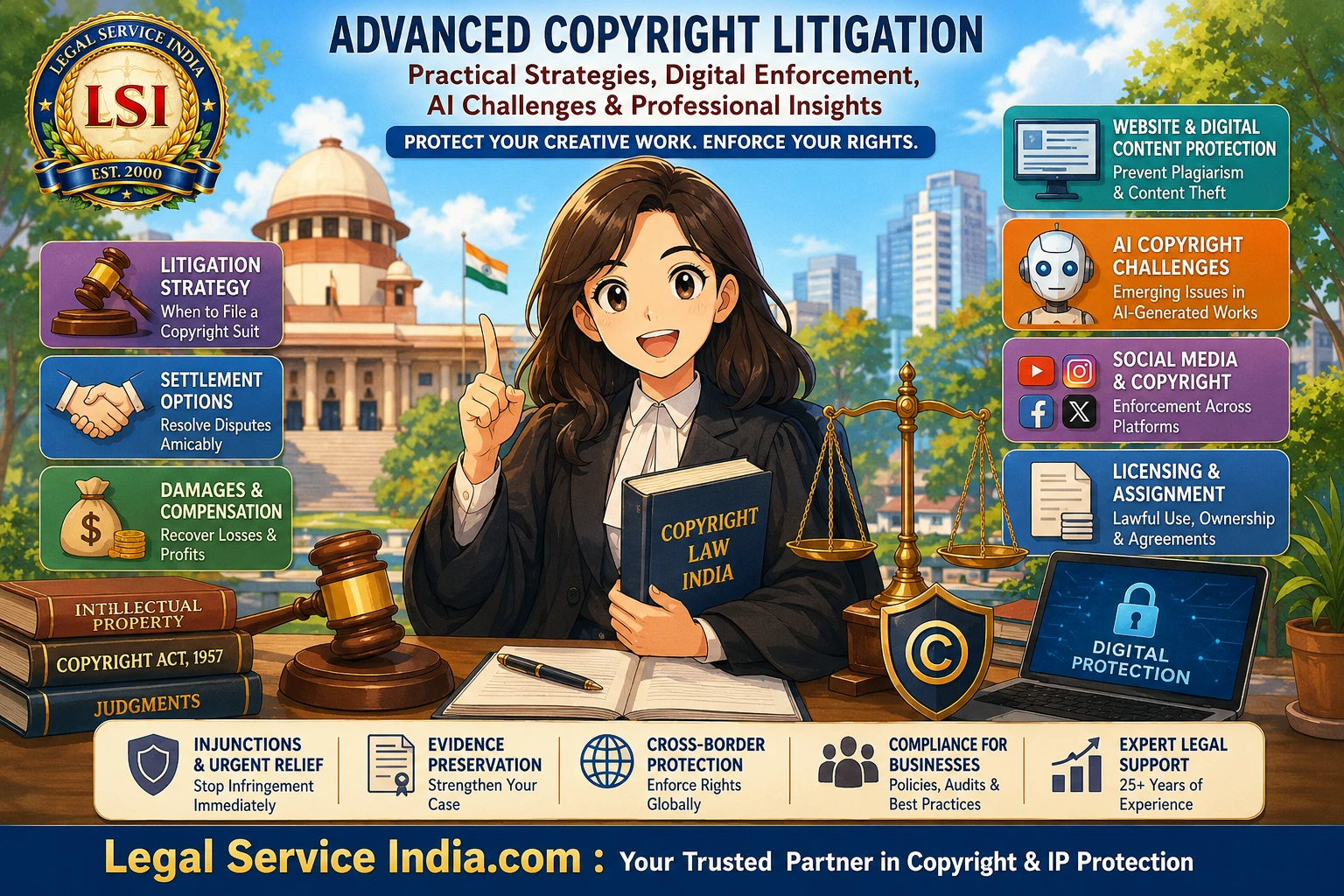
Advanced Copyright Litigation: Practical Strategies, Digital Enforcement, AI Challenges & Professional Insights
Most articles on copyright infringement stop after explaining how to file a lawsuit. However, successful copyright litigation involves much more than merely filing a plaint. Strategic planning, evidence preservation, digital enforcement, valuation of damages, and prompt interim relief often determine whether a copyright owner succeeds or fails.
This final part explores the practical aspects of copyright enforcement that every creator, entrepreneur, software developer, publisher, YouTuber, photographer, artist, and business owner should understand.
| Article Overview | What You Will Learn |
|---|---|
| Litigation Strategy | When to file a copyright suit immediately |
| Settlement | Situations where negotiation may be preferable |
| Damages | How courts assess compensation |
| Website Protection | Protecting online content against plagiarism |
| Artificial Intelligence (AI) | Emerging copyright issues involving AI-generated content |
| Social Media | Copyright ownership on digital platforms |
| Licensing & Assignment | Commercial alternatives to litigation |
Litigation Strategy: When Should You File a Suit Immediately?
Many copyright owners hesitate before taking legal action, hoping that the infringer will voluntarily remove the offending material. While negotiation is often worthwhile, delay can sometimes weaken your position, particularly where infringing copies continue to circulate or evidence is likely to disappear.
Immediate legal action should generally be considered where:
- The infringement is ongoing and causing significant commercial loss.
- The infringer refuses to comply with a legal notice.
- There is a risk that evidence may be destroyed.
- Counterfeit goods are entering the market.
- Website content is repeatedly copied despite warnings.
- Software or digital products are being widely pirated.
- Confidential source code has been copied.
- The infringement affects your business reputation or goodwill.
- The infringer is earning substantial profits from your work.
- The infringement is likely to continue unless restrained by the court.
In such situations, seeking an urgent interim injunction may be the most effective remedy.
When Should You Attempt Settlement?
Not every dispute requires lengthy litigation.
A negotiated settlement may be appropriate where:
- The infringement was accidental.
- The infringer promptly removes the material.
- The parties wish to maintain a commercial relationship.
- A licensing arrangement is possible.
- Compensation can be agreed upon without litigation.
Settlement may save considerable time, costs, and uncertainty while preserving business relationships.
How Courts Assess Damages
One of the most common questions clients ask is:
“How much compensation can I recover?”
There is no fixed formula.
Courts generally consider:
- Nature of the copyrighted work.
- Extent of copying.
- Duration of infringement.
- Commercial benefit obtained by the defendant.
- Loss of sales.
- Damage to goodwill.
- Licensing value.
- Deliberate or dishonest conduct.
- Conduct of the parties during litigation.
- Whether punitive damages are justified.
The court may award:
| Possible Remedy | Description |
|---|---|
| Compensatory damages | Compensation for actual loss suffered. |
| Nominal damages | Awarded where infringement is established but actual loss is minimal. |
| Exemplary or punitive damages (in appropriate cases) | Granted in suitable cases involving deliberate misconduct. |
| An account of profits instead of damages | Recovery of profits earned by the infringer. |
How to Calculate Financial Loss
Businesses often struggle to quantify the loss caused by infringement.
Relevant factors may include:
- Decline in sales.
- Reduction in subscriptions.
- Lost licensing revenue.
- Loss of advertising income.
- Market dilution.
- Reduced website traffic.
- Damage to search engine rankings.
- Harm to brand reputation.
- Customer diversion.
- Unfair competitive advantage gained by the infringer.
Maintaining accurate financial records significantly strengthens claims for damages.
Protecting Website Content
Website plagiarism has become one of the most common forms of copyright infringement.
Typical Examples Include
- Copying legal articles.
- Copying blogs.
- Copying FAQs.
- Copying service pages.
- Copying graphics.
- Copying infographics.
- Copying downloadable guides.
- Copying client testimonials.
- Copying legal templates.
Website Owners Should
- Include copyright notices.
- Preserve publication dates.
- Maintain backups.
- Use plagiarism monitoring tools.
- Document infringements immediately.
- Send take-down notices without delay.
Copyright Protection for Artificial Intelligence (AI)
Artificial intelligence has introduced complex legal questions that are still evolving.
Some of the issues presently debated include:
- Can AI-generated works receive copyright protection?
- Can AI systems be trained on copyrighted material?
- When does AI output become substantially similar to an existing work?
- Who owns AI-assisted creations?
- Can prompts themselves attract copyright?
Indian law is still developing in this area. Businesses using AI-generated content should therefore conduct careful legal reviews before commercial publication.
Copyright and Social Media
Posting content on social media does not mean you lose ownership of your copyright.
Original content uploaded to platforms such as:
- X
- Threads
- YouTube
continues to enjoy copyright protection.
However, each platform has its own terms of service and internal copyright complaint mechanisms.
Creators should promptly use those mechanisms where unauthorised copying occurs.
Copyright Licensing: An Alternative to Litigation
Many disputes arise because users assume that material available online is free to use.
Instead of prohibiting use altogether, copyright owners may choose to licence their work.
A copyright licence may permit another person to:
- reproduce the work;
- publish the work;
- translate it;
- adapt it;
- distribute it;
- commercially exploit it,
subject to agreed terms and conditions.
Every Licence Should Clearly Specify
| Licence Component | Purpose |
|---|---|
| Duration | Defines how long the licence remains valid. |
| Territory | Specifies the geographical scope. |
| Royalty | States the agreed commercial consideration. |
| Permitted Use | Clearly defines authorised usage. |
| Prohibited Acts | Specifies restrictions and limitations. |
| Termination Clause | Explains when the licence may end. |
| Dispute Resolution Mechanism | Provides the method for resolving disputes. |
Assignment of Copyright
Unlike a licence, an assignment transfers ownership.
Businesses should ensure that:
- Employees assign copyright where required
- freelancers execute assignment deeds;
- Consultants transfer ownership where commercially intended;
- Software development agreements clearly define ownership.
Failure to execute proper agreements often leads to avoidable disputes.
Copyright Compliance for Businesses
Every organisation should adopt an internal copyright compliance policy.
Recommended Measures Include
- ✔ Employee awareness programmes.
- ✔ Intellectual property audits.
- ✔ Copyright ownership registers.
- ✔ Document retention policies.
- ✔ Source code repositories.
- ✔ Standard licensing procedures.
- ✔ Vendor agreements.
- ✔ Regular legal review of marketing material.
- ✔ AI usage policy.
- ✔ Digital asset management systems.
Such preventive measures often reduce litigation risks substantially.
| Compliance Area | Business Objective |
|---|---|
| Employee Awareness | Reduce inadvertent copyright violations. |
| IP Audits | Identify valuable intellectual property assets. |
| Ownership Registers | Maintain evidence of copyright ownership. |
| Document Retention | Preserve evidence for future litigation. |
| Source Code Repositories | Protect software ownership records. |
| Licensing Procedures | Ensure lawful commercial use. |
| Vendor Agreements | Clarify ownership and usage rights. |
| AI Policy | Manage risks associated with AI-generated content. |
| Digital Asset Management | Organise and secure creative assets. |
International Copyright Protection
India is a member of important international copyright treaties, including the Berne Convention and the TRIPS Agreement.
As a result, Indian creators often enjoy copyright protection in numerous foreign jurisdictions, subject to the applicable laws of those countries.
Similarly, foreign copyright owners may enforce their rights in India in accordance with Indian law.
Cross-Border Disputes Frequently Involve
- software,
- films,
- music,
- books,
- educational material,
- digital platforms,
- online piracy.
Professional legal advice becomes particularly important where infringement spans multiple jurisdictions.
Emerging Trends in Copyright Litigation
The nature of copyright disputes is rapidly evolving.
Courts increasingly encounter cases involving:
- AI-generated content.
- Deepfake videos.
- Voice cloning.
- NFT-related artwork.
- Metaverse assets.
- Streaming platforms.
- Cloud computing.
- Generative AI.
- Online educational platforms.
- Digital marketplaces.
- Automated content scraping.
- Machine learning datasets.
Future copyright litigation is expected to become increasingly technology-driven.
Best Practices for Copyright Owners
To minimise disputes and strengthen enforcement:
- Register commercially valuable works.
- Maintain original source files.
- Preserve version history.
- Use written agreements with collaborators.
- Clearly identify copyright ownership.
- Monitor online platforms regularly.
- Respond promptly to infringement.
- Seek legal advice before commencing litigation.
- Keep accurate financial records.
- Review intellectual property portfolios periodically.
Frequently Overlooked Issues
Many copyright owners overlook important legal questions, such as:
Employee-Created Works
Who owns copyright when work is created during employment?
Freelancer-Created Works
Has copyright actually been assigned?
Joint Authorship
Do multiple creators own the work jointly?
Moral Rights
Can the author object to distortion or mutilation of the work?
Adaptations
Does translating or adapting a work require permission?
These issues often become central during litigation.
Key Takeaways
| Key Recommendation | Importance |
|---|---|
| Copyright arises automatically upon the creation of an original work. | Understand when legal protection begins. |
| Registration is advisable but generally not mandatory. | Strengthens enforcement. |
| Preserve evidence before taking action. | Supports litigation. |
| Send a well-drafted cease and desist notice where appropriate. | May resolve disputes early. |
| Use online take-down procedures for digital infringement. | Helps remove infringing material quickly. |
| Seek urgent interim relief where necessary. | Prevents continuing infringement. |
| Choose the correct court with proper jurisdiction. | Avoids procedural objections. |
| Document financial losses. | Strengthens damages claims. |
| Monitor digital platforms regularly. | Detects infringement early. |
| Obtain professional legal advice before initiating litigation. | Improves legal strategy. |
Final Conclusion
Copyright law is designed to reward creativity and encourage innovation by granting creators exclusive rights over their original works. In an era where digital technology allows content to be copied and distributed instantly, effective copyright enforcement has become more important than ever.
Whether you are an author, publisher, software developer, filmmaker, musician, architect, photographer, educator, YouTuber, influencer, entrepreneur, or corporate entity, protecting your intellectual property should be a priority rather than an afterthought.
A carefully planned legal strategy—supported by strong evidence, timely action, and experienced legal representation—can help prevent ongoing infringement, recover losses, and safeguard the commercial value of your creative work.
Rather than waiting until the damage becomes irreversible, copyright owners should act promptly when infringement is discovered. Early legal intervention often results in stronger remedies and better commercial outcomes.
Contact for Expert Copyright Litigation & Intellectual Property Services
If your copyright has been infringed, or if you wish to proactively protect your books, software, website content, photographs, videos, artwork, educational material, digital assets, or any other original work, experienced legal guidance can make all the difference.
Adv. Tarun Choudhury
Supreme Court Advocate | 25+ Years of Legal Experience
Professional Legal Services Include
| Copyright & Intellectual Property Service | Description |
|---|---|
| Copyright Registration | Registration of original literary, artistic, musical, software and other copyrightable works. |
| Copyright Infringement Litigation | Representation before courts in copyright infringement matters. |
| Civil & Criminal Copyright Proceedings | Legal remedies under civil and criminal copyright laws. |
| Cease & Desist Legal Notices | Preparation and issuance of legal notices against infringers. |
| Website Content Theft Matters | Legal action against online content plagiarism and copying. |
| Software & Source Code Disputes | Protection of software, applications and proprietary source code. |
| YouTube & Social Media Copyright Issues | Copyright enforcement across digital platforms. |
| Copyright Licensing & Assignment | Drafting and reviewing commercial copyright agreements. |
| Digital Content Protection | Protection of websites, online publications and digital assets. |
| Intellectual Property Portfolio Management | Strategic management of copyright and IP portfolios. |
| Injunction & Emergency Relief Applications | Urgent legal remedies to restrain continuing infringement. |
| Advisory for Authors, Start-ups, Businesses & Content Creators | Comprehensive legal guidance on copyright compliance and enforcement. |
Contact
- 📞 Call: 9891244487
- 💬 WhatsApp: 9891244487
Why Choose Professional Copyright Legal Assistance?
- Protect original creative works before infringement occurs.
- Obtain strategic legal advice for copyright registration and enforcement.
- Preserve evidence and strengthen litigation.
- Seek urgent injunctions against continuing infringement.
- Protect website content, software, books, videos, photographs and digital assets.
- Receive comprehensive intellectual property advisory services.
Closing Note
Protect your creativity before someone else profits from it. Whether you are an individual creator or a business, timely legal advice can help you enforce your rights effectively. Contact Adv. Tarun Choudhury today for trusted legal assistance in copyright registration, infringement litigation, and intellectual property protection across India.
Important Links
Important Links:
- Lawyers in India
- Copyright Registration in India
- Caveat Filing in Supreme Court of India
- Mutual Consent Divorce in Delhi/NCR: WhatsApp 9650499965