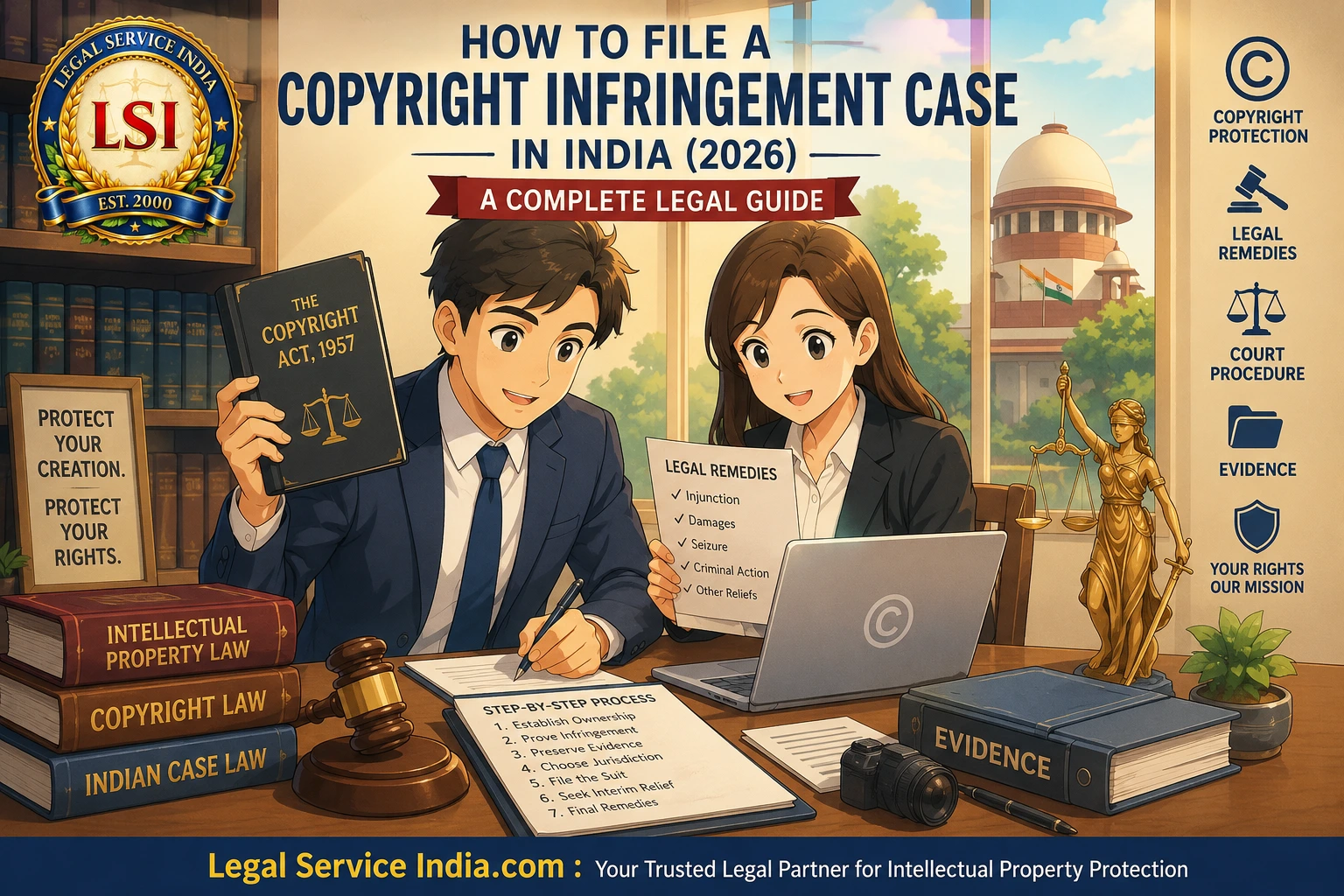
How to File a Copyright Infringement Case in India: A Complete Legal Guide (2026)
Introduction
In today’s digital economy, original ideas are transformed into books, blogs, software, music, films, online courses, photographs, architectural drawings, mobile applications, podcasts, YouTube videos, and countless other creative works. Unfortunately, the ease of copying and distributing digital content has also made copyright infringement one of the fastest-growing forms of intellectual property disputes in India.
Every day, authors discover that their books have been reproduced without permission, businesses find competitors copying website content, software developers encounter pirated versions of their applications, photographers see their images used commercially without consent, and YouTubers struggle against unauthorised uploads of their videos.
If your original work has been copied, reproduced, published, sold, uploaded, translated, adapted, or commercially exploited without your permission, Indian law provides effective legal remedies. The Copyright Act, 1957, empowers copyright owners to seek injunctions, damages, seizure of infringing material, criminal prosecution in appropriate cases, and other reliefs to protect their intellectual property.
However, succeeding in a copyright infringement case requires more than simply proving that someone copied your work. You must establish ownership, demonstrate actionable infringement, preserve evidence, choose the correct forum, and seek appropriate interim and final reliefs.
This comprehensive guide explains everything you need to know about filing a copyright infringement case in India, including the legal provisions, court procedure, jurisdiction, remedies, important judicial precedents, practical litigation strategy, and common mistakes to avoid.
What You Will Learn in This Guide
- Understanding copyright infringement under Indian law
- Legal remedies available to copyright owners
- Court procedure for filing a copyright infringement case
- Jurisdiction and forum selection
- Evidence required to prove infringement
- Interim and final reliefs available
- Important judicial precedents
- Practical litigation strategy
- Common mistakes to avoid
Quick Overview: Filing a Copyright Infringement Case in India
| Aspect | Details |
|---|---|
| Applicable Law | The Copyright Act, 1957 |
| Who Can File | Copyright owner, assignee, or authorised licensee |
| Common Violations | Copying, reproduction, publication, adaptation, translation, commercial exploitation, online uploads |
| Reliefs Available | Injunctions, damages, seizure of infringing material, criminal prosecution, and other legal remedies |
| Key Requirement | Proof of ownership and actionable infringement |
Why Proper Legal Strategy Matters
Successfully pursuing a copyright infringement case involves much more than showing that your work has been copied. A strong case requires careful preparation, proper preservation of evidence, selecting the appropriate legal forum, and seeking suitable interim as well as final reliefs from the court.
- Establish ownership of the copyrighted work.
- Demonstrate actionable infringement.
- Preserve documentary and digital evidence.
- Choose the correct court having jurisdiction.
- Seek timely interim injunctions where necessary.
- Pursue appropriate final reliefs under law.
What Is Copyright?
Copyright is a statutory intellectual property right that protects the original expression of an idea. It grants the creator of an original work the exclusive legal right to reproduce, publish, communicate, adapt, translate, distribute, license, or commercially exploit that work.
Unlike patents or trademarks, copyright protection arises automatically once an original work is created and fixed in a tangible form. Registration is beneficial as evidence of ownership but is not the source of the right itself.
In India, copyright protection is governed primarily by the Copyright Act, 1957, along with the Copyright Rules, 2013.
What Works Are Protected by Copyright?
Indian copyright law protects a wide variety of original creative works, including:
| Category | Examples |
|---|---|
| Literary Works | Books, articles, blogs, website content, research papers, scripts, software code |
| Dramatic Works | Plays, choreography, dramatic performances |
| Musical Works | Musical compositions, background scores |
| Artistic Works | Paintings, drawings, logos, photographs, illustrations, sculptures |
| Cinematograph Films | Movies, documentaries, advertisements, web series |
| Sound Recordings | Songs, podcasts, audiobooks |
| Computer Programs | Software, mobile applications, source code |
| Architectural Works | Original building designs and plans |
| Databases | Original compilations with sufficient creativity |
The law protects the original expression embodied in these works—not merely the underlying ideas or concepts.
Why Copyright Protection Is More Important Than Ever
The internet has made copying content easier than at any point in history. A single click can reproduce an article, photograph, software program, or video and make it instantly available to millions of people.
Today, copyright disputes commonly arise from:
- Website content theft
- AI-assisted copying of creative material
- Software piracy
- YouTube reuploads
- OTT platform piracy
- E-book piracy
- Online coaching material
- Digital photographs
- Mobile applications
- Online courses
- Social media posts
- Business brochures
- Marketing videos
For businesses, copyright is often one of the most valuable commercial assets. Unauthorised copying not only causes financial loss but may also damage goodwill, reputation, search engine rankings, and customer trust.
What Is Copyright Infringement?
Copyright infringement occurs when a person exercises one or more exclusive rights belonging to the copyright owner without obtaining permission, unless the use is specifically permitted under the Copyright Act.
Simply put, if someone copies your protected work without authorisation and without any legal defence, they may be liable for copyright infringement.
Examples of Copyright Infringement
- Copying a book or article.
- Republishing website content.
- Uploading another person’s YouTube video.
- Selling pirated software.
- Copying source code.
- Using copyrighted photographs in advertisements.
- Reproducing paintings or artwork.
- Translating a book without permission.
- Recording and distributing live performances.
- Uploading movies on pirate websites.
- Selling counterfeit educational material.
- Copying online courses.
Commercial gain is not always necessary. Even unauthorised, non-commercial reproduction may constitute infringement depending on the facts.
What Does Not Amount to Copyright Infringement?
One of the biggest misconceptions is that every similarity between two works amounts to copyright infringement. That is not the law.
Indian courts have consistently held that copyright protects the expression of an idea, not the idea itself.
Generally, the following do not constitute copyright infringement:
- Mere reproduction of an idea.
- Similar themes.
- Similar concepts.
- Historical facts.
- Public domain information.
- Scientific principles.
- Methods of operation.
- Systems or procedures.
- Independent creation.
- Coincidental similarity.
The law encourages creativity while preventing monopolisation of ideas.
Illustrative Example
For example:
Two authors may independently write novels about a detective solving crimes in Mumbai. That alone does not amount to infringement. However, if one author copies substantial portions of the other’s plot, characters, dialogue, or narrative expression, infringement may arise.
The Idea–Expression Principle
This principle forms the foundation of copyright law.
Ideas are free. Expressions are protected.
Suppose two filmmakers create movies about a lawyer exposing corruption.
That basic idea belongs to nobody.
However, if one filmmaker copies:
- dialogues,
- screenplay,
- sequence of events,
- unique characters,
- visual treatment,
- music,
- scenes,
Then copyright infringement may occur.
The Supreme Court of India in R.G. Anand v. Deluxe Films (1978) recognised this distinction and held that copyright protects the original expression of an idea rather than the idea itself.
This judgement remains one of the most important authorities governing copyright infringement in India.
What Does Section 51 of the Copyright Act Say?
Section 51 of the Copyright Act, 1957, is the principal provision dealing with copyright infringement.
Broadly speaking, copyright is infringed when a person, without permission from the copyright owner or without any legal defence, performs acts that are exclusively reserved for the copyright owner.
These include:
| Type of Copyright Infringement | Description | Common Examples |
|---|---|---|
| Unauthorised Reproduction | Copying the work in physical or electronic form. | Photocopying books, copying source code, downloading copyrighted software, and reproducing artwork. |
| Commercial Exploitation | Selling, hiring, distributing, or offering infringing copies for commercial purposes. | Selling pirated books, distributing copied software, selling counterfeit DVDs, and offering copied online courses. |
| Public Communication | Permitting copyrighted works to be communicated to the public without authorisation. | Streaming copyrighted movies, public performance without a licence, and broadcasting protected content. |
| Importation of Infringing Copies | Importing infringing copies into India for commercial purposes may also constitute copyright infringement, subject to statutory exceptions. | Commercial import of unauthorised copyrighted copies. |
| Electronic Storage | Modern copyright law also covers unauthorised electronic storage. | Cloud storage, hard drives, servers, mobile devices, and digital archives. |
1. Unauthorised Reproduction
Copying the work in physical or electronic form.
Examples:
- Photocopying books.
- Copying source code.
- Downloading copyrighted software.
- Reproducing artwork.
2. Commercial Exploitation
Selling, hiring, distributing, or offering infringing copies for commercial purposes.
Examples include:
- Selling pirated books.
- Distributing copied software.
- Selling counterfeit DVDs.
- Offering copied online courses.
3. Public Communication
Permitting copyrighted works to be communicated to the public without authorisation.
Examples:
- Streaming copyrighted movies.
- Public performance without licence.
- Broadcasting protected content.
4. Importation of Infringing Copies
Importing infringing copies into India for commercial purposes may also constitute copyright infringement, subject to statutory exceptions.
5. Electronic Storage
Modern copyright law also covers unauthorised electronic storage.
Examples include:
- Cloud storage.
- Hard drives.
- Servers.
- Mobile devices.
- Digital archives.
Key Takeaway
Accordingly, infringement is no longer confined to physical copies.
Types of Copyright Infringement
Although the Copyright Act does not formally classify infringement into separate categories, copyright disputes generally fall into the following practical types.
| Type of Copyright Infringement | Brief Description |
|---|---|
| Direct Infringement | Personal copying or reproduction of a copyrighted work without permission. |
| Indirect or Secondary Infringement | Knowingly facilitating or assisting copyright infringement. |
| Digital Copyright Infringement | Copyright violations committed through digital platforms and online technologies. |
| Software Piracy | Unauthorised copying, installation, or distribution of software. |
| Bootlegging | Unauthorised recording and commercial exploitation of live performances. |
| Counterfeiting | Producing fake copies designed to resemble genuine copyrighted products. |
Direct Infringement
This occurs where the infringer personally copies or reproduces the copyrighted work.
Example:
- A publisher reproduces another author’s book and sells it under a different cover.
Indirect or Secondary Infringement
A person may become liable by knowingly facilitating infringement.
Examples include:
- Distributing pirated copies.
- Knowingly selling infringing goods.
- Permitting commercial premises to be used for infringement.
- Facilitating illegal distribution.
Digital Copyright Infringement
This has become the most common category of infringement.
Examples include:
- Website copying.
- Social media reposting.
- Torrent websites.
- Online piracy.
- Illegal streaming.
- Cloud storage sharing.
- Software cracking.
- Mobile app cloning.
Software Piracy
Software developers frequently face infringement through:
- Illegal installation.
- Cracked software.
- Unauthorised licence sharing.
- Source code copying.
- Reverse engineering beyond permissible limits.
Software is treated as a literary work under Indian copyright law.
Bootlegging
Recording a live performance without permission and commercially exploiting that recording is commonly known as bootlegging.
Examples include:
- Concert recordings.
- Theatre performances.
- Live music events.
- Comedy shows.
Counterfeiting
Counterfeiting occurs where copies are intentionally made to resemble genuine copyrighted products.
Examples:
- Fake books.
- Counterfeit educational material.
- Pirated DVDs.
- Fake branded packaging incorporating copyrighted artwork.
Counterfeiting frequently overlaps with trademark infringement and passing off.
Copyright Infringement in the Digital Era
Modern infringement rarely occurs through traditional photocopying alone.
Today, infringement commonly occurs during:
- Uploading.
- Downloading.
- Caching.
- Cloud storage.
- Server hosting.
- Online streaming.
- Social media sharing.
- Digital reproduction.
- Website scraping.
- AI-assisted copying.
Even temporary electronic storage may have legal implications depending upon the facts of the case.
For businesses operating online, prompt preservation of digital evidence is often the most critical step before initiating legal proceedings.
AI-Generated Content and Copyright
Artificial intelligence has created new challenges for copyright owners.
Questions increasingly arise regarding:
- AI-generated images.
- AI-written articles.
- AI-assisted software development.
- AI-generated music.
- AI voice cloning.
- Machine learning datasets.
While Indian copyright law continues to evolve in this area, creators should remain vigilant where AI tools reproduce substantial portions of protected works without authorisation.
Businesses should also ensure that AI-generated commercial content does not unintentionally infringe third-party copyrights.
Is Copyright Registration Mandatory?
One of the most frequently asked questions is whether registration is compulsory before filing a copyright infringement case.
The answer is no.
Copyright comes into existence automatically the moment an original work is created and expressed in a tangible form.
Registration is not a condition precedent to the existence of copyright.
However, registration offers significant practical advantages.
It:
- Creates an official public record.
- Strengthens evidence of ownership.
- Simplifies litigation.
- Facilitates licensing.
- Assists enforcement.
- Increases commercial value.
- Reduces evidentiary disputes.
Accordingly, while registration is not mandatory, it is highly advisable for valuable commercial works.
Can an Unregistered Copyright Be Enforced?
Yes.
Indian law recognises that copyright subsists from the moment an original work is created.
Therefore, an unregistered copyright may also be enforced through civil proceedings where ownership and originality can otherwise be established.
Nevertheless, registration often makes litigation considerably easier because it serves as strong prima facie evidence of ownership and may reduce disputes over authorship.
For commercially valuable works, obtaining copyright registration before any dispute arises remains the safest legal strategy.
First Steps Before Filing a Copyright Infringement Case
Before rushing to court, a copyright owner should take certain practical steps to strengthen the case.
These include:
- Preserving the original work.
- Saving source files.
- Capturing screenshots of the infringement.
- Recording URLs.
- Preserving metadata.
- Downloading infringing copies.
- Maintaining publication records.
- Documenting financial losses.
- Identifying all infringing parties.
- Consulting an intellectual property lawyer.
These preparatory measures often determine the success or failure of subsequent litigation.
How to File a Copyright Infringement Case in India
Step 1: Gather Evidence of Copyright Ownership
Before initiating any legal proceedings, the copyright owner must collect sufficient evidence establishing ownership of the original work. The stronger your evidence, the easier it becomes to obtain interim relief from the court.
Useful evidence may include:
| Document | Purpose |
|---|---|
| Copyright Registration Certificate | Prima facie evidence of ownership |
| Original manuscript | Proves authorship |
| Source code | Software ownership |
| Original photographs | Ownership of artistic work |
| Original design files | Proof of creation |
| Emails | Establish a creation timeline. |
| Publication records | Shows first publication |
| Metadata | Digital evidence |
| Copyright licence agreements | Establishes licensing rights |
| Assignment deeds | Shows transfer of ownership |
Although registration is not mandatory, it significantly strengthens the evidentiary value of your claim.
Step 2: Preserve Evidence of Infringement
Many copyright owners lose valuable evidence because the infringing content is removed before it can be documented.
Immediately preserve evidence by collecting:
- Screenshots
- Website URLs
- Date and time of infringement
- YouTube links
- Social media posts
- Copies of books
- Copies of software
- Mobile applications
- Product catalogues
- Advertisements
- Online invoices
- Customer complaints
- Purchase receipts
- Screen recordings
Where appropriate, have electronic evidence authenticated in accordance with the Indian Evidence Act, 1872, particularly when relying on electronic records before the court.
Step 3: Assess Whether It Is Actually Copyright Infringement
Not every similarity amounts to infringement.
Before filing a lawsuit, ask the following questions:
- ✔ Has my original work actually been copied?
- ✔ Is only the idea similar?
- ✔ Has a substantial part of my work been reproduced?
- ✔ Is the copying merely coincidental?
- ✔ Does the alleged infringer have any defence under Section 52 (Fair Dealing)?
- ✔ Is there evidence that the infringer had access to my original work?
Experienced intellectual property lawyers often evaluate these questions before recommending litigation.
Step 4: Send a Cease and Desist Legal Notice
Although a legal notice is generally not mandatory, it is often the first and most effective step in resolving a copyright dispute.
A well-drafted cease and desist notice should contain:
- Details of the copyright owner.
- Description of the original work.
- Date of creation.
- Registration particulars (if available).
- Details of infringement.
- Legal provisions violated.
- Demand to immediately stop infringement.
- Demand to remove infringing material.
- Claim for damages.
- Time limit for compliance.
- Warning of civil and criminal proceedings in case of non-compliance.
Many disputes are resolved at this stage without the need for lengthy litigation.
Step 5: Online Take-Down Notice
Where infringement occurs on the internet, court proceedings are not always the first remedy.
The Copyright Rules, 2013, provide a mechanism for requesting intermediaries to remove infringing content.
Typical examples include:
- YouTube
- X (formerly Twitter)
- E-commerce platforms
- Educational platforms
- Website hosting companies
A proper take-down notice generally contains:
- Description of the copyrighted work.
- Proof of ownership.
- Exact URL of infringing material.
- Identity of the uploader (if known).
- Declaration that the material is infringing.
- Contact details of the copyright owner.
Prompt action often prevents wider dissemination of infringing content.
Step 6: Which Court Should You Approach?
Jurisdiction is one of the most important aspects of copyright litigation.
Section 62 of the Copyright Act provides a special jurisdictional rule.
Generally, a copyright infringement suit may be filed before the competent District Court or the Commercial Court having jurisdiction, depending upon the nature and value of the dispute.
The suit may ordinarily be instituted where:
- the plaintiff resides;
- the plaintiff carries on business;
- the defendant resides;
- the defendant carries on business; or
- The cause of action wholly or partly arose.
Where the dispute qualifies as a commercial dispute under the Commercial Courts Act, 2015, the suit may be instituted before the appropriate Commercial Court.
Supreme Court on Jurisdiction
In Indian Performing Rights Society Ltd. v. Sanjay Dalia (2015), the Supreme Court clarified that Section 62 provides an additional forum to the copyright owner but should not be used to create unnecessary inconvenience for the defendant where the plaintiff’s principal place of business and the cause of action coincide.
This judgement continues to guide courts while determining territorial jurisdiction.
Step 7: Drafting the Plaint
The plaint forms the foundation of every copyright infringement suit.
It should clearly contain:
- Name of the Court.
- Details of parties.
- Description of the copyrighted work.
- Facts establishing ownership.
- Copyright registration details (if available).
- Details of infringement.
- Cause of action.
- Territorial jurisdiction.
- Pecuniary jurisdiction.
- Details of loss suffered.
- Interim relief sought.
- Final relief claimed.
- Verification.
Every factual statement should be supported by documentary evidence wherever possible.
Documents Required While Filing the Suit
A comprehensive litigation file should generally contain:
| Document | Importance |
|---|---|
| Plaint | Main pleading |
| Vakalatnama | Authority in favour of advocate |
| Copyright Registration Certificate | Ownership proof |
| Original work | Primary evidence |
| Infringing material | Proof of copying |
| Legal Notice | Shows prior demand |
| Reply to notice (if any). | Defence |
| Screenshots | Electronic evidence |
| Source files | Proof of originality |
| Licence Agreements | Defines rights |
| Assignment Deeds | Ownership |
| Sales records | Assessment of damages |
| Income statements | Quantification of loss |
| List of witnesses | Trial preparation |
Proper documentation significantly strengthens the plaintiff’s case.
Court Procedure After Filing
Once the suit is filed, the proceedings generally follow this sequence:
- Scrutiny of plaint.
- Registration of suit.
- Issue of summons.
- Defendant.Written Statement by defendant.
- Replication by plaintiff.
- Framing of issues.
- Evidence by plaintiff.
- Cross-examination.
- Evidence by defendant.
- Final arguments.
- Judgement.
- Decree.
Where urgent interim relief is sought, the court may hear the injunction application even before issuing notice to the defendant in exceptional cases.
Interim Reliefs Available
One of the greatest advantages of filing a copyright suit is the availability of immediate interim protection.
Courts may grant several important interim remedies.
| Interim Relief | Purpose |
|---|---|
| Temporary (Interim) Injunction | Restrains ongoing infringement during the pendency of the suit. |
| Anton Piller Order | Preserves evidence and prevents its destruction. |
| Mareva Injunction | Prevents disposal of assets before execution of a decree. |
| Appointment of Local Commissioner | Collects and preserves evidence. |
| Delivery-Up of Infringing Copies | Removes infringing goods from circulation. |
Temporary (Interim) Injunction
This is the most frequently sought relief.
The court temporarily restrains the defendant from continuing the infringement until disposal of the suit.
Generally, the plaintiff must establish:
- Prima facie case.
- Balance of convenience.
- Irreparable injury.
These principles are well recognised in Indian civil jurisprudence.
Permanent Injunction
If the plaintiff ultimately succeeds, the court may permanently restrain the defendant from reproducing or commercially exploiting the copyrighted work.
Anton Piller Order
This is one of the most powerful remedies in intellectual property litigation.
An Anton Piller Order allows the court to appoint a local commissioner to enter the defendant’s premises without prior warning for the purpose of:
- inspecting premises;
- preserving evidence;
- seizing infringing material;
- preventing destruction of evidence.
These orders are granted only in exceptional cases where there is a real apprehension that evidence may be concealed or destroyed.
Mareva Injunction
Where there is a genuine apprehension that the defendant may dispose of assets to frustrate the execution of a future decree, the court may grant a Mareva injunction restraining the defendant from alienating specified assets pending disposal of the suit.
Appointment of Local Commissioner
Courts frequently appoint local commissioners to:
- inspect premises;
- prepare inventories;
- seize infringing copies;
- preserve digital evidence;
- photograph infringing material;
- Submit reports to the court.
Such reports often become crucial evidence during trial.
Delivery-Up of Infringing Copies
The court may direct the defendant to surrender:
- pirated books;
- counterfeit products;
- software copies;
- moulds;
- printing plates;
- packaging material;
- storage devices.
This prevents further circulation of infringing goods.
Damages
The plaintiff may seek monetary compensation for losses caused by infringement.
Courts consider several factors while assessing damages:
- Lost sales.
- Reputation damage.
- Market dilution.
- Licence fees.
- Unfair commercial advantage.
- Deliberate infringement.
In appropriate cases, courts have also awarded punitive damages against habitual infringers.
Account of Profits
Instead of damages, the plaintiff may elect to seek an account of profits.
Here, the defendant is directed to disclose profits earned through infringement and surrender those profits to the copyright owner.
Conversion and Recovery of Infringing Goods
The Copyright Act also permits recovery and disposal of infringing copies and articles used in their production.
This remedy is particularly useful where large quantities of counterfeit material have been seized.
Criminal Remedies
Copyright infringement is not merely a civil wrong.
In appropriate cases, it also constitutes a criminal offence.
Serious acts of piracy, commercial counterfeiting, software piracy and organised infringement may invite criminal prosecution under the Copyright Act.
The police may:
- register an FIR where appropriate;
- investigate the offence;
- seize infringing copies;
- seize equipment used for infringement;
- arrest accused persons in accordance with law;
- File a final report before the competent court.
Repeat offenders may face enhanced penalties under the Act.
Importation of Infringing Copies
Section 53 of the Copyright Act enables copyright owners to request Customs authorities to prevent the importation of infringing copies into India.
Where the prescribed requirements are satisfied, Customs authorities may detain suspected infringing goods, thereby providing an effective administrative remedy against cross-border piracy.
Practical Litigation Strategy
Before commencing litigation, experienced copyright lawyers generally recommend the following:
- ✔ Register important works whenever possible.
- ✔ Preserve every piece of digital evidence.
- ✔ Capture date-stamped screenshots.
- ✔ Download infringing webpages.
- ✔ Maintain records of publication.
- ✔ Estimate financial losses.
- ✔ Identify every infringing party.
- ✔ Issue a cease and desist notice.
- ✔ Consider online take-down procedures.
- ✔ File the suit without undue delay.
Early legal intervention often results in stronger interim protection and prevents further commercial damage.
Quick Litigation Checklist
| Action | Purpose |
|---|---|
| Register important works | Strengthen proof of ownership. |
| Preserve digital evidence. | Support infringement claims. |
| Capture screenshots. | Record online infringement |
| Estimate financial losses. | Support damages claims. |
| Issue a cease and desist notice. | Attempt early resolution. |
| File a suit promptly. | Improve chances of interim relief. |
Common Mistakes to Avoid
Many copyright owners unintentionally weaken their own cases.
Avoid the following mistakes:
- Waiting too long before filing suit.
- Failing to preserve electronic evidence.
- Sending vague legal notices.
- Ignoring jurisdictional requirements.
- Failing to document financial losses.
- Assuming registration alone guarantees success.
- Filing proceedings without proper legal advice.
A carefully prepared case has a significantly greater likelihood of success.
Mistakes and Their Impact
| Common Mistake | Possible Consequence |
|---|---|
| Delaying legal action | Loss of valuable evidence |
| Ignoring digital evidence | Weaker infringement claim |
| Vague legal notices | Reduced effectiveness |
| Jurisdiction errors | Procedural complications |
| Poor documentation of losses | Difficulty claiming damages |
| Proceeding without legal advice | Strategic disadvantages |
Conclusion
Copyright is one of the most valuable assets in today’s knowledge-driven economy. Whether the work consists of a book, software, photograph, film, website, online course, artwork, music, or digital content, Indian law provides robust mechanisms to protect creators against unauthorised exploitation.
The key to a successful copyright infringement action lies in timely legal advice, meticulous evidence collection, strategic use of interim remedies, and proper representation before the competent court. Acting swiftly can prevent further loss, preserve crucial evidence, and significantly improve the chances of obtaining effective relief.
Frequently Asked Questions (FAQs)
Can I file a copyright infringement case without registration?
Yes. Copyright subsists automatically upon the creation of an original work. Registration is not mandatory, though it serves as strong evidence of ownership.
Is a legal notice compulsory before filing a suit?
No. However, issuing a cease and desist notice is generally advisable and may resolve the dispute without litigation.
Can I seek both civil and criminal remedies?
Yes. Depending on the facts, civil proceedings for injunctions and damages and criminal prosecution may proceed independently.
Can website content be protected?
Yes. Original website articles, blogs, graphics, photographs, source code, and other creative content are capable of copyright protection.
Can software be protected under copyright law?
Yes. Computer programs are treated as literary works under the Copyright Act and enjoy copyright protection.
Can AI-generated content infringe copyright?
Yes. If AI-generated output substantially reproduces protected expression from an existing copyrighted work, infringement issues may arise and should be evaluated on the specific facts.
Contact an Experienced Copyright Lawyer
If your book, website content, software, YouTube video, online course, photograph, artwork, logo, mobile application, or any other original work has been copied or used without your permission, obtaining timely legal advice can make a significant difference.
Whether you need to issue a cease and desist notice, initiate take-down proceedings, seek an urgent injunction, or file a civil or criminal action, professional legal assistance can help you protect your intellectual property rights effectively.
Adv. Tarun Choudhury
Supreme Court Advocate | 25+ Years of Legal Experience
- 📞 Call: 9891244487
- 💬 WhatsApp: 9891244487
Legal Services Offered
- Copyright Registration
- Copyright Infringement Litigation
- Copyright Legal Notices
- Website Content Theft Cases
- Software Copyright Disputes
- YouTube & Social Media Copyright Matters
- Digital Content Protection
- Copyright Licensing & Assignment
- Interim Injunctions
- Intellectual Property Advisory
- Representation Before Courts Across India
Copyright Legal Services Summary
| Service | Legal Assistance |
|---|---|
| Copyright Registration | Protection of original works |
| Infringement Litigation | Civil and criminal remedies |
| Legal Notices | Cease and desist notices |
| Website & Software Disputes | Protection against digital copying |
| YouTube & Social Media Matters | Content enforcement and takedowns |
| Licensing & Assignment | Commercial exploitation of copyright |
| Court Representation | Representation before courts across India |
Protect your creativity before it is exploited. Contact Adv. Tarun Choudhury today for trusted legal guidance and effective representation in copyright matters throughout India.
Important Links
Important Links:
- Lawyers in India
- Copyright Registration in India
- Caveat Filing in Supreme Court of India
- Mutual Consent Divorce in Delhi NCR: WhatsApp 9650499965