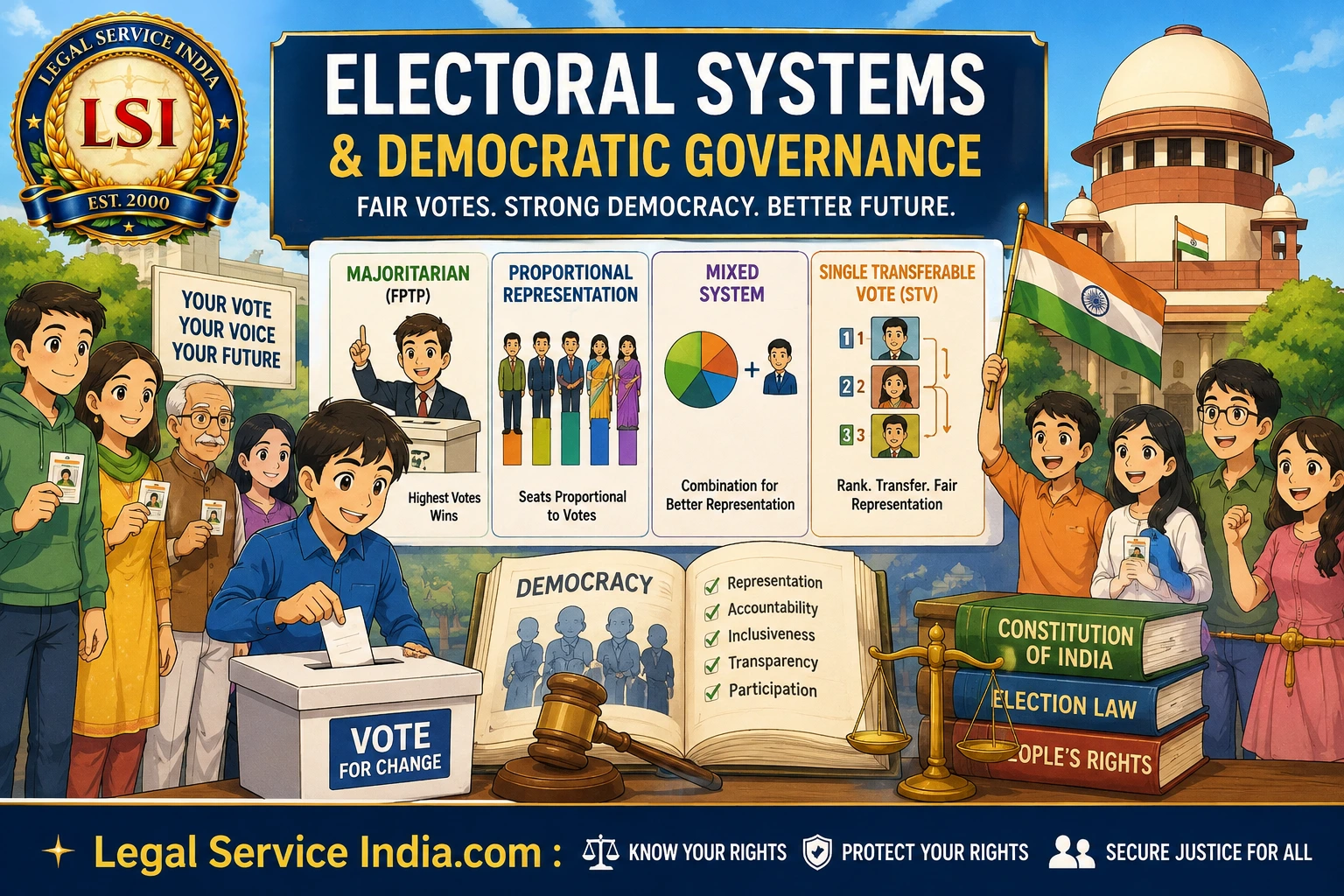
Introduction
“Voters must have faith in the electoral process for our democracy to succeed.”
Blanche Lincon
The electoral system plays a fundamental role in shaping democratic governance by determining how representatives are chosen and how public opinion is translated into political power. It ensures that citizens have a voice in their government, fostering accountability, inclusiveness, and representation.
Meaning Of Electoral System
An electoral system refers to many rules that allow people to choose their representative or political leader. It shapes the outcome of the choice by providing an election mechanism and an election process by determining the representatives of several political parties of the legislator. The election system not only works at the national level but is also intensively used in determining the composition of the local body. This is a critical factor in the various combinations of political parties/groups/people that exist in the country at the legislative and enforcement level. The formation of a coalition involves various strategies decided by political parties to enter the lawmakers and their electoral workers.
At its core, an electoral system refers to the set of rules and procedures through which elections are conducted. It determines how votes are cast, counted, and translated into seats in a legislative body or other governing institutions. The choice of an electoral system can significantly impact political behaviour, party dynamics, and the overall functioning of democracy.1 (Haywood, 2013)
Dynamic Nature Of Electoral System
Everyone depends on the type of electoral system in the political system. The electoral system is not a static concept. Rather, it is a dynamic system that has been continuously developed as needed to meet your political system. A well-defined electoral system promotes a democratic culture to work in its true spirit.
Reference: Haywood, Andrew (2013)
Haywood, Andrew. (2013). Politics. London: Palgrave Macmillan.
Six Fundamental Elements Of The Electoral System
Bernard Groffman, a well-known comparative political scientist, has identified six fundamental elements of the electoral system. These are:
- Defining permission (individual or parties, or a combination of both) to counter choices.
- Specify within-party rules to identify candidates for the party, or determine the criteria for ranking party candidates,
- Voting specifications,
- Constituency (district),
- Determining election times, and
- Voting department rules.
Selection System Rules and Regulations
Separately, the term ‘selection system’ is also used to refer to rules and regulations such as voters, campaigns, advertising, and election stages. The election structure defines the types of electoral systems and the different types that have been injected and counted.
Individual or Party Voting
For example, whether a vote is given to either an individual or a group of people (party list) or a combination of both.
Number And Order Of Votes
How many votes do I need to submit for the candidate and/or list? If multiple votes are handed over, it is based in any order on the preferences or rank of the candidate/list. And finally, whether there is only one round and one multiple round.
Constituency and District Structure
The district structure consists of districts, numbers and hierarchies of the district. Here, the constituency is the area where elections take place. There is one sitting district structure or several sitting district structures, but they are considered national constituencies or divided into several smaller constituencies. For the latter, certain types of hierarchies may exist, such as the top and the lower levels. There is one or more seats in every constituency.
Election Formula and Seat Allocation
An election formula refers to the process in which the voice is converted into a seat. The most popular formula is the PR system with multiple, multiple, proportional representation (PR). These formulas may vary depending on the district structure.
Why Do Varieties Of Electoral Systems Exist?
Electoral systems are essential to the way wherein humans participate in politics and who holds power in a constitutional democracy. The electoral system determines how a fundamental political right – the right to vote – is exercised. The way wherein votes are cast and counted influences the composition of the democratic chamber, the manner wherein representatives relate to the general public, and which party, or institution of parties, is able to form a central authority. The type of electoral system used can affect the selections individuals make while casting their vote(s), as well as the type of authorities that may be fashioned. Electoral structures consequently play a defining role in the person of the political system.
Electoral Systems in Political and Non-Political Elections
Electoral systems are used in politics to opt for governments, whilst non-political elections may also take place in commercial enterprises, nonprofit companies and casual establishments. These policies govern all components of the vote casting procedure: while elections arise, who is allowed to vote, who can stand as a candidate, how ballots are marked and solid, how the ballots are counted, how votes translate into the election final results, limits on campaign spending, and different factors that could affect the result.
Political electoral systems are described by using constitutions and electoral legal guidelines, are typically conducted by means of election commissions, and can use multiple styles of elections for unique workplaces.
Single-Winner and Multiple-Winner Electoral Systems
Some electoral systems elect a single winner to a completely unique role, along with a high minister, president or governor, while others choose a couple of winners, which include contributors of parliament or forms of administrators.
While electing a legislature, areas may be divided into constituencies with one or extra representatives, or the citizens might also opt for representatives as a single unit. Voters may additionally vote at once for an individual candidate or for a listing of candidates recommended by using a political party or alliance. There are many variations in electoral structures.2
Mathematical And Normative Study Of Voting Rules
The mathematical and normative take a look at of vote casting regulations falls underneath the branches of economics called social preference and mechanism design, however the question has also engendered giant contributions from political scientists, analytic philosophers, and computer scientists, and mathematicians.
The field has produced numerous predominant effects, consisting of Arrow’s impossibility theorem (showing that ranked balloting can’t dispose of the spoiler impact) and Gibbard’s theorem (displaying it’s miles impossible to layout a truthful vote casting system, i.e. one wherein it is constantly apparent to a strategic voter which ballot they should solid).
Reference: Rae, D. W. (1971)
Rae D. W. (1971). The Political Consequences of Electoral Laws. New Haven, CT: Yale University Press.
Historical Underpinning and Development of Electoral System
Pre-Democratic
In ancient Greece and Italy, the group of suffrage already existed in a rudimentary form at the outset of the ancient period. Inside the early monarchies it was customary for the king to ask pronouncements of his people on subjects wherein it becomes prudent to confirm its assent beforehand.
In these assemblies the human beings recorded their opinion by way of clamoring (a way which survived in Sparta as overdue because the 4th century BCE), or by using the clashing of spears on shields.
Early Democracy
Voting has been used as a feature of democracy for the reason that in the sixth century BCE, democracy was introduced via the Athenian democracy. However, in Athenian democracy, voting become seen because the least democratic among methods used for selecting public officers, and became little used, due to the fact elections have been believed to inherently want the rich and well-known over common residents.
Considered as extra democratic, they have been assemblies open to all residents and choice by way of lot, as well as rotation of office.
Voting in Ancient Greece
Usually, the taking of votes changed into an effect in the shape of a ballot. The practice of the Athenians, which was proven with the aid of inscriptions to have been widely accompanied inside the different states of Greece, was to keep a show of hands, except on questions affecting the popularity of individuals.
Those latter, which covered all proceedings and proposals of ostracism, in which voters chose the citizen they most wanted to exile for ten years, were decided through mystery ballot (one of the earliest recorded elections in Athens turned into a plurality vote that it changed into unwanted to win, particularly an ostracism vote).
Voting in Ancient Rome
At Rome the technique which prevailed up to the second century BCE became that of department (discision). However, the system has become a concern for intimidation and corruption.
Hence a series of legal guidelines enacted between 139 and 107 BCE prescribed using the ballot (tabella), a slip of wood lined with wax, for all business achieved within the assemblies of the people.
For the cause of wearing resolutions, a majority of votes become deemed sufficient. As a widespread rule equal value became made to attach to each vote; but within the popular assemblies at Rome a system of voting by way of organizations was in pressure until the center of the 3rd century BCE with the aid of which the richer classes secured a decisive preponderance.
Plurality Voting and Venice
Most elections in the early records of democracy were held using plurality voting or some variation, but as an exception, the country of Venice in the 13th century adopted approval balloting to elect their terrific Council.
The Venetians’ Method for Electing the Doge
The Venetians’ technique for electing the Doge turned into an especially convoluted manner, along with 5 rounds of approval vote casting, by way of drawing masses.
A frame of 30 electors became selected, which was similarly reduced to nine electors with the aid of drawing plenty again. An electoral university of 9 contributors elected forty humans by way of approval voting; the ones 40 had been reduced to shape a second electoral university of 12 participants of drawing plenty once more.
The second electoral university elected 25 human beings by means of approval vote casting, which had been decreased from a third electoral college of nine.
The third election elected 40 members who had been tasked to draw a final electoral college of 11 through drawing masses. They in flip elected a final electoral body of 41 contributors, who in the end elected the Doge.
Regardless of its complexity, the approach had sure appropriate homes, such as being difficult to game and ensuring that the winner pondered the opinions of each majority and minority faction.
This method, with slight changes, became central to the politics of the Republic of Venice in the course of its amazing lifespan of over 500 years, from 1268 to 1797.
Borda Count and Condorcet Methods
Jean-Charles de Borda proposed the Borda count in 1770 as a way for electing contributors to the French Academy of Sciences.
His technique changed into opposition through the Marquis de Condorcet, who proposed rather the method of pairwise comparison that he had devised. Implementations of this technique are called Condorcet techniques.
He additionally wrote about the Condorcet paradox, which he is known as the intransitivity of majority preferences.
However, recent studies have shown that the truth seeker Ramon Llull devised each the Borda count number and a pairwise method that satisfied the Condorcet criterion within the 13th century.
The manuscripts wherein he described those methods had been misplaced in history till they had been rediscovered in 2001.
Single Transferable Vote (STV)
The single transferable vote (STV) method was devised with the aid of Carl Andra in Denmark in 1855 and within the United Kingdom with the aid of Thomas Hare in 1857.
STV elections had been first held in Denmark in 1856 and in Tasmania in 1896 after its use became promoted via Andrew Inglis Clark.
Over the route of the 20th century, STV became finally followed through Ireland and Malta for his or her countrywide elections, in Australia for his or her Senate elections, as well as by using many municipal elections around the arena.3
Party-List Proportional Representation
Party party-listing proportional illustration started out for use to go with EU legislatures in the early 20th century, with Belgium the primary to put in force it for its 1900 general elections.
Since then, proportional and semi-proportional techniques have emerged as used in almost all democratic countries, with the maximum exceptions being the former British and French colonies.
Reference 3
Chiriyankandath James. ‘“Democracy” Under the Raj: Elections and Separate Representation in British India’. Journal of Commonwealth & Comparative Politics, 39–63, (1992).
Classification of Electoral Systems
Commonly, the electoral system is classed into three main classes primarily based on the guidelines decided for the conversion of votes into seats inside the legislature:
- First category: The majoritarian system;
- Second category: The proportional representative system; and
- Third category: The combined system.
Majoritarian technique refers to a device where large events get to represent a higher variety of seats, while the proportional representation (PR) system depicts a system where seats are determined in share of the votes obtained inside the election.
Combined structures are the combination of the majoritarian and PR structures.
Majoritarian Electoral System
It is much more likely that during Majoritarian device, parties getting 30 percent of votes may additionally turn out to be the ruling events resulting in more often than not two-party party systems or single-party governments including in 2010 elections in the U.K., while the Conservative party regarded as the most important party acquiring 47 percentage of seats regardless of conserving only 36 percentage of votes while the Liberal Democratic party received nine percentage of seats with 29 percentage of votes.
The Conservatives have held strength for a prolonged duration despite the fact that they have not by any means earned greater than 40-45 per cent of total electoral votes.
Majoritarian systems can also result in big disparities because the seats aren’t allotted in proportion to votes in Ireland.
Also, there are higher probabilities for a party with minimal 5th of votes to Ireland to have the political energy which might impact the efficacy of the authorities and the political device.4
Proportional Representation System
Then again, in PR devices, events get representation on seats in keeping with the share of votes obtained through them in elections.
For instance, a party getting forty per cent of votes gets to represent 40 per cent of general legislative seats, accordingly reducing the opportunities of single-party rule.
PR systems usually bring about multiparty systems or coalition governments, assuring a better consultant system and a more effective political system.
The governments consequently fashioned are famous governments and are better at coping with the popular mandate than those in the majoritarian system, where authorities are in most cases fashioned by using those who have secured less than 50 per cent of overall votes.
Classification at a Glance
| Electoral System | Basis of Representation | General Outcome |
|---|---|---|
| Majoritarian System | Seats are generally won by candidates or parties securing the highest vote share in constituencies. | More likely to produce two-party systems or single-party governments. |
| Proportional Representation | Seats are determined in proportion to the votes obtained. | Usually results in multiparty systems or coalition governments. |
| Combined System | Combines majoritarian and proportional representation structures. | Uses elements of both electoral approaches. |
Reference 4
RAE, Douglas W. 1967. The Political Consequences of Electoral Laws, New Haven: Yale University Press.
Majoritarian Systems
Single-Member Plurality Structures
Within the single-member plurality (SMP) system, the character/party holding the most variety of votes is the winner. This system is famous within the United Kingdom, the U.S.A., Canada, India, and some other international locations that have had their political systems derived from the British colonial past.
In this system, the complete vicinity is divided into single-member constituencies which are usually of the same size. The electoral votes are cast for a single candidate for every constituency, i.e., every voter is to vote for a single candidate.
To govern for his or her constituency. This device, which is likewise known as the first beyond-the-publish system, there may be a higher chance of winning such an election in spite of getting minority votes in favour. For instance, if 5 applicants contesting an election get 32, 25, 14, 18, 11 votes out of total a hundred votes polled, the winner is the one who has secured the most important quantity of votes, 32 votes. This means that even though most of the people of votes (one hundred-32-68 votes) have been no longer favoring this candidate, but this candidate is asserted winner due to the fact the most number of votes casted in favor of any candidate belongs to him.
First-Past-The-Post System: Disadvantages
This accounts for a prime downside of the first-past-the-post system, as it results in wastage of many votes. It is an additional method that in this system, there may be a better opportunity for smaller political parties to get bad insurance and interest. Some scholars preserve that this also undermines the very essence of a healthy democracy, as it dilutes the effect of smaller agencies and political parties in the political device. Given that the elected candidate typically enjoys the best minority help, the legitimacy of such governments also can be puzzled. Some other hazard associated with this system is that it can bring about an unaccountable government because the winner is determined on the basis of easy majority which might not be in essence.
First-Past-The-Post System: Advantages
The choice of the majority of the populace. Despite those barriers, there remain diverse benefits associated with this system. The government fashioned in such structures claims a clear mandate from the electorates even though it is primarily based on a simple majority. This enables avoiding any sort of radical group or extremism from gaining strength in the political system. Furthermore, the provision of numerous single-member constituencies guarantees that every part of the United States of America gets adequate representation in the countrywide legislature. It additionally tends to provide the electorate with ample picks of applicants, and varying standards of selecting the representatives are allowed to be evicted simultaneously, which in turn strengthens the democratic details.
Second-Ballot System
This method has been controlled to address the fundamental shortcoming of the earlier discussed SMP system to a big volume. To make certain that the prevailing candidate receives determined now not only the best on the basis of easy majority but also the absolute majority, a 2nd-ballot device is used. It’s been a well-known electoral system in France, Chile, Austria and Russia. As observed within the SMP system, the whole USA is divided into several single-member constituencies, and people’s vote is based on single-Ireland out of many candidates contesting the election. But there are two rounds of balloting.
After the primary spherical of voting, the second round of voting is held between the leading two applicants who have emerged as winners within the first round. This offers people the liberty to pick out any candidate in the first round but then limits the choice to the top two contenders so that a candidate with an absolute majority emerges as the winner. Due to this layout, this system is also defined as a “mixed majority-pleurality” system.
This device is also accompanied in the USA while the 2 fundamental political parties conduct inner elections to decide on their management and presidential candidates. Rounds of vote casting continue to take place until any of their applicants reach an absolute majority.
Despite the fact that this device may also seem to address the principal downside of the SMP device, it fails to offer sufficient opportunities to the smaller parties and individual candidates. In this system, there is better tendency of larger events’ candidates to comfy the top positions and relegating the huge positions of the third events which may not be far at the back of from the top contenders. This device may additionally represent the applicants opting for reputation over party standards, ensuing in volatile and corrupt contenders accomplishing the pinnacle positions.
Reference
5. Walzer, Michael. On Toleration (New Haven: Yale Univ. Press, 1997).
Advantages of the Second-Ballot System
Notwithstanding those shortcomings, the second-ballot system additionally guarantees that the elected candidate secures consent of most of the populace and is extra widely widespread. It gives the electorates also enough alternatives inside the first sphere and a preferential preference in the 2D round, leading to the most pleasure of the electorates from the consequences of such a rigorous occasion. Furthermore, the legitimacy of the candidate as a result elected remains unquestioned, which therefore ends in a sturdy and solid governance device in contrast to that of the SMP system.
Supplementary Vote System
That is some other approach; this is used to deal with the criticism of the SMP system regarding the dearth of the absolute majority of the prevailing candidate. But, it’s generally utilised in inner elections in distinctive nations and no longer as an obligatory approach to decide the countrywide management of any United States.
As an instance, the election in house of Representatives in Australia is determined through using the opportunity Vote (AV) approach while the election of Mayor in London, United country is determined through the Supplementary Vote (SV) technique, which can be defined as a variant of the AV technique.
The SV and AV strategies are primarily based on the same concepts and differ in details. In each system, there are single-member constituencies, with the citizens getting a share of multiple votes in accordance with their choice.
Preferential Voting In AV And SV Systems
Electorates rank their candidates consistent with their alternatives and alternatives. The first choice is considered as the primary vote, even as the opposite ranks are taken into consideration as opportunity or supplementary votes.
In the AV system, this rating is given to each of the candidates contesting the election, but inside the SV system, there is only one supplementary vote to be had for the electorates. Because of this if 7 candidates are contesting the election, then in step with the AV system, the electorates will rank the candidates as 1, 2, 3, 4, 5, 6 & 7; however in the SV system the candidate will select their topmost favored and rank them 1 and can give 2 to their 2nd most preferred candidate.
This system is repeated till an absolute majority is reached through one of the candidates. There is a mild distinction between the AV and the SV device in counting. While within the AV device the elimination and redistribution of votes is completed more than one instance, inside the SV system in a single round top candidates are decided, and the subsequent spherical makes a decision on the winner.
Limitations Of The AV/SV System
The AV/SV system is a designated and complex procedure; however, it has a tendency to result in a single-party party or -party system where larger parties overshadow the smaller parties and man or woman applicants.
Another predominant grievance that is confronted by using this device is that the preferential counting may additionally bring about the identical final results as that of SMP system in which the winner may additionally have lesser first desired votes, yet they get chosen to govern on behalf the whole populace.
Reference
6. Lakeman, Enid. 1974. How Democracies Vote, London: Faber and Faber.
Proportional Representation System
The term “proportional representation” is commonly used as an umbrella term for different methods and mechanisms that aim to establish proportionality in the election outcomes. The underlying canons for all the methods remain to be the fact that they try to match the share of seats won with the proportion of votes won.
The legislative seats are shared in proportion to the votes acquired by the party/candidates in the election. Some of the well-known and practiced examples include the “Mixed-Member Proportional (MMP) or Additional Member System (AMS)”, “Single-Transferable-Vote (STV) System”, “Party-List System”, “Cumulative Vote System”, and “Slate System.”
Single-Transferable-Vote (STV) System
This system was first proposed by Thomas Hare and is therefore additionally known as the “Hare System”. It’s widely used within the Republic of Ireland and the UK constituencies, and the representatives elected from every constituency vary from a minimum of three to a maximum of eight.
But this doesn’t mean that the voters get to solid a couple of votes. The citizens are entitled to the handiest one vote; however, it’s a preferential vote-casting system as practised in the AV system. As a consequence, the electorate single vote receives transferred in keeping with their second and 0.33 alternatives and so forth until a candidate is able to cozy the defined, “quota” which again is defined in phrases of overall votes acquired and overall wide variety of seats.
Single-Transferable-Vote Example
As an example, if the total number of votes is 100 and the total number of representatives allocated is 4, then all four candidates need to achieve:
| Calculation | Required Votes |
|---|---|
| 1+ (one hundred/1+4) | 21 votes every in order to win the election. |
In case none of the candidates get the desired drop quota, then the candidate getting the least range of votes gets eliminated, and his votes get transferred according to their 2nd options.
This system is repeated until all of the required four applicants get 21 votes every. In a different case, if the candidate surpasses the slump quota, then all of the excess votes acquired by that very candidate additionally get transferred in accordance with the subsequent choice.
Single-Transferable-Vote System in India
The citizens solid single vote, but it receives multiple transferred instances as per the options referred to; for this reason, this system is called the Single-Transferrable Vote (STV) system.
This system is used in Rajya Sabha elections in India, in which every nation meeting works as one multi-member constituency, and the MLAs get one transferable vote every. The Australian Senate, Parliament of Malta and Ireland have also adopted this system.
All the candidates are judged and elected on the same standards and remain at par with each other in representing the constituency, which in turn guarantees a better and greater balanced governance system. It additionally presents the citizens with enough picks to rank their applicants and get a varied aggregate of representatives and reduces the opportunity of single-party party dominance within the political system. Although this system overcomes many barriers of the majoritarian strategies.
Party List System
As the call indicates, this system is based totally on vote casting performed for the party instead of the applicants. The party-list system is observed in each single-member constituency in addition to multi-member constituencies.
Some of the examples consist of states of the European Union (Belgium, Luxembourg); additionally, the EU Parliament gets elected following this technique. Other than this, it’s also followed in the international locations wherein the complete United States is taken into consideration as a single constituency along with Israel and Switzerland.
Party List Voting Process
Votes are cast in favour of parties and no longer candidates. But, the list system is such that the voter is well privy to all the candidates contesting the election as the events list their candidates in order of the preferences, with first rank being given to the very best position.
Subsequently, each of the parties inside the United States of America prepares a list which declares the applicants’ position if they get elected to electricity. Voters forged their votes in favour of their desired party after understanding the list of the applicants.
Parties’ percentage of the seats in the present share with the votes acquired. As an instance, if a party achieves 40 per cent of votes, then it gets to represent forty per cent of seats, which gets stuffed by means of the listing of applicants organised via the party ahead.
In Switzerland this system has been slightly modified in which the citizens get a blank vote, and they could either vote for a party-list or they can create their personal hybrid-list which includes applicants from distinctive party-lists.
Types Of Party-List Systems
- Open-listing systems
- Closed-listing structures
Open-Listing System
The previous is an arrangement where the electorate solidifies their vote for both the party and the candidate in the party. So, they have their say in determining who in the party list have to be chosen for the said function.
For instance, in Finland, the citizens cast two votes – one for the party and the other for the candidate inside that party.
Closed-Listing System
Closed-listing device, however, does not provide any desired information to the voter in the context of the candidate. The list is prepared by using the party and supplied to the voters.
In Israel, which has adopted this system, voters take delivery of the list of candidates nominated by using the party and cast their vote in favour of the party.
Reference
7. Lijphart, Aren d. 1991, Proportional Representation: Double Checking the Evidence, Journal of Democracy 2: 42-48.
Limitations Of The Party List System
Belgium follows the mid-way between the closed-list and the open-list system, in which, the voter gets to select both the list furnished by way of the party or any individual candidate and wherein decrease placed candidate can get better role in case, he/she succeeds in obtaining the desired minimal range of preferential votes.
However, the Party List system runs the risk of having an unstable, fragmented, and weak government. As the voters vote for a party, their link with the candidates may not be as strong as it tends to be in systems which allow voting for their candidate directly.
Also, there remains a chance that a certain candidate may have an influential position in the party but lack mass appeal, leading to a possible disaffection after the leader is elected.
Moreover, candidates may also get into unfair practices to get into the list, and public service might get masked by greed for power, leading towards a corrupt system of governance.
Mixed Electoral Systems
This category includes systems that combine elements of each of the first two types to produce a pattern somewhat in between; that is, with some elements of majoritarian and some of proportionality but not falling completely under either of them.
Mixed-Member Proportional or Additional Member System
With the aid of combining the SMP system and the party-list system, we get the combined Member Proportional (MMP) or extra Member (AM) system. This means that 50 per cent of the seats are crammed via the SMP system, particularly inside the single-member constituencies. Some other states in Europe, like Italy and Scotland, and a few seats get stuffed by using the SMP technique while relaxation of the seats is crammed by the use of the party-list system. An excellent instance of this association in play is in Germany, Wales have followed MMP device wherein extra than 50 percentages of seats are allotted as per the SMP system and relaxation are stuffed using party-list system.
On this system, the electorates are entitled to two votes each—one for the candidate and one for the party. The basis for this hybrid device is to preserve the distinction among the constituency representative and ministerial positions. At the same time as the former is chosen via the people at once through the SMP device, the latter is elected in a more proportional manner, with the party getting its due importance.
In addition, the electorate additionally gets the choice of electing their constituency representative from a special party and the government from an exceptional one, which results in an efficient checks and balances system in place.
| Feature | Description |
|---|---|
| Electoral Method | Combination of SMP and party-list systems |
| Voting | Electors generally have two votes: one for a candidate and one for a party. |
| Constituency Representation | Representatives are elected directly through single-member constituencies |
| Party Representation | Additional representatives are elected through the party-list system. |
| Main Objective | To combine constituency representation with proportional party representation |
Semi-Proportional Method
This is another variant inside the combination of the majoritarian approach and the proportional representation approach. A sure variation in this system is followed in New Zealand and India, where a few arrangements are made to make sure of the involvement of ethnic minorities and backward classes within the political system of the respective countries.
The Maori districts in New Zealand are exclusively confined to individuals who are descendants of Maori community, while in India, there are certain areas from which only Scheduled Castes and Scheduled Tribes can contest the election, but the same criteria do not apply for citizens.
Citizens from all categories and castes can vote, but contesting applicants have to be from the SC or ST category. In a sense, this is more of an arrangement to reserve a few seats for a specific class rather than an actual structure of proportional representation.
- Citizens from all categories can vote.
- Certain constituencies are reserved for specific categories.
- In India, certain seats are reserved for Scheduled Castes and Scheduled Tribes.
- The system seeks to ensure representation of historically disadvantaged groups.
Cumulative Vote System
Another variant of the semi-proportional approach can be seen in the cumulative vote system, in which citizens are entitled to multiple votes in multi-member constituencies.
The number of members to be elected to represent a constituency equals the number of votes cast by every voter. Therefore, if there are five members to be elected from a single constituency, then every voter gets to cast five votes.
The voter is free to cast all of the votes to a single candidate, or one vote to each of those contesting applicants, or divide the votes among the candidates according to his/her discretion.
The top five applicants are taken into consideration as winners. Hence, counting-wise, this follows the SMP device, as the cumulative votes count in the final results.8
| Number of Seats | Votes Available to Each Voter | Voting Choice |
|---|---|---|
| 5 | 5 votes | All votes may be given to one candidate or distributed among several candidates. |
Slate System
This system is solely utilised in the United States of America during the election of the President’s Electoral College. It is closely associated with the party-list system, with the main distinction being that the list organised by the party is called a “slate”.
The electorate get the slates from both the Democratic and the Republican Party and vote for their favoured slate, i.e., they vote for an entire list of candidates and not any individual candidate specifically.
The slate, which receives 51 per cent of votes, wins the complete state, i.e., the party to which the slate belongs gets to represent the complete state.
This issue is relatively like the first-past-the-post system, but the major difference remains the criteria of earning 51 per cent of the general votes to win the election.
Additionally, inside the first-past-the-post system, the constituencies are represented by a single candidate, while in the slate system the constituencies are represented by more than one member, and the party winning 51 percent of votes gets to employ its members listed as representatives.
| Feature | Slate System | First-Past-the-Post System |
|---|---|---|
| Voting | Voters choose a slate of candidates. | Voters generally choose an individual candidate. |
| Representation | More than one member may represent the constituency. | Generally represented by a single candidate |
| Party Role | Party slate plays a central role | The individual candidate plays a central role. |
| Winning Criterion | The slate securing the required majority wins the state’s representation. | The candidate with the highest number of votes generally wins the constituency. |
Key Features of Mixed Electoral Systems
Mixed electoral systems attempt to combine the advantages of majoritarian and proportional representation methods. The principal features discussed above can be summarised as follows:
- Combination of Electoral Methods: Mixed systems combine majoritarian and proportional elements.
- Dual Representation: Some systems allow voters to select both a constituency candidate and a political party.
- Minority Representation: Semi-proportional arrangements may provide reserved representation for particular communities.
- Multiple Voting Options: Cumulative voting allows voters to distribute multiple votes among candidates.
- Party-Based Representation: The slate system places greater emphasis on party lists and collective candidates.
- Constituency Representation: Several mixed systems retain a direct connection between voters and constituency representatives.
Conclusion
Mixed electoral systems represent an attempt to balance the competing objectives of direct constituency representation and proportional political representation. The mixed-member proportional system combines single-member constituencies with party-list representation, while the semi-proportional method seeks to provide representation to particular social or ethnic groups.
The Cumulative Vote system provides voters with multiple votes that can be distributed among candidates, whereas the Slate system emphasises collective party-based representation. Each of these models demonstrates a different way of combining majoritarian and proportional principles within an electoral framework.
Reference
8Clark, William Roberts; Golder, Matt; Golder, Sona Nadenichek. (2013), Principles of Comparative Politics, USA: Sage Publications.
Comparative Assessment of Electoral Systems
Importance of Electoral Systems
The importance of electoral approaches can’t be denied in the wake of rising democratic societies all around the world. An electoral system does not best set guidelines for elections in a country but additionally performs a vital position in shaping the party system and impacting the political system of the country. Therefore, it turns into vital for political events, in return, to steer and regulate the electoral machine as in keeping with their advantage.
Changes In Electoral Systems Across Countries
Electoral systems and procedures range across time and space, and party politics act as a catalyst for such changes and variations. Each the majoritarian and the PR structure has been attempted, altered and replaced by means of countries across the world in distinctive times. Many countries have tried to regulate the elections by easy moving from one kind of electoral device to every other or by way of choosing a combination of two one-of-a-kind electoral structures.
France and Changes in Electoral Systems
A classic example in hand is France, which has changed its electoral structures extra regularly than others. The parliamentary elections had been held in line with 2nd-poll device till 1985, whilst it turned into replaced by means of party party-listing system below the impact of the Socialist party which managed the countrywide meeting within the 1980s and 1990s.
A prime element riding such change becomes derived from the hitherto President Mitterrand’s robust preference to reinforce socialist illustration within the countrywide meeting.
UK Electoral System Reforms
Another example of modifications in electoral system may be referred to in case of UK which has visible adjustments within the electoral structures of Scotland, Wales, and Northern Ireland from single-member plurality (SMP) to proportional techniques with the SMP machine retained in well-known elections.
This is stated to be the end result of an active interest of the Labour Party in opposition in the direction of electoral reforms, especially for devolved bodies.
New Zealand Electoral System
New Zealand has also shifted its electoral device from the SMP to the PR system on the grounds that 1993.
Italy’s Electoral System
Italy has also experimented by changing its erstwhile party-listing machine with the MMP/AM device and returning to the party party-listing device in 2003.
Assessment Of The Electoral Process
An electoral procedure can be assessed in the context of the following elements:
- first of all, the quantity to which the electoral process is able to supply truthful and justified illustration, and
- Secondly, the impact it creates at the performance of the government.
Majoritarian Electoral Methods
Talking of the majoritarian methods, the criteria of delivering truthful and justified representation remain unrealised, as it is driven by popular representation which might or might not represent the society in its truest form.
The overall complaint associated with the majoritarian methods is that they do not stand actual to the electoral energy as reaching; a simple majority is the only criterion to win an election. There’s a bent for the extraordinarily smaller events to be sideline such an association.
2014 General Elections in India
That is very well exemplified inside the 2014 widespread Elections in India, wherein the Bhartiya Janata party (BJP) has swept the elections and shaped majoritarian authorities regardless of getting merely 31 percent of votes in its favor.
Proportional Representation System
In this context, the PR device seems to be a whole lot greater efficient in delivering fair and justified illustration of the masses, here, we want to remember that an crucial feature of an electoral device isn’t most effective to facilitate the technique of authorities formation however additionally in turning in a robust and strong governance machine.
The PR structures seem to be failing on this because they generally result in coalition governments which can be not as stable and strong as single-party authorities appear to be.
Coalition Governments Under PR Systems
It has been observed that the coalition governments fashioned in PR structures face identical criticism and demanding situations post-election no matter how they claim a clear electoral energy in the elections.
The sphere of affect shrinks, and the potential to act and supply on public promises is equally hampered in PR systems due to the formation of coalition governments.
Arguments In Favour Of PR Systems
Advocates of PR structures perceive the best governance in terms of having maximum civil guidance and obedience.
They justify the PR structure as one turning in the maximum possible efficient governance system, as it is the only system which takes the absolute majority as a criterion for forming a government.
So even if there’s a coalition government in place, it assures that each one of its participants and ministers experiences popular support in its purest form possible.
Consensus, Debate And Discussion
Consensus, debate and discussion are essence of particularly green authorities as these not best shield however also make sure coexistence of diverse public opinion and pastimes making majority of its residents content with the government.
Effects of Electoral System on Governance & Policies
“There is no consensus among scholars regarding the impact of electoral systems on policy outcomes. In fact, lively controversies have emerged among prominent scholars on this topic.”
(Carey & Hix, 2013)
Electoral Systems and Policy Outcomes
Theoretical models made conflicting predictions, and researchers consequently turned to empirical work in an attempt to elucidate the relationship between electoral systems and policy. To date, most empirical studies have primarily, but not exclusively, focused on one specific aspect of the electoral system: the electoral formula.
Linking Electoral Institutions to Policy Outcomes
Linking electoral institutions, such as the electoral formula, to policy outcomes is challenging. One challenge is the lengthy chain of events that connects the rules of elections to the outcomes of policies. Additionally, electoral systems may only have an indirect impact on policy outcomes.
Government Formation and Policy
For example, electoral systems may shape policy as a result of their effects on government formation (i.e., single-party government versus coalition government).
Campaigning Incentives and Policy Goals
Alternatively, different electoral institutions may generate different campaigning incentives for parties and politicians. These incentives may cause parties and politicians to pursue different policy goals once they are in power.
Challenges in Identifying Policy Impact
However, it is important to note that there is no assurance that they will attain their intended policy objective. Consequently, it may be challenging to identify any consistent impact of electoral institutions on policy outcomes.
Establishing a link between electoral institutions and policy outcomes is challenging. However, researchers have made efforts to achieve this across various policy areas.
Electoral Systems and Democratic Governance
Electoral systems form the bedrock of democratic governance, establishing the mechanisms through which votes are converted into political representation. The structure of electoral systems shapes the allocation of power, the establishment of government, and the extent of political involvement.
This essay analyses the influence of electoral systems on democratic governance, investigating their strengths, weaknesses, and consequences for the operation of democratic institutions.
Comprehending the Voting Process
Electoral systems encompass the guidelines and procedures through which voters choose representatives to serve in legislative bodies.
There are different types of electoral systems, such as:
- Plurality/majority systems
- Proportional representation (PR) systems
- Mixed-member systems
Plurality/Majority Systems
In Anglo-American countries, plurality systems are prevalent, where candidates who receive the most votes in single-member districts are awarded seats.
Proportional Representation Systems
In countries like Europe and Latin America, proportional representation systems are commonly used, where seats in the legislature are allocated to political parties based on their share of the vote in districts with multiple seats.
Types of Electoral Systems
| Electoral System | How It Operates | Political Representation |
|---|---|---|
| Plurality/Majority Systems | Candidates who receive the most votes in single-member districts are awarded seats. | Representation is generally based on winning individual electoral districts. |
| Proportional Representation (PR) Systems | Seats in the legislature are allocated to political parties based on their share of the vote in districts with multiple seats. | Representation is generally linked to the share of votes received by political parties. |
| Mixed-Member Systems | Electoral arrangements combine elements of different electoral systems. | Representation incorporates features of both constituency-based and proportional approaches. |
Representation and Accountability
The selection of the electoral system has a substantial impact on the representation and accountability of elected officials. Plurality systems often result in governments dominated by the majority, granting them significant executive authority, but they can also sideline minority perspectives and intensify winner-takes-all tendencies. In contrast, proportional representation systems prioritise proportional representation, guaranteeing that a wide range of perspectives are represented in legislative bodies and fostering coalition governments that necessitate consensus-building and compromise.
Promoting Equality and Acceptance
Electoral systems are vital in fostering inclusivity and diversity in political representation. PR systems are more favourable to minority and women’s representation, as political parties have incentives to nominate diverse candidates to attract a wider range of voters. In contrast, plurality systems tend to disadvantage minority groups and women due to the winner-takes-all nature of elections and the prevalence of established incumbents.
Political Harmony and Agreement
The structure of electoral systems has a significant impact on the stability and efficiency of democratic governance. Plurality systems often result in two-party systems where politics are characterised by opposition and outcomes are determined by a single winner. In contrast, PR systems promote multiparty systems that necessitate coalition-building and consensus among diverse political actors. While plurality systems may provide decisive governance, PR systems foster inclusivity and compromise, thereby enhancing political stability in the long term.
Voter Turnout and Involvement
The way electoral systems are structured influences the level of voter involvement and interest in democratic processes. Proportional representation systems tend to have higher voter turnout rates than plurality systems, as voters believe their votes hold more significance in multi-party elections. Nevertheless, the intricacy of party systems and the rise of numerous small parties may result in voter bewilderment and division, potentially undermining the credibility of election results.
The Need for Electoral Reform and Democratic Renewal
The ongoing debate surrounding electoral systems is a reflection of broader conversations about revitalising democracy and implementing necessary institutional changes. Calls for electoral reform frequently focus on improving representation, minimising polarisation, and encouraging voter participation. Countries like New Zealand and Germany have undertaken electoral reforms, shifting from plurality systems to mixed-member proportional representation, in an effort to rectify perceived flaws and enhance democratic governance.
Obstacles and Balancing Act
Electoral systems are essential for democratic governance, but they also come with their own set of challenges and compromises. Every electoral system has its pros and cons, and no system is completely free from manipulation, gerrymandering, or electoral fraud. Additionally, altering electoral systems involves political costs and risks, as incumbent parties may oppose reforms that could diminish their power and influence.
Conclusion
Reflecting on the findings, a profound impact on democratic governance is revealed as an integral aspect of electoral systems, influencing representation, accountability, inclusivity, and political stability. The reality remains that no electoral system is flawless. However, each embodies a distinct set of values and priorities, focused on democratic principles and the deliberate design of institutions. Given these considerations, understanding the merits and drawbacks of varying electoral systems fosters informed dialogues about electoral reform, allowing societies to pursue a renewed commitment to democratic growth that fortifies the core of representative democracy.
This underscores the importance of a comprehensive evaluation, not only to acknowledge the existing strengths and limitations but also to pursue pathways that reinvigorate representative democracy through considered reforms. Electoral systems serve as the foundation for democratic governance, determining how votes are translated into political representation. The design of electoral systems influences the distribution of power, the formation of government, and the inclusivity of political participation. This essay examines the impact of electoral systems on democratic governance, exploring their strengths, weaknesses, and implications for the functioning of democratic institutions.
Electoral Approaches and Democratic Societies
Electoral approaches are of high quality and widespread on the subject of the formation and upkeep of democratic societies. not simply they shape the election outcomes, but also have an impact on the structure of party structures, affect political subculture and government formation in any USA. In turn, the electoral strategies additionally get affected by the social and political shape of the rustic, special-set-united states of America, which call for various electoral systems either totally or in combination. The have a look at various ranges of electoral systems, which can be labelled in two fundamental classes: majoritarian structures and proportional illustration systems.
Majoritarian Electoral Systems
Single-Member Plurality: First-Past the Post
The maximum opted majoritarian method is single-member plurality, also called the “first-past-the-post system”. It’s accompanied by international locations which have single-member constituencies, and the candidate securing the maximum wide variety of votes is declared as the winner. There are not any restrictions on a minimal wide variety of votes which is needed for winning the election. An easy majority of votes is the only criterion.
Alternative Majoritarian Methods
This approach is regularly criticised on the grounds of wasting a big quantity of votes through thinking about the handiest simple majority. A few different strategies consist of a 2nd ballot system, the Opportunity Vote (AV)/Supplementary Vote (SV) gadget, and the Condorcet technique, which offer an alternative.
Proportional Representation Systems
The second category of electoral structures is known as proportional representation (PR) structures, which incorporate a various range of methods which include
- Single-Transferable-Vote (STV) device
- celebration-listing device
- mixed-Member Proportional (MMP) or additional Member (AM) gadget
- Semi-proportional approach
- Cumulative Vote device
- Slate system
Those strategies are more representative, as they apply the proportionality rule, which means that the seats are. allocated according to the votes acquired.
Majoritarian Systems and Proportional Representation Systems
The majoritarian strategies usually result in unmarried-party governments and two-party structures which at instances do mask up the efforts of the 1/3 parties or smaller organisations and parties. The PR systems generally operate in a multi-birthday celebration system and generally tend to yield coalition governments. Each of the systems has its advantages and negative aspects. while the previous yields robust and strong governments with lesser possibilities of mid-term trade in governments, the latter is extra worried with the essence of democracy to be measured in terms of consensus, dialogue and negotiations that could manifest in case of coalition governments handiest.
Advantages And Disadvantages Of Electoral Systems
In context of negative aspects, the majoritarian techniques run the risk of facing public disapproval of the governments as it’s far based on ,,easy majority” which may go against the public at massive.
Alternatively, the PR structure is too complicated and time-consuming and may not be feasible for huge and negative countries due to the fact that multiple rounds of voting appear to be a costly affair.