





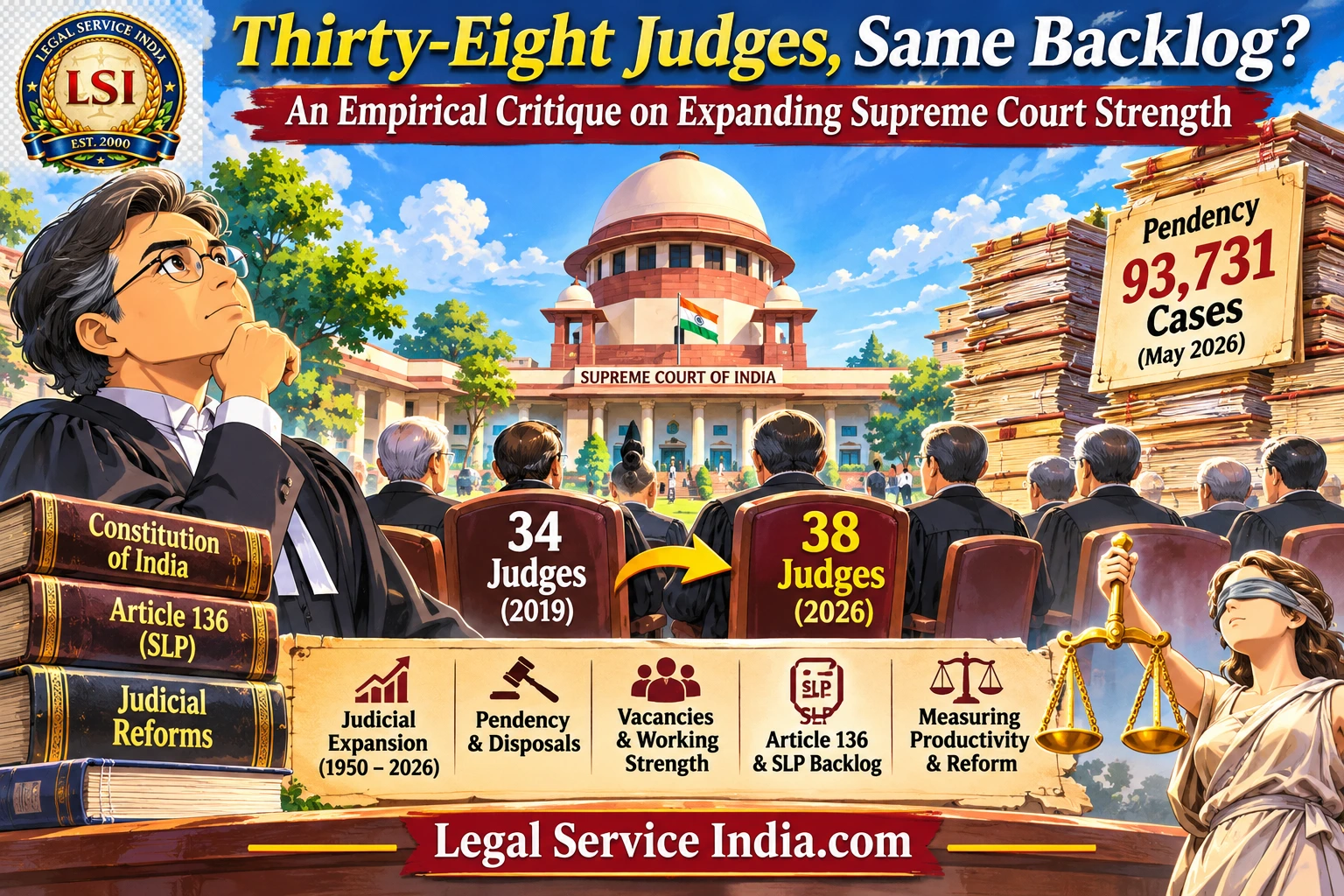
Supreme Court Judges Increased to 38: Will It Reduce Pendency?
The Union government raised the sanctioned strength of the judges of the Supreme Court of India from 34 to 38 in May 2026. The ordinance followed the Supreme Court (Number of Judges) Amendment Bill, 2026.1 The justification is familiar, as previously cited. The rising pendency demands more judges. This piece tries to test that claim against the Court’s own numbers. Previous records show that adding judges has achieved a minimum in this direction; why should four more do so now?
From Eight to Thirty-Eight: Seventy-Six Years of Adding Judges, and the Docket Still Wins
The Constitution of 1950 provides for a Chief Justice and seven other judges. The same article allows Parliament to enlarge the bench by law.2 Parliament has increased the Supreme Court strength seven times.
The strength grew to 11 judges in 1956, as 1,722 cases were pending; to 14 in 1960, with 2,656 pending; to 18 in 1978, with 23,518; and to 26 in 1986, with 85,899. It remained frozen for twenty-three years, and it rose to 31 in 2009 (59,859 pending), to 34 in 2019, and now to 38, with 93,731 cases pending as of 18 May 2026.3
Supreme Court Judicial Strength and Pendency: Historical Timeline
| Year | Sanctioned Judge Strength | Pending Cases |
|---|---|---|
| 1950 | 8 | Not specified |
| 1956 | 11 | 1,722 |
| 1960 | 14 | 2,656 |
| 1978 | 18 | 23,518 |
| 1986 | 26 | 85,899 |
| 2009 | 31 | 59,859 |
| 2019 | 34 | Not specified |
| 2026 | 38 | 93,731 |
Two broad patterns emerge here. First, every expansion seems reactive, arriving after the docket had already swollen. Second, the fall in the pendency in the cases came when no judge was added.
For example, between December 1991 and February 2002, pendency fell from about 1.05 lakh to roughly 22,500 cases.4 It was achieved by computerisation and the grouping of similar cases.5 Part of that fall reflects changes in how cases were counted.6 However, the lesson remains that case management, not headcount, delivered the court’s initial success over its backlog.
The 2019 Rehearsal: What Thirty-Four Judges Already Told Us About Thirty-Eight
If 2026 needs a test case, 2019 may be cited as an example. At then Chief Justice Ranjan Gogoi’s request, the Parliament raised the court’s strength from 31 to 34.7 The government gave the rationale that regular Constitution Benches may otherwise mean fewer benches for other civil and criminal matters.8
The prediction is clear: more judges mean less delay that turns into less pendency of the cases.
However, the outcome was not. Between June 2019 and June 2025, total pendency climbed from 59,695 to 85,204 cases.9 Part of that rise reflects the pandemic and a 2023 decision to count matters awaiting registration,10 but the trend persisted: 2025 alone added about 9,000 cases, closing at 92,318.11
Nor can vacancies explain it: by the government’s own account, the court has worked at near-full strength since 2019.12
Judges’ Strength Versus Case Disposal
Headcount and output do not move together. With an average of 26 judges in 2016, the court disposed of 75,979 cases; with 34 in 2019, it disposed of 41,100.13
Many factors were at play, but that is the point: if a ten per cent increase in judges was swamped by other forces, there is little reason to expect a twelve per cent increase to fare differently.
92,101 Pending Cases, One Prescription: Testing the Bill’s Own Justification Against the Data
The last two expansion bills read like drafts of each other. The 2019 bill cited 58,669 cases pending on 1 June 2019 and the Chief Justice’s view that inadequate strength was a prime cause of the backlog.14
The 2026 Bill records 92,101 cases pending as of 1 January 2026. It calls out more judges as “one of the most exigent and viable solutions”.15
2025 Filings Versus Disposals: The Numbers Behind the Backlog
The 2026 statement concedes that, at near-full strength, the Court received 75,410 fresh matters in 2025 against 65,615 disposals.16 The 2019 remedy, in other words, was applied. Nonetheless, the gap persisted.
The new remedy’s arithmetic is also unkind. Even if disposals rose in exact proportion to the four new judges, they would reach only about 73,300, still short of 2025’s filings, which keep rising.17
Neither this approach asks why filings outrun disposals, nor does it set a target against which expansion may be judged.
A policy that cannot be falsified cannot be evaluated. If pendency keeps rising, the logic of both statements points only towards a forty-two-judge court.
Sanctioned Is Not Sitting: Vacancies, Working Strength and the Arithmetic of Expansion
A sanctioned post decides no cases; only a sitting judge does. Statistics show vacancies persisted after every previous expansion.18
On 1 May 2026, the Court had 32 working judges against a sanctioned strength of 34.19 The four new posts simply joined the two existing gaps. On 18 May, six seats, which amount to 15 per cent of the Court’s strength, remained empty.20 The Collegium led by Chief Justice Surya Kant had made no recommendation in the first 175 days of his tenure.21
Appointments, Retirements and the Continuing Vacancy Problem
With this expansion, the Collegium moved quickly. The five judges were sworn in on 2 June.22 However, retirements reopened the gaps again. Even after three more judges took the oath on 6 October, the Court’s strength stood at 37.23
With judges retiring at sixty-five24 and appointments dependent on Collegium–Union consultation, the bench is rarely full for long.
Expansion creates new posts and new vacancies at once. Without a predictable appointment pipeline, added strength remains merely a promise.
The SLP Floodgate: Is Article 136, Not Headcount, Driving the Backlog?
Article 136 lets the Court hear appeals, by special leave, from any court or tribunal in India.25 Conceived as an exceptional power, it has become the Court’s main entry point.
Over 65 per cent of pending cases sit at the admission stage, largely as SLPs; about 90 per cent of disposals in 2023 and 2024 occurred there; and only around 10 per cent of matters instituted between 2020 and 2024 reached a regular hearing.26
The Admission Stage and the Supreme Court’s Workload
The Court thus spends much of its energy deciding which cases not to decide: in 2024, 89 of its 191 working days were miscellaneous days reserved for admission hearings.27
Tarunabh Khaitan, analysing eleven years of SLP data, argued that this expansive docket has “cannibalised” the Court’s role as an effective constitutional court.28
If entry is effectively open, new benches create capacity that the inflow quickly absorbs, and September filings more than tripled between 2020 and 2025.29
Even the 2019 bill conceded that more High Court judges meant more appeals reaching the Supreme Court.30 More judges, without a firmer admission filter, may simply widen the funnel.
Counting Heads or Counting Disposals? Rethinking How We Measure Supreme Court Productivity
Pendency of a case adds to the existing stock; filings and disposals may be considered as flows. A court can dispose of cases faster than ever and may still record rising pendency if filings grow faster.
Supreme Court Filings and Disposals: Understanding the Numbers
For example, June filings rose from 1,444 in 2019 to 3,852 in 2025. It is an increase of about 167 per cent.31
Through much of 2025, the Court cleared thousands of cases every month and still slipped behind.32
By analogy, judging a court by its pending total is like comparing it with a hospital by its queue, without even counting how many patients walked in a given period of time.
Better Measures of Judicial Efficiency
Better methodologies exist: clearance rates, the age of pending cases and the time taken to reach a hearing may also be considered.
However, on one such measure, the Court would need about 1.4 years to clear its docket even if no new case is filed.33
Without this richer picture, judge strength becomes the only visible lever, and therefore the only one policymakers pull.
Four More Judges, Five-Judge Benches: Will Expansion Revive the Constitution Bench?
The strongest case for expansion is constitutional rather than numerical. Chief Justice Surya Kant’s letter seeking more judges cited pendency and the need to constitute Constitution Benches more regularly.34 Under Article 145(3), substantial questions of constitutional interpretation require at least five judges,35 each such bench withdrawing five judges from routine work.
History is not encouraging. Nick Robinson’s study found that Constitution Bench cases averaged 134 a year in 1960–64 but only 6.4 a year in 2005–09,36 although the Court had nearly doubled in size. As the bench grew, it heard more appeals, not more constitutional cases. As of 1 September 2026, 29 Constitution Bench matters were still listed as pending.37
Four extra judges could, in principle, staff a standing Constitution Bench. But that depends on the Chief Justice’s roster, not the statute. Nothing in the 2026 law reserves the new capacity for constitutional work, and experience suggests the SLP docket will claim it first.
Passed Without Debate: The Ordinance Route to a Bigger Court and the Evidence Parliament Never Weighed
The Union Cabinet approved the Bill on 5 May 2026 for the next session of Parliament; eleven days later, the same measure was promulgated as an ordinance.38 Article 123 permits this only where the President is satisfied that immediate action is necessary.39 The Law Minister later attributed the shift to the Chief Justice’s letter of 11 May,40 but a request for more judges is hardly an emergency that could not await Parliament. Appointments against the new posts preceded the Bill’s introduction on 20 July.41
On 3 August, the Lok Sabha passed the bill in under ten minutes, without debate, amid opposition protests over unrelated issues.42 The Rajya Sabha returned it two days later after a brief debate over the ordinance’s urgency.43 Noting that it is not unconstitutional, Article 124(1) allows parliament to increase the court’s size.44 But the forum best placed to test the government’s empirical claims barely examined them.
The Road Not Taken: Regional Benches, a National Court of Appeal and the Limits of Adding Judges
Expansion is not the only reform available; it is merely the easiest. In its 229th Report (2009), the Law Commission under Justice A.R. Lakshmanan argued that adding judges alone would not address pendency or access, proposing a Constitution Bench in Delhi and four regional cassation benches for ordinary appeals.45 The Full Court rejected this on 18 February 2010.46 A petition seeking a National Court of Appeal, referred to a Constitution Bench in 2016, remains pending.47 That a reference about the Court’s overload has itself waited a decade says much.
Both ideas carry risks, from inconsistent precedents to an extra tier of litigation. But both address the docket’s structure by separating constitutional from appellate work. Expansion leaves that structure untouched, adding judges to a single court still asked to be both a constitutional court and a nationwide court of appeal.
Capacity or Design? Diagnosing What Actually Ails India’s Supreme Court
Taken together, the evidence points to a diagnosis the Bill does not attempt. Critics note that it overlooks systemic drivers such as the appointment process, listing practices and the heavy volume of SLPs.48 Each is a problem of design, not capacity.
Listing illustrates the point. Justice M.N. Venkatachaliah recounted a single case appearing in the cause list 141 times.49 Similar cases are still tagged largely at lawyers’ request. Due to lack of formal mechanism, the pendency policy shifts with each Chief Justice tenure. It also prompts proposals for a permanent in-house body to study pendency.50
None of this makes more judges less capable. A larger bench may improve regional and gender diversity. It also if deployed well, sustain regular Constitution Benches. But capacity works well within a design or formal format. A court that may admit almost everything, lists cases unpredictably and waits months to fill vacancies will convert any number of judges into the same backlog. The real question is not how many judges the Court has, but what it asks them to do.
Conclusion
The case for thirty-eight judges rests on a weak intuition the evidence does not corelate. Over seventy-six years, the Court and its backlog grew together. The reduction came only through better case management. After 2019, pendency is rising. The 2026 Bill itself concedes that filings outran disposals at near-full strength. Sanctioned posts rarely stay filled. An open SLP door shapes the docket, and headline pendency hides the surge in filings. The Constitution Benches dwindled as the bench grows, structural alternatives remain shelved. Further, the lower House passed the latest expansion without debate.
It is early to infer anything out of it, and the new judges arrive in stages. Nonetheless, between September 2025 and September 2026, pendency rose by 11,919 cases. It is the steepest yearly rise since 2020, reaching 95,019 on 1 October 2026.51 Four more judges may help at the margin. But unless expansion is paired with admission reform, predictable appointments, better listing and a settled view of the Court’s structure, the answer to this blog’s title will likely remain unchanged: thirty-eight judges, same backlog.
References
- The Supreme Court (Number of Judges) Amendment Ordinance, 2026 (Ord. 1 of 2026); The Supreme Court (Number of Judges) Amendment Bill, 2026 (Bill No. 128 of 2026), cl. 2, available at: PRS India (last visited on Oct. 29, 2026); The Supreme Court (Number of Judges) Act, 1956 (Act 55 of 1956), s. 2.
- The Constitution of India, art. 124(1).
- Advay Vora, “Bench expansion and pendency: A timeline”, Supreme Court Observer, May 18, 2026, available at: Supreme Court Observer (last visited on Oct. 29, 2026).
- Press Information Bureau, Government of India, “Pending Cases in Various Courts” (Ministry of Law, Justice and Company Affairs, Mar. 18, 2002), available at: Press Information Bureau (last visited on Oct. 29, 2026).
- Press Information Bureau, Government of India, “Upgradation of Computer Network of Four Metropolitan High Courts” (Department of Justice, Sept. 27, 2002), available at: Press Information Bureau (last visited on Oct. 29, 2026); Press Information Bureau, Government of India, Written reply of the Union Minister of Law and Justice in the Rajya Sabha (Ministry of Law and Justice, Dec. 2, 2002), available at: Press Information Bureau (last visited on Oct. 29, 2026).
- Interview with Justice M.N. Venkatachaliah, former Chief Justice of India, “An Evening with Justice M.N. Venkatachaliah”, DAKSH, Mar. 10, 2015, available at: DAKSH (last visited on Oct. 29, 2026); supra note 3.
- The Supreme Court (Number of Judges) Amendment Act, 2019 (Act 37 of 2019); V. Venkatesan, “Ordinance lifts SC strength to 38, Collegium likely to begin deliberations”, Supreme Court Observer, May 18, 2026, available at: Supreme Court Observer (last visited on Oct. 29, 2026).
- The Supreme Court (Number of Judges) Amendment Bill, 2019 (Bill No. 191 of 2019), Statement of Objects and Reasons, para 1, available at: PRS India (last visited on Oct. 29, 2026).
- R. Sai Spandana, “June 2025: Supreme Court records highest pendency of the year so far”, Supreme Court Observer, July 17, 2025, available at: Supreme Court Observer (last visited on Oct. 29, 2026).
- Ajitesh Singh, “September 2025: Pendency nears 89,000 mark”, Supreme Court Observer, Oct. 24, 2025, available at: Supreme Court Observer (last visited on Oct. 29, 2026).
- Advay Vora, “December 2025: Pendency increases by 1600 cases”, Supreme Court Observer, Jan. 9, 2026, available at: Supreme Court Observer (last visited on Oct. 29, 2026).
- The Supreme Court (Number of Judges) Amendment Bill, 2026, supra note 1, Statement of Objects and Reasons, para 1.
- Joyston D’Souza, “Does the SC’s working strength affect its case disposal?”, Supreme Court Observer, Feb. 17, 2023, available at: Supreme Court Observer (last visited on Oct. 29, 2026).
- Supra note 8, Statement of Objects and Reasons, para 1.
- The Supreme Court (Number of Judges) Amendment Bill, 2026, supra note 1, Statement of Objects and Reasons, paras 1, 2.
- Id., Statement of Objects and Reasons, para 1.
- Author’s calculation based on the figures in The Supreme Court (Number of Judges) Amendment Bill, 2026, supra note 1, Statement of Objects and Reasons, para 1: 65,615 × (38 ÷ 34) ≈ 73,334, against 75,410 fresh matters instituted in 2025.
- V. Venkatesan, supra note 7.
- Department of Justice, Government of India, “Sanctioned strength, working strength and vacancies of Judges in the Supreme Court of India and the High Courts (as on 01.05.2026)” (Ministry of Law and Justice, 2026), available at: Department of Justice (last visited on Oct. 29, 2026).
- Debjani M, “Strength and speculation”, Supreme Court Observer, May 25, 2026, available at: Supreme Court Observer (last visited on Oct. 29, 2026).
- Supra note 3.
- “Supreme Court strength rises to 37 after five new judges sworn in”, Business Standard, June 2, 2026, available at: Business Standard (last visited on Oct. 29, 2026).
- SCO Team, “New Judges Appointed to the Supreme Court | October 2026”, Supreme Court Observer, Oct. 7, 2026, available at: Supreme Court Observer (last visited on Oct. 29, 2026); Shashank Shekar and Divya Sridhar, “Opinion: India’s Supreme Court grows, but does justice?”, Telangana Today, Oct. 5, 2026, available at: Telangana Today (last visited on Oct. 29, 2026).
- The Constitution of India, art. 124(2).
- Id., art. 136(1).
- Advay Vora, “More than 65 percent pending Supreme Court cases stuck at admission stage”, Supreme Court Observer, Feb. 28, 2025, available at: Supreme Court Observer (last visited on Oct. 29, 2026).
- Vasudev Devadasan and Amarendra Kumar, “The Supreme Court Can Reduce Its Pendency: Here’s How”, LiveLaw, Apr. 13, 2025, available at: LiveLaw (last visited on Oct. 29, 2026).
- Tarunabh Khaitan, “The Indian Supreme Court’s identity crisis: a constitutional court or a court of appeals?” 4 Indian Law Review 1 (2020).
- Supra note 10.
- Supra note 8, Statement of Objects and Reasons, para 2.
- Supra note 9.
- Supra note 10.
- Advay Vora, “If no new cases are filed, SC will still need 1.4 years to clear its docket”, Supreme Court Observer, Mar. 18, 2026, available at: Supreme Court Observer (last visited on Oct. 29, 2026).
- V. Venkatesan, supra note 7; Gursimran Kaur Bakshi, “Bill To Increase Supreme Court Judge Strength Brought After CJI’s Letter To PM : Law Minister Tells Rajya Sabha”, LiveLaw, Aug. 5, 2026, available at: LiveLaw (last visited on Oct. 29, 2026).
- The Constitution of India, art. 145(3).
- Nick Robinson, Anjana Agarwal, et.al., “Interpreting the Constitution: Supreme Court Constitution Benches since Independence” 46(9) Economic and Political Weekly 27 (2011).
- Debjani M, “August 2026: Pendency decreases by 1079 cases”, Supreme Court Observer, Sept. 10, 2026, available at: Supreme Court Observer (last visited on Oct. 29, 2026).
- V. Venkatesan, supra note 7.
- The Constitution of India, art. 123(1).
- Gursimran Kaur Bakshi, supra note 34.
- Supra note 22; Malavika Prasad, “Bill To Increase Number Of Supreme Court Judges Introduced In Lok Sabha”, LiveLaw, July 20, 2026, available at: LiveLaw (last visited on Oct. 29, 2026).
- The Wire Staff, “In Less Than 10 Minutes and Without Debate, Lok Sabha Passes Bill to Increase Supreme Court Judges”, The Wire, Aug. 3, 2026, available at: The Wire (last visited on Oct. 29, 2026).
- Gursimran Kaur Bakshi, supra note 34; PTI, “Rajya Sabha Approves Bill To Increase Number Of Judges In Supreme Court”, ETV Bharat, Aug. 5, 2026, available at: ETV Bharat (last visited on Oct. 29, 2026).
- The Constitution of India, art. 124(1).
- Law Commission of India, “229th Report on Need for Division of the Supreme Court into a Constitution Bench at Delhi and Cassation Benches in Four Regions at Delhi, Chennai/Hyderabad, Kolkata and Mumbai” (August, 2009).
- V. Venkatesan, supra note 7.
- V. Vasanthakumar v. H.C. Bhatia (2016) 7 SCC 686.
- “Cabinet Clears Bill to Expand SC Strength to 38”, Drishti IAS, May 7, 2026, available at: Drishti IAS (last visited on Oct. 29, 2026); See also Shashank Shekar and Divya Sridhar, supra note 23.
- Interview with Justice M.N. Venkatachaliah, supra note 6.
- Supra note 27.
- Debjani M, “September 2026: Pendency increases by 380 cases”, Supreme Court Observer, Oct. 13, 2026, available at: Supreme Court Observer (last visited on Oct. 29, 2026).
Written By: Atika Khairi – LL.M. Scholar, Jamia Millia Islamia, New Delhi
