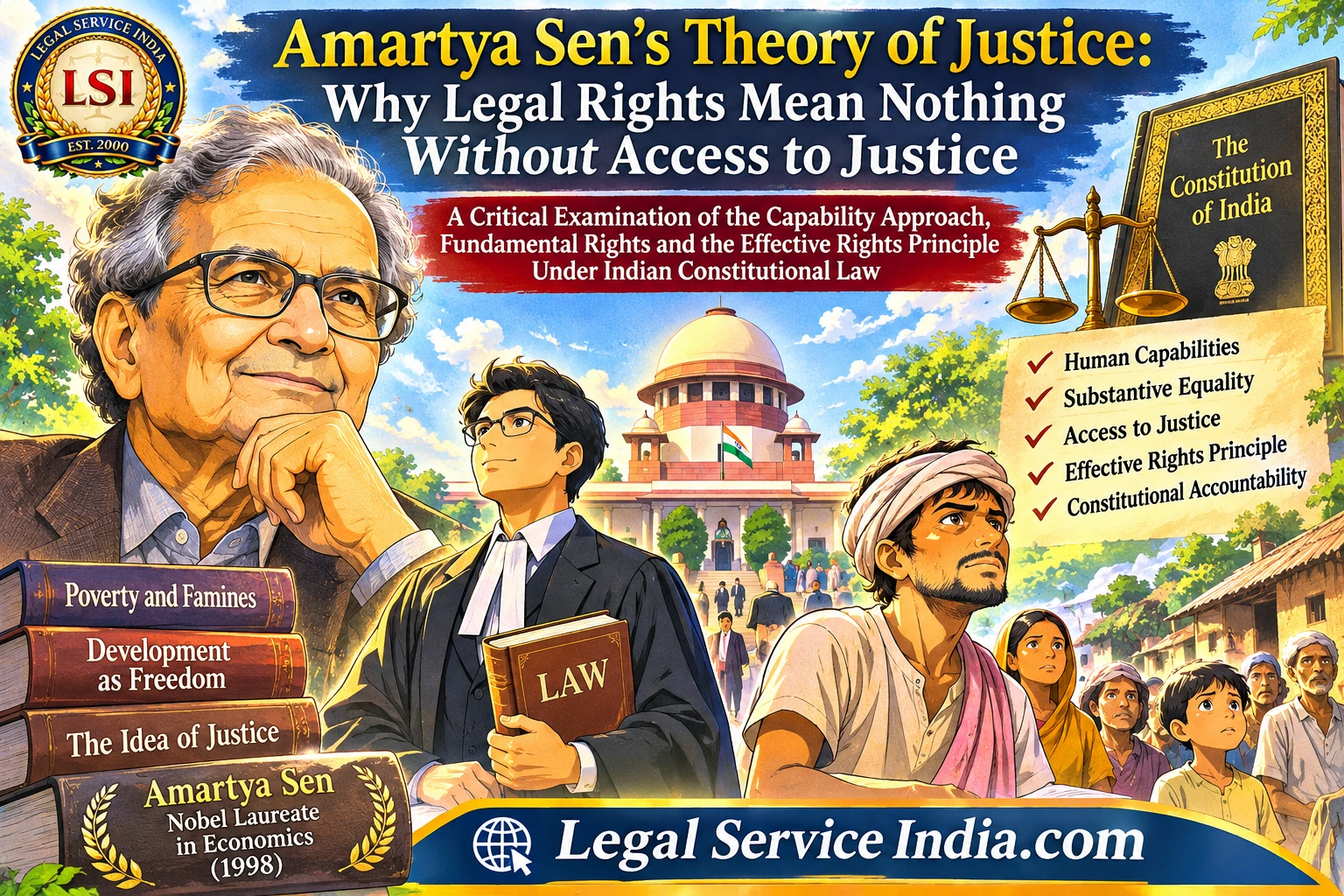
Amartya Sen and the Philosophy of Justice: Can a Country Claim Justice When Its Citizens Cannot Exercise Their Legal Rights?
A Critical Examination of Human Capabilities, Constitutional Rights and the Difference Between Having Rights and Being Able to Exercise Them
By Adv. Tarun Choudhury
Supreme Court Advocate | 25+ Years of Legal Experience
1. Introduction: The Difference Between Having a Right and Being Able to Exercise It
Consider two individuals living in the same constitutional democracy.
Both enjoy the same fundamental rights. Both are entitled to equality before the law, personal liberty, access to justice and protection against arbitrary state action.
The first has financial resources, education and access to competent legal representation. When his rights are violated, he approaches the appropriate institution, engages a lawyer and seeks a remedy.
The second is equally entitled to the protection of the Constitution. However, he cannot afford a lawyer, does not understand the legal procedure and may not even know where to seek assistance. For him, approaching a court is not simply a question of exercising a right. It is a difficult undertaking involving financial, social and institutional obstacles.
Both possess the same legal rights. But do they enjoy the same justice?
This is not merely a theoretical question. It goes to the heart of constitutional democracy.
We often measure the strength of a legal system by the rights recognised in its Constitution, the number of laws enacted, the independence of its judiciary and the judgments delivered by its courts. These are important indicators. Yet they do not necessarily tell us whether an ordinary citizen can actually benefit from the protection that the law promises.
A right may exist on paper and remain inaccessible in practice.
It is this distinction that makes the work of Amartya Sen particularly relevant to contemporary constitutional jurisprudence.
Sen, the Indian economist and Nobel laureate, challenged conventional ways of measuring human welfare. He argued that income, wealth and resources alone cannot adequately explain the advantages or disadvantages experienced by individuals. What matters is also what people are genuinely able to do and to be.
His thinking has profound implications for the way we understand equality, freedom, poverty and justice.
In examining the Amartya Sen Theory of Justice, I find myself substantially agreeing with his insistence that justice must be evaluated through the actual lives people are able to lead. However, I believe that constitutional law must take this argument further.
It is not enough to identify the freedoms people lack. We must also examine the legal responsibilities of institutions that are expected to protect those freedoms.
A constitutional democracy must answer a difficult question: what is the value of a right if the person entitled to it has no meaningful opportunity to exercise it?
That question provides the starting point for this examination.
2. Amartya Sen: The Experiences Behind the Intellectual Journey
Amartya Sen was born on 3 November 1933 in Santiniketan, Bengal. His intellectual journey took him from Presidency College, Calcutta, to Trinity College, Cambridge, and eventually to some of the most influential academic institutions in the world.
In 1998, he received the Nobel Prize in Economic Sciences for his contributions to welfare economics.
Although his principal academic discipline was economics, his work consistently crossed disciplinary boundaries. He wrote about poverty, inequality, political freedom, social choice, individual autonomy and the philosophical foundations of justice.
The Experiences That Shaped His Thinking
One experience from his early life is particularly important in understanding his intellectual concerns.
Sen grew up during a period when Bengal experienced the devastating famine of 1943. He later recalled witnessing the death of a labourer named Kader Mia, who had entered a neighbourhood in search of work despite the communal hostility prevailing at the time.
The incident left a lasting impression on him.
It illustrated something that conventional economic measurements could easily overlook: human suffering is not always caused by an absolute absence of resources. It can also result from the unequal distribution of opportunities and the inability of individuals to obtain what they need to survive.
This observation became important in Sen’s later examination of famine, poverty and entitlement.
His work gradually developed into a broader intellectual inquiry. Why do some people remain deprived even when resources exist in society? Why does economic growth fail to improve everyone’s lives? Why should freedom be treated as an essential component of development rather than merely a consequence of it?
These questions eventually brought him into direct engagement with the philosophy of justice.
Three Important Works of Amartya Sen
Three works are particularly important to understanding his contribution:
- Collective Choice and Social Welfare (1970).
- Development as Freedom (1999).
- The Idea of Justice (2009).
They represent different stages of an intellectual journey, but they share a common concern: how should we evaluate the arrangements under which human beings live?
3. Collective Choice and Social Welfare: Can Society Agree on What Is Just?
In Collective Choice and Social Welfare, Sen examined a fundamental problem in economics and political philosophy.
How can a society make rational collective decisions when individuals have different preferences, interests and judgments?
The question has obvious implications for democracy.
Citizens disagree about taxation, public expenditure, economic policy, social welfare and the distribution of public resources. Governments must make decisions even when there is no complete agreement.
Sen engaged with the work of Kenneth Arrow, whose impossibility theorem demonstrated the difficulty of constructing a collective decision-making system that satisfies several seemingly reasonable conditions simultaneously.
The problem was not simply mathematical. It raised an important question about the limits of democratic decision-making.
Can individual preferences be combined into a coherent social preference without sacrificing important principles of fairness?
Sen’s contribution was to examine the informational foundations of collective choice more broadly. He questioned whether social decisions should depend exclusively on the aggregation of individual preferences.
Why Individual Preferences May Not Reveal Injustice
There is a reason this matters.
Imagine a person who has lived with discrimination for so long that he has come to regard it as normal. His expectations may have adjusted to circumstances that are objectively unjust.
If public policy relies exclusively on what individuals say they want or how satisfied they feel, it may fail to identify serious deprivation.
The absence of dissatisfaction does not necessarily establish the presence of justice.
My Assessment
I agree with Sen that collective decision-making requires a deeper understanding of individual circumstances.
A democratic society cannot determine fairness merely by counting preferences. It must also examine the conditions under which those preferences are formed.
This has a direct bearing on constitutional adjudication.
A court examining a dispute involving vulnerable individuals cannot always treat the absence of an expressed grievance as evidence that no injustice exists.
However, I would introduce an important qualification.
Constitutional rights cannot depend entirely on collective preferences.
There are certain protections that must remain beyond the ordinary reach of majority opinion. Equality, personal liberty and protection against discrimination cannot be withdrawn simply because a majority considers them inconvenient.
Democracy requires collective decision-making, but constitutionalism places limits on what a majority may legitimately decide.
That distinction must never be overlooked.
4. The Capability Approach: What Are People Actually Able to Do?
The Capability Approach is arguably the most influential aspect of Sen’s contribution to the understanding of human welfare.
Traditional economic analysis frequently measures advantage through income, wealth, resources or utility. Sen questioned whether these measurements reveal enough about people’s actual circumstances.
Understanding the Capability Approach Through Examples
Consider two individuals with identical incomes.
One is physically able to travel, work and participate in public life without additional assistance. The other has a disability and requires additional resources to enjoy comparable opportunities.
Their incomes are identical. Their actual freedoms are not.
Similarly, two children may possess an identical legal right to education. One lives near a functioning school and has the support necessary to attend. The other lives in a remote area where access to education is severely restricted.
The formal entitlement is the same. The opportunity to benefit from it is different.
Sen’s argument is that human advantage must be assessed by examining what individuals are genuinely capable of achieving.
To understand this properly, two concepts are important.
4.1 Functionings
Functionings refer to the various states of being and activities that a person actually achieves.
They may include:
- Being adequately nourished.
- Receiving education.
- Enjoying good health.
- Participating in public life.
- Moving freely.
- Maintaining personal autonomy.
- Being able to work and pursue a livelihood.
These are not merely economic achievements. They concern the quality and substance of human life.
4.2 Capabilities
Capabilities refer to the genuine opportunities available to an individual to achieve different combinations of valuable functionings.
The distinction is significant.
A person who chooses not to attend school despite having a genuine opportunity is differently situated from someone who cannot attend because the school is inaccessible.
The outward result may be identical. The underlying freedom is not.
This is one of the most important insights in Sen’s work.
Justice cannot be assessed merely by looking at what people possess. We must also examine what they are actually able to achieve with what they possess.
4.3 Why the Capability Approach Matters to Constitutional Law
The Capability Approach becomes particularly interesting when applied to legal rights.
The Right to Legal Representation
Consider the right to legal representation.
The law may permit every accused person to engage an advocate. But a person who cannot afford legal assistance may be unable to exercise that opportunity in any meaningful sense.
The legal entitlement exists. The practical capability is missing.
Examples of Legal Rights and Practical Barriers
The same problem arises in several areas:
- A person may possess voting rights but lack access to a polling facility.
- A woman may enjoy legal protection against domestic violence but lack the financial independence to leave an abusive environment.
- A citizen may have the right to approach a court but lack the resources to pursue litigation.
- A person may possess freedom of expression but face serious social or institutional barriers to exercising it.
These examples demonstrate why formal equality cannot always be treated as sufficient.
The legal system must also examine the practical conditions under which rights are exercised.
5. The Idea of Justice: Must We Discover a Perfect Society Before Correcting Injustice?
In 2009, Sen published The Idea of Justice, an important work that brought together many of his earlier concerns.
One of his central arguments was directed against what he called transcendental institutionalism.
Broadly speaking, this approach concentrates on identifying perfectly just institutions or establishing the ideal arrangement of society.
Sen questioned whether identifying the characteristics of a perfectly just society necessarily helps us decide what should be done about existing injustice.
His alternative was to place greater emphasis on comparative assessments.
Rather than waiting to discover a perfect model of justice, societies should examine which available arrangements are more just than others.
The Comparative Approach to Justice
The reasoning is straightforward.
If a particular institutional arrangement produces preventable suffering, we should not postpone correcting that suffering merely because a complete theory of perfect justice remains unavailable.
Consider a few examples.
- A society that provides accessible legal assistance is preferable to one where poor citizens cannot obtain representation.
- A system that provides meaningful protection against violence is preferable to one where victims have no effective institutional support.
- A government that ensures access to basic education is preferable to one that recognises educational equality in principle but fails to make schooling accessible.
These comparisons do not require us to identify a perfectly just society.
They require us to recognise that some arrangements are demonstrably better than others.
My Agreement With Sen
I find this argument persuasive.
In legal practice, justice is not an abstract destination. It is also a continuing responsibility to identify and correct injustice wherever it occurs.
A person whose liberty has been unlawfully restricted cannot be asked to wait until society develops a perfect theory of justice.
A citizen denied an effective legal remedy needs an answer now.
A constitutional democracy must therefore remain concerned with the practical correction of identifiable injustice.
Where I Would Qualify His Argument
However, comparative improvement cannot become a substitute for constitutional compliance.
A government cannot defend a violation of fundamental rights merely by arguing that its conduct is less unjust than the conduct of another government.
Constitutional guarantees establish minimum standards that public authorities must respect.
The proper approach, in my view, is to combine Sen’s emphasis on practical improvement with the binding obligations created by constitutional law.
Justice requires both the removal of identifiable injustice and respect for enforceable constitutional guarantees.
6. Where I Agree With Amartya Sen
Sen’s work contains several propositions that deserve serious support, particularly when examined from the perspective of constitutional law.
6.1 Economic Growth Does Not Automatically Produce Justice
A country may experience rapid economic growth while large sections of its population remain deprived of basic opportunities.
National income may rise without a corresponding improvement in access to healthcare, education, housing or personal security.
This is an important warning against treating economic progress as a complete measure of social development.
The same reasoning applies to legal institutions.
- The number of statutes enacted does not necessarily establish the quality of justice.
- The number of courts established does not necessarily establish accessibility.
- The number of rights recognised does not necessarily establish their effective enjoyment.
The more meaningful question is whether these institutions improve the lives of the people they are intended to serve.
6.2 Freedom Is Both a Means and an End of Development
In Development as Freedom, Sen argues that freedom is not merely something that development eventually produces. Freedom is itself an essential component of development.
Political participation, economic opportunity, social facilities, transparency and protective security are interconnected.
This has an important constitutional implication.
A citizen who cannot participate in public life, obtain essential information or challenge arbitrary state action does not enjoy meaningful freedom merely because certain rights appear in the Constitution.
Freedom must have practical content.
6.3 Public Reasoning Is Essential to Justice
Sen also gives considerable importance to public reasoning and democratic discussion.
Justice cannot be determined solely through the judgment of an isolated authority. Different perspectives must be heard and evaluated.
This is particularly relevant to constitutional adjudication.
Courts frequently deal with disputes involving individual autonomy, public interest, equality and competing rights.
A sound judgment must engage with the arguments on both sides.
Nevertheless, public reasoning must operate within constitutional boundaries. A majority cannot simply vote away the fundamental rights of a minority.
7. Where I Respectfully Disagree With Sen
Intellectual respect does not require intellectual agreement.
Sen’s philosophy provides a valuable framework for understanding human freedom. However, when his ideas are translated into constitutional law, certain questions require further examination.
7.1 Capabilities Must Be Supported by Enforceable Legal Guarantees
Sen deliberately avoids prescribing one universally applicable list of capabilities.
He gives considerable importance to democratic discussion in determining which capabilities should receive priority.
There is considerable merit in this approach. Societies differ in their circumstances, resources and institutional arrangements.
However, constitutional law cannot leave every fundamental entitlement dependent upon changing political preferences.
Certain protections must be enforceable irrespective of the prevailing political climate.
The right to life, equality, personal liberty and protection against discrimination cannot depend entirely upon the willingness of a political majority to recognise their importance.
My concern is therefore not with democratic deliberation itself.
It is with the possibility that democratic determination, without sufficiently clear constitutional safeguards, may leave vulnerable individuals exposed to political neglect.
A constitutional democracy requires both public reasoning and enforceable guarantees.
7.2 Identifying Deprivation Is Not the Same as Establishing Accountability
Suppose a government announces a programme to improve access to education.
- Funds are allocated.
- Administrative instructions are issued.
- Official reports describe progress.
Yet children in certain regions remain unable to attend school.
The Capability Approach helps us understand the nature of the deprivation.
But a constitutional lawyer must ask further questions.
- Who is responsible for the failure?
- What legal obligation has been breached?
- Is the affected individual entitled to a remedy?
- Can the responsible authority be required to explain its conduct?
- What happens if the failure continues?
These are questions of legal responsibility and institutional accountability.
A theory may explain why a person lacks an opportunity. Constitutional law must additionally determine whether the state has failed to discharge an enforceable obligation.
This is an area where the Capability Approach requires a stronger connection with legal institutions.
7.3 Justice Must Examine the Fairness of the Process as Well as the Outcome
Sen’s emphasis on real freedoms and comparative improvements is valuable.
However, legal justice cannot be measured exclusively through outcomes.
An individual may obtain a favourable result through an arbitrary process. Another may lose a case because the authority denied a fair hearing.
The outcome alone cannot establish whether justice was administered.
Procedural fairness, natural justice, judicial independence and reasoned decisions are not merely technical requirements. They are essential elements of the rule of law.
Therefore, constitutional justice must examine both substantive human capabilities and the fairness of the procedures through which rights are determined.
8. The Missing Link: From Human Capability to Constitutional Responsibility
This is perhaps the most important question arising from the application of Sen’s philosophy to constitutional law.
A capability is a genuine opportunity.
A legal right is a recognised entitlement.
The two concepts are closely connected, but they are not identical.
An individual may enjoy certain capabilities without those capabilities being expressly guaranteed by law.
Conversely, an individual may possess a legally recognised right without having the practical means to exercise it.
The Practical Accessibility of Legal Rights
Consider a person who cannot access a public institution because the building is physically inaccessible.
The problem is not merely that the individual lacks an opportunity.
Depending on the applicable law, the situation may also involve a failure to discharge legal duties relating to accessibility and non-discrimination.
The Capability Approach helps us understand the human consequences of exclusion.
Constitutional law helps determine the legal responsibilities arising from it.
These approaches should not operate separately.
My Proposition
I would formulate the following principle:
The practical accessibility of a fundamental right must form an important part of its constitutional evaluation. Where an identifiable and serious barrier prevents an individual from exercising an enforceable right, the state must be required to justify its response within the applicable constitutional and statutory framework.
This does not mean that every social disadvantage automatically creates an independently enforceable fundamental right.
Nor does it mean that courts should assume responsibility for every administrative or economic decision.
It means that the practical exercise of existing legal rights must receive serious attention in constitutional adjudication.
The existence of a constitutional guarantee should not become an excuse for ignoring the conditions that make its exercise possible.
9. The Indian Constitution: A Natural Meeting Point With Sen’s Philosophy
India provides an especially interesting constitutional setting for examining these ideas.
The Preamble promises social, economic and political justice.
Part III guarantees Fundamental Rights.
Part IV sets out the Directive Principles of State Policy, directing the state towards social and economic objectives.
The constitutional structure itself recognises that individual liberty cannot be considered entirely separate from the social conditions in which people live.
9.1 Article 14: Equality Must Examine Actual Disadvantage
Article 14 guarantees equality before the law and equal protection of the laws.
The constitutional understanding of equality has developed beyond the simple requirement that everyone must always be treated identically.
There are circumstances in which identical treatment may perpetuate existing disadvantage.
Substantive equality requires attention to the actual position of individuals and groups.
The Constitution Bench decision in State of Punjab v. Davinder Singh (2024) is relevant in this context.
The majority recognised the constitutional permissibility of sub-classification within Scheduled Castes for reservation purposes, subject to constitutional limitations and an evidentiary basis.
The decision illustrates the importance of examining differences in disadvantage within a broader constitutionally recognised category.
Seen through Sen’s framework, the important question is whether formally equal treatment provides individuals with genuinely comparable opportunities.
9.2 Article 21: The Right to Life Must Have Meaningful Content
Article 21 protects life and personal liberty.
Indian constitutional jurisprudence has given this provision an expansive interpretation.
In Olga Tellis v. Bombay Municipal Corporation (1985), the Supreme Court examined the relationship between livelihood and the right to life.
The dispute concerned the threatened eviction of pavement and slum dwellers in Bombay.
The Court recognised the close connection between livelihood and the ability to sustain life.
The judgment is particularly relevant to Sen’s thinking.
A person may formally possess the right to life while lacking the material conditions necessary to sustain it.
The constitutional question cannot always be separated from the economic and social circumstances affecting an individual’s existence.
9.3 Articles 32 and 226: A Right Must Have an Effective Remedy
Articles 32 and 226 are central to the Indian constitutional system.
Article 32 empowers individuals to approach the Supreme Court for enforcement of Fundamental Rights.
Article 226 gives High Courts broad writ jurisdiction.
These provisions demonstrate that constitutional rights are intended to be enforceable through judicial institutions.
However, the existence of a remedy does not automatically make it accessible.
The cost of litigation, procedural complexity, geographical distance, delays and lack of legal awareness may prevent individuals from approaching courts.
This is where Sen’s Capability Approach becomes particularly useful.
It encourages us to examine not merely whether a judicial remedy exists, but whether the individual has a realistic opportunity to obtain it.
9.4 Article 39A: The Constitutional Importance of Access to Justice
One provision deserves particular attention in this discussion: Article 39A.
It directs the state to ensure that the operation of the legal system promotes justice on the basis of equal opportunity and to provide free legal aid through suitable legislation, schemes or other means.
Its significance is considerable.
Access to justice cannot be meaningful if the legal system remains practically inaccessible to those who cannot afford representation.
Article 39A provides an important constitutional foundation for addressing this problem.
Read alongside Articles 14, 21 and 32, it invites a broader examination of the relationship between equality, personal liberty, legal assistance and effective remedies.
From the perspective of the Capability Approach, legal aid is not merely an administrative welfare measure.
It is an institutional mechanism that helps individuals exercise rights they already possess.
10. Landmark Indian Judgments: Where Constitutional Rights Meet Human Capabilities
Several important Supreme Court decisions illustrate the relationship between legal entitlements and the practical conditions necessary to enjoy them.
10.1 Hussainara Khatoon v. State of Bihar: Justice Cannot Be Denied by Poverty and Delay
The Hussainara Khatoon proceedings exposed the plight of undertrial prisoners who had remained in detention for periods extending beyond the possible sentences for their alleged offences.
The Supreme Court recognised the importance of speedy trial as part of Article 21.
The case illustrates a fundamental proposition.
A person may possess the constitutional right to liberty, but prolonged and unjustified delay can make that right meaningless.
The right must be protected through functioning institutions and effective procedures.
10.2 Olga Tellis v. Bombay Municipal Corporation: Livelihood and the Right to Life
The Olga Tellis decision is important because it recognised the relationship between livelihood and survival.
For individuals whose existence depends upon daily earnings, the loss of livelihood may have consequences extending far beyond financial inconvenience.
The case demonstrates why constitutional rights must sometimes be examined in the context of the practical circumstances of those who depend upon them.
10.3 K.S. Puttaswamy v. Union of India: Privacy, Dignity and Autonomy
In Justice K.S. Puttaswamy (Retd.) v. Union of India (2017), a nine-judge Constitution Bench unanimously recognised privacy as a fundamental right.
The judgment examined the relationship between privacy, dignity, autonomy and personal choice.
Its importance extends beyond the protection of information.
Privacy protects an individual’s ability to make important decisions concerning personal life without unjustified interference.
This has a natural connection with Sen’s understanding of freedom.
Human freedom is not simply the absence of physical restraint. It also involves meaningful control over decisions affecting one’s own life.
10.4 People’s Union for Civil Liberties v. Union of India: The Right to Food
The right-to-food proceedings before the Supreme Court brought attention to hunger, food distribution and the implementation of public welfare schemes.
The litigation examined whether existing entitlements and government programmes were reaching the people for whom they were intended.
This is closely connected with Sen’s research on famine and entitlement failures.
The central issue is not simply whether food exists within a country.
It is whether individuals possess the practical means and entitlements necessary to obtain it.
10.5 State of Punjab v. Davinder Singh: Equality and Differentiated Disadvantage
The 2024 Constitution Bench decision is relevant to the continuing debate about substantive equality.
The majority permitted sub-classification within Scheduled Castes, subject to constitutional limitations and supporting evidence.
The decision highlights the importance of examining whether formally grouped communities experience different degrees of disadvantage.
It provides an opportunity to consider equality not merely as identical treatment, but as a constitutional commitment requiring attention to actual circumstances.
11. The International Perspective: Is This a Universal Problem?
Sen’s philosophy has influenced discussions concerning poverty, human development, welfare policy and human rights across the world.
Its usefulness lies partly in the fact that it does not prescribe one institutional model for every country.
Different constitutional systems have different histories, legal traditions and methods of enforcing rights.
Nevertheless, the underlying question remains remarkably similar.
Can individuals genuinely enjoy their rights when social and economic circumstances prevent them from exercising those rights?
South Africa: Constitutional Recognition of Socio-Economic Rights
South Africa provides an important example.
Its Constitution expressly recognises several socio-economic rights, including rights relating to housing, healthcare, food, water and social security.
In Government of the Republic of South Africa v. Grootboom, the Constitutional Court examined the state’s obligations concerning access to adequate housing.
In Minister of Health v. Treatment Action Campaign, the Court examined the government’s obligations concerning access to essential medical treatment.
These decisions demonstrate the importance of examining whether government policies and institutional arrangements reasonably facilitate the enjoyment of constitutional rights.
They also illustrate the difficulties courts face when socio-economic rights involve public resources and competing policy priorities.
Lessons From International Constitutional Experience
The international experience therefore offers two lessons.
- First, constitutional recognition of rights must be accompanied by practical measures for their enjoyment.
- Second, judicial enforcement must remain sensitive to institutional competence, available resources and the separation of powers.
Sen’s work provides a useful intellectual framework for understanding these questions, but the legal answers must emerge from the constitutional structure of each jurisdiction.
12. My Proposed Framework: The Effective Rights Principle
Having examined Sen’s contributions and their implications for Indian constitutional law, I would like to develop one additional proposition.
I call it the Effective Rights Principle.
The principle begins with a simple observation.
The existence of a legal right and the practical ability to exercise that right are not necessarily the same thing.
A constitutional democracy must therefore examine more than the formal recognition of rights. It must also consider whether reasonable institutional arrangements exist to make their exercise possible.
The Five Dimensions of the Effective Rights Principle
I propose evaluating the effectiveness of a right through five dimensions.
First: Recognition
Does the Constitution or applicable law recognise the right?
Without legal recognition, there may be no enforceable entitlement, although other moral or policy considerations may remain relevant.
Second: Accessibility
Can an ordinary citizen realistically approach the institution responsible for protecting that right?
A judicial remedy that is geographically, financially or procedurally inaccessible may offer little practical protection.
Third: Capability
Does the individual possess the practical means necessary to exercise the right?
These may include information, financial resources, physical accessibility, legal assistance and freedom from discrimination.
Fourth: Accountability
Can the responsible public authority be required to explain or justify a failure to facilitate the exercise of an enforceable right?
Without accountability, institutional promises may remain unfulfilled.
Fifth: Remedy
When the right is violated, is an effective legal remedy available?
A right without a meaningful remedy risks becoming an incomplete constitutional protection.
Applying the Principle to Access to Justice
Consider a poor citizen seeking to challenge an unlawful administrative action.
The Constitution provides judicial remedies.
However, the citizen may not know which court has jurisdiction, may not understand the procedure and may not have the resources to engage an advocate.
The five dimensions reveal the problem.
- Recognition exists.
- Accessibility may be inadequate.
- Capability may be severely restricted.
- Accountability may be difficult to secure.
- The remedy may remain practically unavailable.
The Effective Rights Principle encourages constitutional analysis to examine these failures together rather than treating the existence of a legal provision as the end of the inquiry.
Is This a New Constitutional Doctrine?
I would not claim that every component of this framework is entirely new.
Indian constitutional jurisprudence already recognises important principles relating to access to justice, substantive equality, legal aid, procedural fairness and effective remedies.
The contribution I seek to develop is the bringing together of these considerations into a single evaluative framework.
Its purpose is to connect Sen’s concern with actual human capabilities to the constitutional lawyer’s concern with enforceable rights and institutional accountability.
Whether the framework can eventually develop into a recognised standard of constitutional evaluation is a question that deserves further academic and judicial consideration.
It must also operate within constitutional limitations.
Courts cannot assume unlimited authority over public policy or resource allocation. Any judicial intervention must remain grounded in the Constitution, applicable legislation and established legal principles.
The objective is not to transfer every social problem to the judiciary.
It is to ensure that existing constitutional rights are not reduced to inaccessible promises.
13. A New Challenge: Can Digital Inequality Become a Constitutional Problem?
There is another dimension that deserves greater attention.
Increasingly, governments and public institutions are moving essential services onto digital platforms.
Applications for welfare benefits, identity verification, public information, education, healthcare and even certain legal services may require digital access.
This creates new opportunities, but it also creates new forms of exclusion.
Digital Access, Accessibility and Constitutional Rights
Consider an individual who cannot access an essential government service because of poor internet connectivity, lack of digital literacy or difficulties with authentication.
The service may technically be available to every citizen.
But is it genuinely accessible to everyone?
This question has a direct connection with Sen’s Capability Approach.
Digital infrastructure may expand the capabilities of some individuals while restricting those of others.
The problem becomes particularly serious when a digital system is the only practical route to obtaining an essential public service.
In such circumstances, the state must consider whether alternative arrangements are reasonably necessary to prevent exclusion.
This is not an argument against technological development.
It is an argument that technology must serve constitutional values rather than create new barriers to their enjoyment.
Artificial Intelligence, Public Administration and Access to Justice
The same question will become increasingly important as artificial intelligence enters public administration and legal services.
A system may become more efficient while simultaneously becoming less accessible to people who cannot understand or challenge its decisions.
Efficiency and justice are not always identical.
14. Can Democracy Exist Without Meaningful Freedom?
Sen’s work also raises a broader question about the nature of democracy.
Is democracy simply a system of periodic elections?
Or does it require citizens to possess meaningful opportunities to participate in public life?
A person who cannot obtain education, access reliable information, express an opinion or participate in public institutions may formally live in a democracy.
Yet the quality of that person’s democratic participation may remain severely restricted.
Democracy Requires More Than Voting
Democracy requires more than voting.
It requires informed participation, public reasoning, freedom of expression, institutional accountability and protection of individual rights.
Economic and social inequalities can influence the extent to which citizens exercise these freedoms.
A person who lacks access to education and reliable information may be legally entitled to participate in democratic processes but may not enjoy the same practical opportunities as someone with greater resources.
This does not mean that every difference in economic circumstances invalidates democratic equality.
It means that democratic institutions must remain attentive to the conditions affecting meaningful participation.
Sen’s insistence on substantive freedom offers an important perspective on this continuing constitutional challenge.
Conclusion: Justice Must Be Experienced, Not Merely Declared
Amartya Sen has made an important contribution to the way we understand justice.
His work challenges us to look beyond income, wealth, formal entitlements and institutional arrangements. It asks us to examine the actual freedoms people enjoy and the opportunities genuinely available to them.
I agree with this fundamental approach.
However, from the perspective of constitutional law, I believe the argument must go one step further.
A constitutional democracy cannot end its responsibility by recognising rights or announcing programmes intended to improve human welfare.
It must also establish institutions, procedures and legal remedies that make the exercise of those rights realistically possible.
A right that remains inaccessible because of poverty, institutional exclusion or procedural barriers deserves serious constitutional attention.
A legal remedy that remains beyond the reach of ordinary citizens cannot be treated as a complete achievement of the rule of law.
And a system of equality that ignores actual disadvantage may preserve the appearance of equality while allowing substantive inequality to continue.
Sen asks us to examine the lives people are actually able to lead.
Constitutional law must translate that insight into legal responsibility and institutional accountability.
This is where I believe the two disciplines must meet.
The Constitution is not merely a legal document containing rights and restrictions. It is a framework through which individuals are supposed to secure dignity, liberty, equality and protection against arbitrary power.
Its success cannot be measured exclusively by the elegance of its provisions or the intellectual quality of judicial pronouncements.
We must also ask whether an ordinary citizen can invoke its protection without being defeated by poverty, procedural complexity or institutional indifference.
A country may possess an impressive Constitution, an elaborate body of legislation and a sophisticated judiciary.
But if substantial sections of its population cannot meaningfully exercise their legal rights, the promise of constitutional justice remains incomplete.
The real measure of a constitutional right is not simply whether the law grants it, but whether the individual has a meaningful opportunity to exercise it and an effective remedy when it is denied.
That, in my view, is one of the most important lessons that contemporary constitutional jurisprudence can draw from Amartya Sen.
And it leaves us with a question that every constitutional democracy should be prepared to answer:
Can we honestly describe a society as just when the rights written in its Constitution remain beyond the practical reach of the very people for whom they were created?
Have Your Legal Rights Been Recognised but Not Enforced?
A right written in the Constitution is meaningful only when you can actually exercise it.
Whether you are facing a violation of fundamental rights, denial of legal remedies, administrative inaction, constitutional injustice or a dispute involving access to justice, understanding your legal position is the first step towards protecting it.
Do not allow uncertainty about the law to prevent you from exploring your legal remedies.
Seek informed legal guidance on your rights, available remedies and the appropriate legal course of action.
Adv. Tarun Choudhury
Supreme Court Advocate | 25+ Years of Legal Experience
With more than 25 years of legal experience, Adv. Tarun Choudhury provides legal guidance on constitutional law, fundamental rights, civil disputes and other complex legal matters.
For Legal Consultation
- 📞 Call: 9650499965
- 💬 WhatsApp: 8851978611
- ✉️ Email: [email protected]
- 🌐 Visit: LegalServiceIndia.com
Your rights deserve more than recognition. They deserve meaningful protection.
Contact us to discuss your legal concerns and understand the remedies available under Indian law.
📚 Explore the Original Ideas Behind This Article
To understand the philosophical foundations of this discussion, consider reading Amartya Sen’s original work. His writings offer remarkable insights into justice, human freedom, equality and the capabilities that enable individuals to lead meaningful lives.

Don’t Just Read About Justice. Explore the Thinker’s Original Ideas. 📖 Explore the Book on Amazon →
Legal Service India Book Review.
Frequently Asked Questions (FAQs)
1. What Is Amartya Sen’s Theory of Justice?
Amartya Sen’s Theory of Justice focuses on reducing actual injustice rather than merely designing perfectly just institutions. In his book The Idea of Justice, Sen argues that justice should be assessed by examining how people live, the freedoms they enjoy and their real opportunities to improve their lives. His approach places human capabilities, public reasoning and practical freedom at the centre of justice.
2. What Is Amartya Sen’s Capability Approach in Law?
Amartya Sen’s Capability Approach examines whether individuals have the genuine freedom and practical ability to achieve things they value. In the legal context, it raises an important question: does recognising a constitutional or fundamental right ensure that a person can actually exercise it? Access to courts, legal assistance, education, economic opportunity and effective remedies can determine whether legal rights become meaningful in practice.
3. How Does Amartya Sen’s Theory of Justice Relate to the Indian Constitution?
Sen’s philosophy has significant relevance to the Indian Constitution, particularly Articles 14, 21, 32 and 226. These provisions protect equality, life and personal liberty, and access to constitutional remedies. His emphasis on substantive freedom encourages us to examine whether constitutional protections translate into real opportunities and meaningful justice for ordinary citizens.
4. What Is the Difference Between Legal Rights and the Actual Enjoyment of Rights?
Legal rights are protections recognised by law, while the actual enjoyment of rights concerns an individual’s practical ability to exercise those protections. For example, a person may possess the constitutional right to approach a court but lack the financial resources, legal assistance or information necessary to pursue a remedy. This distinction is central to understanding Sen’s Capability Approach and its relevance to access to justice.
5. Can Amartya Sen’s Philosophy Help Improve Access to Justice in India?
Yes. Sen’s philosophy offers a valuable framework for examining barriers that prevent people from exercising their legal rights. It highlights the importance of affordable legal representation, speedy trials, effective judicial remedies, legal awareness and institutional accountability. Applying these ideas can help India move towards a justice system in which constitutional rights are not merely declared but are practically accessible to every citizen.
Key Takeaways: Amartya Sen’s Theory of Justice and Its Relevance to Indian Constitutional Law
- Justice Is More Than Perfect Laws: Amartya Sen argues that justice should be judged by how effectively society reduces actual injustice, rather than merely by the existence of ideal institutions.
- Legal Rights Must Be Practically Enforceable: Recognising a fundamental right is not enough. Citizens must have the practical ability, resources and institutional support to exercise that right.
- The Capability Approach Places Human Freedom at the Centre: Sen’s Capability Approach evaluates justice by examining what individuals are genuinely able to do and become, rather than simply measuring their income or formal legal entitlements.
- Equality Before the Law Does Not Always Mean Equality in Reality: Two citizens may enjoy identical constitutional rights but face vastly different barriers because of poverty, social disadvantage, lack of education or unequal access to legal assistance.
- Public Reasoning Is Essential to a Just Society: Open discussion, democratic participation and informed public debate help identify injustice and hold institutions accountable.
- The Indian Constitution Reflects Important Elements of Sen’s Philosophy: Articles 14, 21, 32 and 226 provide constitutional foundations for equality, personal liberty and judicial remedies. Their effectiveness must also be assessed in practical terms.
- Landmark Judgments Demonstrate the Importance of Substantive Justice: Decisions such as Hussainara Khatoon v. State of Bihar, Olga Tellis v. Bombay Municipal Corporation and Justice K.S. Puttaswamy v. Union of India illustrate how constitutional protections can address real human vulnerabilities.
- Access to Justice Is a Constitutional Necessity: Delayed trials, expensive litigation, inadequate legal representation and lack of legal awareness can prevent citizens from exercising their rights effectively.
- Sen’s Philosophy Also Requires Critical Examination: While his emphasis on freedom and human capabilities is compelling, constitutional justice additionally requires enforceable obligations, institutional accountability and effective remedies.
- The Effective Rights Principle Offers a Practical Framework: This article proposes examining legal rights through five dimensions: recognition, accessibility, capability, accountability and remedy.
- Digital Inequality Creates New Challenges for Justice: Access to online legal services, digital information and technology-enabled public institutions must not become another barrier for economically or socially disadvantaged citizens.
- The Ultimate Test of Constitutional Justice Is Human Experience: A democracy cannot measure its success merely by the rights written in its Constitution. It must also examine whether ordinary citizens can meaningfully exercise those rights.
Central Argument
The true measure of justice is not simply whether the law grants a person a right, but whether that person has a genuine opportunity to exercise it and obtain an effective remedy when it is violated.
References and Further Reading
Original Works of Amartya Sen
- Sen, Amartya, Collective Choice and Social Welfare (1970).
- Sen, Amartya, Poverty and Famines: An Essay on Entitlement and Deprivation (1981).
- Sen, Amartya, Commodities and Capabilities (1985).
- Sen, Amartya, Inequality Reexamined (1992).
- Sen, Amartya, Development as Freedom (1999).
- Sen, Amartya, The Idea of Justice (2009).
- Sen, Amartya, “Equality of What?” (1979), Tanner Lecture on Human Values.
Important Academic Works
- Kenneth Arrow, Social Choice and Individual Values.
- John Rawls, A Theory of Justice.
- Martha Nussbaum, Creating Capabilities: The Human Development Approach.
- Ingrid Robeyns, Wellbeing, Freedom and Social Justice: The Capability Approach Re-Examined.
- Stanford Encyclopedia of Philosophy, “The Capability Approach”.
Important Indian Judicial Authorities
- Hussainara Khatoon v. State of Bihar, (1980) 1 SCC 81.
- Olga Tellis v. Bombay Municipal Corporation, (1985) 3 SCC 545.
- Indra Sawhney v. Union of India, 1992 Supp (3) SCC 217.
- Justice K.S. Puttaswamy (Retd.) v. Union of India, (2017) 10 SCC 1.
- State of Punjab v. Davinder Singh, 2024 INSC 562.
- People’s Union for Civil Liberties v. Union of India, W.P. (C) No. 196 of 2001.
International Judicial Authorities
- Government of the Republic of South Africa v. Grootboom, 2000 (11) BCLR 1169.
- Minister of Health v. Treatment Action Campaign, 2002 (5) SA 721.
- Brown v. Board of Education, 347 U.S. 483 (1954).